Saudi Arabia Electric Vehicle Communication Controller Evcc Market Size, Share, Growth Drivers, Trends, Opportunities & Forecast 2025–2030

Saudi Arabia EVCC Market, valued at USD 0.9 Bn, is growing due to EV adoption, government initiatives under Vision 2030, and advancements in charging infrastructure and communication standards.

Region:Middle East

Author(s):Shubham

Product Code:KRAD6628

Pages:87

Published On:December 2025

About the Report

Base Year 2024

Saudi Arabia Electric Vehicle Communication Controller (EVCC) Market Overview

  • The Saudi Arabia Electric Vehicle Communication Controller (EVCC) Market is valued at USD 0.9 billion, based on a five-year historical analysis and benchmarking against the broader Saudi Arabia electric vehicle and charging infrastructure markets. This growth is primarily driven by the increasing adoption of electric vehicles, large-scale public and private investments in charging networks, and advances in smart charging and vehicle-to-grid–ready infrastructure technology under Vision 2030. The market is witnessing a surge in demand for efficient communication systems that enable secure data exchange, authentication, and power management between electric vehicles and charging stations in both AC and DC fast?charging environments.
  • Key cities such as Riyadh, Jeddah, and Dammam dominate the EVCC market due to their significant urbanization, higher concentration of public charging points, and priority in national pilot and flagship projects. Riyadh, as the capital, leads in government initiatives and investments in electric vehicle infrastructure, supported by targets such as achieving a substantial share of electric vehicles in city traffic under Vision 2030, while Jeddah and Dammam benefit from their roles as commercial and logistics hubs and from the rapid rollout of public and semi?public charging networks for private users and corporate fleets. These cities are pivotal in shaping the future of electric vehicle communication in the region, including interoperability trials, smart charging pilots, and integration with renewable energy projects.
  • In 2023, the Saudi government implemented technical requirements for electric vehicle charging infrastructure under the Electric Vehicle Charging Systems Technical Regulations issued by the Saudi Standards, Metrology and Quality Organization (SASO) in collaboration with the Ministry of Energy and relevant authorities, which mandate that new public charging stations incorporate communication and control functions aligned with international standards such as IEC 61851, IEC 62196 and IEC 61850, and enable compatibility with protocols including ISO 15118 where applicable. This regulatory framework aims to enhance interoperability between different charging networks, support secure identification and billing, and improve the overall user experience for electric vehicle owners, thereby accelerating the deployment of networked, remotely manageable EV charging assets across the country.
Saudi Arabia Electric Vehicle Communication Controller (EVCC) Market Size

Saudi Arabia Electric Vehicle Communication Controller (EVCC) Market Segmentation

By System Type:The EVCC market can be segmented into four main system types: On-board EV Communication Controllers, Off-board / Charging Station Communication Controllers, Vehicle-to-Grid (V2G) Communication Controllers, and Embedded Communication Modules & Gateways. This structure reflects the way communication intelligence is distributed between vehicles, charging equipment, and backend platforms in modern EV ecosystems. Among these, the On-board EV Communication Controllers are currently leading the market due to their critical role in enabling standardized communication between the vehicle and AC and DC charging infrastructure, including support for functions such as charging authorization, power negotiation, and cybersecurity. The increasing number of electric vehicles on the road, combined with the entry of global OEMs and local assembly initiatives, has driven demand for these controllers, as they are essential for efficient charging, load management, and future?ready features such as plug?and?charge and bidirectional charging.
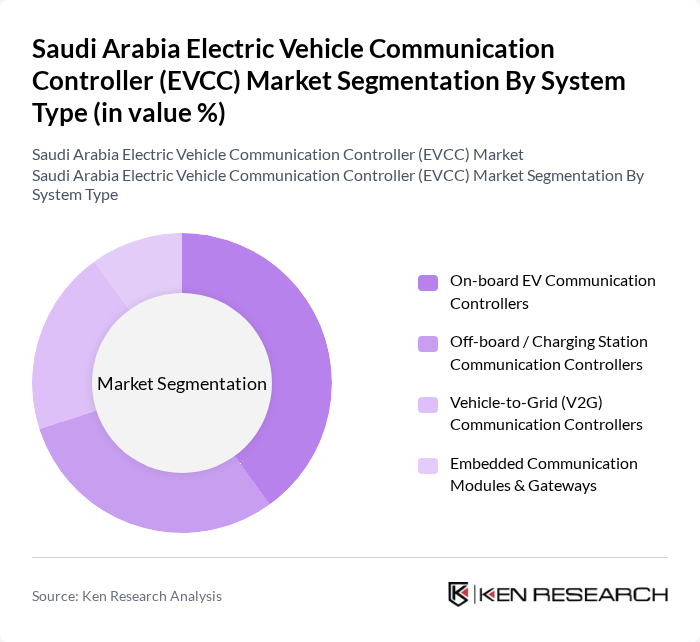
Saudi Arabia Electric Vehicle Communication Controller (EVCC) Market segmentation by System Type.

By Vehicle Type:The market is also segmented by vehicle type, which includes Passenger Cars, Light Commercial Vehicles, Heavy Commercial Vehicles & Buses, and Specialty & Fleet Vehicles. The Passenger Cars segment is the most dominant, aligned with the fact that passenger vehicles currently account for the bulk of electric vehicle adoption in Saudi Arabia, supported by incentives, growing model availability, and consumer?focused charging expansion in major cities. This segment's growth is further supported by government?backed initiatives to localize electric passenger vehicle production, increased corporate and government fleet electrification, and rising awareness of environmental sustainability and total cost of ownership benefits among consumers.
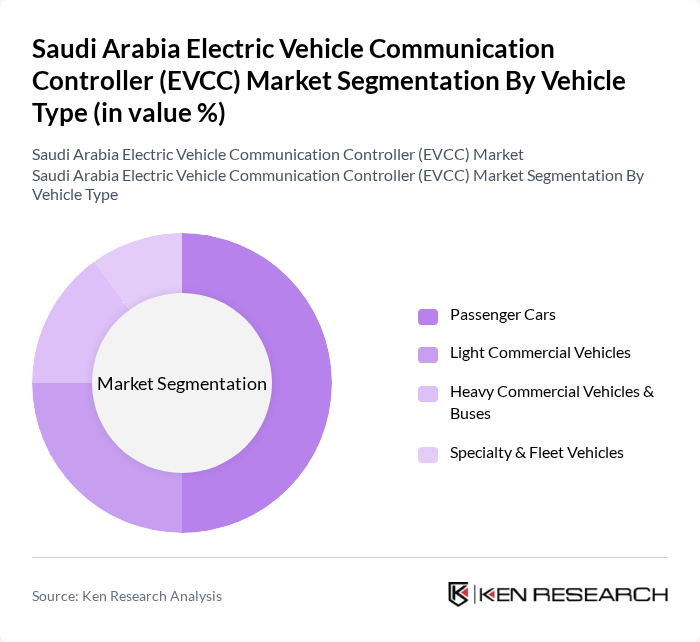
Saudi Arabia Electric Vehicle Communication Controller (EVCC) Market segmentation by Vehicle Type.

Saudi Arabia Electric Vehicle Communication Controller (EVCC) Market Competitive Landscape

The Saudi Arabia Electric Vehicle Communication Controller (EVCC) Market is characterized by a dynamic mix of regional and international players. Leading participants such as ABB Ltd., Siemens AG, Schneider Electric SE, Delta Electronics, Inc., Huawei Digital Power Technologies Co., Ltd., KEBA AG, Alfen N.V., Webasto Group, NXP Semiconductors N.V., Infineon Technologies AG, STMicroelectronics N.V., Texas Instruments Incorporated, EVBox Group, Wallbox N.V., Saudi Electric Vehicle Charging Company (SEVC) contribute to innovation, geographic expansion, and service delivery in this space, supplying components and systems for networked AC and DC chargers, power electronics, and secure communication interfaces compatible with global standards.

ABB Ltd.

1988

Zurich, Switzerland

Siemens AG

1847

Munich, Germany

Schneider Electric SE

1836

Rueil-Malmaison, France

Delta Electronics, Inc.

1971

Taipei, Taiwan

Huawei Digital Power Technologies Co., Ltd.

1987

Shenzhen, China

Company

Establishment Year

Headquarters

Presence in Saudi Arabia (Years Active, Local Entity / JV)

Installed Base of EVCC-Enabled Chargers / Vehicles in KSA

Revenue from EVCC & Charging Communication Solutions in KSA

Share of Fast-Charging / DC Projects in Total KSA Portfolio

Compliance with Key Standards (ISO 15118, OCPP, CCS, CHAdeMO)

Product Breadth (On-board, Off-board, V2G, Backend Communication)

Saudi Arabia Electric Vehicle Communication Controller (EVCC) Market Industry Analysis

Growth Drivers

  • Increasing Government Support for EV Infrastructure:The Saudi government has allocated approximately SAR 1.5 billion (USD 400 million) for the development of electric vehicle infrastructure by 2025. This investment aims to establish over 5,000 charging stations across major cities, significantly enhancing the accessibility of EVs. Additionally, the government’s Vision 2030 initiative emphasizes sustainable transportation, further driving the adoption of electric vehicles and their communication controllers in the region.
  • Rising Consumer Demand for Sustainable Transportation:In future, consumer interest in electric vehicles is projected to increase, with over 30% of new vehicle sales expected to be electric. This shift is driven by heightened environmental awareness and the desire for sustainable transportation options. The growing availability of EV models, coupled with favorable financing options, is expected to further boost consumer demand, thereby increasing the need for advanced EV communication controllers.
  • Technological Advancements in EV Communication:The integration of advanced communication technologies, such as 5G and IoT, is revolutionizing the EV landscape. In future, the number of connected EVs in Saudi Arabia is anticipated to reach 200,000, enhancing vehicle communication capabilities. These advancements facilitate real-time data exchange between vehicles and infrastructure, improving efficiency and user experience, thus driving the demand for sophisticated Electric Vehicle Communication Controllers.

Market Challenges

  • High Initial Costs of EVCC Implementation:The upfront costs associated with implementing Electric Vehicle Communication Controllers can be significant, often exceeding SAR 10,000 (USD 2,700) per unit. This financial barrier can deter manufacturers and consumers from adopting EVCC technology, especially in a market where traditional vehicles remain more affordable. As a result, the high initial investment poses a challenge to widespread EVCC adoption in Saudi Arabia.
  • Limited Consumer Awareness and Education:Despite the growing interest in electric vehicles, consumer awareness regarding EV communication technology remains low. In future, surveys indicate that only 25% of potential EV buyers are familiar with EVCC benefits. This lack of knowledge can hinder market growth, as consumers may be reluctant to invest in technology they do not fully understand, impacting overall adoption rates in the region.

Saudi Arabia Electric Vehicle Communication Controller (EVCC) Market Future Outlook

The future of the Saudi Arabia Electric Vehicle Communication Controller market appears promising, driven by ongoing technological innovations and government initiatives. As the country continues to invest in EV infrastructure and promote sustainable transportation, the adoption of advanced communication technologies is expected to rise. Furthermore, the integration of renewable energy sources into the EV ecosystem will enhance the overall efficiency and appeal of electric vehicles, paving the way for a more robust market landscape in the coming years.

Market Opportunities

  • Growth in Renewable Energy Integration:The increasing focus on renewable energy sources, such as solar and wind, presents a significant opportunity for the EVCC market. By future, Saudi Arabia aims to generate 58.7 GW of renewable energy, which can be utilized to power electric vehicles, enhancing their sustainability and reducing reliance on fossil fuels.
  • Development of Smart City Initiatives:The Saudi government is investing heavily in smart city projects, with an estimated budget of SAR 500 billion (USD 133 billion) by 2030. These initiatives will incorporate advanced EV communication technologies, creating a conducive environment for the growth of EVCCs. The integration of smart technologies will enhance urban mobility and promote the adoption of electric vehicles.

Scope of the Report

SegmentSub-Segments
By System Type

On-board EV Communication Controllers

Off-board / Charging Station Communication Controllers

Vehicle-to-Grid (V2G) Communication Controllers

Embedded Communication Modules & Gateways

By Vehicle Type

Passenger Cars

Light Commercial Vehicles

Heavy Commercial Vehicles & Buses

Specialty & Fleet Vehicles

By Application

AC Charging (Mode 2/Mode 3) Communication

DC Fast Charging (Mode 4) Communication

Vehicle-to-Infrastructure (V2I) & Smart Charging Management

Vehicle-to-Grid (V2G) & Energy Management

By Communication Standard

ISO 15118 / Plug & Charge

CHAdeMO

CCS (Combined Charging System)

OCPP and Backend Communication Protocols

By Connectivity Technology

PLC (Power Line Communication)

Cellular (4G/5G) & C?V2X

Wi?Fi / Bluetooth Low Energy

Ethernet & Other Wired Interfaces

By End-User

Residential Charging Operators

Commercial & Workplace Charging Operators

Public Fast-Charging Network Operators

Fleet & Depot Charging Operators

By Region

Central Region (Riyadh & Surrounding Areas)

Western Region (Makkah, Madinah, Jeddah)

Eastern Region (Dammam, Dhahran, Khobar)

Northern & Southern Regions

Key Target Audience

Investors and Venture Capitalist Firms

Government and Regulatory Bodies (e.g., Saudi Arabian Standards Organization, Ministry of Energy)

Automotive Manufacturers

Telecommunications Companies

Charging Infrastructure Providers

Electric Vehicle Fleet Operators

Energy Providers and Utilities

Automotive Technology Developers

Players Mentioned in the Report:

ABB Ltd.

Siemens AG

Schneider Electric SE

Delta Electronics, Inc.

Huawei Digital Power Technologies Co., Ltd.

KEBA AG

Alfen N.V.

Webasto Group

NXP Semiconductors N.V.

Infineon Technologies AG

STMicroelectronics N.V.

Texas Instruments Incorporated

EVBox Group

Wallbox N.V.

Saudi Electric Vehicle Charging Company (SEVC)

Table of Contents

Market Assessment Phase

1. Executive Summary and Approach


2. Saudi Arabia Electric Vehicle Communication Controller (EVCC) Market Overview

2.1 Key Insights and Strategic Recommendations

2.2 Saudi Arabia Electric Vehicle Communication Controller (EVCC) Market Overview

2.3 Definition and Scope

2.4 Evolution of Market Ecosystem

2.5 Timeline of Key Regulatory Milestones

2.6 Value Chain & Stakeholder Mapping

2.7 Business Cycle Analysis

2.8 Policy & Incentive Landscape


3. Saudi Arabia Electric Vehicle Communication Controller (EVCC) Market Analysis

3.1 Growth Drivers

3.1.1 Increasing Government Support for EV Infrastructure
3.1.2 Rising Consumer Demand for Sustainable Transportation
3.1.3 Technological Advancements in EV Communication
3.1.4 Expansion of Charging Infrastructure

3.2 Market Challenges

3.2.1 High Initial Costs of EVCC Implementation
3.2.2 Limited Consumer Awareness and Education
3.2.3 Regulatory Compliance and Standards
3.2.4 Competition from Traditional Vehicle Technologies

3.3 Market Opportunities

3.3.1 Growth in Renewable Energy Integration
3.3.2 Development of Smart City Initiatives
3.3.3 Partnerships with Technology Providers
3.3.4 Expansion into Neighboring Markets

3.4 Market Trends

3.4.1 Increasing Adoption of IoT in EV Communication
3.4.2 Shift Towards Autonomous Vehicle Technologies
3.4.3 Focus on Cybersecurity in EV Communication
3.4.4 Emergence of Vehicle-to-Grid (V2G) Technologies

3.5 Government Regulation

3.5.1 Implementation of EV Incentive Programs
3.5.2 Establishment of Emission Standards
3.5.3 Regulations on Charging Infrastructure Development
3.5.4 Policies Supporting Renewable Energy Use in EVs

4. SWOT Analysis


5. Stakeholder Analysis


6. Porter's Five Forces Analysis


7. Saudi Arabia Electric Vehicle Communication Controller (EVCC) Market Market Size, 2019-2024

7.1 By Value

7.2 By Volume

7.3 By Average Selling Price


8. Saudi Arabia Electric Vehicle Communication Controller (EVCC) Market Segmentation

8.1 By System Type

8.1.1 On-board EV Communication Controllers
8.1.2 Off-board / Charging Station Communication Controllers
8.1.3 Vehicle-to-Grid (V2G) Communication Controllers
8.1.4 Embedded Communication Modules & Gateways

8.2 By Vehicle Type

8.2.1 Passenger Cars
8.2.2 Light Commercial Vehicles
8.2.3 Heavy Commercial Vehicles & Buses
8.2.4 Specialty & Fleet Vehicles

8.3 By Application

8.3.1 AC Charging (Mode 2/Mode 3) Communication
8.3.2 DC Fast Charging (Mode 4) Communication
8.3.3 Vehicle-to-Infrastructure (V2I) & Smart Charging Management
8.3.4 Vehicle-to-Grid (V2G) & Energy Management

8.4 By Communication Standard

8.4.1 ISO 15118 / Plug & Charge
8.4.2 CHAdeMO
8.4.3 CCS (Combined Charging System)
8.4.4 OCPP and Backend Communication Protocols

8.5 By Connectivity Technology

8.5.1 PLC (Power Line Communication)
8.5.2 Cellular (4G/5G) & C?V2X
8.5.3 Wi?Fi / Bluetooth Low Energy
8.5.4 Ethernet & Other Wired Interfaces

8.6 By End-User

8.6.1 Residential Charging Operators
8.6.2 Commercial & Workplace Charging Operators
8.6.3 Public Fast-Charging Network Operators
8.6.4 Fleet & Depot Charging Operators

8.7 By Region

8.7.1 Central Region (Riyadh & Surrounding Areas)
8.7.2 Western Region (Makkah, Madinah, Jeddah)
8.7.3 Eastern Region (Dammam, Dhahran, Khobar)
8.7.4 Northern & Southern Regions

9. Saudi Arabia Electric Vehicle Communication Controller (EVCC) Market Competitive Analysis

9.1 Market Share of Key Players

9.2 Cross Comparison of Key Players

9.2.1 Company Name
9.2.2 Presence in Saudi Arabia (Years Active, Local Entity / JV)
9.2.3 Installed Base of EVCC-Enabled Chargers / Vehicles in KSA
9.2.4 Revenue from EVCC & Charging Communication Solutions in KSA
9.2.5 Share of Fast-Charging / DC Projects in Total KSA Portfolio
9.2.6 Compliance with Key Standards (ISO 15118, OCPP, CCS, CHAdeMO)
9.2.7 Product Breadth (On-board, Off-board, V2G, Backend Communication)
9.2.8 Local Partnerships & Projects (Utilities, OEMs, Developers)
9.2.9 R&D and Localization Efforts for Middle East Conditions
9.2.10 Service & Support Coverage (Cities Covered, SLA Levels)

9.3 SWOT Analysis of Top Players

9.4 Pricing Analysis

9.5 Detailed Profile of Major Companies

9.5.1 ABB Ltd.
9.5.2 Siemens AG
9.5.3 Schneider Electric SE
9.5.4 Delta Electronics, Inc.
9.5.5 Huawei Digital Power Technologies Co., Ltd.
9.5.6 KEBA AG
9.5.7 Alfen N.V.
9.5.8 Webasto Group
9.5.9 NXP Semiconductors N.V.
9.5.10 Infineon Technologies AG
9.5.11 STMicroelectronics N.V.
9.5.12 Texas Instruments Incorporated
9.5.13 EVBox Group
9.5.14 Wallbox N.V.
9.5.15 Saudi Electric Vehicle Charging Company (SEVC)

10. Saudi Arabia Electric Vehicle Communication Controller (EVCC) Market End-User Analysis

10.1 Procurement Behavior of Key Ministries

10.1.1 Ministry of Transport
10.1.2 Ministry of Energy
10.1.3 Ministry of Environment
10.1.4 Others

10.2 Corporate Spend on Infrastructure & Energy

10.2.1 Investment in Charging Stations
10.2.2 Budget Allocation for EV Initiatives
10.2.3 Partnerships with Private Sector
10.2.4 Others

10.3 Pain Point Analysis by End-User Category

10.3.1 Cost of Implementation
10.3.2 Technical Support and Maintenance
10.3.3 Integration with Existing Systems
10.3.4 Others

10.4 User Readiness for Adoption

10.4.1 Awareness of EV Benefits
10.4.2 Availability of Charging Infrastructure
10.4.3 Financial Incentives
10.4.4 Others

10.5 Post-Deployment ROI and Use Case Expansion

10.5.1 Measurement of Cost Savings
10.5.2 Expansion into New Use Cases
10.5.3 User Feedback and Improvement
10.5.4 Others

11. Saudi Arabia Electric Vehicle Communication Controller (EVCC) Market Future Size, 2025-2030

11.1 By Value

11.2 By Volume

11.3 By Average Selling Price


Go-To-Market Strategy Phase

1. Whitespace Analysis + Business Model Canvas

1.1 Market Gaps Identification

1.2 Business Model Development


2. Marketing and Positioning Recommendations

2.1 Branding Strategies

2.2 Product USPs


3. Distribution Plan

3.1 Urban Retail Strategies

3.2 Rural NGO Tie-ups


4. Channel & Pricing Gaps

4.1 Underserved Routes

4.2 Pricing Bands Analysis


5. Unmet Demand & Latent Needs

5.1 Category Gaps

5.2 Consumer Segments


6. Customer Relationship

6.1 Loyalty Programs

6.2 After-sales Service


7. Value Proposition

7.1 Sustainability Initiatives

7.2 Integrated Supply Chains


8. Key Activities

8.1 Regulatory Compliance

8.2 Branding Efforts

8.3 Distribution Setup


9. Entry Strategy Evaluation

9.1 Domestic Market Entry Strategy

9.1.1 Product Mix Considerations
9.1.2 Pricing Band Strategy
9.1.3 Packaging Options

9.2 Export Entry Strategy

9.2.1 Target Countries Identification
9.2.2 Compliance Roadmap Development

10. Entry Mode Assessment

10.1 Joint Ventures

10.2 Greenfield Investments

10.3 Mergers & Acquisitions

10.4 Distributor Model


11. Capital and Timeline Estimation

11.1 Capital Requirements

11.2 Timelines for Implementation


12. Control vs Risk Trade-Off

12.1 Ownership Considerations

12.2 Partnerships Evaluation


13. Profitability Outlook

13.1 Breakeven Analysis

13.2 Long-term Sustainability Strategies


14. Potential Partner List

14.1 Distributors

14.2 Joint Ventures

14.3 Acquisition Targets


15. Execution Roadmap

15.1 Phased Plan for Market Entry

15.1.1 Market Setup Activities
15.1.2 Market Entry Steps
15.1.3 Growth Acceleration Tactics
15.1.4 Scale & Stabilize Strategies

15.2 Key Activities and Milestones

15.2.1 Milestone Identification
15.2.2 Activity Scheduling

Research Methodology

ApproachModellingSample

Phase 1: Approach1

Desk Research

  • Analysis of government publications on electric vehicle policies and incentives in Saudi Arabia
  • Review of industry reports from automotive associations and energy agencies
  • Examination of market trends and forecasts from reputable market research databases

Primary Research

  • Interviews with key stakeholders in the electric vehicle supply chain, including manufacturers and suppliers
  • Surveys conducted with automotive industry experts and regulatory bodies
  • Focus groups with consumers to understand perceptions and adoption barriers for EVs

Validation & Triangulation

  • Cross-validation of findings through multiple data sources, including trade publications and expert opinions
  • Triangulation of market data with insights from industry conferences and seminars
  • Sanity checks through expert panel reviews to ensure data accuracy and relevance

Phase 2: Market Size Estimation1

Top-down Assessment

  • Estimation of the EVCC market size based on national electric vehicle sales data and projections
  • Segmentation of the market by vehicle type, application, and technology used
  • Incorporation of government initiatives aimed at increasing EV adoption and infrastructure development

Bottom-up Modeling

  • Collection of data from leading EVCC manufacturers regarding production volumes and pricing
  • Estimation of market demand based on consumer adoption rates and charging infrastructure availability
  • Analysis of cost structures and profit margins for EVCC products across different segments

Forecasting & Scenario Analysis

  • Development of forecasting models using historical sales data and growth trends in the EV market
  • Scenario analysis based on varying levels of government support and consumer acceptance
  • Creation of baseline, optimistic, and pessimistic forecasts through 2030 to account for market volatility

Phase 3: CATI Sample Composition1

Scope Item/SegmentSample SizeTarget Respondent Profiles
Electric Vehicle Manufacturers90Product Managers, R&D Directors
Charging Infrastructure Providers80Operations Managers, Business Development Executives
Government Regulatory Bodies40Policy Makers, Environmental Analysts
Automotive Industry Experts70Consultants, Market Analysts
Consumer Focus Groups60Potential EV Buyers, Current EV Owners

Frequently Asked Questions

What is the current value of the Saudi Arabia Electric Vehicle Communication Controller (EVCC) Market?

The Saudi Arabia Electric Vehicle Communication Controller (EVCC) Market is valued at approximately USD 0.9 billion. This valuation is based on a five-year historical analysis and reflects the growing adoption of electric vehicles and investments in charging infrastructure.

What factors are driving the growth of the EVCC market in Saudi Arabia?

Which cities are leading in the EVCC market in Saudi Arabia?

What are the main types of Electric Vehicle Communication Controllers in the market?

Other Regional/Country Reports

Indonesia Electric Vehicle Communication Controller Evcc Market

Malaysia Electric Vehicle Communication Controller Evcc Market

KSA Electric Vehicle Communication Controller Evcc Market

APAC Electric Vehicle Communication Controller Evcc Market

SEA Electric Vehicle Communication Controller Evcc Market

Vietnam Electric Vehicle Communication Controller Evcc Market

Other Adjacent Reports

Oman Electric Vehicle Charging Infrastructure Market

Singapore Electric Vehicle Battery Management System Market

UAE Vehicle-to-Grid Technology Market

Indonesia Smart Grid Communication Market

South Africa Automotive Electronics Market

South Africa IoT in Transportation Market

South Africa Renewable Energy Integration Market

Belgium EV Supply Equipment Market

Vietnam Automotive Semiconductor Market

Oman Electric Mobility Services Market

Why Buy From Us?

Refine Robust Result (RRR) Framework

What makes us stand out is that our consultants follow Robust, Refine and Result (RRR) methodology. Robust for clear definitions, approaches and sanity checking, Refine for differentiating respondents' facts and opinions, and Result for presenting data with story.

Our Reach Is Unmatched

We have set a benchmark in the industry by offering our clients with syndicated and customized market research reports featuring coverage of entire market as well as meticulous research and analyst insights.

Shifting the Research Paradigm

While we don't replace traditional research, we flip the method upside down. Our dual approach of Top Bottom & Bottom Top ensures quality deliverable by not just verifying company fundamentals but also looking at the sector and macroeconomic factors.

More Insights-Better Decisions

With one step in the future, our research team constantly tries to show you the bigger picture. We help with some of the tough questions you may encounter along the way: How is the industry positioned? Best marketing channel? KPI's of competitors? By aligning every element, we help maximize success.

Transparency and Trust

Our report gives you instant access to the answers and sources that other companies might choose to hide. We elaborate each steps of research methodology we have used and showcase you the sample size to earn your trust.

Round the Clock Support

If you need any support, we are here! We pride ourselves on universe strength, data quality, and quick, friendly, and professional service.

Why Clients Choose Us?

400000+
Reports in repository
150+
Consulting projects a year
100+
Analysts
8000+
Client Queries in 2022








