Region:Middle East
Author(s):Geetanshi
Product Code:KRAC4428
Pages:84
Published On:October 2025
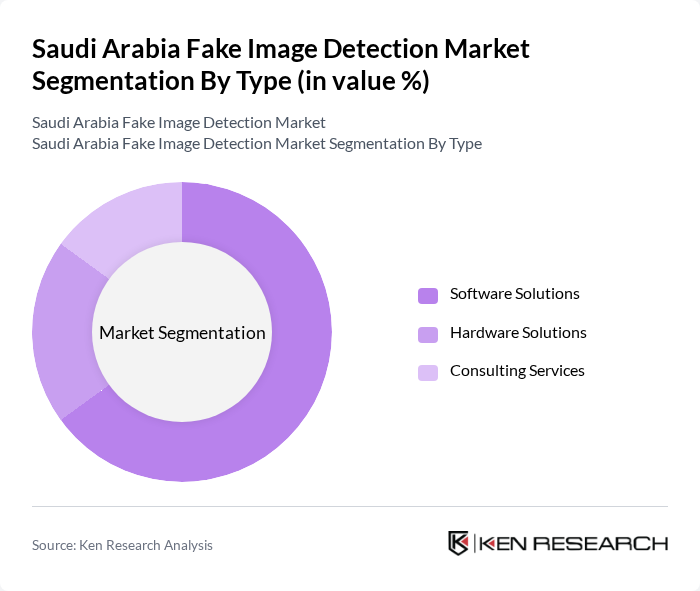
By Type:The market is segmented into Software Solutions, Hardware Solutions, and Consulting Services. Software Solutions dominate the market due to their scalability, ease of integration into existing digital ecosystems, and the ability to support real-time, cross-platform verification—features increasingly demanded by organizations seeking to maintain content integrity in fast-moving digital environments. The shift toward cloud-based and AI-driven software is pronounced, as these solutions offer flexibility, lower costs, and rapid deployment compared to hardware-based alternatives. Consulting Services are also gaining traction, particularly as organizations seek expert guidance on implementation, compliance, and integration with broader cybersecurity frameworks.
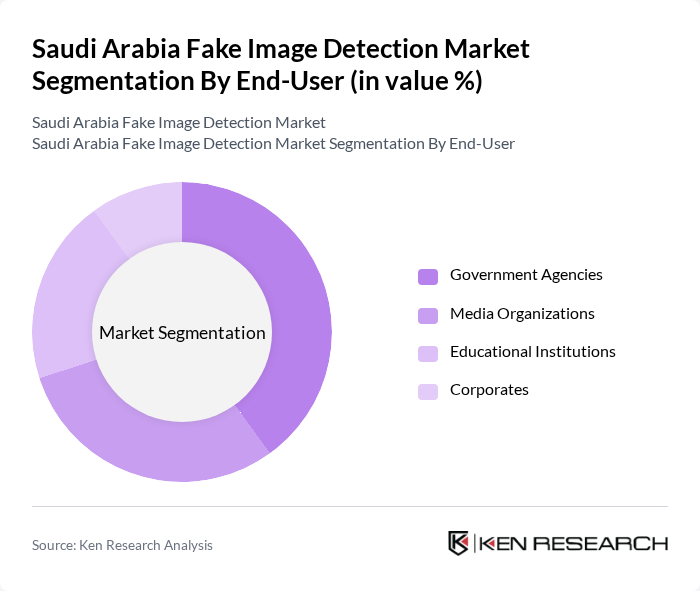
By End-User:The end-user segmentation includes Government Agencies, Media Organizations, Educational Institutions, and Corporates. Government Agencies are the leading segment, driven by regulatory requirements, national security priorities, and the imperative to maintain public trust in official communications. Media Organizations follow closely, as they require robust, real-time solutions to verify the authenticity of visual content in an era of rampant synthetic media and deepfakes. Educational Institutions are increasingly adopting these technologies to safeguard academic integrity and support research into digital forensics. Corporates utilize detection tools to protect brand reputation, ensure the authenticity of marketing materials, and mitigate risks associated with digital fraud.
The Saudi Arabia Fake Image Detection Market is characterized by a dynamic mix of regional and international players. Leading participants such as Veritone, Inc., Deeptrace Technologies, Sensity AI, Truepic, Inc., Adobe Inc., Microsoft Corporation, Google LLC, Clarifai, Inc., Candid Technologies, Zegami Ltd., ImageKit.io, Pixlab, PimEyes, Ximilar, Slyce Inc. contribute to innovation, geographic expansion, and service delivery in this space.
The future of the fake image detection market in Saudi Arabia appears promising, driven by technological advancements and increasing awareness of misinformation. As AI and machine learning technologies evolve, their integration into detection tools will enhance accuracy and efficiency. Furthermore, collaborations between tech firms and government agencies are expected to foster innovation, leading to the development of more sophisticated solutions. The focus on ethical AI practices will also shape the market, ensuring that detection technologies are not only effective but also responsible.
| Segment | Sub-Segments |
|---|---|
| By Type | Software Solutions Hardware Solutions Consulting Services |
| By End-User | Government Agencies Media Organizations Educational Institutions Corporates |
| By Application | Social Media Monitoring News Verification E-commerce Platforms Digital Marketing |
| By Distribution Channel | Direct Sales Online Platforms Resellers |
| By Region | Central Region Eastern Region Western Region Southern Region |
| By Pricing Model | Subscription-Based One-Time Purchase Freemium Model |
| By Others | Custom Solutions Training Services Maintenance Services |
| Scope Item/Segment | Sample Size | Target Respondent Profiles |
|---|---|---|
| Media and Advertising Sector | 120 | Marketing Directors, Content Managers |
| E-commerce Platforms | 80 | Product Managers, IT Security Officers |
| Social Media Companies | 70 | Data Analysts, Compliance Officers |
| Law Enforcement Agencies | 50 | Cybercrime Investigators, Policy Advisors |
| Cybersecurity Firms | 60 | Technical Leads, Business Development Managers |
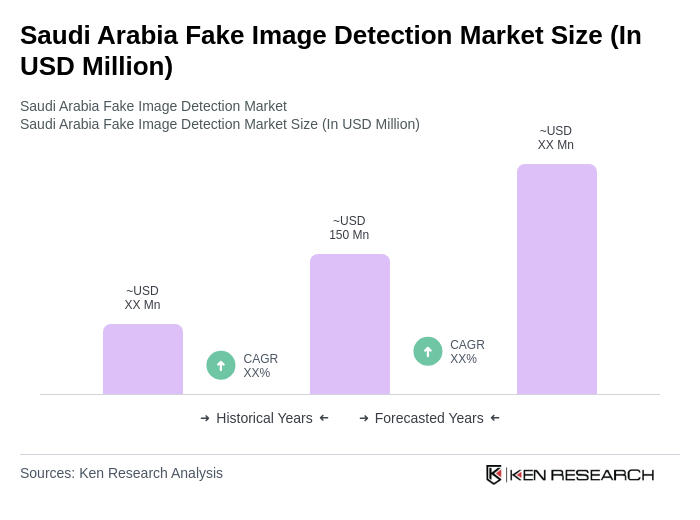
The Saudi Arabia Fake Image Detection Market is valued at approximately USD 150 million, reflecting a significant share of the broader regional market, which was valued at around USD 600 million in 2024. This growth is driven by increasing misinformation and the need for reliable content verification.

What makes us stand out is that our consultants follow Robust, Refine and Result (RRR) methodology. Robust for clear definitions, approaches and sanity checking, Refine for differentiating respondents' facts and opinions, and Result for presenting data with story.

We have set a benchmark in the industry by offering our clients with syndicated and customized market research reports featuring coverage of entire market as well as meticulous research and analyst insights.

While we don't replace traditional research, we flip the method upside down. Our dual approach of Top Bottom & Bottom Top ensures quality deliverable by not just verifying company fundamentals but also looking at the sector and macroeconomic factors.

With one step in the future, our research team constantly tries to show you the bigger picture. We help with some of the tough questions you may encounter along the way: How is the industry positioned? Best marketing channel? KPI's of competitors? By aligning every element, we help maximize success.

Our report gives you instant access to the answers and sources that other companies might choose to hide. We elaborate each steps of research methodology we have used and showcase you the sample size to earn your trust.

If you need any support, we are here! We pride ourselves on universe strength, data quality, and quick, friendly, and professional service.













