About the Report
Base Year 2024Saudi Arabia Fortified Wine Market Overview
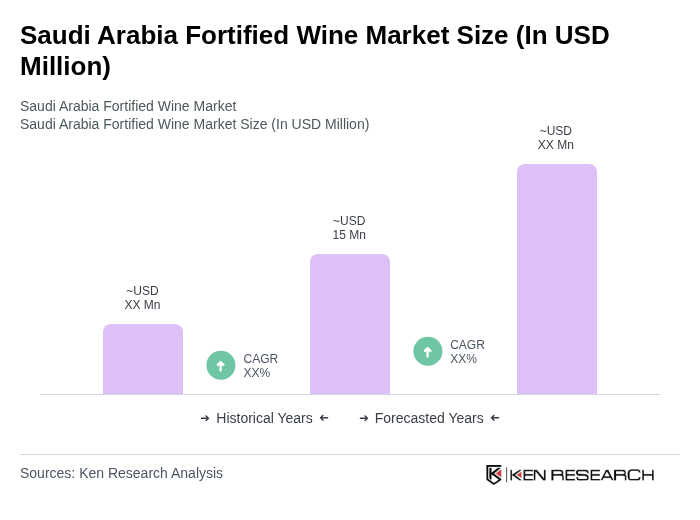
- The Saudi Arabia Fortified Wine Market is valued at approximately USD 15 million, based on a five-year historical analysis. This growth is primarily driven by increasing consumer interest in premium alcoholic beverages, coupled with a rise in tourism and hospitality sectors under Vision 2030 economic diversification, along with growing expatriate populations and expanding luxury beverage channels. The market has seen a notable shift towards fortified wines, which are perceived as high-quality products, appealing to both local and expatriate consumers.
- Key cities such as Riyadh, Jeddah, and Dammam dominate the fortified wine market due to their significant expatriate populations and vibrant hospitality industries. Riyadh, being the capital, serves as a central hub for luxury dining and entertainment, while Jeddah's coastal location attracts tourists, enhancing the demand for premium fortified wines.
- The Food and Drug Authority Licensing Regulations for Imported Food Products, 2020 issued by the Saudi Food and Drug Authority governs the licensing framework for alcoholic beverages, including fortified wines. This regulation requires importers to obtain product registration, comply with labeling standards specifying alcohol content and health warnings, meet quality thresholds for contaminants, and secure facility certifications, thereby streamlining the importation process and ensuring compliance with health and safety standards to support controlled market access.
Saudi Arabia Fortified Wine Market Segmentation
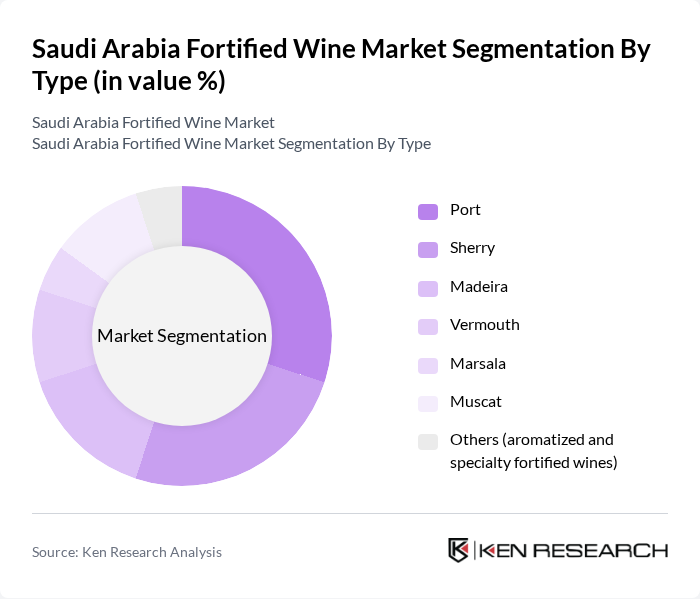
By Type:The fortified wine market in Saudi Arabia is segmented into various types, including Port, Sherry, Madeira, Vermouth, Marsala, Muscat, and others. Each type caters to different consumer preferences and occasions, with Port and Sherry being particularly popular among consumers seeking rich flavors and higher alcohol content. The diversity in types allows for a broad appeal across various demographics, enhancing market growth.
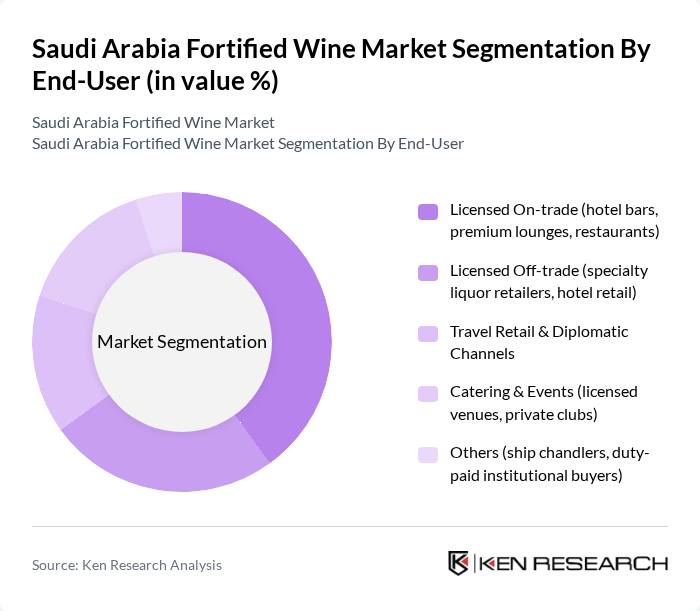
By End-User:The end-user segmentation of the fortified wine market includes licensed on-trade, licensed off-trade, travel retail and diplomatic channels, catering and events, and others. The licensed on-trade segment, which includes hotel bars and premium lounges, is particularly significant due to the high demand for premium beverages in social settings. This segment is expected to continue leading the market as consumer preferences shift towards premium experiences.
Saudi Arabia Fortified Wine Market Competitive Landscape
The Saudi Arabia Fortified Wine Market is characterized by a dynamic mix of regional and international players. Leading participants such as Accolade Wines, E. & J. Gallo Winery, The Wine Group, Sogrape Vinhos, Symington Family Estates, Sogrape’s Sandeman (Port & Sherry), González Byass (including Tio Pepe, Croft), Campari Group (including Cinzano, Averna, Aperol), Bacardi Limited (including Martini & Rossi), Pernod Ricard (including Lillet, Dubonnet), S.A. D.O.C. Port Wine Companies Association Members (key exporting houses), Local and Regional Licensed Importers & Distributors in Saudi Arabia, Middle East Duty Free Retailers Handling Fortified Wine Portfolios, Travel Retail Operators Serving Saudi Arabia Inbound/Outbound Routes, HoReCa Procurement Groups Partnering with International Fortified Wine Brands contribute to innovation, geographic expansion, and service delivery in this space.
Saudi Arabia Fortified Wine Market Industry Analysis
Growth Drivers
- Increasing Consumer Interest in Premium Beverages:The Saudi Arabian market is witnessing a notable shift towards premium beverages, with a reported increase in sales of high-end fortified wines by approximately 15% annually. This trend is driven by a growing population, which is estimated at around 36 million, alongside a rising number of affluent consumers seeking unique drinking experiences. The demand for quality over quantity is reshaping consumer preferences, leading to a surge in premium product offerings.
- Growth of the Hospitality and Tourism Sector:The hospitality sector in Saudi Arabia is expanding, with the government planning very substantial investment in tourism infrastructure as part of Vision 2030. This growth is expected to attract a large number of tourists in future, creating a robust market for beverages served in licensed venues within specific regulatory frameworks. The increasing number of international events and festivals further enhances the demand for premium beverages, including fortified wines, catering to diverse consumer tastes.
- Rising Disposable Incomes Among Consumers:Saudi Arabia has recorded real GDP growth of around 6 to 7 percent in recent periods, reflecting overall economic expansion and supporting higher household purchasing power. The most recent available data indicate GDP per capita in constant terms is above USD 20,000. This increase allows consumers to spend more on luxury items, including fortified wines in settings where such products are legally available. As more individuals enter the middle and upper-income brackets, the market for premium alcoholic beverages is likely to expand in permissible channels, driving sales and brand loyalty in the fortified wine segment.
Market Challenges
- Stringent Regulations on Alcohol Sales:The fortified wine market in Saudi Arabia faces significant challenges due to strict regulations governing alcohol sales. The country enforces a legal prohibition on the production, import, and sale of alcoholic beverages for the general population. This regulatory environment severely limits market access and creates barriers for potential consumers, hindering the growth of fortified wine brands and their market penetration strategies. Any exemptions for specific diplomatic or restricted compounds do not constitute a general consumer market.
- Cultural and Religious Opposition to Alcohol Consumption:Cultural and religious beliefs in Saudi Arabia strongly oppose alcohol consumption, which poses a significant challenge for the fortified wine market. The overwhelming majority of the population is Muslim, and Islamic principles prohibit alcohol consumption. This cultural barrier restricts marketing efforts and consumer education initiatives, making it difficult for brands to establish a foothold in the market.
Saudi Arabia Fortified Wine Market Future Outlook
The future of the fortified wine market in Saudi Arabia appears cautiously optimistic, driven by evolving consumer preferences and a burgeoning hospitality sector in the context of broader economic diversification under Vision 2030. As the government continues to promote tourism and diversify the economy, opportunities for fortified wine brands may arise in strictly regulated and niche channels that comply with national laws. However, overcoming cultural barriers and regulatory challenges will be crucial for sustained growth. The market is likely to see innovative approaches to product offerings and marketing strategies that align with local customs and preferences.
Market Opportunities
- Development of Local Fortified Wine Brands:There is a significant opportunity for the establishment of local fortified wine brands that cater to the unique tastes of Saudi consumers only if and where regulations permit such production and sale. By leveraging local ingredients and traditional production methods, these brands can create a distinct identity, appealing to both local and expatriate markets, potentially increasing market share and consumer loyalty.
- Growth in Online Sales and E-Commerce Platforms:The rise of e-commerce in Saudi Arabia, with online retail activity expanding rapidly as part of the country's digital transformation agenda, presents a valuable opportunity for consumer goods brands. By establishing a strong online presence and utilizing digital marketing strategies, companies can reach a broader audience, facilitating access to products within the boundaries of applicable laws while navigating traditional retail challenges. Specific figures for online sales of fortified wine in Saudi Arabia could not be confirmed.
Scope of the Report
| Segment | Sub-Segments |
|---|---|
| By Type | Port Sherry Madeira Vermouth Marsala Muscat Others (aromatized and specialty fortified wines) |
| By End-User | Licensed On-trade (hotel bars, premium lounges, restaurants) Licensed Off-trade (specialty liquor retailers, hotel retail) Travel Retail & Diplomatic Channels Catering & Events (licensed venues, private clubs) Others (ship chandlers, duty-paid institutional buyers) |
| By Distribution Channel | Direct Importers & Agents Specialized Beverage Distributors Hotel & Restaurant Procurement Channels Travel Retail & Duty-Free Operators E-commerce and Marketplace Platforms (where licensed) Others |
| By Packaging Type | Glass Bottles (standard and premium) Bag-in-Box Cans & Single-Serve Formats Bulk (for HoReCa and re-packaging) Others |
| By Price Range | Premium & Luxury (imported, aged, heritage labels) Mid-Range (mainstream imported brands) Value / Economy (entry-level fortified wines) Private Label & House Brands |
| By Occasion | Tourism & Hospitality Consumption Corporate & Formal Events Gifting (expatriates and diplomatic) Personal / At-Home Consumption (licensed segments) Others |
| By Region | Northern and Central Region (including Riyadh) Western Region (including Jeddah, Makkah, Madinah) Eastern Region (including Dammam, Khobar) Southern Region Others (special economic and tourism zones) |
Key Target Audience
Investors and Venture Capitalist Firms
Government and Regulatory Bodies (e.g., Saudi Food and Drug Authority, Ministry of Commerce)
Manufacturers and Producers
Distributors and Retailers
Importers and Exporters
Hospitality and Restaurant Chains
Industry Associations (e.g., Saudi Arabian Wine and Spirits Association)
Financial Institutions
Players Mentioned in the Report:
Accolade Wines
E. & J. Gallo Winery
The Wine Group
Sogrape Vinhos
Symington Family Estates
Sograpes Sandeman (Port & Sherry)
Gonzalez Byass (including Tio Pepe, Croft)
Campari Group (including Cinzano, Averna, Aperol)
Bacardi Limited (including Martini & Rossi)
Pernod Ricard (including Lillet, Dubonnet)
S.A. D.O.C. Port Wine Companies Association Members (key exporting houses)
Local and Regional Licensed Importers & Distributors in Saudi Arabia
Middle East Duty Free Retailers Handling Fortified Wine Portfolios
Travel Retail Operators Serving Saudi Arabia Inbound/Outbound Routes
HoReCa Procurement Groups Partnering with International Fortified Wine Brands
Table of Contents
Market Assessment Phase
1. Executive Summary and Approach
2. Saudi Arabia Fortified Wine Market Overview
2.1 Key Insights and Strategic Recommendations
2.2 Saudi Arabia Fortified Wine Market Overview
2.3 Definition and Scope
2.4 Evolution of Market Ecosystem
2.5 Timeline of Key Regulatory Milestones
2.6 Value Chain & Stakeholder Mapping
2.7 Business Cycle Analysis
2.8 Policy & Incentive Landscape
3. Saudi Arabia Fortified Wine Market Analysis
3.1 Growth Drivers
3.1.1 Increasing consumer interest in premium beverages
3.1.2 Growth of the hospitality and tourism sector
3.1.3 Rising disposable incomes among consumers
3.1.4 Expansion of retail distribution channels
3.2 Market Challenges
3.2.1 Stringent regulations on alcohol sales
3.2.2 Cultural and religious opposition to alcohol consumption
3.2.3 Limited market awareness and education
3.2.4 Competition from non-alcoholic beverages
3.3 Market Opportunities
3.3.1 Development of local fortified wine brands
3.3.2 Potential for export to neighboring regions
3.3.3 Collaborations with international wine producers
3.3.4 Growth in online sales and e-commerce platforms
3.4 Market Trends
3.4.1 Increasing demand for organic and biodynamic wines
3.4.2 Rise of wine tourism and tasting events
3.4.3 Shift towards sustainable and eco-friendly production
3.4.4 Emergence of wine clubs and subscription services
3.5 Government Regulation
3.5.1 Licensing requirements for alcohol sales
3.5.2 Restrictions on advertising and promotion
3.5.3 Import tariffs on alcoholic beverages
3.5.4 Compliance with health and safety standards
4. SWOT Analysis
5. Stakeholder Analysis
6. Porter's Five Forces Analysis
7. Saudi Arabia Fortified Wine Market Market Size, 2019-2024
7.1 By Value
7.2 By Volume
7.3 By Average Selling Price
8. Saudi Arabia Fortified Wine Market Segmentation
8.1 By Type
8.1.1 Port
8.1.2 Sherry
8.1.3 Madeira
8.1.4 Vermouth
8.1.5 Marsala
8.1.6 Muscat
8.1.7 Others (aromatized and specialty fortified wines)
8.2 By End-User
8.2.1 Licensed On-trade (hotel bars, premium lounges, restaurants)
8.2.2 Licensed Off-trade (specialty liquor retailers, hotel retail)
8.2.3 Travel Retail & Diplomatic Channels
8.2.4 Catering & Events (licensed venues, private clubs)
8.2.5 Others (ship chandlers, duty-paid institutional buyers)
8.3 By Distribution Channel
8.3.1 Direct Importers & Agents
8.3.2 Specialized Beverage Distributors
8.3.3 Hotel & Restaurant Procurement Channels
8.3.4 Travel Retail & Duty-Free Operators
8.3.5 E-commerce and Marketplace Platforms (where licensed)
8.3.6 Others
8.4 By Packaging Type
8.4.1 Glass Bottles (standard and premium)
8.4.2 Bag-in-Box
8.4.3 Cans & Single-Serve Formats
8.4.4 Bulk (for HoReCa and re-packaging)
8.4.5 Others
8.5 By Price Range
8.5.1 Premium & Luxury (imported, aged, heritage labels)
8.5.2 Mid-Range (mainstream imported brands)
8.5.3 Value / Economy (entry-level fortified wines)
8.5.4 Private Label & House Brands
8.6 By Occasion
8.6.1 Tourism & Hospitality Consumption
8.6.2 Corporate & Formal Events
8.6.3 Gifting (expatriates and diplomatic)
8.6.4 Personal / At-Home Consumption (licensed segments)
8.6.5 Others
8.7 By Region
8.7.1 Northern and Central Region (including Riyadh)
8.7.2 Western Region (including Jeddah, Makkah, Madinah)
8.7.3 Eastern Region (including Dammam, Khobar)
8.7.4 Southern Region
8.7.5 Others (special economic and tourism zones)
9. Saudi Arabia Fortified Wine Market Competitive Analysis
9.1 Market Share of Key Players
9.2 Cross Comparison of Key Players
9.2.1 Company Name
9.2.2 Fortified Wine Portfolio Breadth (number of SKUs / styles)
9.2.3 Saudi Arabia Fortified Wine Revenue and Growth Rate
9.2.4 Share of Fortified Wine in Total Saudi Arabia Wine Sales
9.2.5 Average Realized Price per Liter (by channel)
9.2.6 Market Penetration by Region and Channel Mix
9.2.7 On-trade vs Off-trade Volume Split
9.2.8 Distribution Coverage (number of key HoReCa and retail accounts)
9.2.9 Brand Awareness and Preference Scores (target consumer segments)
9.2.10 New Fortified Wine Launches per Year (SKUs / line extensions)
9.2.11 Marketing & Trade Spend as % of Fortified Wine Revenue
9.2.12 Compliance & Licensing Footprint (licenses, permits, approvals)
9.3 SWOT Analysis of Top Players
9.4 Pricing Analysis
9.5 Detailed Profile of Major Companies
9.5.1 Accolade Wines
9.5.2 E. & J. Gallo Winery
9.5.3 The Wine Group
9.5.4 Sogrape Vinhos
9.5.5 Symington Family Estates
9.5.6 Sogrape’s Sandeman (Port & Sherry)
9.5.7 González Byass (including Tio Pepe, Croft)
9.5.8 Campari Group (including Cinzano, Averna, Aperol)
9.5.9 Bacardi Limited (including Martini & Rossi)
9.5.10 Pernod Ricard (including Lillet, Dubonnet)
9.5.11 S.A. D.O.C. Port Wine Companies Association Members (key exporting houses)
9.5.12 Local and Regional Licensed Importers & Distributors in Saudi Arabia
9.5.13 Middle East Duty Free Retailers Handling Fortified Wine Portfolios
9.5.14 Travel Retail Operators Serving Saudi Arabia Inbound/Outbound Routes
9.5.15 HoReCa Procurement Groups Partnering with International Fortified Wine Brands
10. Saudi Arabia Fortified Wine Market End-User Analysis
10.1 Procurement Behavior of Key Ministries
10.1.1 Ministry of Commerce
10.1.2 Ministry of Health
10.1.3 Ministry of Tourism
10.1.4 Others
10.2 Corporate Spend on Infrastructure & Energy
10.2.1 Investment in Hospitality Sector
10.2.2 Expenditure on Marketing and Promotion
10.2.3 Budget for Events and Sponsorships
10.2.4 Others
10.3 Pain Point Analysis by End-User Category
10.3.1 Regulatory Compliance Issues
10.3.2 Supply Chain Disruptions
10.3.3 Quality Assurance Challenges
10.3.4 Others
10.4 User Readiness for Adoption
10.4.1 Awareness of Fortified Wines
10.4.2 Willingness to Experiment with New Products
10.4.3 Availability of Tasting Events
10.4.4 Others
10.5 Post-Deployment ROI and Use Case Expansion
10.5.1 Measurement of Sales Growth
10.5.2 Customer Feedback and Satisfaction
10.5.3 Market Expansion Opportunities
10.5.4 Others
11. Saudi Arabia Fortified Wine Market Future Size, 2025-2030
11.1 By Value
11.2 By Volume
11.3 By Average Selling Price
Go-To-Market Strategy Phase
1. Whitespace Analysis + Business Model Canvas
1.1 Market Gaps Identification
1.2 Business Model Development
2. Marketing and Positioning Recommendations
2.1 Branding Strategies
2.2 Product USPs
3. Distribution Plan
3.1 Urban Retail vs Rural NGO Tie-Ups
4. Channel & Pricing Gaps
4.1 Underserved Routes
4.2 Pricing Bands
5. Unmet Demand & Latent Needs
5.1 Category Gaps
5.2 Consumer Segments
6. Customer Relationship
6.1 Loyalty Programs
6.2 After-Sales Service
7. Value Proposition
7.1 Sustainability
7.2 Integrated Supply Chains
8. Key Activities
8.1 Regulatory Compliance
8.2 Branding
8.3 Distribution Setup
9. Entry Strategy Evaluation
9.1 Domestic Market Entry Strategy
9.1.1 Product Mix
9.1.2 Pricing Band
9.1.3 Packaging
9.2 Export Entry Strategy
9.2.1 Target Countries
9.2.2 Compliance Roadmap
10. Entry Mode Assessment
10.1 JV
10.2 Greenfield
10.3 M&A
10.4 Distributor Model
11. Capital and Timeline Estimation
11.1 Capital Requirements
11.2 Timelines
12. Control vs Risk Trade-Off
12.1 Ownership vs Partnerships
13. Profitability Outlook
13.1 Breakeven Analysis
13.2 Long-Term Sustainability
14. Potential Partner List
14.1 Distributors
14.2 JVs
14.3 Acquisition Targets
15. Execution Roadmap
15.1 Phased Plan for Market Entry
15.1.1 Market Setup
15.1.2 Market Entry
15.1.3 Growth Acceleration
15.1.4 Scale & Stabilize
15.2 Key Activities and Milestones
15.2.1 Milestone Planning
15.2.2 Activity Tracking
Research Methodology
Phase 1: Approach1
Desk Research
- Analysis of market reports from local and international beverage industry associations
- Review of government publications and regulations regarding alcohol production and sales in Saudi Arabia
- Examination of trade statistics and import/export data related to fortified wines
Primary Research
- Interviews with key stakeholders in the fortified wine supply chain, including distributors and retailers
- Surveys targeting consumers to understand preferences and purchasing behavior regarding fortified wines
- Field interviews with sommeliers and wine experts to gather insights on market trends and consumer tastes
Validation & Triangulation
- Cross-validation of findings through multiple data sources, including sales data and consumer feedback
- Triangulation of insights from industry experts, market reports, and consumer surveys
- Sanity checks through expert panel reviews to ensure data accuracy and relevance
Phase 2: Market Size Estimation1
Top-down Assessment
- Estimation of the total market size based on national alcohol consumption statistics and trends
- Segmentation of the market by product type, including various fortified wine categories
- Incorporation of demographic data to assess potential market growth among different consumer segments
Bottom-up Modeling
- Collection of sales data from major retailers and distributors of fortified wines
- Estimation of average pricing and volume sold per product category
- Analysis of consumer purchasing patterns to project future sales volumes
Forecasting & Scenario Analysis
- Development of forecasting models based on historical sales data and market trends
- Scenario analysis considering factors such as regulatory changes and shifts in consumer preferences
- Creation of baseline, optimistic, and pessimistic projections for market growth through 2030
Phase 3: CATI Sample Composition1
| Scope Item/Segment | Sample Size | Target Respondent Profiles |
|---|---|---|
| Retail Sector Insights | 150 | Store Managers, Wine Buyers |
| Consumer Preferences Survey | 100 | Wine Consumers, Age 21-50 |
| Distributor Feedback | 100 | Sales Representatives, Distribution Managers |
| Expert Opinions | 50 | Sommeliers, Wine Critics |
| Market Trend Analysis | 75 | Market Analysts, Industry Consultants |
Frequently Asked Questions
What is the current value of the Saudi Arabia Fortified Wine Market?
The Saudi Arabia Fortified Wine Market is valued at approximately USD 15 million, reflecting a growing consumer interest in premium alcoholic beverages, tourism, and hospitality sectors, particularly under the Vision 2030 economic diversification initiative.
What factors are driving the growth of the fortified wine market in Saudi Arabia?
Which cities are the main hubs for fortified wine consumption in Saudi Arabia?
What types of fortified wines are popular in Saudi Arabia?
Other Regional/Country Reports
Indonesia Fortified Wine Market
Malaysia Fortified Wine Market
KSA Fortified Wine Market
APAC Fortified Wine Market
SEA Fortified Wine Market
Vietnam Fortified Wine Market
Other Adjacent Reports
Singapore Wine Market
Philippines Spirits Market
Malaysia Beer Market
Indonesia Alcoholic Beverages Market
Thailand Premium Beverages Market
Brazil Hospitality Services Market
Germany Tourism Market
Malaysia Luxury Goods Market
Singapore E-Commerce Retail Market
Philippines Imported Goods Market
Why Buy From Us?

What makes us stand out is that our consultants follow Robust, Refine and Result (RRR) methodology. Robust for clear definitions, approaches and sanity checking, Refine for differentiating respondents' facts and opinions, and Result for presenting data with story.

We have set a benchmark in the industry by offering our clients with syndicated and customized market research reports featuring coverage of entire market as well as meticulous research and analyst insights.

While we don't replace traditional research, we flip the method upside down. Our dual approach of Top Bottom & Bottom Top ensures quality deliverable by not just verifying company fundamentals but also looking at the sector and macroeconomic factors.

With one step in the future, our research team constantly tries to show you the bigger picture. We help with some of the tough questions you may encounter along the way: How is the industry positioned? Best marketing channel? KPI's of competitors? By aligning every element, we help maximize success.

Our report gives you instant access to the answers and sources that other companies might choose to hide. We elaborate each steps of research methodology we have used and showcase you the sample size to earn your trust.

If you need any support, we are here! We pride ourselves on universe strength, data quality, and quick, friendly, and professional service.