About the Report
Base Year 2024Saudi Arabia Heating Radiator Market Overview
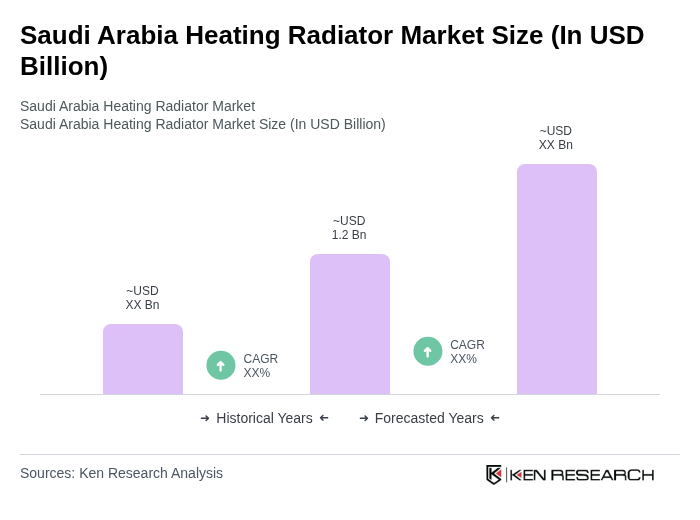
- The Saudi Arabia Heating Radiator Market is valued at USD 1.2 billion, based on a five-year historical analysis. This growth is primarily driven by increasing urbanization, rising disposable incomes, and a growing demand for energy-efficient heating solutions in residential and commercial sectors. The market has seen a significant uptick in the adoption of advanced heating technologies, which cater to the evolving consumer preferences for comfort and sustainability.
- Key cities such as Riyadh, Jeddah, and Dammam dominate the market due to their rapid urban development and significant investments in infrastructure projects. These cities are experiencing a surge in residential and commercial construction, leading to an increased demand for heating solutions. Additionally, the government's focus on enhancing energy efficiency in buildings further propels the market growth in these urban centers.
- In 2023, the Saudi government implemented regulations mandating energy efficiency standards for heating appliances, including radiators. This regulation aims to reduce energy consumption and promote the use of environmentally friendly technologies. Manufacturers are now required to comply with these standards, which has led to an increase in the production of energy-efficient heating solutions in the market.
Saudi Arabia Heating Radiator Market Segmentation
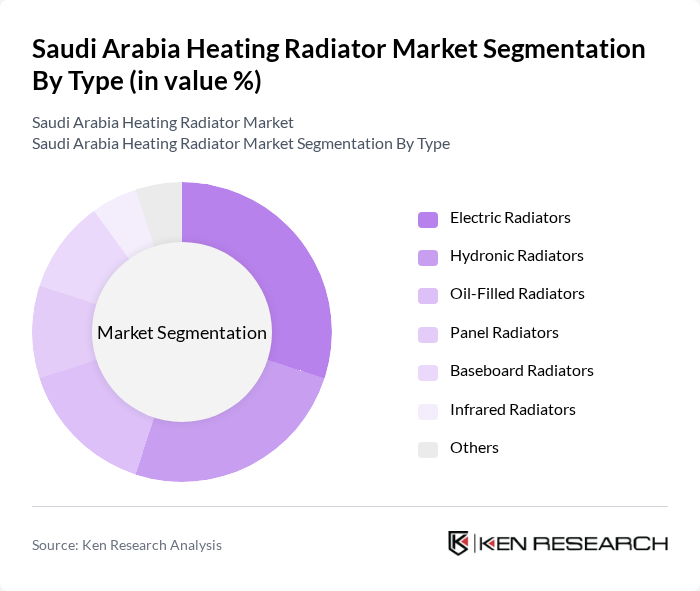
By Type:The market is segmented into various types of heating radiators, including Electric Radiators, Hydronic Radiators, Oil-Filled Radiators, Panel Radiators, Baseboard Radiators, Infrared Radiators, and Others. Among these, Electric Radiators are gaining popularity due to their ease of installation and efficiency, while Hydronic Radiators are preferred for their ability to provide consistent heating in larger spaces.
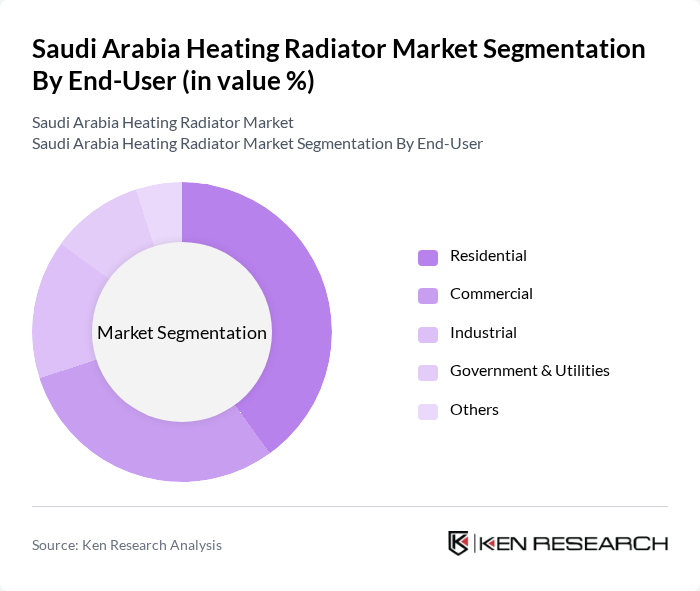
By End-User:The end-user segmentation includes Residential, Commercial, Industrial, Government & Utilities, and Others. The Residential segment is the largest due to the increasing number of housing projects and the growing trend of home automation, which emphasizes the need for efficient heating solutions.
Saudi Arabia Heating Radiator Market Competitive Landscape
The Saudi Arabia Heating Radiator Market is characterized by a dynamic mix of regional and international players. Leading participants such as Saudi Radiators Co., Al-Fanar Company, Zamil Industrial Investment Co., AHI Carrier, Rinnai Corporation, Ariston Thermo Group, Ferroli S.p.A., Vaillant Group, Baxi Heating, Kermi GmbH, Stelrad Radiators, Myson Radiators, Dimplex, Ecostrad, DeLonghi contribute to innovation, geographic expansion, and service delivery in this space.
Saudi Arabia Heating Radiator Market Industry Analysis
Growth Drivers
- Increasing Demand for Energy-Efficient Heating Solutions:The Saudi Arabian government aims to reduce energy consumption by 30% by 2030, driving demand for energy-efficient heating solutions. In future, the energy-efficient heating market is projected to reach approximately SAR 1.5 billion, reflecting a growing consumer preference for sustainable options. This shift is supported by rising electricity prices, which increased by 15% recently, prompting consumers to seek cost-effective heating alternatives that lower energy bills and environmental impact.
- Government Initiatives Promoting Sustainable Energy:The Saudi Vision 2030 initiative emphasizes sustainability and renewable energy, with a target of generating 58.7 GW from renewable sources by 2030. This commitment has led to increased funding for energy-efficient technologies, including heating radiators. In future, the government is expected to allocate SAR 2 billion towards energy efficiency programs, fostering innovation and adoption of advanced heating solutions that align with national sustainability goals.
- Rising Construction Activities in Residential and Commercial Sectors:The construction sector in Saudi Arabia is projected to grow by 6% in future, driven by significant investments in housing and commercial projects. The government plans to build 1.5 million new homes by 2030, creating a substantial demand for heating radiators. This growth is further supported by the increasing urbanization rate, which is expected to reach 85% in future, necessitating efficient heating solutions in new developments.
Market Challenges
- High Initial Investment Costs:The upfront costs associated with energy-efficient heating systems can be a significant barrier for consumers. In future, the average cost of installing a modern heating radiator system is estimated at SAR 10,000, which may deter potential buyers. This challenge is exacerbated by the limited availability of financing options, making it difficult for consumers to justify the initial investment despite long-term savings on energy bills.
- Limited Consumer Awareness About Heating Solutions:A significant portion of the Saudi population remains unaware of the benefits of modern heating solutions. In future, surveys indicate that only 30% of consumers are informed about energy-efficient heating options. This lack of awareness hampers market growth, as consumers may opt for traditional heating methods that are less efficient, leading to higher energy costs and environmental impact.
Saudi Arabia Heating Radiator Market Future Outlook
The Saudi Arabia heating radiator market is poised for significant transformation as consumer preferences shift towards energy efficiency and sustainability. With government initiatives supporting renewable energy and energy-efficient technologies, the market is expected to witness increased innovation and product offerings. Additionally, the integration of smart home technologies will enhance user experience and efficiency. As awareness grows and construction activities expand, the market is likely to see a robust increase in demand for modern heating solutions, aligning with national sustainability goals.
Market Opportunities
- Expansion of Smart Home Technologies:The rise of smart home technologies presents a significant opportunity for the heating radiator market. In future, the smart home market in Saudi Arabia is expected to reach SAR 1 billion, creating demand for integrated heating solutions that enhance energy efficiency and user control, appealing to tech-savvy consumers.
- Potential for Retrofitting Existing Buildings:With over 60% of buildings in Saudi Arabia being over 20 years old, there is a substantial opportunity for retrofitting existing structures with modern heating systems. In future, the retrofitting market is projected to grow by 5%, driven by government incentives and rising energy costs, encouraging property owners to upgrade their heating solutions for improved efficiency.
Scope of the Report
| Segment | Sub-Segments |
|---|---|
| By Type | Electric Radiators Hydronic Radiators Oil-Filled Radiators Panel Radiators Baseboard Radiators Infrared Radiators Others |
| By End-User | Residential Commercial Industrial Government & Utilities Others |
| By Region | Central Region Eastern Region Western Region Southern Region |
| By Application | Residential Heating Commercial Heating Industrial Heating District Heating Others |
| By Material | Steel Radiators Aluminum Radiators Cast Iron Radiators Plastic Radiators Others |
| By Energy Source | Electric Gas Renewable Energy Others |
| By Installation Type | Wall-Mounted Freestanding Integrated Systems Others |
Key Target Audience
Investors and Venture Capitalist Firms
Government and Regulatory Bodies (e.g., Saudi Standards, Metrology and Quality Organization)
Manufacturers and Producers
Distributors and Retailers
Construction and Real Estate Developers
Energy and Utility Companies
Industry Associations (e.g., Saudi Arabian Oil Company)
Financial Institutions
Players Mentioned in the Report:
Saudi Radiators Co.
Al-Fanar Company
Zamil Industrial Investment Co.
AHI Carrier
Rinnai Corporation
Ariston Thermo Group
Ferroli S.p.A.
Vaillant Group
Baxi Heating
Kermi GmbH
Stelrad Radiators
Myson Radiators
Dimplex
Ecostrad
DeLonghi
Table of Contents
Market Assessment Phase
1. Executive Summary and Approach
2. Saudi Arabia Heating Radiator Market Overview
2.1 Key Insights and Strategic Recommendations
2.2 Saudi Arabia Heating Radiator Market Overview
2.3 Definition and Scope
2.4 Evolution of Market Ecosystem
2.5 Timeline of Key Regulatory Milestones
2.6 Value Chain & Stakeholder Mapping
2.7 Business Cycle Analysis
2.8 Policy & Incentive Landscape
3. Saudi Arabia Heating Radiator Market Analysis
3.1 Growth Drivers
3.1.1 Increasing demand for energy-efficient heating solutions
3.1.2 Government initiatives promoting sustainable energy
3.1.3 Rising construction activities in residential and commercial sectors
3.1.4 Technological advancements in heating radiator designs
3.2 Market Challenges
3.2.1 High initial investment costs
3.2.2 Limited consumer awareness about heating solutions
3.2.3 Competition from alternative heating methods
3.2.4 Regulatory hurdles in product approvals
3.3 Market Opportunities
3.3.1 Expansion of smart home technologies
3.3.2 Increasing focus on renewable energy sources
3.3.3 Growth in the hospitality sector
3.3.4 Potential for retrofitting existing buildings
3.4 Market Trends
3.4.1 Shift towards eco-friendly heating solutions
3.4.2 Integration of IoT in heating systems
3.4.3 Customization and personalization of heating products
3.4.4 Rise in online sales channels for heating products
3.5 Government Regulation
3.5.1 Energy efficiency standards for heating appliances
3.5.2 Incentives for renewable energy adoption
3.5.3 Regulations on emissions from heating systems
3.5.4 Compliance requirements for product safety
4. SWOT Analysis
5. Stakeholder Analysis
6. Porter's Five Forces Analysis
7. Saudi Arabia Heating Radiator Market Market Size, 2019-2024
7.1 By Value
7.2 By Volume
7.3 By Average Selling Price
8. Saudi Arabia Heating Radiator Market Segmentation
8.1 By Type
8.1.1 Electric Radiators
8.1.2 Hydronic Radiators
8.1.3 Oil-Filled Radiators
8.1.4 Panel Radiators
8.1.5 Baseboard Radiators
8.1.6 Infrared Radiators
8.1.7 Others
8.2 By End-User
8.2.1 Residential
8.2.2 Commercial
8.2.3 Industrial
8.2.4 Government & Utilities
8.2.5 Others
8.3 By Region
8.3.1 Central Region
8.3.2 Eastern Region
8.3.3 Western Region
8.3.4 Southern Region
8.4 By Application
8.4.1 Residential Heating
8.4.2 Commercial Heating
8.4.3 Industrial Heating
8.4.4 District Heating
8.4.5 Others
8.5 By Material
8.5.1 Steel Radiators
8.5.2 Aluminum Radiators
8.5.3 Cast Iron Radiators
8.5.4 Plastic Radiators
8.5.5 Others
8.6 By Energy Source
8.6.1 Electric
8.6.2 Gas
8.6.3 Renewable Energy
8.6.4 Others
8.7 By Installation Type
8.7.1 Wall-Mounted
8.7.2 Freestanding
8.7.3 Integrated Systems
8.7.4 Others
9. Saudi Arabia Heating Radiator Market Competitive Analysis
9.1 Market Share of Key Players
9.2 Cross Comparison of Key Players
9.2.1 Company Name
9.2.2 Group Size (Large, Medium, or Small as per industry convention)
9.2.3 Revenue Growth Rate
9.2.4 Market Penetration Rate
9.2.5 Customer Retention Rate
9.2.6 Pricing Strategy
9.2.7 Product Innovation Rate
9.2.8 Distribution Efficiency
9.2.9 Brand Recognition Score
9.2.10 Customer Satisfaction Index
9.3 SWOT Analysis of Top Players
9.4 Pricing Analysis
9.5 Detailed Profile of Major Companies
9.5.1 Saudi Radiators Co.
9.5.2 Al-Fanar Company
9.5.3 Zamil Industrial Investment Co.
9.5.4 AHI Carrier
9.5.5 Rinnai Corporation
9.5.6 Ariston Thermo Group
9.5.7 Ferroli S.p.A.
9.5.8 Vaillant Group
9.5.9 Baxi Heating
9.5.10 Kermi GmbH
9.5.11 Stelrad Radiators
9.5.12 Myson Radiators
9.5.13 Dimplex
9.5.14 Ecostrad
9.5.15 DeLonghi
10. Saudi Arabia Heating Radiator Market End-User Analysis
10.1 Procurement Behavior of Key Ministries
10.1.1 Budget Allocation Trends
10.1.2 Procurement Processes
10.1.3 Supplier Selection Criteria
10.1.4 Contract Management Practices
10.2 Corporate Spend on Infrastructure & Energy
10.2.1 Investment Trends in Heating Solutions
10.2.2 Budgeting for Energy Efficiency
10.2.3 Corporate Sustainability Initiatives
10.2.4 Energy Consumption Patterns
10.3 Pain Point Analysis by End-User Category
10.3.1 Residential User Challenges
10.3.2 Commercial User Challenges
10.3.3 Industrial User Challenges
10.3.4 Government User Challenges
10.4 User Readiness for Adoption
10.4.1 Awareness Levels
10.4.2 Adoption Barriers
10.4.3 Training and Support Needs
10.4.4 Feedback Mechanisms
10.5 Post-Deployment ROI and Use Case Expansion
10.5.1 Performance Metrics
10.5.2 Cost Savings Analysis
10.5.3 User Satisfaction Levels
10.5.4 Future Expansion Opportunities
11. Saudi Arabia Heating Radiator Market Future Size, 2025-2030
11.1 By Value
11.2 By Volume
11.3 By Average Selling Price
Go-To-Market Strategy Phase
1. Whitespace Analysis + Business Model Canvas
1.1 Market Gaps Identification
1.2 Value Proposition Development
1.3 Revenue Streams Analysis
1.4 Cost Structure Evaluation
1.5 Key Partnerships Exploration
1.6 Customer Segmentation
1.7 Channels and Customer Relationships
2. Marketing and Positioning Recommendations
2.1 Branding Strategies
2.2 Product USPs
3. Distribution Plan
3.1 Urban Retail vs Rural NGO Tie-ups
4. Channel & Pricing Gaps
4.1 Underserved Routes
4.2 Pricing Bands
5. Unmet Demand & Latent Needs
5.1 Category Gaps
5.2 Consumer Segments
6. Customer Relationship
6.1 Loyalty Programs
6.2 After-sales Service
7. Value Proposition
7.1 Sustainability
7.2 Integrated Supply Chains
8. Key Activities
8.1 Regulatory Compliance
8.2 Branding
8.3 Distribution Setup
9. Entry Strategy Evaluation
9.1 Domestic Market Entry Strategy
9.1.1 Product Mix
9.1.2 Pricing Band
9.1.3 Packaging
9.2 Export Entry Strategy
9.2.1 Target Countries
9.2.2 Compliance Roadmap
10. Entry Mode Assessment
10.1 JV
10.2 Greenfield
10.3 M&A
10.4 Distributor Model
11. Capital and Timeline Estimation
11.1 Capital Requirements
11.2 Timelines
12. Control vs Risk Trade-Off
12.1 Ownership vs Partnerships
13. Profitability Outlook
13.1 Breakeven Analysis
13.2 Long-term Sustainability
14. Potential Partner List
14.1 Distributors
14.2 JVs
14.3 Acquisition Targets
15. Execution Roadmap
15.1 Phased Plan for Market Entry
15.1.1 Market Setup
15.1.2 Market Entry
15.1.3 Growth Acceleration
15.1.4 Scale & Stabilize
15.2 Key Activities and Milestones
15.2.1 Milestone Planning
15.2.2 Activity Tracking
Research Methodology
Phase 1: Approach1
Desk Research
- Analysis of industry reports from local and international market research firms
- Review of government publications and energy efficiency regulations in Saudi Arabia
- Examination of trade statistics and import/export data related to heating radiators
Primary Research
- Interviews with key stakeholders in the heating radiator supply chain, including manufacturers and distributors
- Surveys conducted with HVAC (Heating, Ventilation, and Air Conditioning) professionals and contractors
- Field interviews with end-users, including residential and commercial property managers
Validation & Triangulation
- Cross-validation of findings through multiple data sources, including sales data and market trends
- Triangulation of insights from primary interviews with secondary research findings
- Sanity checks performed by industry experts to ensure data accuracy and relevance
Phase 2: Market Size Estimation1
Top-down Assessment
- Estimation of market size based on national energy consumption statistics and heating needs
- Segmentation of the market by residential, commercial, and industrial applications
- Incorporation of growth rates from related sectors, such as construction and real estate
Bottom-up Modeling
- Collection of sales data from leading heating radiator manufacturers operating in Saudi Arabia
- Estimation of average selling prices and volume sold across different segments
- Analysis of installation and maintenance service revenues associated with heating radiators
Forecasting & Scenario Analysis
- Development of market forecasts using historical data and projected growth rates
- Scenario analysis based on potential regulatory changes and shifts in consumer preferences
- Creation of baseline, optimistic, and pessimistic market scenarios through 2030
Phase 3: CATI Sample Composition1
| Scope Item/Segment | Sample Size | Target Respondent Profiles |
|---|---|---|
| Residential Heating Solutions | 100 | Homeowners, Property Managers |
| Commercial Heating Systems | 80 | Facility Managers, Building Engineers |
| Industrial Heating Applications | 60 | Operations Managers, Plant Supervisors |
| HVAC Contractors and Installers | 90 | HVAC Technicians, Business Owners |
| Energy Efficiency Consultants | 70 | Energy Auditors, Sustainability Experts |
Frequently Asked Questions
What is the current value of the Saudi Arabia Heating Radiator Market?
The Saudi Arabia Heating Radiator Market is valued at approximately USD 1.2 billion, driven by urbanization, rising disposable incomes, and a growing demand for energy-efficient heating solutions in both residential and commercial sectors.
What factors are driving the growth of the heating radiator market in Saudi Arabia?
Which cities are the primary markets for heating radiators in Saudi Arabia?
What types of heating radiators are available in the Saudi market?
Other Regional/Country Reports
Other Adjacent Reports
Malaysia Air Conditioning Market
APAC Heat Pump MarketIndonesia Boiler Systems Market
Oman Smart Thermostat Market Report Size Share Growth Drivers Trends Opportunities & Forecast 2025–2030India Home Automation Market Size, Share & Forecast, By Product Type, Technology & Distribution Channel, 2026–2032South Africa Energy-Efficient Appliances Market
Vietnam Building Insulation Market
Egypt Renewable Energy Equipment Market
India Construction Materials Market Size, Share & Forecast, By Material Type, Application & End User, 2026-2031Why Buy From Us?

What makes us stand out is that our consultants follow Robust, Refine and Result (RRR) methodology. Robust for clear definitions, approaches and sanity checking, Refine for differentiating respondents' facts and opinions, and Result for presenting data with story.

We have set a benchmark in the industry by offering our clients with syndicated and customized market research reports featuring coverage of entire market as well as meticulous research and analyst insights.

While we don't replace traditional research, we flip the method upside down. Our dual approach of Top Bottom & Bottom Top ensures quality deliverable by not just verifying company fundamentals but also looking at the sector and macroeconomic factors.

With one step in the future, our research team constantly tries to show you the bigger picture. We help with some of the tough questions you may encounter along the way: How is the industry positioned? Best marketing channel? KPI's of competitors? By aligning every element, we help maximize success.

Our report gives you instant access to the answers and sources that other companies might choose to hide. We elaborate each steps of research methodology we have used and showcase you the sample size to earn your trust.

If you need any support, we are here! We pride ourselves on universe strength, data quality, and quick, friendly, and professional service.