Region:Middle East
Author(s):Dev
Product Code:KRAC8703
Pages:88
Published On:November 2025
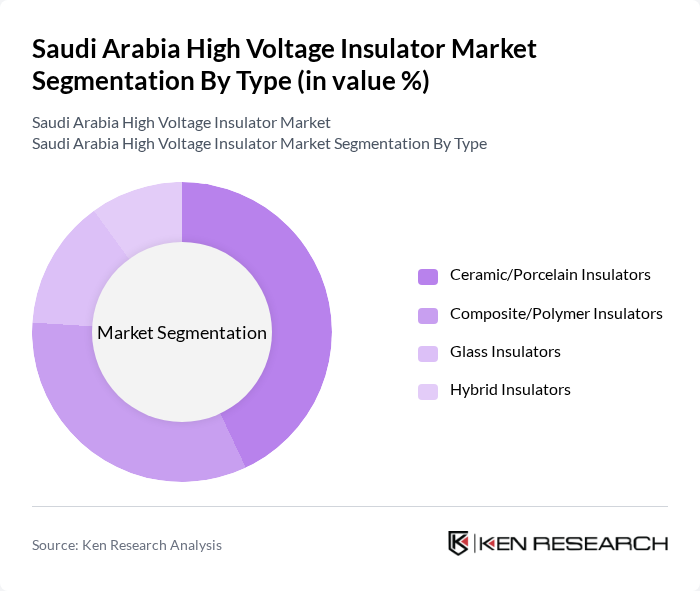
By Type:The market is segmented into four main types of insulators: Ceramic/Porcelain Insulators, Composite/Polymer Insulators, Glass Insulators, and Hybrid Insulators. Each type offers distinct advantages for high voltage transmission. Ceramic/Porcelain Insulators are widely used for their durability and high dielectric strength, making them a preferred choice for utility companies, especially in harsh environmental conditions. Composite/Polymer Insulators are gaining share due to their lighter weight, superior pollution resistance, and ease of installation, particularly in coastal and industrial zones. Glass Insulators are valued for their transparency and self-cleaning properties, while Hybrid Insulators combine features of both ceramic and polymer types for specialized applications .
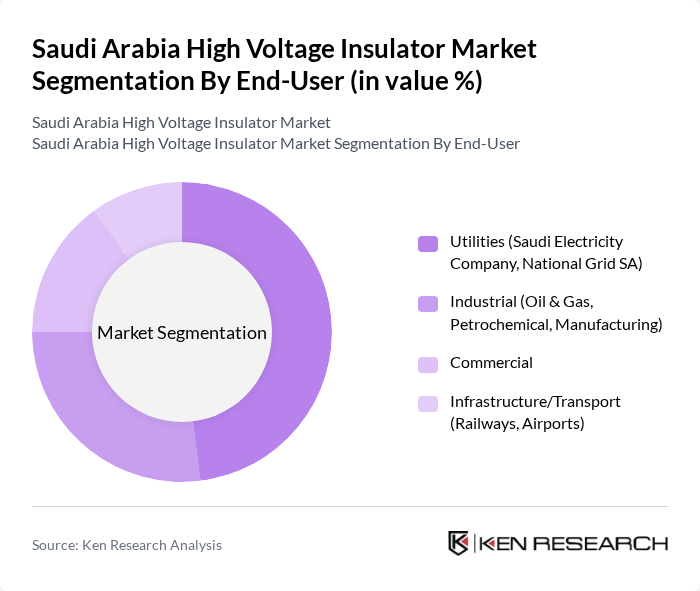
By End-User:The end-user segmentation includes Utilities (such as Saudi Electricity Company and National Grid SA), Industrial (Oil & Gas, Petrochemical, Manufacturing), Commercial, and Infrastructure/Transport (Railways, Airports). Utilities remain the dominant end-user segment, driven by ongoing grid expansion, reliability upgrades, and the integration of renewable energy sources. Industrial users, especially in oil & gas and petrochemicals, require robust insulators for critical process infrastructure. Infrastructure/Transport and Commercial segments are also expanding due to large-scale development projects and urbanization .
The Saudi Arabia High Voltage Insulator Market is characterized by a dynamic mix of regional and international players. Leading participants such as Siemens Energy AG, General Electric (GE Grid Solutions), Schneider Electric, ABB Ltd., Mitsubishi Electric Corporation, NGK Insulators, Ltd., TE Connectivity Ltd., Hubbell Power Systems, Inc., Lapp Insulators GmbH, Isolators & Insulators Co. (IIC), Saudi Arabia, CTC Global Inc., Nexans S.A., Sediver S.A., EATON Corporation plc, Pirelli & C. S.p.A. contribute to innovation, geographic expansion, and service delivery in this space.
The Saudi Arabia high voltage insulator market is poised for significant growth, driven by the ongoing transition to renewable energy and the expansion of the power grid. As the government continues to invest in energy efficiency and infrastructure, the demand for advanced insulator technologies will rise. Additionally, the integration of smart grid solutions and eco-friendly materials will shape the future landscape, presenting opportunities for innovation and sustainability in the sector.
| Segment | Sub-Segments |
|---|---|
| By Type | Ceramic/Porcelain Insulators Composite/Polymer Insulators Glass Insulators Hybrid Insulators |
| By End-User | Utilities (Saudi Electricity Company, National Grid SA) Industrial (Oil & Gas, Petrochemical, Manufacturing) Commercial Infrastructure/Transport (Railways, Airports) |
| By Voltage Rating | –220 kV (High Voltage) –400 kV (Extra High Voltage) Above 400 kV (Ultra High Voltage) |
| By Application | Transmission Lines Distribution Networks Substations HVDC Projects |
| By Material | Porcelain Polymer/Composite Glass Others |
| By Region | Central Region Eastern Region Western Region Southern Region |
| By Policy Support | Government Subsidies Tax Incentives Regulatory Support Local Content Requirements |
| Scope Item/Segment | Sample Size | Target Respondent Profiles |
|---|---|---|
| Utility Company Insulator Procurement | 60 | Procurement Managers, Technical Directors |
| Manufacturing Sector Insulator Usage | 50 | Operations Managers, Quality Assurance Heads |
| Infrastructure Development Projects | 40 | Project Managers, Civil Engineers |
| Renewable Energy Integration | 40 | Renewable Energy Managers, System Integrators |
| Research and Development in Insulator Technology | 40 | R&D Managers, Product Development Engineers |
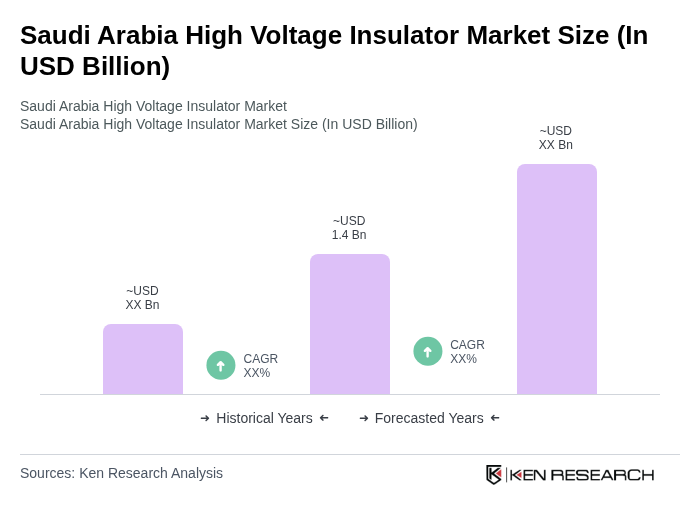
The Saudi Arabia High Voltage Insulator Market is valued at approximately USD 1.4 billion, driven by increasing electricity demand, grid modernization, and renewable energy projects under the Vision 2030 initiative.

What makes us stand out is that our consultants follow Robust, Refine and Result (RRR) methodology. Robust for clear definitions, approaches and sanity checking, Refine for differentiating respondents' facts and opinions, and Result for presenting data with story.

We have set a benchmark in the industry by offering our clients with syndicated and customized market research reports featuring coverage of entire market as well as meticulous research and analyst insights.

While we don't replace traditional research, we flip the method upside down. Our dual approach of Top Bottom & Bottom Top ensures quality deliverable by not just verifying company fundamentals but also looking at the sector and macroeconomic factors.

With one step in the future, our research team constantly tries to show you the bigger picture. We help with some of the tough questions you may encounter along the way: How is the industry positioned? Best marketing channel? KPI's of competitors? By aligning every element, we help maximize success.

Our report gives you instant access to the answers and sources that other companies might choose to hide. We elaborate each steps of research methodology we have used and showcase you the sample size to earn your trust.

If you need any support, we are here! We pride ourselves on universe strength, data quality, and quick, friendly, and professional service.













