About the Report
Base Year 2024Saudi Arabia Home Fragrance Market Overview
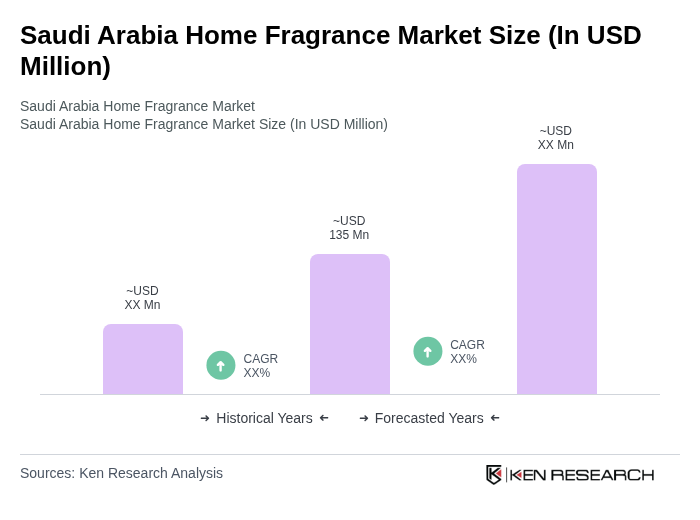
- The Saudi Arabia home fragrance market is valued at approximately USD 135 million, based on a five?year historical analysis of published industry estimates. This growth is primarily driven by increasing consumer interest in home aesthetics and interior décor, the deep cultural significance of fragrances in Saudi households, and a rising trend toward wellness, aromatherapy, and relaxation-focused products. The market has seen rising demand for a broad range of fragrance products, from traditional bakhoor and oud-based formats to modern scented candles, sprays, and diffusers, as consumers seek to personalize and enhance their living spaces.
- Key cities such as Riyadh, Jeddah, and Dammam dominate the market due to their large and growing urban populations, relatively higher disposable incomes, and strong cultural affinity for home and personal fragrances. These urban centers host dense networks of malls, specialty fragrance boutiques, branded mono?stores, and modern grocery/hypermarket chains, making them focal points for both premium and mass home fragrance consumption and distribution.
- While specific 2023 regulations targeted solely at home fragrance products are not clearly documented, Saudi authorities have tightened broader chemical, cosmetic, and consumer product standards to encourage safer, more sustainable formulations, including limits on certain volatile organic compounds and greater scrutiny of ingredient disclosure. These regulatory trends, together with growing consumer awareness, are pushing manufacturers and importers toward eco?friendlier bases, natural or nature?inspired ingredients, and more compliant packaging and labelling practices in home fragrance ranges.
Saudi Arabia Home Fragrance Market Segmentation
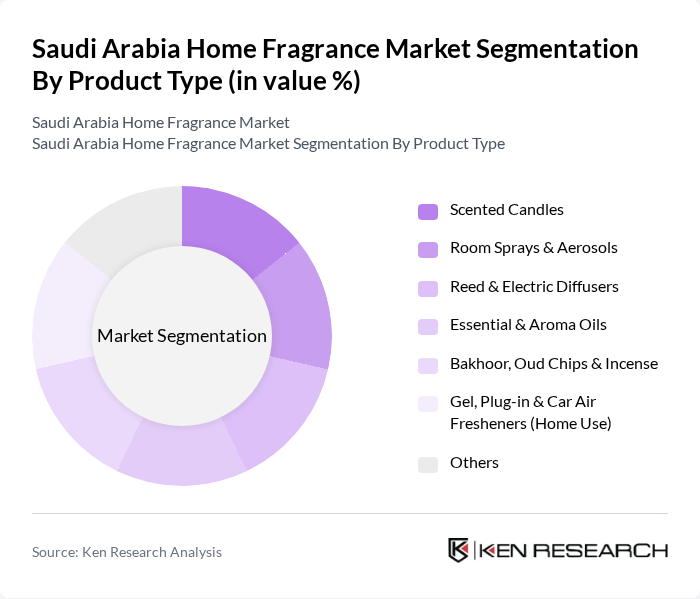
By Product Type:The product type segmentation includes various categories such as scented candles, room sprays & aerosols, reed & electric diffusers, essential & aroma oils, bakhoor, oud chips & incense, gel, plug-in & car air fresheners (home use), and others. Among these, scented candles and bakhoor are particularly popular due to their cultural significance and aesthetic appeal. The demand for room sprays and diffusers has also increased as consumers look for convenient and effective ways to enhance their home environments.
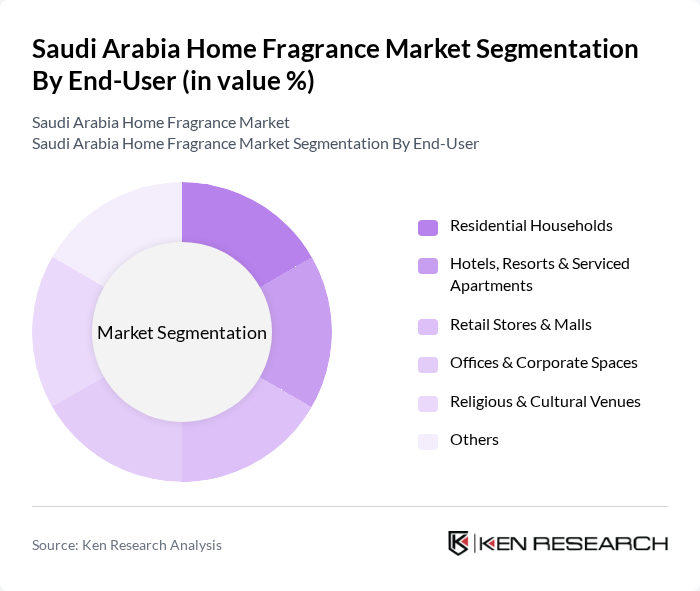
By End-User:The end-user segmentation encompasses residential households, hotels, resorts & serviced apartments, retail stores & malls, offices & corporate spaces, religious & cultural venues, and others. Residential households represent the largest segment, driven by the growing trend of home decoration and personal wellness. Hotels and resorts also contribute significantly, as they seek to create inviting atmospheres for guests through the use of premium fragrances.
Saudi Arabia Home Fragrance Market Competitive Landscape
The Saudi Arabia Home Fragrance Market is characterized by a dynamic mix of regional and international players. Leading participants such as Arabian Oud, Abdul Samad Al Qurashi, Al Haramain Perfumes, Ajmal Perfumes, Swiss Arabian Perfumes, Nabeel Perfumes, Rasasi Perfumes, Al Rehab Perfumes, Afnan Perfumes, Anfasic Dokhoon, Oudh Al Anfar, The Fragrance Kitchen, Lootah Perfumes, Bath & Body Works, and Yankee Candle contribute to innovation, geographic expansion, and service delivery in this space.
Saudi Arabia Home Fragrance Market Industry Analysis
Growth Drivers
- Increasing Disposable Income:The rise in disposable income among Saudi households, projected to reach SAR 1.2 trillion in future, is a significant growth driver for the home fragrance market. As consumers have more financial flexibility, they are more inclined to invest in luxury items, including home fragrances. This trend is supported by the Saudi Arabian Monetary Authority, which reported a 5.0% increase in household income over the past year, indicating a robust economic environment conducive to spending on home aesthetics.
- Rising Consumer Awareness about Home Aesthetics:The growing emphasis on home aesthetics in Saudi Arabia is driving demand for home fragrances. A survey by the Saudi Ministry of Culture indicated that 70% of respondents consider home fragrance essential for creating a pleasant living environment. This cultural shift is reflected in the increasing sales of home fragrance products, which reached SAR 1.6 billion in future, as consumers seek to enhance their living spaces with appealing scents that reflect personal style and comfort.
- Growth in the Hospitality Sector:The hospitality sector in Saudi Arabia is experiencing rapid growth, with the number of hotel rooms expected to increase by 35% in future, reaching approximately 110,000 rooms. This expansion is driven by the government's Vision 2030 initiative, which aims to boost tourism. As hotels and resorts enhance guest experiences, the demand for high-quality home fragrances is expected to rise, creating new opportunities for brands to cater to this burgeoning market segment.
Market Challenges
- High Competition from International Brands:The Saudi home fragrance market faces intense competition from established international brands, which dominate approximately 65% of the market share. Local brands struggle to compete with the marketing power and brand recognition of these global players. This competitive landscape makes it challenging for new entrants and smaller local brands to gain traction, as consumers often prefer well-known brands with proven quality and reliability.
- Fluctuating Raw Material Prices:The home fragrance industry is significantly affected by the volatility of raw material prices, particularly essential oils and synthetic fragrances. In future, prices for key raw materials surged by 18% due to supply chain disruptions and increased demand. This fluctuation poses a challenge for manufacturers, as it impacts production costs and profit margins, forcing them to either absorb costs or pass them on to consumers, which could affect sales.
Saudi Arabia Home Fragrance Market Future Outlook
The future of the Saudi Arabia home fragrance market appears promising, driven by evolving consumer preferences and technological advancements. As the market adapts to the increasing demand for eco-friendly products, brands are likely to innovate in sustainable packaging and natural ingredients. Additionally, the integration of smart technology in fragrance delivery systems is expected to enhance user experience, making home fragrances more accessible and personalized. These trends will likely shape the market landscape, fostering growth and diversification in product offerings.
Market Opportunities
- Expansion of E-commerce Platforms:The rapid growth of e-commerce in Saudi Arabia, projected to reach SAR 55 billion in future, presents a significant opportunity for home fragrance brands. Online platforms allow for wider distribution and accessibility, enabling brands to reach consumers in urban and rural areas alike. This shift towards digital shopping is expected to enhance sales and brand visibility, particularly among younger consumers who prefer online purchasing.
- Increasing Demand for Natural and Organic Products:The trend towards health and wellness is driving demand for natural and organic home fragrance products. With the market for organic products expected to grow by 22% annually, brands that focus on sustainable sourcing and eco-friendly ingredients can capitalize on this opportunity. This shift aligns with consumer preferences for products that are not only effective but also environmentally responsible, enhancing brand loyalty and market share.
Scope of the Report
| Segment | Sub-Segments |
|---|---|
| By Product Type | Scented Candles Room Sprays & Aerosols Reed & Electric Diffusers Essential & Aroma Oils Bakhoor, Oud Chips & Incense Gel, Plug?in & Car Air Fresheners (Home Use) Others |
| By End-User | Residential Households Hotels, Resorts & Serviced Apartments Retail Stores & Malls Offices & Corporate Spaces Religious & Cultural Venues Others |
| By Distribution Channel | Supermarkets & Hypermarkets Specialty Fragrance & Home Décor Stores Branded Boutiques & Kiosks Online Retail & Marketplaces Pharmacies & Convenience Stores Others |
| By Fragrance Family | Oriental & Oud-based Floral Woody & Amber Citrus & Fresh Gourmet & Spicy Others |
| By Packaging Format | Glass Jars & Bottles Metal Tins & Cans Plastic Containers & Refills Ceramic & Decorative Packaging Others |
| By Price Tier | Luxury & Niche Premium Mass & Value Private Label & Economy |
| By Brand Origin | Saudi & GCC Heritage Brands Global Multinational Brands Indie & Boutique Brands Private Labels & Retailer Brands |
Key Target Audience
Investors and Venture Capitalist Firms
Government and Regulatory Bodies (e.g., Saudi Standards, Metrology and Quality Organization)
Manufacturers and Producers
Distributors and Retailers
Importers and Exporters
Marketing and Advertising Agencies
Industry Associations (e.g., Saudi Arabian Chamber of Commerce)
Financial Institutions
Players Mentioned in the Report:
Arabian Oud
Abdul Samad Al Qurashi
Al Haramain Perfumes
Ajmal Perfumes
Swiss Arabian Perfumes
Nabeel Perfumes
Rasasi Perfumes
Al Rehab Perfumes
Afnan Perfumes
Anfasic Dokhoon
Oudh Al Anfar
The Fragrance Kitchen
Lootah Perfumes
Bath & Body Works
Yankee Candle
Table of Contents
Market Assessment Phase
1. Executive Summary and Approach
2. Saudi Arabia Home Fragrance Market Overview
2.1 Key Insights and Strategic Recommendations
2.2 Saudi Arabia Home Fragrance Market Overview
2.3 Definition and Scope
2.4 Evolution of Market Ecosystem
2.5 Timeline of Key Regulatory Milestones
2.6 Value Chain & Stakeholder Mapping
2.7 Business Cycle Analysis
2.8 Policy & Incentive Landscape
3. Saudi Arabia Home Fragrance Market Analysis
3.1 Growth Drivers
3.1.1 Increasing disposable income
3.1.2 Rising consumer awareness about home aesthetics
3.1.3 Growth in the hospitality sector
3.1.4 Cultural significance of fragrances in Saudi traditions
3.2 Market Challenges
3.2.1 High competition from international brands
3.2.2 Fluctuating raw material prices
3.2.3 Regulatory hurdles
3.2.4 Limited distribution channels in rural areas
3.3 Market Opportunities
3.3.1 Expansion of e-commerce platforms
3.3.2 Increasing demand for natural and organic products
3.3.3 Collaborations with local artisans
3.3.4 Growth in gifting culture
3.4 Market Trends
3.4.1 Shift towards eco-friendly packaging
3.4.2 Customization and personalization of fragrances
3.4.3 Integration of technology in fragrance delivery
3.4.4 Rise of subscription-based fragrance services
3.5 Government Regulation
3.5.1 Standards for product safety and quality
3.5.2 Import regulations for fragrance materials
3.5.3 Environmental regulations on packaging
3.5.4 Labeling requirements for consumer transparency
4. SWOT Analysis
5. Stakeholder Analysis
6. Porter's Five Forces Analysis
7. Saudi Arabia Home Fragrance Market Market Size, 2019-2024
7.1 By Value
7.2 By Volume
7.3 By Average Selling Price
8. Saudi Arabia Home Fragrance Market Segmentation
8.1 By Product Type
8.1.1 Scented Candles
8.1.2 Room Sprays & Aerosols
8.1.3 Reed & Electric Diffusers
8.1.4 Essential & Aroma Oils
8.1.5 Bakhoor, Oud Chips & Incense
8.1.6 Gel, Plug?in & Car Air Fresheners (Home Use)
8.1.7 Others
8.2 By End-User
8.2.1 Residential Households
8.2.2 Hotels, Resorts & Serviced Apartments
8.2.3 Retail Stores & Malls
8.2.4 Offices & Corporate Spaces
8.2.5 Religious & Cultural Venues
8.2.6 Others
8.3 By Distribution Channel
8.3.1 Supermarkets & Hypermarkets
8.3.2 Specialty Fragrance & Home Décor Stores
8.3.3 Branded Boutiques & Kiosks
8.3.4 Online Retail & Marketplaces
8.3.5 Pharmacies & Convenience Stores
8.3.6 Others
8.4 By Fragrance Family
8.4.1 Oriental & Oud-based
8.4.2 Floral
8.4.3 Woody & Amber
8.4.4 Citrus & Fresh
8.4.5 Gourmet & Spicy
8.4.6 Others
8.5 By Packaging Format
8.5.1 Glass Jars & Bottles
8.5.2 Metal Tins & Cans
8.5.3 Plastic Containers & Refills
8.5.4 Ceramic & Decorative Packaging
8.5.5 Others
8.6 By Price Tier
8.6.1 Luxury & Niche
8.6.2 Premium
8.6.3 Mass & Value
8.6.4 Private Label & Economy
8.7 By Brand Origin
8.7.1 Saudi & GCC Heritage Brands
8.7.2 Global Multinational Brands
8.7.3 Indie & Boutique Brands
8.7.4 Private Labels & Retailer Brands
9. Saudi Arabia Home Fragrance Market Competitive Analysis
9.1 Market Share of Key Players
9.2 Cross Comparison of Key Players
9.2.1 Company Name.
9.2.2 Revenue from Home Fragrance in Saudi Arabia.
9.2.3 Home Fragrance Revenue CAGR (Historical 3–5 Years).
9.2.4 Product Portfolio Breadth (Number of Home Fragrance SKUs/Formats).
9.2.5 Average Selling Price Positioning (Value, Mid, Premium, Luxury).
9.2.6 Channel Mix (Share of Online vs Offline Sales).
9.2.7 Geographic Coverage within KSA (Number of Cities/Outlets).
9.2.8 Brand Awareness & Preference Score (Consumer Survey-Based).
9.2.9 Innovation Intensity (New Product Launches per Year).
9.2.10 Compliance & Sustainability Metrics (Eco-friendly, Halal, Clean Label Share).
9.3 SWOT Analysis of Top Players
9.4 Pricing Analysis
9.5 Detailed Profile of Major Companies
9.5.1 Arabian Oud
9.5.2 Abdul Samad Al Qurashi
9.5.3 Al Haramain Perfumes
9.5.4 Ajmal Perfumes
9.5.5 Swiss Arabian Perfumes
9.5.6 Nabeel Perfumes
9.5.7 Rasasi Perfumes
9.5.8 Al Rehab Perfumes
9.5.9 Afnan Perfumes
9.5.10 Anfasic Dokhoon
9.5.11 Oudh Al Anfar
9.5.12 The Fragrance Kitchen
9.5.13 Lootah Perfumes
9.5.14 Bath & Body Works
9.5.15 Yankee Candle
10. Saudi Arabia Home Fragrance Market End-User Analysis
10.1 Procurement Behavior of Key Ministries
10.1.1 Ministry of Culture
10.1.2 Ministry of Tourism
10.1.3 Ministry of Commerce
10.1.4 Ministry of Municipal and Rural Affairs
10.2 Corporate Spend on Infrastructure & Energy
10.2.1 Corporate Gifting
10.2.2 Event Sponsorships
10.2.3 Office Aesthetics
10.2.4 Others
10.3 Pain Point Analysis by End-User Category
10.3.1 Residential Users
10.3.2 Commercial Users
10.3.3 Hospitality Sector
10.3.4 Retail Sector
10.4 User Readiness for Adoption
10.4.1 Awareness Levels
10.4.2 Product Availability
10.4.3 Price Sensitivity
10.4.4 Cultural Acceptance
10.5 Post-Deployment ROI and Use Case Expansion
10.5.1 Customer Satisfaction Metrics
10.5.2 Repeat Purchase Rates
10.5.3 Brand Advocacy
10.5.4 Market Expansion Opportunities
11. Saudi Arabia Home Fragrance Market Future Size, 2025-2030
11.1 By Value
11.2 By Volume
11.3 By Average Selling Price
Go-To-Market Strategy Phase
1. Whitespace Analysis + Business Model Canvas
1.1 Market Gaps Identification
1.2 Business Model Development
2. Marketing and Positioning Recommendations
2.1 Branding Strategies
2.2 Product USPs
3. Distribution Plan
3.1 Urban Retail vs Rural NGO Tie-ups
4. Channel & Pricing Gaps
4.1 Underserved Routes
4.2 Pricing Bands
5. Unmet Demand & Latent Needs
5.1 Category Gaps
5.2 Consumer Segments
6. Customer Relationship
6.1 Loyalty Programs
6.2 After-sales Service
7. Value Proposition
7.1 Sustainability
7.2 Integrated Supply Chains
8. Key Activities
8.1 Regulatory Compliance
8.2 Branding
8.3 Distribution Setup
9. Entry Strategy Evaluation
9.1 Domestic Market Entry Strategy
9.1.1 Product Mix
9.1.2 Pricing Band
9.1.3 Packaging
9.2 Export Entry Strategy
9.2.1 Target Countries
9.2.2 Compliance Roadmap
10. Entry Mode Assessment
10.1 JV
10.2 Greenfield
10.3 M&A
10.4 Distributor Model
11. Capital and Timeline Estimation
11.1 Capital Requirements
11.2 Timelines
12. Control vs Risk Trade-Off
12.1 Ownership vs Partnerships
13. Profitability Outlook
13.1 Breakeven Analysis
13.2 Long-term Sustainability
14. Potential Partner List
14.1 Distributors
14.2 JVs
14.3 Acquisition Targets
15. Execution Roadmap
15.1 Phased Plan for Market Entry
15.1.1 Market Setup
15.1.2 Market Entry
15.1.3 Growth Acceleration
15.1.4 Scale & Stabilize
15.2 Key Activities and Milestones
15.2.1 Activity Planning
15.2.2 Milestone Tracking
Research Methodology
Phase 1: Approach1
Desk Research
- Analysis of market reports from industry associations and trade publications specific to home fragrances in Saudi Arabia
- Review of consumer behavior studies and demographic data from government statistical agencies
- Examination of import/export data and market trends from customs and trade databases
Primary Research
- Interviews with key stakeholders in the home fragrance industry, including manufacturers and distributors
- Surveys targeting retail managers and sales personnel in home fragrance outlets
- Focus group discussions with consumers to understand preferences and buying behavior
Validation & Triangulation
- Cross-validation of findings through multiple data sources, including sales data and consumer insights
- Triangulation of qualitative insights from interviews with quantitative data from surveys
- Sanity checks conducted through expert panel reviews comprising industry veterans
Phase 2: Market Size Estimation1
Top-down Assessment
- Estimation of market size based on national retail sales data for home fragrance products
- Segmentation of the market by product type, including candles, diffusers, and sprays
- Incorporation of growth rates derived from historical data and market trends
Bottom-up Modeling
- Collection of sales volume data from leading home fragrance retailers and manufacturers
- Estimation of average selling prices across different product categories
- Calculation of market size based on unit sales multiplied by average prices
Forecasting & Scenario Analysis
- Development of forecasting models using historical sales data and market growth indicators
- Scenario analysis based on potential economic changes and consumer trends in Saudi Arabia
- Projections for market growth through 2030, considering various influencing factors
Phase 3: CATI Sample Composition1
| Scope Item/Segment | Sample Size | Target Respondent Profiles |
|---|---|---|
| Retail Outlets for Home Fragrances | 120 | Store Managers, Sales Associates |
| Manufacturers of Home Fragrance Products | 90 | Product Development Managers, Marketing Directors |
| Distributors and Wholesalers | 80 | Supply Chain Managers, Sales Directors |
| Consumers of Home Fragrance Products | 150 | General Consumers, Brand Loyalists |
| Online Retailers of Home Fragrance | 70 | E-commerce Managers, Digital Marketing Specialists |
Frequently Asked Questions
What is the current value of the Saudi Arabia home fragrance market?
The Saudi Arabia home fragrance market is valued at approximately USD 135 million, driven by consumer interest in home aesthetics, cultural significance of fragrances, and a growing trend towards wellness and relaxation products.
Which cities are the main hubs for the home fragrance market in Saudi Arabia?
What types of home fragrance products are popular in Saudi Arabia?
How is consumer awareness influencing the home fragrance market in Saudi Arabia?
Other Regional/Country Reports
Indonesia Home Fragrance Market
Malaysia Home Fragrance Market
KSA Home Fragrance Market
APAC Home Fragrance Market
SEA Home Fragrance Market
Vietnam Home Fragrance Market
Other Adjacent Reports
Thailand Personal Fragrance Market
Germany Essential Oils Market
UAE Aromatherapy Products Market
Vietnam Home Decor Market
Kuwait Scented Candle Market
Malaysia Air Freshener Market
Thailand Incense Market
Mexico Wellness Products Market
Bahrain Hospitality Supplies Market
KSA Luxury Home Accessories Market
Why Buy From Us?

What makes us stand out is that our consultants follow Robust, Refine and Result (RRR) methodology. Robust for clear definitions, approaches and sanity checking, Refine for differentiating respondents' facts and opinions, and Result for presenting data with story.

We have set a benchmark in the industry by offering our clients with syndicated and customized market research reports featuring coverage of entire market as well as meticulous research and analyst insights.

While we don't replace traditional research, we flip the method upside down. Our dual approach of Top Bottom & Bottom Top ensures quality deliverable by not just verifying company fundamentals but also looking at the sector and macroeconomic factors.

With one step in the future, our research team constantly tries to show you the bigger picture. We help with some of the tough questions you may encounter along the way: How is the industry positioned? Best marketing channel? KPI's of competitors? By aligning every element, we help maximize success.

Our report gives you instant access to the answers and sources that other companies might choose to hide. We elaborate each steps of research methodology we have used and showcase you the sample size to earn your trust.

If you need any support, we are here! We pride ourselves on universe strength, data quality, and quick, friendly, and professional service.