About the Report
Base Year 2024Saudi Arabia Lingerie Market Overview
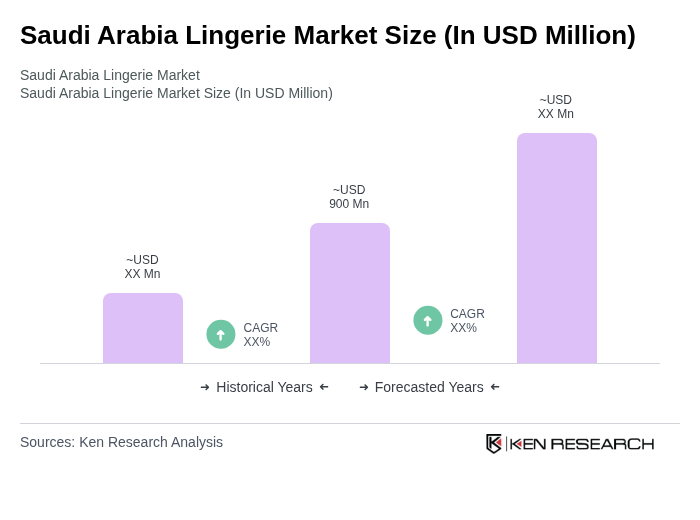
- The Saudi Arabia Lingerie Market is valued at USD 900 million, based on a five-year historical analysis. This growth is primarily driven by increasing consumer awareness regarding fashion trends, rising disposable incomes, greater female workforce participation, and a strong shift towards online and omnichannel shopping platforms. The market has seen a surge in demand for diverse lingerie products, with brands focusing on inclusivity, body positivity, and size extensions to cater to various consumer preferences and body types.
- Key cities such as Riyadh, Jeddah, and Dammam dominate the market due to their large populations, higher income levels, and advanced retail infrastructure, including large shopping malls and modern trade formats. These cities are also home to numerous international fashion and lingerie brands, regional chains, and local designers, making them prime locations for lingerie sales and brand flagships. The presence of strong offline retail networks alongside rapidly growing e-commerce platforms further enhances the market's appeal in these urban centers.
- In line with broader industrial and retail development policies, the Saudi government has introduced initiatives and regulations to support local textile and apparel manufacturing, including intimatewear, under the National Industrial Development and Logistics Program (NIDLP) and Saudi Vision 2030, which encourage import substitution and domestic value-add. For example, the Implementing Regulations of the Commercial Franchise Law issued by the Ministry of Commerce in 2020 set registration, disclosure, and contractual requirements for franchisors and franchisees, impacting the operation and expansion of international lingerie and fashion brands in Saudi Arabia. These measures, along with local content and Saudization policies applied across retail and light manufacturing, aim to boost domestic production, encourage local brand development, and enhance overall competitiveness in categories such as lingerie and innerwear.
Saudi Arabia Lingerie Market Segmentation
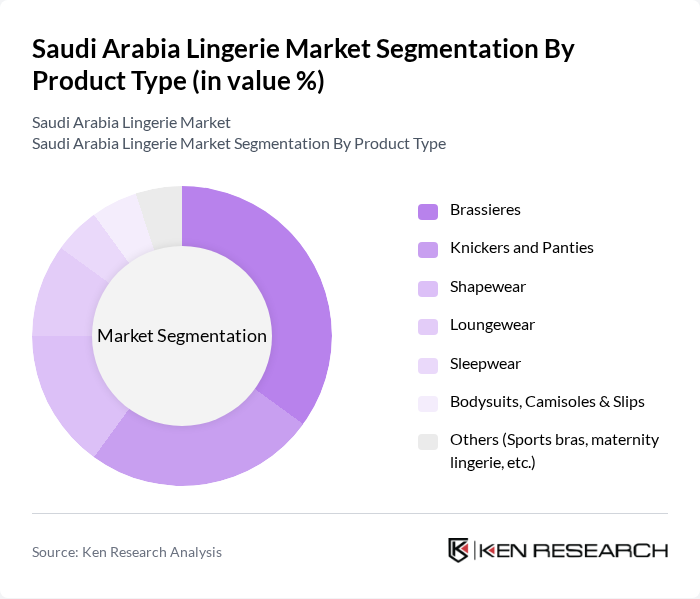
By Product Type:The product type segmentation includes various categories such as Brassieres, Knickers and Panties, Shapewear, Loungewear, Sleepwear, Bodysuits, Camisoles & Slips, and Others (Sports bras, maternity lingerie, etc.). This aligns with regional and country-level breakdowns, where brassieres, knickers or panties, and shapewear are core categories in Saudi Arabia. Among these, Brassieres are the leading sub-segment due to their essential role in women's lingerie collections and higher average selling price, driven by fashion trends, fit specialization, and comfort preferences. The demand for innovative designs, inclusive sizing, seamless and wireless constructions, and performance-focused products (such as sports and maternity bras) has further propelled this segment's growth.
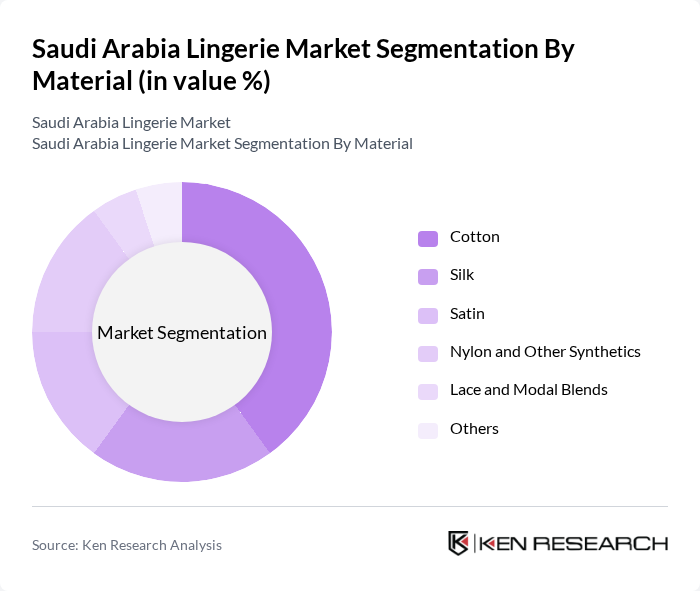
By Material:The material segmentation includes Cotton, Silk, Satin, Nylon and Other Synthetics, Lace and Modal Blends, and Others. Country-level and regional analyses for Saudi Arabia and the wider Middle East identify cotton, silk, satin, nylon, and other synthetic blends as the primary fabric categories used in lingerie. Cotton is the dominant material due to its comfort, breathability, and affordability, making it a preferred choice among consumers for everyday innerwear. The increasing trend towards sustainable and organic materials, including organic cotton and eco-friendly synthetic alternatives, is also influencing the market, with consumers in Saudi Arabia and the wider region showing a growing preference for ethically sourced and environmentally responsible options.
Saudi Arabia Lingerie Market Competitive Landscape
The Saudi Arabia Lingerie Market is characterized by a dynamic mix of regional and international players. Leading participants such as Victoria's Secret & Co., La Senza, Marks & Spencer, H&M, Boux Avenue, Triumph International, Intimissimi, Oysho, Zara, ASOS, Next, Aerie (American Eagle Outfitters), Calvin Klein Underwear, Savage X Fenty, and leading local brands like Nayomi, Redtag, Max Fashion, and Splash contribute to innovation, geographic expansion, and service delivery in this space.
Saudi Arabia Lingerie Market Industry Analysis
Growth Drivers
- Increasing Disposable Income:The disposable income in Saudi Arabia is projected to reach approximately SAR 1.1 trillion (USD 293 billion) in future, reflecting a significant increase from previous years. This rise in income allows consumers to allocate more funds towards discretionary spending, including lingerie. As purchasing power improves, the demand for premium and luxury lingerie brands is expected to grow, driving market expansion. Enhanced financial stability among consumers is a key factor in this growth trajectory.
- Rising Awareness of Fashion Trends:The Saudi Arabian population is increasingly influenced by global fashion trends, with over 60% of women expressing interest in contemporary lingerie styles. This shift is supported by social media and fashion influencers, which have heightened awareness and accessibility to diverse lingerie options. As a result, local brands are adapting their offerings to align with these trends, fostering a competitive market environment that encourages innovation and variety in product lines.
- Growth of E-commerce Platforms:E-commerce sales in Saudi Arabia are expected to exceed SAR 50 billion (USD 13.3 billion) in future, driven by increased internet penetration and smartphone usage. This growth facilitates easier access to lingerie products, allowing consumers to shop from the comfort of their homes. The convenience of online shopping, coupled with the rise of local and international e-commerce platforms, is significantly contributing to the expansion of the lingerie market in the region.
Market Challenges
- Cultural Sensitivities:The lingerie market in Saudi Arabia faces significant cultural sensitivities that can hinder growth. Traditional views on modesty and gender roles often limit the types of lingerie that can be marketed and sold. Retailers must navigate these cultural norms carefully, ensuring that their marketing strategies and product offerings align with local values. This challenge can restrict the potential customer base and limit the scope of product innovation in the market.
- Competition from International Brands:The Saudi lingerie market is increasingly competitive, with numerous international brands entering the landscape. These brands often have established reputations and extensive marketing budgets, making it challenging for local companies to compete effectively. In future, international brands are expected to capture over 40% of the market share, which may pressure local brands to innovate and differentiate their offerings to maintain relevance and market presence.
Saudi Arabia Lingerie Market Future Outlook
The Saudi Arabia lingerie market is poised for significant transformation, driven by evolving consumer preferences and technological advancements. As the demand for athleisure and body-positive lingerie increases, brands are likely to adapt their product lines accordingly. Additionally, the integration of technology in design and marketing strategies will enhance customer engagement. The focus on sustainability will also shape future offerings, as consumers increasingly seek eco-friendly options that align with their values and lifestyle choices.
Market Opportunities
- Growth in Online Shopping:The surge in online shopping presents a substantial opportunity for lingerie brands in Saudi Arabia. With e-commerce projected to grow by 20% annually, brands can leverage this trend to reach a broader audience. Enhanced digital marketing strategies and user-friendly platforms can facilitate this growth, allowing brands to cater to the evolving shopping preferences of consumers.
- Demand for Sustainable Products:The increasing consumer awareness regarding sustainability is creating a demand for eco-friendly lingerie options. Brands that prioritize sustainable materials and ethical production practices can tap into this growing market segment. In future, it is estimated that sustainable products could account for 15% of total lingerie sales, providing a lucrative opportunity for brands willing to innovate and adapt to these consumer preferences.
Scope of the Report
| Segment | Sub-Segments |
|---|---|
| By Product Type | Brassieres Knickers and Panties Shapewear Loungewear Sleepwear Bodysuits, Camisoles & Slips Others (Sports bras, maternity lingerie, etc.) |
| By Material | Cotton Silk Satin Nylon and Other Synthetics Lace and Modal Blends Others |
| By Price Range | Economy / Mass Mid-range Premium Luxury |
| By Distribution Channel | Mass merchandisers & supermarkets/hypermarkets Specialized & exclusive lingerie stores Department stores & multi-brand fashion retailers Online stores and e-commerce platforms Others |
| By Brand Type | Local brands International brands Private labels Others |
| By Consumer Profile | Women Men Teens & Young Adults Others |
| By Region (Within Saudi Arabia) | Northern & Central Region Western Region Eastern Region Southern Region |
Key Target Audience
Investors and Venture Capitalist Firms
Government and Regulatory Bodies (e.g., Saudi Arabian Standards Organization, Ministry of Commerce and Investment)
Manufacturers and Producers
Distributors and Retailers
Fashion and Apparel Brands
Textile Suppliers
Marketing and Advertising Agencies
Financial Institutions
Players Mentioned in the Report:
Victoria's Secret & Co.
La Senza
Marks & Spencer
H&M
Boux Avenue
Triumph International
Intimissimi
Oysho
Zara
ASOS
Next
Aerie (American Eagle Outfitters)
Calvin Klein Underwear
Savage X Fenty
Leading Local & Regional Lingerie Brands (e.g., Nayomi, Redtag, Max Fashion, Splash)
Table of Contents
Market Assessment Phase
1. Executive Summary and Approach
2. Saudi Arabia Lingerie Market Overview
2.1 Key Insights and Strategic Recommendations
2.2 Saudi Arabia Lingerie Market Overview
2.3 Definition and Scope
2.4 Evolution of Market Ecosystem
2.5 Timeline of Key Regulatory Milestones
2.6 Value Chain & Stakeholder Mapping
2.7 Business Cycle Analysis
2.8 Policy & Incentive Landscape
3. Saudi Arabia Lingerie Market Analysis
3.1 Growth Drivers
3.1.1 Increasing disposable income
3.1.2 Rising awareness of fashion trends
3.1.3 Growth of e-commerce platforms
3.1.4 Expansion of retail outlets
3.2 Market Challenges
3.2.1 Cultural sensitivities
3.2.2 Competition from international brands
3.2.3 Regulatory hurdles
3.2.4 Economic fluctuations
3.3 Market Opportunities
3.3.1 Growth in online shopping
3.3.2 Demand for sustainable products
3.3.3 Customization and personalization trends
3.3.4 Expansion into underserved regions
3.4 Market Trends
3.4.1 Shift towards athleisure lingerie
3.4.2 Increasing focus on body positivity
3.4.3 Rise of subscription box services
3.4.4 Integration of technology in lingerie design
3.5 Government Regulation
3.5.1 Import regulations on textiles
3.5.2 Labeling requirements
3.5.3 Health and safety standards
3.5.4 Consumer protection laws
4. SWOT Analysis
5. Stakeholder Analysis
6. Porter's Five Forces Analysis
7. Saudi Arabia Lingerie Market Market Size, 2019-2024
7.1 By Value
7.2 By Volume
7.3 By Average Selling Price
8. Saudi Arabia Lingerie Market Segmentation
8.1 By Product Type
8.1.1 Brassieres
8.1.2 Knickers and Panties
8.1.3 Shapewear
8.1.4 Loungewear
8.1.5 Sleepwear
8.1.6 Bodysuits, Camisoles & Slips
8.1.7 Others (Sports bras, maternity lingerie, etc.)
8.2 By Material
8.2.1 Cotton
8.2.2 Silk
8.2.3 Satin
8.2.4 Nylon and Other Synthetics
8.2.5 Lace and Modal Blends
8.2.6 Others
8.3 By Price Range
8.3.1 Economy / Mass
8.3.2 Mid-range
8.3.3 Premium
8.3.4 Luxury
8.4 By Distribution Channel
8.4.1 Mass merchandisers & supermarkets/hypermarkets
8.4.2 Specialized & exclusive lingerie stores
8.4.3 Department stores & multi-brand fashion retailers
8.4.4 Online stores and e-commerce platforms
8.4.5 Others
8.5 By Brand Type
8.5.1 Local brands
8.5.2 International brands
8.5.3 Private labels
8.5.4 Others
8.6 By Consumer Profile
8.6.1 Women
8.6.2 Men
8.6.3 Teens & Young Adults
8.6.4 Others
8.7 By Region (Within Saudi Arabia)
8.7.1 Northern & Central Region
8.7.2 Western Region
8.7.3 Eastern Region
8.7.4 Southern Region
9. Saudi Arabia Lingerie Market Competitive Analysis
9.1 Market Share of Key Players
9.2 Cross Comparison of Key Players
9.2.1 Company Name
9.2.2 Group Size (Large, Medium, or Small as per industry convention)
9.2.3 Saudi Arabia Lingerie Revenue (USD Million) – Latest Year
9.2.4 3-Year Revenue CAGR in Saudi Arabia (%)
9.2.5 Market Share in Saudi Arabia Lingerie Market (%)
9.2.6 Store Footprint in Saudi Arabia (Number of Outlets)
9.2.7 Online Traffic / Monthly Active Users (Saudi Arabia)
9.2.8 Average Transaction Value (SAR per Purchase)
9.2.9 Gross Margin (%) – Lingerie Portfolio
9.2.10 Marketing Spend as % of Saudi Lingerie Revenue
9.2.11 Customer Repeat Purchase Rate (%)
9.2.12 Net Promoter Score (NPS)
9.3 SWOT Analysis of Top Players
9.4 Pricing Analysis
9.5 Detailed Profile of Major Companies
9.5.1 Victoria's Secret & Co.
9.5.2 La Senza
9.5.3 Marks & Spencer
9.5.4 H&M
9.5.5 Boux Avenue
9.5.6 Triumph International
9.5.7 Intimissimi
9.5.8 Oysho
9.5.9 Zara
9.5.10 ASOS
9.5.11 Next
9.5.12 Aerie (American Eagle Outfitters)
9.5.13 Calvin Klein Underwear
9.5.14 Savage X Fenty
9.5.15 Leading Local & Regional Lingerie Brands (e.g., Nayomi, Redtag, Max Fashion, Splash)
10. Saudi Arabia Lingerie Market End-User Analysis
10.1 Procurement Behavior of Key Ministries
10.1.1 Key procurement policies
10.1.2 Budget allocation trends
10.1.3 Supplier selection criteria
10.1.4 Contract management practices
10.2 Corporate Spend on Infrastructure & Energy
10.2.1 Investment trends in lingerie
10.2.2 Budgeting processes
10.2.3 Spending priorities
10.2.4 Cost-saving initiatives
10.3 Pain Point Analysis by End-User Category
10.3.1 Quality concerns
10.3.2 Availability issues
10.3.3 Price sensitivity
10.3.4 Brand loyalty challenges
10.4 User Readiness for Adoption
10.4.1 Awareness levels
10.4.2 Adoption barriers
10.4.3 Training needs
10.4.4 Support requirements
10.5 Post-Deployment ROI and Use Case Expansion
10.5.1 ROI measurement techniques
10.5.2 Use case identification
10.5.3 Performance tracking
10.5.4 Future expansion opportunities
11. Saudi Arabia Lingerie Market Future Size, 2025-2030
11.1 By Value
11.2 By Volume
11.3 By Average Selling Price
Go-To-Market Strategy Phase
1. Whitespace Analysis + Business Model Canvas
1.1 Market gaps identification
1.2 Business model development
2. Marketing and Positioning Recommendations
2.1 Branding strategies
2.2 Product USPs
3. Distribution Plan
3.1 Urban retail vs rural NGO tie-ups
4. Channel & Pricing Gaps
4.1 Underserved routes
4.2 Pricing bands
5. Unmet Demand & Latent Needs
5.1 Category gaps
5.2 Consumer segments
6. Customer Relationship
6.1 Loyalty programs
6.2 After-sales service
7. Value Proposition
7.1 Sustainability
7.2 Integrated supply chains
8. Key Activities
8.1 Regulatory compliance
8.2 Branding
8.3 Distribution setup
9. Entry Strategy Evaluation
9.1 Domestic Market Entry Strategy
9.1.1 Product mix
9.1.2 Pricing band
9.1.3 Packaging
9.2 Export Entry Strategy
9.2.1 Target countries
9.2.2 Compliance roadmap
10. Entry Mode Assessment
10.1 JV
10.2 Greenfield
10.3 M&A
10.4 Distributor Model
11. Capital and Timeline Estimation
11.1 Capital requirements
11.2 Timelines
12. Control vs Risk Trade-Off
12.1 Ownership vs Partnerships
13. Profitability Outlook
13.1 Breakeven analysis
13.2 Long-term sustainability
14. Potential Partner List
14.1 Distributors
14.2 JVs
14.3 Acquisition targets
15. Execution Roadmap
15.1 Phased Plan for Market Entry
15.1.1 Market Setup
15.1.2 Market Entry
15.1.3 Growth Acceleration
15.1.4 Scale & Stabilize
15.2 Key Activities and Milestones
15.2.1 Milestone tracking
15.2.2 Activity scheduling
Research Methodology
Phase 1: Approach1
Desk Research
- Analysis of market reports from industry associations and trade publications specific to the lingerie sector in Saudi Arabia
- Review of demographic and economic data from the Saudi Arabian General Authority for Statistics
- Examination of consumer behavior studies and fashion trends published by local and international fashion institutes
Primary Research
- Interviews with key stakeholders including lingerie brand managers and retail executives in Saudi Arabia
- Focus group discussions with consumers to understand preferences, buying behavior, and brand perceptions
- Surveys targeting female consumers across various age groups to gather quantitative data on purchasing habits
Validation & Triangulation
- Cross-validation of findings through comparison with historical sales data from major retailers
- Triangulation of insights from consumer interviews and expert opinions to ensure data reliability
- Sanity checks through expert panel reviews consisting of fashion industry analysts and market researchers
Phase 2: Market Size Estimation1
Top-down Assessment
- Estimation of total market size based on national apparel expenditure and specific allocation for lingerie
- Segmentation of the market by product type, including bras, panties, shapewear, and sleepwear
- Incorporation of growth rates derived from historical trends and projected economic indicators
Bottom-up Modeling
- Collection of sales data from leading lingerie retailers and e-commerce platforms operating in Saudi Arabia
- Estimation of average selling prices and volume sold across different lingerie categories
- Analysis of distribution channels to assess market penetration and reach
Forecasting & Scenario Analysis
- Development of forecasting models based on consumer trends, economic growth, and cultural shifts
- Scenario analysis considering factors such as changes in consumer spending, import regulations, and local manufacturing initiatives
- Creation of baseline, optimistic, and pessimistic forecasts for the lingerie market through 2030
Phase 3: CATI Sample Composition1
| Scope Item/Segment | Sample Size | Target Respondent Profiles |
|---|---|---|
| Consumer Preferences in Lingerie | 150 | Female Consumers aged 18-45 |
| Retail Insights from Lingerie Stores | 60 | Store Managers, Sales Associates |
| Online Shopping Behavior for Lingerie | 100 | eCommerce Managers, Digital Marketing Specialists |
| Brand Perception Studies | 80 | Fashion Influencers, Industry Experts |
| Market Trends and Forecasting | 70 | Market Analysts, Retail Strategists |
Frequently Asked Questions
What is the current value of the Saudi Arabia lingerie market?
The Saudi Arabia lingerie market is valued at approximately USD 900 million, reflecting a significant growth trend driven by factors such as rising disposable incomes, increased consumer awareness of fashion trends, and the expansion of online shopping platforms.
What are the key growth drivers for the lingerie market in Saudi Arabia?
Which cities dominate the Saudi Arabia lingerie market?
What types of lingerie products are most popular in Saudi Arabia?
Other Regional/Country Reports
Other Adjacent Reports
UAE Athleisure Market
Germany Womens Apparel Market
Brazil Swimwear Market
Vietnam Activewear Market
Indonesia Sleepwear Market
Mexico Sustainable Fashion Market
Bahrain Textile Manufacturing Market
Thailand E-commerce Retail Market
Qatar Beauty Products Market
KSA Maternity Wear Market
Why Buy From Us?

What makes us stand out is that our consultants follow Robust, Refine and Result (RRR) methodology. Robust for clear definitions, approaches and sanity checking, Refine for differentiating respondents' facts and opinions, and Result for presenting data with story.

We have set a benchmark in the industry by offering our clients with syndicated and customized market research reports featuring coverage of entire market as well as meticulous research and analyst insights.

While we don't replace traditional research, we flip the method upside down. Our dual approach of Top Bottom & Bottom Top ensures quality deliverable by not just verifying company fundamentals but also looking at the sector and macroeconomic factors.

With one step in the future, our research team constantly tries to show you the bigger picture. We help with some of the tough questions you may encounter along the way: How is the industry positioned? Best marketing channel? KPI's of competitors? By aligning every element, we help maximize success.

Our report gives you instant access to the answers and sources that other companies might choose to hide. We elaborate each steps of research methodology we have used and showcase you the sample size to earn your trust.

If you need any support, we are here! We pride ourselves on universe strength, data quality, and quick, friendly, and professional service.