Ken Research Logo

Ksa Myomectomy Market Size, Share, Growth Drivers, Trends, Opportunities & Forecast 2025–2030

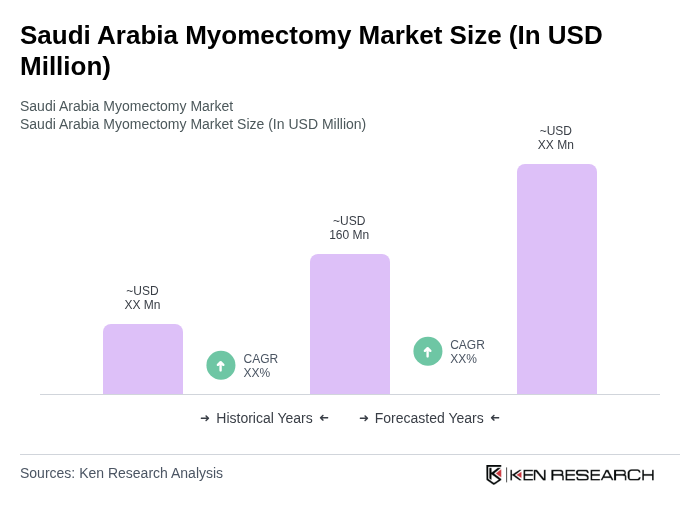
Saudi Arabia Myomectomy Market is worth USD 160 million, fueled by awareness of women's health, adoption of laparoscopic procedures, and government initiatives for gynecology services.

Region:Middle East

Author(s):Geetanshi

Product Code:KRAD5864

Pages:97

Published On:December 2025
About the Report

Base Year 2024

Saudi Arabia Myomectomy Market Overview

  • The Saudi Arabia Myomectomy Market is valued at USD 160 million, based on a five-year historical analysis and regional share benchmarks derived from the Middle East and Africa myomectomy market. This growth is primarily driven by increasing awareness of women's health issues, an expanding burden of uterine fibroids in women of reproductive age, and rapid adoption of minimally invasive and fertility-preserving surgical techniques such as laparoscopic and robotic-assisted myomectomy in leading Saudi hospitals. The market is also supported by rising investment in specialty gynecology services across public and private hospitals, the expansion of day-surgery units, and continued enhancement of surgical infrastructure under national healthcare transformation programs.
  • Key cities dominating the market include Riyadh, Jeddah, and Dammam. Riyadh, as the capital, concentrates major tertiary and quaternary referral centers and academic medical cities, which perform a high volume of complex gynecologic surgeries. Jeddah serves as a major urban and commercial hub on the western coast with strong private hospital presence and sustained demand for women’s health and fertility services, while Dammam and the broader Eastern Province benefit from a large insured population, industrial workforce, and well-developed hospital networks that contribute significantly to procedural volumes.
  • The regulatory environment for surgical care in the Kingdom is shaped by instruments such as the Private Health Institutions Law and its Implementing Regulations issued by the Ministry of Health, and the National Hospital Accreditation Standards issued by the Saudi Central Board for Accreditation of Healthcare Institutions (CBAHI), which mandate hospital-level systems for patient safety, surgical quality, infection prevention, credentialing of surgeons, and adherence to evidence-based clinical protocols for procedures including myomectomy.
Saudi Arabia Myomectomy Market Size

Saudi Arabia Myomectomy Market Segmentation

By Procedure Type:The procedure type segmentation includes various surgical methods employed for myomectomy, each catering to different patient needs and clinical scenarios. The subsegments include Abdominal (Open) Myomectomy, Laparoscopic Myomectomy, Hysteroscopic Myomectomy, Robotic-Assisted Myomectomy, and Vaginal / Combined Approaches. Laparoscopic Myomectomy is increasingly preferred as part of a broader global shift toward minimally invasive surgery, supported by evidence of reduced blood loss, shorter hospital stay, and faster return to normal activities, with global data indicating that laparoscopic approaches account for the largest single share of myomectomy procedures.
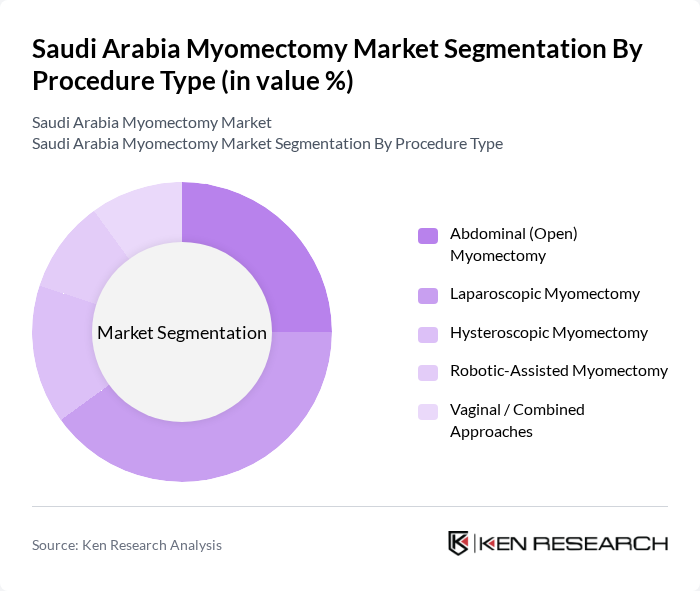
Saudi Arabia Myomectomy Market segmentation by Procedure Type.

By End-User Facility:This segmentation focuses on the types of healthcare facilities where myomectomy procedures are performed. The subsegments include Tertiary Care / Referral Hospitals, Secondary & General Hospitals, Specialized Women’s & Fertility Centers, and Ambulatory Surgical Centers / Day-Surgery Units. Tertiary Care Hospitals dominate this segment as they host advanced laparoscopic and robotic platforms, multidisciplinary gyne-oncology and reproductive medicine teams, and are typically the main referral points for complex fibroid cases, aligning with global patterns in which large hospitals account for the majority of myomectomy procedures while ambulatory and specialty centers grow in share.
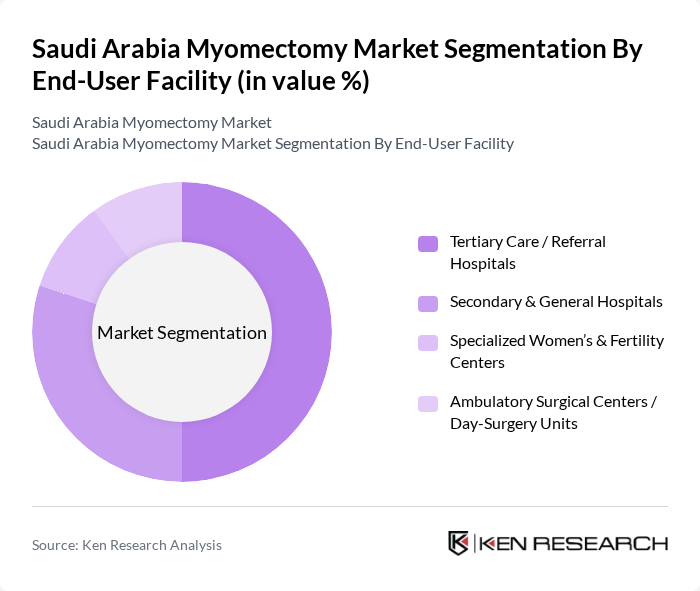
Saudi Arabia Myomectomy Market segmentation by End-User Facility.

Saudi Arabia Myomectomy Market Competitive Landscape

The Saudi Arabia Myomectomy Market is characterized by a dynamic mix of regional and international players. Leading participants such as King Faisal Specialist Hospital & Research Centre, Riyadh, King Abdulaziz Medical City (National Guard Health Affairs), Riyadh, King Saud University Medical City, Riyadh, Dr. Sulaiman Al Habib Medical Group, Saudi German Health (Saudi German Hospital, Riyadh & Jeddah), Mouwasat Medical Services Co., International Medical Center, Jeddah, Dallah Health Company (Dallah Hospital), Riyadh, Al Hammadi Hospitals Co., Al-Moosa Specialist Hospital, Al-Ahsa, King Fahd Medical City, Riyadh, Security Forces Hospital Program, Riyadh, King Abdullah Medical City, Makkah, Dr. Erfan & Bagedo General Hospital, Jeddah, Kingdom Hospital, Riyadh contribute to innovation, geographic expansion, and service delivery in this space.

King Faisal Specialist Hospital & Research Centre

1975

Riyadh

King Abdulaziz Medical City

1983

Riyadh

Dr. Sulaiman Al Habib Medical Group

1995

Riyadh

Saudi German Health

1988

Jeddah

Mouwasat Medical Services Co.

1975

Dammam

Company

Establishment Year

Headquarters

Number of Myomectomy Procedures per Year (Saudi Arabia)

Installed Base of Laparoscopic & Robotic Systems

Share of Minimally Invasive vs Open Myomectomy Cases

Average Length of Stay (Days) Post-Myomectomy

Average Procedure Cost (Public vs Private Tariffs)

Case Mix Complexity (Share of Multiple / Large Fibroid Cases)

Saudi Arabia Myomectomy Market Industry Analysis

Growth Drivers

  • Increasing Prevalence of Uterine Fibroids:The prevalence of uterine fibroids in Saudi Arabia is estimated to affect approximately 20% to 40% of women of reproductive age, translating to around 1.5 million women. This significant number drives the demand for myomectomy procedures, as many women seek treatment options to alleviate symptoms. The rising awareness of fibroid-related health issues is prompting more women to consult healthcare providers, thereby increasing the number of surgical interventions performed annually.
  • Rising Awareness about Minimally Invasive Surgical Options:There has been a notable increase in awareness regarding minimally invasive surgical techniques, such as laparoscopic myomectomy, among Saudi women. In future, it is projected that around 50% of women will prefer these less invasive options due to shorter recovery times and reduced hospital stays. This shift in patient preference is encouraging healthcare providers to adopt advanced surgical methods, further boosting the myomectomy market in the region.
  • Government Initiatives to Improve Women's Health:The Saudi government has launched several initiatives aimed at enhancing women's health services, including funding for specialized clinics and awareness campaigns. In future, the government is expected to allocate approximately SAR 1.5 billion towards women's health programs. These initiatives are designed to improve access to healthcare services, including myomectomy, thereby increasing the number of procedures performed and improving overall health outcomes for women.

Market Challenges

  • High Cost of Myomectomy Procedures:The cost of myomectomy procedures in Saudi Arabia can range from SAR 25,000 to SAR 55,000, depending on the complexity and type of surgery. This high cost poses a significant barrier for many women, particularly those without comprehensive health insurance. As a result, a substantial portion of the population may delay or forgo necessary surgical interventions, impacting overall market growth and patient health outcomes.
  • Cultural Stigmas Surrounding Surgical Interventions:Cultural perceptions regarding surgical procedures can deter women from seeking myomectomy in Saudi Arabia. Many women face societal pressure to avoid surgical interventions, leading to a reluctance to pursue necessary treatments. This cultural stigma can result in delayed diagnoses and increased complications, ultimately hindering the growth of the myomectomy market and affecting women's health negatively.

Saudi Arabia Myomectomy Market Future Outlook

The future of the myomectomy market in Saudi Arabia appears promising, driven by advancements in surgical technology and increasing patient awareness. The integration of robotic-assisted surgeries is expected to enhance precision and reduce recovery times, making procedures more appealing. Additionally, the growing trend of outpatient surgical options will likely lead to increased patient throughput, further supporting market growth. As healthcare infrastructure continues to improve, access to myomectomy procedures will expand, benefiting more women across the region.

Market Opportunities

  • Expansion of Private Healthcare Facilities:The expansion of private healthcare facilities in Saudi Arabia presents a significant opportunity for the myomectomy market. With over 300 private hospitals projected to open by future, increased access to specialized surgical services will likely enhance patient options and drive demand for myomectomy procedures, ultimately improving health outcomes for women.
  • Development of Innovative Surgical Techniques:The ongoing development of innovative surgical techniques, such as uterine artery embolization and advanced laparoscopic methods, offers substantial growth potential. These techniques are expected to provide safer, more effective treatment options for uterine fibroids, attracting more patients to seek myomectomy procedures and enhancing the overall market landscape in Saudi Arabia.

Scope of the Report

SegmentSub-Segments
By Procedure Type

Abdominal (Open) Myomectomy

Laparoscopic Myomectomy

Hysteroscopic Myomectomy

Robotic-Assisted Myomectomy

Vaginal / Combined Approaches

By End-User Facility

Tertiary Care / Referral Hospitals

Secondary & General Hospitals

Specialized Women’s & Fertility Centers

Ambulatory Surgical Centers / Day-Surgery Units

By Patient Demographics

Age Group (20–29, 30–39, 40–49, 50+ years)

Parity Status (Nulliparous, Multiparous)

Nationality (Saudi Nationals, Expatriates)

Geographic Distribution (Riyadh, Makkah, Eastern Province, Others)

By Surgical Setting & Approach

Inpatient Surgery

Day-Care / Outpatient Surgery

Emergency vs Elective Procedures

By Clinical Complexity

Single Small Fibroid (<5 cm)

Multiple / Large Fibroids (?5 cm)

Recurrent Fibroids / Previous Myomectomy

High-Risk Cases (Severe Anemia, Comorbidities)

By Reimbursement & Payer Type

Ministry of Health (Public Funding)

Other Government & Military Providers

Private Health Insurance

Self-Pay / Out-of-Pocket

By Region

Central Region

Western Region

Eastern Region

Northern & Southern Regions

Key Target Audience

Investors and Venture Capitalist Firms

Government and Regulatory Bodies (e.g., Saudi Food and Drug Authority, Ministry of Health)

Manufacturers and Producers of Surgical Instruments

Medical Device Distributors

Healthcare Providers and Hospitals

Pharmaceutical Companies

Health Insurance Companies

Industry Associations (e.g., Saudi Arabian Medical Association)

Players Mentioned in the Report:

King Faisal Specialist Hospital & Research Centre, Riyadh

King Abdulaziz Medical City (National Guard Health Affairs), Riyadh

King Saud University Medical City, Riyadh

Dr. Sulaiman Al Habib Medical Group

Saudi German Health (Saudi German Hospital, Riyadh & Jeddah)

Mouwasat Medical Services Co.

International Medical Center, Jeddah

Dallah Health Company (Dallah Hospital), Riyadh

Al Hammadi Hospitals Co.

Al-Moosa Specialist Hospital, Al-Ahsa

King Fahd Medical City, Riyadh

Security Forces Hospital Program, Riyadh

King Abdullah Medical City, Makkah

Dr. Erfan & Bagedo General Hospital, Jeddah

Kingdom Hospital, Riyadh

Table of Contents

Market Assessment Phase

1. Executive Summary and Approach


2. Saudi Arabia Myomectomy Market Overview

2.1 Key Insights and Strategic Recommendations

2.2 Saudi Arabia Myomectomy Market Overview

2.3 Definition and Scope

2.4 Evolution of Market Ecosystem

2.5 Timeline of Key Regulatory Milestones

2.6 Value Chain & Stakeholder Mapping

2.7 Business Cycle Analysis

2.8 Policy & Incentive Landscape


3. Saudi Arabia Myomectomy Market Analysis

3.1 Growth Drivers

3.1.1 Increasing prevalence of uterine fibroids
3.1.2 Rising awareness about minimally invasive surgical options
3.1.3 Government initiatives to improve women's health
3.1.4 Advancements in surgical technologies

3.2 Market Challenges

3.2.1 High cost of myomectomy procedures
3.2.2 Limited access to specialized healthcare facilities
3.2.3 Cultural stigmas surrounding surgical interventions
3.2.4 Variability in healthcare insurance coverage

3.3 Market Opportunities

3.3.1 Expansion of private healthcare facilities
3.3.2 Increasing investment in healthcare infrastructure
3.3.3 Development of innovative surgical techniques
3.3.4 Growing demand for outpatient surgical procedures

3.4 Market Trends

3.4.1 Shift towards robotic-assisted surgeries
3.4.2 Integration of telemedicine in pre and post-operative care
3.4.3 Focus on patient-centered care models
3.4.4 Rise in collaborative healthcare networks

3.5 Government Regulation

3.5.1 Licensing requirements for surgical facilities
3.5.2 Regulations on medical device approvals
3.5.3 Guidelines for surgical practices
3.5.4 Policies promoting women's health initiatives

4. SWOT Analysis


5. Stakeholder Analysis


6. Porter's Five Forces Analysis


7. Saudi Arabia Myomectomy Market Market Size, 2019-2024

7.1 By Value

7.2 By Volume

7.3 By Average Selling Price


8. Saudi Arabia Myomectomy Market Segmentation

8.1 By Procedure Type

8.1.1 Abdominal (Open) Myomectomy
8.1.2 Laparoscopic Myomectomy
8.1.3 Hysteroscopic Myomectomy
8.1.4 Robotic-Assisted Myomectomy
8.1.5 Vaginal / Combined Approaches

8.2 By End-User Facility

8.2.1 Tertiary Care / Referral Hospitals
8.2.2 Secondary & General Hospitals
8.2.3 Specialized Women’s & Fertility Centers
8.2.4 Ambulatory Surgical Centers / Day-Surgery Units

8.3 By Patient Demographics

8.3.1 Age Group (20–29, 30–39, 40–49, 50+ years)
8.3.2 Parity Status (Nulliparous, Multiparous)
8.3.3 Nationality (Saudi Nationals, Expatriates)
8.3.4 Geographic Distribution (Riyadh, Makkah, Eastern Province, Others)

8.4 By Surgical Setting & Approach

8.4.1 Inpatient Surgery
8.4.2 Day-Care / Outpatient Surgery
8.4.3 Emergency vs Elective Procedures

8.5 By Clinical Complexity

8.5.1 Single Small Fibroid (<5 cm)
8.5.2 Multiple / Large Fibroids (?5 cm)
8.5.3 Recurrent Fibroids / Previous Myomectomy
8.5.4 High-Risk Cases (Severe Anemia, Comorbidities)

8.6 By Reimbursement & Payer Type

8.6.1 Ministry of Health (Public Funding)
8.6.2 Other Government & Military Providers
8.6.3 Private Health Insurance
8.6.4 Self-Pay / Out-of-Pocket

8.7 By Region

8.7.1 Central Region
8.7.2 Western Region
8.7.3 Eastern Region
8.7.4 Northern & Southern Regions

9. Saudi Arabia Myomectomy Market Competitive Analysis

9.1 Market Share of Key Players

9.2 Cross Comparison of Key Players

9.2.1 Company Name
9.2.2 Number of Myomectomy Procedures per Year (Saudi Arabia)
9.2.3 Installed Base of Laparoscopic & Robotic Systems
9.2.4 Share of Minimally Invasive vs Open Myomectomy Cases
9.2.5 Average Length of Stay (Days) Post-Myomectomy
9.2.6 Average Procedure Cost (Public vs Private Tariffs)
9.2.7 Case Mix Complexity (Share of Multiple / Large Fibroid Cases)
9.2.8 Conversion Rate to Hysterectomy
9.2.9 30-Day Readmission / Re-intervention Rate
9.2.10 Patient-Reported Outcome & Satisfaction Scores

9.3 SWOT Analysis of Top Players

9.4 Pricing Analysis

9.5 Detailed Profile of Major Companies

9.5.1 King Faisal Specialist Hospital & Research Centre, Riyadh
9.5.2 King Abdulaziz Medical City (National Guard Health Affairs), Riyadh
9.5.3 King Saud University Medical City, Riyadh
9.5.4 Dr. Sulaiman Al Habib Medical Group
9.5.5 Saudi German Health (Saudi German Hospital, Riyadh & Jeddah)
9.5.6 Mouwasat Medical Services Co.
9.5.7 International Medical Center, Jeddah
9.5.8 Dallah Health Company (Dallah Hospital), Riyadh
9.5.9 Al Hammadi Hospitals Co.
9.5.10 Al-Moosa Specialist Hospital, Al-Ahsa
9.5.11 King Fahd Medical City, Riyadh
9.5.12 Security Forces Hospital Program, Riyadh
9.5.13 King Abdullah Medical City, Makkah
9.5.14 Dr. Erfan & Bagedo General Hospital, Jeddah
9.5.15 Kingdom Hospital, Riyadh

10. Saudi Arabia Myomectomy Market End-User Analysis

10.1 Procurement Behavior of Key Ministries

10.1.1 Ministry of Health
10.1.2 Ministry of Education
10.1.3 Ministry of Finance
10.1.4 Others

10.2 Corporate Spend on Infrastructure & Energy

10.2.1 Healthcare Infrastructure Investments
10.2.2 Energy Efficiency Initiatives
10.2.3 Technology Upgrades
10.2.4 Others

10.3 Pain Point Analysis by End-User Category

10.3.1 Hospitals
10.3.2 Clinics
10.3.3 Patients
10.3.4 Others

10.4 User Readiness for Adoption

10.4.1 Awareness Levels
10.4.2 Training Needs
10.4.3 Financial Readiness
10.4.4 Others

10.5 Post-Deployment ROI and Use Case Expansion

10.5.1 Cost Savings
10.5.2 Patient Outcomes
10.5.3 Service Expansion Opportunities
10.5.4 Others

11. Saudi Arabia Myomectomy Market Future Size, 2025-2030

11.1 By Value

11.2 By Volume

11.3 By Average Selling Price


Go-To-Market Strategy Phase

1. Whitespace Analysis + Business Model Canvas

1.1 Market Gaps Identification

1.2 Business Model Development


2. Marketing and Positioning Recommendations

2.1 Branding Strategies

2.2 Product USPs


3. Distribution Plan

3.1 Urban Retail vs Rural NGO Tie-ups


4. Channel & Pricing Gaps

4.1 Underserved Routes

4.2 Pricing Bands


5. Unmet Demand & Latent Needs

5.1 Category Gaps

5.2 Consumer Segments


6. Customer Relationship

6.1 Loyalty Programs

6.2 After-sales Service


7. Value Proposition

7.1 Sustainability

7.2 Integrated Supply Chains


8. Key Activities

8.1 Regulatory Compliance

8.2 Branding

8.3 Distribution Setup


9. Entry Strategy Evaluation

9.1 Domestic Market Entry Strategy

9.1.1 Product Mix
9.1.2 Pricing Band
9.1.3 Packaging

9.2 Export Entry Strategy

9.2.1 Target Countries
9.2.2 Compliance Roadmap

10. Entry Mode Assessment

10.1 JV

10.2 Greenfield

10.3 M&A

10.4 Distributor Model


11. Capital and Timeline Estimation

11.1 Capital Requirements

11.2 Timelines


12. Control vs Risk Trade-Off

12.1 Ownership vs Partnerships


13. Profitability Outlook

13.1 Breakeven Analysis

13.2 Long-term Sustainability


14. Potential Partner List

14.1 Distributors

14.2 JVs

14.3 Acquisition Targets


15. Execution Roadmap

15.1 Phased Plan for Market Entry

15.1.1 Market Setup
15.1.2 Market Entry
15.1.3 Growth Acceleration
15.1.4 Scale & Stabilize

15.2 Key Activities and Milestones

15.2.1 Activity Planning
15.2.2 Milestone Tracking

Research Methodology

ApproachModellingSample

Phase 1: Approach1

Desk Research

  • Analysis of healthcare expenditure reports from the Saudi Ministry of Health
  • Review of published studies and articles on myomectomy procedures in regional medical journals
  • Examination of demographic and epidemiological data related to uterine fibroids in Saudi Arabia

Primary Research

  • Interviews with gynecologists and surgeons specializing in myomectomy
  • Surveys conducted with hospital administrators regarding surgical volume and patient demographics
  • Focus groups with patients who have undergone myomectomy to understand their experiences and outcomes

Validation & Triangulation

  • Cross-validation of findings with data from health insurance providers and patient registries
  • Triangulation of insights from primary interviews with secondary data sources
  • Sanity checks through expert panel discussions with healthcare professionals

Phase 2: Market Size Estimation1

Top-down Assessment

  • Estimation of the total number of myomectomy procedures performed annually in Saudi Arabia
  • Analysis of healthcare spending trends specific to surgical interventions
  • Incorporation of government health initiatives aimed at women's health and surgical care

Bottom-up Modeling

  • Collection of data on average costs associated with myomectomy procedures from hospitals
  • Estimation of market size based on procedure volume and average treatment costs
  • Analysis of patient demographics to project future demand for myomectomy services

Forecasting & Scenario Analysis

  • Multi-factor regression analysis considering factors such as population growth and healthcare access
  • Scenario modeling based on potential changes in healthcare policies and insurance coverage
  • Development of baseline, optimistic, and pessimistic market forecasts through 2030

Phase 3: CATI Sample Composition1

Scope Item/SegmentSample SizeTarget Respondent Profiles
Gynecological Surgeons60Consultant Gynecologists, Surgical Specialists
Hospital Administrators50Healthcare Facility Managers, Operations Directors
Patients Post-Myomectomy75Women who have undergone myomectomy in the last 2 years
Health Insurance Providers40Policy Analysts, Claims Managers
Healthcare Policy Experts40Health Economists, Policy Advisors

Frequently Asked Questions

What is the current value of the Saudi Arabia Myomectomy Market?

The Saudi Arabia Myomectomy Market is valued at approximately USD 160 million, reflecting a significant demand for myomectomy procedures driven by increasing awareness of women's health issues and the prevalence of uterine fibroids among women of reproductive age.

What factors are driving the growth of the Myomectomy Market in Saudi Arabia?

Which cities are the primary markets for myomectomy procedures in Saudi Arabia?

What types of myomectomy procedures are available in Saudi Arabia?

Other Regional/Country Reports

Indonesia Myomectomy Market Size, Share, Growth Drivers, Trends, Opportunities & Forecast 2025–2030

Malaysia Myomectomy Market Size, Share, Growth Drivers, Trends, Opportunities & Forecast 2025–2030

KSA Myomectomy Market Size, Share, Growth Drivers, Trends, Opportunities & Forecast 2025–2030

APAC Myomectomy Market Size, Share, Growth Drivers, Trends, Opportunities & Forecast 2025–2030

SEA Myomectomy Market Size, Share, Growth Drivers, Trends, Opportunities & Forecast 2025–2030

Vietnam Myomectomy Market Size, Share, Growth Drivers, Trends, Opportunities & Forecast 2025–2030

Other Adjacent Reports

Japan Uterine Fibroids Treatment Market

Brazil Hysterectomy Market

South Korea Gynecological Devices Market

Singapore Minimally Invasive Surgery Market

UAE Robotic-Assisted Surgery Market

Germany Womens Health Services Market

South Korea Fertility Treatment Market

Brazil Laparoscopic Instruments Market

Malaysia Ambulatory Surgical Centers Market

Belgium Healthcare Infrastructure Market

Why Buy From Us?

Refine Robust Result (RRR) Framework

What makes us stand out is that our consultants follow Robust, Refine and Result (RRR) methodology. Robust for clear definitions, approaches and sanity checking, Refine for differentiating respondents' facts and opinions, and Result for presenting data with story.

Our Reach Is Unmatched

We have set a benchmark in the industry by offering our clients with syndicated and customized market research reports featuring coverage of entire market as well as meticulous research and analyst insights.

Shifting the Research Paradigm

While we don't replace traditional research, we flip the method upside down. Our dual approach of Top Bottom & Bottom Top ensures quality deliverable by not just verifying company fundamentals but also looking at the sector and macroeconomic factors.

More Insights-Better Decisions

With one step in the future, our research team constantly tries to show you the bigger picture. We help with some of the tough questions you may encounter along the way: How is the industry positioned? Best marketing channel? KPI's of competitors? By aligning every element, we help maximize success.

Transparency and Trust

Our report gives you instant access to the answers and sources that other companies might choose to hide. We elaborate each steps of research methodology we have used and showcase you the sample size to earn your trust.

Round the Clock Support

If you need any support, we are here! We pride ourselves on universe strength, data quality, and quick, friendly, and professional service.

Why Clients Choose Us?

400000+
Reports in repository
150+
Consulting projects a year
100+
Analysts
8000+
Client Queries in 2022








