Region:Middle East
Author(s):Rebecca
Product Code:KRAA9258
Pages:80
Published On:November 2025
 Market.png "Saudi Arabia Near Field Communication (NFC) Market Size")
By Type:
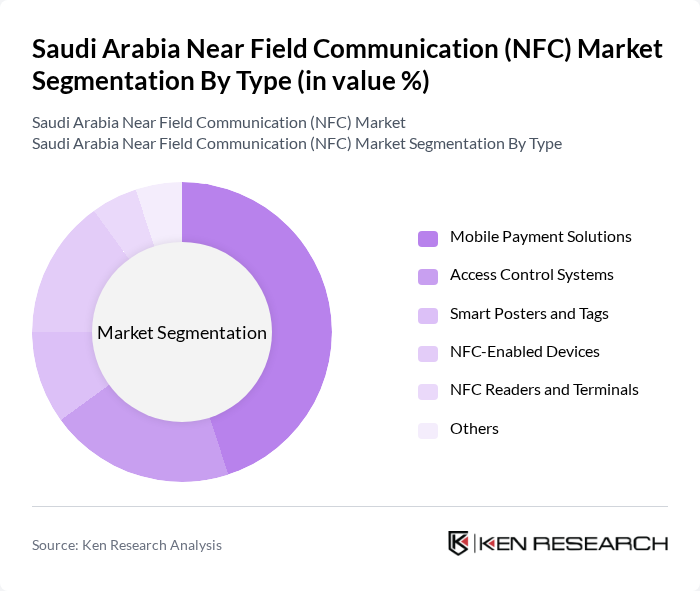
The NFC market can be segmented into various types, including Mobile Payment Solutions, Access Control Systems, Smart Posters and Tags, NFC-Enabled Devices, NFC Readers and Terminals, and Others. Among these, Mobile Payment Solutions are leading the market due to the increasing consumer preference for contactless payments and the proliferation of smartphones equipped with NFC technology. The convenience and speed of mobile payments have significantly influenced consumer behavior, making this sub-segment the most dominant in the NFC landscape. The growth of mobile wallets, integration with e-government services, and expansion of NFC-enabled POS terminals further reinforce the segment’s leadership.
By End-User:
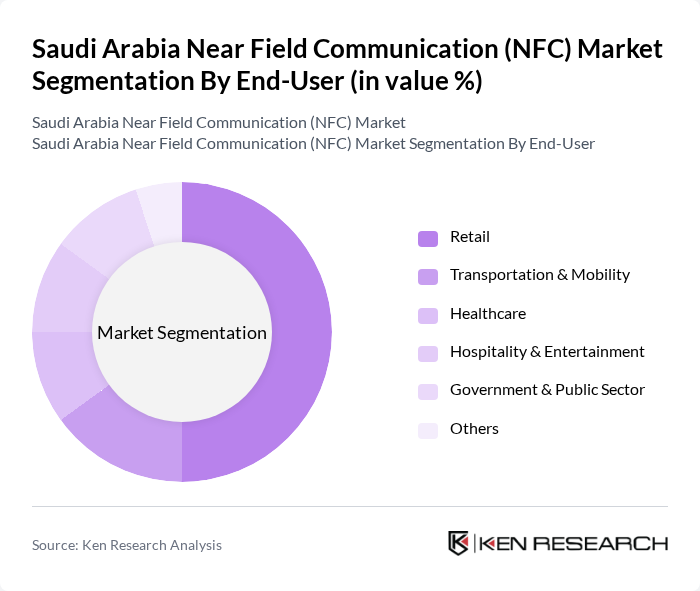
The NFC market is also segmented by end-users, including Retail, Transportation & Mobility, Healthcare, Hospitality & Entertainment, Government & Public Sector, and Others. The Retail sector is the most significant contributor to the NFC market, driven by the rapid adoption of contactless payment systems and the growing trend of digital wallets among consumers. Retailers are increasingly integrating NFC technology to enhance customer experience and streamline payment processes, solidifying its position as the leading end-user segment. The Transportation & Mobility segment is expanding due to NFC-enabled ticketing and fare collection systems, while Healthcare is leveraging NFC for patient identification and secure access.
The Saudi Arabia Near Field Communication (NFC) Market is characterized by a dynamic mix of regional and international players. Leading participants such as STC Pay, Geidea, Visa Inc., Mastercard, Saudi Payments (mada), Apple Inc., Google LLC, Samsung Electronics, Huawei Technologies, NXP Semiconductors, Infineon Technologies, Thales Group (Gemalto), Ingenico Group (Worldline), Verifone Systems, Al Rajhi Bank contribute to innovation, geographic expansion, and service delivery in this space.
The future of the NFC market in Saudi Arabia appears promising, driven by technological advancements and increasing consumer acceptance. As smartphone penetration continues to rise, coupled with government support for digital payment initiatives, the market is poised for significant growth. The integration of NFC technology into various sectors, including retail and transportation, will enhance user experiences. Additionally, the shift towards cashless transactions will further solidify NFC's role in the evolving digital economy, creating a more connected and efficient payment landscape.
| Segment | Sub-Segments |
|---|---|
| By Type | Mobile Payment Solutions Access Control Systems Smart Posters and Tags NFC-Enabled Devices NFC Readers and Terminals Others |
| By End-User | Retail Transportation & Mobility Healthcare Hospitality & Entertainment Government & Public Sector Others |
| By Application | Payment Processing Data Transfer & Sharing Ticketing & Transit Solutions Marketing, Promotions & Loyalty Identification & Authentication Others |
| By Industry Vertical | Banking and Financial Services Retail and E-commerce Transportation and Logistics Healthcare Government Others |
| By Region | Central Region Eastern Region Western Region Southern Region |
| By Technology | NFC Forum Standards Host Card Emulation (HCE) Secure Element (SE)-Based NFC NFC-Enabled Mobile Devices NFC Readers and Terminals Others |
| By Deployment Mode | On-Premises Cloud-Based Hybrid Others |
| Scope Item/Segment | Sample Size | Target Respondent Profiles |
|---|---|---|
| Retail Sector NFC Adoption | 100 | Store Managers, IT Directors |
| Transportation NFC Applications | 80 | Transport Operators, Fleet Managers |
| Healthcare NFC Solutions | 60 | Healthcare Administrators, IT Managers |
| Consumer Attitudes towards NFC | 120 | General Consumers, Tech-savvy Users |
| Financial Institutions' NFC Strategies | 50 | Banking Executives, Payment Solution Managers |
The Saudi Arabia Near Field Communication (NFC) Market is valued at approximately USD 1.15 billion, driven by the increasing adoption of mobile payment solutions and the growing trend of contactless transactions across various sectors.

What makes us stand out is that our consultants follow Robust, Refine and Result (RRR) methodology. Robust for clear definitions, approaches and sanity checking, Refine for differentiating respondents' facts and opinions, and Result for presenting data with story.

We have set a benchmark in the industry by offering our clients with syndicated and customized market research reports featuring coverage of entire market as well as meticulous research and analyst insights.

While we don't replace traditional research, we flip the method upside down. Our dual approach of Top Bottom & Bottom Top ensures quality deliverable by not just verifying company fundamentals but also looking at the sector and macroeconomic factors.

With one step in the future, our research team constantly tries to show you the bigger picture. We help with some of the tough questions you may encounter along the way: How is the industry positioned? Best marketing channel? KPI's of competitors? By aligning every element, we help maximize success.

Our report gives you instant access to the answers and sources that other companies might choose to hide. We elaborate each steps of research methodology we have used and showcase you the sample size to earn your trust.

If you need any support, we are here! We pride ourselves on universe strength, data quality, and quick, friendly, and professional service.













