Saudi Arabia Online Kids Educational Toys Retail Market Size, Share, Growth Drivers, Trends, Opportunities & Forecast 2025–2030

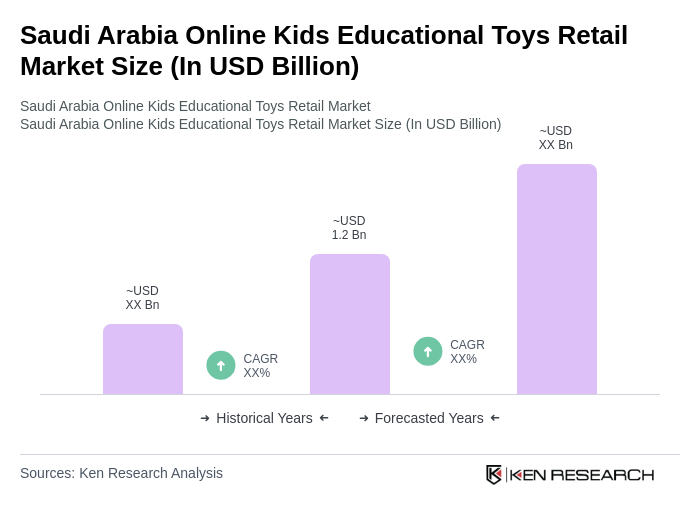
The Saudi Arabia online kids educational toys retail market, valued at USD 1.2 billion, is growing due to e-commerce adoption and demand for interactive learning products.

Region:Middle East

Author(s):Rebecca

Product Code:KRAB7530

Pages:90

Published On:October 2025
About the Report

Base Year 2024

Saudi Arabia Online Kids Educational Toys Retail Market Overview

  • The Saudi Arabia Online Kids Educational Toys Retail Market is valued at USD 1.2 billion, based on a five-year historical analysis. This growth is primarily driven by the increasing adoption of e-commerce platforms, a growing emphasis on educational development among parents, and the rising disposable income of households. The market has seen a significant shift towards online purchasing, especially during the pandemic, which has accelerated digital transformation in retail.
  • Key cities such as Riyadh, Jeddah, and Dammam dominate the market due to their high population density, urbanization, and concentration of affluent families. These cities have a robust infrastructure for e-commerce, with many online platforms catering specifically to educational toys, making them the focal points for market growth and consumer engagement.
  • In 2023, the Saudi government implemented regulations to enhance the safety standards of children's toys, mandating compliance with international safety norms. This regulation aims to protect children from potential hazards associated with low-quality toys and to promote the sale of safe, educational products in the online retail space.
Saudi Arabia Online Kids Educational Toys Retail Market Size

Saudi Arabia Online Kids Educational Toys Retail Market Segmentation

By Type:The market is segmented into various types of educational toys, including Educational Board Games, Interactive Learning Toys, STEM Kits, Arts and Crafts Supplies, Puzzles, Electronic Learning Devices, and Others. Each of these segments caters to different learning styles and preferences among children, influencing purchasing decisions.
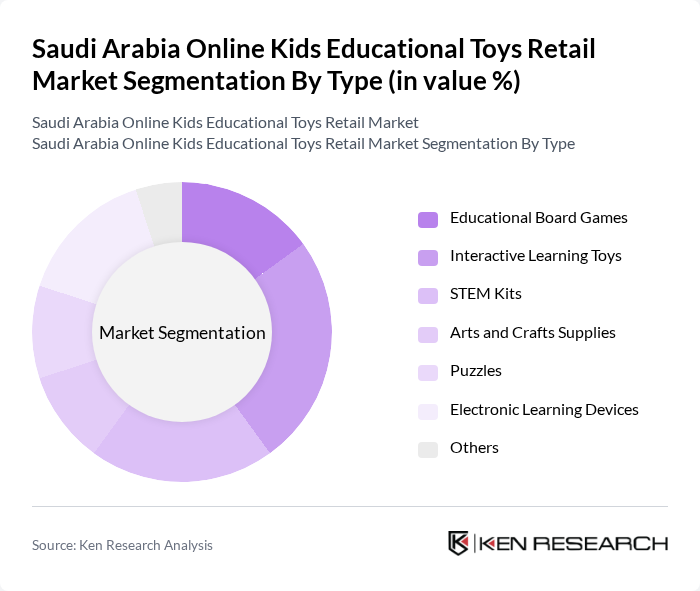
Saudi Arabia Online Kids Educational Toys Retail Market segmentation by Type.

The Interactive Learning Toys segment is currently dominating the market due to the increasing demand for engaging and educational products that promote active learning. Parents are increasingly seeking toys that not only entertain but also enhance cognitive skills and creativity. This trend is further supported by the rise of technology-driven educational tools that integrate play with learning, making them highly appealing to both children and parents. The segment's growth is also fueled by the popularity of brands that offer innovative and interactive solutions.

By Age Group:The market is segmented by age groups, including Infants (0-2 years), Toddlers (3-5 years), Early School Age (6-8 years), and Pre-teens (9-12 years). Each age group has distinct developmental needs and preferences, influencing the types of educational toys that are popular among consumers.
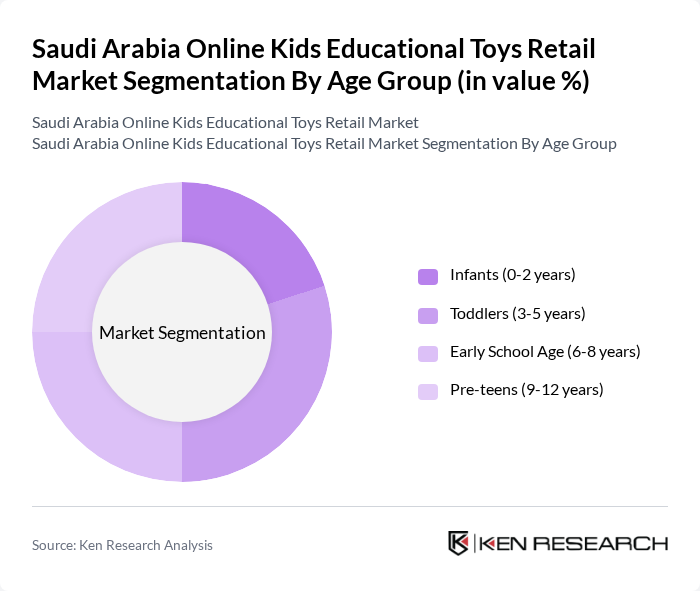
Saudi Arabia Online Kids Educational Toys Retail Market segmentation by Age Group.

The Toddlers (3-5 years) segment is leading the market, driven by the increasing focus on early childhood education and the importance of play in learning. Parents are more inclined to invest in toys that support developmental milestones during this critical age, such as language acquisition, motor skills, and social interaction. The availability of a wide range of products tailored to this age group, including interactive and sensory toys, further enhances its appeal, making it a significant contributor to market growth.

Saudi Arabia Online Kids Educational Toys Retail Market Competitive Landscape

The Saudi Arabia Online Kids Educational Toys Retail Market is characterized by a dynamic mix of regional and international players. Leading participants such as LEGO Group, Mattel, Inc., Hasbro, Inc., VTech Holdings Limited, LeapFrog Enterprises, Inc., Melissa & Doug, LLC, Ravensburger AG, Hape International AG, Galt Toys Limited, Educational Insights, Inc., K'NEX Brands, L.P., Playmobil GmbH, Green Toys Inc., Fat Brain Toys, B. toys contribute to innovation, geographic expansion, and service delivery in this space.

LEGO Group

1932

Billund, Denmark

Mattel, Inc.

1945

El Segundo, California, USA

Hasbro, Inc.

1923

Pawtucket, Rhode Island, USA

VTech Holdings Limited

1976

Hong Kong

LeapFrog Enterprises, Inc.

1995

Emeryville, California, USA

Company

Establishment Year

Headquarters

Group Size (Large, Medium, or Small as per industry convention)

Revenue Growth Rate

Customer Acquisition Cost

Customer Retention Rate

Average Order Value

Market Penetration Rate

Saudi Arabia Online Kids Educational Toys Retail Market Industry Analysis

Growth Drivers

  • Increasing Digital Engagement Among Children:The digital engagement of children in Saudi Arabia has surged, with over 90% of children aged 6-12 using the internet regularly. According to the Communications and Information Technology Commission (CITC), the number of internet users in this age group reached approximately 4 million in the future. This trend drives demand for online educational toys, as parents seek interactive and engaging products that align with their children's digital habits, fostering a conducive learning environment.
  • Rising Parental Awareness of Educational Benefits:A significant increase in parental awareness regarding the educational benefits of toys has been observed, with 80% of parents prioritizing educational value when purchasing toys. The Ministry of Education's initiatives to promote early childhood education have further fueled this trend, leading to a projected increase in spending on educational toys, which is expected to reach SAR 1.5 billion by the end of the future, reflecting a growing commitment to children's learning.
  • Expansion of E-commerce Platforms:The e-commerce sector in Saudi Arabia is projected to grow to SAR 60 billion by the future, driven by increased internet penetration and mobile device usage. Major platforms like Souq.com and Noon.com have expanded their offerings to include educational toys, making them more accessible to consumers. This growth in e-commerce not only enhances convenience for parents but also provides a wider variety of educational toys, catering to diverse learning needs and preferences.

Market Challenges

  • Intense Competition Among Retailers:The online kids' educational toys market in Saudi Arabia faces intense competition, with over 250 retailers vying for market share. This saturation leads to aggressive pricing strategies, which can erode profit margins. According to industry reports, the top five players account for only 25% of the market, indicating a fragmented landscape where smaller retailers struggle to differentiate themselves and maintain sustainable operations.
  • Price Sensitivity Among Consumers:Price sensitivity remains a significant challenge, particularly among middle-income families. With an average household income of SAR 15,000 per month, many parents are cautious about spending on non-essential items. A recent survey indicated that 70% of parents consider price as the primary factor when purchasing educational toys, which can limit the market potential for premium products and innovative offerings that may not align with budget constraints.

Saudi Arabia Online Kids Educational Toys Retail Market Future Outlook

The future of the online kids' educational toys market in Saudi Arabia appears promising, driven by technological advancements and evolving consumer preferences. As digital learning tools become more integrated into educational curricula, demand for innovative toys that support STEM learning is expected to rise. Additionally, the increasing focus on eco-friendly products will likely shape purchasing decisions, encouraging manufacturers to develop sustainable options that appeal to environmentally conscious parents, thus expanding market reach and enhancing brand loyalty.

Market Opportunities

  • Growth of Subscription-Based Models:Subscription-based models for educational toys are gaining traction, with companies like KiwiCo reporting a 35% increase in subscriptions in the future. This model offers parents a convenient way to access a variety of educational toys, fostering continuous learning and engagement. The potential for recurring revenue streams makes this an attractive opportunity for retailers looking to enhance customer loyalty and retention.
  • Increasing Demand for Eco-Friendly Toys:The demand for eco-friendly educational toys is on the rise, with a reported 45% of parents willing to pay a premium for sustainable products. This trend aligns with global sustainability initiatives and reflects a growing awareness of environmental issues. Retailers that prioritize eco-friendly materials and practices can tap into this market segment, appealing to conscientious consumers and differentiating themselves from competitors.

Scope of the Report

SegmentSub-Segments
By Type

Educational Board Games

Interactive Learning Toys

STEM Kits

Arts and Crafts Supplies

Puzzles

Electronic Learning Devices

Others

By Age Group

Infants (0-2 years)

Toddlers (3-5 years)

Early School Age (6-8 years)

Pre-teens (9-12 years)

By Sales Channel

E-commerce Websites

Social Media Platforms

Mobile Applications

Direct-to-Consumer Sales

By Brand Type

Established Brands

Emerging Brands

Private Labels

By Price Range

Budget-Friendly Toys

Mid-Range Toys

Premium Toys

By Distribution Mode

Home Delivery

Click and Collect

Subscription Services

By Educational Focus

Language Development

Cognitive Skills

Social Skills

Physical Development

Key Target Audience

Investors and Venture Capitalist Firms

Government and Regulatory Bodies (e.g., Saudi Arabian Standards Organization, Ministry of Commerce)

Manufacturers and Producers

Distributors and Retailers

Online Marketplaces and E-commerce Platforms

Logistics and Supply Chain Companies

Industry Associations (e.g., Saudi Toy Association)

Financial Institutions

Players Mentioned in the Report:

LEGO Group

Mattel, Inc.

Hasbro, Inc.

VTech Holdings Limited

LeapFrog Enterprises, Inc.

Melissa & Doug, LLC

Ravensburger AG

Hape International AG

Galt Toys Limited

Educational Insights, Inc.

K'NEX Brands, L.P.

Playmobil GmbH

Green Toys Inc.

Fat Brain Toys

B. toys

Table of Contents

Market Assessment Phase

1. Executive Summary and Approach


2. Saudi Arabia Online Kids Educational Toys Retail Market Overview

2.1 Key Insights and Strategic Recommendations

2.2 Saudi Arabia Online Kids Educational Toys Retail Market Overview

2.3 Definition and Scope

2.4 Evolution of Market Ecosystem

2.5 Timeline of Key Regulatory Milestones

2.6 Value Chain & Stakeholder Mapping

2.7 Business Cycle Analysis

2.8 Policy & Incentive Landscape


3. Saudi Arabia Online Kids Educational Toys Retail Market Analysis

3.1 Growth Drivers

3.1.1 Increasing Digital Engagement Among Children
3.1.2 Rising Parental Awareness of Educational Benefits
3.1.3 Expansion of E-commerce Platforms
3.1.4 Government Initiatives Promoting Education

3.2 Market Challenges

3.2.1 Intense Competition Among Retailers
3.2.2 Price Sensitivity Among Consumers
3.2.3 Regulatory Compliance Issues
3.2.4 Supply Chain Disruptions

3.3 Market Opportunities

3.3.1 Growth of Subscription-Based Models
3.3.2 Increasing Demand for Eco-Friendly Toys
3.3.3 Technological Advancements in Educational Toys
3.3.4 Expansion into Rural Markets

3.4 Market Trends

3.4.1 Rise of Interactive and Augmented Reality Toys
3.4.2 Customization and Personalization of Products
3.4.3 Integration of STEM Learning in Toys
3.4.4 Growth of Online Reviews and Influencer Marketing

3.5 Government Regulation

3.5.1 Safety Standards for Educational Toys
3.5.2 Import Regulations and Tariffs
3.5.3 Consumer Protection Laws
3.5.4 Tax Incentives for Educational Products

4. SWOT Analysis


5. Stakeholder Analysis


6. Porter's Five Forces Analysis


7. Saudi Arabia Online Kids Educational Toys Retail Market Market Size, 2019-2024

7.1 By Value

7.2 By Volume

7.3 By Average Selling Price


8. Saudi Arabia Online Kids Educational Toys Retail Market Segmentation

8.1 By Type

8.1.1 Educational Board Games
8.1.2 Interactive Learning Toys
8.1.3 STEM Kits
8.1.4 Arts and Crafts Supplies
8.1.5 Puzzles
8.1.6 Electronic Learning Devices
8.1.7 Others

8.2 By Age Group

8.2.1 Infants (0-2 years)
8.2.2 Toddlers (3-5 years)
8.2.3 Early School Age (6-8 years)
8.2.4 Pre-teens (9-12 years)

8.3 By Sales Channel

8.3.1 E-commerce Websites
8.3.2 Social Media Platforms
8.3.3 Mobile Applications
8.3.4 Direct-to-Consumer Sales

8.4 By Brand Type

8.4.1 Established Brands
8.4.2 Emerging Brands
8.4.3 Private Labels

8.5 By Price Range

8.5.1 Budget-Friendly Toys
8.5.2 Mid-Range Toys
8.5.3 Premium Toys

8.6 By Distribution Mode

8.6.1 Home Delivery
8.6.2 Click and Collect
8.6.3 Subscription Services

8.7 By Educational Focus

8.7.1 Language Development
8.7.2 Cognitive Skills
8.7.3 Social Skills
8.7.4 Physical Development

9. Saudi Arabia Online Kids Educational Toys Retail Market Competitive Analysis

9.1 Market Share of Key Players

9.2 Cross Comparison of Key Players

9.2.1 Company Name
9.2.2 Group Size (Large, Medium, or Small as per industry convention)
9.2.3 Revenue Growth Rate
9.2.4 Customer Acquisition Cost
9.2.5 Customer Retention Rate
9.2.6 Average Order Value
9.2.7 Market Penetration Rate
9.2.8 Pricing Strategy
9.2.9 Product Return Rate
9.2.10 Brand Loyalty Index

9.3 SWOT Analysis of Top Players

9.4 Pricing Analysis

9.5 Detailed Profile of Major Companies

9.5.1 LEGO Group
9.5.2 Mattel, Inc.
9.5.3 Hasbro, Inc.
9.5.4 VTech Holdings Limited
9.5.5 LeapFrog Enterprises, Inc.
9.5.6 Melissa & Doug, LLC
9.5.7 Ravensburger AG
9.5.8 Hape International AG
9.5.9 Galt Toys Limited
9.5.10 Educational Insights, Inc.
9.5.11 K'NEX Brands, L.P.
9.5.12 Playmobil GmbH
9.5.13 Green Toys Inc.
9.5.14 Fat Brain Toys
9.5.15 B. toys

10. Saudi Arabia Online Kids Educational Toys Retail Market End-User Analysis

10.1 Procurement Behavior of Key Ministries

10.1.1 Ministry of Education
10.1.2 Ministry of Commerce
10.1.3 Ministry of Health

10.2 Corporate Spend on Infrastructure & Energy

10.2.1 Corporate Educational Initiatives
10.2.2 Investment in Child Development Programs

10.3 Pain Point Analysis by End-User Category

10.3.1 Parents
10.3.2 Schools
10.3.3 Educational Institutions

10.4 User Readiness for Adoption

10.4.1 Awareness of Educational Toys
10.4.2 Accessibility of Online Platforms

10.5 Post-Deployment ROI and Use Case Expansion

10.5.1 Evaluation of Educational Outcomes
10.5.2 Feedback Mechanisms for Improvement

11. Saudi Arabia Online Kids Educational Toys Retail Market Future Size, 2025-2030

11.1 By Value

11.2 By Volume

11.3 By Average Selling Price


Go-To-Market Strategy Phase

1. Whitespace Analysis + Business Model Canvas

1.1 Market Gaps Identification

1.2 Business Model Framework


2. Marketing and Positioning Recommendations

2.1 Branding Strategies

2.2 Product USPs


3. Distribution Plan

3.1 Urban Retail Strategies

3.2 Rural NGO Tie-ups


4. Channel & Pricing Gaps

4.1 Underserved Routes

4.2 Pricing Bands


5. Unmet Demand & Latent Needs

5.1 Category Gaps

5.2 Consumer Segments


6. Customer Relationship

6.1 Loyalty Programs

6.2 After-sales Service


7. Value Proposition

7.1 Sustainability Initiatives

7.2 Integrated Supply Chains


8. Key Activities

8.1 Regulatory Compliance

8.2 Branding Efforts

8.3 Distribution Setup


9. Entry Strategy Evaluation

9.1 Domestic Market Entry Strategy

9.1.1 Product Mix
9.1.2 Pricing Band
9.1.3 Packaging

9.2 Export Entry Strategy

9.2.1 Target Countries
9.2.2 Compliance Roadmap

10. Entry Mode Assessment

10.1 Joint Ventures

10.2 Greenfield Investments

10.3 Mergers & Acquisitions

10.4 Distributor Model


11. Capital and Timeline Estimation

11.1 Capital Requirements

11.2 Timelines


12. Control vs Risk Trade-Off

12.1 Ownership vs Partnerships


13. Profitability Outlook

13.1 Breakeven Analysis

13.2 Long-term Sustainability


14. Potential Partner List

14.1 Distributors

14.2 Joint Ventures

14.3 Acquisition Targets


15. Execution Roadmap

15.1 Phased Plan for Market Entry

15.1.1 Market Setup
15.1.2 Market Entry
15.1.3 Growth Acceleration
15.1.4 Scale & Stabilize

15.2 Key Activities and Milestones

15.2.1 Activity Timeline
15.2.2 Milestone Tracking

Research Methodology

ApproachModellingSample

Phase 1: Approach1

Desk Research

  • Analysis of market reports from educational toy associations in Saudi Arabia
  • Review of online sales data from e-commerce platforms specializing in children's products
  • Examination of demographic and economic reports from Saudi government publications

Primary Research

  • Interviews with educational toy manufacturers and distributors in the region
  • Surveys conducted with parents regarding purchasing behavior and preferences
  • Focus groups with educators to understand the impact of toys on learning outcomes

Validation & Triangulation

  • Cross-validation of findings through multiple data sources including sales and demographic trends
  • Triangulation of insights from primary interviews with secondary research findings
  • Sanity checks through expert reviews from industry analysts and educational consultants

Phase 2: Market Size Estimation1

Top-down Assessment

  • Estimation of total market size based on national retail sales data for children's products
  • Segmentation of the market by product type, including educational toys, games, and kits
  • Incorporation of growth rates from related sectors such as e-learning and digital toys

Bottom-up Modeling

  • Collection of sales data from leading online retailers in the educational toy segment
  • Estimation of average transaction values and purchase frequency among consumers
  • Analysis of consumer spending patterns on educational toys across different age groups

Forecasting & Scenario Analysis

  • Development of forecasts based on historical growth rates and market trends
  • Scenario analysis considering factors such as economic conditions and consumer preferences
  • Projections for market growth through 2030 under various economic scenarios

Phase 3: CATI Sample Composition1

Scope Item/SegmentSample SizeTarget Respondent Profiles
Parents of Children Aged 3-6150Parents, Guardians
Educators in Early Childhood Education100Teachers, School Administrators
Retailers of Educational Toys80Store Managers, Buyers
Manufacturers of Educational Toys70Product Development Managers, Sales Directors
Online E-commerce Platforms90eCommerce Managers, Marketing Directors

Frequently Asked Questions

What is the current value of the Saudi Arabia Online Kids Educational Toys Retail Market?

The Saudi Arabia Online Kids Educational Toys Retail Market is valued at approximately USD 1.2 billion, reflecting significant growth driven by increased e-commerce adoption and a focus on educational development among parents.

Which cities are the main hubs for the online kids educational toys market in Saudi Arabia?

What types of educational toys are popular in the Saudi Arabian market?

What age groups are targeted in the Saudi Arabia Online Kids Educational Toys Market?

Other Regional/Country Reports

Indonesia Online Kids Educational Toys Retail Market

Malaysia Online Kids Educational Toys Retail Market

KSA Online Kids Educational Toys Retail Market

APAC Online Kids Educational Toys Retail Market

SEA Online Kids Educational Toys Retail Market

Vietnam Online Kids Educational Toys Retail Market

Other Adjacent Reports

Malaysia Online Educational Content Market

Indonesia Childrens E-Learning Tools Market

Egypt STEM Toys Retail Market

Brazil Interactive Learning Devices Market

Oman Arts and Crafts Supplies Market

UAE Puzzle and Board Games Market

Bahrain Eco-Friendly Toys Retail Market

Bahrain Subscription Box Services Market

Bahrain Child Development Apps Market

Qatar Parental Education Resources Market

Why Buy From Us?

Refine Robust Result (RRR) Framework

What makes us stand out is that our consultants follow Robust, Refine and Result (RRR) methodology. Robust for clear definitions, approaches and sanity checking, Refine for differentiating respondents' facts and opinions, and Result for presenting data with story.

Our Reach Is Unmatched

We have set a benchmark in the industry by offering our clients with syndicated and customized market research reports featuring coverage of entire market as well as meticulous research and analyst insights.

Shifting the Research Paradigm

While we don't replace traditional research, we flip the method upside down. Our dual approach of Top Bottom & Bottom Top ensures quality deliverable by not just verifying company fundamentals but also looking at the sector and macroeconomic factors.

More Insights-Better Decisions

With one step in the future, our research team constantly tries to show you the bigger picture. We help with some of the tough questions you may encounter along the way: How is the industry positioned? Best marketing channel? KPI's of competitors? By aligning every element, we help maximize success.

Transparency and Trust

Our report gives you instant access to the answers and sources that other companies might choose to hide. We elaborate each steps of research methodology we have used and showcase you the sample size to earn your trust.

Round the Clock Support

If you need any support, we are here! We pride ourselves on universe strength, data quality, and quick, friendly, and professional service.

Why Clients Choose Us?

400000+
Reports in repository
150+
Consulting projects a year
100+
Analysts
8000+
Client Queries in 2022








