About the Report
Base Year 2024Saudi Arabia Prefab Wood Buildings Market Overview
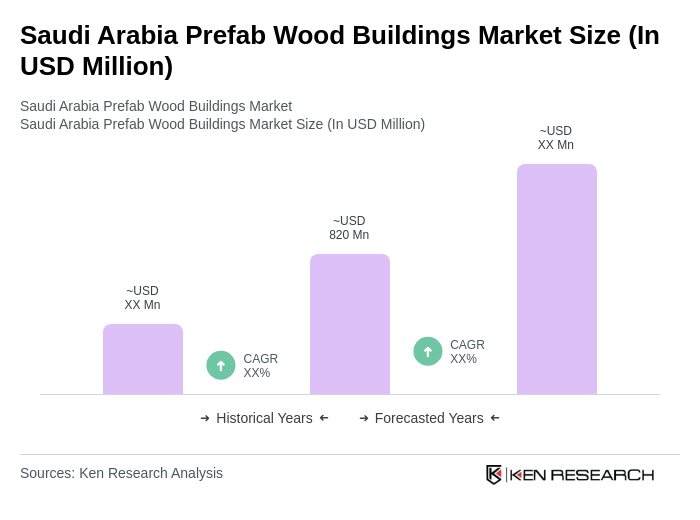
- The Saudi Arabia Prefab Wood Buildings Market is valued at USD 820 million, based on a five-year historical analysis. According to sector research, prefab wood adoption in the Kingdom is underpinned by sustainability targets, offsite efficiency, and cost/time savings in housing and social infrastructure. Rising interest in mass timber and panelized solutions for faster delivery and reduced waste supports uptake in select residential, hospitality, and community applications.
- Key cities such as Riyadh, Jeddah, and Dammam dominate demand due to rapid urbanization and large-scale developments linked to Vision 2030 housing and tourism programs. Government-backed housing delivery in Riyadh (via PIF-backed platforms) and coastal hospitality pipelines in Jeddah drive modular/offsite activity, while the Eastern Province’s industrial base fosters site facilities and modular needs in and around Dammam.
- Saudi Arabia has adopted the Saudi Building Code (SBC) and the MOSTADAM green rating system to push energy-efficient, sustainable construction; however, there is no official regulation titled “Green Building Code” implemented in 2023. Green standards are promoted via SBC efficiency provisions and the MOSTADAM program for new developments, which collectively encourage sustainable materials and offsite methods compatible with prefab wood solutions.
Saudi Arabia Prefab Wood Buildings Market Segmentation
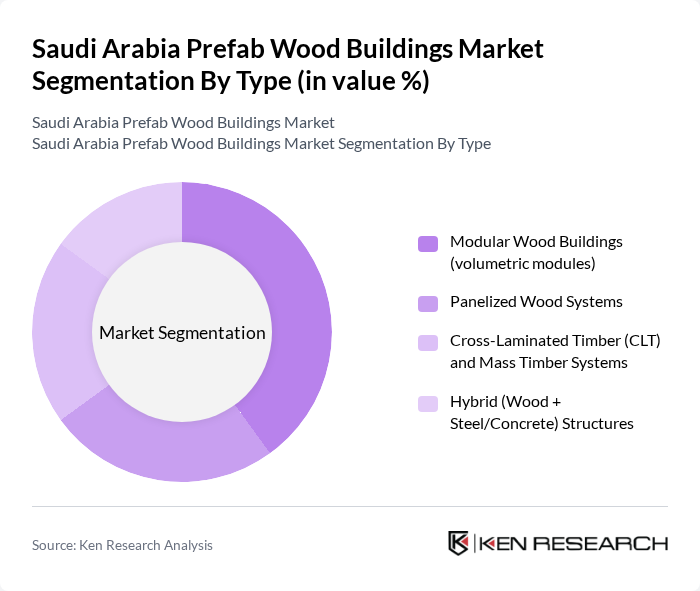
By Type:The market can be segmented into four main types: Modular Wood Buildings (volumetric modules), Panelized Wood Systems, Cross-Laminated Timber (CLT) and Mass Timber Systems, and Hybrid (Wood + Steel/Concrete) Structures. Among these, Modular Wood Buildings are gaining traction due to their efficiency and flexibility in design, making them a preferred choice for various construction projects.
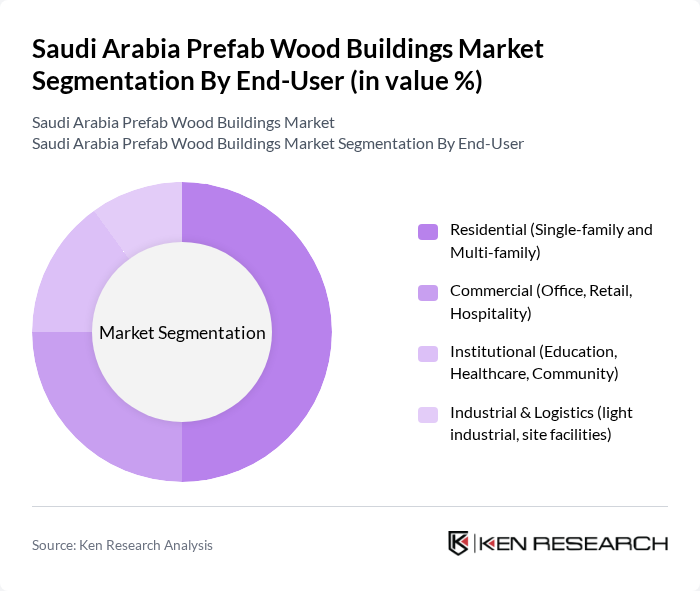
By End-User:The end-user segmentation includes Residential (Single-family and Multi-family), Commercial (Office, Retail, Hospitality), Institutional (Education, Healthcare, Community), and Industrial & Logistics (light industrial, site facilities). The Residential segment is currently leading the market, driven by population growth, affordable housing initiatives, and the speed advantages of offsite delivery.
Saudi Arabia Prefab Wood Buildings Market Competitive Landscape
The Saudi Arabia Prefab Wood Buildings Market is characterized by a dynamic mix of regional and international players. Leading participants such as Red Sea Global (modular and offsite construction programs), ROSHN (Public Investment Fund) Housing Company, Saudi Building Systems Manufacturing Company (SBSM), Katerra Saudi Arabia (legacy assets under local operators), Zamil Industrial Investment Co. (offsite solutions), Alfanar Construction (offsite and modular units), Saudi Pan Kingdom Company – SAPAC (prefab/site facilities), Saudi Prefab Houses Factory Co., Al Nahda Prefab Houses, United Arab Can (UAC) Modular Buildings, Mammut Building Systems KSA, Fakieh Timber and Wood Industries, JAFCO for Wood Industries, Al Sorayai Wood & Timber Trading, WEDIAN Prefab (Wedian Prefabricated Buildings Factory) contribute to innovation, geographic expansion, and service delivery in this space.
Saudi Arabia Prefab Wood Buildings Market Industry Analysis
Growth Drivers
- Increasing Demand for Sustainable Construction:The Saudi Arabian construction sector is witnessing a shift towards sustainable practices, with the government aiming for 30% of buildings to be green in future. This aligns with the Vision 2030 initiative, which emphasizes eco-friendly construction. In future, the market for sustainable materials is projected to reach SAR 15 billion, driven by rising consumer awareness and demand for energy-efficient solutions, thus boosting the prefab wood buildings segment significantly.
- Government Initiatives Supporting Prefabrication:The Saudi government has introduced various initiatives to promote prefabrication, including the National Industrial Development and Logistics Program. In future, SAR 10 billion is allocated to enhance construction efficiency through prefabricated solutions. These initiatives aim to reduce construction time by 30% and costs by 20%, making prefab wood buildings a more attractive option for developers and investors in the region.
- Rising Urbanization and Population Growth:Saudi Arabia's urban population is expected to reach 36 million in future, increasing the demand for housing and infrastructure. The urbanization rate is projected at 83%, necessitating rapid construction solutions. Prefab wood buildings can be erected quickly, addressing the housing shortage effectively. This demographic shift is anticipated to drive the market for prefab solutions, with an estimated 25% increase in demand for residential units in urban areas.
Market Challenges
- Limited Awareness of Prefab Solutions:Despite the advantages of prefab wood buildings, awareness remains low among consumers and builders. A survey indicated that only 30% of construction professionals in Saudi Arabia are familiar with prefabrication benefits. This lack of knowledge hampers market growth, as potential clients may prefer traditional methods, which are perceived as more reliable, thus limiting the adoption of innovative building techniques.
- Regulatory Hurdles in Construction Standards:The construction industry in Saudi Arabia faces stringent regulations that can delay the adoption of prefab wood buildings. In future, compliance with updated building codes is expected to require additional investments of SAR 5 billion. These regulatory challenges can deter companies from pursuing prefabrication, as navigating the complex approval processes can be time-consuming and costly, impacting overall market growth.
Saudi Arabia Prefab Wood Buildings Market Future Outlook
The future of the Saudi Arabia prefab wood buildings market appears promising, driven by increasing urbanization and a strong push for sustainable construction practices. As the government continues to support prefabrication through financial incentives and regulatory reforms, the market is likely to see significant growth. Technological advancements in manufacturing processes will further enhance efficiency and customization, making prefab solutions more appealing to developers and consumers alike, thereby solidifying their role in the construction landscape.
Market Opportunities
- Expansion into Rural Areas:With rural populations growing, there is a significant opportunity for prefab wood buildings to meet housing needs. The government’s focus on rural development, with SAR 3 billion allocated for infrastructure improvements, presents a favorable environment for introducing affordable and sustainable housing solutions in these regions.
- Collaboration with Local Builders:Partnering with local construction firms can enhance market penetration for prefab wood buildings. By leveraging local expertise and networks, companies can effectively address regional preferences and regulatory requirements, potentially increasing market share by 15% in the next few years, as local builders are more familiar with community needs and construction practices.
Scope of the Report
| Segment | Sub-Segments |
|---|---|
| By Type | Modular Wood Buildings (volumetric modules) Panelized Wood Systems Cross-Laminated Timber (CLT) and Mass Timber Systems Hybrid (Wood + Steel/Concrete) Structures |
| By End-User | Residential (Single-family and Multi-family) Commercial (Office, Retail, Hospitality) Institutional (Education, Healthcare, Community) Industrial & Logistics (light industrial, site facilities) |
| By Application | Housing Developments and Villas Educational Buildings (schools, training centers) Healthcare Facilities and Clinics Hospitality & Recreational Buildings |
| By Sales Channel | Direct (Project Tendering/Design-Build) Distributors and Local Agents Online/Configurable Kit Platforms EPC/General Contractor Partnerships |
| By Distribution Mode | B2B (Developers, Contractors, Government) B2C (Self-build and small developers) Turnkey (Design–Manufacture–Install) Component Supply (panels, beams, trusses) |
| By Price Range | Budget Mid-Range Premium |
| By Policy Support | Green Building/ESG Certifications (e.g., Mostadam, LEED) Tax/Customs Incentives and Local Content Programs Public Housing and Social Infrastructure Programs R&D and Industrialization Grants/Financing |
Key Target Audience
Investors and Venture Capitalist Firms
Government and Regulatory Bodies (e.g., Ministry of Housing, Saudi Standards, Metrology and Quality Organization)
Manufacturers and Producers of Prefabricated Wood Structures
Construction and Engineering Firms
Real Estate Developers
Architectural and Design Firms
Building Material Suppliers
Financial Institutions and Banks
Players Mentioned in the Report:
Red Sea Global (modular and offsite construction programs)
ROSHN (Public Investment Fund) Housing Company
Saudi Building Systems Manufacturing Company (SBSM)
Katerra Saudi Arabia (legacy assets under local operators)
Zamil Industrial Investment Co. (offsite solutions)
Alfanar Construction (offsite and modular units)
Saudi Pan Kingdom Company SAPAC (prefab/site facilities)
Saudi Prefab Houses Factory Co.
Al Nahda Prefab Houses
United Arab Can (UAC) Modular Buildings
Mammut Building Systems KSA
Fakieh Timber and Wood Industries
JAFCO for Wood Industries
Al Sorayai Wood & Timber Trading
WEDIAN Prefab (Wedian Prefabricated Buildings Factory)
Table of Contents
Market Assessment Phase
1. Executive Summary and Approach
2. Saudi Arabia Prefab Wood Buildings Market Overview
2.1 Key Insights and Strategic Recommendations
2.2 Saudi Arabia Prefab Wood Buildings Market Overview
2.3 Definition and Scope
2.4 Evolution of Market Ecosystem
2.5 Timeline of Key Regulatory Milestones
2.6 Value Chain & Stakeholder Mapping
2.7 Business Cycle Analysis
2.8 Policy & Incentive Landscape
3. Saudi Arabia Prefab Wood Buildings Market Analysis
3.1 Growth Drivers
3.1.1 Increasing Demand for Sustainable Construction
3.1.2 Government Initiatives Supporting Prefabrication
3.1.3 Rising Urbanization and Population Growth
3.1.4 Cost Efficiency of Prefab Wood Buildings
3.2 Market Challenges
3.2.1 Limited Awareness of Prefab Solutions
3.2.2 Regulatory Hurdles in Construction Standards
3.2.3 Competition from Traditional Building Methods
3.2.4 Supply Chain Disruptions
3.3 Market Opportunities
3.3.1 Expansion into Rural Areas
3.3.2 Technological Advancements in Prefabrication
3.3.3 Collaboration with Local Builders
3.3.4 Export Potential to Neighboring Markets
3.4 Market Trends
3.4.1 Increasing Use of Eco-Friendly Materials
3.4.2 Customization in Prefab Designs
3.4.3 Integration of Smart Home Technologies
3.4.4 Focus on Energy Efficiency
3.5 Government Regulation
3.5.1 Building Code Revisions
3.5.2 Incentives for Sustainable Building Practices
3.5.3 Safety Standards for Prefabricated Structures
3.5.4 Environmental Impact Assessments
4. SWOT Analysis
5. Stakeholder Analysis
6. Porter's Five Forces Analysis
7. Saudi Arabia Prefab Wood Buildings Market Market Size, 2019-2024
7.1 By Value
7.2 By Volume
7.3 By Average Selling Price
8. Saudi Arabia Prefab Wood Buildings Market Segmentation
8.1 By Type
8.1.1 Modular Wood Buildings (volumetric modules)
8.1.2 Panelized Wood Systems
8.1.3 Cross-Laminated Timber (CLT) and Mass Timber Systems
8.1.4 Hybrid (Wood + Steel/Concrete) Structures
8.2 By End-User
8.2.1 Residential (Single-family and Multi-family)
8.2.2 Commercial (Office, Retail, Hospitality)
8.2.3 Institutional (Education, Healthcare, Community)
8.2.4 Industrial & Logistics (light industrial, site facilities)
8.3 By Application
8.3.1 Housing Developments and Villas
8.3.2 Educational Buildings (schools, training centers)
8.3.3 Healthcare Facilities and Clinics
8.3.4 Hospitality & Recreational Buildings
8.4 By Sales Channel
8.4.1 Direct (Project Tendering/Design-Build)
8.4.2 Distributors and Local Agents
8.4.3 Online/Configurable Kit Platforms
8.4.4 EPC/General Contractor Partnerships
8.5 By Distribution Mode
8.5.1 B2B (Developers, Contractors, Government)
8.5.2 B2C (Self-build and small developers)
8.5.3 Turnkey (Design–Manufacture–Install)
8.5.4 Component Supply (panels, beams, trusses)
8.6 By Price Range
8.6.1 Budget
8.6.2 Mid-Range
8.6.3 Premium
8.7 By Policy Support
8.7.1 Green Building/ESG Certifications (e.g., Mostadam, LEED)
8.7.2 Tax/Customs Incentives and Local Content Programs
8.7.3 Public Housing and Social Infrastructure Programs
8.7.4 R&D and Industrialization Grants/Financing
9. Saudi Arabia Prefab Wood Buildings Market Competitive Analysis
9.1 Market Share of Key Players
9.2 Cross Comparison of Key Players
9.2.1 Company Name
9.2.2 Group Size (Large, Medium, or Small as per industry convention)
9.2.3 Saudi Revenue from Prefab Wood/Mass Timber (SAR)
9.2.4 Order Backlog in Saudi (value in SAR, months of coverage)
9.2.5 Installed Manufacturing Capacity in KSA (m² or m³/yr)
9.2.6 Project Delivery Lead Time (factory-to-site, weeks)
9.2.7 Win Rate in Public/PPP Tenders (%)
9.2.8 Average Selling Price per m² (by system)
9.2.9 Product/Technology Mix (CLT, GLT, panelized, modular)
9.2.10 Certification & Compliance (Mostadam/LEED, SASO, ISO)
9.2.11 Local Content Ratio (IKTVA/NIDLP alignment, %)
9.2.12 On-time Delivery and Defect Rate (%)
9.2.13 Customer Satisfaction/Repeat Business (%)
9.3 SWOT Analysis of Top Players
9.4 Pricing Analysis
9.5 Detailed Profile of Major Companies
9.5.1 Red Sea Global (modular and offsite construction programs)
9.5.2 ROSHN (Public Investment Fund) Housing Company
9.5.3 Saudi Building Systems Manufacturing Company (SBSM)
9.5.4 Katerra Saudi Arabia (legacy assets under local operators)
9.5.5 Zamil Industrial Investment Co. (offsite solutions)
9.5.6 Alfanar Construction (offsite and modular units)
9.5.7 Saudi Pan Kingdom Company – SAPAC (prefab/site facilities)
9.5.8 Saudi Prefab Houses Factory Co.
9.5.9 Al Nahda Prefab Houses
9.5.10 United Arab Can (UAC) Modular Buildings
9.5.11 Mammut Building Systems KSA
9.5.12 Fakieh Timber and Wood Industries
9.5.13 JAFCO for Wood Industries
9.5.14 Al Sorayai Wood & Timber Trading
9.5.15 WEDIAN Prefab (Wedian Prefabricated Buildings Factory)
10. Saudi Arabia Prefab Wood Buildings Market End-User Analysis
10.1 Procurement Behavior of Key Ministries
10.1.1 Ministry of Housing
10.1.2 Ministry of Municipal and Rural Affairs
10.1.3 Ministry of Education
10.1.4 Ministry of Health
10.2 Corporate Spend on Infrastructure & Energy
10.2.1 Investment Trends
10.2.2 Budget Allocations
10.2.3 Project Prioritization
10.3 Pain Point Analysis by End-User Category
10.3.1 Cost Overruns
10.3.2 Delays in Project Completion
10.3.3 Quality Assurance Issues
10.4 User Readiness for Adoption
10.4.1 Awareness Levels
10.4.2 Training Needs
10.4.3 Financial Readiness
10.5 Post-Deployment ROI and Use Case Expansion
10.5.1 Performance Metrics
10.5.2 Case Studies
10.5.3 Future Expansion Plans
11. Saudi Arabia Prefab Wood Buildings Market Future Size, 2025-2030
11.1 By Value
11.2 By Volume
11.3 By Average Selling Price
Go-To-Market Strategy Phase
1. Whitespace Analysis + Business Model Canvas
1.1 Market Gaps Identification
1.2 Value Proposition Development
1.3 Revenue Streams
1.4 Cost Structure Analysis
1.5 Key Partnerships
1.6 Customer Segments
1.7 Channels
2. Marketing and Positioning Recommendations
2.1 Branding Strategies
2.2 Product USPs
3. Distribution Plan
3.1 Urban Retail Strategies
3.2 Rural NGO Tie-ups
4. Channel & Pricing Gaps
4.1 Underserved Routes
4.2 Pricing Bands
5. Unmet Demand & Latent Needs
5.1 Category Gaps
5.2 Consumer Segments
6. Customer Relationship
6.1 Loyalty Programs
6.2 After-sales Service
7. Value Proposition
7.1 Sustainability
7.2 Integrated Supply Chains
8. Key Activities
8.1 Regulatory Compliance
8.2 Branding
8.3 Distribution Setup
9. Entry Strategy Evaluation
9.1 Domestic Market Entry Strategy
9.1.1 Product Mix
9.1.2 Pricing Band
9.1.3 Packaging
9.2 Export Entry Strategy
9.2.1 Target Countries
9.2.2 Compliance Roadmap
10. Entry Mode Assessment
10.1 Joint Ventures
10.2 Greenfield Investments
10.3 Mergers & Acquisitions
10.4 Distributor Model
11. Capital and Timeline Estimation
11.1 Capital Requirements
11.2 Timelines
12. Control vs Risk Trade-Off
12.1 Ownership vs Partnerships
13. Profitability Outlook
13.1 Breakeven Analysis
13.2 Long-term Sustainability
14. Potential Partner List
14.1 Distributors
14.2 Joint Ventures
14.3 Acquisition Targets
15. Execution Roadmap
15.1 Phased Plan for Market Entry
15.1.1 Market Setup
15.1.2 Market Entry
15.1.3 Growth Acceleration
15.1.4 Scale & Stabilize
15.2 Key Activities and Milestones
15.2.1 Milestone Planning
15.2.2 Activity Tracking
Research Methodology
Phase 1: Approach1
Desk Research
- Analysis of industry reports from government bodies and trade associations in Saudi Arabia
- Review of market studies and publications focusing on prefab wood building trends and regulations
- Examination of construction and real estate market data from local and international sources
Primary Research
- Interviews with architects and engineers specializing in prefab wood construction
- Surveys with construction project managers and developers involved in wood building projects
- Field interviews with suppliers and manufacturers of prefab wood materials
Validation & Triangulation
- Cross-validation of findings through multiple data sources, including trade publications and expert opinions
- Triangulation of market insights from primary interviews and secondary data analysis
- Sanity checks conducted through expert panel reviews to ensure data accuracy
Phase 2: Market Size Estimation1
Top-down Assessment
- Estimation of market size based on national construction spending and growth rates in the prefab sector
- Segmentation of the market by residential, commercial, and industrial applications
- Incorporation of government initiatives promoting sustainable building practices
Bottom-up Modeling
- Collection of data on production volumes from leading prefab wood manufacturers in Saudi Arabia
- Analysis of pricing structures and cost components associated with prefab wood buildings
- Estimation of market size based on unit sales and average selling prices
Forecasting & Scenario Analysis
- Development of forecasting models using historical growth rates and market trends
- Scenario analysis based on potential regulatory changes and shifts in consumer preferences
- Creation of baseline, optimistic, and pessimistic forecasts through 2030
Phase 3: CATI Sample Composition1
| Scope Item/Segment | Sample Size | Target Respondent Profiles |
|---|---|---|
| Residential Prefab Wood Projects | 100 | Architects, Home Builders |
| Commercial Building Developments | 80 | Project Managers, Real Estate Developers |
| Industrial Wood Construction | 60 | Construction Engineers, Facility Managers |
| Prefab Wood Material Suppliers | 70 | Manufacturers, Sales Representatives |
| Regulatory and Compliance Experts | 50 | Policy Makers, Industry Consultants |
Frequently Asked Questions
What is the current value of the Saudi Arabia Prefab Wood Buildings Market?
The Saudi Arabia Prefab Wood Buildings Market is valued at approximately USD 820 million, reflecting a growing trend towards sustainable construction and offsite efficiency in housing and social infrastructure.
What are the main drivers of growth in the Saudi Arabia Prefab Wood Buildings Market?
Which cities in Saudi Arabia are leading in prefab wood building demand?
What types of prefab wood buildings are available in the Saudi market?
Other Regional/Country Reports
Indonesia Prefab Wood Buildings Market
Malaysia Prefab Wood Buildings Market
Why Buy From Us?

What makes us stand out is that our consultants follow Robust, Refine and Result (RRR) methodology. Robust for clear definitions, approaches and sanity checking, Refine for differentiating respondents' facts and opinions, and Result for presenting data with story.

We have set a benchmark in the industry by offering our clients with syndicated and customized market research reports featuring coverage of entire market as well as meticulous research and analyst insights.

While we don't replace traditional research, we flip the method upside down. Our dual approach of Top Bottom & Bottom Top ensures quality deliverable by not just verifying company fundamentals but also looking at the sector and macroeconomic factors.

With one step in the future, our research team constantly tries to show you the bigger picture. We help with some of the tough questions you may encounter along the way: How is the industry positioned? Best marketing channel? KPI's of competitors? By aligning every element, we help maximize success.

Our report gives you instant access to the answers and sources that other companies might choose to hide. We elaborate each steps of research methodology we have used and showcase you the sample size to earn your trust.

If you need any support, we are here! We pride ourselves on universe strength, data quality, and quick, friendly, and professional service.