Saudi Arabia Prefabricated Buildings Industry Study Market

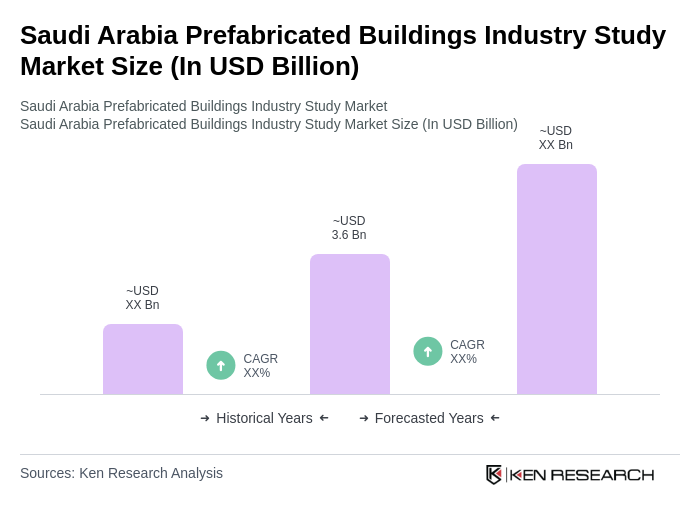
Saudi Arabia prefabricated buildings market, valued at USD 3.6 Bn, is propelled by government initiatives, rapid urbanization, and demand for efficient, eco-friendly solutions aligned with Vision 2030.

Region:Middle East

Author(s):Shubham

Product Code:KRAD0645

Pages:86

Published On:August 2025
About the Report

Base Year 2024

Saudi Arabia Prefabricated Buildings Industry Study Market Overview

  • The Saudi Arabia Prefabricated Buildings Industry is valued at USD 3.6 billion, based on a five-year historical analysis. This growth is primarily driven by rapid urbanization, government initiatives to promote affordable housing, and the increasing demand for sustainable construction solutions, with prefabrication aligned to Vision 2030 priorities for speed, quality, and cost efficiency . The prefabricated buildings sector is gaining traction due to its cost-effectiveness and reduced construction time, making it an attractive option for various stakeholders in the construction industry .
  • Key cities such as Riyadh, Jeddah, and Dammam dominate the market due to their significant infrastructure development projects and population growth, consistent with the concentration of large-scale public and private projects and housing programs under Vision 2030 . Riyadh, as the capital, leads in government investments and urban expansion, while Jeddah's strategic location as a commercial hub enhances its demand for prefabricated solutions; Dammam, with its industrial base, also contributes through ongoing industrial and logistics developments .
  • In 2023, the Saudi government implemented regulations to enhance the prefabricated construction sector, mandating that at least 30% of new public buildings must utilize prefabricated components. This initiative aims to streamline construction processes, reduce waste, and promote sustainable building practices, aligning with the Vision 2030 goals for economic diversification and environmental sustainability .
Saudi Arabia Prefabricated Buildings Industry Study Market Size

Saudi Arabia Prefabricated Buildings Industry Study Market Segmentation

By Type:

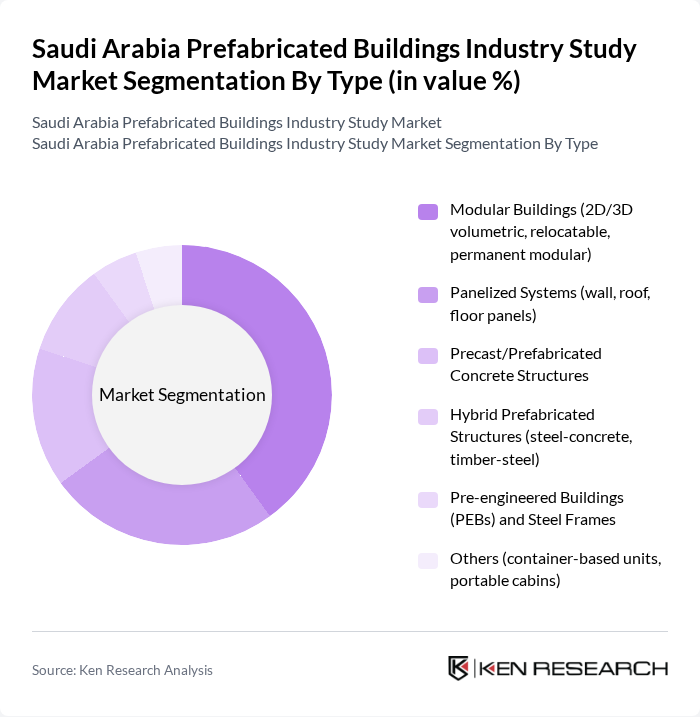
Saudi Arabia Prefabricated Buildings Industry Study Market segmentation by Type.

The prefabricated buildings market is segmented into various types, including Modular Buildings, Panelized Systems, Precast/Prefabricated Concrete Structures, Hybrid Prefabricated Structures, Pre-engineered Buildings (PEBs) and Steel Frames, and Others. Among these, Modular Buildings are currently dominating the market due to their versatility and efficiency in construction. They cater to a wide range of applications, from residential to commercial, and are favored for their quick assembly and reduced labor costs. The trend towards sustainable construction practices further boosts the demand for modular solutions, making them a preferred choice for developers and contractors .

By End-User:
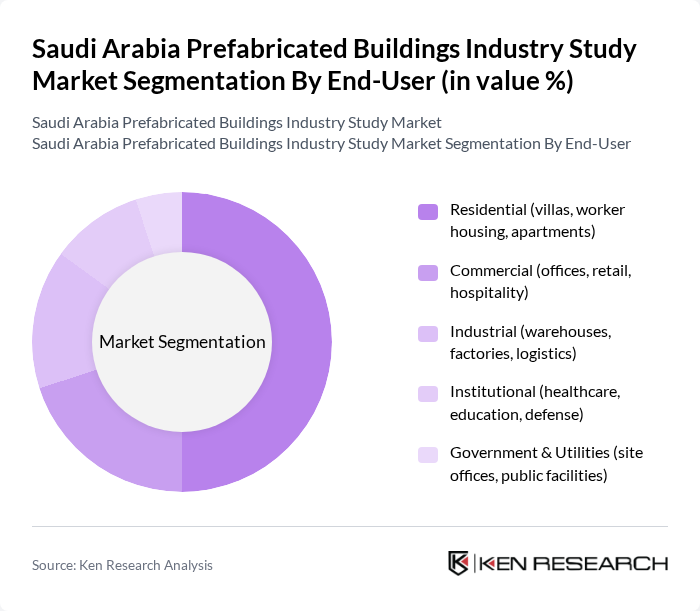
Saudi Arabia Prefabricated Buildings Industry Study Market segmentation by End-User.

The end-user segmentation of the prefabricated buildings market includes Residential, Commercial, Industrial, Institutional, and Government & Utilities. The Residential segment is leading the market, driven by the increasing demand for affordable housing solutions and the rapid urbanization in major cities. The trend towards sustainable living and the need for quick housing solutions in response to population growth further enhance the appeal of prefabricated residential units. Additionally, government initiatives aimed at providing housing for low-income families contribute significantly to the growth of this segment .

Saudi Arabia Prefabricated Buildings Industry Study Market Competitive Landscape

The Saudi Arabia Prefabricated Buildings Industry Study Market is characterized by a dynamic mix of regional and international players. Leading participants such as Red Sea International Company (RSI), Saudi Building Systems Manufacturing Co. (SBSM/Alfanar PEB), Zamil Steel Pre-Engineered Buildings Co. (Zamil Industrial), Saudi Arabian Baytur Construction Co., Nesma & Partners Contracting Co. (Modular solutions), El Seif Engineering Contracting Co. (Modular/PEB projects), Al Bawani Co. (off-site and modular initiatives), Katerra Saudi Arabia (assets now under local operators), Rotating Machinery Services Modular (industrial modules), United Precast Concrete Saudi Arabia (UPC Saudi), Saudi Pan Kingdom Company (SAPAC) – Modular camps, Redco Precast Concrete Saudi, Alfanar Construction – Modular Buildings & PEB, Al Jomaih Modular Buildings (AJMB), Al-Kifah Precast (KPC) – Katerra/AlKifah Building Systems contribute to innovation, geographic expansion, and service delivery in this space .

Red Sea International Company (RSI)

1976

Riyadh, Saudi Arabia

Saudi Building Systems Manufacturing Co. (SBSM)

1976

Riyadh, Saudi Arabia

Zamil Steel Pre-Engineered Buildings Co.

1977

Al Khobar, Saudi Arabia

Saudi Arabian Baytur Construction Co.

2008

Riyadh, Saudi Arabia

Nesma & Partners Contracting Co.

1981

Al Khobar, Saudi Arabia

Company

Establishment Year

Headquarters

Group Size (Large, Medium, Small)

Saudi Revenue from Prefab/Modular (latest FY, SAR)

Order Backlog/Booked Pipeline (SAR, months of coverage)

Installed/Annual Production Capacity (m² or modules/year)

Capacity Utilization (%)

Project Delivery Lead Time (days from order to site)

Saudi Arabia Prefabricated Buildings Industry Study Market Industry Analysis

Growth Drivers

  • Increasing Urbanization:Saudi Arabia's urban population is projected to reach 37 million in future, up from 33 million in 2020, according to the World Bank. This rapid urbanization drives demand for prefabricated buildings, as they offer quick and efficient construction solutions. The urbanization rate is expected to rise to 84% in future, necessitating innovative housing solutions to accommodate the growing population, thereby boosting the prefabricated buildings market significantly.
  • Government Infrastructure Initiatives:The Saudi government has allocated approximately one trillion dollars for infrastructure projects under Vision 2030. This includes investments in housing, transportation, and public facilities, which are expected to increase the demand for prefabricated buildings. In future, the government aims to complete over 1.1 million housing units, creating a substantial market for prefabricated solutions that can be delivered rapidly and cost-effectively.
  • Sustainability and Environmental Concerns:With a commitment to reducing carbon emissions by 31% in future, Saudi Arabia is increasingly focusing on sustainable construction practices. Prefabricated buildings, which generate less waste and utilize energy-efficient materials, align with these environmental goals. The market for sustainable construction is projected to grow, with an estimated 26% of new buildings in future expected to incorporate prefabricated elements, reflecting a shift towards eco-friendly solutions.

Market Challenges

  • Regulatory Compliance Issues:The prefabricated buildings sector faces significant regulatory hurdles, including compliance with local building codes and safety standards. In future, it is estimated that 41% of projects experience delays due to regulatory approvals. This can hinder the timely delivery of prefabricated solutions, impacting overall market growth and increasing costs for manufacturers and developers.
  • High Initial Investment Costs:The upfront costs associated with prefabricated construction can be a barrier for many developers. In future, the average initial investment for prefabricated projects is projected to be around one hundred fifty-five dollars per square foot, compared to one hundred twenty-five dollars for traditional construction. This price differential can deter potential investors, limiting the market's expansion and adoption of prefabricated solutions in the region.

Saudi Arabia Prefabricated Buildings Industry Study Market Future Outlook

The future of the prefabricated buildings market in Saudi Arabia appears promising, driven by urbanization and government initiatives. As the population continues to grow, the demand for affordable and sustainable housing solutions will increase. Technological advancements in construction methods will further enhance efficiency and reduce costs. By future, the integration of smart technologies in prefabricated buildings is expected to become a standard, aligning with global trends towards energy efficiency and sustainability in construction practices.

Market Opportunities

  • Expansion into Rural Areas:As urban centers become saturated, there is a growing opportunity to expand prefabricated building solutions into rural areas. With government initiatives aimed at rural development, the demand for affordable housing in these regions is expected to rise, creating a new market segment for prefabricated solutions.
  • Partnerships with Local Governments:Collaborating with local governments can unlock significant opportunities for prefabricated building companies. By aligning with government housing initiatives, companies can secure contracts for large-scale projects, enhancing their market presence and contributing to the overall development of sustainable communities across the country.

Scope of the Report

SegmentSub-Segments
By Type

Modular Buildings (2D/3D volumetric, relocatable, permanent modular)

Panelized Systems (wall, roof, floor panels)

Precast/Prefabricated Concrete Structures

Hybrid Prefabricated Structures (steel-concrete, timber-steel)

Pre-engineered Buildings (PEBs) and Steel Frames

Others (container-based units, portable cabins)

By End-User

Residential (villas, worker housing, apartments)

Commercial (offices, retail, hospitality)

Industrial (warehouses, factories, logistics)

Institutional (healthcare, education, defense)

Government & Utilities (site offices, public facilities)

By Application

Temporary Structures (site camps, disaster relief)

Permanent Buildings

Infrastructure Projects (transport hubs, utility buildings)

Remote & Mega-Project Accommodations (NEOM/Red Sea camps)

Others

By Material

Steel and Light-Gauge Steel

Precast Concrete

Aluminum

Wood/Engineered Timber

Composites and Insulated Panels (SIP, PIR/PUR)

By Distribution Channel

Direct Sales (project contracts, EPC)

Distributors/Dealers

Online/B2B Platforms

Others

By Price Range

Economy

Mid-Range

Premium

By Investment Source

Domestic Investment

Foreign Direct Investment (FDI)

Public-Private Partnerships (PPP)

Government Programs (Vision 2030, housing initiatives)

Key Target Audience

Investors and Venture Capitalist Firms

Government and Regulatory Bodies (e.g., Ministry of Housing, Saudi Standards, Metrology and Quality Organization)

Manufacturers and Producers

Construction Companies

Real Estate Developers

Architectural and Design Firms

Building Material Suppliers

Financial Institutions

Players Mentioned in the Report:

Red Sea International Company (RSI)

Saudi Building Systems Manufacturing Co. (SBSM/Alfanar PEB)

Zamil Steel Pre-Engineered Buildings Co. (Zamil Industrial)

Saudi Arabian Baytur Construction Co.

Nesma & Partners Contracting Co. (Modular solutions)

El Seif Engineering Contracting Co. (Modular/PEB projects)

Al Bawani Co. (off-site and modular initiatives)

Katerra Saudi Arabia (assets now under local operators)

Rotating Machinery Services Modular (industrial modules)

United Precast Concrete Saudi Arabia (UPC Saudi)

Saudi Pan Kingdom Company (SAPAC) Modular camps

Redco Precast Concrete Saudi

Alfanar Construction Modular Buildings & PEB

Al Jomaih Modular Buildings (AJMB)

Al-Kifah Precast (KPC) Katerra/AlKifah Building Systems

Table of Contents

Market Assessment Phase

1. Executive Summary and Approach


2. Saudi Arabia Prefabricated Buildings Industry Study Market Overview

2.1 Key Insights and Strategic Recommendations

2.2 Saudi Arabia Prefabricated Buildings Industry Study Market Overview

2.3 Definition and Scope

2.4 Evolution of Market Ecosystem

2.5 Timeline of Key Regulatory Milestones

2.6 Value Chain & Stakeholder Mapping

2.7 Business Cycle Analysis

2.8 Policy & Incentive Landscape


3. Saudi Arabia Prefabricated Buildings Industry Study Market Analysis

3.1 Growth Drivers

3.1.1 Increasing Urbanization
3.1.2 Government Infrastructure Initiatives
3.1.3 Cost Efficiency of Prefabricated Solutions
3.1.4 Sustainability and Environmental Concerns

3.2 Market Challenges

3.2.1 Regulatory Compliance Issues
3.2.2 High Initial Investment Costs
3.2.3 Limited Awareness Among Stakeholders
3.2.4 Supply Chain Disruptions

3.3 Market Opportunities

3.3.1 Expansion into Rural Areas
3.3.2 Technological Advancements in Construction
3.3.3 Partnerships with Local Governments
3.3.4 Growing Demand for Affordable Housing

3.4 Market Trends

3.4.1 Adoption of Smart Building Technologies
3.4.2 Increasing Use of Modular Construction
3.4.3 Focus on Energy Efficiency
3.4.4 Rise of Customizable Prefabricated Solutions

3.5 Government Regulation

3.5.1 Building Code Updates
3.5.2 Incentives for Sustainable Construction
3.5.3 Safety Standards Enforcement
3.5.4 Zoning Law Adjustments

4. SWOT Analysis


5. Stakeholder Analysis


6. Porter's Five Forces Analysis


7. Saudi Arabia Prefabricated Buildings Industry Study Market Market Size, 2019-2024

7.1 By Value

7.2 By Volume

7.3 By Average Selling Price


8. Saudi Arabia Prefabricated Buildings Industry Study Market Segmentation

8.1 By Type

8.1.1 Modular Buildings (2D/3D volumetric, relocatable, permanent modular)
8.1.2 Panelized Systems (wall, roof, floor panels)
8.1.3 Precast/Prefabricated Concrete Structures
8.1.4 Hybrid Prefabricated Structures (steel-concrete, timber-steel)
8.1.5 Pre-engineered Buildings (PEBs) and Steel Frames
8.1.6 Others (container-based units, portable cabins)

8.2 By End-User

8.2.1 Residential (villas, worker housing, apartments)
8.2.2 Commercial (offices, retail, hospitality)
8.2.3 Industrial (warehouses, factories, logistics)
8.2.4 Institutional (healthcare, education, defense)
8.2.5 Government & Utilities (site offices, public facilities)

8.3 By Application

8.3.1 Temporary Structures (site camps, disaster relief)
8.3.2 Permanent Buildings
8.3.3 Infrastructure Projects (transport hubs, utility buildings)
8.3.4 Remote & Mega-Project Accommodations (NEOM/Red Sea camps)
8.3.5 Others

8.4 By Material

8.4.1 Steel and Light-Gauge Steel
8.4.2 Precast Concrete
8.4.3 Aluminum
8.4.4 Wood/Engineered Timber
8.4.5 Composites and Insulated Panels (SIP, PIR/PUR)

8.5 By Distribution Channel

8.5.1 Direct Sales (project contracts, EPC)
8.5.2 Distributors/Dealers
8.5.3 Online/B2B Platforms
8.5.4 Others

8.6 By Price Range

8.6.1 Economy
8.6.2 Mid-Range
8.6.3 Premium

8.7 By Investment Source

8.7.1 Domestic Investment
8.7.2 Foreign Direct Investment (FDI)
8.7.3 Public-Private Partnerships (PPP)
8.7.4 Government Programs (Vision 2030, housing initiatives)

9. Saudi Arabia Prefabricated Buildings Industry Study Market Competitive Analysis

9.1 Market Share of Key Players

9.2 Cross Comparison of Key Players

9.2.1 Company Name
9.2.2 Group Size (Large, Medium, Small)
9.2.3 Saudi Revenue from Prefab/Modular (latest FY, SAR)
9.2.4 Order Backlog/Booked Pipeline (SAR, months of coverage)
9.2.5 Installed/Annual Production Capacity (m² or modules/year)
9.2.6 Capacity Utilization (%)
9.2.7 Project Delivery Lead Time (days from order to site)
9.2.8 Share of Permanent vs Temporary Modular (%)
9.2.9 Gross Margin (%) and EBITDA Margin (%)
9.2.10 Win Rate in Public Tenders (%)
9.2.11 Average Selling Price per m² (SAR/m²) by product
9.2.12 On-time Delivery Rate (%) and Defect Rate (snag list per unit)
9.2.13 Safety KPIs (TRIR/LTIR) and QA certifications (SASO/ISO)
9.2.14 R&D/Innovation Intensity (% of revenue; patents, new SKUs)
9.2.15 Saudi Content Compliance (% local content, IKTVA/LC)
9.2.16 Key Client Concentration (top-3 share %) and Sector Mix
9.2.17 ESG Metrics (energy use/m², waste diverted %, EPD availability)

9.3 SWOT Analysis of Top Players

9.4 Pricing Analysis

9.5 Detailed Profile of Major Companies

9.5.1 Red Sea International Company (RSI)
9.5.2 Saudi Building Systems Manufacturing Co. (SBSM/Alfanar PEB)
9.5.3 Zamil Steel Pre-Engineered Buildings Co. (Zamil Industrial)
9.5.4 Saudi Arabian Baytur Construction Co.
9.5.5 Nesma & Partners Contracting Co. (Modular solutions)
9.5.6 El Seif Engineering Contracting Co. (Modular/PEB projects)
9.5.7 Al Bawani Co. (off-site and modular initiatives)
9.5.8 Katerra Saudi Arabia (assets now under local operators)
9.5.9 Rotating Machinery Services Modular (industrial modules)
9.5.10 United Precast Concrete Saudi Arabia (UPC Saudi)
9.5.11 Saudi Pan Kingdom Company (SAPAC) – Modular camps
9.5.12 Redco Precast Concrete Saudi
9.5.13 Alfanar Construction – Modular Buildings & PEB
9.5.14 Al Jomaih Modular Buildings (AJMB)
9.5.15 Al-Kifah Precast (KPC) – Katerra/AlKifah Building Systems

10. Saudi Arabia Prefabricated Buildings Industry Study Market End-User Analysis

10.1 Procurement Behavior of Key Ministries

10.1.1 Ministry of Housing
10.1.2 Ministry of Municipal and Rural Affairs
10.1.3 Ministry of Transport
10.1.4 Ministry of Energy

10.2 Corporate Spend on Infrastructure & Energy

10.2.1 Corporate Investments in Construction
10.2.2 Budget Allocations for Prefabricated Solutions
10.2.3 Trends in Corporate Infrastructure Spending

10.3 Pain Point Analysis by End-User Category

10.3.1 Residential Sector Challenges
10.3.2 Commercial Sector Challenges
10.3.3 Industrial Sector Challenges

10.4 User Readiness for Adoption

10.4.1 Awareness Levels
10.4.2 Training and Support Needs
10.4.3 Financial Readiness

10.5 Post-Deployment ROI and Use Case Expansion

10.5.1 ROI Measurement Techniques
10.5.2 Case Studies of Successful Deployments
10.5.3 Future Use Case Opportunities

11. Saudi Arabia Prefabricated Buildings Industry Study Market Future Size, 2025-2030

11.1 By Value

11.2 By Volume

11.3 By Average Selling Price


Go-To-Market Strategy Phase

1. Whitespace Analysis + Business Model Canvas

1.1 Market Gaps Identification

1.2 Business Model Components


2. Marketing and Positioning Recommendations

2.1 Branding Strategies

2.2 Product USPs


3. Distribution Plan

3.1 Urban Retail vs Rural NGO Tie-ups


4. Channel & Pricing Gaps

4.1 Underserved Routes

4.2 Pricing Bands


5. Unmet Demand & Latent Needs

5.1 Category Gaps

5.2 Consumer Segments


6. Customer Relationship

6.1 Loyalty Programs

6.2 After-sales Service


7. Value Proposition

7.1 Sustainability

7.2 Integrated Supply Chains


8. Key Activities

8.1 Regulatory Compliance

8.2 Branding

8.3 Distribution Setup


9. Entry Strategy Evaluation

9.1 Domestic Market Entry Strategy

9.1.1 Product Mix
9.1.2 Pricing Band
9.1.3 Packaging

9.2 Export Entry Strategy

9.2.1 Target Countries
9.2.2 Compliance Roadmap

10. Entry Mode Assessment

10.1 Joint Ventures

10.2 Greenfield Investments

10.3 Mergers & Acquisitions

10.4 Distributor Model


11. Capital and Timeline Estimation

11.1 Capital Requirements

11.2 Timelines


12. Control vs Risk Trade-Off

12.1 Ownership vs Partnerships


13. Profitability Outlook

13.1 Breakeven Analysis

13.2 Long-term Sustainability


14. Potential Partner List

14.1 Distributors

14.2 Joint Ventures

14.3 Acquisition Targets


15. Execution Roadmap

15.1 Phased Plan for Market Entry

15.1.1 Market Setup
15.1.2 Market Entry
15.1.3 Growth Acceleration
15.1.4 Scale & Stabilize

15.2 Key Activities and Milestones

15.2.1 Milestone Planning
15.2.2 Activity Tracking

Research Methodology

ApproachModellingSample

Phase 1: Approach1

Desk Research

  • Industry reports from Saudi Arabian construction and prefabrication associations
  • Government publications on infrastructure development and housing initiatives
  • Market analysis from real estate and construction market research firms

Primary Research

  • Interviews with project managers at leading construction firms specializing in prefabricated buildings
  • Surveys with architects and engineers involved in prefabrication design and implementation
  • Field interviews with regulatory bodies overseeing construction standards and practices

Validation & Triangulation

  • Cross-validation of data through multiple industry reports and government statistics
  • Triangulation of insights from primary interviews with secondary data findings
  • Sanity checks through expert panels comprising industry veterans and academic professionals

Phase 2: Market Size Estimation1

Top-down Assessment

  • Analysis of national construction spending trends and allocation towards prefabricated solutions
  • Segmentation of the market by residential, commercial, and industrial prefabricated buildings
  • Incorporation of government housing initiatives and their impact on market growth

Bottom-up Modeling

  • Volume estimates based on the number of prefabricated units produced by leading manufacturers
  • Cost analysis derived from material and labor expenses associated with prefabricated construction
  • Revenue projections based on average selling prices of prefabricated buildings across segments

Forecasting & Scenario Analysis

  • Multi-variable regression analysis considering economic growth, urbanization rates, and population demographics
  • Scenario modeling based on potential regulatory changes and sustainability trends in construction
  • Development of baseline, optimistic, and pessimistic forecasts through 2030

Phase 3: CATI Sample Composition1

Scope Item/SegmentSample SizeTarget Respondent Profiles
Residential Prefabricated Housing120Construction Managers, Housing Developers
Commercial Prefabricated Structures90Project Architects, Real Estate Investors
Industrial Prefabricated Facilities80Operations Managers, Facility Planners
Regulatory Compliance in Prefabrication60Regulatory Officials, Compliance Officers
Market Trends and Innovations100Industry Analysts, R&D Managers

Frequently Asked Questions

What is the current value of the Saudi Arabia Prefabricated Buildings Industry?

The Saudi Arabia Prefabricated Buildings Industry is valued at approximately USD 3.6 billion, driven by rapid urbanization, government initiatives for affordable housing, and a growing demand for sustainable construction solutions aligned with Vision 2030.

What factors are driving the growth of prefabricated buildings in Saudi Arabia?

Which cities are leading in the prefabricated buildings market in Saudi Arabia?

What regulations has the Saudi government implemented for prefabricated buildings?

Other Regional/Country Reports

Indonesia Prefabricated Buildings Industry

Malaysia Prefabricated Buildings Industry

KSA Prefabricated Buildings Industry

APAC Prefabricated Buildings Industry

SEA Prefabricated Buildings Industry

Vietnam Prefabricated Buildings Industry

Why Buy From Us?

Refine Robust Result (RRR) Framework

What makes us stand out is that our consultants follow Robust, Refine and Result (RRR) methodology. Robust for clear definitions, approaches and sanity checking, Refine for differentiating respondents' facts and opinions, and Result for presenting data with story.

Our Reach Is Unmatched

We have set a benchmark in the industry by offering our clients with syndicated and customized market research reports featuring coverage of entire market as well as meticulous research and analyst insights.

Shifting the Research Paradigm

While we don't replace traditional research, we flip the method upside down. Our dual approach of Top Bottom & Bottom Top ensures quality deliverable by not just verifying company fundamentals but also looking at the sector and macroeconomic factors.

More Insights-Better Decisions

With one step in the future, our research team constantly tries to show you the bigger picture. We help with some of the tough questions you may encounter along the way: How is the industry positioned? Best marketing channel? KPI's of competitors? By aligning every element, we help maximize success.

Transparency and Trust

Our report gives you instant access to the answers and sources that other companies might choose to hide. We elaborate each steps of research methodology we have used and showcase you the sample size to earn your trust.

Round the Clock Support

If you need any support, we are here! We pride ourselves on universe strength, data quality, and quick, friendly, and professional service.

Why Clients Choose Us?

400000+
Reports in repository
150+
Consulting projects a year
100+
Analysts
8000+
Client Queries in 2022