Saudi Arabia Retail Pharmacy De Identified Health Data Market Report Size, Share, Growth Drivers, Trends, Opportunities & Forecast 2025–2030

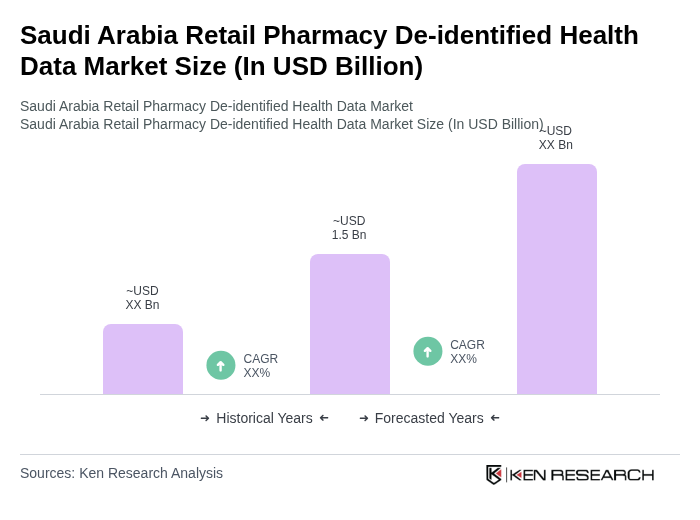
The Saudi Arabia Retail Pharmacy De-identified Health Data Market is worth USD 1.5 Bn, fueled by healthcare digitization, personalized medicine, and data-driven decisions.

Region:Middle East

Author(s):Rebecca

Product Code:KRAD4953

Pages:91

Published On:December 2025
About the Report

Base Year 2024

Saudi Arabia Retail Pharmacy De-identified Health Data Market Overview

  • The Saudi Arabia Retail Pharmacy De-identified Health Data Market is valued at USD 1.5 billion, based on a five-year historical analysis. This growth is primarily driven by the increasing digitization of healthcare services, the rising demand for personalized medicine, and the growing emphasis on data-driven decision-making in healthcare. The integration of technology in pharmacies has facilitated the collection and analysis of de-identified health data, enhancing patient care and operational efficiency. The broader pharmacy retail sector in Saudi Arabia reached USD 17.93 billion in 2024, with digital health services expanding at a 13.20% compound annual growth rate, reflecting strong momentum in e-pharmacy adoption and data analytics capabilities.
  • Key cities such as Riyadh, Jeddah, and Dammam dominate the market due to their large populations, advanced healthcare infrastructure, and concentration of retail pharmacies. Riyadh, as the capital, serves as a hub for healthcare innovation and policy-making, while Jeddah and Dammam benefit from their strategic locations and access to major transportation networks, facilitating the distribution of pharmaceutical products and services. Major pharmacy chains including Nahdi Medical Company and Al-Dawaa Medical Services Co. have implemented robotic dispensing and automated inventory systems that enhance data collection capabilities and operational efficiency across these key regions.
  • The Saudi Health Data Governance Framework, established through regulatory modernization initiatives, mandates the secure handling and sharing of health data among healthcare providers and pharmacies. This regulatory structure aims to enhance patient privacy and data security while promoting the use of de-identified health data for research and public health initiatives, thereby fostering a more robust healthcare ecosystem. The framework aligns with Vision 2030's healthcare modernization agenda, which has allocated substantial resources to develop advanced medical cities and upgrade healthcare infrastructure, creating an enabling environment for de-identified health data utilization.
Saudi Arabia Retail Pharmacy De-identified Health Data Market Size

Saudi Arabia Retail Pharmacy De-identified Health Data Market Segmentation

By Data Asset Type:The market is segmented based on various data asset types, each serving distinct purposes in the healthcare ecosystem. The leading sub-segment is De-identified Prescription Transaction Data, which is crucial for understanding medication usage patterns and improving patient outcomes. This data type is widely utilized by pharmaceutical companies and healthcare providers to analyze prescription trends and enhance medication adherence strategies. Other significant sub-segments include De-identified OTC Purchase Data and De-identified Patient Demographic & Socioeconomic Data, which provide insights into consumer behavior and health disparities.
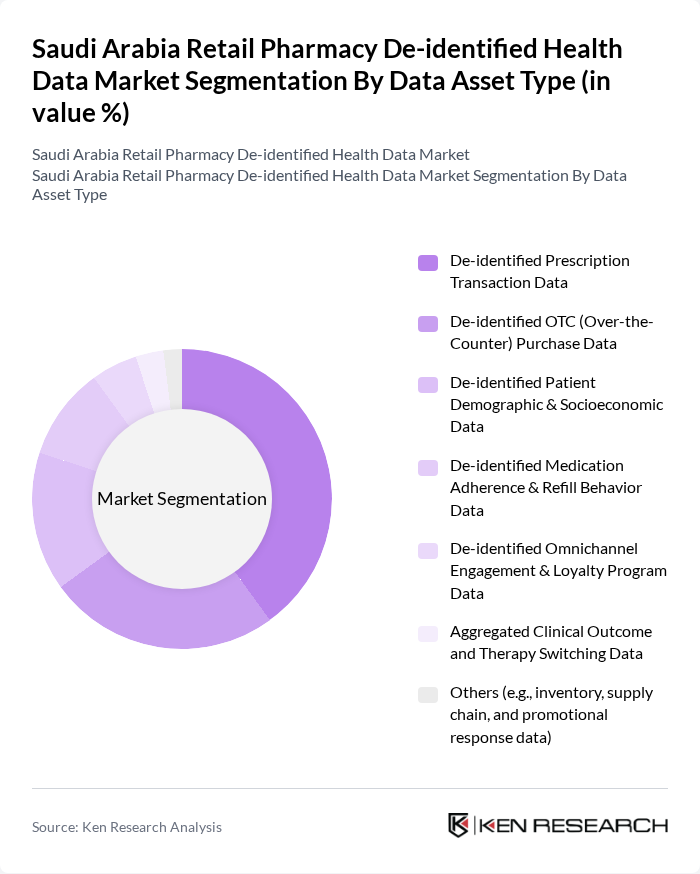
Saudi Arabia Retail Pharmacy De-identified Health Data Market segmentation by Data Asset Type.

By End-User / Data Buyer:The end-user segment includes various stakeholders who utilize de-identified health data for different purposes. Pharmaceutical & Biopharmaceutical Companies lead this segment, leveraging data for drug development and market access strategies. Contract Research Organizations (CROs) and Real-World Evidence Providers also play a significant role, utilizing health data to conduct clinical trials and generate real-world evidence. Healthcare Payers & Insurance Companies are increasingly adopting this data to optimize reimbursement processes and improve patient care management. Government bodies are expanding their utilization of de-identified health data to support Vision 2030's healthcare modernization objectives and public health surveillance initiatives.
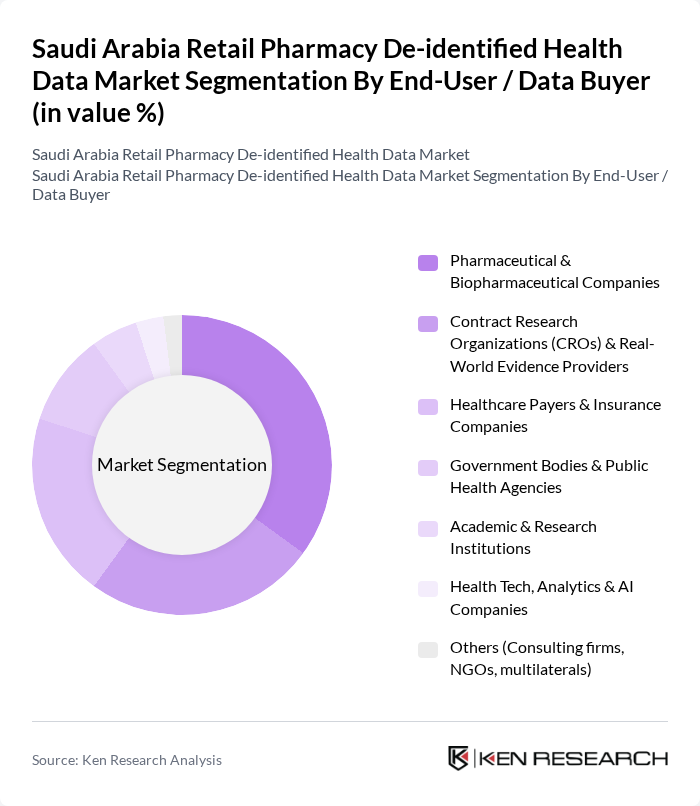
Saudi Arabia Retail Pharmacy De-identified Health Data Market segmentation by End-User / Data Buyer.

Saudi Arabia Retail Pharmacy De-identified Health Data Market Competitive Landscape

The Saudi Arabia Retail Pharmacy De-identified Health Data Market is characterized by a dynamic mix of regional and international players. Leading participants such as Nahdi Medical Company, Al-Dawaa Medical Services Co. (Al-Dawaa Pharmacies), Aljomaih Holding Company – Tadawi Pharmacies, Aster DM Healthcare – Aster Pharmacy Saudi Arabia, Al Nahdi e-Pharmacy & Omnichannel Digital Platforms, Wasfaty (Ministry of Health E?Prescription Program), NUPCO (National Unified Procurement Company) – Data & Analytics Services, Saudi Pharmaceutical Industries and Medical Appliances Corporation (SPIMACO), Tabuk Pharmaceuticals Manufacturing Company, Riyadh Pharma (Saudi Pharmaceutical Industries & Medical Appliances Corp. – Riyadh Pharma Division), Gulf Pharmaceutical Industries (Julphar Saudi Arabia), Alinma Health / Saudi German Health – Retail & Outpatient Pharmacy Networks, Seha Virtual Hospital & Associated Digital Pharmacy Ecosystem, Local & Regional Health Data / Analytics Firms (e.g., Vezeeta, Clinicy, Altibbi – KSA Operations), Global Health Data & Analytics Providers Active in KSA (e.g., IQVIA, Cegedim) contribute to innovation, geographic expansion, and service delivery in this space.

Nahdi Medical Company

1993

Riyadh, Saudi Arabia

Al-Dawaa Medical Services Co.

1993

Riyadh, Saudi Arabia

Aljomaih Holding Company – Tadawi Pharmacies

2000

Riyadh, Saudi Arabia

Aster DM Healthcare

1987

Dubai, UAE

Tabuk Pharmaceuticals Manufacturing Company

1994

Tabuk, Saudi Arabia

Company

Establishment Year

Headquarters

Retail Footprint & Regional Coverage within Saudi Arabia

De-identified Data Asset Depth (Years of History, Variables, Therapeutic Breadth)

Number of Covered Patients / Prescriptions (De?identified Records, Annual)

Share of Digital / E-Pharmacy Transactions Captured

Analytics & Platform Capabilities (Dashboards, APIs, AI/ML Features)

Data Quality & Accuracy Metrics (Completeness, Timeliness, Error Rate)

Saudi Arabia Retail Pharmacy De-identified Health Data Market Industry Analysis

Growth Drivers

  • Increasing Demand for Personalized Medicine:The Saudi healthcare sector is witnessing a significant shift towards personalized medicine, driven by a growing population ofaround 33–34 millionand an increasing prevalence of chronic diseases. In future, the healthcare expenditure is projected to reacharound SAR 200 billion, with personalized medicine accounting for a substantial portion. This trend is supported by advancements in genomics and biotechnology, which are expected to enhance treatment efficacy and patient outcomes, thereby driving demand for de-identified health data.
  • Expansion of Digital Health Solutions:The digital health market in Saudi Arabia is anticipated to grow rapidly, with investments expected to exceedSAR 4–6 billionin health information technology and digital health programs in future. This growth is fueled by the increasing adoption of telemedicine and mobile health applications, which are projected to reachseveral million usersacross the Kingdom. The integration of digital health solutions into retail pharmacies enhances patient engagement and data collection, creating a robust demand for de-identified health data to improve service delivery and health outcomes.
  • Government Initiatives for Healthcare Digitization:The Saudi government has committed to investingmultiple billions of SARin healthcare digitization initiatives as part of its Vision 2030 and Health Sector Transformation Program, including electronic health records, interoperability platforms, and national health information exchanges. This includes the implementation of electronic health records and data-sharing platforms, which are expected to enhance data accessibility and interoperability. In future, these initiatives will significantly increase the volume of de-identified health data available, driving innovation and improving healthcare services across the retail pharmacy sector.

Market Challenges

  • Data Privacy Concerns:As the retail pharmacy sector increasingly relies on de-identified health data, concerns regarding data privacy and security are becoming more pronounced.Authoritative sources do not provide a verified aggregate figure for the total cost of healthcare data breaches in Saudi Arabia expressed as SAR 1.2 billion; available cybersecurity and breach-cost benchmarks are typically regional or global rather than country specific. This raises significant challenges for pharmacies in ensuring compliance with data protection regulations, which could hinder the growth of the de-identified health data market.
  • Regulatory Compliance Issues:The regulatory landscape for health data in Saudi Arabia is complex and evolving, guided by frameworks such as the Personal Data Protection Law and National Data Management Office regulations. In future, it is expected that new regulations will be introduced, requiring retail pharmacies to adhere to stringent compliance standards. The cost of compliance is projected to increase, which may pose a financial burden on smaller pharmacies, limiting their ability to participate in the de-identified health data market effectively.

Saudi Arabia Retail Pharmacy De-identified Health Data Market Future Outlook

The future of the Saudi Arabia retail pharmacy de-identified health data market appears promising, driven by technological advancements and increasing healthcare digitization. In future, the integration of artificial intelligence and machine learning in data analysis is expected to enhance decision-making processes in the Saudi health system, in line with national digital and AI strategies. Additionally, the growing trend of value-based care will further incentivize pharmacies to leverage de-identified health data for improved patient outcomes, fostering a more efficient healthcare ecosystem that prioritizes quality and accessibility.

Market Opportunities

  • Collaborations with Tech Companies:Retail pharmacies have a unique opportunity to partner with technology firms to develop innovative data analytics solutions. Such collaborations can enhance data utilization, leading to improved patient care and operational efficiencies.Authoritative sources do not quantify a 30% increase in data-driven decision-making capabilities specific to Saudi retail pharmacies. By in future, these partnerships are expected to strengthen data-driven decision-making within pharmacies, although the exact percentage impact is not formally established.
  • Expansion into Telehealth Services:The rise of telehealth services presents a significant opportunity for retail pharmacies to diversify their offerings. By integrating telehealth solutions, pharmacies can provide remote consultations and medication management, tapping into a market that is recognized as a growing component of Saudi Arabia’s digital health and virtual care ecosystem.Specific market value estimates such as SAR 5 billion for Saudi telehealth cannot be confirmed from primary official sources. This expansion will drive demand for de-identified health data to optimize service delivery and patient engagement.

Scope of the Report

SegmentSub-Segments
By Data Asset Type

De-identified Prescription Transaction Data

De-identified OTC (Over-the-Counter) Purchase Data

De-identified Patient Demographic & Socioeconomic Data

De-identified Medication Adherence & Refill Behavior Data

De-identified Omnichannel Engagement & Loyalty Program Data

Aggregated Clinical Outcome and Therapy Switching Data

Others (e.g., inventory, supply chain, and promotional response data)

By End-User / Data Buyer

Pharmaceutical & Biopharmaceutical Companies

Contract Research Organizations (CROs) & Real-World Evidence Providers

Healthcare Payers & Insurance Companies

Government Bodies & Public Health Agencies

Academic & Research Institutions

Health Tech, Analytics & AI Companies

Others (Consulting firms, NGOs, multilaterals)

By Data Source within Retail Ecosystem

Chain Community Pharmacies

Independent / Standalone Pharmacies

Hospital-Linked Outpatient Pharmacies

Online / E-Pharmacies & Mobile Pharmacy Apps

Pharmacy Loyalty Programs & CRM Systems

Integrated Health Information Platforms & E?Prescription Systems

Others

By Data Structure & Delivery Mode

Structured Transaction-Level Data Sets

Aggregated & Longitudinal Panel Data

De-identified Patient Cohort & Registry Data Extracts

Dashboards, Analytics-as-a-Service & APIs

Custom Studies, Data Feeds & Benchmark Reports

Others

By Key Application Area

Commercial Analytics & Brand Performance Tracking

Real-World Evidence & Outcomes Research

Market Access, Pricing & Reimbursement Analytics

Patient Journey Mapping & Adherence Programs

Pharmacovigilance & Drug Safety Signal Detection

Public Health Surveillance & Policy Planning

Others (e.g., site selection, forecasting, segmentation)

By Geographic Cluster (Within Saudi Arabia)

Riyadh & Northern–Central Region

Makkah & Western Region (including Jeddah)

Eastern Region (including Dammam & Al-Ahsa)

Southern Region (including Aseer, Jazan, Najran)

Other Regions (including Qassim, Madinah, Tabuk, Al?Jouf, Al?Baha, Hail)

By Commercial Model

Subscription-Based Data Licenses (Annual / Multi?year)

Project-Based & Custom Analytics Engagements

One-Time Data Extracts & Cohort Files

Platform / API Access & SaaS Models

Revenue-Share & Partnership-Based Data Monetization

Others

Key Target Audience

Investors and Venture Capitalist Firms

Government and Regulatory Bodies (e.g., Saudi Food and Drug Authority, Ministry of Health)

Pharmaceutical Manufacturers

Healthcare Providers and Institutions

Health Insurance Companies

Data Analytics and Technology Firms

Pharmacy Chains and Retailers

Health Policy Makers and Advisors

Players Mentioned in the Report:

Nahdi Medical Company

Al-Dawaa Medical Services Co. (Al-Dawaa Pharmacies)

Aljomaih Holding Company Tadawi Pharmacies

Aster DM Healthcare Aster Pharmacy Saudi Arabia

Al Nahdi e-Pharmacy & Omnichannel Digital Platforms

Wasfaty (Ministry of Health EPrescription Program)

NUPCO (National Unified Procurement Company) Data & Analytics Services

Saudi Pharmaceutical Industries and Medical Appliances Corporation (SPIMACO)

Tabuk Pharmaceuticals Manufacturing Company

Riyadh Pharma (Saudi Pharmaceutical Industries & Medical Appliances Corp. Riyadh Pharma Division)

Gulf Pharmaceutical Industries (Julphar Saudi Arabia)

Alinma Health / Saudi German Health Retail & Outpatient Pharmacy Networks

Seha Virtual Hospital & Associated Digital Pharmacy Ecosystem

Local & Regional Health Data / Analytics Firms (e.g., Vezeeta, Clinicy, Altibbi KSA Operations)

Global Health Data & Analytics Providers Active in KSA (e.g., IQVIA, Cegedim)

Table of Contents

Market Assessment Phase

1. Executive Summary and Approach


2. Saudi Arabia Retail Pharmacy De-identified Health Data Market Overview

2.1 Key Insights and Strategic Recommendations

2.2 Saudi Arabia Retail Pharmacy De-identified Health Data Market Overview

2.3 Definition and Scope

2.4 Evolution of Market Ecosystem

2.5 Timeline of Key Regulatory Milestones

2.6 Value Chain & Stakeholder Mapping

2.7 Business Cycle Analysis

2.8 Policy & Incentive Landscape


3. Saudi Arabia Retail Pharmacy De-identified Health Data Market Analysis

3.1 Growth Drivers

3.1.1 Increasing Demand for Personalized Medicine
3.1.2 Expansion of Digital Health Solutions
3.1.3 Government Initiatives for Healthcare Digitization
3.1.4 Rising Health Awareness Among Consumers

3.2 Market Challenges

3.2.1 Data Privacy Concerns
3.2.2 Regulatory Compliance Issues
3.2.3 Limited Infrastructure for Data Management
3.2.4 Competition from Alternative Data Sources

3.3 Market Opportunities

3.3.1 Collaborations with Tech Companies
3.3.2 Expansion into Telehealth Services
3.3.3 Utilization of AI for Data Analysis
3.3.4 Development of New Data Monetization Models

3.4 Market Trends

3.4.1 Shift Towards Value-Based Care
3.4.2 Growth of Mobile Health Applications
3.4.3 Increasing Use of Wearable Health Devices
3.4.4 Integration of Blockchain for Data Security

3.5 Government Regulation

3.5.1 Data Protection Laws
3.5.2 Healthcare Quality Standards
3.5.3 Licensing Requirements for Data Providers
3.5.4 Guidelines for Data Sharing and Usage

4. SWOT Analysis


5. Stakeholder Analysis


6. Porter's Five Forces Analysis


7. Saudi Arabia Retail Pharmacy De-identified Health Data Market Market Size, 2019-2024

7.1 By Value

7.2 By Volume

7.3 By Average Selling Price


8. Saudi Arabia Retail Pharmacy De-identified Health Data Market Segmentation

8.1 By Data Asset Type

8.1.1 De-identified Prescription Transaction Data
8.1.2 De-identified OTC (Over-the-Counter) Purchase Data
8.1.3 De-identified Patient Demographic & Socioeconomic Data
8.1.4 De-identified Medication Adherence & Refill Behavior Data
8.1.5 De-identified Omnichannel Engagement & Loyalty Program Data
8.1.6 Aggregated Clinical Outcome and Therapy Switching Data
8.1.7 Others (e.g., inventory, supply chain, and promotional response data)

8.2 By End-User / Data Buyer

8.2.1 Pharmaceutical & Biopharmaceutical Companies
8.2.2 Contract Research Organizations (CROs) & Real-World Evidence Providers
8.2.3 Healthcare Payers & Insurance Companies
8.2.4 Government Bodies & Public Health Agencies
8.2.5 Academic & Research Institutions
8.2.6 Health Tech, Analytics & AI Companies
8.2.7 Others (Consulting firms, NGOs, multilaterals)

8.3 By Data Source within Retail Ecosystem

8.3.1 Chain Community Pharmacies
8.3.2 Independent / Standalone Pharmacies
8.3.3 Hospital-Linked Outpatient Pharmacies
8.3.4 Online / E-Pharmacies & Mobile Pharmacy Apps
8.3.5 Pharmacy Loyalty Programs & CRM Systems
8.3.6 Integrated Health Information Platforms & E?Prescription Systems
8.3.7 Others

8.4 By Data Structure & Delivery Mode

8.4.1 Structured Transaction-Level Data Sets
8.4.2 Aggregated & Longitudinal Panel Data
8.4.3 De-identified Patient Cohort & Registry Data Extracts
8.4.4 Dashboards, Analytics-as-a-Service & APIs
8.4.5 Custom Studies, Data Feeds & Benchmark Reports
8.4.6 Others

8.5 By Key Application Area

8.5.1 Commercial Analytics & Brand Performance Tracking
8.5.2 Real-World Evidence & Outcomes Research
8.5.3 Market Access, Pricing & Reimbursement Analytics
8.5.4 Patient Journey Mapping & Adherence Programs
8.5.5 Pharmacovigilance & Drug Safety Signal Detection
8.5.6 Public Health Surveillance & Policy Planning
8.5.7 Others (e.g., site selection, forecasting, segmentation)

8.6 By Geographic Cluster (Within Saudi Arabia)

8.6.1 Riyadh & Northern–Central Region
8.6.2 Makkah & Western Region (including Jeddah)
8.6.3 Eastern Region (including Dammam & Al-Ahsa)
8.6.4 Southern Region (including Aseer, Jazan, Najran)
8.6.5 Other Regions (including Qassim, Madinah, Tabuk, Al?Jouf, Al?Baha, Hail)

8.7 By Commercial Model

8.7.1 Subscription-Based Data Licenses (Annual / Multi?year)
8.7.2 Project-Based & Custom Analytics Engagements
8.7.3 One-Time Data Extracts & Cohort Files
8.7.4 Platform / API Access & SaaS Models
8.7.5 Revenue-Share & Partnership-Based Data Monetization
8.7.6 Others

9. Saudi Arabia Retail Pharmacy De-identified Health Data Market Competitive Analysis

9.1 Market Share of Key Players

9.2 Cross Comparison of Key Players

9.2.1 Company Scale (Revenue Tier & Number of Pharmacies / Data Coverage Points)
9.2.2 Retail Footprint & Regional Coverage within Saudi Arabia
9.2.3 De-identified Data Asset Depth (Years of History, Variables, Therapeutic Breadth)
9.2.4 Number of Covered Patients / Prescriptions (De?identified Records, Annual)
9.2.5 Share of Digital / E-Pharmacy Transactions Captured
9.2.6 Analytics & Platform Capabilities (Dashboards, APIs, AI/ML Features)
9.2.7 Data Quality & Accuracy Metrics (Completeness, Timeliness, Error Rate)
9.2.8 Compliance & Certification Profile (SFDA, PDPL, ISO, HITRUST, etc.)
9.2.9 Partnership Ecosystem (Pharma, Payers, CROs, Health Tech)
9.2.10 Pricing & Licensing Model (Subscription Flexibility, Bundling, Customization)
9.2.11 Customer Retention & Contract Renewal Rates
9.2.12 Time-to-Data Delivery & Implementation Lead Time

9.3 SWOT Analysis of Top Players

9.4 Pricing Analysis

9.5 Detailed Profile of Major Companies

9.5.1 Nahdi Medical Company
9.5.2 Al-Dawaa Medical Services Co. (Al-Dawaa Pharmacies)
9.5.3 Aljomaih Holding Company – Tadawi Pharmacies
9.5.4 Aster DM Healthcare – Aster Pharmacy Saudi Arabia
9.5.5 Al Nahdi e-Pharmacy & Omnichannel Digital Platforms
9.5.6 Wasfaty (Ministry of Health E?Prescription Program)
9.5.7 NUPCO (National Unified Procurement Company) – Data & Analytics Services
9.5.8 Saudi Pharmaceutical Industries and Medical Appliances Corporation (SPIMACO)
9.5.9 Tabuk Pharmaceuticals Manufacturing Company
9.5.10 Riyadh Pharma (Saudi Pharmaceutical Industries & Medical Appliances Corp. – Riyadh Pharma Division)
9.5.11 Gulf Pharmaceutical Industries (Julphar Saudi Arabia)
9.5.12 Alinma Health / Saudi German Health – Retail & Outpatient Pharmacy Networks
9.5.13 Seha Virtual Hospital & Associated Digital Pharmacy Ecosystem
9.5.14 Local & Regional Health Data / Analytics Firms (e.g., Vezeeta, Clinicy, Altibbi – KSA Operations)
9.5.15 Global Health Data & Analytics Providers Active in KSA (e.g., IQVIA, Cegedim)

10. Saudi Arabia Retail Pharmacy De-identified Health Data Market End-User Analysis

10.1 Procurement Behavior of Key Ministries

10.1.1 Ministry of Health
10.1.2 Ministry of Commerce
10.1.3 Ministry of Finance
10.1.4 Ministry of Education
10.1.5 Others

10.2 Corporate Spend on Infrastructure & Energy

10.2.1 Healthcare Infrastructure Investments
10.2.2 Technology Upgrades
10.2.3 Data Management Systems
10.2.4 Training and Development
10.2.5 Others

10.3 Pain Point Analysis by End-User Category

10.3.1 Healthcare Providers
10.3.2 Pharmaceutical Companies
10.3.3 Research Institutions
10.3.4 Insurance Companies
10.3.5 Others

10.4 User Readiness for Adoption

10.4.1 Awareness of De-identified Data Benefits
10.4.2 Training Needs
10.4.3 Infrastructure Readiness
10.4.4 Regulatory Compliance Understanding
10.4.5 Others

10.5 Post-Deployment ROI and Use Case Expansion

10.5.1 Measurement of ROI
10.5.2 Use Case Identification
10.5.3 Feedback Mechanisms
10.5.4 Scalability Potential
10.5.5 Others

11. Saudi Arabia Retail Pharmacy De-identified Health Data Market Future Size, 2025-2030

11.1 By Value

11.2 By Volume

11.3 By Average Selling Price


Go-To-Market Strategy Phase

1. Whitespace Analysis + Business Model Canvas

1.1 Market Gaps Identification

1.2 Business Model Development


2. Marketing and Positioning Recommendations

2.1 Branding Strategies

2.2 Product USPs


3. Distribution Plan

3.1 Urban Retail Strategies

3.2 Rural NGO Tie-ups


4. Channel & Pricing Gaps

4.1 Underserved Routes

4.2 Pricing Bands


5. Unmet Demand & Latent Needs

5.1 Category Gaps

5.2 Consumer Segments


6. Customer Relationship

6.1 Loyalty Programs

6.2 After-sales Service


7. Value Proposition

7.1 Sustainability

7.2 Integrated Supply Chains


8. Key Activities

8.1 Regulatory Compliance

8.2 Branding

8.3 Distribution Setup


9. Entry Strategy Evaluation

9.1 Domestic Market Entry Strategy

9.1.1 Product Mix
9.1.2 Pricing Band
9.1.3 Packaging

9.2 Export Entry Strategy

9.2.1 Target Countries
9.2.2 Compliance Roadmap

10. Entry Mode Assessment

10.1 Joint Ventures

10.2 Greenfield Investments

10.3 Mergers & Acquisitions

10.4 Distributor Model


11. Capital and Timeline Estimation

11.1 Capital Requirements

11.2 Timelines


12. Control vs Risk Trade-Off

12.1 Ownership vs Partnerships


13. Profitability Outlook

13.1 Breakeven Analysis

13.2 Long-term Sustainability


14. Potential Partner List

14.1 Distributors

14.2 Joint Ventures

14.3 Acquisition Targets


15. Execution Roadmap

15.1 Phased Plan for Market Entry

15.1.1 Market Setup
15.1.2 Market Entry
15.1.3 Growth Acceleration
15.1.4 Scale & Stabilize

15.2 Key Activities and Milestones

15.2.1 Activity Planning
15.2.2 Milestone Tracking

Research Methodology

ApproachModellingSample

Phase 1: Approach1

Desk Research

  • Analysis of published reports from Saudi health authorities and pharmacy associations
  • Review of academic journals focusing on pharmaceutical retail trends in Saudi Arabia
  • Examination of market studies and white papers from healthcare consulting firms

Primary Research

  • Interviews with pharmacy owners and managers across various regions in Saudi Arabia
  • Surveys targeting healthcare professionals, including pharmacists and pharmacy technicians
  • Focus groups with consumers to understand purchasing behaviors and preferences

Validation & Triangulation

  • Cross-validation of findings with data from government health statistics and pharmacy sales reports
  • Triangulation of insights from primary interviews with secondary data sources
  • Sanity checks through expert panel reviews comprising industry veterans and academic researchers

Phase 2: Market Size Estimation1

Top-down Assessment

  • Estimation of total pharmacy sales based on national healthcare expenditure data
  • Segmentation of market size by therapeutic categories and pharmacy types
  • Incorporation of growth rates from historical data and projected healthcare trends

Bottom-up Modeling

  • Collection of sales data from a representative sample of retail pharmacies
  • Estimation of average transaction values and frequency of customer visits
  • Calculation of market size based on aggregated data from pharmacy chains and independent stores

Forecasting & Scenario Analysis

  • Multi-factor regression analysis incorporating demographic shifts and health policy changes
  • Scenario modeling based on potential impacts of economic fluctuations and healthcare reforms
  • Development of baseline, optimistic, and pessimistic forecasts through 2030

Phase 3: CATI Sample Composition1

Scope Item/SegmentSample SizeTarget Respondent Profiles
Retail Pharmacy Owners80Independent Pharmacy Owners, Chain Pharmacy Managers
Healthcare Professionals70Pharmacists, Pharmacy Technicians
Consumer Insights120Regular Pharmacy Customers, Health-Conscious Consumers
Regulatory Stakeholders40Health Policy Makers, Regulatory Affairs Specialists
Market Analysts50Healthcare Market Researchers, Industry Analysts

Frequently Asked Questions

What is the current value of the Saudi Arabia Retail Pharmacy De-identified Health Data Market?

The Saudi Arabia Retail Pharmacy De-identified Health Data Market is valued at approximately USD 1.5 billion, reflecting significant growth driven by digitization in healthcare, personalized medicine demand, and data-driven decision-making in the sector.

What factors are driving the growth of the retail pharmacy de-identified health data market in Saudi Arabia?

Which cities are the primary markets for retail pharmacy de-identified health data in Saudi Arabia?

What types of data are included in the Saudi Arabia Retail Pharmacy De-identified Health Data Market?

Other Regional/Country Reports

Indonesia Retail Pharmacy De Identified Health Data Market

Malaysia Retail Pharmacy De Identified Health Data Market

KSA Retail Pharmacy De Identified Health Data Market

APAC Retail Pharmacy De Identified Health Data Market

SEA Retail Pharmacy De Identified Health Data Market

Vietnam Retail Pharmacy De Identified Health Data Market

Other Adjacent Reports

Germany Pharmaceutical Data Analytics Market

South Africa Healthcare Data Management Market

UAE E-Pharmacy Services Market

South Korea Telehealth Solutions Market

Oman Personalized Medicine Data Market

Belgium Health Information Exchange Market

Bahrain Big Data Healthcare Market

Egypt Patient Privacy Solutions Market

Mexico Clinical Research Data Market

Egypt Medical Device Integration Market

Why Buy From Us?

Refine Robust Result (RRR) Framework

What makes us stand out is that our consultants follow Robust, Refine and Result (RRR) methodology. Robust for clear definitions, approaches and sanity checking, Refine for differentiating respondents' facts and opinions, and Result for presenting data with story.

Our Reach Is Unmatched

We have set a benchmark in the industry by offering our clients with syndicated and customized market research reports featuring coverage of entire market as well as meticulous research and analyst insights.

Shifting the Research Paradigm

While we don't replace traditional research, we flip the method upside down. Our dual approach of Top Bottom & Bottom Top ensures quality deliverable by not just verifying company fundamentals but also looking at the sector and macroeconomic factors.

More Insights-Better Decisions

With one step in the future, our research team constantly tries to show you the bigger picture. We help with some of the tough questions you may encounter along the way: How is the industry positioned? Best marketing channel? KPI's of competitors? By aligning every element, we help maximize success.

Transparency and Trust

Our report gives you instant access to the answers and sources that other companies might choose to hide. We elaborate each steps of research methodology we have used and showcase you the sample size to earn your trust.

Round the Clock Support

If you need any support, we are here! We pride ourselves on universe strength, data quality, and quick, friendly, and professional service.

Why Clients Choose Us?

400000+
Reports in repository
150+
Consulting projects a year
100+
Analysts
8000+
Client Queries in 2022








