About the Report
Base Year 2024Saudi Arabia Sports Broadcasting Technology Market Overview
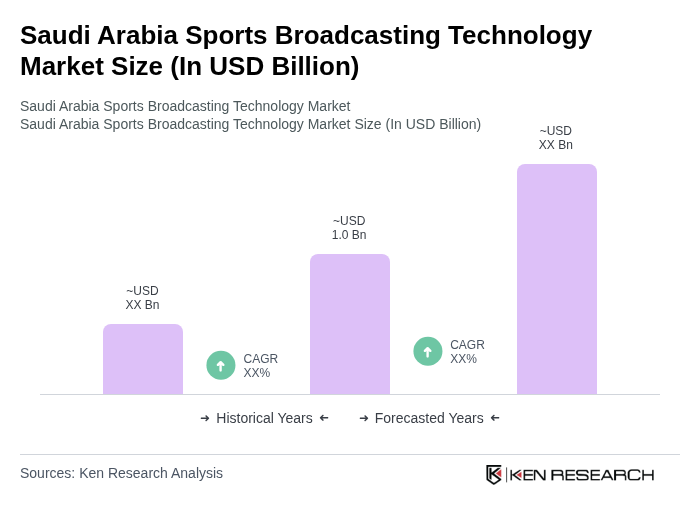
- The Saudi Arabia Sports Broadcasting Technology Market is valued at USD 1.0 billion, based on a five-year historical analysis. This growth is primarily driven by the increasing popularity of sports, strong government investments in sports infrastructure under Vision 2030, and the rapid rise of over-the-top (OTT) and digital platforms that enhance viewer engagement and accessibility.
- Key cities such as Riyadh, Jeddah, and Dammam dominate the market due to their large populations, higher income levels, intense economic activities, and the presence of major sports events and venues, including new and renovated stadiums aligned with Vision 2030 and international event hosting. These cities serve as hubs for broadcasting operations, production facilities, and digital media companies, and attract significant investments in sports technology, connectivity, and media infrastructure.
- In 2019, the Audio-Visual Media Law issued by the General Commission for Audiovisual Media (GCAM) established a licensing and authorization framework for audiovisual media services, including sports broadcasting, requiring broadcasters and on?demand platforms to obtain appropriate licenses, comply with content classification, and adhere to technical and ownership requirements. This framework, together with GCAM’s subsequent implementing regulations on audiovisual media and sports content, aims to streamline rights acquisition processes, enhance transparency, and support fair competition among broadcasters, ultimately improving consumer access to high?quality sports content.
Saudi Arabia Sports Broadcasting Technology Market Segmentation
By Component:
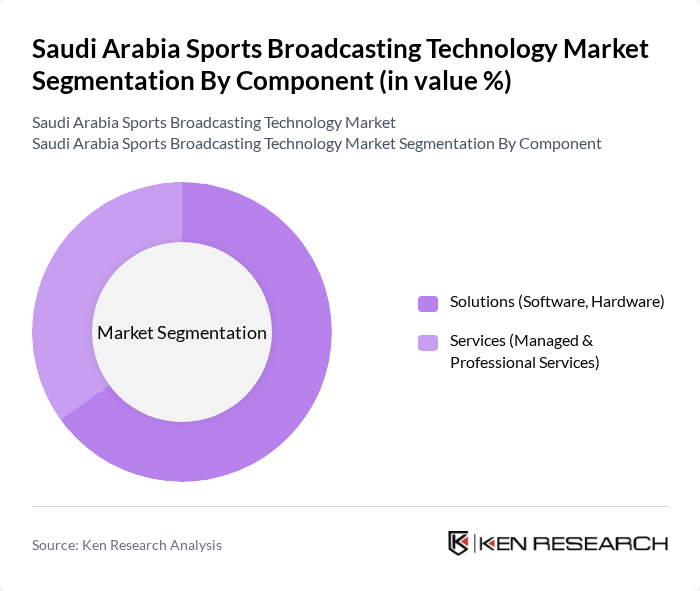
The components of the market include Solutions (Software, Hardware) and Services (Managed & Professional Services). The Solutions segment is currently leading the market, supported by industry data indicating that solution offerings generate the largest share of revenue, driven by the increasing demand for advanced contribution, production, and distribution technologies that enhance viewer experience and operational efficiency. Software solutions, particularly those that support high-definition, 4K, and IP?based broadcasting, OTT delivery, and cloud production workflows, are gaining traction as broadcasters and streaming platforms seek to provide superior content quality and personalized, multi?screen viewing experiences. The Services segment, while growing, is primarily driven by the need for professional expertise in systems integration, managed playout, cloud operations, and end?to?end management of complex live sports broadcasting and OTT platforms.
By Technology:
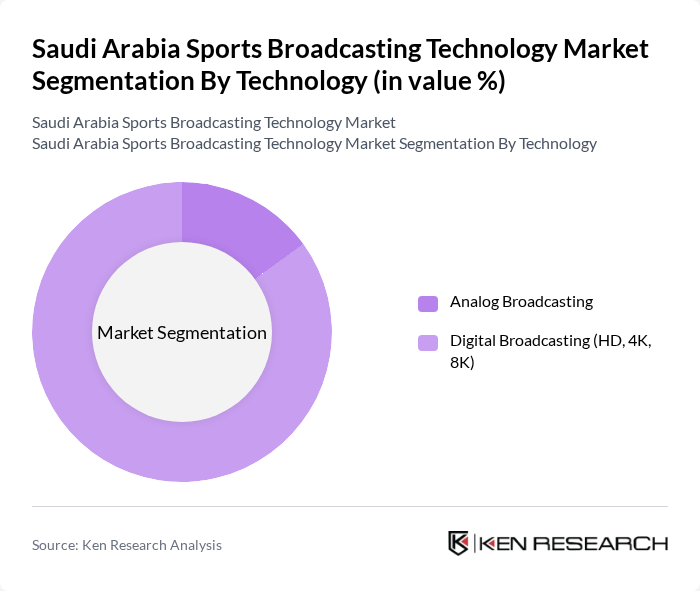
The technology segment encompasses Analog Broadcasting and Digital Broadcasting (HD, 4K, 8K). Digital Broadcasting is the dominant technology in the market, reflecting the broader transition from traditional linear and SD signals to IP-based, high-definition and ultra?high?definition workflows, driven by increasing consumer preference for high?quality video and interactive features on smart TVs, mobiles, and connected devices. The shift towards digital and OTT platforms has led to a steady decline in analog broadcasting infrastructure, which is being phased out in favor of more flexible, software?defined and cloud?enabled delivery models. The demand for 4K content, and early pilots of 8K and advanced formats such as HDR and immersive audio, is on the rise as rights holders and platforms in Saudi Arabia seek to differentiate live sports coverage and align with global best practices in premium sports production.
Saudi Arabia Sports Broadcasting Technology Market Competitive Landscape
The Saudi Arabia Sports Broadcasting Technology Market is characterized by a dynamic mix of regional and international players. Leading participants such as Saudi Sports Company (SSC), Saudi Broadcasting Authority (SBA) / KSA Sports, Saudi Telecom Company (stc) – including stc tv, Shahid (MBC Group), OSN (Orbit Showtime Network), beIN SPORTS (beIN Media Group), Intigral (Jawwy TV), Arabsat, Rotana Media Group, YouTube (sports channels and creators ecosystem), DAZN Group Ltd., StarzPlay Arabia, Snap Inc. (Snapchat sports content in KSA), Muvi Cinemas / Muvi Studios (sports and live events distribution), and Eutelsat Communications (satellite capacity for sports broadcasting) contribute to innovation, geographic expansion, and service delivery in this space through investments in rights acquisition, OTT platforms, satellite capacity, and next?generation production technologies.
Saudi Arabia Sports Broadcasting Technology Market Industry Analysis
Growth Drivers
- Increasing Viewership of Sports Events:The viewership of sports events in Saudi Arabia has surged, with an estimated 15 million people tuning in to major events in future. This growth is driven by a rising interest in both local and international sports, particularly football and motorsports. The Saudi Arabian Football Federation reported a 20% increase in attendance at local matches, indicating a strong cultural shift towards sports engagement, which directly boosts broadcasting demand.
- Technological Advancements in Broadcasting:The adoption of advanced broadcasting technologies, such as 4K and 8K resolution, has transformed the viewing experience. In future, over 30% of households in urban areas are expected to have access to high-definition broadcasts. The introduction of cloud-based broadcasting solutions has also improved content delivery, allowing broadcasters to reach wider audiences efficiently. This technological evolution is crucial for attracting younger viewers who demand high-quality content.
- Government Support for Sports Initiatives:The Saudi government has invested approximately $1.5 billion in sports infrastructure and broadcasting initiatives as part of its Vision 2030 plan. This includes funding for new stadiums and broadcasting facilities, which enhances the overall sports ecosystem. The government's commitment to hosting international sporting events, such as the Formula E and WWE events, further stimulates the broadcasting market by increasing content availability and viewer interest.
Market Challenges
- High Competition Among Broadcasters:The sports broadcasting market in Saudi Arabia is characterized by intense competition, with over 10 major broadcasters vying for audience attention. This competition leads to aggressive pricing strategies and content acquisition battles, which can strain profit margins. In future, the average revenue per user for sports channels is expected to face downward pressure, highlighting the challenges broadcasters face in maintaining profitability amidst fierce rivalry.
- Regulatory Hurdles:Broadcasters in Saudi Arabia must navigate complex regulatory frameworks that can hinder operational flexibility. Licensing requirements are stringent, with the Communications and Information Technology Commission (CITC) overseeing compliance. In future, a significant share of new broadcasting applications may face delays due to regulatory scrutiny, impacting the ability of new entrants to compete effectively in the market and potentially limiting innovation.
Saudi Arabia Sports Broadcasting Technology Market Future Outlook
The future of the Saudi Arabia sports broadcasting technology market appears promising, driven by ongoing technological innovations and increasing consumer demand for diverse content. The rise of mobile broadcasting solutions and the integration of artificial intelligence in content personalization are expected to enhance viewer engagement. Additionally, the government's continued investment in sports infrastructure will likely create new opportunities for broadcasters to expand their reach and improve service delivery, fostering a more competitive landscape.
Market Opportunities
- Expansion of eSports Broadcasting:The eSports sector in Saudi Arabia is rapidly growing, with an estimated audience of 5 million gamers in future. This presents a significant opportunity for broadcasters to tap into a lucrative market by offering dedicated eSports channels and content. Collaborations with gaming companies can further enhance viewer engagement and attract sponsorships, driving revenue growth.
- Partnerships with International Sports Leagues:Forming strategic partnerships with international sports leagues can provide Saudi broadcasters access to exclusive content and enhance their programming. In future, partnerships with leagues like the English Premier League and NBA have shown potential, with viewership reportedly increasing significantly following such deals. Such collaborations can elevate the broadcasting profile and attract a broader audience base.
Scope of the Report
| Segment | Sub-Segments |
|---|---|
| By Component | Solutions (Software, Hardware) Services (Managed & Professional Services) |
| By Technology | Analog Broadcasting Digital Broadcasting (HD, 4K, 8K) |
| By Platform | Television (Satellite, Cable, IPTV, DTT) OTT / Online Streaming Platforms Radio & Audio Streaming |
| By Application | Live Sports Production & Transmission Remote / Cloud Production Replay, Graphics & Data Visualization Content Distribution & Playout Fan Engagement & Interactivity |
| By End-User | Broadcasters & TV Networks OTT Platforms & Telcos Sports Clubs, Leagues & Federations Production Houses & Studios Others |
| By Deployment Model | On-Premises Cloud-Based Hybrid |
| By Region (Within Saudi Arabia) | Central Region (incl. Riyadh) Western Region (incl. Jeddah, Makkah, Madinah) Eastern Region (incl. Dammam, Khobar) Northern & Southern Regions Others |
Key Target Audience
Investors and Venture Capitalist Firms
Government and Regulatory Bodies (e.g., Saudi Arabian General Investment Authority, Ministry of Media)
Broadcasting Networks and Media Companies
Sports Organizations and Federations
Telecommunications Providers
Advertising Agencies
Technology Providers and Equipment Manufacturers
Event Organizers and Promoters
Players Mentioned in the Report:
Saudi Sports Company (SSC)
Saudi Broadcasting Authority (SBA) / KSA Sports
Saudi Telecom Company (stc) Including stc tv
Shahid (MBC Group)
OSN (Orbit Showtime Network)
beIN SPORTS (beIN Media Group)
Intigral (Jawwy TV)
Arabsat
Rotana Media Group
YouTube (Sports Channels & Creators Ecosystem)
DAZN Group Ltd.
StarzPlay Arabia
Snap Inc. (Snapchat Sports Content in KSA)
Muvi Cinemas / Muvi Studios (Sports & Live Events Distribution)
Eutelsat Communications (Satellite Capacity for Sports Broadcasting)
Table of Contents
Market Assessment Phase
1. Executive Summary and Approach
2. Saudi Arabia Sports Broadcasting Technology Market Overview
2.1 Key Insights and Strategic Recommendations
2.2 Saudi Arabia Sports Broadcasting Technology Market Overview
2.3 Definition and Scope
2.4 Evolution of Market Ecosystem
2.5 Timeline of Key Regulatory Milestones
2.6 Value Chain & Stakeholder Mapping
2.7 Business Cycle Analysis
2.8 Policy & Incentive Landscape
3. Saudi Arabia Sports Broadcasting Technology Market Analysis
3.1 Growth Drivers
3.1.1 Increasing viewership of sports events
3.1.2 Technological advancements in broadcasting
3.1.3 Government support for sports initiatives
3.1.4 Rise of digital streaming platforms
3.2 Market Challenges
3.2.1 High competition among broadcasters
3.2.2 Regulatory hurdles
3.2.3 Infrastructure limitations in remote areas
3.2.4 Rapid technological changes
3.3 Market Opportunities
3.3.1 Expansion of eSports broadcasting
3.3.2 Partnerships with international sports leagues
3.3.3 Investment in augmented and virtual reality
3.3.4 Growth of mobile broadcasting solutions
3.4 Market Trends
3.4.1 Shift towards OTT (Over-the-Top) services
3.4.2 Increased focus on personalized content
3.4.3 Integration of AI in broadcasting
3.4.4 Rise of social media as a broadcasting platform
3.5 Government Regulation
3.5.1 Licensing requirements for broadcasters
3.5.2 Content censorship regulations
3.5.3 Advertising regulations in sports broadcasting
3.5.4 Compliance with international broadcasting standards
4. SWOT Analysis
5. Stakeholder Analysis
6. Porter's Five Forces Analysis
7. Saudi Arabia Sports Broadcasting Technology Market Market Size, 2019-2024
7.1 By Value
7.2 By Volume
7.3 By Average Selling Price
8. Saudi Arabia Sports Broadcasting Technology Market Segmentation
8.1 By Component
8.1.1 Solutions (Software, Hardware)
8.1.2 Services (Managed & Professional Services)
8.2 By Technology
8.2.1 Analog Broadcasting
8.2.2 Digital Broadcasting (HD, 4K, 8K)
8.3 By Platform
8.3.1 Television (Satellite, Cable, IPTV, DTT)
8.3.2 OTT / Online Streaming Platforms
8.3.3 Radio & Audio Streaming
8.4 By Application
8.4.1 Live Sports Production & Transmission
8.4.2 Remote / Cloud Production
8.4.3 Replay, Graphics & Data Visualization
8.4.4 Content Distribution & Playout
8.4.5 Fan Engagement & Interactivity
8.5 By End-User
8.5.1 Broadcasters & TV Networks
8.5.2 OTT Platforms & Telcos
8.5.3 Sports Clubs, Leagues & Federations
8.5.4 Production Houses & Studios
8.5.5 Others
8.6 By Deployment Model
8.6.1 On-Premises
8.6.2 Cloud-Based
8.6.3 Hybrid
8.7 By Region (Within Saudi Arabia)
8.7.1 Central Region (incl. Riyadh)
8.7.2 Western Region (incl. Jeddah, Makkah, Madinah)
8.7.3 Eastern Region (incl. Dammam, Khobar)
8.7.4 Northern & Southern Regions
8.7.5 Others
9. Saudi Arabia Sports Broadcasting Technology Market Competitive Analysis
9.1 Market Share of Key Players
9.2 Cross Comparison of Key Players
9.2.1 Company Name
9.2.2 Group Size (Large, Medium, or Small as per industry convention)
9.2.3 Saudi Arabia Sports Broadcasting Technology Revenue
9.2.4 Revenue Growth Rate in Saudi Arabia
9.2.5 Number of Sports Rights / Properties Held
9.2.6 Number of Active Sports Channels / Feeds
9.2.7 Average Viewership / Monthly Active Users (MAUs) in Saudi Arabia
9.2.8 Average Revenue Per User (ARPU) in Saudi Arabia
9.2.9 HD / 4K Penetration in Sports Broadcasts
9.2.10 Share of OTT / Digital in Total Sports Audiences
9.2.11 Content Delivery Network (CDN) Performance Metrics (Latency, Uptime)
9.2.12 Sports Broadcasting Capex / Technology Investment per Year
9.3 SWOT Analysis of Top Players
9.4 Pricing Analysis
9.5 Detailed Profile of Major Companies
9.5.1 Saudi Sports Company (SSC)
9.5.2 Saudi Broadcasting Authority (SBA) / KSA Sports
9.5.3 Saudi Telecom Company (stc) – Including stc tv
9.5.4 Shahid (MBC Group)
9.5.5 OSN (Orbit Showtime Network)
9.5.6 beIN SPORTS (beIN Media Group)
9.5.7 Intigral (Jawwy TV)
9.5.8 Arabsat
9.5.9 Rotana Media Group
9.5.10 YouTube (Sports Channels & Creators Ecosystem)
9.5.11 DAZN Group Ltd.
9.5.12 StarzPlay Arabia
9.5.13 Snap Inc. (Snapchat Sports Content in KSA)
9.5.14 Muvi Cinemas / Muvi Studios (Sports & Live Events Distribution)
9.5.15 Eutelsat Communications (Satellite Capacity for Sports Broadcasting)
10. Saudi Arabia Sports Broadcasting Technology Market End-User Analysis
10.1 Procurement Behavior of Key Ministries
10.1.1 Ministry of Sports
10.1.2 Ministry of Communications and Information Technology
10.1.3 Ministry of Education
10.1.4 Ministry of Culture
10.1.5 Others
10.2 Corporate Spend on Infrastructure & Energy
10.2.1 Investment in Broadcasting Infrastructure
10.2.2 Spending on Technology Upgrades
10.2.3 Budget Allocation for Sports Events
10.2.4 Sponsorship and Advertising Budgets
10.2.5 Others
10.3 Pain Point Analysis by End-User Category
10.3.1 Content Accessibility Issues
10.3.2 Quality of Service Concerns
10.3.3 Pricing Affordability
10.3.4 Regulatory Compliance Challenges
10.3.5 Others
10.4 User Readiness for Adoption
10.4.1 Awareness of New Technologies
10.4.2 Willingness to Pay for Premium Content
10.4.3 Technical Skills of Users
10.4.4 Availability of Support Services
10.4.5 Others
10.5 Post-Deployment ROI and Use Case Expansion
10.5.1 Measurement of Viewer Engagement
10.5.2 Analysis of Revenue Growth
10.5.3 Expansion into New Markets
10.5.4 User Feedback and Improvement
10.5.5 Others
11. Saudi Arabia Sports Broadcasting Technology Market Future Size, 2025-2030
11.1 By Value
11.2 By Volume
11.3 By Average Selling Price
Go-To-Market Strategy Phase
1. Whitespace Analysis + Business Model Canvas
1.1 Market Gaps Identification
1.2 Business Model Development
2. Marketing and Positioning Recommendations
2.1 Branding Strategies
2.2 Product USPs
3. Distribution Plan
3.1 Urban Retail Strategies
3.2 Rural NGO Tie-Ups
4. Channel & Pricing Gaps
4.1 Underserved Routes
4.2 Pricing Bands
5. Unmet Demand & Latent Needs
5.1 Category Gaps
5.2 Consumer Segments
6. Customer Relationship
6.1 Loyalty Programs
6.2 After-Sales Service
7. Value Proposition
7.1 Sustainability Initiatives
7.2 Integrated Supply Chains
8. Key Activities
8.1 Regulatory Compliance
8.2 Branding Efforts
8.3 Distribution Setup
9. Entry Strategy Evaluation
9.1 Domestic Market Entry Strategy
9.1.1 Product Mix
9.1.2 Pricing Band
9.1.3 Packaging Strategies
9.2 Export Entry Strategy
9.2.1 Target Countries
9.2.2 Compliance Roadmap
10. Entry Mode Assessment
10.1 Joint Ventures
10.2 Greenfield Investments
10.3 Mergers & Acquisitions
10.4 Distributor Model
11. Capital and Timeline Estimation
11.1 Capital Requirements
11.2 Timelines
12. Control vs Risk Trade-Off
12.1 Ownership vs Partnerships
13. Profitability Outlook
13.1 Breakeven Analysis
13.2 Long-Term Sustainability
14. Potential Partner List
14.1 Distributors
14.2 Joint Ventures
14.3 Acquisition Targets
15. Execution Roadmap
15.1 Phased Plan for Market Entry
15.1.1 Market Setup
15.1.2 Market Entry
15.1.3 Growth Acceleration
15.1.4 Scale & Stabilize
15.2 Key Activities and Milestones
15.2.1 Milestone Planning
15.2.2 Activity Tracking
Research Methodology
Phase 1: Approach1
Desk Research
- Analysis of industry reports from sports broadcasting associations and technology journals
- Review of government publications and regulations impacting sports broadcasting in Saudi Arabia
- Examination of market trends and forecasts from reputable market research firms
Primary Research
- Interviews with executives from leading sports broadcasting companies in Saudi Arabia
- Surveys targeting technology providers and equipment manufacturers in the sports sector
- Field interviews with sports event organizers and media rights holders
Validation & Triangulation
- Cross-validation of findings through multiple data sources including trade publications and expert opinions
- Triangulation of market data with insights from industry conferences and seminars
- Sanity checks conducted through expert panel reviews and feedback sessions
Phase 2: Market Size Estimation1
Top-down Assessment
- Estimation of market size based on national sports viewership statistics and advertising revenue
- Segmentation of the market by technology type, including OTT, satellite, and cable broadcasting
- Incorporation of growth rates from related sectors such as telecommunications and digital media
Bottom-up Modeling
- Collection of data on equipment sales and service contracts from major technology providers
- Estimation of revenue generated from subscription models and pay-per-view services
- Volume and pricing analysis based on historical data from sports broadcasting contracts
Forecasting & Scenario Analysis
- Multi-factor regression analysis incorporating factors such as population growth and digital adoption rates
- Scenario modeling based on potential regulatory changes and technological advancements
- Development of baseline, optimistic, and pessimistic forecasts through 2030
Phase 3: CATI Sample Composition1
| Scope Item/Segment | Sample Size | Target Respondent Profiles |
|---|---|---|
| Broadcasting Technology Providers | 100 | CTOs, Product Managers |
| Sports Event Organizers | 80 | Event Managers, Marketing Directors |
| Media Rights Holders | 70 | Legal Advisors, Business Development Managers |
| Advertising Agencies in Sports | 60 | Account Executives, Media Planners |
| Telecommunications Companies | 90 | Network Engineers, Sales Directors |
Frequently Asked Questions
What is the current value of the Saudi Arabia Sports Broadcasting Technology Market?
The Saudi Arabia Sports Broadcasting Technology Market is valued at approximately USD 1.0 billion, reflecting a significant growth driven by increased sports popularity, government investments in infrastructure, and the rise of digital platforms enhancing viewer engagement.
What factors are driving growth in the Saudi Arabia Sports Broadcasting Technology Market?
Which cities are the main hubs for sports broadcasting in Saudi Arabia?
What regulatory framework governs sports broadcasting in Saudi Arabia?
Other Regional/Country Reports
Indonesia Sports Broadcasting Technology Market
Malaysia Sports Broadcasting Technology Market
KSA Sports Broadcasting Technology Market
APAC Sports Broadcasting Technology Market
SEA Sports Broadcasting Technology Market
Vietnam Sports Broadcasting Technology Market
Other Adjacent Reports
Kuwait Sports OTT Platforms Market
KSA Sports Analytics Software Market
UAE Digital Content Distribution Market
South Korea Satellite Broadcasting Services Market
Thailand Cloud-Based Media Solutions Market
South Africa Virtual Reality Sports Experiences Market
Brazil eSports Broadcasting Market
Thailand Mobile Streaming Technology Market
Malaysia Sports Advertising Technology Market
Bahrain Augmented Reality in Sports Market
Why Buy From Us?

What makes us stand out is that our consultants follow Robust, Refine and Result (RRR) methodology. Robust for clear definitions, approaches and sanity checking, Refine for differentiating respondents' facts and opinions, and Result for presenting data with story.

We have set a benchmark in the industry by offering our clients with syndicated and customized market research reports featuring coverage of entire market as well as meticulous research and analyst insights.

While we don't replace traditional research, we flip the method upside down. Our dual approach of Top Bottom & Bottom Top ensures quality deliverable by not just verifying company fundamentals but also looking at the sector and macroeconomic factors.

With one step in the future, our research team constantly tries to show you the bigger picture. We help with some of the tough questions you may encounter along the way: How is the industry positioned? Best marketing channel? KPI's of competitors? By aligning every element, we help maximize success.

Our report gives you instant access to the answers and sources that other companies might choose to hide. We elaborate each steps of research methodology we have used and showcase you the sample size to earn your trust.

If you need any support, we are here! We pride ourselves on universe strength, data quality, and quick, friendly, and professional service.