Region:Middle East
Author(s):Shubham
Product Code:KRAD2455
Pages:98
Published On:January 2026
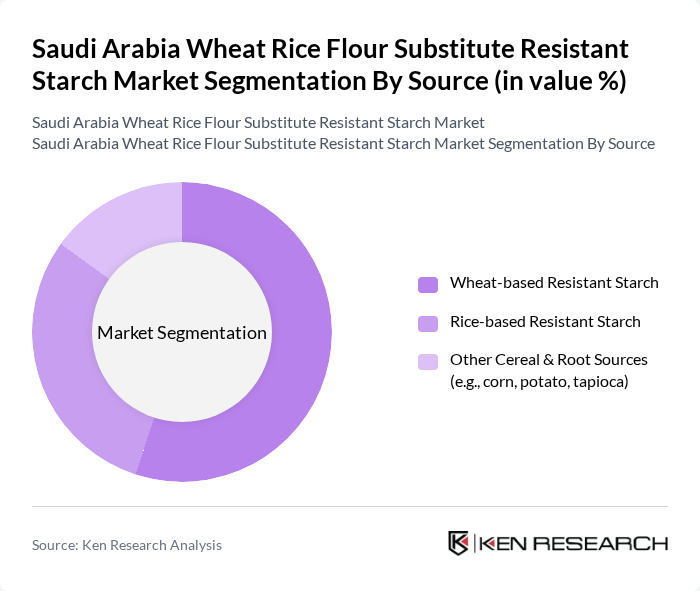
By Source:The market is segmented into three primary sources: Wheat-based Resistant Starch, Rice-based Resistant Starch, and Other Cereal & Root Sources (e.g., corn, potato, tapioca). Wheat-based resistant starch is currently the leading subsegment, supported by the strong penetration of wheat flour in bakery, snacks, and foodservice applications in Saudi Arabia and the broader Middle East, as well as the ease of integrating wheat-derived resistant starch into existing formulations. Rice-based resistant starch is gaining traction in gluten?sensitive consumer segments and in better?for?you rice and instant meal offerings, in line with the high per?capita rice consumption in the region. Other cereal and root sources, such as corn, potato, and tapioca, are emerging as alternatives, particularly among health-conscious consumers and manufacturers seeking diverse texturizing and fiber solutions for clean?label and plant?based products.
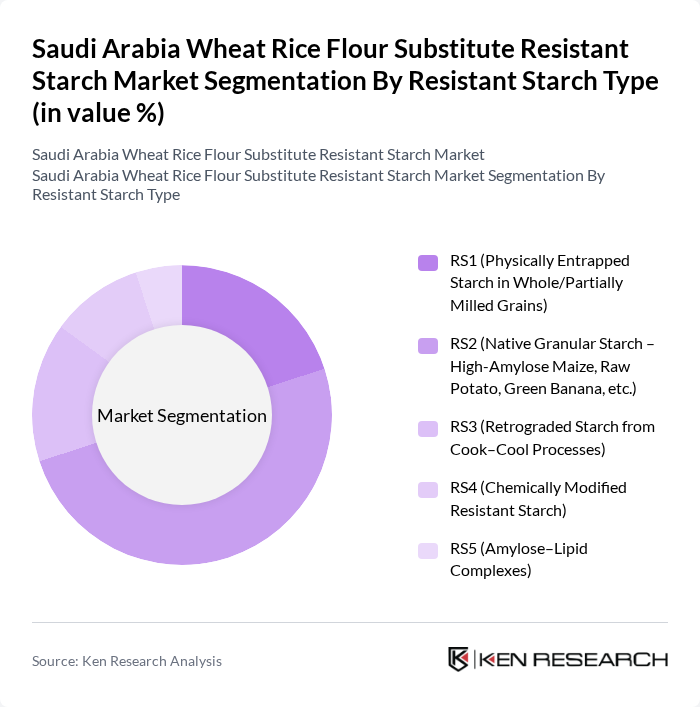
By Resistant Starch Type:This segmentation includes RS1 (Physically Entrapped Starch in Whole/Partially Milled Grains), RS2 (Native Granular Starch – High-Amylose Maize, Raw Potato, Green Banana, etc.), RS3 (Retrograded Starch from Cook–Cool Processes), RS4 (Chemically Modified Resistant Starch), and RS5 (Amylose–Lipid Complexes). RS2 is a major type used in the market, aligned with global trends where RS2 and RS3 hold significant shares due to their physiological benefits and compatibility with bakery, cereal, and snack formats. RS3 is also gaining popularity because it is generated through cook–cool processes in breads, pasta, and rice-based foods and offers improved digestive health and glycemic response, which are key positioning angles in Saudi retail and foodservice. RS1 and RS4 tend to be utilized in more specific niches, such as high?fiber wholegrain formulations and applications requiring tailored functional properties, while RS5 remains a smaller, emerging segment linked to advanced product development.
The Saudi Arabia Wheat Rice Flour Substitute Resistant Starch Market is characterized by a dynamic mix of regional and international players. Leading participants such as Cargill, Incorporated, Archer Daniels Midland Company (ADM), Ingredion Incorporated, Tate & Lyle PLC, Roquette Frères, Emsland Group, Tereos Group, Grain Processing Corporation, Royal Cosun / Avebe, AGRANA Beteiligungs-AG, Local Saudi Starch & Ingredients Manufacturers, Regional GCC Food Ingredient Blenders & Distributors, Multinational Bakery & Snack OEMs Active in Saudi Arabia, Emerging Specialist Resistant Starch Start-ups (Global), Contract Manufacturers & Toll Processors Serving the Saudi Market contribute to innovation, geographic expansion, and service delivery in this space.
The future of the resistant starch market in Saudi Arabia appears promising, driven by increasing health awareness and a growing preference for gluten-free products. As the food processing industry expands, manufacturers are likely to innovate and incorporate resistant starch into a wider range of products. Additionally, the government's support for agricultural innovation will likely enhance production capabilities, making resistant starch more accessible to consumers. This evolving landscape presents significant opportunities for growth and diversification in the market.
| Segment | Sub-Segments |
|---|---|
| By Source | Wheat-based Resistant Starch Rice-based Resistant Starch Other Cereal & Root Sources (e.g., corn, potato, tapioca) |
| By Resistant Starch Type | RS1 (Physically Entrapped Starch in Whole/Partially Milled Grains) RS2 (Native Granular Starch – High-Amylose Maize, Raw Potato, Green Banana, etc.) RS3 (Retrograded Starch from Cook–Cool Processes) RS4 (Chemically Modified Resistant Starch) RS5 (Amylose–Lipid Complexes) |
| By Application | Bakery & Baked Goods (breads, flatbreads, cakes, biscuits) Snacks & Convenience Foods Noodles, Pasta & Dough-based Products Dairy & Dairy Alternatives Nutraceuticals & Dietary Supplements Others (including clinical & medical nutrition) |
| By Functionality | Dietary Fibre Enrichment & Glycaemic Control Texturizing & Fat Replacement Calorie Reduction & Sugar Replacement Support Clean-label & Gluten-free Formulation |
| By End-User Industry | Food & Beverage Manufacturers Bakery & Confectionery Processors Nutraceutical & Supplement Manufacturers Foodservice & HoReCa (Hotels, Restaurants, Cafés) Others |
| By Distribution Channel | Direct Institutional Sales (B2B) Distributors & Wholesalers Online B2B Platforms Others |
| By Region (Saudi Arabia) | Central Region Eastern Region Western Region Southern Region |
| Scope Item/Segment | Sample Size | Target Respondent Profiles |
|---|---|---|
| Retail Market for Flour Substitutes | 120 | Store Managers, Category Buyers |
| Food Manufacturing Sector | 90 | Production Managers, Quality Assurance Specialists |
| Health and Wellness Segment | 80 | Nutritional Experts, Dietitians |
| Consumer Insights on Resistant Starch | 110 | Health-Conscious Consumers, Fitness Enthusiasts |
| Distribution Channels for Flour Products | 75 | Logistics Coordinators, Supply Chain Analysts |
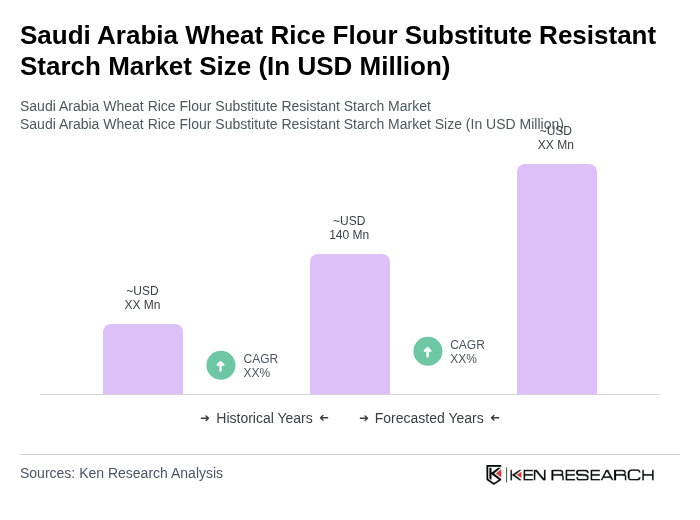
The Saudi Arabia Wheat Rice Flour Substitute Resistant Starch Market is valued at approximately USD 140 million, reflecting a growing demand for healthier food ingredients driven by health consciousness and rising obesity rates in the Kingdom.

What makes us stand out is that our consultants follow Robust, Refine and Result (RRR) methodology. Robust for clear definitions, approaches and sanity checking, Refine for differentiating respondents' facts and opinions, and Result for presenting data with story.

We have set a benchmark in the industry by offering our clients with syndicated and customized market research reports featuring coverage of entire market as well as meticulous research and analyst insights.

While we don't replace traditional research, we flip the method upside down. Our dual approach of Top Bottom & Bottom Top ensures quality deliverable by not just verifying company fundamentals but also looking at the sector and macroeconomic factors.

With one step in the future, our research team constantly tries to show you the bigger picture. We help with some of the tough questions you may encounter along the way: How is the industry positioned? Best marketing channel? KPI's of competitors? By aligning every element, we help maximize success.

Our report gives you instant access to the answers and sources that other companies might choose to hide. We elaborate each steps of research methodology we have used and showcase you the sample size to earn your trust.

If you need any support, we are here! We pride ourselves on universe strength, data quality, and quick, friendly, and professional service.













