South Africa EdTech Digital Platforms Market

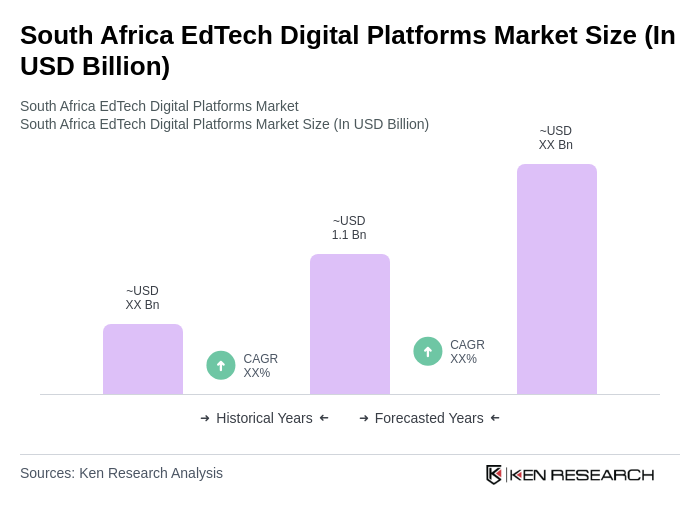
The South Africa EdTech Digital Platforms Market, worth USD 1.1 billion, grows with rising internet access and mobile platforms, focusing on personalized learning and urban innovation.

Region:Africa

Author(s):Geetanshi

Product Code:KRAB5165

Pages:93

Published On:October 2025
About the Report

Base Year 2024

South Africa EdTech Digital Platforms Market Overview

  • The South Africa EdTech Digital Platforms Market is valued at USD 1.1 billion, based on a five-year historical analysis. This growth is primarily driven by the increasing adoption of digital learning solutions, rising internet penetration, and the demand for flexible, personalized education experiences. The market has seen a significant shift towards online and mobile-first learning platforms, especially in response to the COVID-19 pandemic, which accelerated the transition to digital education. Mobile-first platforms are particularly prominent, with smartphone penetration exceeding 190% and internet penetration reaching nearly 75% in South Africa, enabling broad access to digital education resources even in low-bandwidth environments .
  • Key cities such as Johannesburg, Cape Town, and Durban continue to dominate the South African EdTech market due to robust digital infrastructure, high population density, and a concentration of educational institutions. These urban centers serve as hubs for innovation and technology, attracting both local and international EdTech companies seeking to capitalize on the growing demand for digital learning solutions .
  • In 2023, the South African government implemented the National Digital and Future Skills Strategy, issued by the Department of Communications and Digital Technologies. This policy aims to enhance digital literacy and integrate technology into the education system nationwide. The initiative includes a dedicated budget of USD 200 million to support the development of digital learning resources and educator training programs, fostering a more inclusive and technologically advanced educational environment .
South Africa EdTech Digital Platforms Market Size

South Africa EdTech Digital Platforms Market Segmentation

By Type:The EdTech market in South Africa is segmented into Learning Management Systems (LMS), Online Course Platforms, Assessment Tools, Tutoring Services, Educational Games, Content Creation Platforms, Virtual Classrooms, Collaboration Tools, Analytics and Reporting Tools, Adaptive Learning Platforms, Communication & Parent Engagement Apps, and Others. Among these, Learning Management Systems (LMS) have emerged as the dominant segment, supported by their ability to streamline educational processes and enhance the learning experience through centralized content management and student performance tracking. E-learning platforms and school administration solutions also account for a significant share, reflecting the sector’s focus on scalable, accessible digital education .
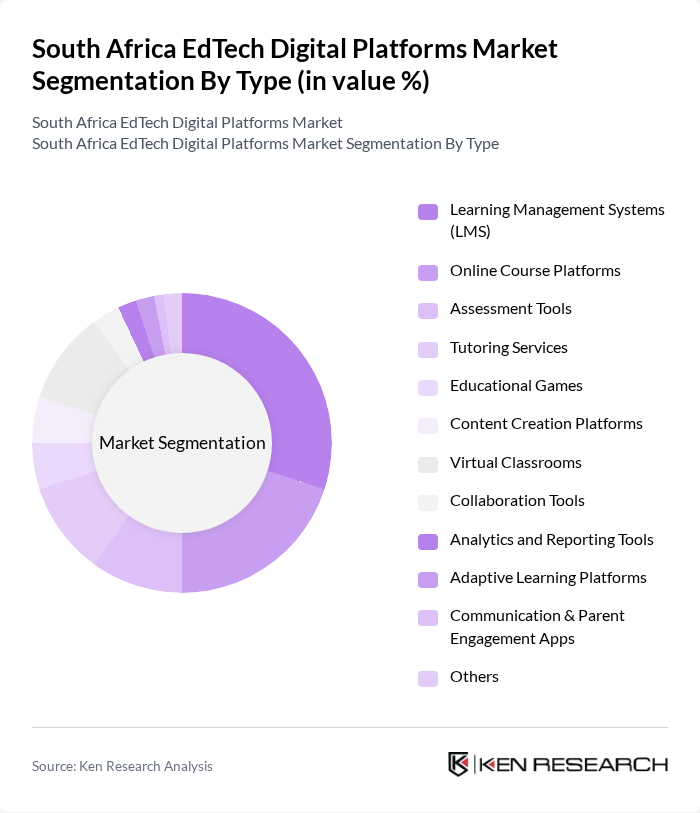
South Africa EdTech Digital Platforms Market segmentation by Type.

By End-User:The end-user segmentation of the EdTech market includes Primary Schools, Secondary Schools, Private and Independent Schools, Government Educational Bodies, Private Tutoring Centers, Homeschooling Networks, and Others. The primary schools segment is currently leading the market, driven by the increasing emphasis on foundational education and the integration of technology in early learning environments, which enhances student engagement and learning outcomes. K-12 (basic education) accounts for the largest share of the market, reflecting the sector’s focus on improving access and quality at the foundational level .
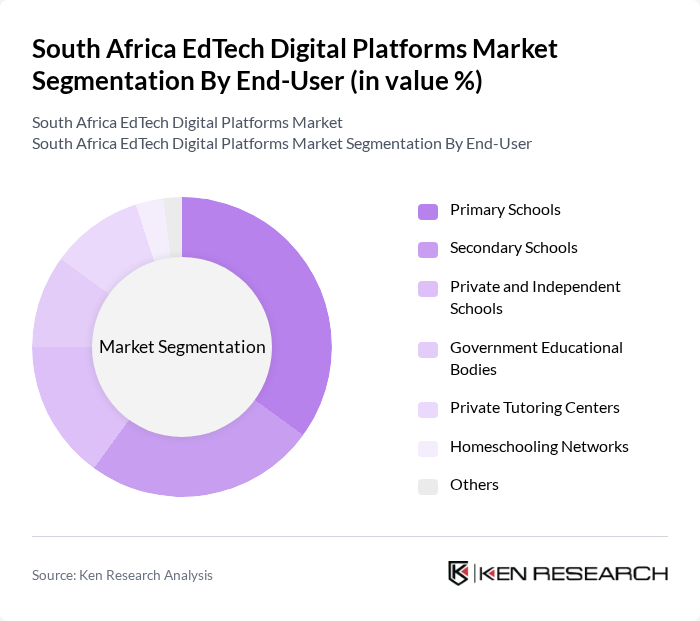
South Africa EdTech Digital Platforms Market segmentation by End-User.

South Africa EdTech Digital Platforms Market Competitive Landscape

The South Africa EdTech Digital Platforms Market is characterized by a dynamic mix of regional and international players. Leading participants such as D6 School Communicator, GetSmarter, Siyavula Education, Snapplify, The Student Hub, FoondaMate, Mindset Learn, TeachMe2, iXperience, Digicampus, Eduvation, Enko Education, Valenture Institute, Reflective Learning, and Click Learning contribute to innovation, geographic expansion, and service delivery in this space.

D6 School Communicator

2010

Pretoria, South Africa

GetSmarter

2008

Cape Town, South Africa

Siyavula Education

2012

Cape Town, South Africa

Snapplify

2012

Cape Town, South Africa

The Student Hub

2015

Cape Town, South Africa

Company

Establishment Year

Headquarters

Group Size (Large, Medium, Small)

Customer Acquisition Cost (CAC)

Monthly Active Users (MAU)

Customer Retention Rate

Average Revenue Per User (ARPU)

Pricing Strategy (Subscription, Freemium, Licensing, etc.)

South Africa EdTech Digital Platforms Market Industry Analysis

Growth Drivers

  • Increased Internet Penetration:South Africa's internet penetration rate is approximately72%with around43 millionusers accessing online content. This growth is driven by affordable mobile data plans, which have decreased byabout 30%since 2020. The expansion of 4G and 5G networks has also facilitated access to digital platforms, enabling more learners to engage with EdTech solutions. This connectivity is crucial for the adoption of online learning tools and resources, enhancing educational opportunities across the country.
  • Government Initiatives for Digital Learning:The South African government allocatedapproximately ZAR 1.5 billion (about USD 80 million)to enhance digital learning infrastructure in schools. Initiatives such as the "Digital Learning Strategy" aim to integrate technology into the curriculum, promoting the use of EdTech platforms. This funding supports the development of digital resources and training for educators, ensuring that both teachers and students are equipped to utilize these technologies effectively, thereby driving market growth.
  • Rising Demand for Remote Learning Solutions:The COVID-19 pandemic accelerated the demand for remote learning solutions, with a reportedover 40% increasein online course enrollments. Currently, more than1 millionlearners are engaged in online education platforms, reflecting a shift in educational preferences. This trend is supported by the growing recognition of the flexibility and accessibility that digital learning offers, particularly for non-traditional students and those in remote areas, further propelling the EdTech market.

Market Challenges

  • Limited Access to Technology in Rural Areas:Approximately32%of South Africa's population resides in rural areas, where access to technology remains a significant barrier. Onlyabout 37% of rural householdshave internet access, compared toover 80% in urban regions. This digital divide hampers the ability of rural students to benefit from EdTech platforms, limiting the overall market potential and exacerbating educational inequalities across the country.
  • High Cost of Digital Infrastructure:The cost of implementing digital infrastructure in educational institutions is a major challenge, with estimates indicating that schools require an average investment ofZAR 500,000 (about USD 27,000)to upgrade their facilities. Many institutions struggle to secure funding for such investments, which can hinder the adoption of EdTech solutions. This financial barrier limits the ability of schools to provide necessary resources and technology for effective digital learning environments.

South Africa EdTech Digital Platforms Market Future Outlook

The South African EdTech market is poised for significant transformation as technological advancements and educational reforms converge. With a focus on personalized learning experiences and the integration of AI, platforms are expected to evolve, catering to diverse learner needs. Additionally, the emphasis on data privacy and security will shape the development of new solutions. As partnerships between EdTech companies and educational institutions grow, the market will likely see innovative approaches to learning, enhancing accessibility and engagement for all students.

Market Opportunities

  • Expansion of Mobile Learning Platforms:Withover 90% of internet usersaccessing the web via mobile devices, there is a substantial opportunity for mobile learning platforms to thrive. The demand for mobile-optimized educational content is expected to increase, allowing EdTech companies to reach a broader audience and enhance user engagement through interactive and accessible learning experiences.
  • Partnerships with Educational Institutions:Collaborations between EdTech firms and educational institutions can drive innovation and resource sharing.Over 200 partnershipsare anticipated to form, focusing on curriculum development and technology integration. These partnerships will facilitate the creation of tailored educational solutions, improving learning outcomes and expanding market reach for EdTech providers.

Scope of the Report

SegmentSub-Segments
By Type

Learning Management Systems (LMS)

Online Course Platforms

Assessment Tools

Tutoring Services

Educational Games

Content Creation Platforms

Virtual Classrooms

Collaboration Tools

Analytics and Reporting Tools

Adaptive Learning Platforms

Communication & Parent Engagement Apps

Others

By End-User

Primary Schools

Secondary Schools

Private and Independent Schools

Government Educational Bodies

Private Tutoring Centers

Homeschooling Networks

Others

By Application

Curriculum Delivery

Student Assessment

Teacher Professional Development

Parental Engagement

School Administration & Reporting

Others

By Distribution Channel

Direct Sales

Online Marketplaces

Resellers and Distributors

Partnerships with Schools & Districts

Telecom Bundling & Data Partnerships

Others

By Pricing Model

Subscription-Based

Pay-Per-Use

Freemium Models

Licensing Fees

Institutional Contracts

Others

By Content Type

Textbooks and E-Books

Video Content

Interactive Simulations

Quizzes and Assessments

Gamified Content

Others

By User Demographics

Age Group

Learning Styles

Socioeconomic Status

Language Preference

Others

Key Target Audience

Investors and Venture Capitalist Firms

Government and Regulatory Bodies (e.g., Department of Basic Education, Department of Higher Education and Training)

Telecommunications Companies

Content Developers and Publishers

Non-Governmental Organizations (NGOs) focused on Education

Corporate Training Providers

Technology Providers and Software Developers

Educational Technology Associations

Players Mentioned in the Report:

D6 School Communicator

GetSmarter

Siyavula Education

Snapplify

The Student Hub

FoondaMate

Mindset Learn

TeachMe2

iXperience

Digicampus

Eduvation

Enko Education

Valenture Institute

Reflective Learning

Click Learning

Table of Contents

Market Assessment Phase

1. Executive Summary and Approach


2. South Africa EdTech Digital Platforms Market Overview

2.1 Key Insights and Strategic Recommendations

2.2 South Africa EdTech Digital Platforms Market Overview

2.3 Definition and Scope

2.4 Evolution of Market Ecosystem

2.5 Timeline of Key Regulatory Milestones

2.6 Value Chain & Stakeholder Mapping

2.7 Business Cycle Analysis

2.8 Policy & Incentive Landscape


3. South Africa EdTech Digital Platforms Market Analysis

3.1 Growth Drivers

3.1.1 Increased Internet Penetration
3.1.2 Government Initiatives for Digital Learning
3.1.3 Rising Demand for Remote Learning Solutions
3.1.4 Investment in Educational Technology Startups

3.2 Market Challenges

3.2.1 Limited Access to Technology in Rural Areas
3.2.2 High Cost of Digital Infrastructure
3.2.3 Resistance to Change from Traditional Education Models
3.2.4 Regulatory Compliance Issues

3.3 Market Opportunities

3.3.1 Expansion of Mobile Learning Platforms
3.3.2 Partnerships with Educational Institutions
3.3.3 Development of Localized Content
3.3.4 Growth of Corporate Training Programs

3.4 Market Trends

3.4.1 Gamification in Learning
3.4.2 AI and Machine Learning Integration
3.4.3 Personalized Learning Experiences
3.4.4 Increased Focus on Data Privacy and Security

3.5 Government Regulation

3.5.1 National Education Policy Reforms
3.5.2 Data Protection Regulations
3.5.3 Funding for EdTech Initiatives
3.5.4 Accreditation Standards for Online Courses

4. SWOT Analysis


5. Stakeholder Analysis


6. Porter's Five Forces Analysis


7. South Africa EdTech Digital Platforms Market Market Size, 2019-2024

7.1 By Value

7.2 By Volume

7.3 By Average Selling Price


8. South Africa EdTech Digital Platforms Market Segmentation

8.1 By Type

8.1.1 Learning Management Systems (LMS)
8.1.2 Online Course Platforms
8.1.3 Assessment Tools
8.1.4 Tutoring Services
8.1.5 Educational Games
8.1.6 Content Creation Platforms
8.1.7 Virtual Classrooms
8.1.8 Collaboration Tools
8.1.9 Analytics and Reporting Tools
8.1.10 Adaptive Learning Platforms
8.1.11 Communication & Parent Engagement Apps
8.1.12 Others

8.2 By End-User

8.2.1 Primary Schools
8.2.2 Secondary Schools
8.2.3 Private and Independent Schools
8.2.4 Government Educational Bodies
8.2.5 Private Tutoring Centers
8.2.6 Homeschooling Networks
8.2.7 Others

8.3 By Application

8.3.1 Curriculum Delivery
8.3.2 Student Assessment
8.3.3 Teacher Professional Development
8.3.4 Parental Engagement
8.3.5 School Administration & Reporting
8.3.6 Others

8.4 By Distribution Channel

8.4.1 Direct Sales
8.4.2 Online Marketplaces
8.4.3 Resellers and Distributors
8.4.4 Partnerships with Schools & Districts
8.4.5 Telecom Bundling & Data Partnerships
8.4.6 Others

8.5 By Pricing Model

8.5.1 Subscription-Based
8.5.2 Pay-Per-Use
8.5.3 Freemium Models
8.5.4 Licensing Fees
8.5.5 Institutional Contracts
8.5.6 Others

8.6 By Content Type

8.6.1 Textbooks and E-Books
8.6.2 Video Content
8.6.3 Interactive Simulations
8.6.4 Quizzes and Assessments
8.6.5 Gamified Content
8.6.6 Others

8.7 By User Demographics

8.7.1 Age Group
8.7.2 Learning Styles
8.7.3 Socioeconomic Status
8.7.4 Language Preference
8.7.5 Others

9. South Africa EdTech Digital Platforms Market Competitive Analysis

9.1 Market Share of Key Players

9.2 Cross Comparison of Key Players

9.2.1 Company Name
9.2.2 Group Size (Large, Medium, Small)
9.2.3 Customer Acquisition Cost (CAC)
9.2.4 Monthly Active Users (MAU)
9.2.5 Customer Retention Rate
9.2.6 Average Revenue Per User (ARPU)
9.2.7 Pricing Strategy (Subscription, Freemium, Licensing, etc.)
9.2.8 Market Penetration Rate
9.2.9 User Engagement Metrics (Session Duration, Daily Active Users, etc.)
9.2.10 Content Completion Rate
9.2.11 Geographic Reach (Urban/Rural Penetration)
9.2.12 Platform Accessibility (Mobile/Desktop/Offline)
9.2.13 Partnerships with Educational Institutions
9.2.14 Product Innovation Index
9.2.15 Regulatory Compliance Score

9.3 SWOT Analysis of Top Players

9.4 Pricing Analysis

9.5 Detailed Profile of Major Companies

9.5.1 D6 School Communicator
9.5.2 GetSmarter
9.5.3 Siyavula Education
9.5.4 Snapplify
9.5.5 The Student Hub
9.5.6 FoondaMate
9.5.7 Mindset Learn
9.5.8 TeachMe2
9.5.9 iXperience
9.5.10 Digicampus
9.5.11 Eduvation
9.5.12 Enko Education
9.5.13 Valenture Institute
9.5.14 Reflective Learning
9.5.15 Click Learning

10. South Africa EdTech Digital Platforms Market End-User Analysis

10.1 Procurement Behavior of Key Ministries

10.1.1 Budget Allocation for EdTech
10.1.2 Decision-Making Processes
10.1.3 Preferred Vendors
10.1.4 Evaluation Criteria

10.2 Corporate Spend on Infrastructure & Energy

10.2.1 Investment in Digital Tools
10.2.2 Budget Trends
10.2.3 Infrastructure Upgrades

10.3 Pain Point Analysis by End-User Category

10.3.1 Accessibility Issues
10.3.2 Content Relevance
10.3.3 Technical Support

10.4 User Readiness for Adoption

10.4.1 Training Needs
10.4.2 Technology Familiarity
10.4.3 Attitude Towards Digital Learning

10.5 Post-Deployment ROI and Use Case Expansion

10.5.1 Measurement of Success
10.5.2 User Feedback Mechanisms
10.5.3 Future Expansion Plans

11. South Africa EdTech Digital Platforms Market Future Size, 2025-2030

11.1 By Value

11.2 By Volume

11.3 By Average Selling Price


Go-To-Market Strategy Phase

1. Whitespace Analysis + Business Model Canvas

1.1 Market Gaps Identification

1.2 Value Proposition Development

1.3 Revenue Streams

1.4 Cost Structure Analysis

1.5 Key Partnerships

1.6 Customer Segments

1.7 Channels


2. Marketing and Positioning Recommendations

2.1 Branding Strategies

2.2 Product USPs


3. Distribution Plan

3.1 Urban Retail vs Rural NGO Tie-Ups


4. Channel & Pricing Gaps

4.1 Underserved Routes

4.2 Pricing Bands


5. Unmet Demand & Latent Needs

5.1 Category Gaps

5.2 Consumer Segments


6. Customer Relationship

6.1 Loyalty Programs

6.2 After-Sales Service


7. Value Proposition

7.1 Sustainability

7.2 Integrated Supply Chains


8. Key Activities

8.1 Regulatory Compliance

8.2 Branding

8.3 Distribution Setup


9. Entry Strategy Evaluation

9.1 Domestic Market Entry Strategy

9.1.1 Product Mix
9.1.2 Pricing Band
9.1.3 Packaging

9.2 Export Entry Strategy

9.2.1 Target Countries
9.2.2 Compliance Roadmap

10. Entry Mode Assessment

10.1 JV

10.2 Greenfield

10.3 M&A

10.4 Distributor Model


11. Capital and Timeline Estimation

11.1 Capital Requirements

11.2 Timelines


12. Control vs Risk Trade-Off

12.1 Ownership vs Partnerships


13. Profitability Outlook

13.1 Breakeven Analysis

13.2 Long-Term Sustainability


14. Potential Partner List

14.1 Distributors

14.2 JVs

14.3 Acquisition Targets


15. Execution Roadmap

15.1 Phased Plan for Market Entry

15.1.1 Market Setup
15.1.2 Market Entry
15.1.3 Growth Acceleration
15.1.4 Scale & Stabilize

15.2 Key Activities and Milestones

15.2.1 Activity Timeline
15.2.2 Milestone Tracking

Research Methodology

ApproachModellingSample

Phase 1: Approach1

Desk Research

  • Analysis of government reports on digital education initiatives in South Africa
  • Review of industry publications and white papers on EdTech trends and adoption rates
  • Examination of statistical data from educational institutions and EdTech platforms

Primary Research

  • Interviews with key stakeholders in the EdTech sector, including founders and executives
  • Surveys targeting educators and administrators to understand platform usage and preferences
  • Focus groups with students and parents to gather insights on digital learning experiences

Validation & Triangulation

  • Cross-validation of findings through multiple data sources, including academic studies and market reports
  • Triangulation of qualitative insights from interviews with quantitative data from surveys
  • Sanity checks conducted through expert panel reviews and feedback sessions

Phase 2: Market Size Estimation1

Top-down Assessment

  • Estimation of the overall education market size in South Africa and its digital segment
  • Analysis of government funding and investment in EdTech initiatives
  • Segmentation of the market by educational levels (K-12, higher education, vocational training)

Bottom-up Modeling

  • Data collection from leading EdTech companies regarding user base and revenue figures
  • Estimation of average revenue per user (ARPU) across different platforms
  • Calculation of growth rates based on historical data and emerging trends in digital learning

Forecasting & Scenario Analysis

  • Development of growth scenarios based on technological advancements and policy changes
  • Multi-factor analysis considering demographic shifts and digital literacy rates
  • Projections for market growth through 2030 under various economic conditions

Phase 3: CATI Sample Composition1

Scope Item/SegmentSample SizeTarget Respondent Profiles
K-12 EdTech Platforms120School Administrators, Teachers, EdTech Developers
Higher Education Digital Tools90University Faculty, IT Managers, Student Representatives
Vocational Training Solutions60Training Coordinators, Industry Experts, Learners
Parental Engagement Apps50Parents, Educational Consultants, App Developers
Corporate Learning Platforms70HR Managers, Learning & Development Specialists, Corporate Trainers

Frequently Asked Questions

What is the current value of the South Africa EdTech Digital Platforms Market?

The South Africa EdTech Digital Platforms Market is valued at approximately USD 1.1 billion, reflecting significant growth driven by the increasing adoption of digital learning solutions and rising internet penetration across the country.

What factors are driving the growth of the EdTech market in South Africa?

Which cities are leading in the South African EdTech market?

What is the impact of the COVID-19 pandemic on EdTech in South Africa?

Other Regional/Country Reports

Indonesia EdTech Digital Platforms Market

Malaysia EdTech Digital Platforms Market

KSA EdTech Digital Platforms Market

APAC EdTech Digital Platforms Market

SEA EdTech Digital Platforms Market

Vietnam EdTech Digital Platforms Market

Other Adjacent Reports

Malaysia E-Learning Platforms Market

Indonesia Learning Management Systems Market

US online tutoring services market size, share, growth drivers, trends, opportunities & forecast 2025–2030

South Africa Educational Content Creation Market

Belgium Virtual Reality Education Market

Indonesia Artificial Intelligence Education Market

Germany Mobile Learning Applications Market

Philippines Corporate Training Platforms Market

Kuwait Educational Analytics Tools Market

Japan Digital Assessment Solutions Market

Why Buy From Us?

Refine Robust Result (RRR) Framework

What makes us stand out is that our consultants follow Robust, Refine and Result (RRR) methodology. Robust for clear definitions, approaches and sanity checking, Refine for differentiating respondents' facts and opinions, and Result for presenting data with story.

Our Reach Is Unmatched

We have set a benchmark in the industry by offering our clients with syndicated and customized market research reports featuring coverage of entire market as well as meticulous research and analyst insights.

Shifting the Research Paradigm

While we don't replace traditional research, we flip the method upside down. Our dual approach of Top Bottom & Bottom Top ensures quality deliverable by not just verifying company fundamentals but also looking at the sector and macroeconomic factors.

More Insights-Better Decisions

With one step in the future, our research team constantly tries to show you the bigger picture. We help with some of the tough questions you may encounter along the way: How is the industry positioned? Best marketing channel? KPI's of competitors? By aligning every element, we help maximize success.

Transparency and Trust

Our report gives you instant access to the answers and sources that other companies might choose to hide. We elaborate each steps of research methodology we have used and showcase you the sample size to earn your trust.

Round the Clock Support

If you need any support, we are here! We pride ourselves on universe strength, data quality, and quick, friendly, and professional service.

Why Clients Choose Us?

400000+
Reports in repository
150+
Consulting projects a year
100+
Analysts
8000+
Client Queries in 2022








