About the Report
Base Year 2024South America Industrial Flooring Market Overview
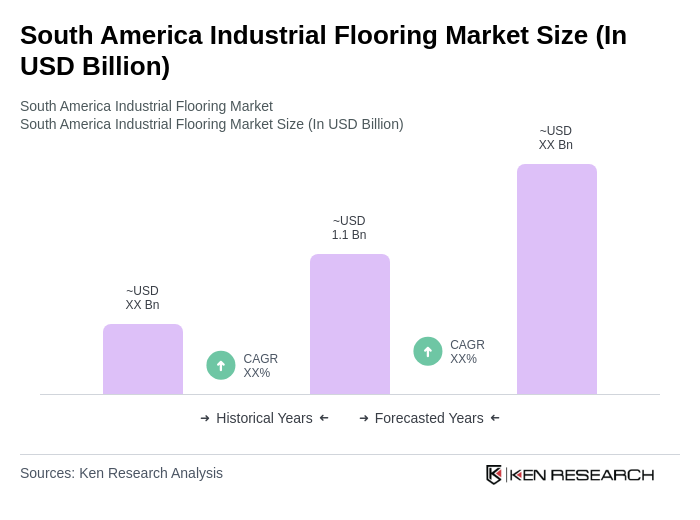
- The South America Industrial Flooring Market is valued at USD 1.1 billion, based on a five-year historical analysis. This valuation aligns with multiple industry sources indicating a market size a little above the one-billion mark for the region, reflecting strong demand in Brazil and Argentina and steady uptake across food, pharma, logistics, and manufacturing facilities .
- Brazil and Argentina are the dominant countries in the South America Industrial Flooring Market due to larger industrial bases, sustained logistics and infrastructure investments, and higher adoption of hygienic, chemical-resistant flooring solutions in F&B and pharma. Sources consistently identify Brazil as the largest share of the regional market, followed by Argentina .
- Brazil has promoted sustainability in construction materials through national policy instruments and voluntary certification, but no authoritative federal regulation was found that specifically mandates eco-friendly materials exclusively for industrial flooring applications in the stated period; however, green procurement, environmental licensing, and rising ESG requirements are encouraging low-VOC, solvent-free, and recycled-content systems in industrial settings .
South America Industrial Flooring Market Segmentation
By Resin/System Type:The resin/system type segmentation includes various flooring solutions that cater to different industrial needs. The subsegments are as follows:

The epoxy flooring segment is currently dominating the market due to its excellent durability, chemical resistance, and ease of maintenance, making it a preferred choice for heavy-duty applications. Epoxy and polyurethane systems are widely cited as the leading technologies in regional industrial facilities, with epoxy often holding the largest share in South America . The growing trend towards industrial automation and the need for hygienic surfaces further bolster the demand for epoxy solutions, solidifying its position as the leading subsegment in the South America Industrial Flooring Market .
By End-User Industry:The end-user industry segmentation highlights the various sectors utilizing industrial flooring solutions. The subsegments are as follows:

The food and beverage processing industry is the largest consumer of industrial flooring solutions, driven by stringent hygiene standards and the need for durable, easy-to-clean surfaces. Industry analyses for South America point to strong demand from food, beverage, and pharmaceutical facilities due to hygiene, chemical resistance, and cleanability needs, with automotive, chemicals, and logistics also contributing . As a result, this segment continues to dominate the market, supported by ongoing investments in food processing facilities across South America .
South America Industrial Flooring Market Competitive Landscape
The South America Industrial Flooring Market is characterized by a dynamic mix of regional and international players. Leading participants such as Sika AG (Sika Brasil, Sika Argentina), BASF SE (Master Builders Solutions legacy; MBCC integration), The Sherwin-Williams Company (Sherwin-Williams Protective & Marine), PPG Industries, Inc., RPM International Inc. (Stonhard; Flowcrete/Soprema South America), Saint-Gobain (Vetrotech/Weber; Norton abrasives for concrete prep), Mapei S.p.A., Ardex Group, Fosroc International Ltd, Grupo Premium Paints S.A. (Brazil) / Tintas Coral (AkzoNobel Brasil), Quartzolit (Saint-Gobain Brasil), Viapol Ltda. (Viapol Impermeabilizantes, Brazil), ParexGroup (now Saint-Gobain Weber) Latin America, Behr Process Corporation (industrial concrete coatings), Portobello Grupo (industrial porcelain tiles) contribute to innovation, geographic expansion, and service delivery in this space.
South America Industrial Flooring Market Industry Analysis
Growth Drivers
- Increasing Demand for Durable Flooring Solutions:The South American industrial flooring market is experiencing a surge in demand for durable flooring solutions, driven by the region's expanding industrial base. In future, the manufacturing sector is projected to contribute approximately $1.5 trillion to the regional GDP, reflecting a 5% increase from the prior period. This growth necessitates robust flooring options that can withstand heavy machinery and foot traffic, thereby propelling the demand for high-performance flooring materials.
- Rising Investments in Infrastructure Development:Significant investments in infrastructure development across South America are fueling the industrial flooring market. In future, the region is expected to allocate around $200 billion towards infrastructure projects, including transportation and logistics facilities. This investment is anticipated to create a robust demand for industrial flooring solutions that meet the rigorous standards required for these facilities, thus driving market growth.
- Expansion of the Logistics and Warehousing Industry:The logistics and warehousing sector in South America is projected to grow significantly, with an estimated market value of $150 billion in future. This expansion is largely attributed to the rise of e-commerce, which is expected to increase by 25% annually. As warehouses require durable and efficient flooring solutions to support high-volume operations, this trend is a key driver for the industrial flooring market.
Market Challenges
- High Initial Installation Costs:One of the primary challenges facing the South American industrial flooring market is the high initial installation costs associated with premium flooring materials. For instance, the average cost of installing epoxy flooring can range from $4 to $15 per square foot, which can deter small to medium-sized enterprises from investing in these solutions. This financial barrier limits market penetration and growth potential in the region.
- Limited Availability of Skilled Labor:The industrial flooring sector is also challenged by a shortage of skilled labor, which is critical for the proper installation and maintenance of flooring systems. In future, it is estimated that the construction industry in South America will face a labor shortfall of approximately 2 million workers. This shortage can lead to project delays and increased costs, hindering market growth and efficiency.
South America Industrial Flooring Market Future Outlook
The South American industrial flooring market is poised for significant transformation, driven by technological advancements and a growing emphasis on sustainability. As companies increasingly adopt eco-friendly flooring solutions, the demand for recyclable materials is expected to rise. Additionally, the integration of smart technologies into flooring systems will enhance functionality and safety. These trends indicate a shift towards innovative flooring solutions that not only meet industrial needs but also align with environmental standards, positioning the market for robust growth in the coming years.
Market Opportunities
- Adoption of Eco-Friendly Flooring Solutions:The growing awareness of environmental issues presents a significant opportunity for the industrial flooring market. In future, the demand for eco-friendly flooring materials is expected to increase by 35%, driven by regulatory incentives and consumer preferences for sustainable products. This shift can lead to the development of innovative flooring solutions that cater to environmentally conscious businesses.
- Technological Advancements in Flooring Materials:The ongoing technological advancements in flooring materials, such as the development of self-healing and antimicrobial surfaces, offer substantial market opportunities. By future, these innovations are projected to capture a market share of 20%, as industries seek flooring solutions that enhance safety and reduce maintenance costs. This trend will likely attract investments and drive growth in the sector.
Scope of the Report
| Segment | Sub-Segments |
|---|---|
| By Resin/System Type | Epoxy Flooring Polyurethane (PU) Flooring Polyaspartic/Polyurea Systems Acrylic/MMA (Methyl Methacrylate) Cementitious/Urethane Cement Concrete Densified/Polished Concrete Others |
| By End-User Industry | Food & Beverage Processing Pharmaceuticals & Healthcare Chemicals & Petrochemicals Automotive & Transportation Warehousing & Logistics/Cold Chain Electronics/General Manufacturing Others |
| By Functional Application | Heavy-Duty/High-Traffic Areas Chemical-Resistant/Corrosion Areas Hygienic/Anti-microbial Areas ESD/Conductive Flooring Thermal Shock/Hot-Wash Areas Slip-Resistant/Safety Zones Others |
| By Installation Method | Trowel-Applied/Slurry Systems Self-Leveling/Pourable Systems Broadcast/Coating Systems Polished/Densified Concrete Tiles/Interlocking Industrial Tiles Others |
| By Distribution Channel | Direct Projects/Specification Sales Authorized Applicators/Installers Distributors and Wholesalers Online/Indirect Others |
| By Country | Brazil Argentina Chile Colombia Peru Rest of South America |
| By Performance Tier | Standard/Cost-Optimized Mid-Performance High-Performance/Premium |
Key Target Audience
Investors and Venture Capitalist Firms
Government and Regulatory Bodies (e.g., Ministry of Industry, Ministry of Environment)
Manufacturers and Producers
Distributors and Retailers
Construction and Engineering Firms
Real Estate Developers
Facility Management Companies
Logistics and Warehousing Companies
Players Mentioned in the Report:
Sika AG (Sika Brasil, Sika Argentina)
BASF SE (Master Builders Solutions legacy; MBCC integration)
The Sherwin-Williams Company (Sherwin-Williams Protective & Marine)
PPG Industries, Inc.
RPM International Inc. (Stonhard; Flowcrete/Soprema South America)
Saint-Gobain (Vetrotech/Weber; Norton abrasives for concrete prep)
Mapei S.p.A.
Ardex Group
Fosroc International Ltd
Grupo Premium Paints S.A. (Brazil) / Tintas Coral (AkzoNobel Brasil)
Quartzolit (Saint-Gobain Brasil)
Viapol Ltda. (Viapol Impermeabilizantes, Brazil)
ParexGroup (now Saint-Gobain Weber) Latin America
Behr Process Corporation (industrial concrete coatings)
Portobello Grupo (industrial porcelain tiles)
Table of Contents
Market Assessment Phase
1. Executive Summary and Approach
2. South America Industrial Flooring Market Overview
2.1 Key Insights and Strategic Recommendations
2.2 South America Industrial Flooring Market Overview
2.3 Definition and Scope
2.4 Evolution of Market Ecosystem
2.5 Timeline of Key Regulatory Milestones
2.6 Value Chain & Stakeholder Mapping
2.7 Business Cycle Analysis
2.8 Policy & Incentive Landscape
3. South America Industrial Flooring Market Analysis
3.1 Growth Drivers
3.1.1 Increasing demand for durable flooring solutions
3.1.2 Growth in the manufacturing sector
3.1.3 Rising investments in infrastructure development
3.1.4 Expansion of the logistics and warehousing industry
3.2 Market Challenges
3.2.1 High initial installation costs
3.2.2 Limited availability of skilled labor
3.2.3 Stringent environmental regulations
3.2.4 Competition from alternative flooring materials
3.3 Market Opportunities
3.3.1 Adoption of eco-friendly flooring solutions
3.3.2 Technological advancements in flooring materials
3.3.3 Growth in e-commerce and retail sectors
3.3.4 Increasing focus on industrial safety and hygiene
3.4 Market Trends
3.4.1 Shift towards sustainable and recyclable materials
3.4.2 Integration of smart technologies in flooring
3.4.3 Customization and personalization of flooring solutions
3.4.4 Rise of online sales channels for flooring products
3.5 Government Regulation
3.5.1 Compliance with safety standards
3.5.2 Regulations on VOC emissions
3.5.3 Incentives for using sustainable materials
3.5.4 Building codes affecting flooring materials
4. SWOT Analysis
5. Stakeholder Analysis
6. Porter's Five Forces Analysis
7. South America Industrial Flooring Market Market Size, 2019-2024
7.1 By Value
7.2 By Volume
7.3 By Average Selling Price
8. South America Industrial Flooring Market Segmentation
8.1 By Resin/System Type
8.1.1 Epoxy Flooring
8.1.2 Polyurethane (PU) Flooring
8.1.3 Polyaspartic/Polyurea Systems
8.1.4 Acrylic/MMA (Methyl Methacrylate)
8.1.5 Cementitious/Urethane Cement
8.1.6 Concrete Densified/Polished Concrete
8.1.7 Others
8.2 By End-User Industry
8.2.1 Food & Beverage Processing
8.2.2 Pharmaceuticals & Healthcare
8.2.3 Chemicals & Petrochemicals
8.2.4 Automotive & Transportation
8.2.5 Warehousing & Logistics/Cold Chain
8.2.6 Electronics/General Manufacturing
8.2.7 Others
8.3 By Functional Application
8.3.1 Heavy-Duty/High-Traffic Areas
8.3.2 Chemical-Resistant/Corrosion Areas
8.3.3 Hygienic/Anti-microbial Areas
8.3.4 ESD/Conductive Flooring
8.3.5 Thermal Shock/Hot-Wash Areas
8.3.6 Slip-Resistant/Safety Zones
8.3.7 Others
8.4 By Installation Method
8.4.1 Trowel-Applied/Slurry Systems
8.4.2 Self-Leveling/Pourable Systems
8.4.3 Broadcast/Coating Systems
8.4.4 Polished/Densified Concrete
8.4.5 Tiles/Interlocking Industrial Tiles
8.4.6 Others
8.5 By Distribution Channel
8.5.1 Direct Projects/Specification Sales
8.5.2 Authorized Applicators/Installers
8.5.3 Distributors and Wholesalers
8.5.4 Online/Indirect
8.5.5 Others
8.6 By Country
8.6.1 Brazil
8.6.2 Argentina
8.6.3 Chile
8.6.4 Colombia
8.6.5 Peru
8.6.6 Rest of South America
8.7 By Performance Tier
8.7.1 Standard/Cost-Optimized
8.7.2 Mid-Performance
8.7.3 High-Performance/Premium
9. South America Industrial Flooring Market Competitive Analysis
9.1 Market Share of Key Players
9.2 Cross Comparison of Key Players
9.2.1 Company Name (regional revenue in industrial flooring)
9.2.2 Product Portfolio Breadth (resin systems, cementitious urethane, ESD, hygienic)
9.2.3 South America Footprint (countries served, local warehouses/plants)
9.2.4 Project Win Rate in Target Verticals (F&B, pharma, logistics, automotive)
9.2.5 Installed Base/Reference Sites (no. of large facilities)
9.2.6 Certified Applicator Network Size (no. of approved installers)
9.2.7 Lead Time to Installation (average weeks from PO to install)
9.2.8 System Lifecycle/Warranty (years; maintenance intervals)
9.2.9 Compliance & Certifications (VOC, HACCP, ISO, ANVISA/INVIMA specs)
9.2.10 Innovation Pipeline (new system launches per year; patents)
9.2.11 Pricing Positioning (value, mid, premium per m² for epoxy/PU)
9.2.12 After-Sales Support (response SLAs; warranty claims rate)
9.3 SWOT Analysis of Top Players
9.4 Pricing Analysis
9.5 Detailed Profile of Major Companies
9.5.1 Sika AG (Sika Brasil, Sika Argentina)
9.5.2 BASF SE (Master Builders Solutions legacy; MBCC integration)
9.5.3 The Sherwin-Williams Company (Sherwin-Williams Protective & Marine)
9.5.4 PPG Industries, Inc.
9.5.5 RPM International Inc. (Stonhard; Flowcrete/Soprema South America)
9.5.6 Saint-Gobain (Vetrotech/Weber; Norton abrasives for concrete prep)
9.5.7 Mapei S.p.A.
9.5.8 Ardex Group
9.5.9 Fosroc International Ltd
9.5.10 Grupo Premium Paints S.A. (Brazil) / Tintas Coral (AkzoNobel Brasil)
9.5.11 Quartzolit (Saint-Gobain Brasil)
9.5.12 Viapol Ltda. (Viapol Impermeabilizantes, Brazil)
9.5.13 ParexGroup (now Saint-Gobain Weber) Latin America
9.5.14 Behr Process Corporation (industrial concrete coatings)
9.5.15 Portobello Grupo (industrial porcelain tiles)
10. South America Industrial Flooring Market End-User Analysis
10.1 Procurement Behavior of Key Ministries
10.1.1 Government procurement policies
10.1.2 Budget allocation for infrastructure
10.1.3 Preference for local suppliers
10.1.4 Compliance with sustainability standards
10.2 Corporate Spend on Infrastructure & Energy
10.2.1 Investment trends in industrial facilities
10.2.2 Budgeting for flooring upgrades
10.2.3 Impact of economic conditions on spending
10.3 Pain Point Analysis by End-User Category
10.3.1 Durability concerns in manufacturing
10.3.2 Safety regulations in food processing
10.3.3 Aesthetic requirements in retail
10.4 User Readiness for Adoption
10.4.1 Awareness of flooring options
10.4.2 Training needs for installation
10.4.3 Financial readiness for investment
10.5 Post-Deployment ROI and Use Case Expansion
10.5.1 Measurement of performance improvements
10.5.2 Case studies of successful implementations
10.5.3 Future expansion plans based on ROI
11. South America Industrial Flooring Market Future Size, 2025-2030
11.1 By Value
11.2 By Volume
11.3 By Average Selling Price
Go-To-Market Strategy Phase
1. Whitespace Analysis + Business Model Canvas
1.1 Market gaps identification
1.2 Value proposition development
1.3 Revenue model exploration
1.4 Customer segmentation analysis
1.5 Competitive landscape overview
1.6 Key partnerships identification
1.7 Risk assessment
2. Marketing and Positioning Recommendations
2.1 Branding strategies
2.2 Product USPs
2.3 Target audience definition
2.4 Communication channels
2.5 Marketing budget allocation
3. Distribution Plan
3.1 Urban retail strategies
3.2 Rural NGO tie-ups
3.3 E-commerce integration
3.4 Logistics and supply chain management
4. Channel & Pricing Gaps
4.1 Underserved routes
4.2 Pricing bands analysis
4.3 Competitor pricing strategies
4.4 Customer willingness to pay
5. Unmet Demand & Latent Needs
5.1 Category gaps identification
5.2 Consumer segments analysis
5.3 Emerging trends and needs
6. Customer Relationship
6.1 Loyalty programs
6.2 After-sales service
6.3 Customer feedback mechanisms
7. Value Proposition
7.1 Sustainability initiatives
7.2 Integrated supply chains
7.3 Competitive advantages
8. Key Activities
8.1 Regulatory compliance
8.2 Branding efforts
8.3 Distribution setup
9. Entry Strategy Evaluation
9.1 Domestic Market Entry Strategy
9.1.1 Product mix considerations
9.1.2 Pricing band strategy
9.1.3 Packaging options
9.2 Export Entry Strategy
9.2.1 Target countries analysis
9.2.2 Compliance roadmap
10. Entry Mode Assessment
10.1 JV opportunities
10.2 Greenfield investments
10.3 M&A considerations
10.4 Distributor model evaluation
11. Capital and Timeline Estimation
11.1 Capital requirements
11.2 Timelines for market entry
12. Control vs Risk Trade-Off
12.1 Ownership considerations
12.2 Partnerships evaluation
13. Profitability Outlook
13.1 Breakeven analysis
13.2 Long-term sustainability strategies
14. Potential Partner List
14.1 Distributors
14.2 JVs
14.3 Acquisition targets
15. Execution Roadmap
15.1 Phased Plan for Market Entry
15.1.1 Market Setup
15.1.2 Market Entry
15.1.3 Growth Acceleration
15.1.4 Scale & Stabilize
15.2 Key Activities and Milestones
15.2.1 Milestone tracking
15.2.2 Activity scheduling
Research Methodology
Phase 1: Approach1
Desk Research
- Industry reports from South American trade associations and market research firms
- Government publications on industrial flooring regulations and standards
- Market analysis articles from construction and manufacturing journals
Primary Research
- Interviews with facility managers and procurement officers in manufacturing sectors
- Surveys with flooring contractors and installation service providers
- Field interviews with architects and designers specializing in industrial spaces
Validation & Triangulation
- Cross-validation of data through multiple industry sources and expert opinions
- Triangulation of market trends using sales data and economic indicators
- Sanity checks through feedback from industry panels and focus groups
Phase 2: Market Size Estimation1
Top-down Assessment
- Analysis of national construction spending and its allocation to flooring solutions
- Segmentation of the market by end-user industries such as manufacturing, warehousing, and logistics
- Incorporation of regional growth trends and urbanization impacts on flooring demand
Bottom-up Modeling
- Volume estimates based on sales data from leading industrial flooring manufacturers
- Cost analysis derived from installation and maintenance pricing structures
- Calculation of market size based on unit sales and average selling prices
Forecasting & Scenario Analysis
- Multi-variable regression analysis incorporating economic growth and construction activity
- Scenario modeling based on potential shifts in regulatory frameworks and sustainability trends
- Development of baseline, optimistic, and pessimistic forecasts through 2030
Phase 3: CATI Sample Composition1
| Scope Item/Segment | Sample Size | Target Respondent Profiles |
|---|---|---|
| Manufacturing Facility Flooring | 120 | Facility Managers, Operations Directors |
| Warehouse and Distribution Center Flooring | 100 | Logistics Managers, Warehouse Supervisors |
| Commercial and Retail Space Flooring | 80 | Architects, Interior Designers |
| Industrial Flooring Installation Services | 70 | Contractors, Installation Managers |
| Government and Regulatory Bodies | 50 | Policy Makers, Compliance Officers |
Frequently Asked Questions
What is the current value of the South America Industrial Flooring Market?
The South America Industrial Flooring Market is valued at approximately USD 1.1 billion, reflecting strong demand particularly in Brazil and Argentina, driven by sectors such as food, pharmaceuticals, logistics, and manufacturing.
Which countries dominate the South America Industrial Flooring Market?
What types of flooring systems are most popular in South America?
What are the main end-user industries for industrial flooring in South America?
Other Regional/Country Reports
Indonesia Industrial Flooring Market
Malaysia Industrial Flooring Market
KSA Industrial Flooring Market
APAC Industrial Flooring Market
SEA Industrial Flooring Market
Why Buy From Us?

What makes us stand out is that our consultants follow Robust, Refine and Result (RRR) methodology. Robust for clear definitions, approaches and sanity checking, Refine for differentiating respondents' facts and opinions, and Result for presenting data with story.

We have set a benchmark in the industry by offering our clients with syndicated and customized market research reports featuring coverage of entire market as well as meticulous research and analyst insights.

While we don't replace traditional research, we flip the method upside down. Our dual approach of Top Bottom & Bottom Top ensures quality deliverable by not just verifying company fundamentals but also looking at the sector and macroeconomic factors.

With one step in the future, our research team constantly tries to show you the bigger picture. We help with some of the tough questions you may encounter along the way: How is the industry positioned? Best marketing channel? KPI's of competitors? By aligning every element, we help maximize success.

Our report gives you instant access to the answers and sources that other companies might choose to hide. We elaborate each steps of research methodology we have used and showcase you the sample size to earn your trust.

If you need any support, we are here! We pride ourselves on universe strength, data quality, and quick, friendly, and professional service.