About the Report
Base Year 2024Listen to the audio summary
South Korea E-Sports & Gaming Ecosystem Market Overview
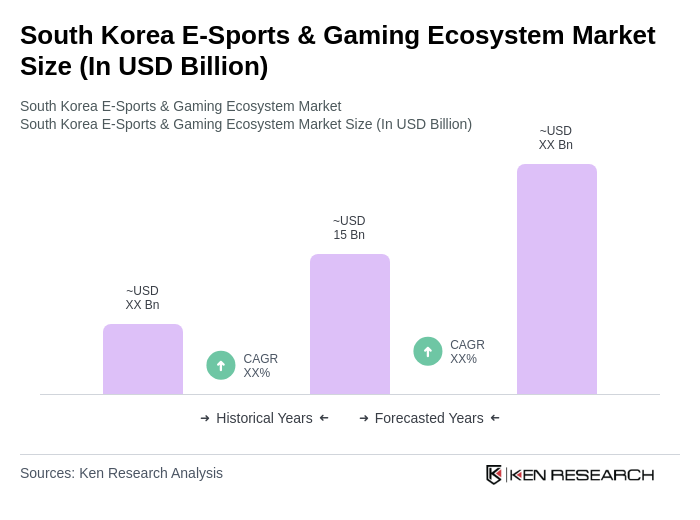
- The South Korea E-Sports & Gaming Ecosystem Market is valued at USD 15 billion, based on a five-year historical analysis. This growth is primarily driven by the increasing popularity of mobile gaming, the rise of e-sports as a mainstream entertainment option, and the expansion of game streaming services. The market has seen a surge in user engagement and monetization strategies, contributing to its robust financial performance.
- Key players in this market include Seoul, Busan, and Incheon, which dominate due to their advanced technological infrastructure, high internet penetration rates, and a vibrant gaming culture. These cities host numerous gaming events and tournaments, attracting both local and international audiences, thereby solidifying their positions as gaming hubs in the region.
- In 2023, the South Korean government implemented regulations to promote fair play and transparency in the gaming industry. This includes the establishment of guidelines for e-sports tournaments and the enforcement of age restrictions for certain games, aimed at protecting younger audiences and ensuring a safe gaming environment.
South Korea E-Sports & Gaming Ecosystem Market Segmentation
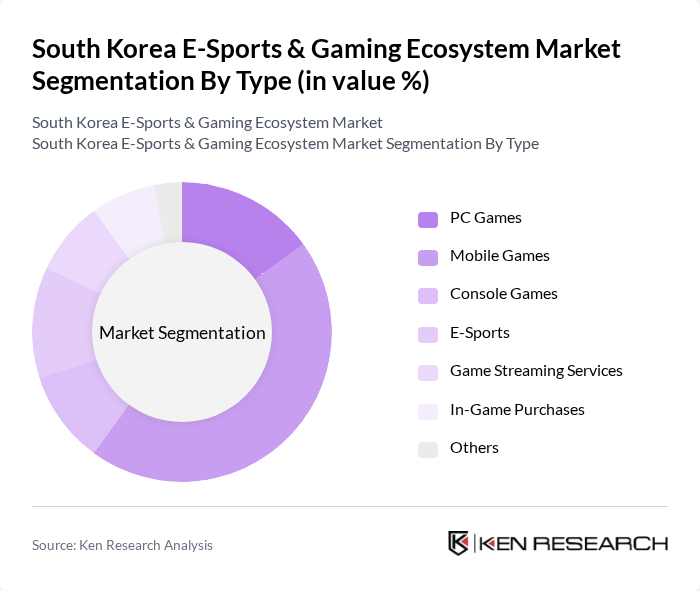
By Type:The market is segmented into various types, including PC Games, Mobile Games, Console Games, E-Sports, Game Streaming Services, In-Game Purchases, and Others. Among these, Mobile Games have emerged as the dominant segment due to their accessibility and the growing number of smartphone users. The convenience of mobile gaming has led to a significant increase in user engagement, making it a preferred choice for casual gamers. The rise of social gaming and in-game purchases further enhances the revenue potential of this segment.
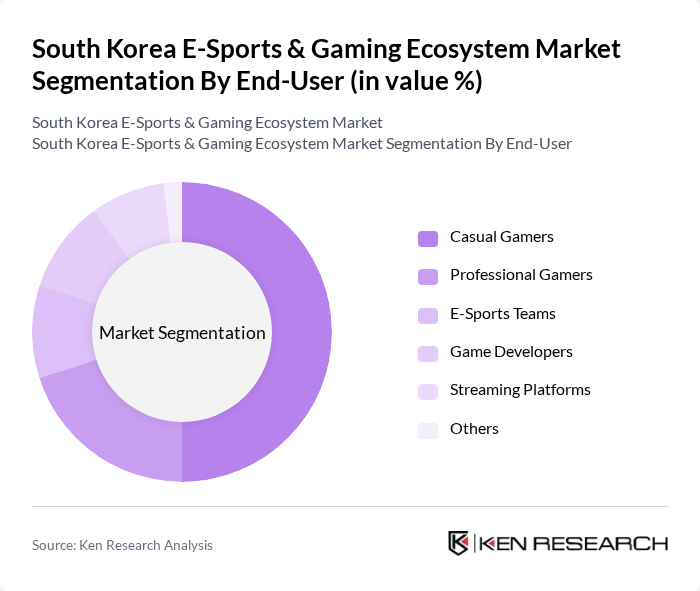
By End-User:The end-user segmentation includes Casual Gamers, Professional Gamers, E-Sports Teams, Game Developers, Streaming Platforms, and Others. Casual Gamers represent the largest segment, driven by the increasing availability of free-to-play games and the rise of mobile gaming. This demographic is characterized by a preference for short gaming sessions and social interaction, which has led to a surge in casual gaming platforms and community-driven content.
South Korea E-Sports & Gaming Ecosystem Market Competitive Landscape
The South Korea E-Sports & Gaming Ecosystem Market is characterized by a dynamic mix of regional and international players. Leading participants such as Nexon Co., Ltd., Riot Games, Inc., Krafton, Inc., NCSoft Corporation, Blizzard Entertainment, Inc., Smilegate Holdings, Inc., PUBG Corporation, HanbitSoft Inc., Gamevil Inc., Com2uS Holdings Corporation, Netmarble Games Corp., Daum Games, Webzen Inc., T1 Entertainment & Sports, AfreecaTV Co., Ltd. contribute to innovation, geographic expansion, and service delivery in this space.
South Korea E-Sports & Gaming Ecosystem Market Industry Analysis
Growth Drivers
- Increasing Internet Penetration:South Korea boasts an internet penetration rate of approximately 98%, one of the highest globally. This extensive connectivity facilitates seamless online gaming experiences, attracting a larger audience. The country had around 46 million internet users in the future, with a significant portion engaging in gaming activities. The robust infrastructure supports high-speed connections, enabling gamers to participate in real-time multiplayer games and e-sports tournaments, thus driving market growth.
- Rise of Mobile Gaming:The mobile gaming sector in South Korea generated approximately $3.6 billion in revenue in the future, reflecting a growing trend among gamers who prefer mobile platforms. With over 31 million mobile gamers, the convenience and accessibility of mobile devices have significantly contributed to this growth. The proliferation of smartphones, with over 91% of the population owning one, has further fueled the demand for mobile gaming, making it a key driver in the e-sports and gaming ecosystem.
- Growing Popularity of E-Sports Tournaments:E-sports tournaments in South Korea attracted over 11 million viewers in the future, showcasing the increasing interest in competitive gaming. Major events like the League of Legends World Championship and Overwatch League have drawn significant crowds, both online and offline. The total prize pool for e-sports tournaments reached approximately $32 million, highlighting the financial viability and popularity of competitive gaming, which continues to drive investment and participation in the sector.
Market Challenges
- Regulatory Restrictions:The South Korean government has implemented strict regulations on gaming, including age restrictions and limitations on gaming hours for minors. In the future, approximately 21% of gaming companies reported challenges in compliance with these regulations, which can hinder market growth. These restrictions aim to address concerns about gaming addiction and its impact on youth, but they also create barriers for developers and players, potentially stifling innovation and participation.
- High Competition Among Players:The South Korean gaming market is characterized by intense competition, with over 510 game development companies vying for market share. This saturation leads to challenges in differentiation and profitability. In the future, around 61% of new game releases failed to achieve significant market traction, indicating the difficulty of capturing consumer attention. As established franchises dominate, new entrants face uphill battles to gain visibility and establish a loyal player base.
South Korea E-Sports & Gaming Ecosystem Market Future Outlook
The South Korean e-sports and gaming ecosystem is poised for continued evolution, driven by technological advancements and changing consumer preferences. The integration of augmented reality (AR) and virtual reality (VR) technologies is expected to enhance gaming experiences, attracting new players. Additionally, the increasing collaboration between gaming and traditional sports is likely to create new revenue streams and broaden audience engagement. As the market matures, a focus on mental health and responsible gaming practices will also shape future developments, ensuring sustainable growth.
Market Opportunities
- Investment in Infrastructure:The South Korean government plans to invest approximately $210 million in e-sports infrastructure in the future. This investment aims to enhance facilities and support local tournaments, fostering a more robust competitive environment. Improved infrastructure will attract international events, boosting tourism and local economies while providing gamers with better resources and opportunities to excel.
- Collaborations with Traditional Sports:Collaborations between e-sports and traditional sports leagues are gaining traction, with partnerships like the Korean Baseball Organization (KBO) exploring e-sports initiatives. These collaborations can tap into existing fan bases, potentially increasing viewership and participation. By leveraging traditional sports' popularity, e-sports can expand its reach and create new revenue opportunities through cross-promotional events and merchandise.
Scope of the Report
| Segment | Sub-Segments |
|---|---|
| By Type | PC Games Mobile Games Console Games E-Sports Game Streaming Services In-Game Purchases Others |
| By End-User | Casual Gamers Professional Gamers E-Sports Teams Game Developers Streaming Platforms Others |
| By Distribution Channel | Online Platforms Retail Stores E-Commerce Subscription Services Others |
| By Genre | Action Adventure Strategy Sports Simulation Others |
| By Age Group | Children Teenagers Young Adults Adults Seniors |
| By Payment Model | Free-to-Play Pay-to-Play Subscription-Based In-App Purchases Others |
| By Platform | PC Mobile Console Cloud Gaming Others |
Key Target Audience
Investors and Venture Capitalist Firms
Government and Regulatory Bodies (e.g., Korea Creative Content Agency, Ministry of Culture, Sports and Tourism)
Game Developers and Publishers
Streaming Platforms and Content Creators
Event Organizers and Tournament Hosts
Hardware Manufacturers and Suppliers
Marketing and Advertising Agencies
Telecommunications Companies
Players Mentioned in the Report:
Nexon Co., Ltd.
Riot Games, Inc.
Krafton, Inc.
NCSoft Corporation
Blizzard Entertainment, Inc.
Smilegate Holdings, Inc.
PUBG Corporation
HanbitSoft Inc.
Gamevil Inc.
Com2uS Holdings Corporation
Netmarble Games Corp.
Daum Games
Webzen Inc.
T1 Entertainment & Sports
AfreecaTV Co., Ltd.
Table of Contents
Market Assessment Phase
1. Executive Summary and Approach
2. South Korea E-Sports & Gaming Ecosystem Market Overview
2.1 Key Insights and Strategic Recommendations
2.2 South Korea E-Sports & Gaming Ecosystem Market Overview
2.3 Definition and Scope
2.4 Evolution of Market Ecosystem
2.5 Timeline of Key Regulatory Milestones
2.6 Value Chain & Stakeholder Mapping
2.7 Business Cycle Analysis
2.8 Policy & Incentive Landscape
3. South Korea E-Sports & Gaming Ecosystem Market Analysis
3.1 Growth Drivers
3.1.1 Increasing Internet Penetration
3.1.2 Rise of Mobile Gaming
3.1.3 Growing Popularity of E-Sports Tournaments
3.1.4 Expansion of Streaming Platforms
3.2 Market Challenges
3.2.1 Regulatory Restrictions
3.2.2 High Competition Among Players
3.2.3 Cybersecurity Threats
3.2.4 Market Saturation in Certain Segments
3.3 Market Opportunities
3.3.1 Investment in Infrastructure
3.3.2 Collaborations with Traditional Sports
3.3.3 Growth of Virtual Reality Gaming
3.3.4 Expansion into International Markets
3.4 Market Trends
3.4.1 Rise of Women in Gaming
3.4.2 Integration of Blockchain Technology
3.4.3 Increased Focus on Mental Health in Gaming
3.4.4 Development of Localized Content
3.5 Government Regulation
3.5.1 Age Restrictions on Gaming
3.5.2 Tax Incentives for Game Developers
3.5.3 Regulations on E-Sports Betting
3.5.4 Support for E-Sports Infrastructure Development
4. SWOT Analysis
5. Stakeholder Analysis
6. Porter's Five Forces Analysis
7. South Korea E-Sports & Gaming Ecosystem Market Market Size, 2019-2024
7.1 By Value
7.2 By Volume
7.3 By Average Selling Price
8. South Korea E-Sports & Gaming Ecosystem Market Segmentation
8.1 By Type
8.1.1 PC Games
8.1.2 Mobile Games
8.1.3 Console Games
8.1.4 E-Sports
8.1.5 Game Streaming Services
8.1.6 In-Game Purchases
8.1.7 Others
8.2 By End-User
8.2.1 Casual Gamers
8.2.2 Professional Gamers
8.2.3 E-Sports Teams
8.2.4 Game Developers
8.2.5 Streaming Platforms
8.2.6 Others
8.3 By Distribution Channel
8.3.1 Online Platforms
8.3.2 Retail Stores
8.3.3 E-Commerce
8.3.4 Subscription Services
8.3.5 Others
8.4 By Genre
8.4.1 Action
8.4.2 Adventure
8.4.3 Strategy
8.4.4 Sports
8.4.5 Simulation
8.4.6 Others
8.5 By Age Group
8.5.1 Children
8.5.2 Teenagers
8.5.3 Young Adults
8.5.4 Adults
8.5.5 Seniors
8.6 By Payment Model
8.6.1 Free-to-Play
8.6.2 Pay-to-Play
8.6.3 Subscription-Based
8.6.4 In-App Purchases
8.6.5 Others
8.7 By Platform
8.7.1 PC
8.7.2 Mobile
8.7.3 Console
8.7.4 Cloud Gaming
8.7.5 Others
9. South Korea E-Sports & Gaming Ecosystem Market Competitive Analysis
9.1 Market Share of Key Players
9.2 Cross Comparison of Key Players
9.2.1 Company Name
9.2.2 Group Size (Large, Medium, or Small as per industry convention)
9.2.3 Revenue Growth Rate
9.2.4 Market Penetration Rate
9.2.5 Customer Retention Rate
9.2.6 Average Revenue Per User (ARPU)
9.2.7 Pricing Strategy
9.2.8 User Engagement Metrics
9.2.9 Brand Recognition Score
9.2.10 Innovation Index
9.3 SWOT Analysis of Top Players
9.4 Pricing Analysis
9.5 Detailed Profile of Major Companies
9.5.1 Nexon Co., Ltd.
9.5.2 Riot Games, Inc.
9.5.3 Krafton, Inc.
9.5.4 NCSoft Corporation
9.5.5 Blizzard Entertainment, Inc.
9.5.6 Smilegate Holdings, Inc.
9.5.7 PUBG Corporation
9.5.8 HanbitSoft Inc.
9.5.9 Gamevil Inc.
9.5.10 Com2uS Holdings Corporation
9.5.11 Netmarble Games Corp.
9.5.12 Daum Games
9.5.13 Webzen Inc.
9.5.14 T1 Entertainment & Sports
9.5.15 AfreecaTV Co., Ltd.
10. South Korea E-Sports & Gaming Ecosystem Market End-User Analysis
10.1 Procurement Behavior of Key Ministries
10.1.1 Government Funding for E-Sports
10.1.2 Support for Game Development Initiatives
10.1.3 Collaboration with Educational Institutions
10.1.4 Promotion of E-Sports Events
10.2 Corporate Spend on Infrastructure & Energy
10.2.1 Investment in Gaming Infrastructure
10.2.2 Sponsorship of E-Sports Teams
10.2.3 Funding for Game Development
10.2.4 Expenditure on Marketing and Promotions
10.3 Pain Point Analysis by End-User Category
10.3.1 Accessibility Issues
10.3.2 High Costs of Gaming Equipment
10.3.3 Limited Game Variety
10.3.4 Regulatory Compliance Challenges
10.4 User Readiness for Adoption
10.4.1 Awareness of E-Sports
10.4.2 Acceptance of Mobile Gaming
10.4.3 Interest in Streaming Services
10.4.4 Engagement in Community Events
10.5 Post-Deployment ROI and Use Case Expansion
10.5.1 Measurement of User Engagement
10.5.2 Analysis of Revenue Streams
10.5.3 Feedback Mechanisms for Improvement
10.5.4 Expansion into New Markets
11. South Korea E-Sports & Gaming Ecosystem Market Future Size, 2025-2030
11.1 By Value
11.2 By Volume
11.3 By Average Selling Price
Go-To-Market Strategy Phase
1. Whitespace Analysis + Business Model Canvas
1.1 Market Gaps Identification
1.2 Business Model Framework
2. Marketing and Positioning Recommendations
2.1 Branding Strategies
2.2 Product USPs
3. Distribution Plan
3.1 Urban Retail Strategies
3.2 Rural NGO Tie-Ups
4. Channel & Pricing Gaps
4.1 Underserved Routes
4.2 Pricing Bands Analysis
5. Unmet Demand & Latent Needs
5.1 Category Gaps
5.2 Consumer Segments
6. Customer Relationship
6.1 Loyalty Programs
6.2 After-Sales Service
7. Value Proposition
7.1 Sustainability Initiatives
7.2 Integrated Supply Chains
8. Key Activities
8.1 Regulatory Compliance
8.2 Branding Efforts
8.3 Distribution Setup
9. Entry Strategy Evaluation
9.1 Domestic Market Entry Strategy
9.1.1 Product Mix Considerations
9.1.2 Pricing Band Strategy
9.1.3 Packaging Options
9.2 Export Entry Strategy
9.2.1 Target Countries
9.2.2 Compliance Roadmap
10. Entry Mode Assessment
10.1 Joint Ventures
10.2 Greenfield Investments
10.3 Mergers & Acquisitions
10.4 Distributor Model
11. Capital and Timeline Estimation
11.1 Capital Requirements
11.2 Timelines for Implementation
12. Control vs Risk Trade-Off
12.1 Ownership Considerations
12.2 Partnerships Evaluation
13. Profitability Outlook
13.1 Breakeven Analysis
13.2 Long-Term Sustainability
14. Potential Partner List
14.1 Distributors
14.2 Joint Ventures
14.3 Acquisition Targets
15. Execution Roadmap
15.1 Phased Plan for Market Entry
15.1.1 Market Setup
15.1.2 Market Entry
15.1.3 Growth Acceleration
15.1.4 Scale & Stabilize
15.2 Key Activities and Milestones
15.2.1 Milestone Planning
15.2.2 Activity Tracking
Research Methodology
Phase 1: Approach1
Desk Research
- Analysis of industry reports from gaming associations and e-sports federations in South Korea
- Review of market trends and statistics from government publications and trade journals
- Examination of academic papers and case studies focusing on the South Korean gaming ecosystem
Primary Research
- Interviews with key stakeholders including game developers, publishers, and e-sports organizers
- Surveys targeting gamers to understand preferences, spending habits, and engagement levels
- Focus groups with industry experts and analysts to gather insights on market dynamics
Validation & Triangulation
- Cross-validation of findings through multiple data sources including sales data and user engagement metrics
- Triangulation of insights from primary interviews with secondary data trends
- Sanity checks conducted through expert panel reviews to ensure data reliability
Phase 2: Market Size Estimation1
Top-down Assessment
- Estimation of total market size based on national gaming revenue reports and e-sports event revenues
- Segmentation of the market by game genre, platform, and demographic profiles
- Incorporation of growth rates from historical data and projected trends in gaming technology
Bottom-up Modeling
- Collection of revenue data from leading gaming companies and e-sports organizations
- Estimation of user base growth through analysis of active gamers and e-sports participants
- Calculation of average revenue per user (ARPU) across different gaming segments
Forecasting & Scenario Analysis
- Multi-variable forecasting models incorporating factors such as technological advancements and regulatory changes
- Scenario analysis based on potential shifts in consumer behavior and market disruptions
- Development of baseline, optimistic, and pessimistic forecasts through 2030
Phase 3: CATI Sample Composition1
| Scope Item/Segment | Sample Size | Target Respondent Profiles |
|---|---|---|
| Mobile Gaming Users | 150 | Casual Gamers, Mobile Game Developers |
| PC Gaming Community | 120 | Hardcore Gamers, PC Game Publishers |
| E-sports Event Attendees | 100 | Event Organizers, E-sports Athletes |
| Streaming Platform Users | 80 | Content Creators, Viewers |
| Game Development Studios | 70 | Game Designers, Marketing Managers |
Frequently Asked Questions
What is the current value of the South Korea E-Sports & Gaming Ecosystem Market?
The South Korea E-Sports & Gaming Ecosystem Market is valued at approximately USD 15 billion, reflecting significant growth driven by mobile gaming popularity, e-sports mainstreaming, and the expansion of game streaming services.
What factors are driving the growth of the South Korean gaming market?
Which cities are the main hubs for gaming in South Korea?
What regulations has the South Korean government implemented in the gaming industry?
Other Regional/Country Reports
Indonesia E-Sports & Gaming Ecosystem Market
Malaysia E-Sports & Gaming Ecosystem Market
KSA E-Sports & Gaming Ecosystem Market
APAC E-Sports & Gaming Ecosystem Market
SEA E-Sports & Gaming Ecosystem Market
Vietnam E-Sports & Gaming Ecosystem Market
Other Adjacent Reports
Vietnam Mobile Gaming Market
Thailand Game Streaming Services Market
Bahrain E-Sports Tournaments Market
Kuwait Gaming Hardware Market
Global Virtual Reality Gaming Market Size, Share & Forecast, By Product Type, Technology & Distribution Channel, 2025-2032South Africa Augmented Reality Gaming Market
Vietnam Game Development Software Market
Global In-Game Advertising Market Size, Share & Forecast, By Ad Format, Gaming Platform & Buying Model, 2026-2031Mexico Esports Betting Market
Mexico Gaming Content Creation Market
Why Buy From Us?

What makes us stand out is that our consultants follow Robust, Refine and Result (RRR) methodology. Robust for clear definitions, approaches and sanity checking, Refine for differentiating respondents' facts and opinions, and Result for presenting data with story.

We have set a benchmark in the industry by offering our clients with syndicated and customized market research reports featuring coverage of entire market as well as meticulous research and analyst insights.

While we don't replace traditional research, we flip the method upside down. Our dual approach of Top Bottom & Bottom Top ensures quality deliverable by not just verifying company fundamentals but also looking at the sector and macroeconomic factors.

With one step in the future, our research team constantly tries to show you the bigger picture. We help with some of the tough questions you may encounter along the way: How is the industry positioned? Best marketing channel? KPI's of competitors? By aligning every element, we help maximize success.

Our report gives you instant access to the answers and sources that other companies might choose to hide. We elaborate each steps of research methodology we have used and showcase you the sample size to earn your trust.

If you need any support, we are here! We pride ourselves on universe strength, data quality, and quick, friendly, and professional service.