Region:Asia
Author(s):Geetanshi
Product Code:KRAA0171
Pages:92
Published On:August 2025
By Type:The reverse logistics market can be segmented into B2B Returns and Commercial Returns, Recall Returns, Repairable Returns, End-of-Use Returns, and End-of-Life Returns. Each of these sub-segments plays a crucial role in the overall market dynamics, driven by different consumer needs and industry requirements. B2B Returns and Commercial Returns are primarily driven by the need for efficient inventory management and cost reduction in business operations. Recall Returns are influenced by regulatory compliance and product safety standards. Repairable Returns focus on sustainability and cost savings through refurbishment, while End-of-Use and End-of-Life Returns are shaped by environmental regulations and circular economy initiatives .
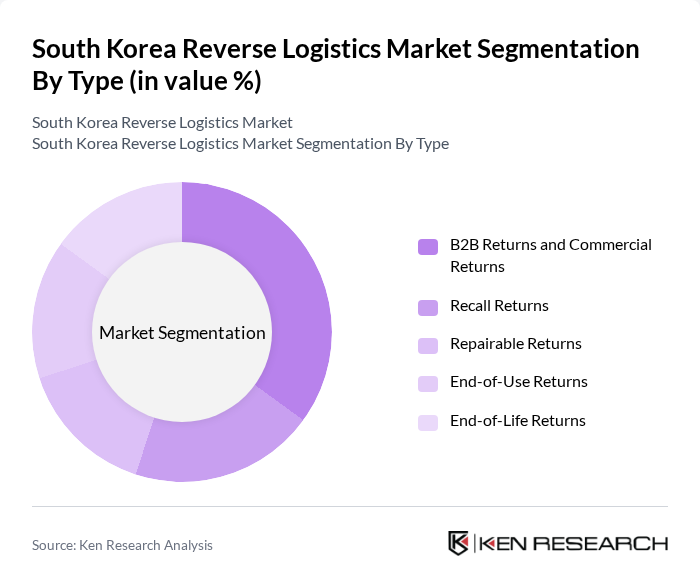
The B2B Returns and Commercial Returns sub-segment is currently dominating the market due to the increasing volume of returns in the business sector, driven by the growth of e-commerce and the need for efficient inventory management. Companies are focusing on optimizing their return processes to minimize costs and enhance customer satisfaction. The trend towards sustainability and regulatory compliance is also pushing businesses to adopt more efficient reverse logistics practices, making this sub-segment a key player in the market .
By End-User:The market can also be segmented by end-user categories, including Retail & E-commerce, Electronics & Electricals, Automotive & Mobility, Pharmaceuticals & Healthcare, Industrial & Manufacturing, and Others. Each of these segments has unique requirements and challenges that influence their reverse logistics strategies. Retail & E-commerce is characterized by high return volumes and a focus on customer experience. Electronics & Electricals emphasize safe disposal and recycling of e-waste. Automotive & Mobility prioritize parts recovery and remanufacturing, while Pharmaceuticals & Healthcare require strict regulatory compliance for returns. Industrial & Manufacturing focus on cost efficiency and sustainability in handling industrial by-products .
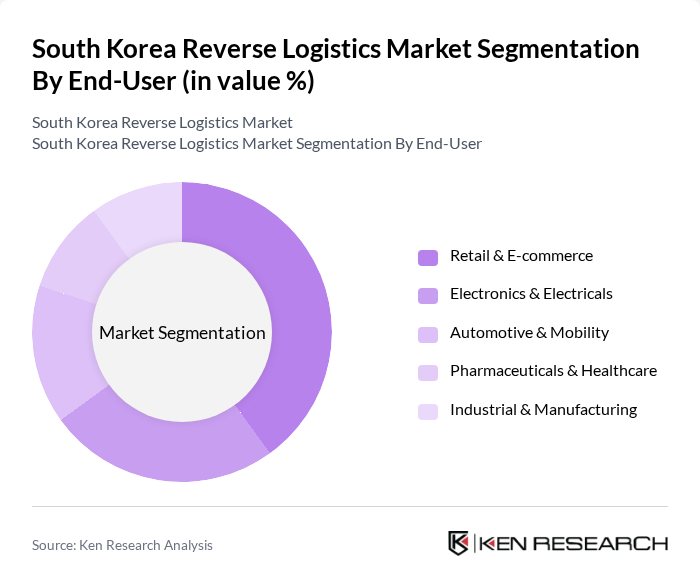
The Retail & E-commerce segment is leading the market due to the rapid growth of online shopping, which has significantly increased the volume of product returns. This sector is particularly focused on enhancing customer experience through efficient return processes, which is crucial for maintaining customer loyalty. The rise in consumer expectations for hassle-free returns and the adoption of omnichannel retail strategies are driving innovations in reverse logistics within this segment .
The South Korea Reverse Logistics Market is characterized by a dynamic mix of regional and international players. Leading participants such as CJ Logistics, Hanjin Transportation, Lotte Global Logistics, Hyundai Glovis, SK Networks, DB Schenker Korea, Kuehne + Nagel Korea, Samsung SDS, GS Global, DPD Korea, Logen, Hanil Express, KCTC, YT Logistics, CJ OliveNetworks, Coupang Logistics Service, ePost Korea (Korea Post), Sagawa Express Korea, Pantos Logistics (LG CNS), Seino Logix Korea contribute to innovation, geographic expansion, and service delivery in this space.
The South Korean reverse logistics market is poised for significant transformation, driven by technological advancements and increasing consumer demand for sustainable practices. As e-commerce continues to flourish, companies will increasingly invest in automation and AI to enhance return processes. Additionally, the growing emphasis on circular economy principles will encourage businesses to adopt more efficient reverse logistics strategies, ultimately leading to improved customer satisfaction and reduced environmental impact in future.
| Segment | Sub-Segments |
|---|---|
| By Type | B2B Returns and Commercial Returns Recall Returns Repairable Returns End-of-Use Returns End-of-Life Returns |
| By End-User | Retail & E-commerce Electronics & Electricals Automotive & Mobility Pharmaceuticals & Healthcare Industrial & Manufacturing Others |
| By Region | Seoul Busan Incheon Daegu Others |
| By Technology | Automated Return Systems Data Analytics for Returns Mobile Applications for Returns RFID & IoT Solutions Robotics & Automation Others |
| By Application | Consumer Electronics Fashion and Apparel Home Appliances Automotive Parts Pharmaceuticals Others |
| By Investment Source | Private Investments Government Funding Venture Capital Corporate Investments Others |
| By Policy Support | Government Subsidies Tax Incentives Grants for Sustainable Practices Regulatory Support for Recycling Others |
| Scope Item/Segment | Sample Size | Target Respondent Profiles |
|---|---|---|
| Retail Sector Reverse Logistics | 100 | Logistics Managers, Supply Chain Directors |
| Electronics Returns Management | 80 | Operations Managers, Customer Service Heads |
| Automotive Parts Recovery | 60 | Procurement Officers, Warehouse Managers |
| Textile Recycling Initiatives | 50 | Sustainability Officers, Product Development Managers |
| E-commerce Returns Processes | 70 | eCommerce Managers, Fulfillment Center Supervisors |
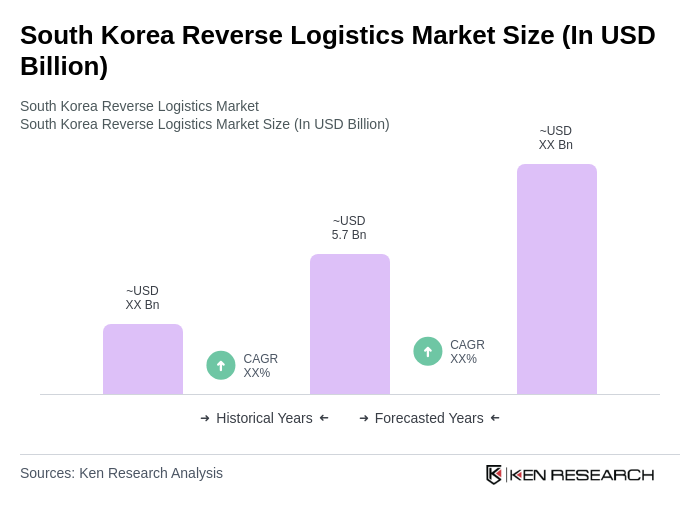
The South Korea Reverse Logistics Market is valued at approximately USD 5.7 billion, reflecting a significant growth trend driven by e-commerce expansion, efficient supply chain management, and increased consumer awareness of sustainability practices.

What makes us stand out is that our consultants follow Robust, Refine and Result (RRR) methodology. Robust for clear definitions, approaches and sanity checking, Refine for differentiating respondents' facts and opinions, and Result for presenting data with story.

We have set a benchmark in the industry by offering our clients with syndicated and customized market research reports featuring coverage of entire market as well as meticulous research and analyst insights.

While we don't replace traditional research, we flip the method upside down. Our dual approach of Top Bottom & Bottom Top ensures quality deliverable by not just verifying company fundamentals but also looking at the sector and macroeconomic factors.

With one step in the future, our research team constantly tries to show you the bigger picture. We help with some of the tough questions you may encounter along the way: How is the industry positioned? Best marketing channel? KPI's of competitors? By aligning every element, we help maximize success.

Our report gives you instant access to the answers and sources that other companies might choose to hide. We elaborate each steps of research methodology we have used and showcase you the sample size to earn your trust.

If you need any support, we are here! We pride ourselves on universe strength, data quality, and quick, friendly, and professional service.













