Thailand Barrier Systems Market Size Share Growth Drivers Trends Opportunities & Forecast 2025–2030

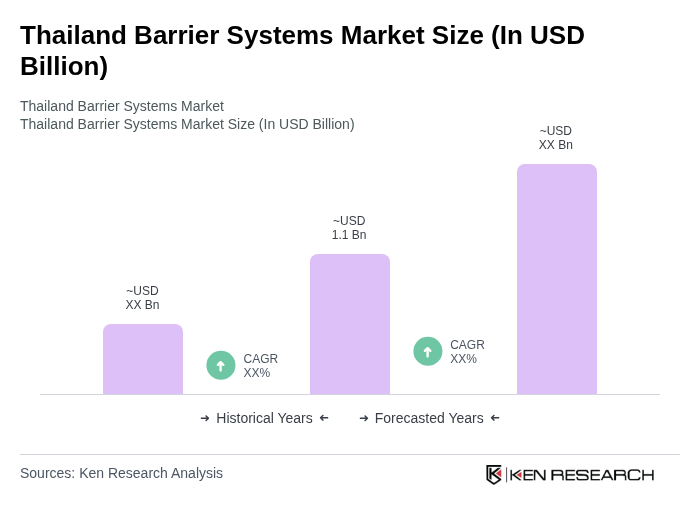
Thailand barrier systems market, valued at USD 1.1 billion, grows due to infrastructure investments, road safety mandates, and urbanization, focusing on crash barriers and roadway applications.

Region:Asia

Author(s):Dev

Product Code:KRAC5002

Pages:95

Published On:January 2026
About the Report

Base Year 2024

Thailand Barrier Systems Market Overview

  • The Thailand Barrier Systems Market is valued at USD 1.1 billion, based on a five-year historical analysis of Thailand’s share within the Asia–Pacific and global barrier systems and crash barrier systems markets, where Asia–Pacific is the fastest?growing region and a leading demand center for roadside and perimeter barriers. This growth is primarily driven by increasing infrastructure development, rapid urbanization, and progressively stricter road and occupational safety requirements in Thailand. Strong demand for various barrier systems, including crash barriers, guardrails, and access control solutions, has emerged in line with the government’s focus on improving road safety, reducing accident severity, and strengthening security measures across expressways, urban corridors, and key industrial zones.
  • Key demand centers in this market include the Bangkok Metropolitan Region, which dominates barrier deployment due to its extensive urban road network, expressways, mass transit infrastructure, and consistently high traffic density. Other significant areas include the Eastern Economic Corridor (EEC), positioned as Thailand’s flagship industrial, logistics, and export hub with major investments in highways, ports, airports, and rail links, and Central Thailand, where ongoing urban development, logistics parks, and manufacturing clusters are rapidly increasing the requirement for roadside safety barriers, perimeter fences, and access?control installations.
  • Road safety and barrier deployment are guided by national strategies and binding technical standards, including the Thailand Road Safety Master Plan and the Highway Act B.E. 2535 (1992), under which the Department of Highways issues design standards mandating guardrails, crash barriers, and related safety devices on national highways and controlled-access roads. In addition, the Department of Highways’ Standard Drawings and Specifications for Roadside Safety Hardware require the use of approved barrier types and configurations on new and upgraded road projects, with a focus on reducing fatalities and serious injuries by improving containment, redirection, and protection performance along critical road segments.
Thailand Barrier Systems Market Size

Thailand Barrier Systems Market Segmentation

By Barrier Type:The barrier type segmentation includes various subsegments such as crash barriers, safety fences, bollards, gates, work-zone barriers, access control barriers, and other devices. Crash barriers, including roadside, median, and bridge barriers, account for the largest share of installed barrier length in Thailand because they are integral to road safety programs and are routinely specified in national and provincial highway designs to mitigate run?off?road and head?on collisions. The increasing number of registered vehicles and freight traffic, together with ongoing expansion and upgrading of expressways and arterial roads, continues to support strong demand for these systems. Safety fences and guardrails also play a vital role in protecting pedestrians and vehicles along urban corridors, flyovers, and hazardous roadside environments, making them essential in metropolitan and industrial areas. Bollards, security gates, and access-control barriers (such as rising beams and turnstiles) are increasingly deployed around airports, ports, railway stations, commercial complexes, and critical infrastructure sites in line with global trends toward hostile vehicle mitigation and controlled access management.
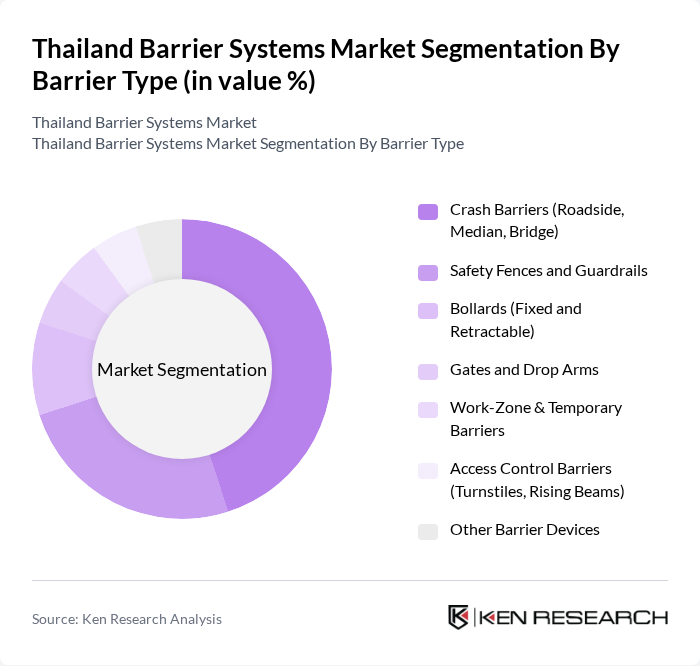
Thailand Barrier Systems Market segmentation by Barrier Type.

By End-User / End-Use Sector:The end-user segmentation encompasses various sectors, including roadways, urban infrastructure, railways, airports, industrial facilities, commercial complexes, residential areas, and defense sites. The roadway and highway sector is the dominant segment, as barrier systems are a core element of national and provincial highway safety design and are installed extensively on expressways, motorways, ring roads, and rural arterials. Urban roads and municipal infrastructure are also significant contributors, driven by Bangkok and secondary cities’ investments in grade-separated intersections, bus lanes, and pedestrian facilities that require guardrails, parapets, and pedestrian?protection barriers. The growing logistics and transportation sectors, including upgrades and expansion at airports, ports, rail terminals, and large logistics parks, further boost demand for barrier systems in airports and industrial facilities, where perimeter security, traffic segregation, and asset protection are key priorities.
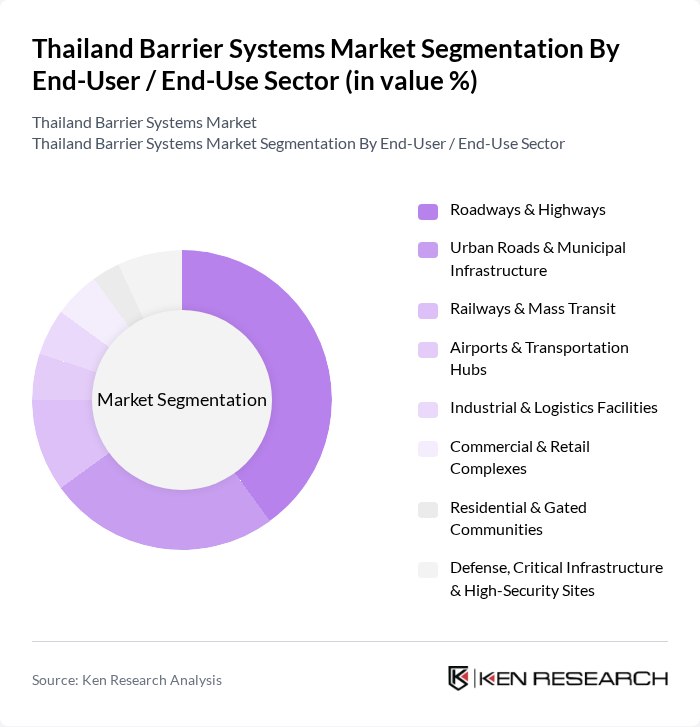
Thailand Barrier Systems Market segmentation by End-User / End-Use Sector.

Thailand Barrier Systems Market Competitive Landscape

The Thailand Barrier Systems Market is characterized by a dynamic mix of regional and international players. Leading participants such as The Siam Cement Public Company Limited (SCG), TPI Polene Public Company Limited, Bangkok Steel Wire Co., Ltd., Thai Wire Products Public Company Limited, Pacific Pipe Public Company Limited, Thai Herrick Co., Ltd., Italian-Thai Development Public Company Limited, CH. Karnchang Public Company Limited, Sino-Thai Engineering and Construction Public Company Limited, Unique Engineering and Construction Public Company Limited, Nawarat Patanakarn Public Company Limited, BTS Group Holdings Public Company Limited, Bangkok Expressway and Metro Public Company Limited (BEM), Provincial Electricity Authority (PEA) – Infrastructure & Safety Division, Selected Specialized Barrier & Guardrail SMEs in Thailand contribute to innovation, geographic expansion, and service delivery in this space.

The Siam Cement Public Company Limited (SCG)

1913

Bangkok, Thailand

TPI Polene Public Company Limited

1987

Bangkok, Thailand

Bangkok Steel Wire Co., Ltd.

1980

Bangkok, Thailand

Thai Wire Products Public Company Limited

1985

Bangkok, Thailand

Pacific Pipe Public Company Limited

1991

Bangkok, Thailand

Company

Establishment Year

Headquarters

Revenue (USD Million, Latest FY)

Thailand Barrier Systems Revenue Share (%)

3-Year Revenue CAGR in Barrier Systems (%)

EBITDA Margin from Barrier Systems Business (%)

Order Backlog / Confirmed Pipeline (Months of Revenue)

Installed Barrier Length / Units in Thailand (Cumulative)

Thailand Barrier Systems Market Industry Analysis

Growth Drivers

  • Increasing Infrastructure Development:Thailand's government allocated approximately THB 1.5 trillion (USD 45 billion) for infrastructure projects in future, focusing on transportation and urban development. This investment is expected to enhance road safety and necessitate the installation of advanced barrier systems. The construction of new highways and urban transit systems will drive demand for effective safety solutions, ensuring the protection of both vehicles and pedestrians in rapidly developing areas.
  • Rising Safety Regulations:The Thai government has implemented stricter safety regulations, mandating the installation of safety barriers on major roads and construction sites. In future, the Ministry of Transport reported a 20% increase in compliance inspections, emphasizing the importance of barrier systems. This regulatory push aims to reduce road accidents, which accounted for over 12,000 fatalities in future, thereby driving the demand for reliable barrier solutions across the nation.
  • Urbanization and Population Growth:Thailand's urban population is projected to reach 50 million in future, leading to increased traffic congestion and safety concerns. The urbanization rate is expected to rise to 60% in future, necessitating the development of robust barrier systems to manage the growing number of vehicles. This demographic shift will create a significant market for innovative barrier solutions that enhance safety in densely populated urban areas.

Market Challenges

  • High Initial Investment Costs:The upfront costs associated with installing advanced barrier systems can be a significant barrier to market entry. For instance, the average cost of a high-quality barrier system can range from THB 500,000 to THB 1 million (USD 15,000 to USD 30,000) per kilometer. This financial burden can deter smaller construction firms from adopting these safety measures, limiting market growth and innovation in barrier technologies.
  • Regulatory Compliance Issues:Navigating the complex regulatory landscape in Thailand poses challenges for barrier system manufacturers. Compliance with various safety standards and construction codes can be time-consuming and costly. In future, the government is expected to introduce new regulations that may require additional certifications, further complicating the market landscape and potentially delaying project timelines for barrier installations.

Thailand Barrier Systems Market Future Outlook

The Thailand barrier systems market is poised for significant growth as infrastructure development accelerates and safety regulations tighten. With urbanization driving demand for innovative safety solutions, manufacturers are likely to focus on integrating smart technologies into barrier systems. Additionally, the increasing emphasis on eco-friendly materials will shape product offerings, aligning with global sustainability trends. As the market evolves, collaboration between government bodies and private firms will be crucial in addressing safety challenges and enhancing overall road safety in Thailand.

Market Opportunities

  • Expansion in Smart City Projects:The Thai government is investing THB 100 billion (USD 3 billion) in smart city initiatives in future. This investment will create opportunities for barrier systems that incorporate IoT technology, enhancing safety and traffic management. Manufacturers can leverage this trend to develop innovative solutions that meet the needs of modern urban environments.
  • Government Initiatives for Infrastructure Improvement:With a projected 15% increase in infrastructure spending in future, there is a significant opportunity for barrier system providers. Government initiatives aimed at improving road safety and reducing accidents will drive demand for high-quality barrier solutions, creating a favorable environment for market growth and innovation.

Scope of the Report

SegmentSub-Segments
By Barrier Type

Crash Barriers (Roadside, Median, Bridge)

Safety Fences and Guardrails

Bollards (Fixed and Retractable)

Gates and Drop Arms

Work-Zone & Temporary Barriers

Access Control Barriers (Turnstiles, Rising Beams)

Other Barrier Devices

By End-User / End-Use Sector

Roadways & Highways

Urban Roads & Municipal Infrastructure

Railways & Mass Transit

Airports & Transportation Hubs

Industrial & Logistics Facilities

Commercial & Retail Complexes

Residential & Gated Communities

Defense, Critical Infrastructure & High-Security Sites

By Application

Road Safety & Vehicle Impact Protection

Perimeter Security & Access Restriction

Crowd Management & Pedestrian Safety

Construction & Work-Zone Safety

Event & Temporary Security

Flood, Anti-Ram & Specialized Safety Applications

By Material

Metal (Steel, Aluminum)

Concrete

Plastic & Composite Materials

Wood & Hybrid Materials

Other Materials

By Function / Operation

Passive (Fixed) Barrier Systems

Active (Automated / Movable) Barrier Systems

Semi-Automated Barrier Systems

By Technology / Design

Rigid Barrier Systems

Semi-Rigid Barrier Systems

Flexible Barrier Systems

Smart & IoT-Enabled Barrier Systems

By Region

Bangkok Metropolitan Region

Central Thailand (Excl. Bangkok)

Northern Thailand

Northeastern Thailand

Eastern Economic Corridor (EEC)

Southern Thailand

Western Thailand

Key Target Audience

Investors and Venture Capitalist Firms

Government and Regulatory Bodies (e.g., Ministry of Transport, Department of Highways)

Manufacturers and Producers

Distributors and Retailers

Construction and Infrastructure Companies

Transportation and Logistics Firms

Safety and Compliance Organizations

Insurance Companies

Players Mentioned in the Report:

The Siam Cement Public Company Limited (SCG)

TPI Polene Public Company Limited

Bangkok Steel Wire Co., Ltd.

Thai Wire Products Public Company Limited

Pacific Pipe Public Company Limited

Thai Herrick Co., Ltd.

Italian-Thai Development Public Company Limited

CH. Karnchang Public Company Limited

Sino-Thai Engineering and Construction Public Company Limited

Unique Engineering and Construction Public Company Limited

Nawarat Patanakarn Public Company Limited

BTS Group Holdings Public Company Limited

Bangkok Expressway and Metro Public Company Limited (BEM)

Provincial Electricity Authority (PEA) Infrastructure & Safety Division

Selected Specialized Barrier & Guardrail SMEs in Thailand

Table of Contents

Market Assessment Phase

1. Executive Summary and Approach


2. Thailand Barrier Systems Market Overview

2.1 Key Insights and Strategic Recommendations

2.2 Thailand Barrier Systems Market Overview

2.3 Definition and Scope

2.4 Evolution of Market Ecosystem

2.5 Timeline of Key Regulatory Milestones

2.6 Value Chain & Stakeholder Mapping

2.7 Business Cycle Analysis

2.8 Policy & Incentive Landscape


3. Thailand Barrier Systems Market Analysis

3.1 Growth Drivers

3.1.1 Increasing Infrastructure Development
3.1.2 Rising Safety Regulations
3.1.3 Urbanization and Population Growth
3.1.4 Technological Advancements in Barrier Systems

3.2 Market Challenges

3.2.1 High Initial Investment Costs
3.2.2 Regulatory Compliance Issues
3.2.3 Competition from Alternative Safety Solutions
3.2.4 Limited Awareness Among End-Users

3.3 Market Opportunities

3.3.1 Expansion in Smart City Projects
3.3.2 Government Initiatives for Infrastructure Improvement
3.3.3 Growing Demand for Eco-Friendly Barrier Solutions
3.3.4 Partnerships with Construction Firms

3.4 Market Trends

3.4.1 Integration of IoT in Barrier Systems
3.4.2 Shift Towards Modular Barrier Solutions
3.4.3 Increased Focus on Aesthetic Designs
3.4.4 Adoption of Automated Barrier Systems

3.5 Government Regulation

3.5.1 Safety Standards for Road Barriers
3.5.2 Environmental Regulations on Material Use
3.5.3 Compliance with Construction Codes
3.5.4 Incentives for Sustainable Practices

4. SWOT Analysis


5. Stakeholder Analysis


6. Porter's Five Forces Analysis


7. Thailand Barrier Systems Market Market Size, 2019-2024

7.1 By Value

7.2 By Volume

7.3 By Average Selling Price


8. Thailand Barrier Systems Market Segmentation

8.1 By Barrier Type

8.1.1 Crash Barriers (Roadside, Median, Bridge)
8.1.2 Safety Fences and Guardrails
8.1.3 Bollards (Fixed and Retractable)
8.1.4 Gates and Drop Arms
8.1.5 Work-Zone & Temporary Barriers
8.1.6 Access Control Barriers (Turnstiles, Rising Beams)
8.1.7 Other Barrier Devices

8.2 By End-User / End-Use Sector

8.2.1 Roadways & Highways
8.2.2 Urban Roads & Municipal Infrastructure
8.2.3 Railways & Mass Transit
8.2.4 Airports & Transportation Hubs
8.2.5 Industrial & Logistics Facilities
8.2.6 Commercial & Retail Complexes
8.2.7 Residential & Gated Communities
8.2.8 Defense, Critical Infrastructure & High-Security Sites

8.3 By Application

8.3.1 Road Safety & Vehicle Impact Protection
8.3.2 Perimeter Security & Access Restriction
8.3.3 Crowd Management & Pedestrian Safety
8.3.4 Construction & Work-Zone Safety
8.3.5 Event & Temporary Security
8.3.6 Flood, Anti-Ram & Specialized Safety Applications

8.4 By Material

8.4.1 Metal (Steel, Aluminum)
8.4.2 Concrete
8.4.3 Plastic & Composite Materials
8.4.4 Wood & Hybrid Materials
8.4.5 Other Materials

8.5 By Function / Operation

8.5.1 Passive (Fixed) Barrier Systems
8.5.2 Active (Automated / Movable) Barrier Systems
8.5.3 Semi-Automated Barrier Systems

8.6 By Technology / Design

8.6.1 Rigid Barrier Systems
8.6.2 Semi-Rigid Barrier Systems
8.6.3 Flexible Barrier Systems
8.6.4 Smart & IoT-Enabled Barrier Systems

8.7 By Region

8.7.1 Bangkok Metropolitan Region
8.7.2 Central Thailand (Excl. Bangkok)
8.7.3 Northern Thailand
8.7.4 Northeastern Thailand
8.7.5 Eastern Economic Corridor (EEC)
8.7.6 Southern Thailand
8.7.7 Western Thailand

9. Thailand Barrier Systems Market Competitive Analysis

9.1 Market Share of Key Players

9.2 Cross Comparison of Key Players

9.2.1 Company Name
9.2.2 Revenue (USD Million, Latest FY)
9.2.3 Thailand Barrier Systems Revenue Share (%)
9.2.4 3-Year Revenue CAGR in Barrier Systems (%)
9.2.5 EBITDA Margin from Barrier Systems Business (%)
9.2.6 Order Backlog / Confirmed Pipeline (Months of Revenue)
9.2.7 Installed Barrier Length / Units in Thailand (Cumulative)
9.2.8 Market Coverage (No. of Provinces / Key Corridors Served)
9.2.9 Average Project Ticket Size (USD / THB)
9.2.10 Win Rate in Competitive Tenders (%)
9.2.11 R&D / Technology Spend as % of Revenue
9.2.12 Share of Smart / IoT-Enabled Barrier Projects (%)
9.2.13 Key Client Concentration (Top 3 Clients’ Revenue Share %)
9.2.14 On-Time Project Delivery Rate (%)

9.3 SWOT Analysis of Top Players

9.4 Pricing Analysis

9.5 Detailed Profile of Major Companies

9.5.1 The Siam Cement Public Company Limited (SCG)
9.5.2 TPI Polene Public Company Limited
9.5.3 Bangkok Steel Wire Co., Ltd.
9.5.4 Thai Wire Products Public Company Limited
9.5.5 Pacific Pipe Public Company Limited
9.5.6 Thai Herrick Co., Ltd.
9.5.7 Italian-Thai Development Public Company Limited
9.5.8 CH. Karnchang Public Company Limited
9.5.9 Sino-Thai Engineering and Construction Public Company Limited
9.5.10 Unique Engineering and Construction Public Company Limited
9.5.11 Nawarat Patanakarn Public Company Limited
9.5.12 BTS Group Holdings Public Company Limited
9.5.13 Bangkok Expressway and Metro Public Company Limited (BEM)
9.5.14 Provincial Electricity Authority (PEA) – Infrastructure & Safety Division
9.5.15 Selected Specialized Barrier & Guardrail SMEs in Thailand

10. Thailand Barrier Systems Market End-User Analysis

10.1 Procurement Behavior of Key Ministries

10.1.1 Ministry of Transport
10.1.2 Ministry of Interior
10.1.3 Ministry of Industry
10.1.4 Ministry of Education

10.2 Corporate Spend on Infrastructure & Energy

10.2.1 Investment Trends
10.2.2 Budget Allocation
10.2.3 Project Prioritization
10.2.4 Spending Patterns

10.3 Pain Point Analysis by End-User Category

10.3.1 Transportation Sector
10.3.2 Construction Sector
10.3.3 Event Management
10.3.4 Government Projects

10.4 User Readiness for Adoption

10.4.1 Awareness Levels
10.4.2 Training Needs
10.4.3 Technology Acceptance
10.4.4 Financial Readiness

10.5 Post-Deployment ROI and Use Case Expansion

10.5.1 Performance Metrics
10.5.2 User Feedback
10.5.3 Case Studies
10.5.4 Future Expansion Plans

11. Thailand Barrier Systems Market Future Size, 2025-2030

11.1 By Value

11.2 By Volume

11.3 By Average Selling Price


Go-To-Market Strategy Phase

1. Whitespace Analysis + Business Model Canvas

1.1 Market Gaps Identification

1.2 Business Model Development


2. Marketing and Positioning Recommendations

2.1 Branding Strategies

2.2 Product USPs


3. Distribution Plan

3.1 Urban Retail vs Rural NGO Tie-ups


4. Channel & Pricing Gaps

4.1 Underserved Routes

4.2 Pricing Bands


5. Unmet Demand & Latent Needs

5.1 Category Gaps

5.2 Consumer Segments


6. Customer Relationship

6.1 Loyalty Programs

6.2 After-sales Service


7. Value Proposition

7.1 Sustainability

7.2 Integrated Supply Chains


8. Key Activities

8.1 Regulatory Compliance

8.2 Branding

8.3 Distribution Setup


9. Entry Strategy Evaluation

9.1 Domestic Market Entry Strategy

9.1.1 Product Mix
9.1.2 Pricing Band
9.1.3 Packaging

9.2 Export Entry Strategy

9.2.1 Target Countries
9.2.2 Compliance Roadmap

10. Entry Mode Assessment

10.1 JV

10.2 Greenfield

10.3 M&A

10.4 Distributor Model


11. Capital and Timeline Estimation

11.1 Capital Requirements

11.2 Timelines


12. Control vs Risk Trade-Off

12.1 Ownership vs Partnerships


13. Profitability Outlook

13.1 Breakeven Analysis

13.2 Long-term Sustainability


14. Potential Partner List

14.1 Distributors

14.2 JVs

14.3 Acquisition Targets


15. Execution Roadmap

15.1 Phased Plan for Market Entry

15.1.1 Market Setup
15.1.2 Market Entry
15.1.3 Growth Acceleration
15.1.4 Scale & Stabilize

15.2 Key Activities and Milestones

15.2.1 Milestone Planning
15.2.2 Activity Tracking

Research Methodology

ApproachModellingSample

Phase 1: Approach1

Desk Research

  • Analysis of industry reports from Thai government agencies and trade associations
  • Review of market studies and white papers published by industry experts
  • Examination of statistical data from the National Statistical Office of Thailand

Primary Research

  • Interviews with key stakeholders in the barrier systems supply chain, including manufacturers and distributors
  • Surveys targeting construction project managers and civil engineers involved in barrier system implementation
  • Focus group discussions with end-users to understand preferences and pain points

Validation & Triangulation

  • Cross-validation of findings through multiple data sources, including trade publications and expert opinions
  • Triangulation of quantitative data with qualitative insights from interviews
  • Sanity checks through expert panel reviews to ensure data reliability

Phase 2: Market Size Estimation1

Top-down Assessment

  • Estimation of market size based on national infrastructure spending and development plans
  • Segmentation of the market by application areas such as transportation, construction, and public safety
  • Incorporation of government initiatives and regulations impacting barrier system adoption

Bottom-up Modeling

  • Collection of sales data from leading barrier system manufacturers in Thailand
  • Estimation of market share based on production capacity and sales volume
  • Analysis of pricing strategies and cost structures of barrier systems

Forecasting & Scenario Analysis

  • Development of forecasting models based on historical growth rates and market trends
  • Scenario analysis considering factors such as economic growth, urbanization, and regulatory changes
  • Creation of baseline, optimistic, and pessimistic forecasts through 2030

Phase 3: CATI Sample Composition1

Scope Item/SegmentSample SizeTarget Respondent Profiles
Transportation Infrastructure Projects120Project Managers, Civil Engineers
Construction Industry Barrier Systems90Construction Managers, Safety Officers
Public Safety Applications60Urban Planners, Safety Inspectors
Manufacturing Sector Barriers70Facility Managers, Operations Directors
Environmental Protection Initiatives50Sustainability Managers, Environmental Consultants

Frequently Asked Questions

What is the current value of the Thailand Barrier Systems Market?

The Thailand Barrier Systems Market is valued at approximately USD 1.1 billion, reflecting its significant role within the Asia-Pacific region, which is the fastest-growing market for roadside and perimeter barriers due to increasing infrastructure development and safety regulations.

What factors are driving the growth of the Thailand Barrier Systems Market?

Which regions in Thailand are the primary demand centers for barrier systems?

What types of barriers are included in the Thailand Barrier Systems Market?

Other Adjacent Reports

Indonesia Road Safety Equipment Market

Philippines Traffic Management Systems Market

Brazil Perimeter Security Systems Market

Japan Access Control Systems Market

India Construction Materials Market Outlook to 2030

Oman Highway Construction Market

Qatar Railway Infrastructure Market

APAC airport security market size, share, growth drivers, trends, opportunities & forecast 2025–2030

Belgium Industrial Fencing Market

Egypt Work Zone Safety Market

Why Buy From Us?

Refine Robust Result (RRR) Framework

What makes us stand out is that our consultants follow Robust, Refine and Result (RRR) methodology. Robust for clear definitions, approaches and sanity checking, Refine for differentiating respondents' facts and opinions, and Result for presenting data with story.

Our Reach Is Unmatched

We have set a benchmark in the industry by offering our clients with syndicated and customized market research reports featuring coverage of entire market as well as meticulous research and analyst insights.

Shifting the Research Paradigm

While we don't replace traditional research, we flip the method upside down. Our dual approach of Top Bottom & Bottom Top ensures quality deliverable by not just verifying company fundamentals but also looking at the sector and macroeconomic factors.

More Insights-Better Decisions

With one step in the future, our research team constantly tries to show you the bigger picture. We help with some of the tough questions you may encounter along the way: How is the industry positioned? Best marketing channel? KPI's of competitors? By aligning every element, we help maximize success.

Transparency and Trust

Our report gives you instant access to the answers and sources that other companies might choose to hide. We elaborate each steps of research methodology we have used and showcase you the sample size to earn your trust.

Round the Clock Support

If you need any support, we are here! We pride ourselves on universe strength, data quality, and quick, friendly, and professional service.

Why Clients Choose Us?

400000+
Reports in repository
150+
Consulting projects a year
100+
Analysts
8000+
Client Queries in 2022








