About the Report
Base Year 2024Thailand Cool Roof Market Overview
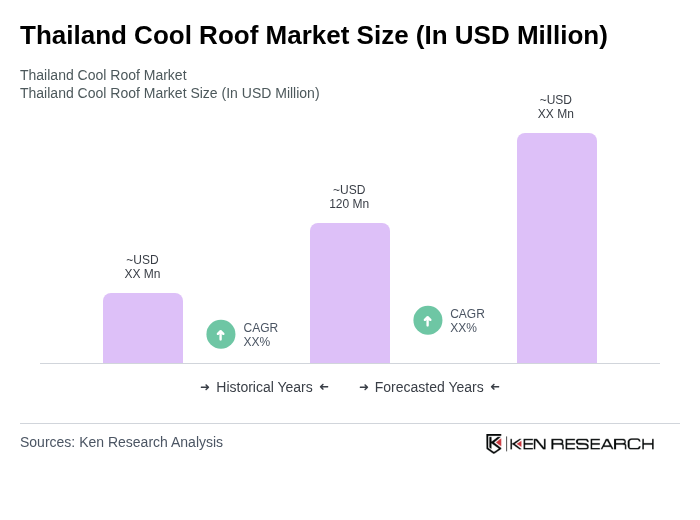
- The Thailand Cool Roof Market is valued at USD 120 million, based on a five-year historical analysis. This growth is primarily driven by increasing urbanization, rising temperatures, growing construction activity, increasing renovation projects, and a rising focus on sustainable and energy-efficient buildings among consumers and businesses. The demand for cool roofing solutions has surged as they contribute to reducing energy consumption and improving indoor comfort, particularly in hot climates.
- Key cities in this market include Bangkok, Chiang Mai, and Phuket, which dominate due to their high population density and significant commercial activities. These cities are experiencing rapid urban development and infrastructure projects, leading to a greater need for energy-efficient building solutions, including cool roofs, to combat the urban heat island effect.
- The Building Energy Code (BEC), 2009 issued by the Department of Energy Business, Ministry of Energy, mandates energy efficiency standards for building envelopes including roofs in new constructions exceeding 2,000 square meters, requiring minimum solar reflectance values and thermal insulation compliance for public and private buildings to achieve specified energy performance thresholds. This initiative aims to enhance energy efficiency and reduce the overall carbon footprint of urban areas, aligning with Thailand's commitment to sustainable development and climate change mitigation.
Thailand Cool Roof Market Segmentation
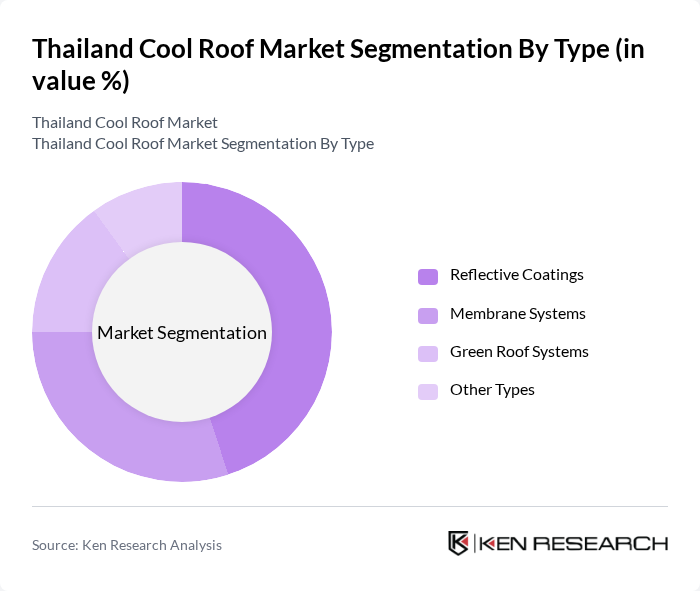
By Type:The market can be segmented into various types, including Reflective Coatings, Membrane Systems, Green Roof Systems, and Other Types. Among these, Reflective Coatings are currently leading the market due to their cost-effectiveness and ease of application. They are widely adopted in both residential and commercial sectors, driven by the increasing demand for energy-efficient solutions. Membrane Systems also hold a significant share, particularly in commercial applications, due to their durability and performance in extreme weather conditions.
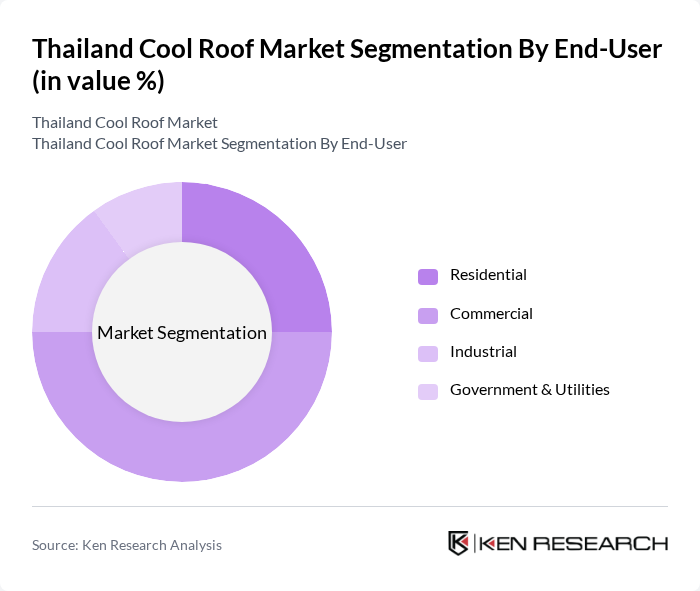
By End-User:The end-user segmentation includes Residential, Commercial, Industrial, and Government & Utilities. The Commercial sector is the largest consumer of cool roofing solutions, driven by the need for energy efficiency in office buildings and retail spaces. The Residential segment is also growing, as homeowners increasingly seek sustainable solutions to reduce energy costs. Government initiatives promoting energy-efficient buildings further bolster demand across all segments.
Thailand Cool Roof Market Competitive Landscape
The Thailand Cool Roof Market is characterized by a dynamic mix of regional and international players. Leading participants such as SCG Building Materials, Siam Cement Group, TPI Polene Public Company Limited, TPI Polene Power Public Company Limited, Thai Cool Roof Co., Ltd., PTT Global Chemical Public Company Limited, Bangkok Roof Co., Ltd., Sika (Thailand) Ltd., BASF (Thailand) Ltd., Dow Chemical Thailand, 3M Thailand, Jotun Thailand Ltd., Nippon Paint (Thailand) Co., Ltd., Asian Paints (Thailand) Ltd., KCC Corporation (Thailand) contribute to innovation, geographic expansion, and service delivery in this space.
Thailand Cool Roof Market Industry Analysis
Growth Drivers
- Increasing Urban Heat Island Effect:The urban heat island effect in Thailand has led to temperature increases of up to 5°C in metropolitan areas compared to surrounding rural regions. This phenomenon has prompted local governments to seek solutions to mitigate heat, with cool roofs being a viable option. The Thai government reported that urban areas account for approximately 50% of the country's population, highlighting the urgent need for effective cooling solutions to enhance urban livability and reduce energy consumption.
- Government Initiatives for Energy Efficiency:The Thai government has set ambitious energy efficiency targets, aiming for a 30% reduction in energy consumption in future. This includes the promotion of cool roofs as part of the Energy Efficiency Plan, which allocates approximately THB 1.5 billion (USD 45 million) annually for energy-saving initiatives. These efforts are expected to drive the adoption of cool roofing technologies, as they align with national goals for sustainable development and energy conservation.
- Rising Awareness of Sustainable Building Practices:There is a growing awareness among Thai consumers and builders regarding sustainable building practices, with a reported 60% of construction firms now prioritizing eco-friendly materials. This shift is supported by the increasing number of green building certifications, which rose by 25% in the last year. As a result, cool roofs are gaining traction as a sustainable option, contributing to reduced energy costs and improved environmental performance in buildings.
Market Challenges
- High Initial Installation Costs:The initial installation costs for cool roofs can be significantly higher than traditional roofing solutions, with estimates ranging from THB 1,200 to THB 1,800 per square meter. This financial barrier can deter homeowners and businesses from investing in cool roofing technologies, especially in a market where budget constraints are prevalent. As a result, many potential customers may opt for cheaper, conventional roofing options despite the long-term energy savings offered by cool roofs.
- Limited Consumer Awareness:Despite the benefits of cool roofs, consumer awareness remains limited, with only 35% of the population familiar with the concept. This lack of knowledge hampers market growth, as many potential users are unaware of the energy savings and environmental benefits associated with cool roofing technologies. Educational campaigns and outreach programs are essential to increase awareness and drive adoption, but currently, these initiatives are not widespread or adequately funded.
Thailand Cool Roof Market Future Outlook
The future of the Thailand cool roof market appears promising, driven by increasing urbanization and a strong governmental push for energy efficiency. As cities expand, the demand for sustainable building solutions will likely rise, with cool roofs playing a crucial role in mitigating heat and reducing energy consumption. Additionally, advancements in technology and materials will enhance the performance and affordability of cool roofs, making them more accessible to a broader audience. The integration of cool roofs with smart building technologies will further enhance their appeal in the coming years.
Market Opportunities
- Expansion in Residential Sector:The residential sector presents a significant opportunity for cool roof adoption, with over 1.5 million new housing units projected to be built in Thailand in future. This growth can drive demand for energy-efficient roofing solutions, as homeowners increasingly seek to reduce energy costs and enhance comfort. Targeting this sector with tailored marketing strategies could yield substantial market growth.
- Integration with Renewable Energy Solutions:The integration of cool roofs with renewable energy solutions, such as solar panels, offers a unique opportunity to enhance energy efficiency. With Thailand's solar energy capacity expected to reach 6,000 MW in future, combining cool roofs with solar technology can maximize energy savings and promote sustainable practices, appealing to environmentally conscious consumers and businesses alike.
Scope of the Report
| Segment | Sub-Segments |
|---|---|
| By Type | Reflective Coatings Membrane Systems Green Roof Systems Other Types |
| By End-User | Residential Commercial Industrial Government & Utilities |
| By Application | New Construction Retrofitting Maintenance and Repair Other Applications |
| By Material | Asphalt Metal Concrete Other Materials |
| By Region | Central Thailand Northern Thailand Southern Thailand Northeastern Thailand |
| By Investment Source | Domestic Investment Foreign Direct Investment (FDI) Public-Private Partnerships (PPP) Government Grants |
| By Policy Support | Subsidies Tax Exemptions Renewable Energy Certificates (RECs) Other Policy Supports |
Key Target Audience
Investors and Venture Capitalist Firms
Government and Regulatory Bodies (e.g., Ministry of Energy, Department of Environmental Quality Promotion)
Manufacturers and Producers of Cool Roofing Materials
Distributors and Retailers of Construction Materials
Building Contractors and Construction Companies
Architectural and Design Firms
Real Estate Developers
Energy Efficiency Program Administrators
Players Mentioned in the Report:
SCG Building Materials
Siam Cement Group
TPI Polene Public Company Limited
TPI Polene Power Public Company Limited
Thai Cool Roof Co., Ltd.
PTT Global Chemical Public Company Limited
Bangkok Roof Co., Ltd.
Sika (Thailand) Ltd.
BASF (Thailand) Ltd.
Dow Chemical Thailand
3M Thailand
Jotun Thailand Ltd.
Nippon Paint (Thailand) Co., Ltd.
Asian Paints (Thailand) Ltd.
KCC Corporation (Thailand)
Table of Contents
Market Assessment Phase
1. Executive Summary and Approach
2. Thailand Cool Roof Market Overview
2.1 Key Insights and Strategic Recommendations
2.2 Thailand Cool Roof Market Overview
2.3 Definition and Scope
2.4 Evolution of Market Ecosystem
2.5 Timeline of Key Regulatory Milestones
2.6 Value Chain & Stakeholder Mapping
2.7 Business Cycle Analysis
2.8 Policy & Incentive Landscape
3. Thailand Cool Roof Market Analysis
3.1 Growth Drivers
3.1.1 Increasing Urban Heat Island Effect
3.1.2 Government Initiatives for Energy Efficiency
3.1.3 Rising Awareness of Sustainable Building Practices
3.1.4 Technological Advancements in Cool Roof Materials
3.2 Market Challenges
3.2.1 High Initial Installation Costs
3.2.2 Limited Consumer Awareness
3.2.3 Regulatory Compliance Issues
3.2.4 Competition from Traditional Roofing Solutions
3.3 Market Opportunities
3.3.1 Expansion in Residential Sector
3.3.2 Integration with Renewable Energy Solutions
3.3.3 Partnerships with Construction Firms
3.3.4 Development of Innovative Cool Roof Technologies
3.4 Market Trends
3.4.1 Increasing Adoption of Green Building Standards
3.4.2 Growth in Smart Building Technologies
3.4.3 Rising Demand for Energy-Efficient Solutions
3.4.4 Focus on Climate Resilience in Urban Planning
3.5 Government Regulation
3.5.1 Energy Efficiency Standards for Buildings
3.5.2 Incentives for Cool Roof Installations
3.5.3 Environmental Impact Assessment Requirements
3.5.4 Building Code Amendments for Cool Roofs
4. SWOT Analysis
5. Stakeholder Analysis
6. Porter's Five Forces Analysis
7. Thailand Cool Roof Market Market Size, 2019-2024
7.1 By Value
7.2 By Volume
7.3 By Average Selling Price
8. Thailand Cool Roof Market Segmentation
8.1 By Type
8.1.1 Reflective Coatings
8.1.2 Membrane Systems
8.1.3 Green Roof Systems
8.1.4 Other Types
8.2 By End-User
8.2.1 Residential
8.2.2 Commercial
8.2.3 Industrial
8.2.4 Government & Utilities
8.3 By Application
8.3.1 New Construction
8.3.2 Retrofitting
8.3.3 Maintenance and Repair
8.3.4 Other Applications
8.4 By Material
8.4.1 Asphalt
8.4.2 Metal
8.4.3 Concrete
8.4.4 Other Materials
8.5 By Region
8.5.1 Central Thailand
8.5.2 Northern Thailand
8.5.3 Southern Thailand
8.5.4 Northeastern Thailand
8.6 By Investment Source
8.6.1 Domestic Investment
8.6.2 Foreign Direct Investment (FDI)
8.6.3 Public-Private Partnerships (PPP)
8.6.4 Government Grants
8.7 By Policy Support
8.7.1 Subsidies
8.7.2 Tax Exemptions
8.7.3 Renewable Energy Certificates (RECs)
8.7.4 Other Policy Supports
9. Thailand Cool Roof Market Competitive Analysis
9.1 Market Share of Key Players
9.2 Cross Comparison of Key Players
9.2.1 Company Name
9.2.2 Group Size (Large, Medium, or Small as per industry convention)
9.2.3 Revenue Growth Rate
9.2.4 Market Penetration Rate
9.2.5 Customer Retention Rate
9.2.6 Pricing Strategy
9.2.7 Product Innovation Rate
9.2.8 Operational Efficiency
9.2.9 Brand Recognition
9.2.10 Customer Satisfaction Score
9.3 SWOT Analysis of Top Players
9.4 Pricing Analysis
9.5 Detailed Profile of Major Companies
9.5.1 SCG Building Materials
9.5.2 Siam Cement Group
9.5.3 TPI Polene Public Company Limited
9.5.4 TPI Polene Power Public Company Limited
9.5.5 Thai Cool Roof Co., Ltd.
9.5.6 PTT Global Chemical Public Company Limited
9.5.7 Bangkok Roof Co., Ltd.
9.5.8 Sika (Thailand) Ltd.
9.5.9 BASF (Thailand) Ltd.
9.5.10 Dow Chemical Thailand
9.5.11 3M Thailand
9.5.12 Jotun Thailand Ltd.
9.5.13 Nippon Paint (Thailand) Co., Ltd.
9.5.14 Asian Paints (Thailand) Ltd.
9.5.15 KCC Corporation (Thailand)
10. Thailand Cool Roof Market End-User Analysis
10.1 Procurement Behavior of Key Ministries
10.1.1 Ministry of Energy
10.1.2 Ministry of Interior
10.1.3 Ministry of Education
10.1.4 Ministry of Public Health
10.2 Corporate Spend on Infrastructure & Energy
10.2.1 Corporate Sustainability Initiatives
10.2.2 Budget Allocation for Energy Efficiency
10.2.3 Investment in Renewable Energy
10.2.4 Infrastructure Development Projects
10.3 Pain Point Analysis by End-User Category
10.3.1 Cost of Implementation
10.3.2 Maintenance Challenges
10.3.3 Regulatory Compliance Issues
10.3.4 Lack of Awareness
10.4 User Readiness for Adoption
10.4.1 Awareness Levels
10.4.2 Financial Readiness
10.4.3 Technical Capability
10.4.4 Support from Stakeholders
10.5 Post-Deployment ROI and Use Case Expansion
10.5.1 Energy Savings Analysis
10.5.2 Performance Metrics
10.5.3 User Feedback and Adaptation
10.5.4 Future Expansion Opportunities
11. Thailand Cool Roof Market Future Size, 2025-2030
11.1 By Value
11.2 By Volume
11.3 By Average Selling Price
Go-To-Market Strategy Phase
1. Whitespace Analysis + Business Model Canvas
1.1 Market Gaps Identification
1.2 Business Model Development
2. Marketing and Positioning Recommendations
2.1 Branding Strategies
2.2 Product USPs
3. Distribution Plan
3.1 Urban Retail Strategies
3.2 Rural NGO Tie-ups
4. Channel & Pricing Gaps
4.1 Underserved Routes
4.2 Pricing Bands Analysis
5. Unmet Demand & Latent Needs
5.1 Category Gaps
5.2 Consumer Segments
6. Customer Relationship
6.1 Loyalty Programs
6.2 After-sales Service
7. Value Proposition
7.1 Sustainability Initiatives
7.2 Integrated Supply Chains
8. Key Activities
8.1 Regulatory Compliance
8.2 Branding Efforts
8.3 Distribution Setup
9. Entry Strategy Evaluation
9.1 Domestic Market Entry Strategy
9.1.1 Product Mix Considerations
9.1.2 Pricing Band Strategy
9.1.3 Packaging Solutions
9.2 Export Entry Strategy
9.2.1 Target Countries Analysis
9.2.2 Compliance Roadmap
10. Entry Mode Assessment
10.1 Joint Ventures
10.2 Greenfield Investments
10.3 Mergers & Acquisitions
10.4 Distributor Model
11. Capital and Timeline Estimation
11.1 Capital Requirements
11.2 Timelines for Implementation
12. Control vs Risk Trade-Off
12.1 Ownership Considerations
12.2 Partnerships Evaluation
13. Profitability Outlook
13.1 Breakeven Analysis
13.2 Long-term Sustainability Strategies
14. Potential Partner List
14.1 Distributors
14.2 Joint Ventures
14.3 Acquisition Targets
15. Execution Roadmap
15.1 Phased Plan for Market Entry
15.1.1 Market Setup
15.1.2 Market Entry
15.1.3 Growth Acceleration
15.1.4 Scale & Stabilize
15.2 Key Activities and Milestones
15.2.1 Milestone Planning
15.2.2 Activity Tracking
Research Methodology
Phase 1: Approach1
Desk Research
- Analysis of government reports on energy efficiency and building regulations in Thailand
- Review of academic publications and case studies on cool roof technologies and their benefits
- Examination of market reports from industry associations related to construction and roofing materials
Primary Research
- Interviews with architects and urban planners involved in sustainable building projects
- Surveys with roofing contractors and suppliers to understand market dynamics
- Focus groups with property developers to gauge interest in cool roof solutions
Validation & Triangulation
- Cross-validation of findings through multiple data sources including government and industry reports
- Triangulation of insights from primary interviews with secondary data trends
- Sanity checks conducted through expert panels comprising industry veterans and academics
Phase 2: Market Size Estimation1
Top-down Assessment
- Estimation of the total addressable market based on national construction spending and growth rates
- Segmentation of the market by residential, commercial, and industrial applications
- Incorporation of government incentives for energy-efficient building materials
Bottom-up Modeling
- Collection of sales data from leading cool roof manufacturers and suppliers
- Estimation of market penetration rates based on historical adoption trends
- Volume and pricing analysis to determine revenue potential across different segments
Forecasting & Scenario Analysis
- Development of forecasting models based on economic indicators and construction activity
- Scenario analysis considering regulatory changes and environmental policies impacting the market
- Projections for market growth under baseline, optimistic, and pessimistic scenarios through 2030
Phase 3: CATI Sample Composition1
| Scope Item/Segment | Sample Size | Target Respondent Profiles |
|---|---|---|
| Residential Cool Roof Adoption | 100 | Homeowners, Property Managers |
| Commercial Building Implementations | 80 | Facility Managers, Building Owners |
| Industrial Sector Applications | 70 | Operations Managers, Sustainability Officers |
| Government Projects and Initiatives | 50 | Public Sector Officials, Urban Planners |
| Architectural Perspectives on Cool Roofs | 60 | Architects, Design Consultants |
Frequently Asked Questions
What is the current value of the Thailand Cool Roof Market?
The Thailand Cool Roof Market is valued at approximately USD 120 million, driven by factors such as urbanization, rising temperatures, and a growing focus on energy-efficient buildings. This market is expected to continue growing as demand for sustainable roofing solutions increases.
What are the main types of cool roofing solutions available in Thailand?
Which cities in Thailand are leading in cool roof adoption?
What government initiatives support the cool roof market in Thailand?
Other Regional/Country Reports
Other Adjacent Reports
Brazil Building Insulation Market
Mexico Solar Energy Market Size, Share & Forecast, By Technology, Application & Project Scale, 2026-2031Netherlands Green Building Materials Market Size, Share & Forecast, By Material Type, End User & Application, 2026-2031KSA Energy-Efficient Coatings Market
Malaysia Construction Chemicals Market Size, Share & Forecast, By Product Type, End-Use Sector & Application, 2026–2031Global Paints and Coatings Market Size, Share & Forecast, By Resin Type, Technology & End-Use Industry, 2025-2032South Korea Sustainable Construction Market
U.S. HVAC Systems Market Size, Share & Forecast, By Equipment Type, End-Use Industry & Technology, 2026-2031UAE Urban Infrastructure Market
Why Buy From Us?

What makes us stand out is that our consultants follow Robust, Refine and Result (RRR) methodology. Robust for clear definitions, approaches and sanity checking, Refine for differentiating respondents' facts and opinions, and Result for presenting data with story.

We have set a benchmark in the industry by offering our clients with syndicated and customized market research reports featuring coverage of entire market as well as meticulous research and analyst insights.

While we don't replace traditional research, we flip the method upside down. Our dual approach of Top Bottom & Bottom Top ensures quality deliverable by not just verifying company fundamentals but also looking at the sector and macroeconomic factors.

With one step in the future, our research team constantly tries to show you the bigger picture. We help with some of the tough questions you may encounter along the way: How is the industry positioned? Best marketing channel? KPI's of competitors? By aligning every element, we help maximize success.

Our report gives you instant access to the answers and sources that other companies might choose to hide. We elaborate each steps of research methodology we have used and showcase you the sample size to earn your trust.

If you need any support, we are here! We pride ourselves on universe strength, data quality, and quick, friendly, and professional service.