About the Report
Base Year 2024Listen to the audio summary
Thailand Diesel Particulate Filter Market Overview
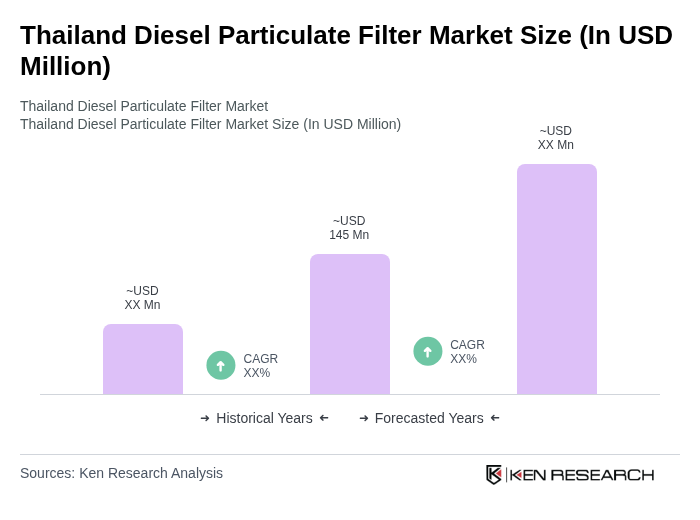
- The Thailand Diesel Particulate Filter Market is valued at USD 145 million, based on a five-year historical analysis. This growth is primarily driven by stringent emission regulations and increasing awareness of air quality issues. The automotive sector's shift towards cleaner technologies has further propelled the demand for diesel particulate filters, as they play a crucial role in reducing harmful emissions from diesel engines.
- Key cities such as Bangkok, Chiang Mai, and Pattaya dominate the market due to their high vehicle density and industrial activities. Bangkok, being the capital, has a significant number of diesel vehicles, while Chiang Mai faces challenges with air pollution, prompting local authorities to enforce stricter emission standards. These factors contribute to the heightened demand for diesel particulate filters in these regions.
- The Notification of the Ministry of Natural Resources and Environment Re: Standards for Controlling Smoke Opacity from Motor Vehicles B.E. 2568 (2025), issued by the Ministry of Natural Resources and Environment, halves the diesel smoke opacity limit to 20% for vehicles in Bangkok and its vicinity starting November 2025, requiring retrofit of diesel particulate filters on non-compliant diesel vehicles to meet the threshold and ensure compliance through mandatory inspections.
Thailand Diesel Particulate Filter Market Segmentation
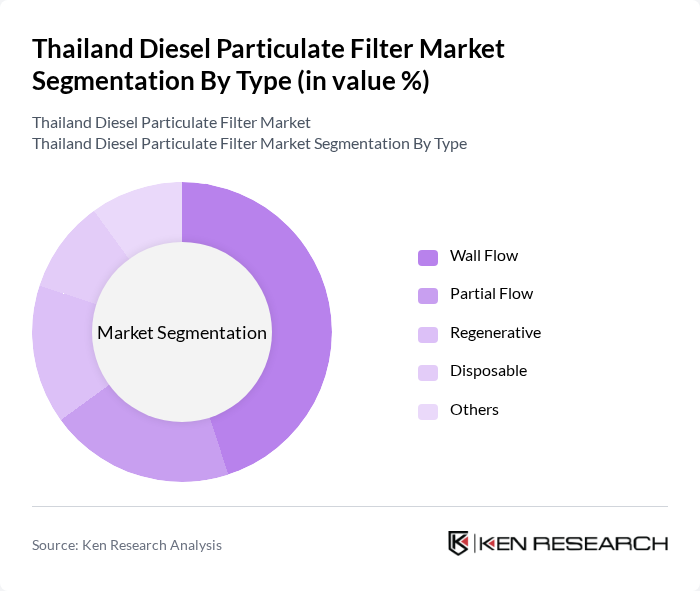
By Type:The market is segmented into various types of diesel particulate filters, including Wall Flow, Partial Flow, Regenerative, Disposable, and Others. Among these, Wall Flow filters are the most widely used due to their efficiency in trapping particulate matter. The increasing adoption of advanced filtration technologies in vehicles has led to a growing preference for Wall Flow filters, which are known for their high filtration efficiency and durability.
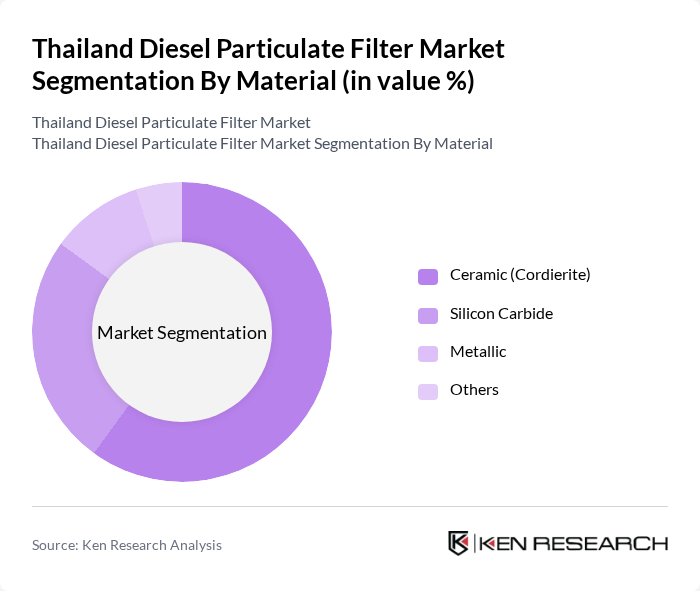
By Material:The diesel particulate filter market is also categorized by material types, including Ceramic (Cordierite), Silicon Carbide, Metallic, and Others. Ceramic (Cordierite) filters dominate the market due to their excellent thermal stability and filtration efficiency. The increasing demand for lightweight and high-performance materials in automotive applications has further solidified the position of Ceramic filters in the market.
Thailand Diesel Particulate Filter Market Competitive Landscape
The Thailand Diesel Particulate Filter Market is characterized by a dynamic mix of regional and international players. Leading participants such as Donaldson Company, Inc., Tenneco Inc., Faurecia S.A., Eberspächer Group, Denso Corporation, HJS Emission Technology, BASF SE, Johnson Matthey PLC, Umicore S.A., NGK Insulators, Ltd., Cormetech, Inc., Clean Diesel Technologies, Inc., SootTech, Aisin Seiki Co., Ltd., Ecomotive Solutions contribute to innovation, geographic expansion, and service delivery in this space.
Thailand Diesel Particulate Filter Market Industry Analysis
Growth Drivers
- Increasing Environmental Regulations:Thailand's commitment to reducing air pollution has led to stringent environmental regulations. The government aims to cut PM2.5 levels by 50% in future, necessitating the adoption of diesel particulate filters (DPFs). In future, the Ministry of Natural Resources and Environment reported that over 70% of urban areas exceeded safe air quality levels, driving demand for cleaner technologies. This regulatory push is expected to significantly boost the DPF market as industries comply with these standards.
- Rising Demand for Cleaner Emission Technologies:The Thai automotive sector is increasingly focused on reducing emissions, with a projected increase in DPF installations by 30% in future. The government’s initiative to promote electric vehicles (EVs) and hybrid technologies is also influencing traditional diesel engines to adopt cleaner technologies. In future, the automotive industry reported a 15% rise in demand for vehicles equipped with advanced emission control systems, further propelling the DPF market.
- Growth in Automotive and Industrial Sectors:Thailand's automotive production reached 2.1 million units in future, with a significant portion being diesel vehicles. The industrial sector, particularly logistics and transportation, is also expanding, with a 10% growth forecast for future. This growth is driving the need for DPFs to meet emission standards. The increasing number of diesel-powered vehicles and machinery is expected to create a robust demand for DPFs in the coming years.
Market Challenges
- High Initial Investment Costs:The adoption of diesel particulate filters involves substantial initial costs, often exceeding THB 100,000 per vehicle for retrofitting. This financial barrier can deter small and medium enterprises from upgrading their fleets. In future, only 25% of diesel vehicle owners opted for DPF installations due to these costs, limiting market penetration. The high upfront investment remains a significant challenge for widespread adoption in Thailand.
- Limited Awareness Among End-Users:Despite the environmental benefits, awareness of diesel particulate filters remains low among end-users. A survey indicated that only 30% of diesel vehicle owners understood the importance of DPFs in reducing emissions in future. This lack of knowledge hampers market growth, as many potential customers are unaware of the long-term savings and regulatory compliance benefits associated with DPF installation, posing a challenge for manufacturers and suppliers.
Thailand Diesel Particulate Filter Market Future Outlook
The future of the Thailand diesel particulate filter market appears promising, driven by increasing environmental awareness and regulatory pressures. As the government intensifies its efforts to combat air pollution, the demand for DPFs is expected to rise significantly in future. Additionally, advancements in filter technology and the growing trend towards sustainability will likely enhance market dynamics. The automotive sector's shift towards cleaner technologies will further support the adoption of DPFs, creating a favorable environment for growth in the coming years.
Market Opportunities
- Expansion in Emerging Markets:The growing industrialization in neighboring Southeast Asian countries presents opportunities for Thai DPF manufacturers. With a projected 20% increase in demand for cleaner technologies in these markets in future, Thai companies can leverage their expertise to expand their reach and establish strategic partnerships, enhancing their market presence and revenue potential.
- Development of Innovative Filter Technologies:Investing in R&D for advanced filtration technologies can open new avenues for growth. Innovations such as self-cleaning filters and enhanced durability can attract more customers. The Thai government’s support for clean technology initiatives can provide funding opportunities, encouraging manufacturers to innovate and improve their product offerings in the DPF market.
Scope of the Report
| Segment | Sub-Segments |
|---|---|
| By Type | Wall Flow Partial Flow Regenerative Disposable Others |
| By Material | Ceramic (Cordierite) Silicon Carbide Metallic Others |
| By Vehicle Type | Passenger Vehicles Light Commercial Vehicles Heavy Commercial Vehicles Off-Highway Vehicles Others |
| By Regeneration Type | Active Passive Others |
| By Sales Channel | OEM Aftermarket Others |
| By Region | Central Thailand Northern Thailand Southern Thailand Northeastern Thailand |
Key Target Audience
Investors and Venture Capitalist Firms
Government and Regulatory Bodies (e.g., Ministry of Industry, Pollution Control Department)
Manufacturers and Producers of Diesel Particulate Filters
Automotive OEMs (Original Equipment Manufacturers)
Aftermarket Parts Suppliers
Logistics and Transportation Companies
Environmental NGOs and Advocacy Groups
Financial Institutions and Banks
Players Mentioned in the Report:
Donaldson Company, Inc.
Tenneco Inc.
Faurecia S.A.
Eberspacher Group
Denso Corporation
HJS Emission Technology
BASF SE
Johnson Matthey PLC
Umicore S.A.
NGK Insulators, Ltd.
Cormetech, Inc.
Clean Diesel Technologies, Inc.
SootTech
Aisin Seiki Co., Ltd.
Ecomotive Solutions
Table of Contents
Market Assessment Phase
1. Executive Summary and Approach
2. Thailand Diesel Particulate Filter Market Overview
2.1 Key Insights and Strategic Recommendations
2.2 Thailand Diesel Particulate Filter Market Overview
2.3 Definition and Scope
2.4 Evolution of Market Ecosystem
2.5 Timeline of Key Regulatory Milestones
2.6 Value Chain & Stakeholder Mapping
2.7 Business Cycle Analysis
2.8 Policy & Incentive Landscape
3. Thailand Diesel Particulate Filter Market Analysis
3.1 Growth Drivers
3.1.1 Increasing Environmental Regulations
3.1.2 Rising Demand for Cleaner Emission Technologies
3.1.3 Growth in Automotive and Industrial Sectors
3.1.4 Technological Advancements in Filtration Systems
3.2 Market Challenges
3.2.1 High Initial Investment Costs
3.2.2 Limited Awareness Among End-Users
3.2.3 Competition from Alternative Technologies
3.2.4 Regulatory Compliance Complexity
3.3 Market Opportunities
3.3.1 Expansion in Emerging Markets
3.3.2 Development of Innovative Filter Technologies
3.3.3 Strategic Partnerships with Automotive Manufacturers
3.3.4 Government Incentives for Clean Technologies
3.4 Market Trends
3.4.1 Shift Towards Electrification in Transportation
3.4.2 Increasing Focus on Sustainability
3.4.3 Adoption of Smart Filtration Systems
3.4.4 Growing Investment in R&D for Emission Control
3.5 Government Regulation
3.5.1 Emission Standards for Diesel Engines
3.5.2 Incentives for Retrofitting Existing Vehicles
3.5.3 Regulations on Manufacturing and Disposal
3.5.4 Compliance Requirements for Importing Filters
4. SWOT Analysis
5. Stakeholder Analysis
6. Porter's Five Forces Analysis
7. Thailand Diesel Particulate Filter Market Market Size, 2019-2024
7.1 By Value
7.2 By Volume
7.3 By Average Selling Price
8. Thailand Diesel Particulate Filter Market Segmentation
8.1 By Type
8.1.1 Wall Flow
8.1.2 Partial Flow
8.1.3 Regenerative
8.1.4 Disposable
8.1.5 Others
8.2 By Material
8.2.1 Ceramic (Cordierite)
8.2.2 Silicon Carbide
8.2.3 Metallic
8.2.4 Others
8.3 By Vehicle Type
8.3.1 Passenger Vehicles
8.3.2 Light Commercial Vehicles
8.3.3 Heavy Commercial Vehicles
8.3.4 Off-Highway Vehicles
8.3.5 Others
8.4 By Regeneration Type
8.4.1 Active
8.4.2 Passive
8.4.3 Others
8.5 By Sales Channel
8.5.1 OEM
8.5.2 Aftermarket
8.5.3 Others
8.6 By Region
8.6.1 Central Thailand
8.6.2 Northern Thailand
8.6.3 Southern Thailand
8.6.4 Northeastern Thailand
9. Thailand Diesel Particulate Filter Market Competitive Analysis
9.1 Market Share of Key Players
9.2 Cross Comparison of Key Players
9.2.1 Revenue Growth (CAGR %)
9.2.2 EBITDA Margin (%)
9.2.3 Market Share (%)
9.2.4 R&D Investment (% of Revenue)
9.2.5 Production Capacity (Units)
9.2.6 Global Presence (Countries)
9.2.7 Patent Portfolio (Count)
9.2.8 Customer Satisfaction Score
9.2.9 Supply Chain Resilience Index
9.2.10 ESG Compliance Score
9.3 SWOT Analysis of Top Players
9.4 Pricing Analysis
9.5 Detailed Profile of Major Companies
9.5.1 Donaldson Company, Inc.
9.5.2 Tenneco Inc.
9.5.3 Faurecia S.A.
9.5.4 Eberspächer Group
9.5.5 Denso Corporation
9.5.6 HJS Emission Technology
9.5.7 BASF SE
9.5.8 Johnson Matthey PLC
9.5.9 Umicore S.A.
9.5.10 NGK Insulators, Ltd.
9.5.11 Cormetech, Inc.
9.5.12 Clean Diesel Technologies, Inc.
9.5.13 SootTech
9.5.14 Aisin Seiki Co., Ltd.
9.5.15 Ecomotive Solutions
10. Thailand Diesel Particulate Filter Market End-User Analysis
10.1 Procurement Behavior of Key Ministries
10.1.1 Government Procurement Policies
10.1.2 Budget Allocation for Environmental Technologies
10.1.3 Collaboration with Private Sector
10.1.4 Evaluation Criteria for Suppliers
10.2 Corporate Spend on Infrastructure & Energy
10.2.1 Investment Trends in Clean Technologies
10.2.2 Budgeting for Diesel Particulate Filters
10.2.3 Long-term Infrastructure Plans
10.2.4 Corporate Sustainability Goals
10.3 Pain Point Analysis by End-User Category
10.3.1 Automotive Sector Challenges
10.3.2 Industrial Sector Challenges
10.3.3 Regulatory Compliance Issues
10.3.4 Cost Management Concerns
10.4 User Readiness for Adoption
10.4.1 Awareness of Diesel Particulate Filters
10.4.2 Training and Support Needs
10.4.3 Financial Readiness for Investment
10.4.4 Technological Adaptability
10.5 Post-Deployment ROI and Use Case Expansion
10.5.1 Measurement of Emission Reductions
10.5.2 Cost Savings Analysis
10.5.3 Expansion into New Applications
10.5.4 Long-term Performance Tracking
11. Thailand Diesel Particulate Filter Market Future Size, 2025-2030
11.1 By Value
11.2 By Volume
11.3 By Average Selling Price
Go-To-Market Strategy Phase
1. Whitespace Analysis + Business Model Canvas
1.1 Market Gaps Identification
1.2 Value Proposition Development
1.3 Revenue Streams Analysis
1.4 Cost Structure Evaluation
1.5 Key Partnerships Exploration
1.6 Customer Segmentation
1.7 Channels of Distribution
2. Marketing and Positioning Recommendations
2.1 Branding Strategies
2.2 Product USPs
2.3 Target Market Identification
2.4 Communication Strategies
2.5 Digital Marketing Approaches
2.6 Customer Engagement Tactics
2.7 Performance Metrics
3. Distribution Plan
3.1 Urban Retail Strategies
3.2 Rural NGO Tie-ups
3.3 E-commerce Opportunities
3.4 Logistics and Supply Chain Management
3.5 Distribution Partnerships
3.6 Inventory Management
3.7 Performance Tracking
4. Channel & Pricing Gaps
4.1 Underserved Routes
4.2 Pricing Bands Analysis
4.3 Competitor Pricing Strategies
4.4 Customer Willingness to Pay
4.5 Value-Based Pricing Models
4.6 Discount Strategies
4.7 Pricing Optimization Techniques
5. Unmet Demand & Latent Needs
5.1 Category Gaps Identification
5.2 Consumer Segments Analysis
5.3 Product Development Opportunities
5.4 Market Entry Strategies
5.5 Customer Feedback Mechanisms
5.6 Innovation Opportunities
5.7 Future Trends Analysis
6. Customer Relationship
6.1 Loyalty Programs
6.2 After-sales Service
6.3 Customer Support Strategies
6.4 Feedback and Improvement Processes
6.5 Community Engagement Initiatives
6.6 Customer Retention Strategies
6.7 Performance Metrics
7. Value Proposition
7.1 Sustainability Initiatives
7.2 Integrated Supply Chains
7.3 Competitive Advantages
7.4 Customer-Centric Approaches
7.5 Value Creation Strategies
7.6 Market Differentiation
7.7 Performance Metrics
8. Key Activities
8.1 Regulatory Compliance
8.2 Branding Initiatives
8.3 Distribution Setup
8.4 Marketing Campaigns
8.5 Training and Development
8.6 Performance Monitoring
8.7 Continuous Improvement Processes
9. Entry Strategy Evaluation
9.1 Domestic Market Entry Strategy
9.1.1 Product Mix Considerations
9.1.2 Pricing Band Analysis
9.1.3 Packaging Strategies
9.2 Export Entry Strategy
9.2.1 Target Countries Identification
9.2.2 Compliance Roadmap Development
10. Entry Mode Assessment
10.1 Joint Ventures
10.2 Greenfield Investments
10.3 Mergers & Acquisitions
10.4 Distributor Model Evaluation
10.5 Risk Assessment
10.6 Strategic Fit Analysis
10.7 Performance Metrics
11. Capital and Timeline Estimation
11.1 Capital Requirements
11.2 Timelines for Implementation
11.3 Financial Projections
11.4 Funding Sources
11.5 Risk Management Strategies
11.6 Performance Metrics
12. Control vs Risk Trade-Off
12.1 Ownership Considerations
12.2 Partnership Opportunities
12.3 Risk Mitigation Strategies
12.4 Performance Metrics
13. Profitability Outlook
13.1 Breakeven Analysis
13.2 Long-term Sustainability Strategies
13.3 Financial Health Monitoring
13.4 Performance Metrics
14. Potential Partner List
14.1 Distributors
14.2 Joint Ventures
14.3 Acquisition Targets
14.4 Strategic Alliances
14.5 Performance Metrics
15. Execution Roadmap
15.1 Phased Plan for Market Entry
15.1.1 Market Setup
15.1.2 Market Entry
15.1.3 Growth Acceleration
15.1.4 Scale & Stabilize
15.2 Key Activities and Milestones
15.2.1 Activity Planning
15.2.2 Milestone Tracking
15.2.3 Performance Metrics
Research Methodology
Phase 1: Approach1
Desk Research
- Analysis of government reports and publications on diesel emissions regulations in Thailand
- Review of industry reports from environmental agencies and automotive associations
- Examination of academic journals and white papers focusing on diesel particulate filter technologies
Primary Research
- Interviews with automotive manufacturers and suppliers involved in diesel particulate filter production
- Surveys with fleet operators and logistics companies utilizing diesel vehicles
- Field interviews with environmental consultants and regulatory bodies in Thailand
Validation & Triangulation
- Cross-validation of findings through multiple data sources including trade publications and expert opinions
- Triangulation of market data with insights from industry experts and stakeholders
- Sanity checks through comparative analysis of historical market trends and forecasts
Phase 2: Market Size Estimation1
Top-down Assessment
- Estimation of the market size based on national diesel consumption statistics and emissions data
- Segmentation of the market by vehicle type, including passenger cars, commercial vehicles, and heavy-duty trucks
- Incorporation of government initiatives aimed at reducing diesel emissions and promoting cleaner technologies
Bottom-up Modeling
- Collection of sales data from leading manufacturers of diesel particulate filters in Thailand
- Estimation of installation rates based on vehicle registration data and retrofit programs
- Cost analysis of diesel particulate filters and their impact on overall vehicle maintenance expenses
Forecasting & Scenario Analysis
- Multi-variable forecasting using economic indicators, regulatory changes, and technological advancements
- Scenario analysis based on potential shifts in consumer preferences towards electric vehicles
- Development of baseline, optimistic, and pessimistic market growth projections through 2030
Phase 3: CATI Sample Composition1
| Scope Item/Segment | Sample Size | Target Respondent Profiles |
|---|---|---|
| Automotive Manufacturers | 45 | Product Development Managers, Compliance Officers |
| Fleet Operators | 80 | Fleet Managers, Operations Directors |
| Environmental Consultants | 50 | Environmental Engineers, Policy Advisors |
| Regulatory Bodies | 30 | Regulatory Affairs Specialists, Policy Makers |
| Aftermarket Suppliers | 70 | Sales Managers, Technical Support Engineers |
Frequently Asked Questions
What is the current value of the Thailand Diesel Particulate Filter Market?
The Thailand Diesel Particulate Filter Market is valued at approximately USD 145 million, driven by stringent emission regulations and a growing focus on air quality. This market is expected to expand as the automotive sector increasingly adopts cleaner technologies.
What are the main drivers of growth in the Thailand Diesel Particulate Filter Market?
Which cities in Thailand are leading in the Diesel Particulate Filter Market?
What are the types of diesel particulate filters available in Thailand?
Other Regional/Country Reports
Other Adjacent Reports
Kuwait Automotive Emission Control Market
South Korea Catalytic Converter Market
Vietnam Exhaust Systems Market
Belgium Diesel Engine Market
KSA Air Pollution Control Market
Oman Vehicle Retrofit Market
United States Industrial Filtration MarketPhilippines Ceramic Materials Market
Egypt Emission Testing Equipment Market
South Africa Automotive Aftermarket Market
Why Buy From Us?

What makes us stand out is that our consultants follow Robust, Refine and Result (RRR) methodology. Robust for clear definitions, approaches and sanity checking, Refine for differentiating respondents' facts and opinions, and Result for presenting data with story.

We have set a benchmark in the industry by offering our clients with syndicated and customized market research reports featuring coverage of entire market as well as meticulous research and analyst insights.

While we don't replace traditional research, we flip the method upside down. Our dual approach of Top Bottom & Bottom Top ensures quality deliverable by not just verifying company fundamentals but also looking at the sector and macroeconomic factors.

With one step in the future, our research team constantly tries to show you the bigger picture. We help with some of the tough questions you may encounter along the way: How is the industry positioned? Best marketing channel? KPI's of competitors? By aligning every element, we help maximize success.

Our report gives you instant access to the answers and sources that other companies might choose to hide. We elaborate each steps of research methodology we have used and showcase you the sample size to earn your trust.

If you need any support, we are here! We pride ourselves on universe strength, data quality, and quick, friendly, and professional service.