About the Report
Base Year 2024Thailand Freestanding Canopy Market Overview
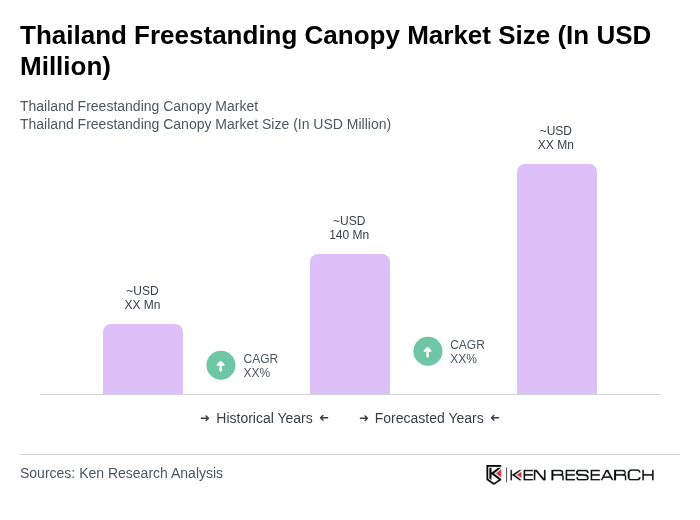
- The Thailand Freestanding Canopy Market is valued at USD 140 million, based on a five-year historical analysis and benchmarking against regional awning and canopy demand within Asia Pacific and Thailand’s dedicated freestanding canopy trade data. This growth is primarily driven by the increasing demand for outdoor spaces in residential and commercial sectors, the expansion of cafés and restaurants with outdoor dining, and the rising trend of outdoor living and leisure activities in urban areas. The market has also seen greater adoption of canopies in hospitality and tourism projects, retail frontages, and public realm upgrades, which has significantly contributed to its expansion.
- Key cities such as Bangkok, Chiang Mai, and Pattaya dominate the market due to their high tourist footfall, dense concentration of hospitality assets, and ongoing urbanization. Bangkok, being the capital, has a robust infrastructure pipeline, a large stock of commercial establishments, and a strong foodservice and retail base that increasingly deploy outdoor shading solutions to improve customer comfort and usable space. Chiang Mai and Pattaya, as leading domestic and international tourism hubs, attract visitors seeking outdoor experiences in hotels, cafés, night markets, and beachfront venues, further driving the demand for freestanding canopies in these regions.
- In 2023, the Thai government continued to advance regulations to promote sustainable construction practices, including the integration of greener materials and energy-efficient design in outdoor structures. A key instrument is the Building Energy Code (BEC) requirements issued under the Energy Conservation Promotion Act by the Ministry of Energy and implemented by the Department of Alternative Energy Development and Efficiency, which set performance-based energy efficiency standards and encourage shading devices and envelope measures to reduce cooling loads in buildings. In parallel, green building frameworks such as TREES (Thai’s Rating of Energy and Environmental Sustainability), overseen by the Thai Green Building Institute, provide criteria that reward use of eco-friendly, durable materials and climate-responsive shading solutions in building and site design, supporting the shift toward more sustainable freestanding canopy installations.
Thailand Freestanding Canopy Market Segmentation
By Material:The market is segmented based on the materials used in the construction of freestanding canopies. The primary materials include metal, fabric, polycarbonate, PVC, and others. This mix is consistent with global canopy product offerings, where metal frames and fabric membranes dominate, while plastic and composite sheets (such as polycarbonate) serve roofing and skylight-style canopy applications. Each material offers distinct advantages, such as durability, aesthetic appeal, UV resistance, low maintenance, and cost-effectiveness, influencing consumer preferences and market dynamics in Thailand’s hot, humid, and high-UV climate.
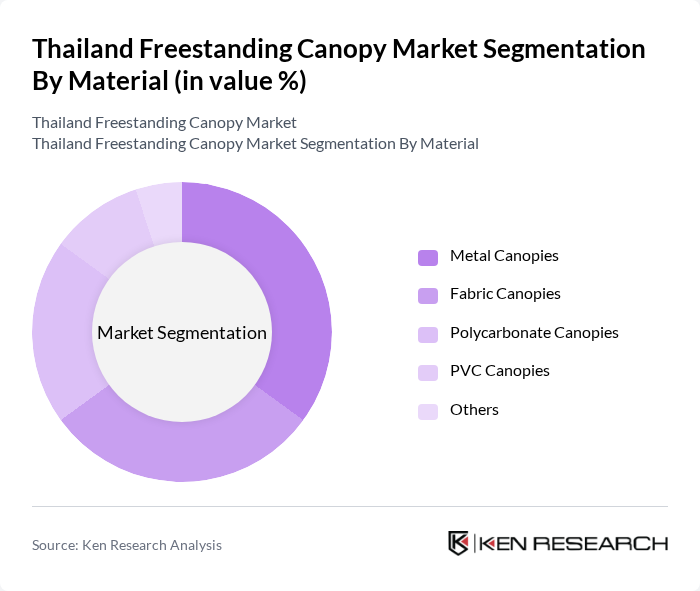
The metal canopies segment leads the market due to their strength, durability, and ability to withstand harsh weather conditions, aligning with broader Asia Pacific demand for metal-framed structures in commercial and mixed-use developments. They are widely used in commercial applications, such as restaurants, parking areas, retail forecourts, and outdoor event spaces, where longevity, structural integrity, and low lifecycle cost are paramount. Fabric canopies follow closely, favored for their versatility, light weight, ease of installation, and aesthetic appeal, particularly in residential patios, gardens, poolside areas, and temporary event setups. The growing trend of outdoor living spaces, home improvement, and café culture has further propelled the demand for both metal and fabric canopies, making them the dominant materials in the market. Polycarbonate and PVC solutions are also gaining ground for modern walkway covers, carports, and semi-permanent roofing where light transmission and impact resistance are important.
By Application:The market is segmented based on the applications of freestanding canopies, which include commercial use, outdoor public spaces and parks, residential outdoor areas, hospitality and tourism (hotels, resorts, cafés), and others. This application mix reflects the broader canopy and awning industry, where residential and commercial uses account for the majority of installations, with growing uptake in public infrastructure and recreational environments.
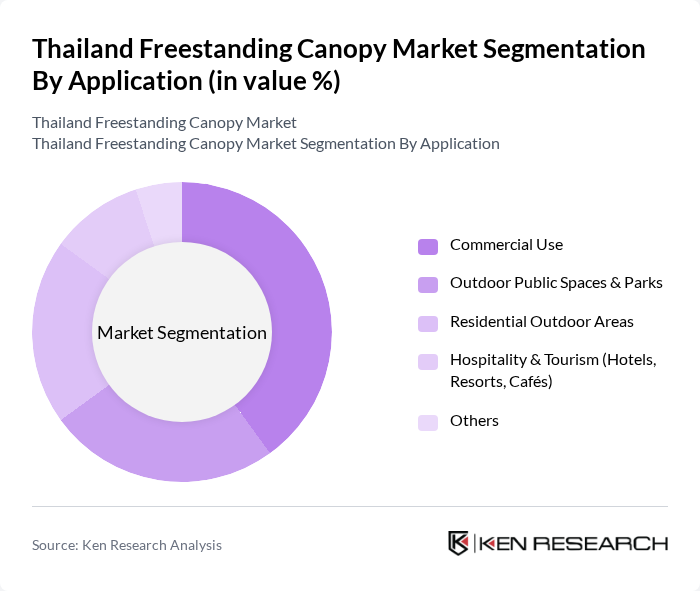
Commercial use is the leading application segment, driven by the need for outdoor shading solutions in restaurants, cafés, retail frontages, car parks, and temporary event venues. The increasing focus on enhancing customer experience in outdoor settings, complying with thermal comfort goals, and expanding usable floor area has led to a rise in the installation of freestanding canopies. Outdoor public spaces and parks also contribute significantly to the market, as municipalities and developers invest in walkways, playgrounds, sports fields, and transit waiting areas that require shade and weather protection. Residential outdoor areas remain an important and steadily growing segment, supported by rising interest in home improvement, balconies, and garden living, while the hospitality sector is expanding its use of design-forward canopy solutions to enhance pool decks, beachfront zones, rooftop bars, and resort common areas.
Thailand Freestanding Canopy Market Competitive Landscape
The Thailand Freestanding Canopy Market is characterized by a dynamic mix of regional and international players. Leading participants such as Thai Awning & Canopy Co., Ltd., Bangkok Canopy & Shade Solutions, Siam Canopy Systems, Sunshade Thailand Co., Ltd., Outdoor Living (Thailand) Co., Ltd., Green Canopy Solutions Co., Ltd., Thai Shade Systems Co., Ltd., Eco Canopy Thailand Co., Ltd., Shade Masters (Thailand) Co., Ltd., Premium Canopies Thailand Co., Ltd., Thai Outdoor Solutions Co., Ltd., Canopy Creations Thailand, Shade & Shelter Co., Ltd., Canopy Experts Thailand Co., Ltd., Thai Outdoor Living & Leisure Co., Ltd. contribute to innovation, geographic expansion, and service delivery in this space, typically competing on customized design, installation capability, after-sales service, and the integration of durable and sustainable materials.
Thailand Freestanding Canopy Market Industry Analysis
Growth Drivers
- Increasing Demand for Outdoor Recreational Spaces:The Thai government has invested approximately THB 60 billion in developing parks and recreational areas, leading to a surge in outdoor activities. This investment has resulted in a 15% increase in public park usage over the past two years. As more people seek outdoor leisure, the demand for freestanding canopies has risen, with an estimated 25% growth in sales reported by local manufacturers in the future, indicating a robust market trend.
- Rising Awareness of Sun Protection:With Thailand's average UV index reaching 11.5, awareness of sun protection has significantly increased. Reports indicate that 75% of Thai consumers are now prioritizing sun safety in their outdoor activities. This shift has led to a 30% increase in the sales of UV-resistant canopies in the future, as consumers invest in protective outdoor solutions, driving market growth and expanding product offerings in the freestanding canopy sector.
- Growth in Tourism and Hospitality Sectors:Thailand welcomed over 45 million international tourists in the future, contributing THB 2.5 trillion to the economy. This influx has spurred demand for outdoor amenities in hotels and resorts, with a reported 35% increase in canopy installations in hospitality settings. As the tourism sector continues to thrive, the freestanding canopy market is poised for further growth, catering to the evolving needs of both tourists and service providers.
Market Challenges
- Fluctuating Raw Material Prices:The volatility in raw material prices, particularly for aluminum and fabric, poses a significant challenge for manufacturers. In the future, aluminum prices surged by 20% due to global supply chain disruptions, impacting production costs. This fluctuation has forced companies to either absorb costs or pass them onto consumers, potentially limiting market growth and affecting profit margins in the freestanding canopy sector.
- Regulatory Compliance Issues:Compliance with local building codes and safety standards can be complex and costly for manufacturers. In the future, approximately 50% of companies reported challenges in meeting these regulations, leading to delays in product launches. The need for rigorous testing and certification processes can hinder innovation and increase operational costs, creating barriers for new entrants in the freestanding canopy market.
Thailand Freestanding Canopy Market Future Outlook
The Thailand freestanding canopy market is expected to evolve significantly, driven by increasing consumer preferences for outdoor living and sustainable products. Innovations in materials, such as biodegradable fabrics and lightweight structures, will likely enhance product appeal. Additionally, the integration of smart technology, such as automated shading systems, is anticipated to attract tech-savvy consumers. As urbanization continues, the demand for multifunctional outdoor spaces will further propel market growth, creating new opportunities for manufacturers and retailers alike.
Market Opportunities
- Innovations in Materials and Designs:The introduction of eco-friendly materials presents a significant opportunity for manufacturers. With a growing consumer base prioritizing sustainability, companies that invest in innovative, sustainable designs can capture market share and enhance brand loyalty, potentially increasing sales by 25% in the future.
- Expansion into E-commerce Platforms:The rise of online shopping in Thailand, with e-commerce sales projected to reach THB 600 billion in the future, offers a lucrative opportunity for freestanding canopy brands. By establishing a strong online presence, companies can tap into a broader customer base, increasing accessibility and convenience, which could lead to a 35% boost in sales through digital channels.
Scope of the Report
| Segment | Sub-Segments |
|---|---|
| By Material | Metal Canopies Fabric Canopies Polycarbonate Canopies PVC Canopies Others |
| By Application | Commercial Use Outdoor Public Spaces & Parks Residential Outdoor Areas Hospitality & Tourism (Hotels, Resorts, Cafés) Others |
| By Type / Structure | Standard Freestanding Canopies Retractable Freestanding Canopies Modular / Multi-bay Canopies Portable / Event Canopies Others |
| By Installation Type | Permanent Installation Temporary / Semi-permanent Installation DIY Installation Professional Installation Others |
| By End-User Sector | Residential Commercial & Retail Industrial & Logistics Government, Municipalities & Public Sector Hospitality & Leisure Operators |
| By Distribution Channel | Direct Sales (Project & B2B) Specialist Dealers & Installers Home Improvement & Building Material Stores Online / E-commerce Others |
| By Region (Thailand) | Bangkok & Central Region Northern Region Northeastern (Isan) Region Eastern & Eastern Economic Corridor (EEC) Southern Region |
Key Target Audience
Investors and Venture Capitalist Firms
Government and Regulatory Bodies (e.g., Ministry of Industry, Department of Business Development)
Manufacturers and Producers
Distributors and Retailers
Construction and Landscaping Companies
Event Management Firms
Hospitality and Tourism Operators
Real Estate Developers
Players Mentioned in the Report:
Thai Awning & Canopy Co., Ltd.
Bangkok Canopy & Shade Solutions
Siam Canopy Systems
Sunshade Thailand Co., Ltd.
Outdoor Living (Thailand) Co., Ltd.
Green Canopy Solutions Co., Ltd.
Thai Shade Systems Co., Ltd.
Eco Canopy Thailand Co., Ltd.
Shade Masters (Thailand) Co., Ltd.
Premium Canopies Thailand Co., Ltd.
Thai Outdoor Solutions Co., Ltd.
Canopy Creations Thailand
Shade & Shelter Co., Ltd.
Canopy Experts Thailand Co., Ltd.
Thai Outdoor Living & Leisure Co., Ltd.
Table of Contents
Market Assessment Phase
1. Executive Summary and Approach
2. Thailand Freestanding Canopy Market Overview
2.1 Key Insights and Strategic Recommendations
2.2 Thailand Freestanding Canopy Market Overview
2.3 Definition and Scope
2.4 Evolution of Market Ecosystem
2.5 Timeline of Key Regulatory Milestones
2.6 Value Chain & Stakeholder Mapping
2.7 Business Cycle Analysis
2.8 Policy & Incentive Landscape
3. Thailand Freestanding Canopy Market Analysis
3.1 Growth Drivers
3.1.1 Increasing demand for outdoor recreational spaces
3.1.2 Rising awareness of sun protection
3.1.3 Growth in tourism and hospitality sectors
3.1.4 Expansion of residential outdoor living spaces
3.2 Market Challenges
3.2.2 Fluctuating raw material prices
3.2.3 Regulatory compliance issues
3.2.4 Seasonal demand fluctuations
3.3 Market Opportunities
3.3.1 Innovations in materials and designs
3.3.2 Expansion into e-commerce platforms
3.3.3 Collaborations with outdoor furniture brands
3.3.4 Increasing urbanization and outdoor living trends
3.4 Market Trends
3.4.1 Growing popularity of eco-friendly materials
3.4.2 Customization and personalization of products
3.4.3 Integration of smart technology in canopies
3.4.4 Rise of multifunctional outdoor spaces
3.5 Government Regulation
3.5.1 Building codes and safety standards
3.5.2 Environmental regulations on materials
3.5.3 Import/export tariffs on outdoor products
3.5.4 Incentives for sustainable product development
4. SWOT Analysis
5. Stakeholder Analysis
6. Porter's Five Forces Analysis
7. Thailand Freestanding Canopy Market Market Size, 2019-2024
7.1 By Value
7.2 By Volume
7.3 By Average Selling Price
8. Thailand Freestanding Canopy Market Segmentation
8.1 By Material
8.1.1 Metal Canopies
8.1.2 Fabric Canopies
8.1.3 Polycarbonate Canopies
8.1.4 PVC Canopies
8.1.5 Others
8.2 By Application
8.2.1 Commercial Use
8.2.2 Outdoor Public Spaces & Parks
8.2.3 Residential Outdoor Areas
8.2.4 Hospitality & Tourism (Hotels, Resorts, Cafés)
8.2.5 Others
8.3 By Type / Structure
8.3.1 Standard Freestanding Canopies
8.3.2 Retractable Freestanding Canopies
8.3.3 Modular / Multi-bay Canopies
8.3.4 Portable / Event Canopies
8.3.5 Others
8.4 By Installation Type
8.4.1 Permanent Installation
8.4.2 Temporary / Semi-permanent Installation
8.4.3 DIY Installation
8.4.4 Professional Installation
8.4.5 Others
8.5 By End-User Sector
8.5.1 Residential
8.5.2 Commercial & Retail
8.5.3 Industrial & Logistics
8.5.4 Government, Municipalities & Public Sector
8.5.5 Hospitality & Leisure Operators
8.6 By Distribution Channel
8.6.1 Direct Sales (Project & B2B)
8.6.2 Specialist Dealers & Installers
8.6.3 Home Improvement & Building Material Stores
8.6.4 Online / E-commerce
8.6.5 Others
8.7 By Region (Thailand)
8.7.1 Bangkok & Central Region
8.7.2 Northern Region
8.7.3 Northeastern (Isan) Region
8.7.4 Eastern & Eastern Economic Corridor (EEC)
8.7.5 Southern Region
9. Thailand Freestanding Canopy Market Competitive Analysis
9.1 Market Share of Key Players
9.2 Cross Comparison of Key Players
9.2.1 Company Name
9.2.2 Group Size (Large, Medium, or Small as per industry convention)
9.2.3 Thailand Freestanding Canopy Revenue (THB, latest year)
9.2.4 3-year Revenue CAGR in Freestanding Canopy Segment
9.2.5 Market Share in Thailand Freestanding Canopy Market (%)
9.2.6 EBITDA Margin (%) – Canopy Business
9.2.7 Order Backlog / Project Pipeline (THB)
9.2.8 Average Project Ticket Size (THB per project)
9.2.9 Customer Retention Rate (%) – Key Accounts
9.2.10 Win-rate in Tenders / Bids (%)
9.2.11 Distribution Coverage (No. of Provinces / Key Cities)
9.2.12 Channel Mix (% Revenue by Direct / Dealer / Online)
9.2.13 Product Portfolio Breadth (No. of Freestanding Canopy SKUs)
9.2.14 Average Delivery & Installation Lead Time (days)
9.2.15 Warranty / Service Commitment (years)
9.3 SWOT Analysis of Top Players
9.4 Pricing Analysis
9.5 Detailed Profile of Major Companies
9.5.1 Thai Awning & Canopy Co., Ltd.
9.5.2 Bangkok Canopy & Shade Solutions
9.5.3 Siam Canopy Systems
9.5.4 Sunshade Thailand Co., Ltd.
9.5.5 Outdoor Living (Thailand) Co., Ltd.
9.5.6 Green Canopy Solutions Co., Ltd.
9.5.7 Thai Shade Systems Co., Ltd.
9.5.8 Eco Canopy Thailand Co., Ltd.
9.5.9 Shade Masters (Thailand) Co., Ltd.
9.5.10 Premium Canopies Thailand Co., Ltd.
9.5.11 Thai Outdoor Solutions Co., Ltd.
9.5.12 Canopy Creations Thailand
9.5.13 Shade & Shelter Co., Ltd.
9.5.14 Canopy Experts Thailand Co., Ltd.
9.5.15 Thai Outdoor Living & Leisure Co., Ltd.
10. Thailand Freestanding Canopy Market End-User Analysis
10.1 Procurement Behavior of Key Ministries
10.1.1 Government procurement processes
10.1.2 Budget allocation for outdoor infrastructure
10.1.3 Evaluation criteria for suppliers
10.1.4 Contracting and tendering practices
10.2 Corporate Spend on Infrastructure & Energy
10.2.1 Investment trends in outdoor facilities
10.2.2 Budgeting for sustainability initiatives
10.2.3 Corporate social responsibility spending
10.2.4 Infrastructure development priorities
10.3 Pain Point Analysis by End-User Category
10.3.1 Residential user challenges
10.3.2 Commercial user challenges
10.3.3 Government user challenges
10.3.4 Industrial user challenges
10.4 User Readiness for Adoption
10.4.1 Awareness of product benefits
10.4.2 Willingness to invest in quality
10.4.3 Availability of financing options
10.4.4 User education and training needs
10.5 Post-Deployment ROI and Use Case Expansion
10.5.1 Measurement of ROI post-installation
10.5.2 Case studies of successful deployments
10.5.3 Expansion into new use cases
10.5.4 Long-term maintenance considerations
11. Thailand Freestanding Canopy Market Future Size, 2025-2030
11.1 By Value
11.2 By Volume
11.3 By Average Selling Price
Go-To-Market Strategy Phase
1. Whitespace Analysis + Business Model Canvas
1.1 Market gaps identification
1.2 Business model development
2. Marketing and Positioning Recommendations
2.1 Branding strategies
2.2 Product USPs
3. Distribution Plan
3.1 Urban retail vs rural NGO tie-ups
4. Channel & Pricing Gaps
4.1 Underserved routes
4.2 Pricing bands
5. Unmet Demand & Latent Needs
5.1 Category gaps
5.2 Consumer segments
6. Customer Relationship
6.1 Loyalty programs
6.2 After-sales service
7. Value Proposition
7.1 Sustainability
7.2 Integrated supply chains
8. Key Activities
8.1 Regulatory compliance
8.2 Branding
8.3 Distribution setup
9. Entry Strategy Evaluation
9.1 Domestic Market Entry Strategy
9.1.1 Product mix
9.1.2 Pricing band
9.1.3 Packaging
9.2 Export Entry Strategy
9.2.1 Target countries
9.2.2 Compliance roadmap
10. Entry Mode Assessment
10.1 JV, Greenfield, M&A, Distributor Model
11. Capital and Timeline Estimation
11.1 Capital requirements
11.2 Timelines
12. Control vs Risk Trade-Off
12.1 Ownership vs Partnerships
13. Profitability Outlook
13.1 Breakeven analysis
13.2 Long-term sustainability
14. Potential Partner List
14.1 Distributors
14.2 JVs
14.3 Acquisition targets
15. Execution Roadmap
15.1 Phased Plan for Market Entry
15.1.1 Market Setup
15.1.2 Market Entry
15.1.3 Growth Acceleration
15.1.4 Scale & Stabilize
15.2 Key Activities and Milestones
15.2.1 Milestone tracking
15.2.2 Activity scheduling
Research Methodology
Phase 1: Approach1
Desk Research
- Analysis of industry reports from Thai trade associations and market research firms
- Review of government publications on tourism and outdoor activities impacting canopy demand
- Examination of online resources, including e-commerce platforms and consumer reviews related to freestanding canopies
Primary Research
- Interviews with manufacturers and suppliers of freestanding canopies in Thailand
- Surveys targeting retailers specializing in outdoor equipment and home improvement
- Field interviews with end-users, including homeowners and event organizers, to gather insights on preferences and usage
Validation & Triangulation
- Cross-validation of findings through multiple data sources, including sales data and consumer feedback
- Triangulation of market trends with insights from industry experts and stakeholders
- Sanity checks through expert panel reviews to ensure data accuracy and relevance
Phase 2: Market Size Estimation1
Top-down Assessment
- Estimation of market size based on overall outdoor equipment sales in Thailand
- Segmentation of the market by application areas such as residential, commercial, and recreational
- Incorporation of growth trends in tourism and outdoor events influencing canopy sales
Bottom-up Modeling
- Collection of sales data from leading manufacturers and retailers of freestanding canopies
- Estimation of average selling prices and volume sold across different segments
- Analysis of distribution channels and their impact on market penetration and pricing strategies
Forecasting & Scenario Analysis
- Multi-factor regression analysis considering economic indicators, consumer spending, and outdoor activity trends
- Scenario modeling based on potential impacts of climate change and urbanization on outdoor living spaces
- Development of baseline, optimistic, and pessimistic forecasts through 2030
Phase 3: CATI Sample Composition1
| Scope Item/Segment | Sample Size | Target Respondent Profiles |
|---|---|---|
| Residential Canopy Users | 110 | Homeowners, DIY Enthusiasts |
| Commercial Event Organizers | 85 | Event Planners, Venue Managers |
| Retail Sector Insights | 75 | Store Managers, Product Buyers |
| Tourism and Hospitality Sector | 65 | Hotel Managers, Resort Owners |
| Outdoor Equipment Retailers | 95 | Sales Representatives, Marketing Managers |
Frequently Asked Questions
What is the current value of the Thailand Freestanding Canopy Market?
The Thailand Freestanding Canopy Market is valued at approximately USD 140 million, reflecting a robust demand driven by outdoor living trends, hospitality expansions, and urbanization in key cities like Bangkok, Chiang Mai, and Pattaya.
What factors are driving the growth of the freestanding canopy market in Thailand?
Which materials are commonly used in freestanding canopies in Thailand?
What are the main applications of freestanding canopies in Thailand?
Other Regional/Country Reports
Other Adjacent Reports
Vietnam Awning Market
Middle East Outdoor Furniture Market Report Size Share Growth Drivers Trends Opportunities & Forecast 2025–2030Kuwait Shade Sail Market
Thailand Pergola Market
UAE Gazebo Market
Indonesia Sun Umbrella Market
Bahrain Patio Cover Market
Singapore Hospitality Amenity Market
Mexico Sustainable Building Material Market
Singapore Commercial Outdoor Structure Market
Why Buy From Us?

What makes us stand out is that our consultants follow Robust, Refine and Result (RRR) methodology. Robust for clear definitions, approaches and sanity checking, Refine for differentiating respondents' facts and opinions, and Result for presenting data with story.

We have set a benchmark in the industry by offering our clients with syndicated and customized market research reports featuring coverage of entire market as well as meticulous research and analyst insights.

While we don't replace traditional research, we flip the method upside down. Our dual approach of Top Bottom & Bottom Top ensures quality deliverable by not just verifying company fundamentals but also looking at the sector and macroeconomic factors.

With one step in the future, our research team constantly tries to show you the bigger picture. We help with some of the tough questions you may encounter along the way: How is the industry positioned? Best marketing channel? KPI's of competitors? By aligning every element, we help maximize success.

Our report gives you instant access to the answers and sources that other companies might choose to hide. We elaborate each steps of research methodology we have used and showcase you the sample size to earn your trust.

If you need any support, we are here! We pride ourselves on universe strength, data quality, and quick, friendly, and professional service.