About the Report
Base Year 2024Thailand Metal Fabrication Equipment Market Overview
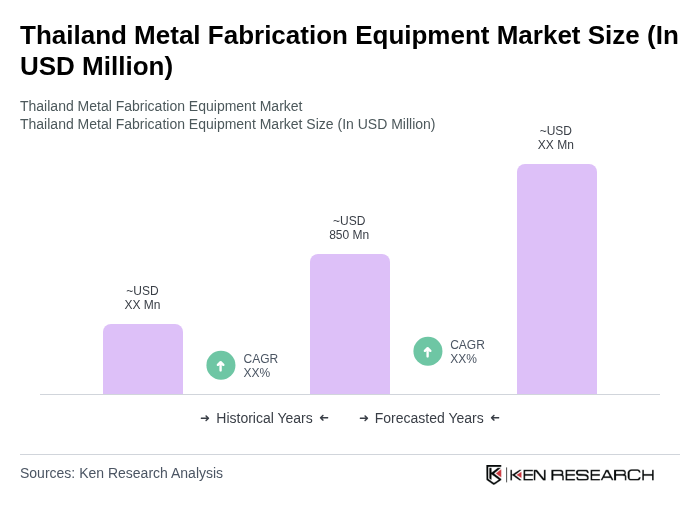
- The Thailand Metal Fabrication Equipment Market is valued at USD 850 million, based on a five-year historical analysis. This growth is primarily driven by the increasing demand for advanced manufacturing technologies, coupled with the expansion of the automotive and construction sectors. The rise in infrastructure projects and the push for automation in manufacturing processes have significantly contributed to the market's growth.
- Key cities such as Bangkok, Chonburi, and Rayong dominate the market due to their robust industrial bases and proximity to major manufacturing hubs. Bangkok serves as the economic center, while Chonburi and Rayong are known for their industrial estates and automotive manufacturing facilities, attracting both local and foreign investments.
- The Thailand 4.0 Model, launched by the Thai government in 2016, promotes advanced manufacturing technologies and innovation in the metal fabrication sector through the National Innovation Agency. This initiative includes incentives for companies adopting smart manufacturing practices and investments in research and development, fostering a more competitive environment in the market.
Thailand Metal Fabrication Equipment Market Segmentation
By Type:
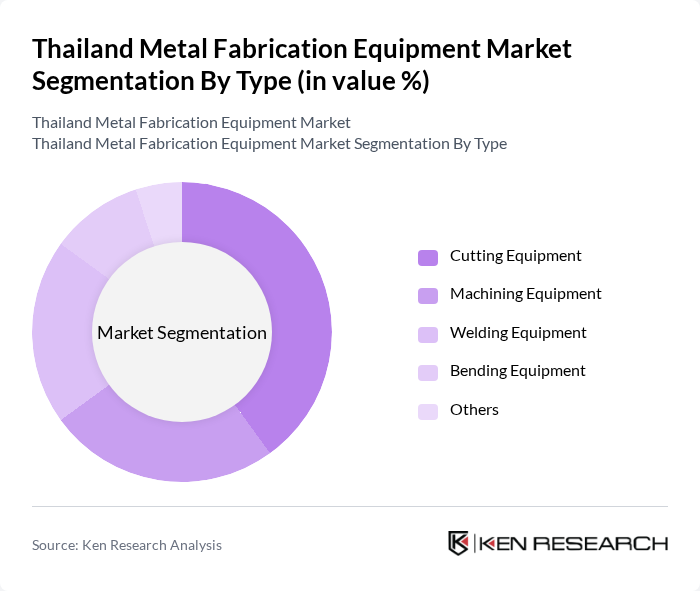
The market is segmented into various types, including Cutting Equipment, Machining Equipment, Welding Equipment, Bending Equipment, and Others. Among these, Cutting Equipment is the leading sub-segment, driven by its essential role in various manufacturing processes. The demand for precision cutting tools has surged due to the increasing need for high-quality metal components in industries such as automotive and aerospace. Additionally, advancements in cutting technologies, such as laser and plasma cutting, have further enhanced the efficiency and accuracy of metal fabrication, making this sub-segment a key player in the market.
By End-User:
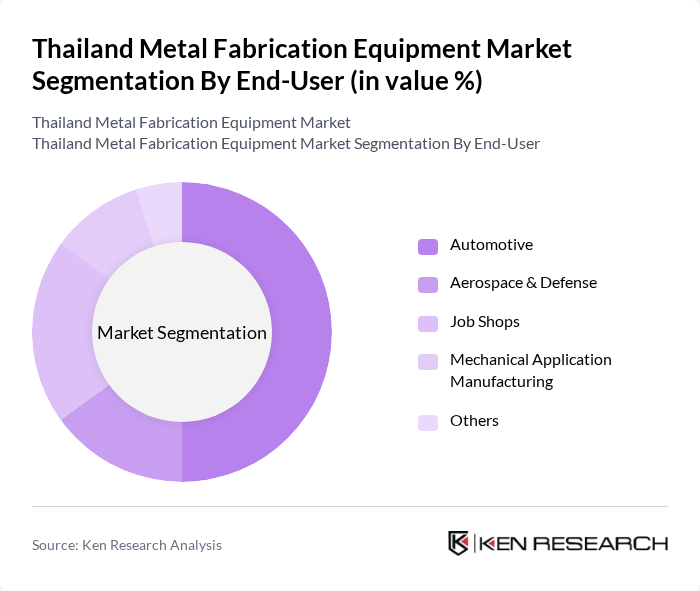
The market is categorized by end-users, including Automotive, Aerospace & Defense, Job Shops, Mechanical Application Manufacturing, and Others. The Automotive sector is the dominant end-user, accounting for a significant portion of the market. This is attributed to the rapid growth of the automotive industry in Thailand, which is one of the largest automotive manufacturing hubs in Southeast Asia. The increasing production of vehicles and components has led to a higher demand for metal fabrication equipment, particularly in cutting and welding technologies, to meet the stringent quality standards of the automotive sector.
Thailand Metal Fabrication Equipment Market Competitive Landscape
The Thailand Metal Fabrication Equipment Market is characterized by a dynamic mix of regional and international players. Leading participants such as Thai Rung Union Car Public Co., Ltd., Precision Metal Works Co., Ltd., S.K.I. Metal Stamp Co., Ltd., Thai Precision Metal Works, Metal Forming Co., Ltd., Charoen Pokphand Group, Thai Union Group, S.P. Metal Works, A.P. Metal Fabrication, P.K. Engineering, S.K. Metal Fabrication, T.M. Engineering, R.S. Metal Works, A.M. Fabrication, B.C. Metal Solutions contribute to innovation, geographic expansion, and service delivery in this space.
Thailand Metal Fabrication Equipment Market Industry Analysis
Growth Drivers
- Increasing Demand for Customized Metal Products:The demand for customized metal products in Thailand is projected to reach 1.3 million tons in the future, driven by sectors such as automotive and electronics. This surge is attributed to the growing consumer preference for tailored solutions, which has led to a 16% increase in orders for bespoke metal components. The rise in local manufacturing capabilities further supports this trend, as companies invest in advanced fabrication technologies to meet specific client needs.
- Growth in Construction and Infrastructure Projects:Thailand's construction sector is expected to grow by 9% in the future, fueled by government initiatives to enhance infrastructure. The government allocated THB 650 billion for infrastructure projects, including roads and bridges, which significantly boosts the demand for metal fabrication equipment. This investment is crucial for meeting the rising needs of urbanization and industrialization, creating a robust market for metal fabrication services and equipment.
- Technological Advancements in Fabrication Processes:The adoption of advanced technologies, such as laser cutting and 3D printing, is revolutionizing the metal fabrication landscape in Thailand. In the future, it is estimated that 32% of fabrication processes will utilize these technologies, enhancing efficiency and precision. This shift not only reduces production time by 26% but also lowers waste, making operations more sustainable and cost-effective, thus driving market growth.
Market Challenges
- High Initial Investment Costs:The metal fabrication equipment market in Thailand faces significant challenges due to high initial investment costs, which can exceed THB 11 million for advanced machinery. This financial barrier limits access for small and medium enterprises (SMEs), which constitute 98% of the manufacturing sector. Consequently, many SMEs struggle to upgrade their equipment, hindering overall market growth and technological advancement.
- Skilled Labor Shortages:The industry is grappling with a shortage of skilled labor, with an estimated gap of 160,000 workers in the future. This shortage is exacerbated by an aging workforce and insufficient vocational training programs. As a result, companies face challenges in maintaining production efficiency and quality standards, which can lead to increased operational costs and delays in project timelines, ultimately affecting competitiveness in the market.
Thailand Metal Fabrication Equipment Market Future Outlook
The future of the Thailand metal fabrication equipment market appears promising, driven by ongoing technological innovations and increasing demand for customized solutions. As industries embrace automation and smart technologies, the market is likely to witness a significant transformation. Additionally, government initiatives aimed at enhancing manufacturing capabilities will further stimulate growth. The focus on sustainability and eco-friendly practices will also shape the market, encouraging investments in green technologies and processes that align with global trends.
Market Opportunities
- Expansion of Export Markets:Thailand's strategic location in Southeast Asia positions it as a hub for metal fabrication exports. With a projected increase in exports to neighboring countries by 22% in the future, manufacturers can capitalize on this opportunity to diversify their markets and enhance revenue streams, thereby strengthening their competitive edge in the region.
- Adoption of Automation and Smart Technologies:The integration of automation and smart technologies in metal fabrication processes is expected to grow significantly, with investments projected to reach THB 16 billion in the future. This shift will enhance productivity and reduce operational costs, allowing companies to meet the increasing demand for high-quality products while maintaining competitive pricing in the market.
Scope of the Report
| Segment | Sub-Segments |
|---|---|
| By Type | Cutting Equipment Machining Equipment Welding Equipment Bending Equipment Others |
| By End-User | Automotive Aerospace & Defense Job Shops Mechanical Application Manufacturing Others |
| By Application | Structural Fabrication Sheet Metal Fabrication Custom Fabrication Prototyping Others |
| By Material Type | Steel Aluminum Copper Brass Others |
| By Technology | Traditional Fabrication Advanced Fabrication Hybrid Fabrication Others |
| By Distribution Channel | Direct Sales Distributors Online Sales Others |
| By Region | Central Thailand Northern Thailand Northeastern Thailand Southern Thailand Eastern Thailand Western Thailand |
Key Target Audience
Investors and Venture Capitalist Firms
Government and Regulatory Bodies (e.g., Ministry of Industry, Department of Industrial Works)
Manufacturers and Producers
Distributors and Retailers
Metal Fabrication Equipment Suppliers
Industry Associations (e.g., Thai Metalworking Federation)
Financial Institutions
Trade Associations and Chambers of Commerce
Players Mentioned in the Report:
Thai Rung Union Car Public Co., Ltd.
Precision Metal Works Co., Ltd.
S.K.I. Metal Stamp Co., Ltd.
Thai Precision Metal Works
Metal Forming Co., Ltd.
Charoen Pokphand Group
Thai Union Group
S.P. Metal Works
A.P. Metal Fabrication
P.K. Engineering
S.K. Metal Fabrication
T.M. Engineering
R.S. Metal Works
A.M. Fabrication
B.C. Metal Solutions
Table of Contents
Market Assessment Phase
1. Executive Summary and Approach
2. Thailand Metal Fabrication Equipment Market Overview
2.1 Key Insights and Strategic Recommendations
2.2 Thailand Metal Fabrication Equipment Market Overview
2.3 Definition and Scope
2.4 Evolution of Market Ecosystem
2.5 Timeline of Key Regulatory Milestones
2.6 Value Chain & Stakeholder Mapping
2.7 Business Cycle Analysis
2.8 Policy & Incentive Landscape
3. Thailand Metal Fabrication Equipment Market Analysis
3.1 Growth Drivers
3.1.1 Increasing demand for customized metal products
3.1.2 Growth in construction and infrastructure projects
3.1.3 Technological advancements in fabrication processes
3.1.4 Rising investments in manufacturing sectors
3.2 Market Challenges
3.2.1 High initial investment costs
3.2.2 Skilled labor shortages
3.2.3 Fluctuating raw material prices
3.2.4 Regulatory compliance complexities
3.3 Market Opportunities
3.3.1 Expansion of export markets
3.3.2 Adoption of automation and smart technologies
3.3.3 Government incentives for manufacturing
3.3.4 Increasing demand for sustainable practices
3.4 Market Trends
3.4.1 Shift towards digital fabrication technologies
3.4.2 Growing emphasis on sustainability and eco-friendly practices
3.4.3 Rise in collaborative manufacturing models
3.4.4 Integration of AI and machine learning in production
3.5 Government Regulation
3.5.1 Environmental compliance regulations
3.5.2 Safety standards for manufacturing equipment
3.5.3 Import/export tariffs on metal products
3.5.4 Labor laws affecting manufacturing operations
4. SWOT Analysis
5. Stakeholder Analysis
6. Porter's Five Forces Analysis
7. Thailand Metal Fabrication Equipment Market Size, 2019-2024
7.1 By Value
7.2 By Volume
7.3 By Average Selling Price
8. Thailand Metal Fabrication Equipment Market Segmentation
8.1 By Type
8.1.1 Cutting Equipment
8.1.2 Machining Equipment
8.1.3 Welding Equipment
8.1.4 Bending Equipment
8.1.5 Others
8.2 By End-User
8.2.1 Automotive
8.2.2 Aerospace & Defense
8.2.3 Job Shops
8.2.4 Mechanical Application Manufacturing
8.2.5 Others
8.3 By Application
8.3.1 Structural Fabrication
8.3.2 Sheet Metal Fabrication
8.3.3 Custom Fabrication
8.3.4 Prototyping
8.3.5 Others
8.4 By Material Type
8.4.1 Steel
8.4.2 Aluminum
8.4.3 Copper
8.4.4 Brass
8.4.5 Others
8.5 By Technology
8.5.1 Traditional Fabrication
8.5.2 Advanced Fabrication
8.5.3 Hybrid Fabrication
8.5.4 Others
8.6 By Distribution Channel
8.6.1 Direct Sales
8.6.2 Distributors
8.6.3 Online Sales
8.6.4 Others
8.7 By Region
8.7.1 Central Thailand
8.7.2 Northern Thailand
8.7.3 Northeastern Thailand
8.7.4 Southern Thailand
8.7.5 Eastern Thailand
8.7.6 Western Thailand
9. Thailand Metal Fabrication Equipment Market Competitive Analysis
9.1 Market Share of Key Players
9.2 Cross Comparison of Key Players
9.2.1 Company Name
9.2.2 Revenue Growth Rate (%)
9.2.3 Market Share (%)
9.2.4 Market Penetration Rate (%)
9.2.5 Customer Retention Rate (%)
9.2.6 Average Selling Price (USD)
9.2.7 Product Portfolio Breadth (Number of Product Lines)
9.2.8 Operational Efficiency Ratio (Revenue per Employee)
9.2.9 Brand Recognition Score (1-10)
9.2.10 Net Promoter Score (NPS)
9.3 SWOT Analysis of Top Players
9.4 Pricing Analysis
9.5 Detailed Profile of Major Companies
9.5.1 Thai Rung Union Car Public Co., Ltd.
9.5.2 Precision Metal Works Co., Ltd.
9.5.3 S.K.I. Metal Stamp Co., Ltd.
9.5.4 Thai Precision Metal Works
9.5.5 Metal Forming Co., Ltd.
9.5.6 Charoen Pokphand Group
9.5.7 Thai Union Group
9.5.8 S.P. Metal Works
9.5.9 A.P. Metal Fabrication
9.5.10 P.K. Engineering
9.5.11 S.K. Metal Fabrication
9.5.12 T.M. Engineering
9.5.13 R.S. Metal Works
9.5.14 A.M. Fabrication
9.5.15 B.C. Metal Solutions
10. Thailand Metal Fabrication Equipment Market End-User Analysis
10.1 Procurement Behavior of Key Ministries
10.1.1 Government procurement policies
10.1.2 Budget allocation for metal fabrication
10.1.3 Supplier selection criteria
10.1.4 Contract management practices
10.2 Corporate Spend on Infrastructure & Energy
10.2.1 Investment trends in infrastructure projects
10.2.2 Corporate budgets for energy-efficient solutions
10.2.3 Spending on maintenance and upgrades
10.2.4 Long-term contracts and partnerships
10.3 Pain Point Analysis by End-User Category
10.3.1 Challenges faced by automotive manufacturers
10.3.2 Issues in construction sector
10.3.3 Pain points in aerospace fabrication
10.3.4 Common problems in electronics manufacturing
10.4 User Readiness for Adoption
10.4.1 Awareness of new technologies
10.4.2 Training and skill development needs
10.4.3 Financial readiness for investment
10.4.4 Infrastructure readiness for implementation
10.5 Post-Deployment ROI and Use Case Expansion
10.5.1 Measurement of ROI post-implementation
10.5.2 Case studies of successful deployments
10.5.3 Expansion opportunities in new applications
10.5.4 Long-term benefits of technology adoption
11. Thailand Metal Fabrication Equipment Market Future Size, 2025-2030
11.1 By Value
11.2 By Volume
11.3 By Average Selling Price
Go-To-Market Strategy Phase
1. Whitespace Analysis + Business Model Canvas
1.1 Market gaps identification
1.2 Business model evaluation
2. Marketing and Positioning Recommendations
2.1 Branding strategies
2.2 Product USPs
3. Distribution Plan
3.1 Urban retail vs rural NGO tie-ups
4. Channel & Pricing Gaps
4.1 Underserved routes
4.2 Pricing bands
5. Unmet Demand & Latent Needs
5.1 Category gaps
5.2 Consumer segments
6. Customer Relationship
6.1 Loyalty programs
6.2 After-sales service
7. Value Proposition
7.1 Sustainability
7.2 Integrated supply chains
8. Key Activities
8.1 Regulatory compliance
8.2 Branding
8.3 Distribution setup
9. Entry Strategy Evaluation
9.1 Domestic Market Entry Strategy
9.1.1 Product mix
9.1.2 Pricing band
9.1.3 Packaging
9.2 Export Entry Strategy
9.2.1 Target countries
9.2.2 Compliance roadmap
10. Entry Mode Assessment
10.1 JV
10.2 Greenfield
10.3 M&A
10.4 Distributor Model
11. Capital and Timeline Estimation
11.1 Capital requirements
11.2 Timelines
12. Control vs Risk Trade-Off
12.1 Ownership vs Partnerships
13. Profitability Outlook
13.1 Breakeven analysis
13.2 Long-term sustainability
14. Potential Partner List
14.1 Distributors
14.2 JVs
14.3 Acquisition targets
15. Execution Roadmap
15.1 Phased Plan for Market Entry
15.1.1 Market Setup
15.1.2 Market Entry
15.1.3 Growth Acceleration
15.1.4 Scale & Stabilize
15.2 Key Activities and Milestones
15.2.1 Milestone tracking
15.2.2 Activity scheduling
Research Methodology
Phase 1: Approach1
Desk Research
- Industry reports from the Thailand Ministry of Industry and relevant trade associations
- Market analysis publications focusing on metal fabrication equipment trends and forecasts
- Statistical data from the National Statistical Office of Thailand regarding manufacturing output
Primary Research
- Interviews with key stakeholders in the metal fabrication sector, including manufacturers and suppliers
- Surveys conducted with end-users in industries such as automotive, construction, and aerospace
- Field visits to fabrication facilities to gather insights on equipment usage and preferences
Validation & Triangulation
- Cross-validation of findings through multiple data sources, including trade publications and expert opinions
- Triangulation of market data with insights from industry conferences and seminars
- Sanity checks through feedback from a panel of industry experts and analysts
Phase 2: Market Size Estimation1
Top-down Assessment
- Analysis of national manufacturing growth rates to estimate demand for metal fabrication equipment
- Segmentation of the market by equipment type, including CNC machines, welding equipment, and cutting tools
- Incorporation of government initiatives promoting local manufacturing and infrastructure development
Bottom-up Modeling
- Data collection from leading manufacturers to establish production capacity and sales volumes
- Cost analysis based on equipment pricing and operational expenses in the fabrication sector
- Estimation of market size through aggregation of sales data from various equipment categories
Forecasting & Scenario Analysis
- Utilization of historical growth trends to project future market developments through 2030
- Scenario modeling based on potential economic shifts and technological advancements in fabrication
- Development of baseline, optimistic, and pessimistic forecasts to account for market volatility
Phase 3: CATI Sample Composition1
| Scope Item/Segment | Sample Size | Target Respondent Profiles |
|---|---|---|
| CNC Machine Manufacturers | 100 | Production Managers, Sales Directors |
| Welding Equipment Suppliers | 80 | Technical Sales Representatives, Product Managers |
| End-users in Automotive Sector | 75 | Operations Managers, Engineering Leads |
| Construction Equipment Fabricators | 60 | Procurement Officers, Project Managers |
| Aerospace Component Manufacturers | 50 | Quality Assurance Managers, R&D Engineers |
Frequently Asked Questions
What is the current value of the Thailand Metal Fabrication Equipment Market?
The Thailand Metal Fabrication Equipment Market is valued at approximately USD 850 million, reflecting a robust growth trajectory driven by advancements in manufacturing technologies and the expansion of key sectors such as automotive and construction.
Which cities are the key players in the Thailand Metal Fabrication Equipment Market?
What are the main types of metal fabrication equipment in Thailand?
How is the automotive sector influencing the metal fabrication equipment market in Thailand?
Other Regional/Country Reports
Other Adjacent Reports
Japan Automotive Manufacturing Equipment Market
Vietnam Aerospace Manufacturing Equipment Market
Australia Construction Machinery Market Size, Share & Forecast, By Product Type, End-Use Industry & Sales Channel, 2026-2031India Industrial Automation Market Size, Share & Forecast, By Solution Type, Deployment Model & End-Use Industry, 2026-2031Vietnam CNC Machine Tools Market
Belgium Welding Technology Market
Thailand Laser Processing Equipment Market
Saudi Arabia Additive Manufacturing Market Report Size Share Growth Drivers Trends Opportunities & Forecast 2025–2030Belgium Metalworking Tools Market
Mexico Precision Engineering Market
Why Buy From Us?

What makes us stand out is that our consultants follow Robust, Refine and Result (RRR) methodology. Robust for clear definitions, approaches and sanity checking, Refine for differentiating respondents' facts and opinions, and Result for presenting data with story.

We have set a benchmark in the industry by offering our clients with syndicated and customized market research reports featuring coverage of entire market as well as meticulous research and analyst insights.

While we don't replace traditional research, we flip the method upside down. Our dual approach of Top Bottom & Bottom Top ensures quality deliverable by not just verifying company fundamentals but also looking at the sector and macroeconomic factors.

With one step in the future, our research team constantly tries to show you the bigger picture. We help with some of the tough questions you may encounter along the way: How is the industry positioned? Best marketing channel? KPI's of competitors? By aligning every element, we help maximize success.

Our report gives you instant access to the answers and sources that other companies might choose to hide. We elaborate each steps of research methodology we have used and showcase you the sample size to earn your trust.

If you need any support, we are here! We pride ourselves on universe strength, data quality, and quick, friendly, and professional service.