About the Report
Base Year 2025UAE Car Leasing Market Overview
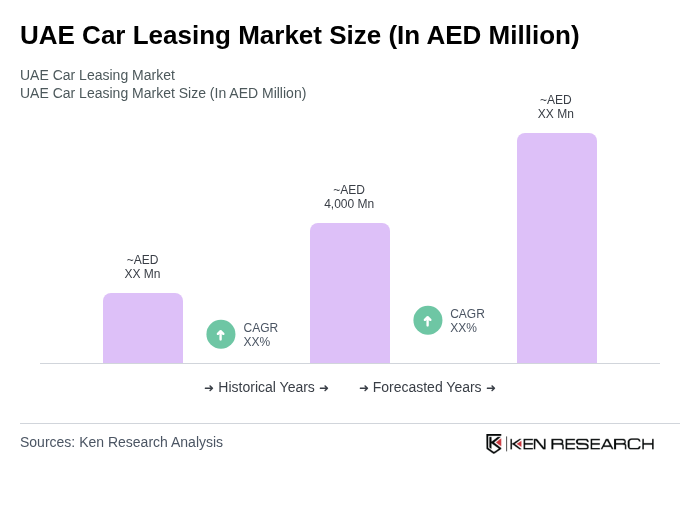
- The UAE Car Leasing Market is valued at AED 4,000 million, based on a five-year historical analysis and benchmarking against published estimates for the UAE car rental market and the broader GCC car rental and leasing space, where the UAE accounts for a significant share of regional demand.This growth is primarily driven by the increasing demand for flexible transportation solutions, particularly among businesses and individuals seeking cost-effective alternatives to vehicle ownership, supported by subscription-style and operating-lease products targeted at corporates and high-mileage users.The rise in tourism and expatriate population has also contributed significantly to the market's expansion, as more people require short-term vehicle access and prefer leasing or rental over outright purchase, especially in Dubai and Abu Dhabi, where expatriates and business travellers are highly concentrated.
- Dubai and Abu Dhabi are the dominant cities in the UAE Car Leasing Market due to their status as economic hubs and leading tourist destinations in the country, accounting for the bulk of inbound visitor arrivals, hotels, and commercial activity.The high concentration of corporate offices, hotels, logistics hubs, and entertainment venues in these cities drives demand for car leasing and rental services from corporate fleets, SMEs, and hospitality partners.Additionally, the well-developed road infrastructure, large-scale real-estate developments, and policy support for the automotive and mobility sector further enhance their market dominance, with dedicated free zones, fleet operators, and mobility platforms headquartered in these emirates.
- In 2023, the UAE government implemented a new regulation mandating that all car leasing companies provide electric vehicle options in their fleets. This initiative aims to promote sustainability and reduce carbon emissions, aligning with the UAE's broader environmental goals. Companies are required to ensure that at least 20% of their leased vehicles are electric or hybrid by 2024, fostering a shift towards greener transportation solutions.
UAE Car Leasing Market Segmentation
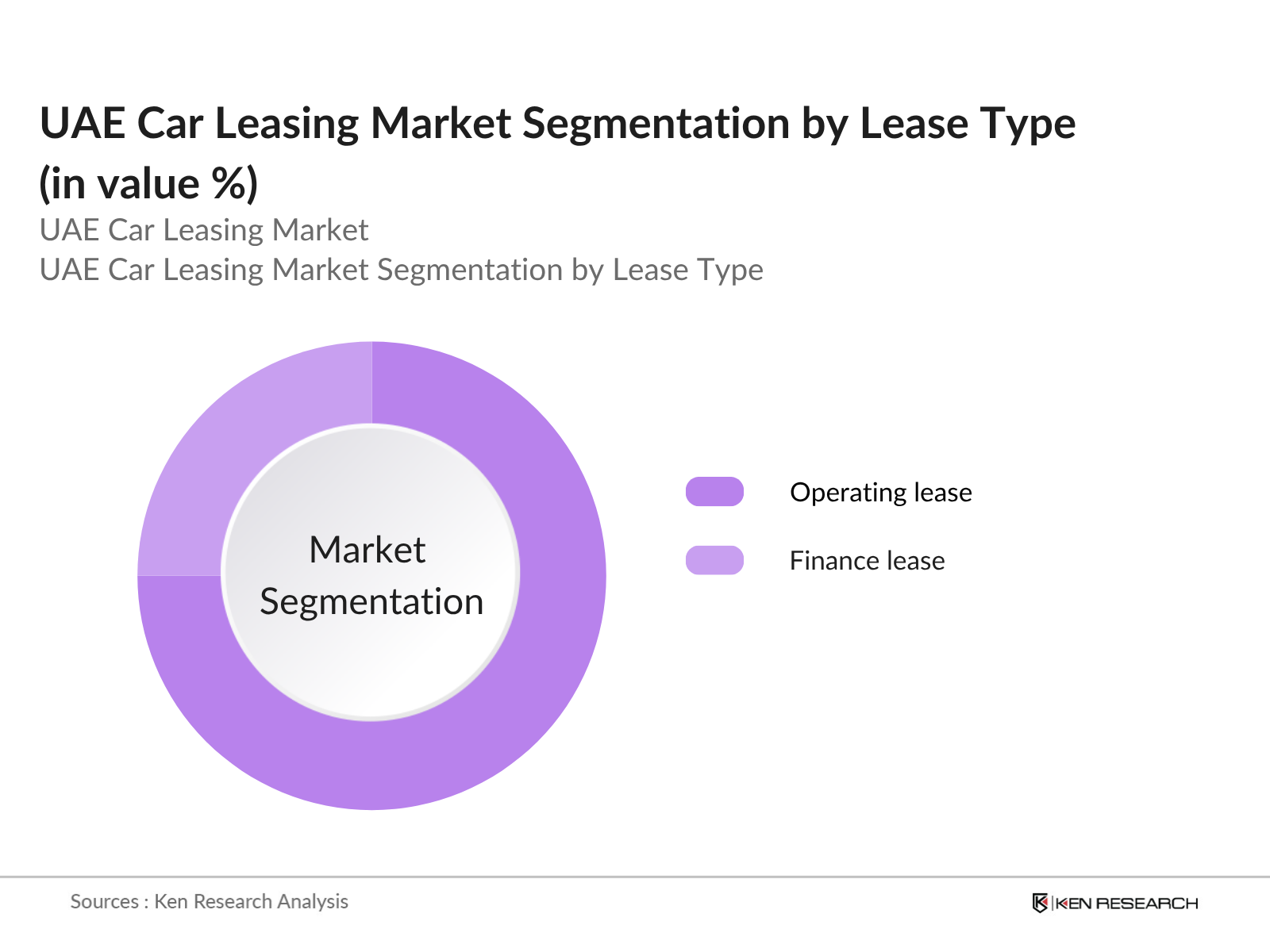
By Lease Type:The lease type segmentation includes Operating Lease and Financial Lease within the UAE car leasing market. Operating Lease dominates the market, supported by strong demand from corporates, government entities, expatriates, and fleet users seeking flexible vehicle access without ownership responsibility. This model is preferred because it reduces upfront financial burden, simplifies fleet administration, and often includes maintenance, insurance, replacement vehicles, and other value-added services. It also enables businesses to maintain updated fleets while keeping mobility costs predictable. Financial Lease remains relevant for companies and SMEs that prefer eventual asset ownership, greater vehicle control, and structured repayment over the lease period. However, its adoption is comparatively lower as many users prioritise operational flexibility, outsourced fleet management, and lower ownership-related risk.
By Vehicle Type:The vehicle type segmentation includes SUVs and MUVs, Premium/Luxury vehicles, Economy/Sedans, and Others such as pickup trucks and vans. SUVs and MUVs dominate the UAE car leasing market, supported by a strong preference for spacious, comfortable, and versatile vehicles suited to families, executives, expatriates, and intercity travellers. Their popularity is reinforced by the UAE’s road infrastructure, lifestyle-oriented mobility demand, and frequent use for business, leisure, and group travel. Premium/Luxury vehicles also hold a significant position, driven by corporate users, high-income residents, hospitality-linked demand, and experience-led rentals. Economy/Sedans remain relevant for cost-conscious customers and daily urban mobility, while pickup trucks and vans serve logistics, utility, SME, and commercial transportation needs.
UAE Car Leasing Market Competitive Landscape
The UAE Car Leasing Market is characterised by a dynamic mix of regional and international players. Leading participants such as Thrifty Car Rental, Emirates Transport, Shift Leasing Rent a Car, Massar Solutions, and Diamondlease LLC. Other notable regional leasing companies contribute to innovation, geographic expansion, and service delivery in this space.
UAE Car Leasing Market Industry Analysis
Growth Drivers
- Expanding Expatriate Base Driving Individual Leasing:The UAE’s expatriate population increased from 9.6 million in 2021 to 11.4 million in 2025, with expatriates accounting for around 90% of the population by 2025. This makes expats the largest demand base for individual car leasing, as many prefer flexible mobility over vehicle ownership. Since leasing contracts require UAE residency, the expanding resident expatriate base directly supports long-term individual leasing demand.
- Rising Company Registrations Supporting Fleet Leasing:UAE new company registrations increased from 120,000 in 2021 to 250,000 in 2025, expanding the addressable base for corporate fleet leasing. Each new business formation creates potential demand for employee mobility, sales fleets, service vehicles and operating leases. SMEs are particularly important, as growing businesses often prefer leasing to avoid upfront vehicle ownership costs and maintain flexibility in fleet size.
- MNC and Government Shift Toward Operating Leases:MNCs and government entities are increasingly converting owned fleets into multi-year operating leases, supporting stable demand for professional leasing providers. These contracts typically run for 36–60 months and involve large tenders, SLA guarantees and proven service track records. This shift is strengthening organised fleet leasing demand, as institutions prioritise predictable costs, vehicle availability, maintenance support and outsourced fleet management.
Market Challenges
- Intense Pricing Pressure:The UAE car leasing market faces strong rate pressure due to high market saturation and aggressive price competition. In 2023, daily rental rates fell by more than 20% amid price wars, cutting revenue per rental by over 20%. This forces operators to increase volumes simply to break even, while smaller firms face sharper margin compression, with profit margins shrinking by almost 25%.
- Accelerated Fleet Renewal Costs:UAE leasing operators face rising reinvestment pressure due to regulatory limits on vehicle age, including Dubai’s four-year manual and six-year EV replacement rule. If fleet replacement cycles shorten from four years to three years, annual CapEx per fleet could rise by 25–33%. For larger fleets, this adds significant replacement costs, strains financing capacity, and increases pressure on profitability.
UAE Car Leasing Market Future Outlook
The UAE car leasing market is poised for transformation, driven by technological advancements and evolving consumer preferences. The shift towards digital leasing platforms is expected to streamline processes, enhancing customer engagement. Additionally, the increasing focus on sustainability will drive demand for electric vehicle leasing, aligning with government initiatives. As the market adapts to these trends, companies that embrace innovation and prioritise customer experience will likely thrive in this dynamic environment.
Market Opportunities
- EV and Sustainable Fleet Leasing Expansion:UAE’s Net Zero 2050 strategy is accelerating EV adoption, pushing leasing companies to align fleets with corporate ESG and sustainability mandates. Hertz UAE and Europcar UAE have already introduced Tesla and hybrid vehicles, while DEWA’s 1,000+ public charging points reduce range anxiety. Leasing operators expanding EV and hybrid portfolios can attract corporates seeking premium, low-emission mobility solutions.
- Subscription and App-Based Leasing Growth:The UAE leasing market is shifting toward long-term, subscription, and app-based mobility models, supported by corporate leasing demand and 2–5 year operating leases. Platforms such as ekar and Udrive continue to scale across Dubai and Abu Dhabi, while most short-term bookings are now online. This creates opportunities for tech-enabled leasing firms to offer flexible access, dynamic pricing, and digital fleet management.
Scope of the Report
| Segment | Sub-Segments |
|---|---|
| By Lease Type | Operating lease Finance lease |
| By Vehicle Type | SUVs and MUV's Premium/ Luxury Economy/ Sedans Pickup Trucks/ Vans |
| By Powertrain | ICE EV + Hybrid |
| By Duration of Leasing | 25- 36 Months 37- 48 Months 12- 24 Months 49- 60 Months |
| By End-User | Corporate Individual Government Agencies |
| By Mode of Booking | Offline Online |
| By Region | Dubai Abu Dhabi Sharjah Others |
Key Target Audience
Investors and Venture Capitalist Firms
Government and Regulatory Bodies (e.g., Ministry of Economy, Roads and Transport Authority)
Automobile Manufacturers
Leasing Companies and Fleet Management Firms
Insurance Providers
Automotive Dealerships
Technology Providers (e.g., Telematics and Fleet Management Solutions)
Financial Institutions (e.g., Banks and Credit Unions)
Players Mentioned in the Report:
Thrifty Car Rental
Emirates Transport
Shift Leasing Rent a Car
Massar Solutions
Diamondlease LLC
Europcar
Hertz
Budget Rent A Car
Enterprise Rent A Car
Belhasa
Table of Contents
Market Assessment Phase
1. Executive Summary and Approach
2. UAE Car Leasing Market Overview
2.1 Key Insights and Strategic Recommendations
2.2 UAE Car Leasing Market Overview
2.3 Definition and Scope
2.4 Evolution of Market Ecosystem
2.5 Timeline of Key Regulatory Milestones
2.6 Value Chain & Stakeholder Mapping
2.7 Business Cycle Analysis
2.8 Policy & Incentive Landscape
3. UAE Car Leasing Market Analysis
3.1 Growth Drivers
3.1.1 Increasing urbanization and population growth
3.1.2 Rising demand for flexible mobility solutions
3.1.3 Government initiatives promoting car leasing
3.1.4 Expansion of the tourism sector
3.2 Market Challenges
3.2.1 High competition among leasing companies
3.2.2 Economic fluctuations affecting consumer spending
3.2.3 Regulatory compliance and licensing issues
3.2.4 Limited awareness of leasing benefits
3.3 Market Opportunities
3.3.1 Growth in electric vehicle leasing
3.3.2 Expansion into underserved regions
3.3.3 Partnerships with ride-sharing platforms
3.3.4 Development of customized leasing packages
3.4 Market Trends
3.4.1 Shift towards digital leasing platforms
3.4.2 Increasing focus on sustainability
3.4.3 Rise of subscription-based leasing models
3.4.4 Enhanced customer experience through technology
3.5 Government Regulation
3.5.1 Emission standards for leased vehicles
3.5.2 Licensing requirements for leasing companies
3.5.3 Consumer protection laws in leasing agreements
3.5.4 Tax incentives for electric vehicle leasing
4. SWOT Analysis
5. Stakeholder Analysis
6. Porter's Five Forces Analysis
7. UAE Car Leasing Market Size, 2019-2024
7.1 By Value
7.2 By Volume
7.3 By Average Selling Price
8. UAE Car Leasing Market Segmentation
8.1 By Lease Type
8.1.1 Operating Lease
8.1.2 Finance Lease
8.2 By Vehicle Type
8.2.1 SUVs and MUVs
8.2.2 Premium/Luxury
8.2.3 Economy/Sedans
8.2.4 Pickup Trucks/Vans
8.3 By Powertrain
8.3.1 ICE
8.3.2 EV + Hybrid
8.4 By Duration of Leasing
8.4.1 25–36 Months
8.4.2 37–48 Months
8.4.3 12–24 Months
8.4.4 49–60 Months
8.5 By End-User
8.5.1 Corporate
8.5.2 Individual
8.5.3 Government Agencies
8.6 By Mode of Booking
8.6.1 Offline
8.6.2 Online
8.7 By Region
8.7.1 Dubai
8.7.2 Abu Dhabi
8.7.3 Sharjah
8.7.4 Others
9. UAE Car Leasing Market Competitive Analysis
9.1 Market Share of Key Players
9.2 Cross Comparison of Key Players
9.2.1 Company Name
9.2.2 Group Size (Large, Medium, or Small as per industry convention)
9.2.3 Fleet size (number of leased vehicles)
9.2.4 Fleet utilization rate (%)
9.2.5 Revenue per vehicle (USD / AED per year)
9.2.6 EBITDA margin (%)
9.2.7 Return on capital employed (ROCE %)
9.2.8 Average lease tenure (months)
9.2.9 Share of long-term leases in portfolio (%)
9.2.10 Electric/hybrid vehicles as % of fleet
9.2.11 Customer acquisition cost (CAC)
9.2.12 Customer lifetime value (CLV)
9.2.13 Customer retention/renewal rate (%)
9.2.14 Non-performing / overdue contracts (% of portfolio)
9.2.15 Digital bookings as % of new contracts
9.3 SWOT Analysis of Top Players
9.4 Pricing Analysis
9.5 Detailed Profile of Major Companies
9.5.1 Thrifty Car Rental
9.5.2 Emirates Transport
9.5.3 Shift Leasing Rent a Car
9.5.4 Massar Solutions
9.5.5 Diamondlease LLC
9.5.6 Europcar
9.5.7 Hertz
9.5.8 Budget Rent A Car
9.5.9 Enterprise Rent A Car
9.5.10 Belhasa
10. UAE Car Leasing Market End-User Analysis
10.1 Procurement Behavior of Key Ministries
10.1.1 Ministry of Interior
10.1.2 Ministry of Economy
10.1.3 Ministry of Transport
10.1.4 Ministry of Finance
10.2 Corporate Spend on Infrastructure & Energy
10.2.1 Corporate fleet management
10.2.2 Investment in sustainable transport
10.2.3 Budget allocation for leasing
10.2.4 Partnerships with leasing companies
10.3 Pain Point Analysis by End-User Category
10.3.1 Cost management for corporates
10.3.2 Vehicle maintenance concerns
10.3.3 Flexibility in leasing terms
10.3.4 Availability of vehicle types
10.4 User Readiness for Adoption
10.4.1 Awareness of leasing benefits
10.4.2 Financial readiness of consumers
10.4.3 Technological adoption
10.4.4 Corporate policies on leasing
10.5 Post-Deployment ROI and Use Case Expansion
10.5.1 Cost savings analysis
10.5.2 Performance metrics tracking
10.5.3 Expansion into new vehicle types
10.5.4 Customer feedback integration
11. UAE Car Leasing Market Future Size, 2025-2030
11.1 By Value
11.2 By Volume
11.3 By Average Selling Price
Go-To-Market Strategy Phase
1. Whitespace Analysis + Business Model Canvas
1.1 Market gaps identification
1.2 Value proposition development
1.3 Revenue model exploration
1.4 Customer segment targeting
1.5 Competitive landscape analysis
2. Marketing and Positioning Recommendations
2.1 Branding strategies
2.2 Product USPs
2.3 Target audience engagement
2.4 Digital marketing initiatives
2.5 Partnership opportunities
3. Distribution Plan
3.1 Urban retail strategies
3.2 Rural outreach initiatives
3.3 Online vs offline distribution
3.4 Strategic partnerships
3.5 Logistics and supply chain management
4. Channel & Pricing Gaps
4.1 Underserved routes
4.2 Pricing bands analysis
4.3 Competitor pricing strategies
4.4 Customer willingness to pay
4.5 Value-based pricing models
5. Unmet Demand & Latent Needs
5.1 Category gaps identification
5.2 Consumer segments analysis
5.3 Emerging trends in leasing
5.4 Customer feedback mechanisms
5.5 Future demand forecasting
6. Customer Relationship
6.1 Loyalty programs
6.2 After-sales service enhancements
6.3 Customer engagement strategies
6.4 Feedback and improvement loops
6.5 Community building initiatives
7. Value Proposition
7.1 Sustainability initiatives
7.2 Integrated supply chains
7.3 Customer-centric offerings
7.4 Competitive advantages
7.5 Long-term value creation
8. Key Activities
8.1 Regulatory compliance
8.2 Branding efforts
8.3 Distribution setup
8.4 Training and development
8.5 Performance monitoring
9. Entry Strategy Evaluation
9.1 Domestic Market Entry Strategy
9.1.1 Product mix considerations
9.1.2 Pricing band analysis
9.1.3 Packaging strategies
9.2 Export Entry Strategy
9.2.1 Target countries identification
9.2.2 Compliance roadmap development
10. Entry Mode Assessment
10.1 Joint Ventures
10.2 Greenfield investments
10.3 Mergers & Acquisitions
10.4 Distributor Model
10.5 Risk assessment
11. Capital and Timeline Estimation
11.1 Capital requirements
11.2 Timelines for implementation
11.3 Financial projections
11.4 Funding sources
11.5 Milestone tracking
12. Control vs Risk Trade-Off
12.1 Ownership considerations
12.2 Partnerships evaluation
12.3 Risk management strategies
12.4 Control mechanisms
12.5 Long-term sustainability
13. Profitability Outlook
13.1 Breakeven analysis
13.2 Long-term sustainability strategies
13.3 Profit margin optimization
13.4 Revenue growth strategies
13.5 Cost management practices
14. Potential Partner List
14.1 Distributors
14.2 Joint Ventures
14.3 Acquisition targets
14.4 Strategic alliances
14.5 Partnership evaluation criteria
15. Execution Roadmap
15.1 Phased Plan for Market Entry
15.1.1 Market Setup
15.1.2 Market Entry
15.1.3 Growth Acceleration
15.1.4 Scale & Stabilize
15.2 Key Activities and Milestones
15.2.1 Activity tracking
15.2.2 Milestone achievement
15.2.3 Performance evaluation
15.2.4 Adjustments and pivots
Research Methodology
Phase 1: Approach1
Desk Research
- Analysis of industry reports from government agencies and trade associations related to car leasing in the UAE
- Review of market trends and consumer behavior studies published by automotive research firms
- Examination of economic indicators and demographic data from UAE's National Bureau of Statistics
Primary Research
- Interviews with executives from leading car leasing companies in the UAE
- Surveys targeting fleet managers and corporate clients utilizing leasing services
- Focus group discussions with consumers to understand preferences and leasing experiences
Validation & Triangulation
- Cross-validation of findings through comparison with historical leasing data and growth rates
- Triangulation of insights from primary interviews with secondary data sources
- Sanity checks conducted through expert panels comprising industry veterans and analysts
Phase 2: Market Size Estimation1
Top-down Assessment
- Estimation of total addressable market based on national vehicle registration statistics
- Segmentation of the market by vehicle type, lease duration, and customer demographics
- Incorporation of macroeconomic factors such as GDP growth and consumer spending trends
Bottom-up Modeling
- Collection of data on average lease rates and terms from major leasing companies
- Analysis of fleet sizes and utilization rates across different sectors
- Calculation of revenue potential based on vehicle turnover and lease renewals
Forecasting & Scenario Analysis
- Development of predictive models using historical leasing trends and economic forecasts
- Scenario analysis based on potential regulatory changes and shifts in consumer preferences
- Creation of multiple growth scenarios (baseline, optimistic, and pessimistic) through 2030
Phase 3: CATI Sample Composition1
| Scope Item/Segment | Sample Size | Target Respondent Profiles |
|---|---|---|
| Corporate Car Leasing | 120 | Fleet Managers, Procurement Officers |
| Individual Consumer Leasing | 100 | Leasing Customers, Automotive Enthusiasts |
| Luxury Vehicle Leasing | 60 | Luxury Car Dealerships, High-Net-Worth Individuals |
| Government Fleet Leasing | 50 | Government Procurement Officers, Fleet Administrators |
| Small Business Leasing | 70 | Small Business Owners, Entrepreneurs |
Frequently Asked Questions
What is the current value of the UAE Car Leasing Market?
The UAE Car Leasing Market is valued at approximately AED 4,000 million, reflecting significant growth driven by the demand for flexible transportation solutions among businesses and individuals, particularly in major cities like Dubai and Abu Dhabi.
What factors are driving the growth of the UAE Car Leasing Market?
Which cities dominate the UAE Car Leasing Market?
What types of leases are available in the UAE Car Leasing Market?
Other Regional/Country Reports
Indonesia Car Leasing Market
Malaysia Car Leasing Market
APAC Car Leasing Market
Other Adjacent Reports
Brazil Corporate Fleet Management Market
South Africa Electric Vehicle Charging Infrastructure Market Size, Share & Forecast, 2025-2032Bahrain Mobility-as-a-Service Market
Japan Corporate Vehicle Subscription Market
Mexico Used Car Resale and Dealer Market
Singapore Ride-Hailing Fleet Leasing Market
KSA Commercial Vehicle Leasing Market
KSA Auto Insurance Market
Egypt Fleet Telematics and GPS Tracking Market
Germany Vehicle Maintenance and Servicing Market
Why Buy From Us?

What makes us stand out is that our consultants follow Robust, Refine and Result (RRR) methodology. Robust for clear definitions, approaches and sanity checking, Refine for differentiating respondents' facts and opinions, and Result for presenting data with story.

We have set a benchmark in the industry by offering our clients with syndicated and customized market research reports featuring coverage of entire market as well as meticulous research and analyst insights.

While we don't replace traditional research, we flip the method upside down. Our dual approach of Top Bottom & Bottom Top ensures quality deliverable by not just verifying company fundamentals but also looking at the sector and macroeconomic factors.

With one step in the future, our research team constantly tries to show you the bigger picture. We help with some of the tough questions you may encounter along the way: How is the industry positioned? Best marketing channel? KPI's of competitors? By aligning every element, we help maximize success.

Our report gives you instant access to the answers and sources that other companies might choose to hide. We elaborate each steps of research methodology we have used and showcase you the sample size to earn your trust.

If you need any support, we are here! We pride ourselves on universe strength, data quality, and quick, friendly, and professional service.