Uae Consumer Electronic Biometrics Market Size, Share, Growth Drivers, Trends, Opportunities & Forecast 2025–2030

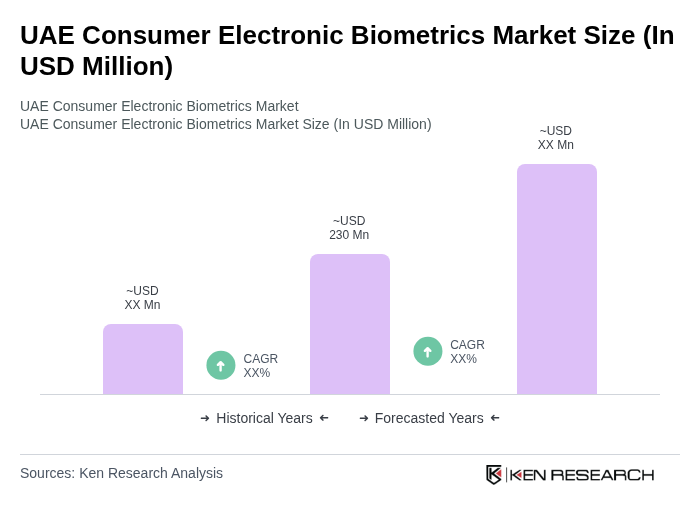
The UAE Consumer Electronic Biometrics Market, worth USD 230 million, grows due to demand for secure methods in consumer electronics, led by smartphones and fingerprint recognition.

Region:Middle East

Author(s):Rebecca

Product Code:KRAD4924

Pages:94

Published On:December 2025
About the Report

Base Year 2024

UAE Consumer Electronic Biometrics Market Overview

  • The UAE Consumer Electronic Biometrics Market is valued at USD 230 million, based on a five-year historical analysis and extrapolation from the broader UAE biometrics market and the consumer electronics share within it. This growth is primarily driven by the increasing demand for secure authentication methods in consumer electronics, coupled with the rising adoption of smart devices and IoT technologies. The market is also supported by advancements in biometric technologies such as in-display fingerprint sensors, 3D facial recognition, and contactless biometrics, which enhance user experience, enable seamless authentication, and strengthen device and data security.
  • Dubai and Abu Dhabi are the dominant cities in the UAE Consumer Electronic Biometrics Market due to their status as technological hubs and centers for innovation. The presence of numerous tech companies, government initiatives promoting smart city projects such as Dubai Smart City and Abu Dhabi’s digital innovation programs, and a high concentration of affluent, digitally savvy consumers contribute to the market's growth in these regions.
  • The UAE government has implemented regulations to enhance data protection and privacy in the biometric sector. The Federal Decree?Law No. 45 of 2021 on the Protection of Personal Data (UAE Personal Data Protection Law), issued by the UAE Cabinet, applies to the processing of personal data, including biometric identifiers, and requires organizations to implement appropriate security measures, obtain clear and explicit consent for processing, limit processing to specified purposes, and ensure cross?border transfers comply with adequacy and safeguard requirements. These provisions foster higher levels of trust and compliance in the biometric technology landscape, especially for consumer electronic devices that rely on facial, fingerprint, and other biometric authentication methods.
UAE Consumer Electronic Biometrics Market Size

UAE Consumer Electronic Biometrics Market Segmentation

By Type:The market can be segmented into various types of biometric technologies, including fingerprint recognition, facial recognition, iris & retina recognition, voice recognition, palm & vein recognition, behavioral biometrics, and multimodal biometrics. Among these, fingerprint recognition has emerged as the leading sub-segment due to its widespread adoption in smartphones and tablets, strong consumer familiarity, and its integration in mid-range as well as premium devices, driven by consumer preference for convenient, fast, and reliable security.
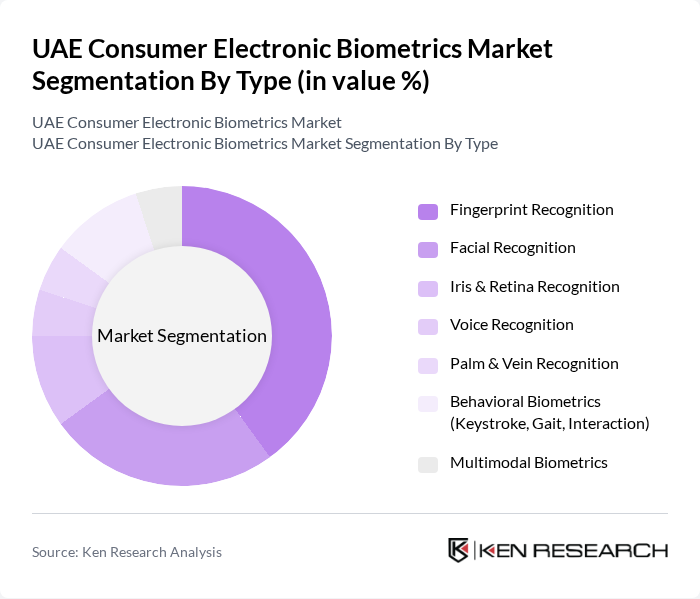
UAE Consumer Electronic Biometrics Market segmentation by Type.

By End-User Device Category:The segmentation by end-user device category includes smartphones & tablets, laptops & PCs, wearables, smart home & IoT devices, gaming consoles, and others. Smartphones & tablets dominate this segment, driven by the increasing integration of biometric authentication features such as fingerprint sensors, 3D facial recognition, and under?display readers in mobile devices, as well as the growing use of these devices for mobile banking, digital identity, and contactless payments which require strong, frictionless security.
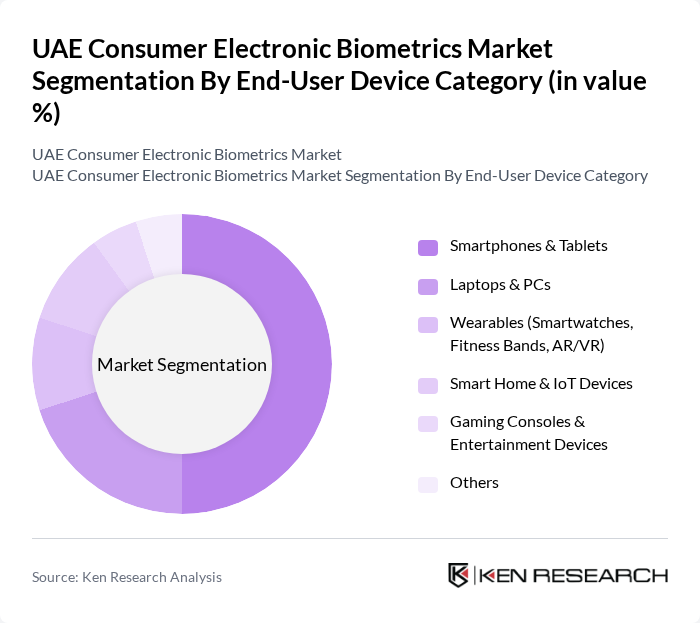
UAE Consumer Electronic Biometrics Market segmentation by End-User Device Category.

UAE Consumer Electronic Biometrics Market Competitive Landscape

The UAE Consumer Electronic Biometrics Market is characterized by a dynamic mix of regional and international players. Leading participants such as Apple Inc., Samsung Electronics Co., Ltd., Huawei Technologies Co., Ltd., Xiaomi Corporation, HONOR Device Co., Ltd., OPPO (Guangdong OPPO Mobile Telecommunications Corp., Ltd.), vivo Communication Technology Co., Ltd., Google LLC (Pixel Devices), Qualcomm Technologies, Inc., Synaptics Incorporated, Fingerprint Cards AB, IDEMIA, Thales Group, HID Global Corporation, Emirates Telecommunications Group Company PJSC (e&) contribute to innovation, geographic expansion, and service delivery in this space.

Apple Inc.

1976

Cupertino, California, USA

Samsung Electronics Co., Ltd.

1969

Suwon-si, South Korea

Huawei Technologies Co., Ltd.

1987

Shenzhen, China

Xiaomi Corporation

2010

Beijing, China

OPPO (Guangdong OPPO Mobile Telecommunications Corp., Ltd.)

2004

Dongguan, China

Company

Establishment Year

Headquarters

Presence in UAE Consumer Electronics OEMs (Number of Active Design Wins)

Estimated Biometrics Revenue from UAE (USD Million)

3?Year Revenue CAGR in Consumer Electronic Biometrics

Installed Base in UAE (Million Devices Enabled)

Share of Contactless / Face & Iris Solutions in Portfolio (%)

R&D Intensity (% of Revenue Spent on Biometrics R&D)

UAE Consumer Electronic Biometrics Market Industry Analysis

Growth Drivers

  • Increasing Demand for Security Solutions:The UAE's security solutions market is projected to reach AED 12 billion in future, driven by heightened concerns over safety and security. The rise in crime rates and terrorist threats has led both consumers and businesses to seek advanced security measures. This demand is further fueled by the UAE's strategic initiatives to enhance national security, making biometric systems a preferred choice for identity verification and access control.
  • Government Initiatives Promoting Biometric Technology:The UAE government has invested over AED 1 billion in biometric technology as part of its Smart Government initiative. This investment aims to integrate biometric systems across various sectors, including immigration and law enforcement. The introduction of the Emirates ID program, which mandates biometric registration for all residents, has significantly increased the adoption of biometric solutions, positioning the UAE as a leader in biometric technology implementation.
  • Rising Consumer Awareness About Identity Theft:With identity theft incidents increasing by 30% in the UAE over the past two years, consumer awareness regarding personal data security has surged. Reports indicate that 60% of UAE residents are concerned about identity theft, prompting them to seek biometric solutions for enhanced security. This growing awareness is driving demand for biometric authentication methods, as consumers prioritize safeguarding their personal information against unauthorized access.

Market Challenges

  • High Implementation Costs:The initial costs associated with deploying biometric systems can be substantial, often exceeding AED 500,000 for comprehensive installations. This financial barrier can deter small and medium-sized enterprises from adopting biometric solutions. Additionally, ongoing maintenance and updates further contribute to the overall expenditure, making it challenging for businesses to justify the investment despite the long-term benefits of enhanced security.
  • Privacy Concerns Among Consumers:Privacy issues surrounding biometric data collection are significant, with 70% of consumers expressing concerns about how their data is stored and used. The lack of transparency in data handling practices can lead to distrust in biometric systems. As a result, companies must navigate these concerns carefully, ensuring compliance with data protection regulations while fostering consumer confidence in the security and privacy of their biometric information.

UAE Consumer Electronic Biometrics Market Future Outlook

The future of the UAE consumer electronic biometrics market appears promising, driven by technological advancements and increasing integration across various sectors. The rise of artificial intelligence in biometric authentication is expected to enhance accuracy and efficiency, while the growing trend towards contactless solutions will cater to consumer preferences for hygiene and convenience. As regulatory frameworks evolve, they will likely support innovation while ensuring consumer protection, fostering a conducive environment for market growth.

Market Opportunities

  • Expansion in E-commerce and Online Services:The e-commerce sector in the UAE is projected to reach AED 27 billion in future, creating significant opportunities for biometric authentication solutions. As online transactions increase, businesses are likely to adopt biometric systems to enhance security and reduce fraud, thereby improving consumer trust and driving sales.
  • Growth in Mobile Biometric Applications:With over 90% smartphone penetration in the UAE, mobile biometric applications are set to expand rapidly. The demand for secure mobile payment solutions and identity verification in apps is expected to rise, providing a lucrative opportunity for developers to innovate and integrate biometric technologies into mobile platforms, enhancing user experience and security.

Scope of the Report

SegmentSub-Segments
By Type

Fingerprint Recognition

Facial Recognition

Iris & Retina Recognition

Voice Recognition

Palm & Vein Recognition

Behavioral Biometrics (Keystroke, Gait, Interaction)

Multimodal Biometrics

By End-User Device Category

Smartphones & Tablets

Laptops & PCs

Wearables (Smartwatches, Fitness Bands, AR/VR)

Smart Home & IoT Devices

Gaming Consoles & Entertainment Devices

Others

By Application

Device Unlock & User Authentication

Digital Payments & Wallet Authentication

Access to Apps & Online Services (Banking, e?Gov)

Parental Control & Usage Management

Anti?Fraud & Identity Protection

Others

By Integration Level

Embedded / On?Device Biometrics

Biometric Sensors & Modules

Software Development Kits (SDKs) & APIs

Cloud?Based Biometric Authentication Services

Others

By Emirate

Abu Dhabi

Dubai

Sharjah

Ajman

Ras Al Khaimah

Fujairah

Umm Al-Quwain

By Technology

Optical Sensors

Capacitive & CMOS Sensors

Ultrasonic Sensors

D & Infrared Imaging (ToF, Structured Light)

AI?Based Biometric Software & Algorithms

Others

By Sales Channel

OEM / Device Manufacturer Installations

Aftermarket & Peripheral Devices

Online Retail & Marketplaces

Offline Retail (Electronics Stores, Operators)

Others

Key Target Audience

Investors and Venture Capitalist Firms

Government and Regulatory Bodies (e.g., UAE Ministry of Interior, Telecommunications and Digital Government Regulatory Authority)

Manufacturers and Producers

Distributors and Retailers

Technology Providers

Industry Associations

Financial Institutions

Security and Surveillance Companies

Players Mentioned in the Report:

Apple Inc.

Samsung Electronics Co., Ltd.

Huawei Technologies Co., Ltd.

Xiaomi Corporation

HONOR Device Co., Ltd.

OPPO (Guangdong OPPO Mobile Telecommunications Corp., Ltd.)

vivo Communication Technology Co., Ltd.

Google LLC (Pixel Devices)

Qualcomm Technologies, Inc.

Synaptics Incorporated

Fingerprint Cards AB

IDEMIA

Thales Group

HID Global Corporation

Emirates Telecommunications Group Company PJSC (e&)

Table of Contents

Market Assessment Phase

1. Executive Summary and Approach


2. UAE Consumer Electronic Biometrics Market Overview

2.1 Key Insights and Strategic Recommendations

2.2 UAE Consumer Electronic Biometrics Market Overview

2.3 Definition and Scope

2.4 Evolution of Market Ecosystem

2.5 Timeline of Key Regulatory Milestones

2.6 Value Chain & Stakeholder Mapping

2.7 Business Cycle Analysis

2.8 Policy & Incentive Landscape


3. UAE Consumer Electronic Biometrics Market Analysis

3.1 Growth Drivers

3.1.1 Increasing demand for security solutions
3.1.2 Government initiatives promoting biometric technology
3.1.3 Rising consumer awareness about identity theft
3.1.4 Technological advancements in biometric systems

3.2 Market Challenges

3.2.1 High implementation costs
3.2.2 Privacy concerns among consumers
3.2.3 Lack of standardization in biometric technologies
3.2.4 Integration issues with existing systems

3.3 Market Opportunities

3.3.1 Expansion in e-commerce and online services
3.3.2 Growth in mobile biometric applications
3.3.3 Increasing adoption in financial services
3.3.4 Potential in healthcare sector for patient identification

3.4 Market Trends

3.4.1 Shift towards multi-modal biometric systems
3.4.2 Increasing use of AI in biometric authentication
3.4.3 Growth of biometric payment solutions
3.4.4 Rising demand for contactless biometric systems

3.5 Government Regulation

3.5.1 Data protection laws impacting biometric data usage
3.5.2 Regulations on biometric data storage and processing
3.5.3 Compliance requirements for biometric service providers
3.5.4 Standards for biometric technology implementation

4. SWOT Analysis


5. Stakeholder Analysis


6. Porter's Five Forces Analysis


7. UAE Consumer Electronic Biometrics Market Market Size, 2019-2024

7.1 By Value

7.2 By Volume

7.3 By Average Selling Price


8. UAE Consumer Electronic Biometrics Market Segmentation

8.1 By Type

8.1.1 Fingerprint Recognition
8.1.2 Facial Recognition
8.1.3 Iris & Retina Recognition
8.1.4 Voice Recognition
8.1.5 Palm & Vein Recognition
8.1.6 Behavioral Biometrics (Keystroke, Gait, Interaction)
8.1.7 Multimodal Biometrics

8.2 By End-User Device Category

8.2.1 Smartphones & Tablets
8.2.2 Laptops & PCs
8.2.3 Wearables (Smartwatches, Fitness Bands, AR/VR)
8.2.4 Smart Home & IoT Devices
8.2.5 Gaming Consoles & Entertainment Devices
8.2.6 Others

8.3 By Application

8.3.1 Device Unlock & User Authentication
8.3.2 Digital Payments & Wallet Authentication
8.3.3 Access to Apps & Online Services (Banking, e?Gov)
8.3.4 Parental Control & Usage Management
8.3.5 Anti?Fraud & Identity Protection
8.3.6 Others

8.4 By Integration Level

8.4.1 Embedded / On?Device Biometrics
8.4.2 Biometric Sensors & Modules
8.4.3 Software Development Kits (SDKs) & APIs
8.4.4 Cloud?Based Biometric Authentication Services
8.4.5 Others

8.5 By Emirate

8.5.1 Abu Dhabi
8.5.2 Dubai
8.5.3 Sharjah
8.5.4 Ajman
8.5.5 Ras Al Khaimah
8.5.6 Fujairah
8.5.7 Umm Al-Quwain

8.6 By Technology

8.6.1 Optical Sensors
8.6.2 Capacitive & CMOS Sensors
8.6.3 Ultrasonic Sensors
8.6.4 3D & Infrared Imaging (ToF, Structured Light)
8.6.5 AI?Based Biometric Software & Algorithms
8.6.6 Others

8.7 By Sales Channel

8.7.1 OEM / Device Manufacturer Installations
8.7.2 Aftermarket & Peripheral Devices
8.7.3 Online Retail & Marketplaces
8.7.4 Offline Retail (Electronics Stores, Operators)
8.7.5 Others

9. UAE Consumer Electronic Biometrics Market Competitive Analysis

9.1 Market Share of Key Players

9.2 Cross Comparison of Key Players

9.2.1 Company Name
9.2.2 Presence in UAE Consumer Electronics OEMs (Number of Active Design Wins)
9.2.3 Estimated Biometrics Revenue from UAE (USD Million)
9.2.4 3?Year Revenue CAGR in Consumer Electronic Biometrics
9.2.5 Installed Base in UAE (Million Devices Enabled)
9.2.6 Share of Contactless / Face & Iris Solutions in Portfolio (%)
9.2.7 R&D Intensity (% of Revenue Spent on Biometrics R&D)
9.2.8 Average Time?to?Integrate with OEM (Weeks per Project)
9.2.9 Average Selling Price Band of Biometric Module / License
9.2.10 Number of Local Partnerships / System Integrators in UAE
9.2.11 Compliance & Certification Coverage (e.g., ISO/IEC, UAE Data Regulations)
9.2.12 Notable Consumer?Facing Brands / Flagship Devices Using the Technology

9.3 SWOT Analysis of Top Players

9.4 Pricing Analysis

9.5 Detailed Profile of Major Companies

9.5.1 Apple Inc.
9.5.2 Samsung Electronics Co., Ltd.
9.5.3 Huawei Technologies Co., Ltd.
9.5.4 Xiaomi Corporation
9.5.5 HONOR Device Co., Ltd.
9.5.6 OPPO (Guangdong OPPO Mobile Telecommunications Corp., Ltd.)
9.5.7 vivo Communication Technology Co., Ltd.
9.5.8 Google LLC (Pixel Devices)
9.5.9 Qualcomm Technologies, Inc.
9.5.10 Synaptics Incorporated
9.5.11 Fingerprint Cards AB
9.5.12 IDEMIA
9.5.13 Thales Group
9.5.14 HID Global Corporation
9.5.15 Emirates Telecommunications Group Company PJSC (e&)

10. UAE Consumer Electronic Biometrics Market End-User Analysis

10.1 Procurement Behavior of Key Ministries

10.1.1 Government procurement processes
10.1.2 Budget allocation for biometric systems
10.1.3 Evaluation criteria for suppliers
10.1.4 Trends in government contracts

10.2 Corporate Spend on Infrastructure & Energy

10.2.1 Investment in security infrastructure
10.2.2 Budgeting for technology upgrades
10.2.3 Spending on compliance and regulations
10.2.4 Trends in corporate spending

10.3 Pain Point Analysis by End-User Category

10.3.1 Security concerns in residential areas
10.3.2 Integration challenges in commercial sectors
10.3.3 Compliance issues in government
10.3.4 Cost-related challenges in industrial applications

10.4 User Readiness for Adoption

10.4.1 Awareness of biometric technologies
10.4.2 Training and support needs
10.4.3 Perceived benefits vs. costs
10.4.4 Adoption barriers

10.5 Post-Deployment ROI and Use Case Expansion

10.5.1 Measuring ROI post-implementation
10.5.2 Use case expansion opportunities
10.5.3 Long-term benefits of biometric systems
10.5.4 Customer feedback and improvement

11. UAE Consumer Electronic Biometrics Market Future Size, 2025-2030

11.1 By Value

11.2 By Volume

11.3 By Average Selling Price


Go-To-Market Strategy Phase

1. Whitespace Analysis + Business Model Canvas

1.1 Market gaps and opportunities

1.2 Business model components


2. Marketing and Positioning Recommendations

2.1 Branding strategies

2.2 Product USPs


3. Distribution Plan

3.1 Urban retail vs rural NGO tie-ups


4. Channel & Pricing Gaps

4.1 Underserved routes

4.2 Pricing bands


5. Unmet Demand & Latent Needs

5.1 Category gaps

5.2 Consumer segments


6. Customer Relationship

6.1 Loyalty programs

6.2 After-sales service


7. Value Proposition

7.1 Sustainability

7.2 Integrated supply chains


8. Key Activities

8.1 Regulatory compliance

8.2 Branding

8.3 Distribution setup


9. Entry Strategy Evaluation

9.1 Domestic Market Entry Strategy

9.1.1 Product mix
9.1.2 Pricing band
9.1.3 Packaging

9.2 Export Entry Strategy

9.2.1 Target countries
9.2.2 Compliance roadmap

10. Entry Mode Assessment

10.1 JV

10.2 Greenfield

10.3 M&A

10.4 Distributor Model


11. Capital and Timeline Estimation

11.1 Capital requirements

11.2 Timelines


12. Control vs Risk Trade-Off

12.1 Ownership vs Partnerships


13. Profitability Outlook

13.1 Breakeven analysis

13.2 Long-term sustainability


14. Potential Partner List

14.1 Distributors

14.2 JVs

14.3 Acquisition targets


15. Execution Roadmap

15.1 Phased Plan for Market Entry

15.1.1 Market Setup
15.1.2 Market Entry
15.1.3 Growth Acceleration
15.1.4 Scale & Stabilize

15.2 Key Activities and Milestones

15.2.1 Milestone tracking
15.2.2 Activity scheduling

Research Methodology

ApproachModellingSample

Phase 1: Approach1

Desk Research

  • Analysis of market reports from industry associations and government publications
  • Review of consumer behavior studies and trends in biometric technology adoption
  • Examination of regulatory frameworks and compliance requirements in the UAE

Primary Research

  • Interviews with key stakeholders in the consumer electronics sector, including manufacturers and retailers
  • Surveys targeting end-users to understand preferences and adoption rates of biometric technologies
  • Focus group discussions with technology experts and consumer advocacy groups

Validation & Triangulation

  • Cross-validation of findings through multiple data sources, including sales data and consumer feedback
  • Triangulation of insights from primary interviews with secondary research findings
  • Sanity checks conducted through expert panel reviews and industry roundtables

Phase 2: Market Size Estimation1

Top-down Assessment

  • Estimation of the total addressable market based on national consumer electronics sales data
  • Segmentation of the market by product type, including smartphones, laptops, and smart home devices
  • Incorporation of growth projections based on technological advancements and consumer trends

Bottom-up Modeling

  • Collection of sales volume data from leading consumer electronics retailers in the UAE
  • Estimation of average selling prices for biometric-enabled devices across different categories
  • Calculation of market size based on unit sales and revenue generation from biometric features

Forecasting & Scenario Analysis

  • Development of forecasting models using historical sales data and market growth rates
  • Scenario analysis based on varying levels of consumer adoption and regulatory impacts
  • Projections for market growth through 2030 under different economic conditions

Phase 3: CATI Sample Composition1

Scope Item/SegmentSample SizeTarget Respondent Profiles
Smartphone Biometric Features150Mobile Device Users, Tech Enthusiasts
Smart Home Device Adoption110Homeowners, Smart Home Integrators
Wearable Technology Insights80Fitness Enthusiasts, Health Tech Users
Consumer Attitudes Towards Biometric Security120General Consumers, Security Professionals
Retail Sector Biometric Payment Systems90Retail Managers, Payment Solution Providers

Frequently Asked Questions

What is the current value of the UAE Consumer Electronic Biometrics Market?

The UAE Consumer Electronic Biometrics Market is valued at approximately USD 230 million, reflecting a significant growth driven by the increasing demand for secure authentication methods in consumer electronics and the rising adoption of smart devices and IoT technologies.

What are the main drivers of growth in the UAE Consumer Electronic Biometrics Market?

Which cities are leading in the UAE Consumer Electronic Biometrics Market?

What types of biometric technologies are prevalent in the UAE market?

Other Regional/Country Reports

Indonesia Consumer Electronic Biometrics Market

Malaysia Consumer Electronic Biometrics Market

KSA Consumer Electronic Biometrics Market

APAC Consumer Electronic Biometrics Market

SEA Consumer Electronic Biometrics Market

Vietnam Consumer Electronic Biometrics Market

Other Adjacent Reports

Germany Fingerprint Recognition Market

Vietnam Facial Recognition Market

Egypt Iris Recognition Market

Vietnam Voice Recognition Market

UAE Wearable Devices Market

Belgium Smart Home Devices Market

Bahrain Mobile Payment Security Market

KSA Identity Verification Market

South Africa Cybersecurity Solutions Market

Malaysia IoT Security Market

Why Buy From Us?

Refine Robust Result (RRR) Framework

What makes us stand out is that our consultants follow Robust, Refine and Result (RRR) methodology. Robust for clear definitions, approaches and sanity checking, Refine for differentiating respondents' facts and opinions, and Result for presenting data with story.

Our Reach Is Unmatched

We have set a benchmark in the industry by offering our clients with syndicated and customized market research reports featuring coverage of entire market as well as meticulous research and analyst insights.

Shifting the Research Paradigm

While we don't replace traditional research, we flip the method upside down. Our dual approach of Top Bottom & Bottom Top ensures quality deliverable by not just verifying company fundamentals but also looking at the sector and macroeconomic factors.

More Insights-Better Decisions

With one step in the future, our research team constantly tries to show you the bigger picture. We help with some of the tough questions you may encounter along the way: How is the industry positioned? Best marketing channel? KPI's of competitors? By aligning every element, we help maximize success.

Transparency and Trust

Our report gives you instant access to the answers and sources that other companies might choose to hide. We elaborate each steps of research methodology we have used and showcase you the sample size to earn your trust.

Round the Clock Support

If you need any support, we are here! We pride ourselves on universe strength, data quality, and quick, friendly, and professional service.

Why Clients Choose Us?

400000+
Reports in repository
150+
Consulting projects a year
100+
Analysts
8000+
Client Queries in 2022








