About the Report
Base Year 2024UAE Hydrodesulfurization Catalysts Market Overview
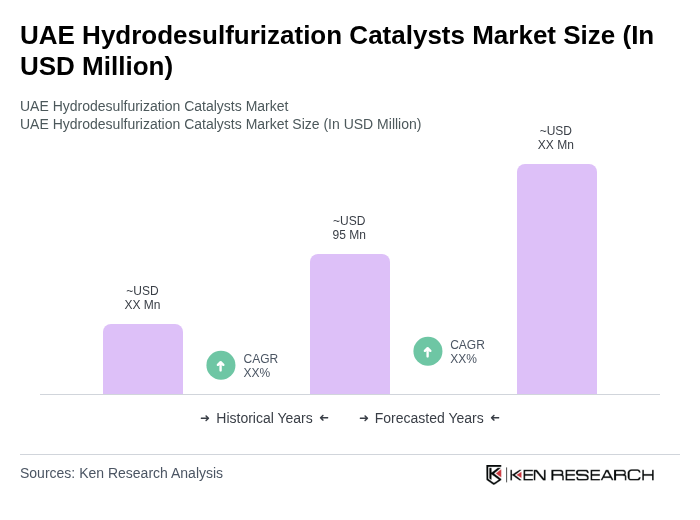
- The UAE Hydrodesulfurization Catalysts Market is valued at USD 95 million, based on a five-year historical analysis and its share within the broader Middle East refinery and hydroprocessing catalyst market. This growth is primarily driven by stringent environmental regulations aimed at reducing sulfur emissions from fuels, alongside the increasing demand for cleaner fuels in the region, supported by ongoing refinery upgrades to produce ultra-low sulfur diesel and gasoline. The market is also supported by advancements in catalyst technology, including high-activity Co-Mo and Ni-Mo formulations with longer cycle lengths and better performance on sour/heavy feeds, which enhance the efficiency of hydrodesulfurization processes in refineries.
- Key demand centers for hydrodesulfurization catalysts in the UAE include Abu Dhabi, Dubai, and Sharjah, which dominate due to their robust oil and gas infrastructure, large integrated complexes such as Ruwais and Jebel Ali, and significant investments in expanding and modernizing refining capacities. The presence of major national and international oil companies and a strategic focus on sustainability initiatives and cleaner fuels further bolster the market's growth in these emirates, making them pivotal hubs for hydrodesulfurization catalyst applications.
- The UAE has aligned its fuel quality regulations with international best practices, including low-sulfur road fuels, through measures implemented under projects such as ADNOC Distribution’s low-sulfur gasoline and diesel rollout and broader national clean air strategies. In particular, the UAE applies Gulf Standardization Organization (GSO) fuel specifications based on Euro-equivalent limits, which mandate stringent caps on sulfur content in gasoline and diesel to meet global environmental and air quality objectives, driving continued investment in hydrodesulfurization units and catalysts.
UAE Hydrodesulfurization Catalysts Market Segmentation
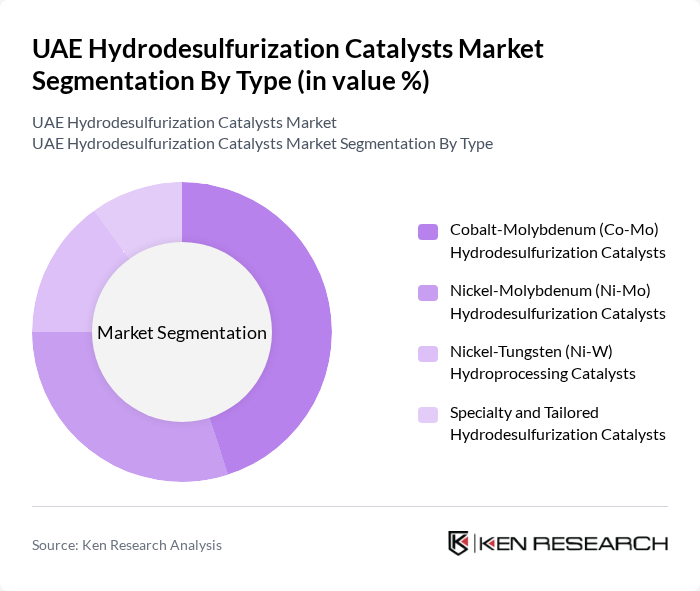
By Type:The market is segmented into various types of hydrodesulfurization catalysts, including Cobalt-Molybdenum (Co-Mo), Nickel-Molybdenum (Ni-Mo), Nickel-Tungsten (Ni-W), and Specialty and Tailored Hydrodesulfurization Catalysts. Co-Mo catalysts are widely used in diesel and gas oil hydrotreating because of their strong hydrodesulfurization activity, robustness on standard middle distillate feeds, and cost-effectiveness. The demand for Ni-Mo catalysts is also significant, particularly in integrated refineries processing heavier or more sour feeds, as they offer higher hydrogenation and hydrodenitrogenation activity and better performance on cracked feedstocks. Ni-W hydroprocessing catalysts and specialty/tailored formulations are increasingly applied in high-pressure and residue hydroprocessing units, where deep desulfurization and aromatics saturation are required for ultra-low sulfur fuels and petrochemical feedstock preparation.
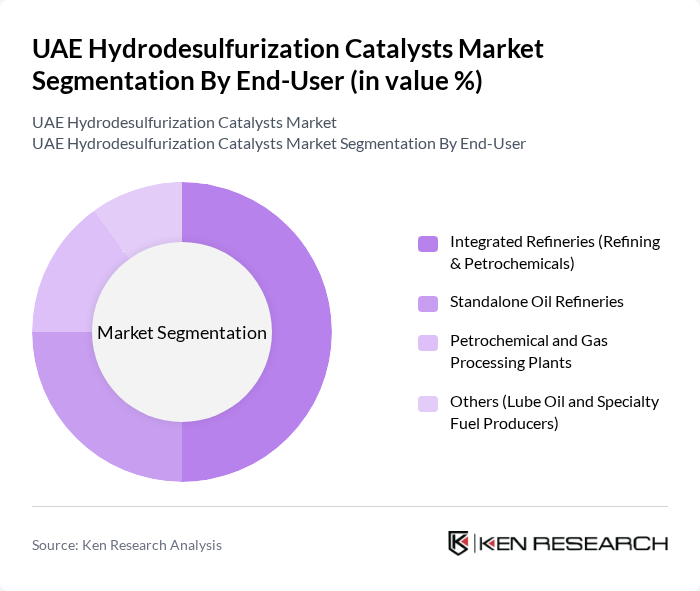
By End-User:The end-user segment includes Integrated Refineries, Standalone Oil Refineries, Petrochemical and Gas Processing Plants, and Others such as Lube Oil and Specialty Fuel Producers. Integrated Refineries dominate the market due to their comprehensive processing configurations, larger hydroprocessing capacity, and the need for advanced catalyst systems to meet stringent international fuel and petrochemical feedstock specifications. Standalone Oil Refineries also contribute significantly, as they require efficient hydrotreating catalysts to optimize operations, extend run lengths, and consistently achieve low-sulfur diesel, gasoline, and jet fuel grades. Petrochemical and gas processing plants, along with lube oil and specialty fuel producers, utilize hydrodesulfurization catalysts to remove sulfur and other impurities from feedstocks, protecting downstream catalysts and ensuring product quality for aromatics, olefins, and high-grade lubricants.
UAE Hydrodesulfurization Catalysts Market Competitive Landscape
The UAE Hydrodesulfurization Catalysts Market is characterized by a dynamic mix of regional and international players. Leading participants such as Albemarle Corporation, Haldor Topsoe A/S, Axens, Honeywell UOP, BASF SE, Johnson Matthey, W. R. Grace & Co., Shell Catalysts & Technologies, Advanced Refining Technologies LLC (ART Hydroprocessing), China Petroleum & Chemical Corporation (Sinopec Catalyst), Clariant AG, JGC C&C, Linde plc, Technip Energies, KBR, Inc. contribute to innovation, geographic expansion, and service delivery in this space, with many of these companies recognized globally as key suppliers of hydroprocessing and hydrotreating catalysts.
UAE Hydrodesulfurization Catalysts Market Industry Analysis
Growth Drivers
- Increasing Demand for Low-Sulfur Fuels:The UAE's fuel consumption reached approximately 0.9 million barrels per day, with a significant shift towards low-sulfur fuels driven by global environmental standards. The International Maritime Organization's regulations mandate a maximum sulfur content of 0.5% in marine fuels, propelling demand for hydrodesulfurization catalysts. This trend is expected to continue, with the UAE refining sector investing several billion United States dollars in upgrading facilities to meet these stringent requirements in future.
- Stringent Environmental Regulations:The UAE government has implemented strict emission regulations, aiming for a significant reduction in greenhouse gas emissions by 2030. This regulatory framework necessitates the adoption of advanced hydrodesulfurization technologies to comply with local and international standards. The Ministry of Climate Change and Environment reported that compliance costs for refineries could exceed $1 billion, emphasizing the need for effective catalysts to minimize sulfur emissions and enhance fuel quality.
- Technological Advancements in Catalyst Formulations:The UAE's investment in research and development for catalyst technologies has surged, with over $200 million allocated in recent years. Innovations such as improved catalyst formulations and enhanced performance metrics are driving efficiency in hydrodesulfurization processes. These advancements are crucial as they enable refineries to achieve lower sulfur levels while maintaining operational efficiency, thus supporting the growing demand for cleaner fuels in the region.
Market Challenges
- High Initial Investment Costs:The capital expenditure for upgrading hydrodesulfurization units in the UAE can exceed $300 million per facility. This high initial investment poses a significant barrier for smaller refineries, limiting their ability to adopt advanced catalyst technologies. As a result, many facilities may struggle to comply with stringent regulations, potentially leading to increased operational costs and reduced competitiveness in the market.
- Limited Availability of Raw Materials:The production of hydrodesulfurization catalysts relies heavily on specific raw materials, such as cobalt and molybdenum, which are subject to supply chain constraints. The UAE faced a significant reduction in the availability of these critical materials due to geopolitical tensions and export restrictions. This scarcity can hinder the production capacity of catalysts, impacting the overall efficiency of the refining process and increasing costs for manufacturers.
UAE Hydrodesulfurization Catalysts Market Future Outlook
The UAE hydrodesulfurization catalysts market is poised for significant transformation as the region prioritizes sustainable refining practices and compliance with stringent environmental regulations. In future, the integration of digital technologies in catalyst management is expected to enhance operational efficiencies, while ongoing investments in research and development will lead to innovative catalyst formulations. As the market evolves, strategic partnerships among key players will be crucial in addressing challenges and capitalizing on emerging opportunities in the sector.
Market Opportunities
- Growth in Petrochemical Industry:The UAE's petrochemical sector is projected to grow by 4% annually, reaching $30 billion in future. This growth presents a significant opportunity for hydrodesulfurization catalysts, as increased production will require advanced desulfurization technologies to meet quality standards and environmental regulations.
- Increasing Investments in Renewable Energy:The UAE government has committed over $160 billion to renewable energy projects in future. This investment will likely drive demand for cleaner fuels, creating opportunities for hydrodesulfurization catalysts to play a pivotal role in transitioning to a more sustainable energy landscape while supporting the country's energy diversification goals.
Scope of the Report
| Segment | Sub-Segments |
|---|---|
| By Type | Cobalt-Molybdenum (Co-Mo) Hydrodesulfurization Catalysts Nickel-Molybdenum (Ni-Mo) Hydrodesulfurization Catalysts Nickel-Tungsten (Ni-W) Hydroprocessing Catalysts Specialty and Tailored Hydrodesulfurization Catalysts |
| By End-User | Integrated Refineries (Refining & Petrochemicals) Standalone Oil Refineries Petrochemical and Gas Processing Plants Others (Lube Oil and Specialty Fuel Producers) |
| By Application | Diesel and Gasoil Hydrotreating Naphtha and Gasoline Hydrotreating Kerosene and Jet Fuel Hydrotreating Residue and Vacuum Gas Oil (VGO) Hydrodesulfurization |
| By Catalyst Composition | Cobalt-Molybdenum on Alumina Nickel-Molybdenum on Alumina Nickel-Tungsten on Alumina or Silica-Alumina Others (Promoted and Multi-Metal Systems) |
| By Region | Abu Dhabi Dubai Sharjah Northern Emirates (Ajman, Fujairah, Ras Al Khaimah, Umm Al Quwain) |
| By Technology | Fixed-Bed Hydrotreating Units Trickle-Bed Reactors Ebullated-Bed and Slurry-Phase Systems Others (Hybrid and Proprietary Reactor Configurations) |
| By Market Structure | Presence of Global Catalyst Suppliers Presence of Technology Licensors and Service Providers Role of Local Distributors and Agents |
Key Target Audience
Investors and Venture Capitalist Firms
Government and Regulatory Bodies (e.g., Ministry of Energy and Infrastructure, Federal Authority for Nuclear Regulation)
Manufacturers and Producers of Hydrodesulfurization Catalysts
Oil and Gas Companies
Refinery Operators
Environmental Agencies (e.g., Ministry of Climate Change and Environment)
Industry Associations (e.g., UAE Society of Petroleum Engineers)
Financial Institutions and Banks
Players Mentioned in the Report:
Albemarle Corporation
Haldor Topsoe A/S
Axens
Honeywell UOP
BASF SE
Johnson Matthey
W. R. Grace & Co.
Shell Catalysts & Technologies
Advanced Refining Technologies LLC (ART Hydroprocessing)
China Petroleum & Chemical Corporation (Sinopec Catalyst)
Clariant AG
JGC C&C
Linde plc
Technip Energies
KBR, Inc.
Table of Contents
Market Assessment Phase
1. Executive Summary and Approach
2. UAE Hydrodesulfurization Catalysts Market Overview
2.1 Key Insights and Strategic Recommendations
2.2 UAE Hydrodesulfurization Catalysts Market Overview
2.3 Definition and Scope
2.4 Evolution of Market Ecosystem
2.5 Timeline of Key Regulatory Milestones
2.6 Value Chain & Stakeholder Mapping
2.7 Business Cycle Analysis
2.8 Policy & Incentive Landscape
3. UAE Hydrodesulfurization Catalysts Market Analysis
3.1 Growth Drivers
3.1.1 Increasing demand for low-sulfur fuels
3.1.2 Stringent environmental regulations
3.1.3 Technological advancements in catalyst formulations
3.1.4 Expansion of refining capacities in the UAE
3.2 Market Challenges
3.2.1 High initial investment costs
3.2.2 Limited availability of raw materials
3.2.3 Competition from alternative desulfurization technologies
3.2.4 Fluctuating crude oil prices
3.3 Market Opportunities
3.3.1 Growth in petrochemical industry
3.3.2 Increasing investments in renewable energy
3.3.3 Development of new catalyst technologies
3.3.4 Strategic partnerships and collaborations
3.4 Market Trends
3.4.1 Shift towards sustainable refining practices
3.4.2 Adoption of digital technologies in catalyst management
3.4.3 Rising focus on circular economy initiatives
3.4.4 Enhanced research and development activities
3.5 Government Regulation
3.5.1 Implementation of stricter emission standards
3.5.2 Incentives for low-sulfur fuel production
3.5.3 Regulations on catalyst disposal and recycling
3.5.4 Support for R&D in catalyst technologies
4. SWOT Analysis
5. Stakeholder Analysis
6. Porter's Five Forces Analysis
7. UAE Hydrodesulfurization Catalysts Market Market Size, 2019-2024
7.1 By Value
7.2 By Volume
7.3 By Average Selling Price
8. UAE Hydrodesulfurization Catalysts Market Segmentation
8.1 By Type
8.1.1 Cobalt-Molybdenum (Co-Mo) Hydrodesulfurization Catalysts
8.1.2 Nickel-Molybdenum (Ni-Mo) Hydrodesulfurization Catalysts
8.1.3 Nickel-Tungsten (Ni-W) Hydroprocessing Catalysts
8.1.4 Specialty and Tailored Hydrodesulfurization Catalysts
8.2 By End-User
8.2.1 Integrated Refineries (Refining & Petrochemicals)
8.2.2 Standalone Oil Refineries
8.2.3 Petrochemical and Gas Processing Plants
8.2.4 Others (Lube Oil and Specialty Fuel Producers)
8.3 By Application
8.3.1 Diesel and Gasoil Hydrotreating
8.3.2 Naphtha and Gasoline Hydrotreating
8.3.3 Kerosene and Jet Fuel Hydrotreating
8.3.4 Residue and Vacuum Gas Oil (VGO) Hydrodesulfurization
8.4 By Catalyst Composition
8.4.1 Cobalt-Molybdenum on Alumina
8.4.2 Nickel-Molybdenum on Alumina
8.4.3 Nickel-Tungsten on Alumina or Silica-Alumina
8.4.4 Others (Promoted and Multi-Metal Systems)
8.5 By Region
8.5.1 Abu Dhabi
8.5.2 Dubai
8.5.3 Sharjah
8.5.4 Northern Emirates (Ajman, Fujairah, Ras Al Khaimah, Umm Al Quwain)
8.6 By Technology
8.6.1 Fixed-Bed Hydrotreating Units
8.6.2 Trickle-Bed Reactors
8.6.3 Ebullated-Bed and Slurry-Phase Systems
8.6.4 Others (Hybrid and Proprietary Reactor Configurations)
8.7 By Market Structure
8.7.1 Presence of Global Catalyst Suppliers
8.7.2 Presence of Technology Licensors and Service Providers
8.7.3 Role of Local Distributors and Agents
9. UAE Hydrodesulfurization Catalysts Market Competitive Analysis
9.1 Market Share of Key Players
9.2 Cross Comparison of Key Players
9.2.1 Company Name
9.2.2 Group Size (Global, Regional, or Local Player)
9.2.3 Revenue from Hydrodesulfurization Catalysts in the UAE
9.2.4 Installed Hydroprocessing Capacity Supported in the UAE (kb/d)
9.2.5 Number of Active Catalyst Grades Supplied for UAE Refinery Units
9.2.6 Average Catalyst Cycle Length / Run-Length Performance
9.2.7 Share of ULSD and Euro V/VI-Compliant Projects in Portfolio
9.2.8 R&D Intensity (R&D Spend as % of Catalyst Revenue)
9.2.9 Local Technical Service and Turnaround Support Presence
9.2.10 Strategic Partnerships or Licensing Agreements with UAE Refiners
9.2.11 Average Catalyst Price Band in the UAE (USD/kg)
9.2.12 Supply Chain Lead Time and On-Time Delivery Rate for UAE Clients
9.3 SWOT Analysis of Top Players
9.4 Pricing Analysis
9.5 Detailed Profile of Major Companies
9.5.1 Albemarle Corporation
9.5.2 Haldor Topsoe A/S
9.5.3 Axens
9.5.4 Honeywell UOP
9.5.5 BASF SE
9.5.6 Johnson Matthey
9.5.7 W. R. Grace & Co.
9.5.8 Shell Catalysts & Technologies
9.5.9 Advanced Refining Technologies LLC (ART Hydroprocessing)
9.5.10 China Petroleum & Chemical Corporation (Sinopec Catalyst)
9.5.11 Clariant AG
9.5.12 JGC C&C
9.5.13 Linde plc
9.5.14 Technip Energies
9.5.15 KBR, Inc.
10. UAE Hydrodesulfurization Catalysts Market End-User Analysis
10.1 Procurement Behavior of Key Ministries
10.1.1 Ministry of Energy and Infrastructure
10.1.2 Ministry of Climate Change and Environment
10.1.3 Others
10.2 Corporate Spend on Infrastructure & Energy
10.2.1 Investment in Refining Infrastructure
10.2.2 Expenditure on Environmental Compliance
10.2.3 Others
10.3 Pain Point Analysis by End-User Category
10.3.1 Oil Refineries
10.3.2 Petrochemical Companies
10.3.3 Others
10.4 User Readiness for Adoption
10.4.1 Awareness of Low-Sulfur Fuel Benefits
10.4.2 Availability of Training and Support
10.4.3 Others
10.5 Post-Deployment ROI and Use Case Expansion
10.5.1 Measurement of Cost Savings
10.5.2 Evaluation of Environmental Impact
10.5.3 Others
11. UAE Hydrodesulfurization Catalysts Market Future Size, 2025-2030
11.1 By Value
11.2 By Volume
11.3 By Average Selling Price
Go-To-Market Strategy Phase
1. Whitespace Analysis + Business Model Canvas
1.1 Market Gaps Identification
1.2 Business Model Development
2. Marketing and Positioning Recommendations
2.1 Branding Strategies
2.2 Product USPs
3. Distribution Plan
3.1 Urban Retail Strategies
3.2 Rural NGO Tie-ups
4. Channel & Pricing Gaps
4.1 Underserved Routes
4.2 Pricing Bands
5. Unmet Demand & Latent Needs
5.1 Category Gaps
5.2 Consumer Segments
6. Customer Relationship
6.1 Loyalty Programs
6.2 After-sales Service
7. Value Proposition
7.1 Sustainability Initiatives
7.2 Integrated Supply Chains
8. Key Activities
8.1 Regulatory Compliance
8.2 Branding Efforts
8.3 Distribution Setup
9. Entry Strategy Evaluation
9.1 Domestic Market Entry Strategy
9.1.1 Product Mix
9.1.2 Pricing Band
9.1.3 Packaging
9.2 Export Entry Strategy
9.2.1 Target Countries
9.2.2 Compliance Roadmap
10. Entry Mode Assessment
10.1 Joint Ventures
10.2 Greenfield Investments
10.3 Mergers & Acquisitions
10.4 Distributor Model
11. Capital and Timeline Estimation
11.1 Capital Requirements
11.2 Timelines
12. Control vs Risk Trade-Off
12.1 Ownership vs Partnerships
13. Profitability Outlook
13.1 Breakeven Analysis
13.2 Long-term Sustainability
14. Potential Partner List
14.1 Distributors
14.2 Joint Ventures
14.3 Acquisition Targets
15. Execution Roadmap
15.1 Phased Plan for Market Entry
15.1.1 Market Setup
15.1.2 Market Entry
15.1.3 Growth Acceleration
15.1.4 Scale & Stabilize
15.2 Key Activities and Milestones
15.2.1 Activity Planning
15.2.2 Milestone Tracking
Research Methodology
Phase 1: Approach1
Desk Research
- Analysis of industry reports from chemical associations and market research firms
- Review of government publications and regulations related to sulfur emissions and refining processes
- Examination of academic journals and white papers on hydrodesulfurization technologies and catalysts
Primary Research
- Interviews with refinery managers and chemical engineers specializing in hydrodesulfurization
- Surveys targeting procurement specialists in the oil and gas sector
- Field visits to operational refineries to gather insights on catalyst usage and performance
Validation & Triangulation
- Cross-validation of findings through multiple data sources including trade publications and expert opinions
- Triangulation of market data with insights from industry conferences and seminars
- Sanity checks through feedback from a panel of industry experts and stakeholders
Phase 2: Market Size Estimation1
Top-down Assessment
- Estimation of the total market size based on national oil refining capacity and sulfur content regulations
- Segmentation of the market by catalyst type, application, and end-user industries
- Incorporation of trends in environmental regulations and their impact on catalyst demand
Bottom-up Modeling
- Collection of data on catalyst consumption rates from leading refineries in the UAE
- Estimation of market size based on production volumes and average pricing of hydrodesulfurization catalysts
- Analysis of historical sales data to project future demand trends
Forecasting & Scenario Analysis
- Development of predictive models using historical data and market drivers such as crude oil prices and regulatory changes
- Scenario analysis based on varying levels of investment in refining technologies and environmental compliance
- Creation of baseline, optimistic, and pessimistic forecasts through 2030
Phase 3: CATI Sample Composition1
| Scope Item/Segment | Sample Size | Target Respondent Profiles |
|---|---|---|
| Refinery Operations | 110 | Refinery Managers, Process Engineers |
| Catalyst Suppliers | 90 | Sales Directors, Product Managers |
| Environmental Compliance | 60 | Regulatory Affairs Specialists, Environmental Engineers |
| Research & Development | 70 | R&D Managers, Chemical Researchers |
| Market Analysts | 50 | Market Analysts, Industry Consultants |
Frequently Asked Questions
What is the current value of the UAE Hydrodesulfurization Catalysts Market?
The UAE Hydrodesulfurization Catalysts Market is valued at approximately USD 95 million, reflecting its significance within the broader Middle East refinery and hydroprocessing catalyst market, driven by environmental regulations and the demand for cleaner fuels.
What factors are driving the growth of the UAE Hydrodesulfurization Catalysts Market?
Which regions in the UAE are the primary demand centers for hydrodesulfurization catalysts?
What types of hydrodesulfurization catalysts are available in the UAE market?
Other Regional/Country Reports
Indonesia Hydrodesulfurization Catalysts Market
Malaysia Hydrodesulfurization Catalysts Market
KSA Hydrodesulfurization Catalysts Market
APAC Hydrodesulfurization Catalysts Market
SEA Hydrodesulfurization Catalysts Market
Vietnam Hydrodesulfurization Catalysts Market
Other Adjacent Reports
Malaysia Refinery Catalysts Market
UAE Hydrotreating Catalysts Market
Thailand Petrochemical Catalysts Market
Qatar Catalyst Regeneration Market
Japan Sulfur Recovery Market
Qatar Low-Sulfur Fuels Market
KSA Environmental Compliance Market
Oman Oil Refining Equipment Market
Kuwait Molybdenum Catalysts Market
Germany Refinery Modernization Market
Why Buy From Us?

What makes us stand out is that our consultants follow Robust, Refine and Result (RRR) methodology. Robust for clear definitions, approaches and sanity checking, Refine for differentiating respondents' facts and opinions, and Result for presenting data with story.

We have set a benchmark in the industry by offering our clients with syndicated and customized market research reports featuring coverage of entire market as well as meticulous research and analyst insights.

While we don't replace traditional research, we flip the method upside down. Our dual approach of Top Bottom & Bottom Top ensures quality deliverable by not just verifying company fundamentals but also looking at the sector and macroeconomic factors.

With one step in the future, our research team constantly tries to show you the bigger picture. We help with some of the tough questions you may encounter along the way: How is the industry positioned? Best marketing channel? KPI's of competitors? By aligning every element, we help maximize success.

Our report gives you instant access to the answers and sources that other companies might choose to hide. We elaborate each steps of research methodology we have used and showcase you the sample size to earn your trust.

If you need any support, we are here! We pride ourselves on universe strength, data quality, and quick, friendly, and professional service.