About the Report
Base Year 2024UAE Virtual Try On Market Overview
- The UAE Virtual Try On Market is valued at USD 900 million, based on a five-year historical analysis and its share within the broader global virtual try-on and beauty tech markets. This growth is primarily driven by the increasing adoption of augmented reality (AR) and artificial intelligence (AI) technologies in retail, which enhance customer engagement, support data-driven personalization, and improve conversion rates. The rise in e-commerce, particularly in fashion and beauty, along with higher smartphone penetration and social commerce integration, has further fueled the market's expansion in the UAE.
- Dubai and Abu Dhabi are the dominant cities in the UAE Virtual Try On Market due to their status as major retail and tourism hubs and their high concentration of luxury brands, malls, and flagship stores. The presence of a tech-savvy population, strong penetration of online fashion and beauty platforms, and a large influx of international tourists to destinations such as Dubai Mall, Mall of the Emirates, and Yas Mall contribute to the market's growth in these cities, making them key players in the virtual try-on landscape.
- In 2023, the UAE government strengthened the broader digital commerce and data framework that underpins the use of AR technologies in retail, aiming to enhance customer experiences and drive innovation. For instance, the Federal Decree-Law No. 45 of 2021 on the Protection of Personal Data, issued by the UAE Cabinet, sets requirements for consent, data minimization, and security when processing biometric and image data commonly used in virtual try-on solutions, impacting how retailers and technology providers deploy these tools. In parallel, national initiatives under the UAE Digital Economy Strategy and programs led by entities such as Dubai Future Foundation and Abu Dhabi’s Hub71 provide funding, accelerator programs, and incentives for tech startups and retailers to adopt immersive technologies, thereby fostering a more competitive and technologically advanced retail environment.

UAE Virtual Try On Market Segmentation
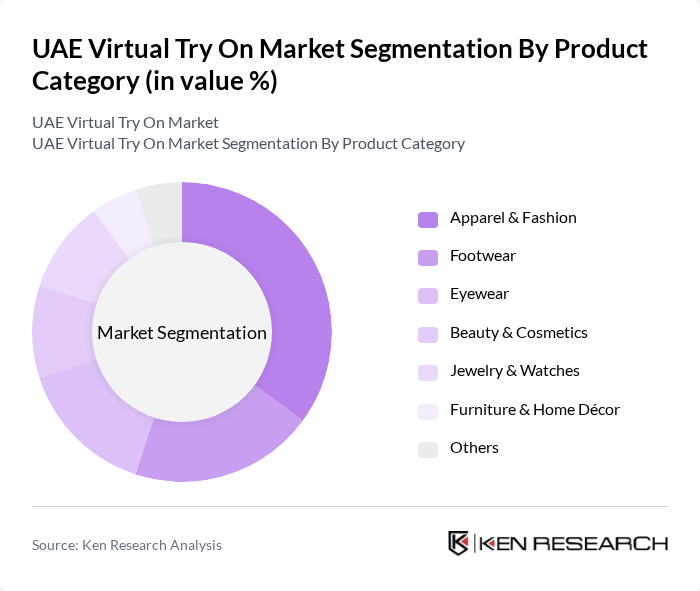
By Product Category:The product category segmentation of the UAE Virtual Try On Market includes various segments such as Apparel & Fashion, Footwear, Eyewear, Beauty & Cosmetics, Jewelry & Watches, Furniture & Home Décor, and Others. Among these, the Apparel & Fashion segment is leading due to the increasing demand for online shopping and the need for consumers to visualize clothing and fit before purchase, supported by global advances in virtual fitting room and virtual try-on technologies. The rise of social media influencers, fashion e-commerce platforms, and live-shopping formats in the UAE, along with AR-enabled apparel and footwear try-on features offered by leading online fashion platforms, has also significantly contributed to the growth of this segment.
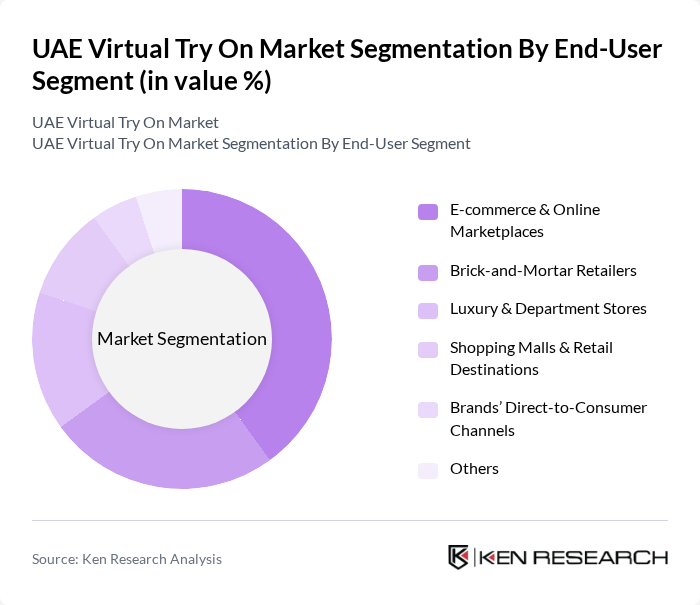
By End-User Segment:The end-user segment of the UAE Virtual Try On Market includes E-commerce & Online Marketplaces, Brick-and-Mortar Retailers, Luxury & Department Stores, Shopping Malls & Retail Destinations, Brands’ Direct-to-Consumer Channels, and Others. The E-commerce & Online Marketplaces segment is currently the most significant due to the rapid growth of online shopping, strong penetration of fashion and beauty e-commerce in the UAE, and the increasing preference for virtual try-on solutions to reduce product return rates and increase conversion. This trend is driven by the convenience of online and omnichannel shopping, the integration of AR try-on tools into mobile apps and web stores, and the need for enhanced, personalized customer experiences across beauty, eyewear, and fashion categories.
UAE Virtual Try On Market Competitive Landscape
The UAE Virtual Try On Market is characterized by a dynamic mix of regional and international players. Leading participants such as Perfect Corp., ModiFace Inc. (L'Oréal Group), Snapchat / Snap Inc. (Lens Studio & AR Try-on), 3DLOOK Inc., FittingBox, Vue.ai (Mad Street Den Inc.), Zero10, Wanna Fashion (Wanna Kicks), Avataar.ai, Obsess, Amazon.com Inc. (Amazon AR View & Virtual Try-On), L'Oréal Middle East (including NYX, Maybelline virtual try-on), Majid Al Futtaim Holding LLC (VOX, Mall-based VTO & Retail Innovation), Noon.com, Namshi contribute to innovation, geographic expansion, and service delivery in this space.
UAE Virtual Try On Market Industry Analysis
Growth Drivers
- Increasing Demand for Online Shopping:The UAE's e-commerce sector is projected to reach AED 27 billion (approximately USD 7.35 billion) in future, driven by a 20% annual growth rate. This surge in online shopping is fueled by a tech-savvy population, with 99% of UAE residents using the internet. The convenience of online shopping, coupled with the pandemic's impact, has significantly increased the demand for virtual try-on solutions, allowing consumers to visualize products before purchase.
- Advancements in AR and VR Technology:The UAE is investing heavily in AR and VR technologies, with the market expected to reach AED 1.5 billion (approximately USD 408 million) in future. This growth is supported by government initiatives like the Dubai 10X project, which aims to position Dubai as a global leader in innovation. Enhanced AR/VR capabilities are enabling more realistic and immersive virtual try-on experiences, attracting both consumers and retailers to adopt these technologies.
- Rising Consumer Preference for Personalized Experiences:A study by PwC indicates that 73% of consumers in the UAE prefer personalized shopping experiences. This trend is driving retailers to adopt virtual try-on solutions that offer tailored recommendations based on individual preferences. The increasing use of AI in these solutions is enhancing personalization, with the UAE's AI market projected to reach AED 7.5 billion (approximately USD 2 billion) in future, further supporting this growth driver.
Market Challenges
- High Initial Investment Costs:Implementing virtual try-on technology requires significant upfront investment, often exceeding AED 1 million (approximately USD 272,000) for retailers. This financial barrier can deter smaller businesses from adopting these solutions, limiting market growth. Additionally, ongoing maintenance and updates to AR/VR systems can further strain budgets, especially in a competitive retail environment where cost efficiency is crucial.
- Consumer Skepticism Towards Virtual Solutions:Despite the growing interest in virtual try-on technologies, approximately 40% of consumers in the UAE express skepticism about their effectiveness. Concerns about the accuracy of virtual representations and the overall user experience can hinder adoption rates. Retailers must invest in educating consumers about the benefits and reliability of these technologies to overcome this challenge and build trust in virtual shopping experiences.
UAE Virtual Try On Market Future Outlook
The UAE virtual try-on market is poised for significant growth, driven by technological advancements and changing consumer behaviors. As retailers increasingly integrate AR and VR solutions into their platforms, the demand for personalized shopping experiences will continue to rise. Additionally, the expansion of e-commerce and omnichannel strategies will further enhance the market landscape. By future, the focus on sustainability and ethical practices in fashion will also shape consumer preferences, creating new avenues for innovation and engagement in the virtual try-on space.
Market Opportunities
- Integration with Social Media Platforms:Collaborating with social media platforms can enhance user engagement, as 90% of UAE residents are active on social media. By integrating virtual try-on features into these platforms, brands can reach a wider audience, driving traffic and sales. This strategy can leverage the popularity of influencer marketing, which is expected to grow by AED 1 billion (approximately USD 272 million) in future.
- Development of Mobile Applications:With over 90% smartphone penetration in the UAE, developing mobile applications for virtual try-on solutions presents a lucrative opportunity. These apps can provide seamless user experiences, allowing consumers to try on products anytime, anywhere. The mobile app market in the UAE is projected to grow to AED 3 billion (approximately USD 816 million) in future, indicating strong potential for virtual try-on applications.
Scope of the Report
| Segment | Sub-Segments |
|---|---|
| By Product Category | Apparel & Fashion Footwear Eyewear Beauty & Cosmetics Jewelry & Watches Furniture & Home Décor Others |
| By End-User Segment | E-commerce & Online Marketplaces Brick-and-Mortar Retailers Luxury & Department Stores Shopping Malls & Retail Destinations Brands’ Direct-to-Consumer Channels Others |
| By User Demographics | Age Group (13–17, 18–24, 25–34, 35–44, 45+) Gender Income Level (Mass, Premium, Luxury) Tourist vs Resident Users |
| By Technology Stack | Smartphone-based AR (apps & webAR) In-store Smart Mirrors & Kiosks Social AR Filters (Snap, Instagram, TikTok, etc.) AI/ML-based 3D Body & Face Scanning VR/MR Experiences Others |
| By Use Case | Online Product Visualization In-store Experience Enhancement Social Commerce & Influencer-led Try-ons Marketing & Campaign-based Activations Size & Fit Recommendation Others |
| By Deployment Model | Cloud-based Solutions On-premise / In-store Installations Hybrid Deployments SDK/API Integrations |
| By Buyer Type | Large Enterprise Retailers & Groups SMEs & Boutique Retailers Pure-play E-commerce Platforms Social Sellers & Marketplaces Others |
Key Target Audience
Investors and Venture Capitalist Firms
Government and Regulatory Bodies (e.g., Ministry of Economy, Telecommunications and Digital Government Regulatory Authority)
Manufacturers and Producers of Virtual Try-On Technology
Distributors and Retailers in the Fashion and Beauty Industry
Augmented Reality and Virtual Reality Developers
Marketing and Advertising Agencies
Industry Associations (e.g., UAE Fashion Council)
Financial Institutions and Banks
Players Mentioned in the Report:
Perfect Corp.
ModiFace Inc. (L'Oreal Group)
Snapchat / Snap Inc. (Lens Studio & AR Try-on)
3DLOOK Inc.
FittingBox
Vue.ai (Mad Street Den Inc.)
Zero10
Wanna Fashion (Wanna Kicks)
Avataar.ai
Obsess
Amazon.com Inc. (Amazon AR View & Virtual Try-On)
L'Oreal Middle East (including NYX, Maybelline virtual try-on)
Majid Al Futtaim Holding LLC (VOX, Mall-based VTO & Retail Innovation)
Noon.com
Namshi
Table of Contents
Market Assessment Phase
1. Executive Summary and Approach
2. UAE Virtual Try On Market Overview
2.1 Key Insights and Strategic Recommendations
2.2 UAE Virtual Try On Market Overview
2.3 Definition and Scope
2.4 Evolution of Market Ecosystem
2.5 Timeline of Key Regulatory Milestones
2.6 Value Chain & Stakeholder Mapping
2.7 Business Cycle Analysis
2.8 Policy & Incentive Landscape
3. UAE Virtual Try On Market Analysis
3.1 Growth Drivers
3.1.1 Increasing demand for online shopping
3.1.2 Advancements in AR and VR technology
3.1.3 Rising consumer preference for personalized experiences
3.1.4 Expansion of e-commerce platforms
3.2 Market Challenges
3.2.1 High initial investment costs
3.2.2 Technical limitations in AR/VR technology
3.2.3 Consumer skepticism towards virtual solutions
3.2.4 Data privacy and security concerns
3.3 Market Opportunities
3.3.1 Integration with social media platforms
3.3.2 Collaborations with fashion retailers
3.3.3 Development of mobile applications
3.3.4 Expansion into emerging markets
3.4 Market Trends
3.4.1 Growth of omnichannel retailing
3.4.2 Increasing use of AI in virtual try-on solutions
3.4.3 Focus on sustainability in fashion
3.4.4 Rise of influencer marketing in virtual experiences
3.5 Government Regulation
3.5.1 Data protection regulations
3.5.2 E-commerce regulations
3.5.3 Consumer rights protection laws
3.5.4 Standards for AR/VR technology
4. SWOT Analysis
5. Stakeholder Analysis
6. Porter's Five Forces Analysis
7. UAE Virtual Try On Market Market Size, 2019-2024
7.1 By Value
7.2 By Volume
7.3 By Average Selling Price
8. UAE Virtual Try On Market Segmentation
8.1 By Product Category
8.1.1 Apparel & Fashion
8.1.2 Footwear
8.1.3 Eyewear
8.1.4 Beauty & Cosmetics
8.1.5 Jewelry & Watches
8.1.6 Furniture & Home Décor
8.1.7 Others
8.2 By End-User Segment
8.2.1 E-commerce & Online Marketplaces
8.2.2 Brick-and-Mortar Retailers
8.2.3 Luxury & Department Stores
8.2.4 Shopping Malls & Retail Destinations
8.2.5 Brands’ Direct-to-Consumer Channels
8.2.6 Others
8.3 By User Demographics
8.3.1 Age Group (13–17, 18–24, 25–34, 35–44, 45+)
8.3.2 Gender
8.3.3 Income Level (Mass, Premium, Luxury)
8.3.4 Tourist vs Resident Users
8.4 By Technology Stack
8.4.1 Smartphone-based AR (apps & webAR)
8.4.2 In-store Smart Mirrors & Kiosks
8.4.3 Social AR Filters (Snap, Instagram, TikTok, etc.)
8.4.4 AI/ML-based 3D Body & Face Scanning
8.4.5 VR/MR Experiences
8.4.6 Others
8.5 By Use Case
8.5.1 Online Product Visualization
8.5.2 In-store Experience Enhancement
8.5.3 Social Commerce & Influencer-led Try-ons
8.5.4 Marketing & Campaign-based Activations
8.5.5 Size & Fit Recommendation
8.5.6 Others
8.6 By Deployment Model
8.6.1 Cloud-based Solutions
8.6.2 On-premise / In-store Installations
8.6.3 Hybrid Deployments
8.6.4 SDK/API Integrations
8.7 By Buyer Type
8.7.1 Large Enterprise Retailers & Groups
8.7.2 SMEs & Boutique Retailers
8.7.3 Pure-play E-commerce Platforms
8.7.4 Social Sellers & Marketplaces
8.7.5 Others
9. UAE Virtual Try On Market Competitive Analysis
9.1 Market Share of Key Players
9.2 Cross Comparison of Key Players
9.2.1 Company Name
9.2.2 Primary Offering (Software Platform / SDK / In-store Hardware / Full-stack)
9.2.3 Focus Segment (Beauty, Fashion, Eyewear, Multi-category)
9.2.4 Geographic Presence in UAE (Dubai, Abu Dhabi, Other Emirates, GCC-wide)
9.2.5 Number of Active UAE Retail/E-commerce Clients
9.2.6 Monthly Active Users of VTO Experiences in UAE
9.2.7 Integration Capabilities (Mobile Apps, Web, POS, Social Platforms)
9.2.8 Average Deployment Time per Client
9.2.9 Pricing Model (SaaS, Per-use, License + Services, Revenue-share)
9.2.10 Estimated Annual Recurring Revenue from UAE
9.2.11 Customer Retention Rate (UAE)
9.2.12 Impact KPIs (Conversion Uplift, Return-rate Reduction)
9.2.13 R&D / Innovation Intensity (Patents, Feature Releases per Year)
9.3 SWOT Analysis of Top Players
9.4 Pricing Analysis
9.5 Detailed Profile of Major Companies
9.5.1 Perfect Corp.
9.5.2 ModiFace Inc. (L'Oréal Group)
9.5.3 Snapchat / Snap Inc. (Lens Studio & AR Try-on)
9.5.4 3DLOOK Inc.
9.5.5 FittingBox
9.5.6 Vue.ai (Mad Street Den Inc.)
9.5.7 Zero10
9.5.8 Wanna Fashion (Wanna Kicks)
9.5.9 Avataar.ai
9.5.10 Obsess
9.5.11 Amazon.com Inc. (Amazon AR View & Virtual Try-On)
9.5.12 L'Oréal Middle East (including NYX, Maybelline virtual try-on)
9.5.13 Majid Al Futtaim Holding LLC (VOX, Mall-based VTO & Retail Innovation)
9.5.14 Noon.com
9.5.15 Namshi
10. UAE Virtual Try On Market End-User Analysis
10.1 Procurement Behavior of Key Ministries
10.1.1 Budget Allocation
10.1.2 Decision-Making Process
10.1.3 Vendor Selection Criteria
10.1.4 Others
10.2 Corporate Spend on Infrastructure & Energy
10.2.1 Investment Trends
10.2.2 Spending Priorities
10.2.3 Budget Constraints
10.2.4 Others
10.3 Pain Point Analysis by End-User Category
10.3.1 Technical Challenges
10.3.2 User Experience Issues
10.3.3 Cost-Related Concerns
10.3.4 Others
10.4 User Readiness for Adoption
10.4.1 Awareness Levels
10.4.2 Training Needs
10.4.3 Technology Accessibility
10.4.4 Others
10.5 Post-Deployment ROI and Use Case Expansion
10.5.1 Performance Metrics
10.5.2 User Feedback
10.5.3 Future Use Cases
10.5.4 Others
11. UAE Virtual Try On Market Future Size, 2025-2030
11.1 By Value
11.2 By Volume
11.3 By Average Selling Price
Go-To-Market Strategy Phase
1. Whitespace Analysis + Business Model Canvas
1.1 Market Gaps Identification
1.2 Business Model Development
2. Marketing and Positioning Recommendations
2.1 Branding Strategies
2.2 Product USPs
3. Distribution Plan
3.1 Urban Retail vs Rural NGO Tie-Ups
4. Channel & Pricing Gaps
4.1 Underserved Routes
4.2 Pricing Bands
5. Unmet Demand & Latent Needs
5.1 Category Gaps
5.2 Consumer Segments
6. Customer Relationship
6.1 Loyalty Programs
6.2 After-Sales Service
7. Value Proposition
7.1 Sustainability
7.2 Integrated Supply Chains
8. Key Activities
8.1 Regulatory Compliance
8.2 Branding
8.3 Distribution Setup
9. Entry Strategy Evaluation
9.1 Domestic Market Entry Strategy
9.1.1 Product Mix
9.1.2 Pricing Band
9.1.3 Packaging
9.2 Export Entry Strategy
9.2.1 Target Countries
9.2.2 Compliance Roadmap
10. Entry Mode Assessment
10.1 JV
10.2 Greenfield
10.3 M&A
10.4 Distributor Model
11. Capital and Timeline Estimation
11.1 Capital Requirements
11.2 Timelines
12. Control vs Risk Trade-Off
12.1 Ownership vs Partnerships
13. Profitability Outlook
13.1 Breakeven Analysis
13.2 Long-Term Sustainability
14. Potential Partner List
14.1 Distributors
14.2 JVs
14.3 Acquisition Targets
15. Execution Roadmap
15.1 Phased Plan for Market Entry
15.1.1 Market Setup
15.1.2 Market Entry
15.1.3 Growth Acceleration
15.1.4 Scale & Stabilize
15.2 Key Activities and Milestones
15.2.1 Milestone Planning
15.2.2 Activity Tracking
Research Methodology
Phase 1: Approach1
Desk Research
- Market reports from industry associations and trade publications focused on virtual try-on technologies
- Analysis of consumer behavior studies and trends in the UAE fashion and retail sectors
- Review of technological advancements and patents related to augmented reality and virtual fitting solutions
Primary Research
- Interviews with technology providers specializing in virtual try-on solutions
- Surveys with retailers and e-commerce platforms utilizing virtual fitting technologies
- Focus groups with consumers to gather insights on user experience and preferences
Validation & Triangulation
- Cross-validation of findings through multiple data sources, including sales data and user feedback
- Triangulation of insights from industry experts, consumer surveys, and market reports
- Sanity checks through expert panel reviews to ensure data accuracy and relevance
Phase 2: Market Size Estimation1
Top-down Assessment
- Estimation of market size based on overall retail growth in the UAE and adoption rates of virtual try-on technologies
- Segmentation of the market by product categories such as apparel, accessories, and cosmetics
- Incorporation of demographic factors influencing technology adoption, such as age and tech-savviness
Bottom-up Modeling
- Collection of data from leading retailers on the volume of virtual try-on usage and conversion rates
- Estimation of average revenue per user (ARPU) for virtual try-on services across different sectors
- Analysis of operational costs associated with implementing virtual fitting solutions
Forecasting & Scenario Analysis
- Multi-factor regression analysis incorporating e-commerce growth, consumer preferences, and technological advancements
- Scenario modeling based on varying levels of market penetration and consumer acceptance
- Development of baseline, optimistic, and pessimistic forecasts through 2030
Phase 3: CATI Sample Composition1
| Scope Item/Segment | Sample Size | Target Respondent Profiles |
|---|---|---|
| Fashion Retailers Using Virtual Try-On | 90 | Retail Managers, E-commerce Directors |
| Cosmetics Brands Implementing AR Solutions | 70 | Marketing Managers, Product Development Heads |
| Technology Providers for Virtual Fitting | 40 | Product Managers, Technical Leads |
| Consumers Engaging with Virtual Try-On | 140 | Online Shoppers, Fashion Enthusiasts |
| Market Analysts and Industry Experts | 40 | Market Researchers, Industry Consultants |
Frequently Asked Questions
What is the current value of the UAE Virtual Try On Market?
The UAE Virtual Try On Market is valued at approximately USD 900 million, reflecting significant growth driven by the adoption of augmented reality (AR) and artificial intelligence (AI) technologies in retail, particularly in fashion and beauty sectors.
Which cities are leading in the UAE Virtual Try On Market?
What factors are driving the growth of the UAE Virtual Try On Market?
What challenges does the UAE Virtual Try On Market face?
Other Regional/Country Reports
Indonesia Virtual Try On Market
Malaysia Virtual Try On Market
KSA Virtual Try On Market
APAC Virtual Try On Market
SEA Virtual Try On Market
Vietnam Virtual Try On Market
Other Adjacent Reports
Vietnam Virtual Reality Fashion Market
Thailand E-commerce Personalization Market
Philippines Beauty Tech Solutions Market
South Korea Digital Fitting Room Market
Germany AR Eyewear Technology Market
Egypt Online Cosmetics Retail Market
Philippines Mobile Shopping App Market
Brazil AI-Driven Retail Analytics Market
Japan Social Commerce Platform Market
Why Buy From Us?

What makes us stand out is that our consultants follow Robust, Refine and Result (RRR) methodology. Robust for clear definitions, approaches and sanity checking, Refine for differentiating respondents' facts and opinions, and Result for presenting data with story.

We have set a benchmark in the industry by offering our clients with syndicated and customized market research reports featuring coverage of entire market as well as meticulous research and analyst insights.

While we don't replace traditional research, we flip the method upside down. Our dual approach of Top Bottom & Bottom Top ensures quality deliverable by not just verifying company fundamentals but also looking at the sector and macroeconomic factors.

With one step in the future, our research team constantly tries to show you the bigger picture. We help with some of the tough questions you may encounter along the way: How is the industry positioned? Best marketing channel? KPI's of competitors? By aligning every element, we help maximize success.

Our report gives you instant access to the answers and sources that other companies might choose to hide. We elaborate each steps of research methodology we have used and showcase you the sample size to earn your trust.

If you need any support, we are here! We pride ourselves on universe strength, data quality, and quick, friendly, and professional service.