About the Report
Base Year 2024UAE Wealth Preservation Market Overview
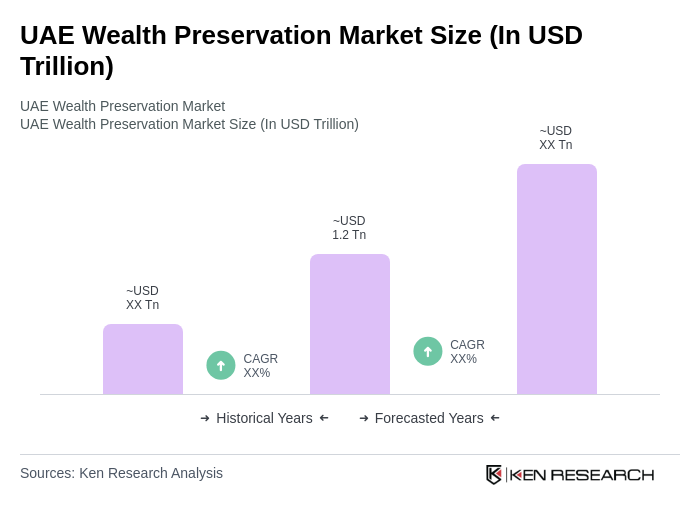
- The UAE Wealth Preservation Market is valued at USD 1.2 trillion, based on a five-year analysis of assets managed by family offices, private banks, and wealth management entities in Dubai International Financial Centre and Abu Dhabi Global Market. This growth is primarily driven by the rapid increase in high-net-worth individuals (HNWIs) and ultra-high-net-worth individuals (UHNWIs), robust inflows of global wealth, and the UAE’s status as a premier destination for private wealth migration and asset protection. Dubai and Abu Dhabi continue to attract significant international capital due to their stable regulatory environment, tax advantages, and comprehensive financial services infrastructure .
- Dubai and Abu Dhabi are the dominant cities in the UAE Wealth Preservation Market, serving as leading financial hubs in the Middle East. Their prominence is reinforced by the presence of over 400 wealth and asset management firms, a concentration of international banks, and a rapidly expanding ecosystem of family offices and investment advisory entities. These cities offer a favorable tax regime, world-class infrastructure, and a cosmopolitan lifestyle, making them highly attractive to global investors and affluent individuals .
- The “Wealth Management Regulatory Framework” was introduced under the Dubai Financial Services Authority (DFSA) and Abu Dhabi Global Market (ADGM) Financial Services Regulatory Authority (FSRA) regimes, with key updates in 2023. These frameworks require financial institutions to comply with rigorous standards on client due diligence, risk management, and transparency. The DFSA’s Conduct of Business Rulebook (COB), updated in 2023, mandates suitability assessments, disclosure obligations, and robust investor protection measures for all wealth management providers operating within the Dubai International Financial Centre .
UAE Wealth Preservation Market Segmentation
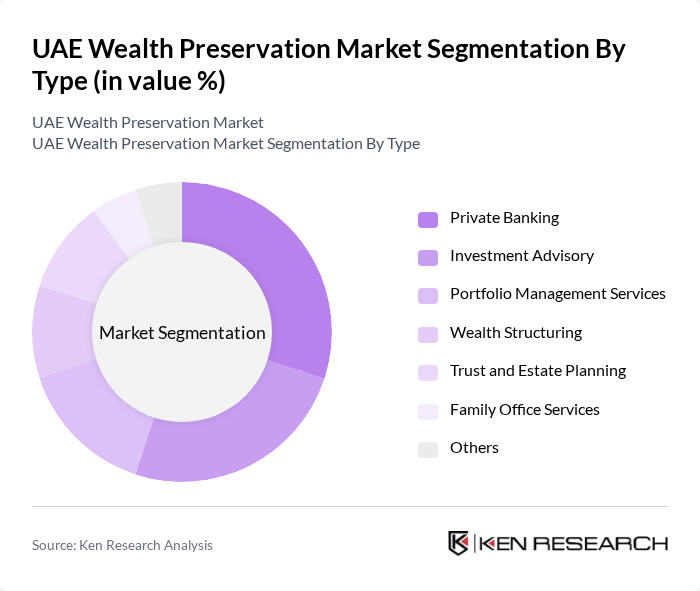
By Type:The market is segmented into various types of wealth preservation services, including Private Banking, Investment Advisory, Portfolio Management Services, Wealth Structuring, Trust and Estate Planning, Family Office Services, and Others. Each of these segments addresses distinct client needs, with Private Banking and Investment Advisory remaining particularly prominent due to their tailored, relationship-driven approach and the increasing complexity of client portfolios in the UAE’s evolving wealth landscape .
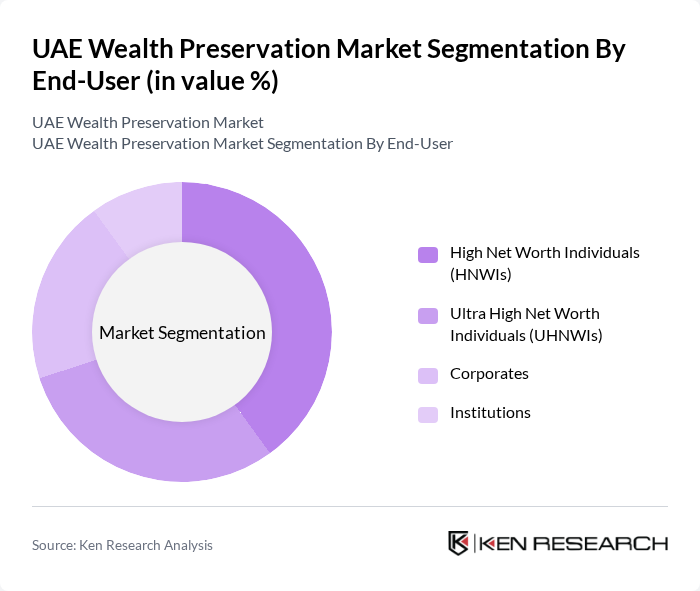
By End-User:The wealth preservation market serves various end-users, including High Net Worth Individuals (HNWIs), Ultra High Net Worth Individuals (UHNWIs), Corporates, and Institutions. HNWIs and UHNWIs dominate the market, reflecting the UAE’s role as a global magnet for affluent individuals seeking asset protection, succession planning, and international diversification. Corporates and institutions also contribute to market growth, leveraging UAE-based structures for treasury management and cross-border investment .
UAE Wealth Preservation Market Competitive Landscape
The UAE Wealth Preservation Market is characterized by a dynamic mix of regional and international players. Leading participants such as Emirates NBD, Abu Dhabi Commercial Bank, Dubai Islamic Bank, HSBC Middle East, Standard Chartered Bank, Citibank UAE, Al Hilal Bank, FAB (First Abu Dhabi Bank), Mashreq Bank, RAKBANK, BNP Paribas Wealth Management, Julius Baer, Credit Suisse, UBS Group AG, Abu Dhabi Investment Authority (ADIA), Dubai Investments, Morgan Stanley, Deutsche Bank, Lighthouse Canton, Union Bancaire Privée (UBP) contribute to innovation, geographic expansion, and service delivery in this space.
UAE Wealth Preservation Market Industry Analysis
Growth Drivers
- Increasing High Net Worth Individuals (HNWIs):The UAE has seen a significant rise in HNWIs, with over109,500 individuals possessing wealth exceeding $1 millionin future. This number is projected to increase by 5% annually, driven by the region's robust economic growth and favorable investment climate. The influx of expatriates and the establishment of new businesses contribute to this trend, creating a larger client base for wealth preservation services, which are essential for managing and protecting assets effectively.
- Demand for Estate Planning Services:The estate planning sector in the UAE is experiencing heightened demand, with the market valued at approximately$1.2 billionin future. This growth is fueled by an increasing awareness of the importance of asset distribution and inheritance planning among affluent families. The introduction of new laws, such as the UAE's inheritance law reforms, has further stimulated interest, as individuals seek to ensure their wealth is preserved and passed on according to their wishes.
- Regulatory Support for Wealth Management:The UAE government has implemented various regulatory frameworks to enhance the wealth management sector, including the Financial Services Regulatory Authority's guidelines. In future, the total number of licensed financial advisors reached1,200, reflecting a 15% increase from the previous year. This regulatory support fosters a secure environment for wealth preservation, encouraging both local and international investors to engage in wealth management services, thus driving market growth.
Market Challenges
- Economic Volatility:The UAE's economy faces challenges from fluctuating oil prices and geopolitical tensions, which can impact investor confidence. In future, oil prices averaged$80per barrel, down from $100, leading to concerns about economic stability. This volatility can deter potential investors from engaging in wealth preservation strategies, as they may prioritize liquidity over long-term investments, creating uncertainty in the market.
- Regulatory Compliance Complexity:Navigating the regulatory landscape in the UAE can be challenging for wealth management firms. The introduction of stringent compliance requirements, such as the Anti-Money Laundering (AML) regulations, has increased operational costs. In future, compliance-related expenses for financial institutions rose by20%, straining resources and potentially limiting the ability to offer comprehensive wealth preservation services, thereby hindering market growth.
UAE Wealth Preservation Market Future Outlook
The UAE wealth preservation market is poised for significant evolution, driven by technological advancements and changing investor preferences. As digital wealth management solutions gain traction, firms are expected to adopt innovative platforms to enhance client engagement and service delivery. Additionally, the growing interest in sustainable investments will likely shape product offerings, aligning with global trends. This dynamic environment presents opportunities for firms to differentiate themselves and cater to the evolving needs of HNWIs in the region.
Market Opportunities
- Growth in Digital Wealth Management Solutions:The digital wealth management sector is projected to reach$500 millionby future, driven by increased smartphone penetration and internet access. This growth presents an opportunity for firms to leverage technology to offer personalized wealth preservation solutions, enhancing client experience and operational efficiency.
- Expansion of Family Offices:The number of family offices in the UAE has surged to over300in future, reflecting a growing trend among HNWIs to manage their wealth independently. This expansion offers wealth management firms a chance to collaborate with family offices, providing tailored services that address unique family needs and investment strategies, thereby enhancing market presence.
Scope of the Report
| Segment | Sub-Segments |
|---|---|
| By Type | Private Banking Investment Advisory Portfolio Management Services Wealth Structuring Trust and Estate Planning Family Office Services Others |
| By End-User | High Net Worth Individuals (HNWIs) Ultra High Net Worth Individuals (UHNWIs) Corporates Institutions |
| By Investment Strategy | Active Management Passive Management Tactical Asset Allocation Strategic Asset Allocation |
| By Service Channel | Direct Sales Online Platforms Financial Advisors Wealth Management Firms |
| By Geographic Focus | Domestic Investments International Investments Regional Investments |
| By Asset Class | Equities Fixed Income Real Estate Commodities Alternatives |
| By Client Relationship Model | Transactional Relationship Advisory Relationship Discretionary Management Others |
Key Target Audience
Investors and Venture Capitalist Firms
Government and Regulatory Bodies (e.g., Central Bank of the UAE, Securities and Commodities Authority)
High-Net-Worth Individuals (HNWIs)
Family Offices
Private Wealth Management Firms
Real Estate Investment Trusts (REITs)
Insurance Companies
Trust and Estate Planning Services
Players Mentioned in the Report:
Emirates NBD
Abu Dhabi Commercial Bank
Dubai Islamic Bank
HSBC Middle East
Standard Chartered Bank
Citibank UAE
Al Hilal Bank
FAB (First Abu Dhabi Bank)
Mashreq Bank
RAKBANK
BNP Paribas Wealth Management
Julius Baer
Credit Suisse
UBS Group AG
Abu Dhabi Investment Authority (ADIA)
Dubai Investments
Morgan Stanley
Deutsche Bank
Lighthouse Canton
Union Bancaire Privee (UBP)
Table of Contents
Market Assessment Phase
1. Executive Summary and Approach
2. UAE Wealth Preservation Market Overview
2.1 Key Insights and Strategic Recommendations
2.2 UAE Wealth Preservation Market Overview
2.3 Definition and Scope
2.4 Evolution of Market Ecosystem
2.5 Timeline of Key Regulatory Milestones
2.6 Value Chain & Stakeholder Mapping
2.7 Business Cycle Analysis
2.8 Policy & Incentive Landscape
3. UAE Wealth Preservation Market Analysis
3.1 Growth Drivers
3.1.1 Increasing High Net Worth Individuals (HNWIs)
3.1.2 Demand for Estate Planning Services
3.1.3 Rise in Financial Literacy
3.1.4 Regulatory Support for Wealth Management
3.2 Market Challenges
3.2.1 Economic Volatility
3.2.2 Regulatory Compliance Complexity
3.2.3 Competition from Global Players
3.2.4 Limited Awareness of Wealth Preservation Options
3.3 Market Opportunities
3.3.1 Growth in Digital Wealth Management Solutions
3.3.2 Expansion of Family Offices
3.3.3 Increasing Interest in Alternative Investments
3.3.4 Cross-Border Wealth Management Services
3.4 Market Trends
3.4.1 Shift Towards Sustainable Investment Strategies
3.4.2 Integration of Technology in Wealth Management
3.4.3 Customization of Wealth Preservation Solutions
3.4.4 Focus on Tax Efficiency
3.5 Government Regulation
3.5.1 Implementation of Anti-Money Laundering Laws
3.5.2 Taxation Policies for Wealth Management
3.5.3 Licensing Requirements for Financial Advisors
3.5.4 Consumer Protection Regulations
4. SWOT Analysis
5. Stakeholder Analysis
6. Porter's Five Forces Analysis
7. UAE Wealth Preservation Market Market Size, 2019-2024
7.1 By Value
7.2 By Volume
7.3 By Average Selling Price
8. UAE Wealth Preservation Market Segmentation
8.1 By Type
8.1.1 Private Banking
8.1.2 Investment Advisory
8.1.3 Portfolio Management Services
8.1.4 Wealth Structuring
8.1.5 Trust and Estate Planning
8.1.6 Family Office Services
8.1.7 Others
8.2 By End-User
8.2.1 High Net Worth Individuals (HNWIs)
8.2.2 Ultra High Net Worth Individuals (UHNWIs)
8.2.3 Corporates
8.2.4 Institutions
8.3 By Investment Strategy
8.3.1 Active Management
8.3.2 Passive Management
8.3.3 Tactical Asset Allocation
8.3.4 Strategic Asset Allocation
8.4 By Service Channel
8.4.1 Direct Sales
8.4.2 Online Platforms
8.4.3 Financial Advisors
8.4.4 Wealth Management Firms
8.5 By Geographic Focus
8.5.1 Domestic Investments
8.5.2 International Investments
8.5.3 Regional Investments
8.6 By Asset Class
8.6.1 Equities
8.6.2 Fixed Income
8.6.3 Real Estate
8.6.4 Commodities
8.6.5 Alternatives
8.7 By Client Relationship Model
8.7.1 Transactional Relationship
8.7.2 Advisory Relationship
8.7.3 Discretionary Management
8.7.4 Others
9. UAE Wealth Preservation Market Competitive Analysis
9.1 Market Share of Key Players
9.2 Cross Comparison of Key Players
9.2.1 Company Name
9.2.2 Group Size (Large, Medium, or Small as per industry convention)
9.2.3 Assets Under Management (AUM)
9.2.4 Revenue Growth Rate
9.2.5 Client Retention Rate
9.2.6 Market Penetration Rate
9.2.7 Average Client Portfolio Size
9.2.8 Fee Structure (e.g., % of AUM, fixed, performance-based)
9.2.9 Customer Satisfaction Score (e.g., NPS)
9.2.10 Regulatory Compliance Record
9.2.11 Digital Platform Adoption Rate
9.2.12 Breadth of Service Offering (e.g., number of product lines)
9.3 SWOT Analysis of Top Players
9.4 Pricing Analysis
9.5 Detailed Profile of Major Companies
9.5.1 Emirates NBD
9.5.2 Abu Dhabi Commercial Bank
9.5.3 Dubai Islamic Bank
9.5.4 HSBC Middle East
9.5.5 Standard Chartered Bank
9.5.6 Citibank UAE
9.5.7 Al Hilal Bank
9.5.8 FAB (First Abu Dhabi Bank)
9.5.9 Mashreq Bank
9.5.10 RAKBANK
9.5.11 BNP Paribas Wealth Management
9.5.12 Julius Baer
9.5.13 Credit Suisse
9.5.14 UBS Group AG
9.5.15 Abu Dhabi Investment Authority (ADIA)
9.5.16 Dubai Investments
9.5.17 Morgan Stanley
9.5.18 Deutsche Bank
9.5.19 Lighthouse Canton
9.5.20 Union Bancaire Privée (UBP)
10. UAE Wealth Preservation Market End-User Analysis
10.1 Procurement Behavior of Key Ministries
10.1.1 Ministry of Finance
10.1.2 Ministry of Economy
10.1.3 Ministry of Foreign Affairs
10.2 Corporate Spend on Infrastructure & Energy
10.2.1 Corporate Investment Trends
10.2.2 Budget Allocation for Wealth Management
10.3 Pain Point Analysis by End-User Category
10.3.1 Regulatory Compliance Issues
10.3.2 Lack of Awareness
10.4 User Readiness for Adoption
10.4.1 Technology Adoption Levels
10.4.2 Financial Literacy Rates
10.5 Post-Deployment ROI and Use Case Expansion
10.5.1 Measurement of ROI
10.5.2 Expansion Opportunities
11. UAE Wealth Preservation Market Future Size, 2025-2030
11.1 By Value
11.2 By Volume
11.3 By Average Selling Price
Go-To-Market Strategy Phase
1. Whitespace Analysis + Business Model Canvas
1.1 Market Gaps Identification
1.2 Business Model Framework
2. Marketing and Positioning Recommendations
2.1 Branding Strategies
2.2 Product USPs
3. Distribution Plan
3.1 Urban Retail Strategies
3.2 Rural NGO Tie-Ups
4. Channel & Pricing Gaps
4.1 Underserved Routes
4.2 Pricing Bands
5. Unmet Demand & Latent Needs
5.1 Category Gaps
5.2 Consumer Segments
6. Customer Relationship
6.1 Loyalty Programs
6.2 After-Sales Service
7. Value Proposition
7.1 Sustainability
7.2 Integrated Supply Chains
8. Key Activities
8.1 Regulatory Compliance
8.2 Branding
8.3 Distribution Setup
9. Entry Strategy Evaluation
9.1 Domestic Market Entry Strategy
9.1.1 Product Mix
9.1.2 Pricing Band
9.1.3 Packaging
9.2 Export Entry Strategy
9.2.1 Target Countries
9.2.2 Compliance Roadmap
10. Entry Mode Assessment
10.1 JV
10.2 Greenfield
10.3 M&A
10.4 Distributor Model
11. Capital and Timeline Estimation
11.1 Capital Requirements
11.2 Timelines
12. Control vs Risk Trade-Off
12.1 Ownership vs Partnerships
13. Profitability Outlook
13.1 Breakeven Analysis
13.2 Long-Term Sustainability
14. Potential Partner List
14.1 Distributors
14.2 JVs
14.3 Acquisition Targets
15. Execution Roadmap
15.1 Phased Plan for Market Entry
15.1.1 Market Setup
15.1.2 Market Entry
15.1.3 Growth Acceleration
15.1.4 Scale & Stabilize
15.2 Key Activities and Milestones
15.2.1 Milestone Planning
15.2.2 Activity Tracking
Research Methodology
Phase 1: Approach1
Desk Research
- Analysis of financial reports from leading wealth management firms in the UAE
- Review of market studies and white papers published by financial institutions and consultancy firms
- Examination of regulatory frameworks and guidelines from the UAE Central Bank and Securities and Commodities Authority
Primary Research
- Interviews with wealth managers and financial advisors operating in the UAE
- Surveys targeting high-net-worth individuals (HNWIs) regarding their wealth preservation strategies
- Focus groups with estate planners and tax consultants to understand market needs
Validation & Triangulation
- Cross-validation of findings through multiple data sources, including industry reports and expert opinions
- Triangulation of qualitative insights from interviews with quantitative data from surveys
- Sanity checks through expert panel reviews comprising industry veterans and financial analysts
Phase 2: Market Size Estimation1
Top-down Assessment
- Estimation of total wealth in the UAE based on national economic indicators and wealth reports
- Segmentation of wealth by asset classes, including real estate, stocks, and alternative investments
- Incorporation of demographic trends affecting wealth distribution among HNWIs
Bottom-up Modeling
- Analysis of service uptake rates among wealth management firms and their client bases
- Operational cost assessments for wealth preservation services offered by financial institutions
- Volume and pricing analysis for various wealth preservation products and services
Forecasting & Scenario Analysis
- Multi-factor regression analysis incorporating economic growth, inflation rates, and investment trends
- Scenario modeling based on potential regulatory changes and shifts in consumer behavior
- Development of baseline, optimistic, and pessimistic forecasts through 2030
Phase 3: CATI Sample Composition1
| Scope Item/Segment | Sample Size | Target Respondent Profiles |
|---|---|---|
| Wealth Management Services | 100 | Wealth Managers, Financial Advisors |
| Investment Strategies for HNWIs | 80 | High-Net-Worth Individuals, Investment Analysts |
| Estate Planning and Trust Services | 60 | Estate Planners, Tax Consultants |
| Alternative Investments Market | 50 | Portfolio Managers, Alternative Investment Advisors |
| Regulatory Compliance in Wealth Management | 40 | Compliance Officers, Legal Advisors |
Frequently Asked Questions
What is the current value of the UAE Wealth Preservation Market?
The UAE Wealth Preservation Market is valued at approximately USD 1.2 trillion, driven by the growth of high-net-worth individuals (HNWIs) and ultra-high-net-worth individuals (UHNWIs), along with the UAE's favorable investment climate and asset protection regulations.
Which cities dominate the UAE Wealth Preservation Market?
What types of services are included in the UAE Wealth Preservation Market?
Who are the primary end-users of wealth preservation services in the UAE?
Other Regional/Country Reports
Indonesia Wealth Preservation Market
Malaysia Wealth Preservation Market
KSA Wealth Preservation Market
Other Adjacent Reports
Indonesia Investment Advisory Market
Thailand Estate Planning Market
UAE Family Office Services MarketUAE Asset Management Market Size, Share, Growth Drivers & Forecast 2025–2030Brazil Financial Planning Market
Brazil Trust Services Market
Malaysia Portfolio Management Market
Indonesia Tax Advisory Market
Why Buy From Us?

What makes us stand out is that our consultants follow Robust, Refine and Result (RRR) methodology. Robust for clear definitions, approaches and sanity checking, Refine for differentiating respondents' facts and opinions, and Result for presenting data with story.

We have set a benchmark in the industry by offering our clients with syndicated and customized market research reports featuring coverage of entire market as well as meticulous research and analyst insights.

While we don't replace traditional research, we flip the method upside down. Our dual approach of Top Bottom & Bottom Top ensures quality deliverable by not just verifying company fundamentals but also looking at the sector and macroeconomic factors.

With one step in the future, our research team constantly tries to show you the bigger picture. We help with some of the tough questions you may encounter along the way: How is the industry positioned? Best marketing channel? KPI's of competitors? By aligning every element, we help maximize success.

Our report gives you instant access to the answers and sources that other companies might choose to hide. We elaborate each steps of research methodology we have used and showcase you the sample size to earn your trust.

If you need any support, we are here! We pride ourselves on universe strength, data quality, and quick, friendly, and professional service.