About the Report
Base Year 2024UK Regenerative Agriculture and Organic Supply Chains Market Overview
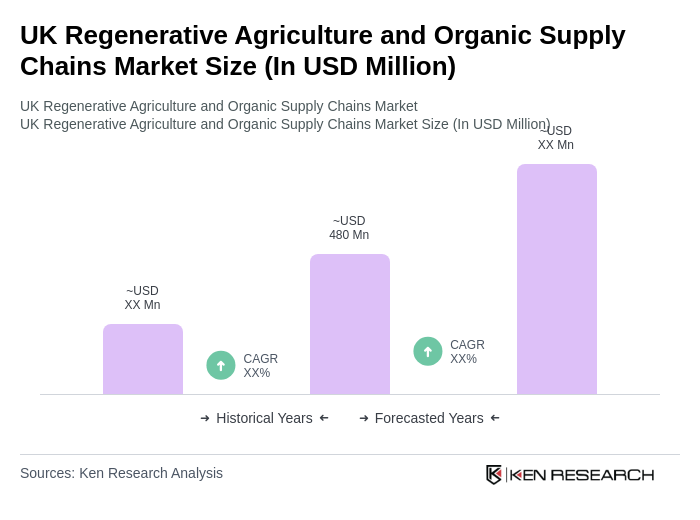
- The UK Regenerative Agriculture and Organic Supply Chains Market is valued at USD 480 million, based on a five-year historical analysis. This growth is primarily driven by increasing consumer demand for sustainable food sources, heightened awareness of environmental issues, and government support for organic farming practices. The market has seen a significant shift towards regenerative practices that enhance soil health and biodiversity, aligning with global sustainability goals.
- Key players in this market include London, Bristol, and Edinburgh, which dominate due to their strong local food movements, access to organic produce, and supportive community initiatives. These cities have established networks that promote organic farming and regenerative practices, making them hubs for innovation and consumer engagement in sustainable agriculture.
- In 2023, the UK government implemented the Environmental Land Management Scheme (ELMS), which incentivizes farmers to adopt sustainable practices, including regenerative agriculture. This initiative, established under the Agriculture Act 2020 and administered by the Department for Environment, Food & Rural Affairs (DEFRA), rewards farmers for enhancing biodiversity, improving soil health, and reducing carbon emissions, thereby fostering a more sustainable agricultural landscape. The scheme sets out compliance requirements for land management, biodiversity enhancement, and climate action.
UK Regenerative Agriculture and Organic Supply Chains Market Segmentation
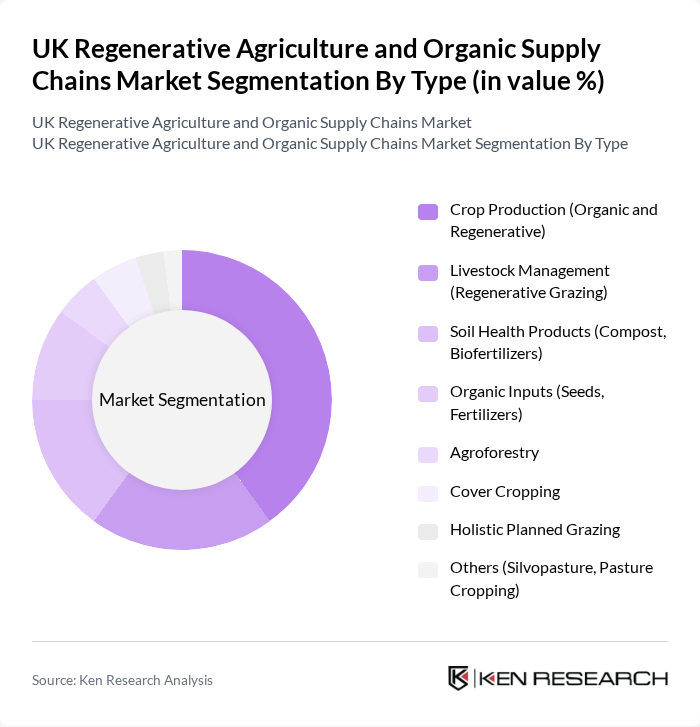
By Type:The market is segmented into various types, including Crop Production (Organic and Regenerative), Livestock Management (Regenerative Grazing), Soil Health Products (Compost, Biofertilizers), Organic Inputs (Seeds, Fertilizers), Agroforestry, Cover Cropping, Holistic Planned Grazing, and Others (Silvopasture, Pasture Cropping). Among these, Crop Production is the leading sub-segment, driven by the increasing consumer preference for organic produce and the growing awareness of the health benefits associated with organic farming. The demand for organic fruits and vegetables has surged, leading to a significant market share for this category.
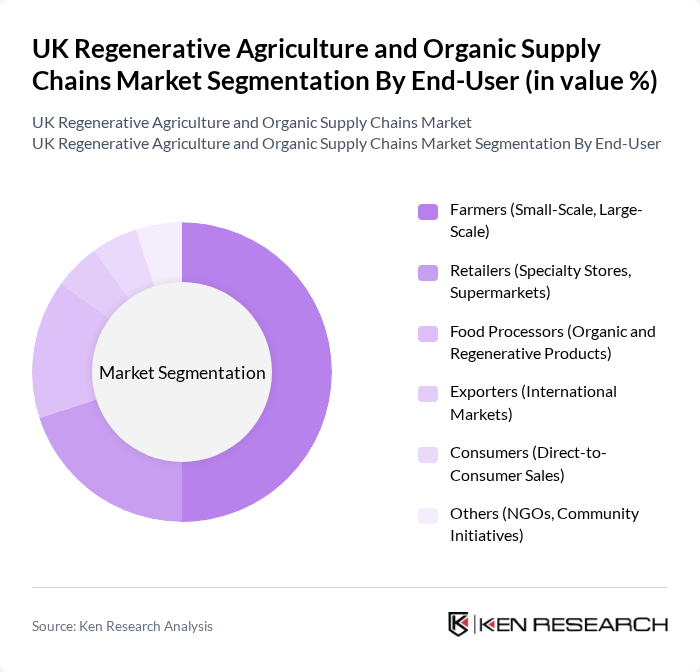
By End-User:The end-user segmentation includes Farmers (Small-Scale, Large-Scale), Retailers (Specialty Stores, Supermarkets), Food Processors (Organic and Regenerative Products), Exporters (International Markets), Consumers (Direct-to-Consumer Sales), and Others (NGOs, Community Initiatives). Farmers, particularly small-scale ones, dominate this segment as they are increasingly adopting organic and regenerative practices to meet consumer demand and improve their sustainability credentials. The trend towards local sourcing and community-supported agriculture has further bolstered the position of farmers in this market.
UK Regenerative Agriculture and Organic Supply Chains Market Competitive Landscape
The UK Regenerative Agriculture and Organic Supply Chains Market is characterized by a dynamic mix of regional and international players. Leading participants such as Soil Association, Organic Farmers & Growers, The Organic Trade Board, Riverford Organic Farmers, Abel & Cole, Whole Foods Market, The Co-operative Group, Waitrose, Tesco, Sainsbury's, Ocado, Planet Organic, Ecover, Green & Black's, Yeo Valley, Unilever (for regenerative initiatives) contribute to innovation, geographic expansion, and service delivery in this space.
UK Regenerative Agriculture and Organic Supply Chains Market Industry Analysis
Growth Drivers
- Increasing Consumer Demand for Organic Products:The UK organic food market reached £3.5 billion in future, reflecting a notable increase from previous periods. This surge is driven by heightened consumer awareness of health and sustainability, with approximately 50% of UK consumers actively seeking organic options. The demand for organic fruits and vegetables alone accounted for £1.5 billion, indicating a robust market for regenerative agriculture practices that align with consumer preferences for environmentally friendly products.
- Government Support for Sustainable Practices:The UK government allocated £2 billion in future to support sustainable farming initiatives, including regenerative agriculture. This funding is part of the Environmental Land Management scheme, which incentivizes farmers to adopt eco-friendly practices. Additionally, about 70% of farmers reported that government grants significantly influenced their decision to transition to organic farming, highlighting the critical role of public policy in driving market growth.
- Technological Advancements in Agriculture:The adoption of precision agriculture technologies has increased by over 25% in the UK, enhancing efficiency in organic farming. Innovations such as soil health monitoring and data analytics tools are enabling farmers to optimize yields while minimizing environmental impact. In future, investments in agri-tech reached £600 million, underscoring the importance of technology in supporting regenerative practices and meeting the growing demand for organic products.
Market Challenges
- High Initial Investment Costs:Transitioning to regenerative agriculture often requires significant upfront investments, estimated at £25,000 to £60,000 per farm. Many farmers face financial barriers, with about 35% citing high costs as a primary obstacle to adopting organic practices. This challenge is compounded by the need for specialized equipment and training, which can deter potential entrants into the organic market, limiting overall growth.
- Regulatory Compliance Complexity:Navigating the regulatory landscape for organic certification can be daunting, with over 150 specific requirements outlined by the UK’s Soil Association. Farmers often report spending an average of 120 hours annually on compliance-related activities. This complexity can discourage new entrants and slow the adoption of regenerative practices, as many farmers lack the resources to manage the certification process effectively.
UK Regenerative Agriculture and Organic Supply Chains Market Future Outlook
The future of the UK regenerative agriculture and organic supply chains market appears promising, driven by increasing consumer awareness and government initiatives. As urban populations grow, the demand for locally sourced organic products is expected to rise, creating new market segments. Additionally, advancements in sustainable farming technologies will likely enhance productivity and environmental stewardship, positioning regenerative agriculture as a key player in the UK’s agricultural landscape. Collaborative efforts among stakeholders will further bolster market resilience and innovation.
Market Opportunities
- Expansion into Urban Markets:Urban areas are witnessing a 20% increase in demand for organic produce, driven by health-conscious consumers. This trend presents a significant opportunity for regenerative agriculture to establish direct supply chains, reducing transportation costs and enhancing freshness. Farmers can leverage local markets to increase their visibility and profitability, tapping into the growing urban consumer base.
- Collaboration with NGOs and Community Initiatives:Partnerships with NGOs focused on sustainability can enhance market reach and credibility. In future, over 80 NGOs collaborated with farmers to promote organic practices, resulting in a 10% increase in community-supported agriculture programs. These collaborations can provide farmers with resources, training, and access to new markets, fostering a more robust organic supply chain.
Scope of the Report
| Segment | Sub-Segments |
|---|---|
| By Type | Crop Production (Organic and Regenerative) Livestock Management (Regenerative Grazing) Soil Health Products (Compost, Biofertilizers) Organic Inputs (Seeds, Fertilizers) Agroforestry Cover Cropping Holistic Planned Grazing Others (Silvopasture, Pasture Cropping) |
| By End-User | Farmers (Small-Scale, Large-Scale) Retailers (Specialty Stores, Supermarkets) Food Processors (Organic and Regenerative Products) Exporters (International Markets) Consumers (Direct-to-Consumer Sales) Others (NGOs, Community Initiatives) |
| By Distribution Channel | Direct Sales (Farmers' Markets, Online Platforms) Online Retail (E-commerce Platforms) Wholesale (Bulk Sales to Retailers) Farmers' Markets Others (Community Supported Agriculture) |
| By Certification Type | Organic Certification (Soil Association, Organic Farmers & Growers) Biodynamic Certification Regenerative Certification (Emerging Trends) Others (Local and Regional Certifications) |
| By Product Form | Raw Products (Fresh Produce) Processed Products (Organic and Regenerative Food Products) Packaged Products (Ready-to-Eat Meals) Others (Value-Added Products) |
| By Market Segment | Local Markets (Regional Sales) National Markets (UK-Wide Distribution) International Markets (Export Opportunities) Others (Niche Markets) |
| By Price Range | Premium (High-End Organic Products) Mid-Range (Mainstream Organic Products) Budget (Affordable Organic Options) Others (Discounted or Bulk Sales) |
| By Cross Comparison of Key Players | Company Name Group Size (Large, Medium, or Small as per industry convention) Revenue Growth Rate Market Penetration Rate Customer Retention Rate Pricing Strategy (Premium, Competitive, Discounted) Product Diversification (Range of Organic and Regenerative Products) Supply Chain Efficiency (Lead Time, Inventory Turnover) Brand Recognition (Market Awareness, Customer Loyalty) Sustainability Initiatives (Carbon Footprint Reduction, Soil Health Improvement) Certification Compliance (Organic, Biodynamic, Regenerative Certifications) Innovation Index (Adoption of New Technologies, Practices) |
| By Detailed Profile of Major Companies | Soil Association Organic Farmers & Growers The Organic Trade Board Riverford Organic Farmers Abel & Cole Whole Foods Market The Co-operative Group Waitrose Tesco Sainsbury's Ocado Planet Organic Ecover Green & Black's Yeo Valley Unilever (for regenerative initiatives) |
Key Target Audience
Investors and Venture Capitalist Firms
Government and Regulatory Bodies (e.g., Department for Environment, Food & Rural Affairs)
Manufacturers and Producers
Distributors and Retailers
Organic Certification Bodies (e.g., Soil Association)
Agri-tech Companies
Food and Beverage Brands
Environmental NGOs and Advocacy Groups
Players Mentioned in the Report:
Soil Association
Organic Farmers & Growers
The Organic Trade Board
Riverford Organic Farmers
Abel & Cole
Whole Foods Market
The Co-operative Group
Waitrose
Tesco
Sainsbury's
Ocado
Planet Organic
Ecover
Green & Black's
Yeo Valley
Unilever (for regenerative initiatives)
Table of Contents
Market Assessment Phase
1. Executive Summary and Approach
2. UK Regenerative Agriculture and Organic Supply Chains Market Overview
2.1 Key Insights and Strategic Recommendations
2.2 UK Regenerative Agriculture and Organic Supply Chains Market Overview
2.3 Definition and Scope
2.4 Evolution of Market Ecosystem
2.5 Timeline of Key Regulatory Milestones
2.6 Value Chain & Stakeholder Mapping
2.7 Business Cycle Analysis
2.8 Policy & Incentive Landscape
3. UK Regenerative Agriculture and Organic Supply Chains Market Analysis
3.1 Growth Drivers
3.1.1 Increasing Consumer Demand for Organic Products
3.1.2 Government Support for Sustainable Practices
3.1.3 Technological Advancements in Agriculture
3.1.4 Rising Awareness of Environmental Issues
3.2 Market Challenges
3.2.1 High Initial Investment Costs
3.2.2 Limited Consumer Awareness
3.2.3 Regulatory Compliance Complexity
3.2.4 Competition from Conventional Agriculture
3.3 Market Opportunities
3.3.1 Expansion into Urban Markets
3.3.2 Development of Value-Added Products
3.3.3 Collaboration with NGOs and Community Initiatives
3.3.4 Export Potential to International Markets
3.4 Market Trends
3.4.1 Shift Towards Circular Economy Practices
3.4.2 Growth of Online Organic Retail
3.4.3 Increased Focus on Soil Health
3.4.4 Adoption of Regenerative Practices by Large Farms
3.5 Government Regulation
3.5.1 Organic Certification Standards
3.5.2 Environmental Protection Regulations
3.5.3 Subsidies for Sustainable Farming
3.5.4 Restrictions on Pesticide Use
4. SWOT Analysis
5. Stakeholder Analysis
6. Porter's Five Forces Analysis
7. UK Regenerative Agriculture and Organic Supply Chains Market Market Size, 2019-2024
7.1 By Value
7.2 By Volume
7.3 By Average Selling Price
8. UK Regenerative Agriculture and Organic Supply Chains Market Segmentation
8.1 By Type
8.1.1 Crop Production (Organic and Regenerative)
8.1.2 Livestock Management (Regenerative Grazing)
8.1.3 Soil Health Products (Compost, Biofertilizers)
8.1.4 Organic Inputs (Seeds, Fertilizers)
8.1.5 Agroforestry
8.1.6 Cover Cropping
8.1.7 Holistic Planned Grazing
8.1.8 Others (Silvopasture, Pasture Cropping)
8.2 By End-User
8.2.1 Farmers (Small-Scale, Large-Scale)
8.2.2 Retailers (Specialty Stores, Supermarkets)
8.2.3 Food Processors (Organic and Regenerative Products)
8.2.4 Exporters (International Markets)
8.2.5 Consumers (Direct-to-Consumer Sales)
8.2.6 Others (NGOs, Community Initiatives)
8.3 By Distribution Channel
8.3.1 Direct Sales (Farmers' Markets, Online Platforms)
8.3.2 Online Retail (E-commerce Platforms)
8.3.3 Wholesale (Bulk Sales to Retailers)
8.3.4 Farmers' Markets
8.3.5 Others (Community Supported Agriculture)
8.4 By Certification Type
8.4.1 Organic Certification (Soil Association, Organic Farmers & Growers)
8.4.2 Biodynamic Certification
8.4.3 Regenerative Certification (Emerging Trends)
8.4.4 Others (Local and Regional Certifications)
8.5 By Product Form
8.5.1 Raw Products (Fresh Produce)
8.5.2 Processed Products (Organic and Regenerative Food Products)
8.5.3 Packaged Products (Ready-to-Eat Meals)
8.5.4 Others (Value-Added Products)
8.6 By Market Segment
8.6.1 Local Markets (Regional Sales)
8.6.2 National Markets (UK-Wide Distribution)
8.6.3 International Markets (Export Opportunities)
8.6.4 Others (Niche Markets)
8.7 By Price Range
8.7.1 Premium (High-End Organic Products)
8.7.2 Mid-Range (Mainstream Organic Products)
8.7.3 Budget (Affordable Organic Options)
8.7.4 Others (Discounted or Bulk Sales)
9. UK Regenerative Agriculture and Organic Supply Chains Market Competitive Analysis
9.1 Market Share of Key Players
9.2 Cross Comparison of Key Players
9.2.1 Company Name
9.2.2 Group Size (Large, Medium, or Small as per industry convention)
9.2.3 Revenue Growth Rate
9.2.4 Market Penetration Rate
9.2.5 Customer Retention Rate
9.2.6 Pricing Strategy (Premium, Competitive, Discounted)
9.2.7 Product Diversification (Range of Organic and Regenerative Products)
9.2.8 Supply Chain Efficiency (Lead Time, Inventory Turnover)
9.2.9 Brand Recognition (Market Awareness, Customer Loyalty)
9.2.10 Sustainability Initiatives (Carbon Footprint Reduction, Soil Health Improvement)
9.2.11 Certification Compliance (Organic, Biodynamic, Regenerative Certifications)
9.2.12 Innovation Index (Adoption of New Technologies, Practices)
9.3 SWOT Analysis of Top Players
9.4 Pricing Analysis
9.5 Detailed Profile of Major Companies
9.5.1 Soil Association
9.5.2 Organic Farmers & Growers
9.5.3 The Organic Trade Board
9.5.4 Riverford Organic Farmers
9.5.5 Abel & Cole
9.5.6 Whole Foods Market
9.5.7 The Co-operative Group
9.5.8 Waitrose
9.5.9 Tesco
9.5.10 Sainsbury's
9.5.11 Ocado
9.5.12 Planet Organic
9.5.13 Ecover
9.5.14 Green & Black's
9.5.15 Yeo Valley
9.5.16 Unilever (for regenerative initiatives)
10. UK Regenerative Agriculture and Organic Supply Chains Market End-User Analysis
10.1 Procurement Behavior of Key Ministries
10.1.1 Sustainable Sourcing Policies
10.1.2 Budget Allocations for Organic Products
10.1.3 Collaboration with Local Farmers
10.2 Corporate Spend on Infrastructure & Energy
10.2.1 Investment in Sustainable Practices
10.2.2 Funding for Organic Certification
10.2.3 Expenditure on Research and Development
10.3 Pain Point Analysis by End-User Category
10.3.1 Supply Chain Disruptions
10.3.2 Cost of Organic Inputs
10.3.3 Market Access Challenges
10.4 User Readiness for Adoption
10.4.1 Awareness of Regenerative Practices
10.4.2 Training and Support Needs
10.4.3 Financial Incentives for Adoption
10.5 Post-Deployment ROI and Use Case Expansion
10.5.1 Measurement of Environmental Impact
10.5.2 Financial Returns from Organic Practices
10.5.3 Opportunities for Scaling Operations
11. UK Regenerative Agriculture and Organic Supply Chains Market Future Size, 2025-2030
11.1 By Value
11.2 By Volume
11.3 By Average Selling Price
Go-To-Market Strategy Phase
1. Whitespace Analysis + Business Model Canvas
1.1 Market Gaps Identification</h
Research Methodology
Phase 1: Approach1
Desk Research
- Analysis of government reports on agricultural practices and sustainability initiatives in the UK
- Review of academic journals and publications focusing on regenerative agriculture and organic farming
- Examination of industry white papers and market analysis reports from agricultural organizations
Primary Research
- Interviews with farmers practicing regenerative agriculture to gather insights on challenges and benefits
- Surveys with supply chain managers in organic food companies to understand sourcing and logistics
- Focus groups with consumers to assess perceptions and demand for organic products
Validation & Triangulation
- Cross-validation of findings through multiple data sources, including trade associations and market reports
- Triangulation of qualitative insights from interviews with quantitative data from surveys
- Sanity checks conducted through expert panel reviews comprising agronomists and supply chain experts
Phase 2: Market Size Estimation1
Top-down Assessment
- Estimation of market size based on national agricultural output and organic product sales data, noting the UK organic market reached £3.7 billion in 2024
- Segmentation of the market by product type, including fruits, vegetables, and grains
- Incorporation of government incentives and subsidies for organic farming practices
Bottom-up Modeling
- Collection of data from organic farms regarding production volumes and pricing
- Analysis of distribution channels and their respective market shares in the organic sector
- Cost analysis of organic farming practices versus conventional methods to determine profitability
Forecasting & Scenario Analysis
- Multi-factor regression analysis incorporating consumer trends towards sustainability and health
- Scenario modeling based on potential changes in regulations affecting organic farming
- Development of baseline, optimistic, and pessimistic forecasts through 2030
Phase 3: CATI Sample Composition1
| Scope Item/Segment | Sample Size | Target Respondent Profiles |
|---|---|---|
| Regenerative Agriculture Practices | 50 | Farmers, Agricultural Consultants |
| Organic Supply Chain Management | 60 | Supply Chain Managers, Logistics Coordinators |
| Consumer Preferences for Organic Products | 120 | Health-Conscious Consumers, Organic Product Buyers |
| Market Trends in Organic Farming | 80 | Market Analysts, Industry Experts |
| Impact of Regulations on Organic Farming | 70 | Policy Makers, Regulatory Affairs Specialists |
Frequently Asked Questions
What is the current value of the UK Regenerative Agriculture and Organic Supply Chains Market?
The UK Regenerative Agriculture and Organic Supply Chains Market is valued at approximately USD 480 million, reflecting a significant growth driven by consumer demand for sustainable food sources and government support for organic farming practices.
What are the main drivers of growth in the UK organic market?
Which cities are leading in the UK Regenerative Agriculture market?
What is the Environmental Land Management Scheme (ELMS)?
Other Regional/Country Reports
Indonesia Regenerative Agriculture and Organic Supply Chains Market
Malaysia Regenerative Agriculture and Organic Supply Chains Market
KSA Regenerative Agriculture and Organic Supply Chains Market
APAC Regenerative Agriculture and Organic Supply Chains Market
SEA Regenerative Agriculture and Organic Supply Chains Market
Vietnam Regenerative Agriculture and Organic Supply Chains Market
Other Adjacent Reports
Egypt Sustainable Farming Equipment Market
Thailand Agri-Tech Solutions Market
Germany Soil Health Products Market
India Biofertilizers Market Outlook to 2030Oman Agroforestry Market
Mexico Organic Certification Services Market
Vietnam Carbon Credit Trading Market
South Korea Eco-Friendly Packaging Market
Egypt Farm-to-Table Logistics Market
Why Buy From Us?

What makes us stand out is that our consultants follow Robust, Refine and Result (RRR) methodology. Robust for clear definitions, approaches and sanity checking, Refine for differentiating respondents' facts and opinions, and Result for presenting data with story.

We have set a benchmark in the industry by offering our clients with syndicated and customized market research reports featuring coverage of entire market as well as meticulous research and analyst insights.

While we don't replace traditional research, we flip the method upside down. Our dual approach of Top Bottom & Bottom Top ensures quality deliverable by not just verifying company fundamentals but also looking at the sector and macroeconomic factors.

With one step in the future, our research team constantly tries to show you the bigger picture. We help with some of the tough questions you may encounter along the way: How is the industry positioned? Best marketing channel? KPI's of competitors? By aligning every element, we help maximize success.

Our report gives you instant access to the answers and sources that other companies might choose to hide. We elaborate each steps of research methodology we have used and showcase you the sample size to earn your trust.

If you need any support, we are here! We pride ourselves on universe strength, data quality, and quick, friendly, and professional service.