About the Report
Base Year 2024United States Aluminum Beverage Cans Market Overview
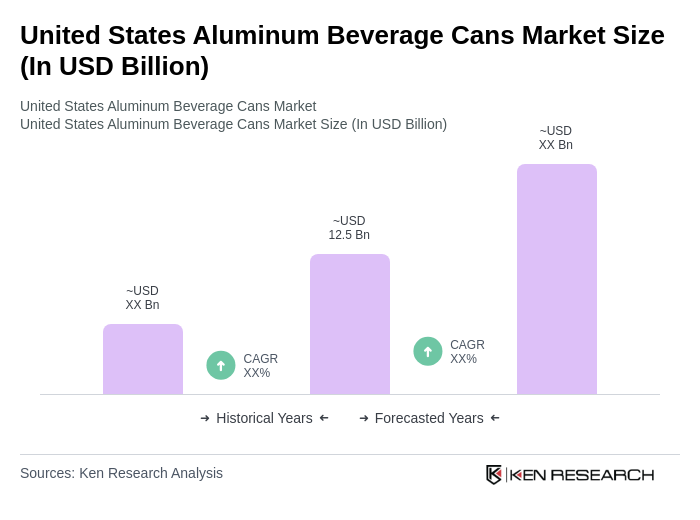
- The United States Aluminum Beverage Cans Market is valued at USD 12.5 billion, based on a five-year historical analysis. This growth is primarily driven by the increasing demand for sustainable packaging solutions, as consumers and manufacturers alike prioritize eco-friendly options. The shift towards aluminum cans is also fueled by their recyclability and lightweight nature, making them a preferred choice for beverage packaging.
- Key demand centers are not “players”; market activity is driven by nationwide beverage producers and can-makers. However, population-dense regions and beverage hubs such as the Midwest, West Coast, and Northeast exhibit high can throughput due to large beverage consumption, extensive distributor networks, and proximity to major can plants and filling operations. Industry coverage points to leading states/regions adopting aluminum cans in response to recycling policies and beverage demand.
- Federal action in 2023 did not impose a nationwide ban on single-use plastics; rather, sustainability momentum is being advanced through a mix of federal agency procurement directives and state-level policies. At the federal level, agencies have moved to reduce single-use plastic in procurement, while several states tightened recycling and packaging policies—developments that indirectly support aluminum can usage due to high recyclability.
United States Aluminum Beverage Cans Market Segmentation
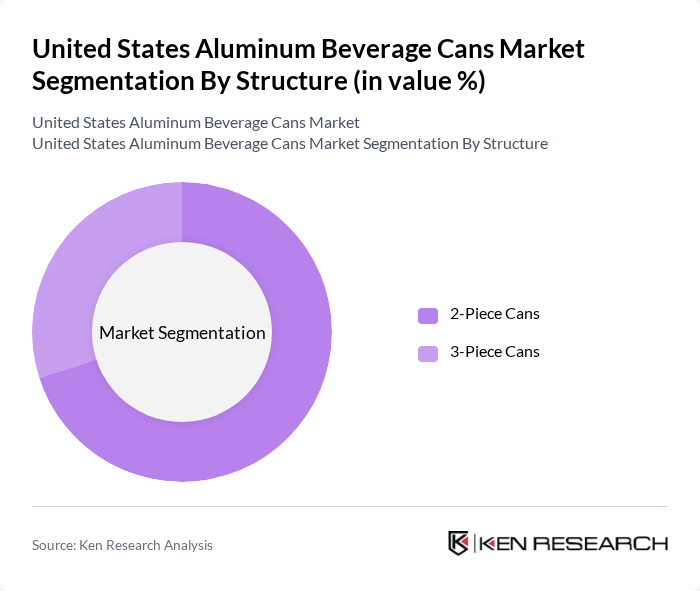
By Structure:The market is segmented into two primary structures: 2-Piece Cans and 3-Piece Cans. The 2-piece cans dominate the market due to their lightweight design and lower production costs, making them more appealing to manufacturers. The 3-piece cans, while less common, are still utilized for specific applications where durability is a priority.
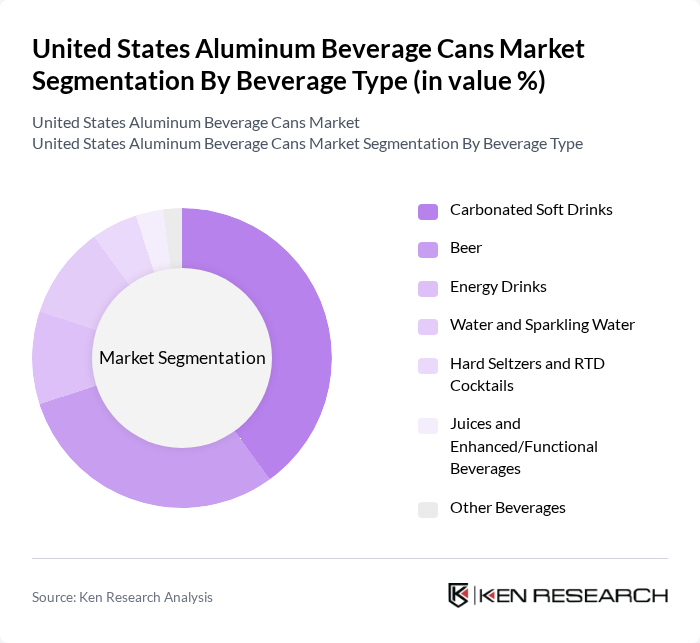
By Beverage Type:The beverage type segmentation includes Carbonated Soft Drinks, Beer, Energy Drinks, Water and Sparkling Water, Hard Seltzers and Ready-to-Drink (RTD) Cocktails, Juices and Enhanced/Functional Beverages, and Other Beverages. Carbonated Soft Drinks lead the market, driven by consumer preferences for fizzy drinks, while the growing popularity of Hard Seltzers has also significantly impacted market dynamics.
United States Aluminum Beverage Cans Market Competitive Landscape
The United States Aluminum Beverage Cans Market is characterized by a dynamic mix of regional and international players. Leading participants such as Ball Corporation, Crown Holdings, Inc., Ardagh Group S.A., CANPACK S.A., Silgan Holdings Inc., Envases Group, Trivium Packaging, Orora Limited, Novelis Inc. (can sheet supplier), Constellium SE (can sheet supplier), Golden Aluminum (can sheet supplier), Crown Beverage Packaging Mexico (U.S.-serving entity), Mauser Packaging Solutions (recycling/logistics partner), Arconic Corporation (aluminum supplier), Tri-Arrows Aluminum Inc. (U.S. can sheet supplier) contribute to innovation, geographic expansion, and service delivery in this space.
United States Aluminum Beverage Cans Market Industry Analysis
Growth Drivers
- Increasing Demand for Sustainable Packaging:The U.S. aluminum beverage can market is experiencing a surge in demand for sustainable packaging solutions, driven by consumer preferences for eco-friendly products. In future, the recycling rate for aluminum cans is expected to be approximately 71%, significantly higher than the 50% average for other packaging materials. This trend is supported by the U.S. Environmental Protection Agency (EPA), which reported that aluminum cans are among the most recycled consumer products, enhancing their appeal in a sustainability-focused market.
- Growth in the Beverage Industry:The beverage industry in the U.S. is projected to reach $1.7 trillion in future, with a notable increase in demand for canned beverages. According to the Beverage Marketing Corporation, the consumption of canned beverages is anticipated to rise by 5% in future, driven by the popularity of ready-to-drink cocktails and health-oriented beverages. This growth directly correlates with the rising production of aluminum cans, as manufacturers adapt to meet the increasing demand for convenient and portable beverage options.
- Innovations in Can Design and Functionality:Innovations in aluminum can design are enhancing functionality and consumer appeal. In future, over 30% of beverage cans introduced are expected to feature new designs, such as resealable tops and integrated straws, catering to on-the-go consumers. The Can Manufacturers Institute reported that these innovations not only improve user experience but also contribute to increased sales, as brands leverage unique packaging to differentiate themselves in a competitive market.
Market Challenges
- Fluctuating Raw Material Prices:The aluminum market is subject to significant price volatility, impacting production costs for beverage can manufacturers. In future, the price of aluminum is projected to fluctuate around $2,500 per metric ton, reflecting a notable increase from the previous year. This fluctuation poses challenges for manufacturers, as they must balance cost management with maintaining competitive pricing for their products, potentially affecting profit margins and market stability.
- Competition from Alternative Packaging Solutions:The aluminum beverage can market faces increasing competition from alternative packaging solutions, such as glass and plastic. In future, the market share of glass bottles in the beverage sector is expected to be approximately 25%, while plastic containers are anticipated to account for 30%. This competition is intensified by consumer trends favoring lightweight and convenient packaging, compelling aluminum can manufacturers to innovate continuously to retain market share and consumer loyalty.
United States Aluminum Beverage Cans Market Future Outlook
The future of the U.S. aluminum beverage can market appears promising, driven by ongoing trends in sustainability and innovation. As consumer awareness of environmental issues grows, manufacturers are likely to invest in more eco-friendly production processes and materials. Additionally, the rise of e-commerce and direct-to-consumer sales channels will further enhance market accessibility, allowing brands to reach a broader audience. These factors will collectively shape a dynamic landscape for aluminum beverage cans, fostering growth and adaptation in the industry.
Market Opportunities
- Expansion into Emerging Beverage Segments:The rise of health-conscious consumers presents opportunities for aluminum can manufacturers to expand into emerging beverage segments, such as functional drinks and plant-based beverages. The market for functional beverages is expected to grow by $100 billion in future, providing a lucrative avenue for aluminum can adoption in new product lines.
- Adoption of Recyclable and Eco-Friendly Materials:There is a growing opportunity for manufacturers to adopt recyclable and eco-friendly materials in can production. With 75% of consumers indicating a preference for sustainable packaging, companies that invest in innovative materials and processes can enhance brand loyalty and capture a larger market share, aligning with consumer values and regulatory trends.
Scope of the Report
| Segment | Sub-Segments |
|---|---|
| By Structure | Piece Cans Piece Cans |
| By Beverage Type | Carbonated Soft Drinks Beer Energy Drinks Water and Sparkling Water Hard Seltzers and Ready-to-Drink (RTD) Cocktails Juices and Enhanced/Functional Beverages Other Beverages |
| By Capacity/Size | oz – 8.4 oz oz oz oz oz and Above |
| By Can Format | Standard Sleek/Slim Tall |
| By Coating/Lining Type | BPA-NI (Non-Intent) Epoxy and Next-Gen Linings Acrylic/Polyester Others |
| By Recycling Content | High-Recycled-Content Cans (e.g., ?70% recycled content) Conventional Recycled Content Non-Recycled Content |
| By Region (U.S.) | New England Mideast Great Lakes Plains Southeast Southwest Rocky Mountain Far West |
Key Target Audience
Investors and Venture Capitalist Firms
Government and Regulatory Bodies (e.g., Environmental Protection Agency, Food and Drug Administration)
Aluminum Beverage Can Manufacturers
Raw Material Suppliers
Recycling and Waste Management Companies
Packaging Technology Providers
Trade Associations (e.g., Can Manufacturers Institute)
Logistics and Supply Chain Companies
Players Mentioned in the Report:
Ball Corporation
Crown Holdings, Inc.
Ardagh Group S.A.
CANPACK S.A.
Silgan Holdings Inc.
Envases Group
Trivium Packaging
Orora Limited
Novelis Inc. (can sheet supplier)
Constellium SE (can sheet supplier)
Golden Aluminum (can sheet supplier)
Crown Beverage Packaging Mexico (U.S.-serving entity)
Mauser Packaging Solutions (recycling/logistics partner)
Arconic Corporation (aluminum supplier)
Tri-Arrows Aluminum Inc. (U.S. can sheet supplier)
Table of Contents
Market Assessment Phase
1. Executive Summary and Approach
2. United States Aluminum Beverage Cans Market Overview
2.1 Key Insights and Strategic Recommendations
2.2 United States Aluminum Beverage Cans Market Overview
2.3 Definition and Scope
2.4 Evolution of Market Ecosystem
2.5 Timeline of Key Regulatory Milestones
2.6 Value Chain & Stakeholder Mapping
2.7 Business Cycle Analysis
2.8 Policy & Incentive Landscape
3. United States Aluminum Beverage Cans Market Analysis
3.1 Growth Drivers
3.1.1 Increasing Demand for Sustainable Packaging
3.1.2 Growth in the Beverage Industry
3.1.3 Innovations in Can Design and Functionality
3.1.4 Rising Consumer Preference for Lightweight Packaging
3.2 Market Challenges
3.2.1 Fluctuating Raw Material Prices
3.2.2 Environmental Regulations and Compliance Costs
3.2.3 Competition from Alternative Packaging Solutions
3.2.4 Supply Chain Disruptions
3.3 Market Opportunities
3.3.1 Expansion into Emerging Beverage Segments
3.3.2 Adoption of Recyclable and Eco-Friendly Materials
3.3.3 Technological Advancements in Manufacturing
3.3.4 Strategic Partnerships with Beverage Brands
3.4 Market Trends
3.4.1 Shift Towards Lightweight and Compact Packaging
3.4.2 Increasing Focus on Circular Economy Practices
3.4.3 Growth of E-commerce and Direct-to-Consumer Sales
3.4.4 Customization and Personalization in Packaging
3.5 Government Regulation
3.5.1 Recycling Mandates and Incentives
3.5.2 Environmental Protection Agency (EPA) Guidelines
3.5.3 Food and Drug Administration (FDA) Regulations
3.5.4 State-Level Packaging Laws
4. SWOT Analysis
5. Stakeholder Analysis
6. Porter's Five Forces Analysis
7. United States Aluminum Beverage Cans Market Market Size, 2019-2024
7.1 By Value
7.2 By Volume
7.3 By Average Selling Price
8. United States Aluminum Beverage Cans Market Segmentation
8.1 By Structure
8.1.1 2-Piece Cans
8.1.2 3-Piece Cans
8.2 By Beverage Type
8.2.1 Carbonated Soft Drinks
8.2.2 Beer
8.2.3 Energy Drinks
8.2.4 Water and Sparkling Water
8.2.5 Hard Seltzers and Ready-to-Drink (RTD) Cocktails
8.2.6 Juices and Enhanced/Functional Beverages
8.2.7 Other Beverages
8.3 By Capacity/Size
8.3.1 7.5 oz – 8.4 oz
8.3.2 12 oz
8.3.3 16 oz
8.3.4 19.2 oz
8.3.5 24 oz and Above
8.4 By Can Format
8.4.1 Standard
8.4.2 Sleek/Slim
8.4.3 Tall
8.5 By Coating/Lining Type
8.5.1 BPA-NI (Non-Intent) Epoxy and Next-Gen Linings
8.5.2 Acrylic/Polyester
8.5.3 Others
8.6 By Recycling Content
8.6.1 High-Recycled-Content Cans (e.g., ?70% recycled content)
8.6.2 Conventional Recycled Content
8.6.3 Non-Recycled Content
8.7 By Region (U.S.)
8.7.1 New England
8.7.2 Mideast
8.7.3 Great Lakes
8.7.4 Plains
8.7.5 Southeast
8.7.6 Southwest
8.7.7 Rocky Mountain
8.7.8 Far West
9. United States Aluminum Beverage Cans Market Competitive Analysis
9.1 Market Share of Key Players
9.2 KPIs for Cross Comparison of Key Players
9.2.1 U.S. Beverage Can Production Capacity (billion cans/year)
9.2.2 U.S. Beverage Can Shipments/Volume (billion cans)
9.2.3 Revenue from U.S. Beverage Cans ($ and % of total)
9.2.4 U.S. Market Share by Beverage Type (beer, CSD, energy, water)
9.2.5 Plant Footprint and Utilization (number of U.S. can plants; % utilization)
9.2.6 Average Realized Price per Thousand Cans (by format/size)
9.2.7 Production Yield and Line Speed (cans/min and spoilage rate)
9.2.8 Recycled Content and Recycling Performance (% PCR; scrap recovery rate)
9.2.9 On-time Delivery and Lead Time (days)
9.2.10 New Line/Format Introductions per Year (sleek, tall, RTD-focused)
9.2.11 Contract Portfolio Mix (share with top beverage customers; contract duration)
9.2.12 Energy Intensity and Scope 1/2 Emissions per Thousand Cans
9.2.13 Capex Intensity (capex as % of U.S. segment sales)
9.2.14 EBITDA Margin for U.S. Beverage Can Segment
9.2.15 Safety KPIs (TRIR rate) and Quality KPIs (customer complaints ppm)
9.3 SWOT Analysis of Top Players
9.4 Pricing Analysis
9.5 List of Major Companies
9.5.1 Ball Corporation
9.5.2 Crown Holdings, Inc.
9.5.3 Ardagh Group S.A.
9.5.4 CANPACK S.A.
9.5.5 Silgan Holdings Inc.
9.5.6 Envases Group
9.5.7 Trivium Packaging
9.5.8 Orora Limited
9.5.9 Novelis Inc. (can sheet supplier)
9.5.10 Constellium SE (can sheet supplier)
9.5.11 Golden Aluminum (can sheet supplier)
9.5.12 Crown Beverage Packaging Mexico (U.S.-serving entity)
9.5.13 Mauser Packaging Solutions (recycling/logistics partner)
9.5.14 Arconic Corporation (aluminum supplier)
9.5.15 Tri-Arrows Aluminum Inc. (U.S. can sheet supplier)
10. United States Aluminum Beverage Cans Market End-User Analysis
10.1 Procurement Behavior of Key Ministries
10.1.1 Government Procurement Policies
10.1.2 Budget Allocations for Beverage Packaging
10.1.3 Sustainability Initiatives
10.2 Corporate Spend on Infrastructure & Energy
10.2.1 Investment in Sustainable Packaging Solutions
10.2.2 Budget for Recycling Programs
10.2.3 Expenditure on Innovation and R&D
10.3 Pain Point Analysis by End-User Category
10.3.1 Cost Management Challenges
10.3.2 Supply Chain Reliability Issues
10.3.3 Compliance with Environmental Regulations
10.4 User Readiness for Adoption
10.4.1 Awareness of Sustainable Practices
10.4.2 Willingness to Invest in Eco-Friendly Solutions
10.5 Post-Deployment ROI and Use Case Expansion
10.5.1 Measurement of Cost Savings
10.5.2 Expansion into New Beverage Categories
10.5.3 Long-term Sustainability Goals
11. United States Aluminum Beverage Cans Market Future Size, 2025-2030
11.1 By Value
11.2 By Volume
11.3 By Average Selling Price
Go-To-Market Strategy Phase
1. Whitespace Analysis + Business Model Canvas
1.1 Market Gaps Identification
1.2 Value Proposition Development
1.3 Revenue Streams Analysis
1.4 Cost Structure Evaluation
1.5 Key Partnerships Exploration
1.6 Customer Segmentation
1.7 Channels of Distribution
2. Marketing and Positioning Recommendations
2.1 Branding Strategies
2.2 Product USPs
2.3 Target Market Identification
2.4 Communication Strategies
2.5 Digital Marketing Approaches
3. Distribution Plan
3.1 Urban Retail Strategies
3.2 Rural NGO Tie-ups
3.3 E-commerce Distribution
3.4 Direct Sales Channels
4. Channel & Pricing Gaps
4.1 Underserved Routes
4.2 Pricing Bands Analysis
4.3 Competitor Pricing Strategies
5. Unmet Demand & Latent Needs
5.1 Category Gaps Identification
5.2 Consumer Segments Analysis
5.3 Emerging Trends Exploration
6. Customer Relationship
6.1 Loyalty Programs
6.2 After-sales Service
6.3 Customer Feedback Mechanisms
7. Value Proposition
7.1 Sustainability Initiatives
7.2 Integrated Supply Chains
7.3 Competitive Advantages
8. Key Activities
8.1 Regulatory Compliance
8.2 Branding Initiatives
8.3 Distribution Setup
9. Entry Strategy Evaluation
9.1 Domestic Market Entry Strategy
9.1.1 Product Mix Considerations
9.1.2 Pricing Band Strategy
9.1.3 Packaging Innovations
9.2 Export Entry Strategy
9.2.1 Target Countries Identification
9.2.2 Compliance Roadmap Development
10. Entry Mode Assessment
10.1 Joint Ventures
10.2 Greenfield Investments
10.3 Mergers & Acquisitions
10.4 Distributor Model Evaluation
11. Capital and Timeline Estimation
11.1 Capital Requirements
11.2 Timelines for Implementation
12. Control vs Risk Trade-Off
12.1 Ownership vs Partnerships
13. Profitability Outlook
13.1 Breakeven Analysis
13.2 Long-term Sustainability
14. Potential Partner List
14.1 Distributors
14.2 Joint Ventures
14.3 Acquisition Targets
15. Execution Roadmap
15.1 Phased Plan for Market Entry
15.1.1 Market Setup
15.1.2 Market Entry
15.1.3 Growth Acceleration
15.1.4 Scale & Stabilize
15.2 Key Activities and Milestones
15.2.1 Milestone Planning
15.2.2 Activity Tracking
Research Methodology
Phase 1: Approach1
Desk Research
- Industry reports from the Aluminum Association and other relevant trade organizations
- Market analysis from government publications and statistical databases
- Academic journals and white papers focusing on aluminum recycling and sustainability trends
Primary Research
- Interviews with key stakeholders in beverage manufacturing and packaging
- Surveys targeting distributors and retailers of aluminum beverage cans
- Field visits to recycling facilities and aluminum production plants
Validation & Triangulation
- Cross-validation of data through multiple industry sources and expert opinions
- Triangulation of market size estimates using historical data and current trends
- Sanity checks through feedback from industry experts and market analysts
Phase 2: Market Size Estimation1
Top-down Assessment
- Analysis of total beverage consumption trends in the U.S. to estimate can demand
- Segmentation of market size by beverage type (e.g., soft drinks, beer, energy drinks)
- Incorporation of growth rates from the aluminum can recycling market
Bottom-up Modeling
- Volume estimates based on production capacities of major aluminum can manufacturers
- Cost analysis of aluminum production and recycling processes
- Estimation of market share based on sales data from leading beverage companies
Forecasting & Scenario Analysis
- Multi-variable forecasting using historical growth rates and market dynamics
- Scenario analysis based on potential regulatory changes and consumer preferences
- Development of baseline, optimistic, and pessimistic market projections through 2030
Phase 3: CATI Sample Composition1
| Scope Item/Segment | Sample Size | Target Respondent Profiles |
|---|---|---|
| Beverage Manufacturers | 120 | Production Managers, Supply Chain Directors |
| Retail Distributors | 100 | Logistics Coordinators, Sales Managers |
| Recycling Facilities | 80 | Operations Managers, Environmental Compliance Officers |
| Consumer Insights | 140 | End Consumers, Sustainability Advocates |
| Industry Experts | 50 | Market Analysts, Academic Researchers |
Frequently Asked Questions
What is the current value of the United States Aluminum Beverage Cans Market?
The United States Aluminum Beverage Cans Market is valued at approximately USD 12.5 billion, reflecting a significant growth trend driven by increasing consumer demand for sustainable packaging solutions and the recyclability of aluminum cans.
What factors are driving the growth of the aluminum beverage can market in the U.S.?
Which regions in the U.S. show the highest demand for aluminum beverage cans?
What types of beverages are primarily packaged in aluminum cans?
Other Regional/Country Reports
Indonesia Aluminum Beverage Cans Market
Malaysia Aluminum Beverage Cans Market
KSA Aluminum Beverage Cans Market
APAC Aluminum Beverage Cans Market
SEA Aluminum Beverage Cans Market
Vietnam Aluminum Beverage Cans Market
Why Buy From Us?

What makes us stand out is that our consultants follow Robust, Refine and Result (RRR) methodology. Robust for clear definitions, approaches and sanity checking, Refine for differentiating respondents' facts and opinions, and Result for presenting data with story.

We have set a benchmark in the industry by offering our clients with syndicated and customized market research reports featuring coverage of entire market as well as meticulous research and analyst insights.

While we don't replace traditional research, we flip the method upside down. Our dual approach of Top Bottom & Bottom Top ensures quality deliverable by not just verifying company fundamentals but also looking at the sector and macroeconomic factors.

With one step in the future, our research team constantly tries to show you the bigger picture. We help with some of the tough questions you may encounter along the way: How is the industry positioned? Best marketing channel? KPI's of competitors? By aligning every element, we help maximize success.

Our report gives you instant access to the answers and sources that other companies might choose to hide. We elaborate each steps of research methodology we have used and showcase you the sample size to earn your trust.

If you need any support, we are here! We pride ourselves on universe strength, data quality, and quick, friendly, and professional service.