About the Report
Base Year 2024Listen to the audio summary
United States Gaming Console And Accessories Market Overview
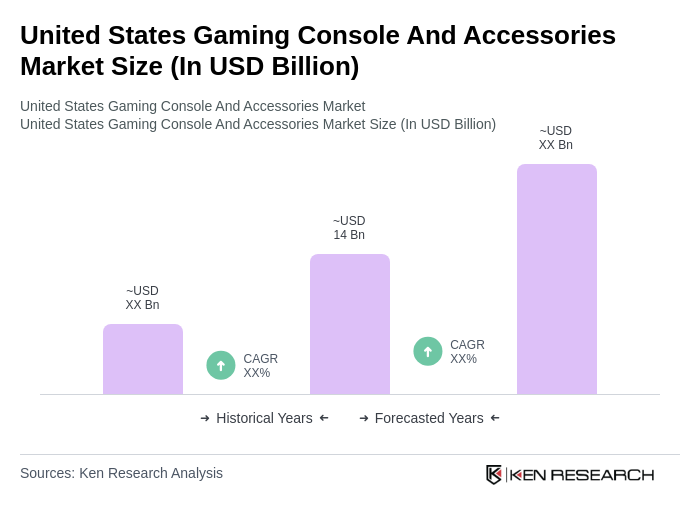
- The United States Gaming Console and Accessories Market is valued at USD 14 billion, based on a five-year historical analysis. This growth is primarily driven by the increasing popularity of gaming among diverse demographics, technological advancements in gaming hardware, and the rise of online and subscription-based gaming services that enhance user engagement and monetization.
- Key players in this market include major cities such as Los Angeles, New York, and San Francisco, which contribute through large consumer bases, active developer and publisher ecosystems, and frequent industry events; these metros host major publishers, platform operators, and esports venues that act as hubs for innovation and consumer engagement.
- In 2023, the U.S. government advanced enforcement and rulemaking on digital markets and privacy relevant to gaming platforms, including actions by the Federal Trade Commission on dark patterns and children’s privacy (COPPA) and broader data practices guidance aimed at transparency and consent in online services, which cover many gaming-related transactions and data handling.
United States Gaming Console And Accessories Market Segmentation
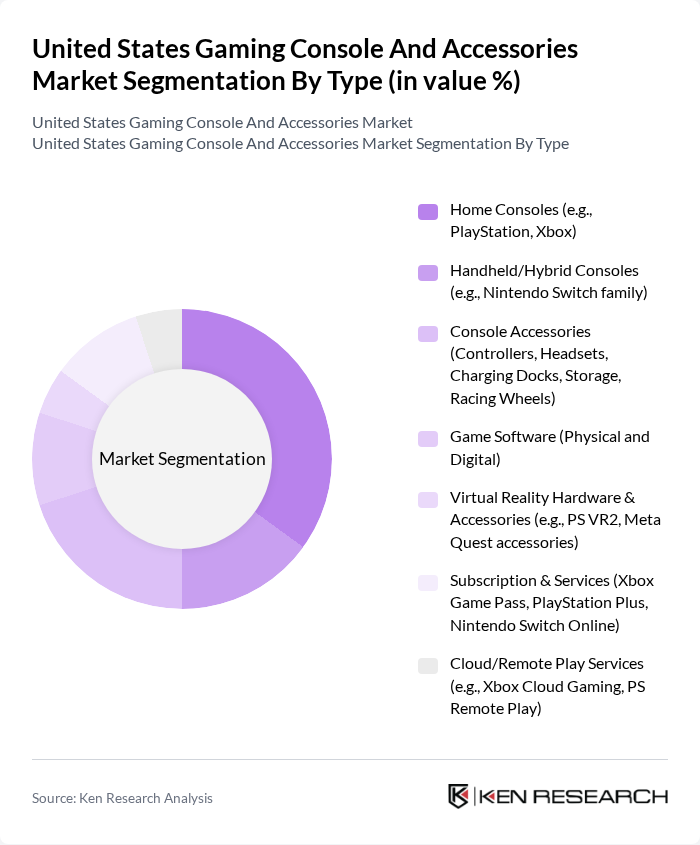
By Type:The market is segmented into various types, including home consoles, handheld/hybrid consoles, console accessories, game software, virtual reality hardware and accessories, subscription and services, and cloud/remote play services. Each sub-segment caters to different consumer preferences and technological advancements, contributing to the overall market growth.
By End-User:The end-user segmentation includes individual consumers, household/family gaming, eSports and competitive gamers, and educational/community programs and libraries. Each segment reflects different gaming habits and preferences, influencing the types of products and services offered in the market.

United States Gaming Console And Accessories Market Competitive Landscape
The United States Gaming Console And Accessories Market is characterized by a dynamic mix of regional and international players. Leading participants such as Sony Interactive Entertainment LLC, Microsoft Corporation (Xbox), Nintendo of America Inc., Electronic Arts Inc., Activision Blizzard, Inc. (a Microsoft company), Take-Two Interactive Software, Inc., Ubisoft Entertainment S.A., Valve Corporation, Epic Games, Inc., Razer Inc., Logitech International S.A. (Logitech G), Corsair Gaming, Inc. (including Elgato), Turtle Beach Corporation, HyperX (HP Inc.), SteelSeries ApS (a GN Store Nord brand) contribute to innovation, geographic expansion, and service delivery in this space.
United States Gaming Console And Accessories Market Industry Analysis
Growth Drivers
- Increasing Popularity of eSports:The eSports industry has seen exponential growth, with revenues projected to reach $1.8 billion in future, driven by sponsorships, advertising, and media rights. The number of eSports viewers in the U.S. is expected to surpass 30 million, reflecting a growing audience that fuels demand for gaming consoles and accessories. This surge in interest is encouraging manufacturers to innovate and enhance their offerings, further propelling market growth.
- Advancements in Gaming Technology:The gaming industry is experiencing rapid technological advancements, with the global gaming hardware market expected to reach $45 billion in future. Innovations such as 4K resolution, high refresh rates, and improved graphics processing units (GPUs) are enhancing user experiences. These advancements are driving consumers to upgrade their consoles and accessories, thereby increasing sales and market penetration in the United States.
- Expansion of Online Gaming Platforms:The online gaming sector is projected to grow significantly, with revenues expected to hit $21 billion in future. This growth is attributed to the increasing number of online multiplayer games and subscription services. As more players engage in online gaming, the demand for compatible consoles and accessories rises, creating a robust market environment that supports sustained growth in the gaming console sector.
Market Challenges
- Intense Competition Among Major Players:The gaming console market is characterized by fierce competition, with major players like Sony, Microsoft, and Nintendo vying for market share. In future, these companies are expected to invest over $10 billion in marketing and product development. This intense rivalry can lead to price wars and reduced profit margins, posing a significant challenge for companies trying to maintain profitability while innovating.
- Supply Chain Disruptions:The gaming industry continues to face supply chain challenges, exacerbated by global events and semiconductor shortages. In future, the average lead time for gaming hardware components is projected to remain at 20 weeks, impacting production schedules. These disruptions can lead to inventory shortages, delayed product launches, and ultimately, lost sales opportunities for manufacturers in the gaming console market.
United States Gaming Console And Accessories Market Future Outlook
The future of the United States gaming console and accessories market appears promising, driven by technological advancements and evolving consumer preferences. As the industry embraces cloud gaming and subscription models, companies are likely to adapt their strategies to meet changing demands. Additionally, the integration of virtual reality (VR) and augmented reality (AR) technologies is expected to enhance gaming experiences, attracting a broader audience and fostering innovation in product development.
Market Opportunities
- Growth in Mobile Gaming:The mobile gaming market is projected to reach $100 billion in future, presenting a significant opportunity for console manufacturers to develop cross-platform solutions. By creating accessories that enhance mobile gaming experiences, companies can tap into this lucrative segment and attract a new generation of gamers who prefer mobile platforms.
- Increasing Demand for VR and AR Gaming:The VR and AR gaming market is expected to grow to $12 billion in future, driven by advancements in technology and consumer interest. This presents an opportunity for console manufacturers to innovate and create compatible accessories, enhancing user experiences and expanding their product offerings in a rapidly growing segment of the gaming industry.
Scope of the Report
| Segment | Sub-Segments |
|---|---|
| By Type | Home Consoles (e.g., PlayStation, Xbox) Handheld/Hybrid Consoles (e.g., Nintendo Switch family) Console Accessories (Controllers, Headsets, Charging Docks, Storage, Racing Wheels) Game Software (Physical and Digital) Virtual Reality Hardware & Accessories (e.g., PS VR2, Meta Quest accessories) Subscription & Services (Xbox Game Pass, PlayStation Plus, Nintendo Switch Online) Cloud/Remote Play Services (e.g., Xbox Cloud Gaming, PS Remote Play) |
| By End-User | Individual Consumers Household/Family Gaming eSports and Competitive Gamers Educational/Community Programs and Libraries |
| By Sales Channel | Online Retailers/Marketplaces (e.g., Amazon, Walmart.com, BestBuy.com) Specialty and Big-Box Retail (e.g., GameStop, Best Buy, Walmart, Target) First-Party Direct (PlayStation Direct, Microsoft Store, My Nintendo Store) Wholesale/Distributors |
| By Distribution Mode | Physical (In-store, packaged) Digital (Download codes, online storefronts) E-commerce Platforms/Marketplaces |
| By Price Range | Entry/Budget (e.g., Series S, Switch Lite, prior-gen models) Mid-Range Premium/Performance (e.g., PS5, Xbox Series X, OLED models) |
| By Brand Ecosystem | PlayStation Xbox Nintendo Multi-platform Accessories |
| By Game Genre | Action/Adventure Sports/Racing Role-Playing Games (RPG) Simulation/Strategy Family/Party and Others |
Key Target Audience
Investors and Venture Capitalist Firms
Government and Regulatory Bodies (e.g., Federal Trade Commission, Federal Communications Commission)
Manufacturers and Producers
Distributors and Retailers
Content Developers and Publishers
Technology Providers
Industry Associations (e.g., Entertainment Software Association)
Financial Institutions
Players Mentioned in the Report:
Sony Interactive Entertainment LLC
Microsoft Corporation (Xbox)
Nintendo of America Inc.
Electronic Arts Inc.
Activision Blizzard, Inc. (a Microsoft company)
Take-Two Interactive Software, Inc.
Ubisoft Entertainment S.A.
Valve Corporation
Epic Games, Inc.
Razer Inc.
Logitech International S.A. (Logitech G)
Corsair Gaming, Inc. (including Elgato)
Turtle Beach Corporation
HyperX (HP Inc.)
SteelSeries ApS (a GN Store Nord brand)
Table of Contents
Market Assessment Phase
1. Executive Summary and Approach
2. United States Gaming Console And Accessories Market Overview
2.1 Key Insights and Strategic Recommendations
2.2 United States Gaming Console And Accessories Market Overview
2.3 Definition and Scope
2.4 Evolution of Market Ecosystem
2.5 Timeline of Key Regulatory Milestones
2.6 Value Chain & Stakeholder Mapping
2.7 Business Cycle Analysis
2.8 Policy & Incentive Landscape
3. United States Gaming Console And Accessories Market Analysis
3.1 Growth Drivers
3.1.1 Increasing popularity of eSports
3.1.2 Advancements in gaming technology
3.1.3 Rise in disposable income
3.1.4 Expansion of online gaming platforms
3.2 Market Challenges
3.2.1 Intense competition among major players
3.2.2 Supply chain disruptions
3.2.3 Rapid technological changes
3.2.4 Regulatory hurdles
3.3 Market Opportunities
3.3.1 Growth in mobile gaming
3.3.2 Increasing demand for VR and AR gaming
3.3.3 Expansion into emerging markets
3.3.4 Collaborations with content creators
3.4 Market Trends
3.4.1 Shift towards subscription-based models
3.4.2 Integration of cloud gaming services
3.4.3 Focus on sustainability in production
3.4.4 Rise of cross-platform gaming
3.5 Government Regulation
3.5.1 Data privacy regulations
3.5.2 Consumer protection laws
3.5.3 Tax incentives for gaming companies
3.5.4 Content rating systems
4. SWOT Analysis
5. Stakeholder Analysis
6. Porter's Five Forces Analysis
7. United States Gaming Console And Accessories Market Market Size, 2019-2024
7.1 By Value
7.2 By Volume
7.3 By Average Selling Price
8. United States Gaming Console And Accessories Market Segmentation
8.1 By Type
8.1.1 Home Consoles (e.g., PlayStation, Xbox)
8.1.2 Handheld/Hybrid Consoles (e.g., Nintendo Switch family)
8.1.3 Console Accessories (Controllers, Headsets, Charging Docks, Storage, Racing Wheels)
8.1.4 Game Software (Physical and Digital)
8.1.5 Virtual Reality Hardware & Accessories (e.g., PS VR2, Meta Quest accessories)
8.1.6 Subscription & Services (Xbox Game Pass, PlayStation Plus, Nintendo Switch Online)
8.1.7 Cloud/Remote Play Services (e.g., Xbox Cloud Gaming, PS Remote Play)
8.2 By End-User
8.2.1 Individual Consumers
8.2.2 Household/Family Gaming
8.2.3 eSports and Competitive Gamers
8.2.4 Educational/Community Programs and Libraries
8.3 By Sales Channel
8.3.1 Online Retailers/Marketplaces (e.g., Amazon, Walmart.com, BestBuy.com)
8.3.2 Specialty and Big-Box Retail (e.g., GameStop, Best Buy, Walmart, Target)
8.3.3 First-Party Direct (PlayStation Direct, Microsoft Store, My Nintendo Store)
8.3.4 Wholesale/Distributors
8.4 By Distribution Mode
8.4.1 Physical (In-store, packaged)
8.4.2 Digital (Download codes, online storefronts)
8.4.3 E-commerce Platforms/Marketplaces
8.5 By Price Range
8.5.1 Entry/Budget (e.g., Series S, Switch Lite, prior-gen models)
8.5.2 Mid-Range
8.5.3 Premium/Performance (e.g., PS5, Xbox Series X, OLED models)
8.6 By Brand Ecosystem
8.6.1 PlayStation
8.6.2 Xbox
8.6.3 Nintendo
8.6.4 Multi-platform Accessories
8.7 By Game Genre
8.7.1 Action/Adventure
8.7.2 Sports/Racing
8.7.3 Role-Playing Games (RPG)
8.7.4 Simulation/Strategy
8.7.5 Family/Party and Others
9. United States Gaming Console And Accessories Market Competitive Analysis
9.1 Market Share of Key Players
9.2 Cross Comparison of Key Players
9.2.1 Company Name
9.2.2 Installed Base in the U.S. (cumulative units)
9.2.3 U.S. Console Hardware Revenue Mix (%)
9.2.4 U.S. Software and Services Revenue (DLC, digital, subscriptions)
9.2.5 Subscription Metrics (paid subscribers, ARPU)
9.2.6 Exclusive Titles Pipeline (count/major IPs)
9.2.7 Average Selling Price (Hardware)
9.2.8 Accessory Attach Rate (controllers/headsets per console)
9.2.9 Distribution Reach (online + retail partners coverage)
9.2.10 Customer Satisfaction/NPS (U.S.)
9.3 SWOT Analysis of Top Players
9.4 Pricing Analysis
9.5 Detailed Profile of Major Companies
9.5.1 Sony Interactive Entertainment LLC
9.5.2 Microsoft Corporation (Xbox)
9.5.3 Nintendo of America Inc.
9.5.4 Electronic Arts Inc.
9.5.5 Activision Blizzard, Inc. (a Microsoft company)
9.5.6 Take-Two Interactive Software, Inc.
9.5.7 Ubisoft Entertainment S.A.
9.5.8 Valve Corporation
9.5.9 Epic Games, Inc.
9.5.10 Razer Inc.
9.5.11 Logitech International S.A. (Logitech G)
9.5.12 Corsair Gaming, Inc. (including Elgato)
9.5.13 Turtle Beach Corporation
9.5.14 HyperX (HP Inc.)
9.5.15 SteelSeries ApS (a GN Store Nord brand)
10. United States Gaming Console And Accessories Market End-User Analysis
10.1 Procurement Behavior of Key Ministries
10.1.1 Government Procurement Policies
10.1.2 Budget Allocations for Gaming
10.1.3 Approval Processes for Gaming Products
10.2 Corporate Spend on Infrastructure & Energy
10.2.1 Investment in Gaming Infrastructure
10.2.2 Expenditure on Gaming Technology
10.2.3 Funding for Game Development
10.3 Pain Point Analysis by End-User Category
10.3.1 Accessibility Issues
10.3.2 Cost of Entry
10.3.3 Quality of Customer Support
10.4 User Readiness for Adoption
10.4.1 Awareness of New Technologies
10.4.2 Willingness to Invest in Gaming
10.4.3 Training and Support Needs
10.5 Post-Deployment ROI and Use Case Expansion
10.5.1 Measurement of ROI
10.5.2 Expansion into New Use Cases
10.5.3 Long-term Engagement Strategies
11. United States Gaming Console And Accessories Market Future Size, 2025-2030
11.1 By Value
11.2 By Volume
11.3 By Average Selling Price
Go-To-Market Strategy Phase
1. Whitespace Analysis + Business Model Canvas
1.1 Market Gaps Identification
1.2 Business Model Framework
2. Marketing and Positioning Recommendations
2.1 Branding Strategies
2.2 Product USPs
3. Distribution Plan
3.1 Urban Retail Strategies
3.2 Rural NGO Tie-ups
4. Channel & Pricing Gaps
4.1 Underserved Routes
4.2 Pricing Bands Analysis
5. Unmet Demand & Latent Needs
5.1 Category Gaps
5.2 Consumer Segments
6. Customer Relationship
6.1 Loyalty Programs
6.2 After-sales Service
7. Value Proposition
7.1 Sustainability Initiatives
7.2 Integrated Supply Chains
8. Key Activities
8.1 Regulatory Compliance
8.2 Branding Efforts
8.3 Distribution Setup
9. Entry Strategy Evaluation
9.1 Domestic Market Entry Strategy
9.1.1 Product Mix Considerations
9.1.2 Pricing Band Strategy
9.1.3 Packaging Innovations
9.2 Export Entry Strategy
9.2.1 Target Countries Analysis
9.2.2 Compliance Roadmap
10. Entry Mode Assessment
10.1 Joint Ventures
10.2 Greenfield Investments
10.3 Mergers & Acquisitions
10.4 Distributor Model
11. Capital and Timeline Estimation
11.1 Capital Requirements
11.2 Timelines for Market Entry
12. Control vs Risk Trade-Off
12.1 Ownership vs Partnerships
13. Profitability Outlook
13.1 Breakeven Analysis
13.2 Long-term Sustainability
14. Potential Partner List
14.1 Distributors
14.2 Joint Ventures
14.3 Acquisition Targets
15. Execution Roadmap
15.1 Phased Plan for Market Entry
15.1.1 Market Setup
15.1.2 Market Entry
15.1.3 Growth Acceleration
15.1.4 Scale & Stabilize
15.2 Key Activities and Milestones
15.2.1 Milestone Planning
15.2.2 Activity Tracking
Research Methodology
Phase 1: Approach1
Desk Research
- Industry reports from gaming associations and market research firms
- Sales data from major gaming console manufacturers and accessory suppliers
- Consumer behavior studies published in gaming journals and magazines
Primary Research
- Interviews with product managers at leading gaming console companies
- Surveys targeting gamers to understand purchasing habits and preferences
- Focus groups with gaming enthusiasts to gather qualitative insights
Validation & Triangulation
- Cross-validation of findings with sales data from retail partners
- Triangulation of consumer insights with industry expert opinions
- Sanity checks through feedback from gaming industry analysts
Phase 2: Market Size Estimation1
Top-down Assessment
- Analysis of total gaming market revenue to estimate console and accessory share
- Segmentation by console type (e.g., handheld, home consoles) and accessory category
- Incorporation of trends in digital gaming and subscription services
Bottom-up Modeling
- Volume estimates based on unit sales data from major retailers
- Pricing analysis of consoles and accessories across different market segments
- Calculation of market size based on average revenue per user (ARPU) metrics
Forecasting & Scenario Analysis
- Multi-variable regression analysis incorporating gaming trends and economic indicators
- Scenario modeling based on technological advancements and consumer adoption rates
- Baseline, optimistic, and pessimistic forecasts through 2030
Phase 3: CATI Sample Composition1
| Scope Item/Segment | Sample Size | Target Respondent Profiles |
|---|---|---|
| Console Gamers | 150 | Casual Gamers, Hardcore Gamers |
| Accessory Purchasers | 120 | Retail Buyers, Online Shoppers |
| Game Developers | 80 | Game Designers, Product Managers |
| Retail Store Managers | 70 | Store Managers, Sales Associates |
| Industry Analysts | 50 | Market Analysts, Research Directors |
Frequently Asked Questions
What is the current value of the United States Gaming Console and Accessories Market?
The United States Gaming Console and Accessories Market is valued at approximately USD 14 billion, reflecting significant growth driven by the increasing popularity of gaming, technological advancements, and the rise of online gaming services.
What factors are driving growth in the gaming console market?
Who are the major players in the U.S. gaming console market?
What are the main segments of the gaming console market?
Other Regional/Country Reports
Indonesia Gaming Console And Accessories Market
Malaysia Gaming Console And Accessories Market
KSA Gaming Console And Accessories Market
APAC Gaming Console And Accessories Market
SEA Gaming Console And Accessories Market
Vietnam Gaming Console And Accessories Market
Why Buy From Us?

What makes us stand out is that our consultants follow Robust, Refine and Result (RRR) methodology. Robust for clear definitions, approaches and sanity checking, Refine for differentiating respondents' facts and opinions, and Result for presenting data with story.

We have set a benchmark in the industry by offering our clients with syndicated and customized market research reports featuring coverage of entire market as well as meticulous research and analyst insights.

While we don't replace traditional research, we flip the method upside down. Our dual approach of Top Bottom & Bottom Top ensures quality deliverable by not just verifying company fundamentals but also looking at the sector and macroeconomic factors.

With one step in the future, our research team constantly tries to show you the bigger picture. We help with some of the tough questions you may encounter along the way: How is the industry positioned? Best marketing channel? KPI's of competitors? By aligning every element, we help maximize success.

Our report gives you instant access to the answers and sources that other companies might choose to hide. We elaborate each steps of research methodology we have used and showcase you the sample size to earn your trust.

If you need any support, we are here! We pride ourselves on universe strength, data quality, and quick, friendly, and professional service.