United States Household Side By Side Refrigerator Market

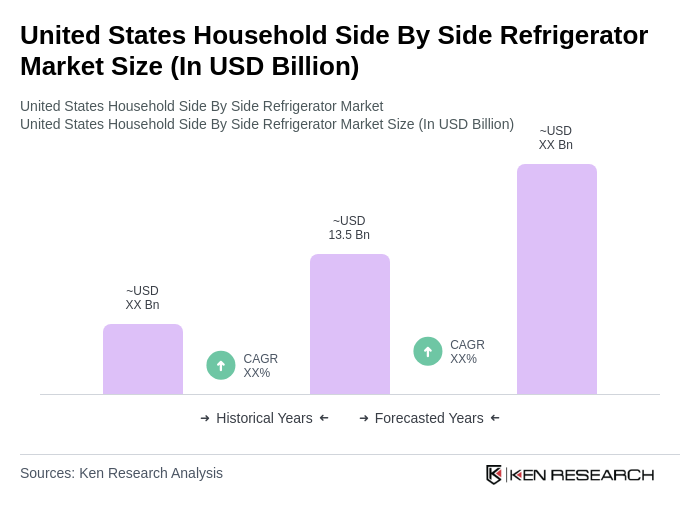
The US household side by side refrigerator market, valued at USD 13.5 billion, grows due to energy efficiency trends, smart integration, and home applications dominance.

Region:North America

Author(s):Rebecca

Product Code:KRAD0225

Pages:90

Published On:August 2025
About the Report

Base Year 2024

United States Household Side By Side Refrigerator Market Overview

  • The United States Household Side By Side Refrigerator Market is valued at USD 13.5 billion, based on a five-year historical analysis. This growth is primarily driven by rising consumer demand for energy-efficient appliances, rapid technological advancements such as smart connectivity and touch-screen controls, and the growing trend toward smart home integration. The market has seen a notable increase in the adoption of side-by-side refrigerators due to their convenience, space-saving designs, and enhanced storage flexibility, addressing the evolving needs of modern households .
  • Key states such as California, New York, and Texas are major contributors to market volume, with California alone accounting for over a quarter of all side-by-side refrigerator sales in the country. These regions are characterized by high urbanization rates, elevated disposable incomes, and a strong demand for innovative home appliances. The presence of major retailers and appliance manufacturers in these areas further accelerates market growth, while consumer preferences in these regions increasingly favor premium, energy-efficient, and smart-enabled models .
  • In 2023, the U.S. government introduced updated energy efficiency regulations for household appliances, mandating that all new refrigerators meet stricter energy performance standards. These regulations have promoted the adoption of Energy Star certified models and accelerated the shift toward sustainable practices in the appliance sector. The initiative is part of a broader federal strategy to reduce household energy consumption and carbon emissions, with states like California enforcing even more stringent local standards .
United States Household Side By Side Refrigerator Market Size

United States Household Side By Side Refrigerator Market Segmentation

By Type:The market is segmented by capacity into Under 15 cu. ft., 15-20 cu. ft., 20-25 cu. ft., and Above 25 cu. ft. The 20-25 cu. ft. segment leads the market, offering an optimal balance of storage capacity and energy efficiency, which appeals to a broad consumer base including families and urban dwellers. The Under 15 cu. ft. segment, while smaller, is favored in compact urban apartments and secondary household spaces .

United States Household Side By Side Refrigerator Market segmentation by Type.

By Application:The market is segmented into Home and Commercial applications. The Home segment dominates, driven by the increasing number of households, the popularity of open-plan and modern kitchen designs, and the growing preference for appliances that combine convenience with advanced features. Side-by-side refrigerators are increasingly chosen for their accessibility, organization, and integration with smart home systems, making this segment the primary driver of market growth .

United States Household Side By Side Refrigerator Market segmentation by Application.

United States Household Side By Side Refrigerator Market Competitive Landscape

The United States Household Side By Side Refrigerator Market is characterized by a dynamic mix of regional and international players. Leading participants such as Whirlpool Corporation, Samsung Electronics America, Inc., LG Electronics USA, Inc., Frigidaire (Electrolux North America, Inc.), GE Appliances (a Haier company), Bosch Home Appliances (BSH Home Appliances Corporation), Maytag (Whirlpool Corporation), KitchenAid (Whirlpool Corporation), Amana (Whirlpool Corporation), Hisense USA Corporation, Miele, Inc., Sub-Zero Group, Inc., Viking Range, LLC, Danby Products Ltd., Smeg USA, Inc. contribute to innovation, geographic expansion, and service delivery in this space.

Whirlpool Corporation

1911

Benton Harbor, Michigan

Samsung Electronics America, Inc.

1969

Ridgefield Park, New Jersey

LG Electronics USA, Inc.

1958

Englewood Cliffs, New Jersey

Frigidaire (Electrolux North America, Inc.)

1918

Charlotte, North Carolina

GE Appliances (a Haier company)

1907

Louisville, Kentucky

Company

Establishment Year

Headquarters

Group Size (Large, Medium, or Small as per industry convention)

US Side By Side Refrigerator Revenue (USD, latest fiscal year)

Revenue Growth Rate (YoY %)

Market Share (%) in US Side By Side Refrigerator Segment

Average Selling Price (ASP) in US Market

Distribution Channel Coverage (No. of retail points/online presence)

United States Household Side By Side Refrigerator Market Industry Analysis

Growth Drivers

  • Increasing Consumer Demand for Energy-Efficient Appliances:The U.S. market for energy-efficient appliances is projected to reach $80 billion in the future, driven by consumer awareness of energy conservation. According to the U.S. Department of Energy, energy-efficient refrigerators can save households approximately $200 annually on energy bills. This growing demand is further supported by the Energy Star program, which has certified over 40 million appliances, indicating a strong consumer preference for energy-efficient options in the household sector.
  • Rising Disposable Income and Spending on Home Appliances:The U.S. disposable personal income is expected to increase by $1.5 trillion in the future, leading to higher consumer spending on home appliances. The National Retail Federation reported that household spending on major appliances, including refrigerators, is projected to grow by 5% in the future. This increase in disposable income allows consumers to invest in higher-quality, feature-rich side-by-side refrigerators, enhancing their kitchen experience and overall home value.
  • Technological Advancements in Refrigeration:The integration of advanced technologies in refrigeration, such as inverter compressors and smart sensors, is revolutionizing the market. The U.S. market for smart refrigerators is anticipated to grow to $5 billion in the future, driven by innovations that enhance energy efficiency and user convenience. These advancements not only improve food preservation but also offer features like remote monitoring and diagnostics, appealing to tech-savvy consumers looking for modern solutions in their kitchens.

Market Challenges

  • High Competition Among Established Brands:The U.S. household refrigerator market is highly competitive, with major players like Whirlpool, Samsung, and LG dominating the landscape. In the future, these brands are expected to invest over $1 billion in marketing and product development to maintain market share. This intense competition can lead to price wars, reducing profit margins and making it challenging for new entrants to establish themselves in the market.
  • Fluctuating Raw Material Prices:The prices of raw materials such as steel and plastics have seen significant volatility, with steel prices projected to fluctuate between $800 and $1,200 per ton in the future. This unpredictability can impact production costs for manufacturers, leading to potential price increases for consumers. Additionally, manufacturers may face challenges in maintaining consistent supply chains, further complicating their ability to manage costs effectively.

United States Household Side By Side Refrigerator Market Future Outlook

The future of the U.S. household side-by-side refrigerator market appears promising, driven by a growing emphasis on energy efficiency and smart technology integration. As consumers increasingly prioritize sustainability, manufacturers are likely to focus on developing eco-friendly models that meet stringent energy standards. Additionally, the rise of e-commerce is expected to reshape distribution channels, making it easier for consumers to access a wider range of products and enhancing overall market growth in the coming years.

Market Opportunities

  • Expansion into Emerging Markets:Manufacturers have a significant opportunity to expand into emerging markets, where rising middle-class populations are driving demand for modern appliances. The U.S. Census Bureau projects that in the future, the number of households in these regions will increase by 10 million, creating a substantial market for side-by-side refrigerators that cater to evolving consumer preferences.
  • Development of Eco-Friendly Models:There is a growing market opportunity for eco-friendly refrigerator models that utilize natural refrigerants and sustainable materials. The Environmental Protection Agency has set ambitious targets for reducing greenhouse gas emissions, which could incentivize manufacturers to innovate. In the future, eco-friendly models could capture up to 30% of the market share, appealing to environmentally conscious consumers.

Scope of the Report

SegmentSub-Segments
By Type

Under 15 cu. ft.

20 cu. ft.

25 cu. ft.

Above 25 cu. ft.

By Application

Home

Commercial

By Price Range

Budget Side By Side Refrigerators

Mid-Range Side By Side Refrigerators

Premium Side By Side Refrigerators

By Distribution Channel

Supermarkets/Hypermarkets

Specialty Stores

Online Stores

Other Distribution Channels

By Brand

Major National Brands

Regional Brands

Private Label Brands

By Feature

Ice and Water Dispenser

Adjustable Shelves

Smart Technology Features

By Energy Efficiency Rating

Energy Star Certified

Non-Energy Star Certified

Others

Key Target Audience

Investors and Venture Capitalist Firms

Government and Regulatory Bodies (e.g., U.S. Department of Energy, U.S. Environmental Protection Agency)

Manufacturers and Producers

Distributors and Retailers

Home Appliance Wholesalers

Industry Associations (e.g., Association of Home Appliance Manufacturers)

Financial Institutions

Supply Chain and Logistics Companies

Players Mentioned in the Report:

Whirlpool Corporation

Samsung Electronics America, Inc.

LG Electronics USA, Inc.

Frigidaire (Electrolux North America, Inc.)

GE Appliances (a Haier company)

Bosch Home Appliances (BSH Home Appliances Corporation)

Maytag (Whirlpool Corporation)

KitchenAid (Whirlpool Corporation)

Amana (Whirlpool Corporation)

Hisense USA Corporation

Miele, Inc.

Sub-Zero Group, Inc.

Viking Range, LLC

Danby Products Ltd.

Smeg USA, Inc.

Table of Contents

Market Assessment Phase

1. Executive Summary and Approach


2. United States Household Side By Side Refrigerator Market Overview

2.1 Key Insights and Strategic Recommendations

2.2 United States Household Side By Side Refrigerator Market Overview

2.3 Definition and Scope

2.4 Evolution of Market Ecosystem

2.5 Timeline of Key Regulatory Milestones

2.6 Value Chain & Stakeholder Mapping

2.7 Business Cycle Analysis

2.8 Policy & Incentive Landscape


3. United States Household Side By Side Refrigerator Market Analysis

3.1 Growth Drivers

3.1.1 Increasing consumer demand for energy-efficient appliances
3.1.2 Rising disposable income and spending on home appliances
3.1.3 Technological advancements in refrigeration
3.1.4 Growing trend of smart home integration

3.2 Market Challenges

3.2.1 High competition among established brands
3.2.2 Fluctuating raw material prices
3.2.3 Supply chain disruptions
3.2.4 Consumer price sensitivity

3.3 Market Opportunities

3.3.1 Expansion into emerging markets
3.3.2 Development of eco-friendly models
3.3.3 Partnerships with smart home technology providers
3.3.4 Increasing online sales channels

3.4 Market Trends

3.4.1 Shift towards energy-efficient and sustainable products
3.4.2 Growth of smart refrigerators with IoT capabilities
3.4.3 Customization and personalization in appliance design
3.4.4 Increased focus on health and food preservation technologies

3.5 Government Regulation

3.5.1 Energy efficiency standards and labeling requirements
3.5.2 Environmental regulations on refrigerants
3.5.3 Safety standards for household appliances
3.5.4 Incentives for energy-efficient appliance purchases

4. SWOT Analysis


5. Stakeholder Analysis


6. Porter's Five Forces Analysis


7. United States Household Side By Side Refrigerator Market Market Size, 2019-2024

7.1 By Value

7.2 By Volume

7.3 By Average Selling Price


8. United States Household Side By Side Refrigerator Market Segmentation

8.1 By Type

8.1.1 Under 15 cu. ft.
8.1.2 15-20 cu. ft.
8.1.3 20-25 cu. ft.
8.1.4 Above 25 cu. ft.

8.2 By Application

8.2.1 Home
8.2.2 Commercial

8.3 By Price Range

8.3.1 Budget Side By Side Refrigerators
8.3.2 Mid-Range Side By Side Refrigerators
8.3.3 Premium Side By Side Refrigerators

8.4 By Distribution Channel

8.4.1 Supermarkets/Hypermarkets
8.4.2 Specialty Stores
8.4.3 Online Stores
8.4.4 Other Distribution Channels

8.5 By Brand

8.5.1 Major National Brands
8.5.2 Regional Brands
8.5.3 Private Label Brands

8.6 By Feature

8.6.1 Ice and Water Dispenser
8.6.2 Adjustable Shelves
8.6.3 Smart Technology Features

8.7 By Energy Efficiency Rating

8.7.1 Energy Star Certified
8.7.2 Non-Energy Star Certified
8.7.3 Others

9. United States Household Side By Side Refrigerator Market Competitive Analysis

9.1 Market Share of Key Players(Micro, Small, Medium, Large Enterprises)

9.2 KPIs for Cross Comparison of Key Players

9.2.1 Company Name
9.2.2 Group Size (Large, Medium, or Small as per industry convention)
9.2.3 US Side By Side Refrigerator Revenue (USD, latest fiscal year)
9.2.4 Revenue Growth Rate (YoY %)
9.2.5 Market Share (%) in US Side By Side Refrigerator Segment
9.2.6 Average Selling Price (ASP) in US Market
9.2.7 Distribution Channel Coverage (No. of retail points/online presence)
9.2.8 Customer Satisfaction Index (e.g., J.D. Power, Consumer Reports)
9.2.9 Product Return/Failure Rate (%)
9.2.10 Energy Star Certification Rate (%)
9.2.11 Innovation Index (e.g., patents, new features launched)
9.2.12 Brand Recognition Score (US Market)

9.3 SWOT Analysis of Top Players

9.4 Pricing Analysis(By Class and Payload)

9.5 Detailed Profile of Major Companies

9.5.1 Whirlpool Corporation
9.5.2 Samsung Electronics America, Inc.
9.5.3 LG Electronics USA, Inc.
9.5.4 Frigidaire (Electrolux North America, Inc.)
9.5.5 GE Appliances (a Haier company)
9.5.6 Bosch Home Appliances (BSH Home Appliances Corporation)
9.5.7 Maytag (Whirlpool Corporation)
9.5.8 KitchenAid (Whirlpool Corporation)
9.5.9 Amana (Whirlpool Corporation)
9.5.10 Hisense USA Corporation
9.5.11 Miele, Inc.
9.5.12 Sub-Zero Group, Inc.
9.5.13 Viking Range, LLC
9.5.14 Danby Products Ltd.
9.5.15 Smeg USA, Inc.

10. United States Household Side By Side Refrigerator Market End-User Analysis

10.1 Procurement Behavior of Key Ministries

10.1.1 Trends in procurement for government housing projects
10.1.2 Budget allocations for energy-efficient appliances
10.1.3 Evaluation criteria for appliance procurement

10.2 Corporate Spend on Infrastructure & Energy

10.2.1 Investment in energy-efficient appliances
10.2.2 Budgeting for appliance upgrades in corporate settings

10.3 Pain Point Analysis by End-User Category

10.3.1 Common issues faced by residential users
10.3.2 Challenges for commercial users

10.4 User Readiness for Adoption

10.4.1 Awareness of energy-efficient options
10.4.2 Willingness to invest in smart technology

10.5 Post-Deployment ROI and Use Case Expansion

10.5.1 Evaluation of energy savings
10.5.2 User satisfaction and feedback mechanisms

11. United States Household Side By Side Refrigerator Market Future Size, 2025-2030

11.1 By Value

11.2 By Volume

11.3 By Average Selling Price


Go-To-Market Strategy Phase

1. Whitespace Analysis + Business Model Canvas

1.1 Market gaps and opportunities

1.2 Business model components


2. Marketing and Positioning Recommendations

2.1 Branding strategies

2.2 Product USPs


3. Distribution Plan

3.1 Urban retail vs rural NGO tie-ups


4. Channel & Pricing Gaps

4.1 Underserved routes

4.2 Pricing bands


5. Unmet Demand & Latent Needs

5.1 Category gaps

5.2 Consumer segments


6. Customer Relationship

6.1 Loyalty programs

6.2 After-sales service


7. Value Proposition

7.1 Sustainability

7.2 Integrated supply chains


8. Key Activities

8.1 Regulatory compliance

8.2 Branding

8.3 Distribution setup


9. Entry Strategy Evaluation

9.1 Domestic Market Entry Strategy

9.1.1 Product mix
9.1.2 Pricing band
9.1.3 Packaging

9.2 Export Entry Strategy

9.2.1 Target countries
9.2.2 Compliance roadmap

10. Entry Mode Assessment

10.1 JV, Greenfield, M&A, Distributor Model


11. Capital and Timeline Estimation

11.1 Capital requirements

11.2 Timelines


12. Control vs Risk Trade-Off

12.1 Ownership vs Partnerships


13. Profitability Outlook

13.1 Breakeven analysis

13.2 Long-term sustainability


14. Potential Partner List

14.1 Distributors

14.2 JVs

14.3 Acquisition targets


15. Execution Roadmap

15.1 Phased Plan for Market Entry

15.1.1 Market Setup
15.1.2 Market Entry
15.1.3 Growth Acceleration
15.1.4 Scale & Stabilize

15.2 Key Activities and Milestones

15.2.1 Milestone planning
15.2.2 Activity tracking

Research Methodology

ApproachModellingSample

Phase 1: Approach1

Desk Research

  • Analysis of industry reports from market research firms focusing on the U.S. household appliance sector
  • Review of government publications and statistics from the U.S. Census Bureau and Energy Information Administration
  • Examination of consumer behavior studies and trends in appliance purchasing from academic journals

Primary Research

  • Interviews with product managers and marketing executives from leading refrigerator manufacturers
  • Surveys conducted with appliance retailers to gather insights on sales trends and consumer preferences
  • Focus groups with consumers to understand purchasing motivations and brand perceptions

Validation & Triangulation

  • Cross-validation of findings through comparison with historical sales data and market growth rates
  • Triangulation of insights from primary interviews with secondary data sources to ensure consistency
  • Sanity checks through expert panel reviews involving industry analysts and appliance experts

Phase 2: Market Size Estimation1

Top-down Assessment

  • Estimation of total market size based on national household appliance sales data
  • Segmentation of the refrigerator market by type (e.g., side-by-side, French door, top freezer) and price range
  • Incorporation of macroeconomic indicators such as GDP growth and consumer spending trends

Bottom-up Modeling

  • Collection of sales volume data from major retailers and manufacturers to establish baseline figures
  • Analysis of average selling prices across different refrigerator types to calculate revenue potential
  • Estimation of market share distribution among key players based on sales data and market presence

Forecasting & Scenario Analysis

  • Utilization of time-series analysis to project future market growth based on historical trends
  • Scenario modeling considering factors such as technological advancements and shifts in consumer preferences
  • Development of best-case, worst-case, and most-likely scenarios through 2030

Phase 3: CATI Sample Composition1

Scope Item/SegmentSample SizeTarget Respondent Profiles
Retail Sales Insights100Store Managers, Sales Associates
Consumer Purchase Behavior120Homeowners, Apartment Dwellers
Market Trends Analysis80Industry Analysts, Market Researchers
Product Feature Preferences60Product Designers, Consumer Advocates
Post-Purchase Satisfaction40Recent Refrigerator Buyers

Frequently Asked Questions

What is the current value of the United States Household Side By Side Refrigerator Market?

The United States Household Side By Side Refrigerator Market is valued at approximately USD 13.5 billion, reflecting a significant growth trend driven by consumer demand for energy-efficient and technologically advanced appliances.

Which states are the largest contributors to the Side By Side Refrigerator Market in the U.S.?

What are the main growth drivers for the Side By Side Refrigerator Market in the U.S.?

How have recent government regulations impacted the Side By Side Refrigerator Market?

Other Regional/Country Reports

Indonesia Household Side By Side Refrigerator Market

Malaysia Household Side By Side Refrigerator Market

KSA Household Side By Side Refrigerator Market

APAC Household Side By Side Refrigerator Market

SEA Household Side By Side Refrigerator Market

Vietnam Household Side By Side Refrigerator Market

Why Buy From Us?

Refine Robust Result (RRR) Framework

What makes us stand out is that our consultants follow Robust, Refine and Result (RRR) methodology. Robust for clear definitions, approaches and sanity checking, Refine for differentiating respondents' facts and opinions, and Result for presenting data with story.

Our Reach Is Unmatched

We have set a benchmark in the industry by offering our clients with syndicated and customized market research reports featuring coverage of entire market as well as meticulous research and analyst insights.

Shifting the Research Paradigm

While we don't replace traditional research, we flip the method upside down. Our dual approach of Top Bottom & Bottom Top ensures quality deliverable by not just verifying company fundamentals but also looking at the sector and macroeconomic factors.

More Insights-Better Decisions

With one step in the future, our research team constantly tries to show you the bigger picture. We help with some of the tough questions you may encounter along the way: How is the industry positioned? Best marketing channel? KPI's of competitors? By aligning every element, we help maximize success.

Transparency and Trust

Our report gives you instant access to the answers and sources that other companies might choose to hide. We elaborate each steps of research methodology we have used and showcase you the sample size to earn your trust.

Round the Clock Support

If you need any support, we are here! We pride ourselves on universe strength, data quality, and quick, friendly, and professional service.

Why Clients Choose Us?

400000+
Reports in repository
150+
Consulting projects a year
100+
Analysts
8000+
Client Queries in 2022








