About the Report
Base Year 2024Listen to the audio summary
United States Marketing Agencies Market Overview
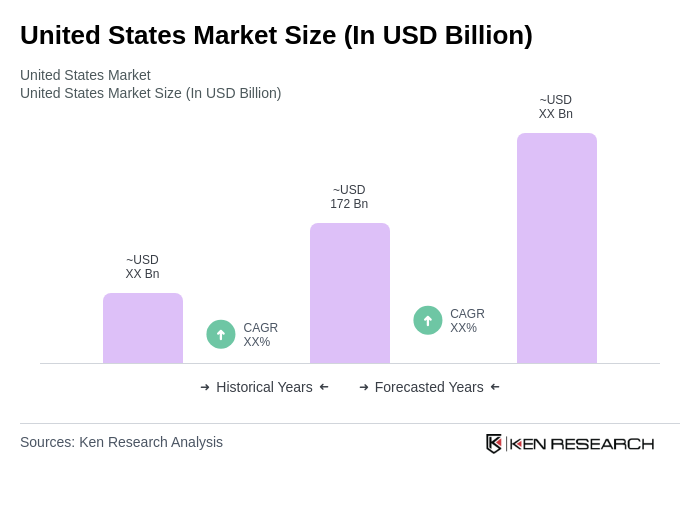
- The United States Marketing Agencies Market is valued at approximatelyUSD 172 billion, based on a five-year historical analysis. This growth is primarily driven by the increasing digitalization of marketing strategies, the rise of social media platforms, and the growing demand for personalized marketing solutions. Companies are increasingly investing in innovative marketing techniques such as data-driven targeting, AI-powered content creation, and omnichannel campaigns to engage consumers effectively, leading to a robust market environment.
- Key cities dominating the market includeNew York, Los Angeles, and Chicago. These cities are hubs for major advertising agencies and tech companies, providing a rich ecosystem for marketing innovation. The concentration of talent, resources, and financial investment in these urban centers fosters a competitive landscape that drives growth and creativity in marketing strategies.
- In 2023, the Federal Trade Commission (FTC) implemented the“Guides Concerning the Use of Endorsements and Testimonials in Advertising” (16 CFR Part 255, revised 2023), requiring marketing agencies to disclose the use of consumer data and the methods employed in targeted advertising. This regulation aims to protect consumer privacy and ensure ethical marketing practices across the industry, mandating clear disclosures for endorsements, influencer marketing, and data-driven advertising.
United States Marketing Agencies Market Segmentation
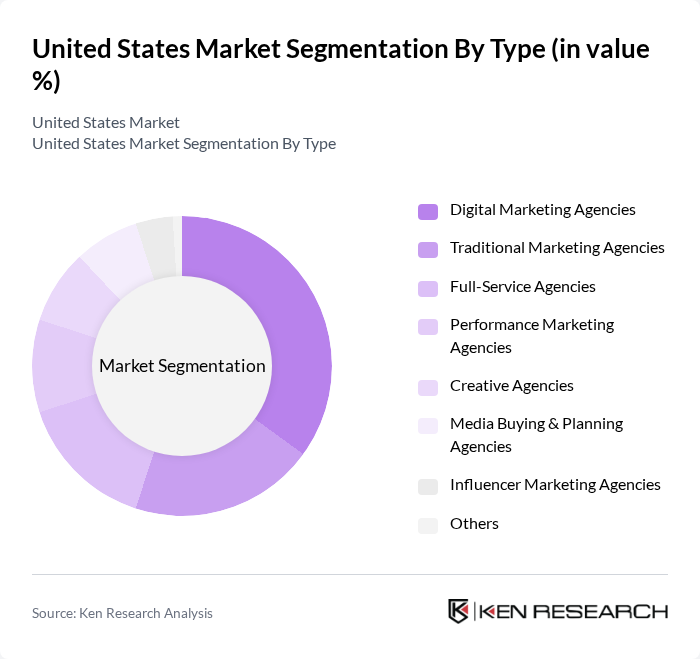
By Type:The marketing agencies market can be segmented into various types, includingDigital Marketing Agencies,Traditional Marketing Agencies,Full-Service Agencies,Performance Marketing Agencies,Creative Agencies,Media Buying & Planning Agencies,Influencer Marketing Agencies, andOthers. Each of these segments plays a crucial role in catering to the diverse needs of clients across different industries. Digital agencies are increasingly focused on personalized advertising, data analytics, and mobile-first campaigns, while traditional agencies maintain expertise in broadcast, print, and out-of-home media.
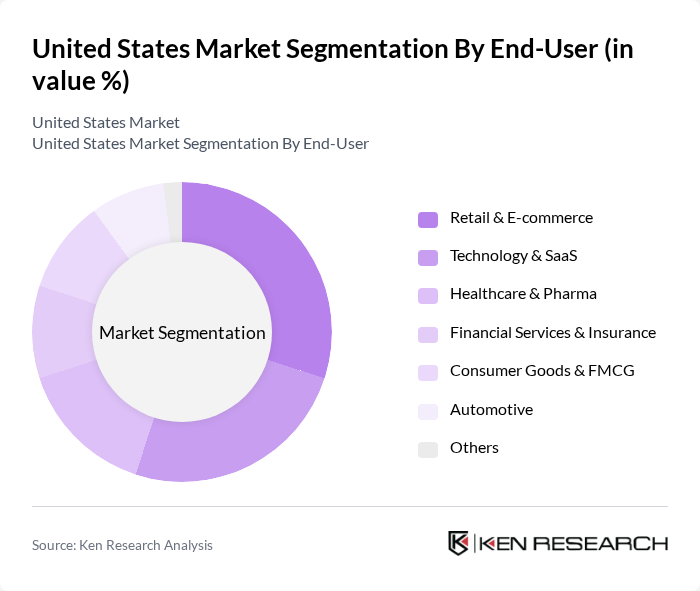
By End-User:The end-user segmentation includesRetail & E-commerce,Technology & SaaS,Healthcare & Pharma,Financial Services & Insurance,Consumer Goods & FMCG,Automotive, andOthers. Each sector has unique marketing needs, driving the demand for specialized marketing services tailored to their specific audiences. Retail and e-commerce brands are leading adopters of digital marketing, while healthcare and financial services emphasize compliance and data privacy.
United States Marketing Agencies Market Competitive Landscape
The United States Marketing Agencies Market is characterized by a dynamic mix of regional and international players. Leading participants such as Ogilvy, WPP, McCann Worldgroup, DDB Worldwide, TBWA Worldwide, Publicis Groupe, BBDO, Leo Burnett, Edelman, VML, R/GA, 360i, Wieden+Kennedy, Grey Group, Droga5 contribute to innovation, geographic expansion, and service delivery in this space.
United States Market Industry Analysis
Growth Drivers
- Increasing Digital Transformation:The United States is experiencing a significant shift towards digital transformation, with IT spending projected to reach $1.2 trillion in future, according to Gartner. This transition is driven by businesses seeking to enhance operational efficiency and customer engagement through digital tools. The adoption of cloud computing, which is expected to grow by $200 billion, is a key component, enabling agencies to deliver innovative marketing solutions that cater to evolving consumer needs.
- Rising Demand for Data-Driven Marketing:In future, the demand for data-driven marketing strategies is expected to surge, with U.S. companies investing approximately $100 billion in analytics and data management. This trend is fueled by the need for personalized customer experiences and targeted advertising. As businesses increasingly rely on data insights to inform their marketing decisions, agencies that leverage advanced analytics tools will gain a competitive edge, driving growth in the marketing sector.
- Growth of E-commerce Platforms:The e-commerce sector in the U.S. is projected to reach $900 billion in sales in future, according to eMarketer. This growth is spurred by changing consumer behaviors, with 15% of retail sales expected to occur online. As e-commerce continues to expand, marketing agencies are capitalizing on this trend by developing tailored strategies that enhance online visibility and drive sales, thus contributing to the overall growth of the marketing industry.
Market Challenges
- High Competition Among Agencies:The marketing agency landscape in the U.S. is highly competitive, with over 40,000 agencies vying for market share. This saturation leads to price wars and reduced profit margins, making it challenging for agencies to differentiate themselves. As clients become more discerning, agencies must innovate and offer unique value propositions to maintain their competitive edge, which can strain resources and impact profitability.
- Rapidly Changing Consumer Preferences:Consumer preferences are evolving at an unprecedented pace, with approximately 60% of consumers indicating they prefer brands that adapt to their needs. This rapid change poses a challenge for marketing agencies, as they must continuously adjust their strategies to align with shifting trends. Failure to keep up can result in ineffective campaigns and lost business opportunities, necessitating ongoing market research and agile marketing approaches.
United States Market Future Outlook
The future of the U.S. marketing industry is poised for transformation, driven by technological advancements and changing consumer behaviors. Agencies will increasingly adopt artificial intelligence and machine learning to enhance campaign effectiveness and personalization. Additionally, the focus on sustainability will shape marketing strategies, as consumers demand more environmentally responsible practices. As agencies adapt to these trends, they will find new avenues for growth and innovation, positioning themselves for success in a dynamic market landscape.
Market Opportunities
- Emergence of AI in Marketing:The integration of artificial intelligence in marketing strategies presents a significant opportunity, with the AI market in marketing expected to reach $20 billion in future. Agencies can leverage AI for predictive analytics, customer segmentation, and personalized content delivery, enhancing campaign effectiveness and client satisfaction.
- Growth in Influencer Marketing:Influencer marketing is projected to grow to $10 billion in future, driven by the increasing effectiveness of social media endorsements. Agencies can capitalize on this trend by developing strategic partnerships with influencers, enabling brands to reach targeted audiences more authentically and effectively, thus driving engagement and sales.
Scope of the Report
| Segment | Sub-Segments |
|---|---|
| By Type | Digital Marketing Agencies Traditional Marketing Agencies Full-Service Agencies Performance Marketing Agencies Creative Agencies Media Buying & Planning Agencies Influencer Marketing Agencies Others |
| By End-User | Retail & E-commerce Technology & SaaS Healthcare & Pharma Financial Services & Insurance Consumer Goods & FMCG Automotive Others |
| By Sales Channel | Direct Sales Online Platforms/Marketplaces Agency Partnerships/Alliances Affiliate/Referral Marketing Others |
| By Service Offering | SEO & SEM Services Content Marketing & Strategy Social Media Management & Advertising Email & CRM Marketing PPC & Performance Advertising Web Design & Development Analytics & Data Services Others |
| By Client Size | Startups Small Enterprises Medium Enterprises Large Enterprises Others |
| By Geographic Focus | National Campaigns Regional Campaigns Local Campaigns International Campaigns Others |
| By Marketing Channel | Online Marketing (Digital) Offline Marketing (Traditional) Social Media Marketing Influencer Marketing Video & Content Marketing Others |
Key Target Audience
Investors and Venture Capitalist Firms
Government and Regulatory Bodies (e.g., Federal Trade Commission, Federal Communications Commission)
Advertising Agencies
Public Relations Firms
Media Buying Agencies
Brand Management Companies
Market Research Organizations
Digital Marketing Platforms
Players Mentioned in the Report:
Ogilvy
WPP
McCann Worldgroup
DDB Worldwide
TBWA Worldwide
Publicis Groupe
BBDO
Leo Burnett
Edelman
VML
R/GA
360i
Wieden+Kennedy
Grey Group
Droga5
Table of Contents
Market Assessment Phase
1. Executive Summary and Approach
2. United States Market Overview
2.1 Key Insights and Strategic Recommendations
2.2 United States Market Overview
2.3 Definition and Scope
2.4 Evolution of Market Ecosystem
2.5 Timeline of Key Regulatory Milestones
2.6 Value Chain & Stakeholder Mapping
2.7 Business Cycle Analysis
2.8 Policy & Incentive Landscape
3. United States Market Analysis
3.1 Growth Drivers
3.1.1 Increasing Digital Transformation
3.1.2 Rising Demand for Data-Driven Marketing
3.1.3 Growth of E-commerce Platforms
3.1.4 Expansion of Social Media Advertising
3.2 Market Challenges
3.2.1 High Competition Among Agencies
3.2.2 Rapidly Changing Consumer Preferences
3.2.3 Regulatory Compliance Issues
3.2.4 Budget Constraints for Clients
3.3 Market Opportunities
3.3.1 Emergence of AI in Marketing
3.3.2 Growth in Influencer Marketing
3.3.3 Increased Focus on Sustainability
3.3.4 Expansion into Emerging Markets
3.4 Market Trends
3.4.1 Personalization of Marketing Campaigns
3.4.2 Integration of Omnichannel Strategies
3.4.3 Use of Big Data Analytics
3.4.4 Shift Towards Video Content Marketing
3.5 Government Regulation
3.5.1 GDPR Compliance for Data Privacy
3.5.2 FTC Guidelines on Advertising
3.5.3 CCPA Regulations in California
3.5.4 Restrictions on Influencer Marketing
4. SWOT Analysis
5. Stakeholder Analysis
6. Porter's Five Forces Analysis
7. United States Market Market Size, 2019-2024
7.1 By Value
7.2 By Volume
7.3 By Average Selling Price
8. United States Market Segmentation
8.1 By Type
8.1.1 Digital Marketing Agencies
8.1.2 Traditional Marketing Agencies
8.1.3 Full-Service Agencies
8.1.4 Performance Marketing Agencies
8.1.5 Creative Agencies
8.1.6 Media Buying & Planning Agencies
8.1.7 Influencer Marketing Agencies
8.1.8 Others
8.2 By End-User
8.2.1 Retail & E-commerce
8.2.2 Technology & SaaS
8.2.3 Healthcare & Pharma
8.2.4 Financial Services & Insurance
8.2.5 Consumer Goods & FMCG
8.2.6 Automotive
8.2.7 Others
8.3 By Sales Channel
8.3.1 Direct Sales
8.3.2 Online Platforms/Marketplaces
8.3.3 Agency Partnerships/Alliances
8.3.4 Affiliate/Referral Marketing
8.3.5 Others
8.4 By Service Offering
8.4.1 SEO & SEM Services
8.4.2 Content Marketing & Strategy
8.4.3 Social Media Management & Advertising
8.4.4 Email & CRM Marketing
8.4.5 PPC & Performance Advertising
8.4.6 Web Design & Development
8.4.7 Analytics & Data Services
8.4.8 Others
8.5 By Client Size
8.5.1 Startups
8.5.2 Small Enterprises
8.5.3 Medium Enterprises
8.5.4 Large Enterprises
8.5.5 Others
8.6 By Geographic Focus
8.6.1 National Campaigns
8.6.2 Regional Campaigns
8.6.3 Local Campaigns
8.6.4 International Campaigns
8.6.5 Others
8.7 By Marketing Channel
8.7.1 Online Marketing (Digital)
8.7.2 Offline Marketing (Traditional)
8.7.3 Social Media Marketing
8.7.4 Influencer Marketing
8.7.5 Video & Content Marketing
8.7.6 Others
9. United States Market Competitive Analysis
9.1 Market Share of Key Players
9.2 Cross Comparison of Key Players
9.2.1 Company Name
9.2.2 Group Size (Large, Medium, or Small as per industry convention)
9.2.3 Annual Revenue
9.2.4 Revenue Growth Rate (YoY)
9.2.5 Client Retention Rate
9.2.6 Customer Acquisition Cost (CAC)
9.2.7 Average Client Lifetime Value (CLV)
9.2.8 Average Project Duration
9.2.9 Pricing Model (Retainer, Project-based, Performance-based, etc.)
9.2.10 Market Penetration Rate
9.2.11 Brand Recognition Score
9.2.12 Digital Engagement Metrics (e.g., website traffic, social followers)
9.2.13 Employee Count
9.2.14 Service Portfolio Breadth
9.3 SWOT Analysis of Top Players
9.4 Pricing Analysis
9.5 Detailed Profile of Major Companies
9.5.1 Ogilvy
9.5.2 WPP
9.5.3 McCann Worldgroup
9.5.4 DDB Worldwide
9.5.5 TBWA Worldwide
9.5.6 Publicis Groupe
9.5.7 BBDO
9.5.8 Leo Burnett
9.5.9 Edelman
9.5.10 VML
9.5.11 R/GA
9.5.12 360i
9.5.13 Wieden+Kennedy
9.5.14 Grey Group
9.5.15 Droga5
10. United States Market End-User Analysis
10.1 Procurement Behavior of Key Ministries
10.1.1 Budget Allocation Trends
10.1.2 Decision-Making Processes
10.1.3 Preferred Vendor Criteria
10.1.4 Contracting Procedures
10.2 Corporate Spend on Infrastructure & Energy
10.2.1 Investment Priorities
10.2.2 Budget Trends
10.2.3 Spending Patterns
10.3 Pain Point Analysis by End-User Category
10.3.1 Common Challenges Faced
10.3.2 Service Gaps
10.3.3 Expectations from Agencies
10.4 User Readiness for Adoption
10.4.1 Technology Adoption Rates
10.4.2 Training and Support Needs
10.4.3 Feedback Mechanisms
10.5 Post-Deployment ROI and Use Case Expansion
10.5.1 Measurement of Success
10.5.2 Case Studies of Successful Implementations
10.5.3 Future Investment Plans
11. United States Market Future Size, 2025-2030
11.1 By Value
11.2 By Volume
11.3 By Average Selling Price
Go-To-Market Strategy Phase
1. Whitespace Analysis + Business Model Canvas
1.1 Market Gaps Identification
1.2 Value Proposition Development
1.3 Revenue Streams Analysis
1.4 Key Resources and Activities
1.5 Customer Segments and Relationships
1.6 Channels for Delivery
1.7 Cost Structure Overview
2. Marketing and Positioning Recommendations
2.1 Branding Strategies
2.2 Product USPs
2.3 Target Audience Identification
2.4 Messaging Framework
2.5 Marketing Channels Selection
3. Distribution Plan
3.1 Urban Retail Strategies
3.2 Rural NGO Tie-ups
3.3 Online Distribution Channels
3.4 Partnership Opportunities
4. Channel & Pricing Gaps
4.1 Underserved Routes
4.2 Pricing Bands Analysis
4.3 Competitive Pricing Strategies
5. Unmet Demand & Latent Needs
5.1 Category Gaps
5.2 Consumer Segments Analysis
5.3 Emerging Trends Identification
6. Customer Relationship
6.1 Loyalty Programs
6.2 After-sales Service
6.3 Customer Feedback Mechanisms
7. Value Proposition
7.1 Sustainability Initiatives
7.2 Integrated Supply Chains
7.3 Unique Selling Points
8. Key Activities
8.1 Regulatory Compliance
8.2 Branding Efforts
8.3 Distribution Setup
9. Entry Strategy Evaluation
9.1 Domestic Market Entry Strategy
9.1.1 Product Mix Considerations
9.1.2 Pricing Band Strategy
9.1.3 Packaging Options
9.2 Export Entry Strategy
9.2.1 Target Countries
9.2.2 Compliance Roadmap
10. Entry Mode Assessment
10.1 Joint Ventures
10.2 Greenfield Investments
10.3 Mergers & Acquisitions
10.4 Distributor Model
11. Capital and Timeline Estimation
11.1 Capital Requirements
11.2 Timelines for Implementation
12. Control vs Risk Trade-Off
12.1 Ownership vs Partnerships
13. Profitability Outlook
13.1 Breakeven Analysis
13.2 Long-term Sustainability
14. Potential Partner List
14.1 Distributors
14.2 Joint Ventures
14.3 Acquisition Targets
15. Execution Roadmap
15.1 Phased Plan for Market Entry
15.1.1 Market Setup
15.1.2 Market Entry
15.1.3 Growth Acceleration
15.1.4 Scale & Stabilize
15.2 Key Activities and Milestones
15.2.1 Milestone Planning
15.2.2 Activity Tracking
Research Methodology
Phase 1: Approach1
Desk Research
- Analysis of market reports from industry associations and government publications
- Review of financial statements and annual reports from key players in the market
- Examination of consumer behavior studies and demographic data from the U.S. Census Bureau
Primary Research
- In-depth interviews with industry experts and thought leaders in the U.S. market
- Surveys targeting end-users to gather insights on preferences and purchasing behavior
- Focus groups with consumers to understand trends and emerging needs in the market
Validation & Triangulation
- Cross-referencing findings from desk research with primary research insights
- Utilizing expert panels to validate assumptions and findings
- Conducting sanity checks through comparative analysis with historical data
Phase 2: Market Size Estimation1
Top-down Assessment
- Estimation of total market size based on national economic indicators and sector performance
- Segmentation of the market by product categories and geographic regions
- Incorporation of macroeconomic factors influencing market growth, such as GDP and consumer spending
Bottom-up Modeling
- Collection of sales data from leading companies to establish baseline figures
- Analysis of unit sales and pricing strategies across different market segments
- Estimation of market share for emerging players based on growth trajectories
Forecasting & Scenario Analysis
- Development of predictive models using historical data and market trends
- Scenario planning based on potential economic shifts and consumer behavior changes
- Creation of multiple forecasts (pessimistic, realistic, optimistic) through 2030
Phase 3: CATI Sample Composition1
| Scope Item/Segment | Sample Size | Target Respondent Profiles |
|---|---|---|
| Consumer Electronics Market | 100 | Product Managers, Marketing Directors |
| Health & Wellness Products | 80 | Retail Buyers, Brand Managers |
| Food & Beverage Sector | 90 | Supply Chain Analysts, Quality Control Managers |
| Automotive Industry Insights | 60 | Sales Executives, Aftermarket Managers |
| Fashion & Apparel Trends | 50 | Designers, Merchandising Managers |
Frequently Asked Questions
What is the current value of the United States Marketing Agencies Market?
The United States Marketing Agencies Market is valued at approximately USD 172 billion, driven by the increasing digitalization of marketing strategies, the rise of social media platforms, and the demand for personalized marketing solutions.
Which cities are the main hubs for marketing agencies in the U.S.?
What recent regulations have impacted marketing agencies in the U.S.?
What are the main types of marketing agencies in the U.S.?
Other Regional/Country Reports
Indonesia Marketing Agencies Market
Malaysia Marketing Agencies Market
APAC Marketing Agencies Market
SEA Marketing Agencies Market
Why Buy From Us?

What makes us stand out is that our consultants follow Robust, Refine and Result (RRR) methodology. Robust for clear definitions, approaches and sanity checking, Refine for differentiating respondents' facts and opinions, and Result for presenting data with story.

We have set a benchmark in the industry by offering our clients with syndicated and customized market research reports featuring coverage of entire market as well as meticulous research and analyst insights.

While we don't replace traditional research, we flip the method upside down. Our dual approach of Top Bottom & Bottom Top ensures quality deliverable by not just verifying company fundamentals but also looking at the sector and macroeconomic factors.

With one step in the future, our research team constantly tries to show you the bigger picture. We help with some of the tough questions you may encounter along the way: How is the industry positioned? Best marketing channel? KPI's of competitors? By aligning every element, we help maximize success.

Our report gives you instant access to the answers and sources that other companies might choose to hide. We elaborate each steps of research methodology we have used and showcase you the sample size to earn your trust.

If you need any support, we are here! We pride ourselves on universe strength, data quality, and quick, friendly, and professional service.