About the Report
Base Year 2024Unites States Household Refrigerators Market Overview
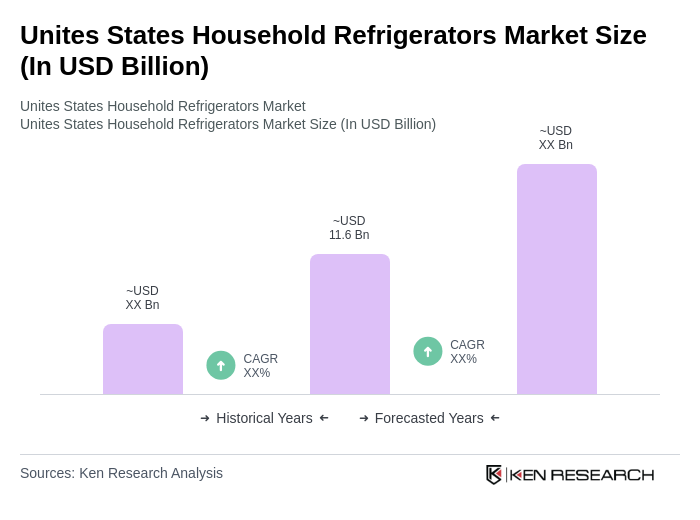
- The United States Household Refrigerators Market is valued at USD 11.6 billion, based on a five-year historical analysis. This market is driven by rising demand for energy?efficient appliances, accelerating adoption of connected/smart features, and replacement demand tied to home improvement activity.
- Key cities dominating the market include New York, Los Angeles, and Chicago, where high population density and strong retail and e?commerce footprints support premium and smart model availability. National retail coverage and online penetration are widely cited drivers in North America, supporting access to varied refrigerator formats including luxury and smart models.
- The U.S. Department of Energy finalized updated energy efficiency standards for residential refrigerators and freezers, which will apply to newly manufactured units and drive further efficiency improvements and ENERGY STAR adoption.
Unites States Household Refrigerators Market Segmentation
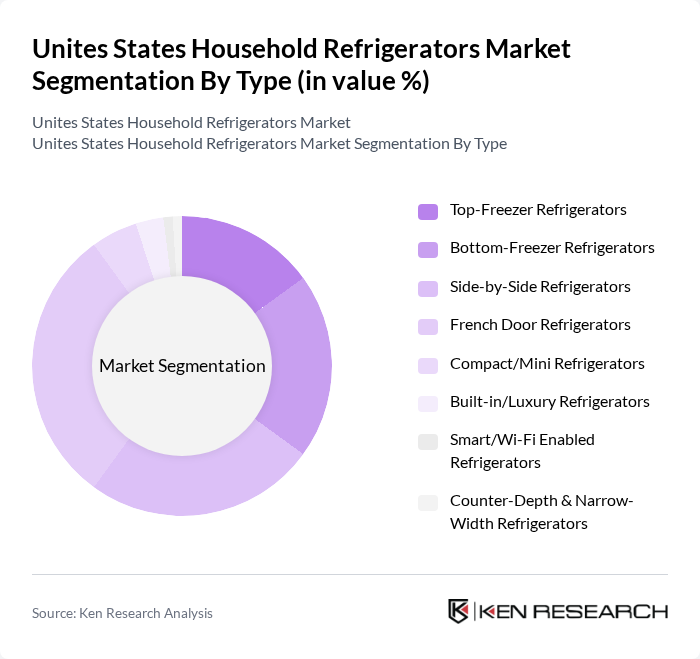
By Type:The market is segmented into various types of refrigerators, each catering to different consumer needs and preferences. The primary subsegments include Top-Freezer Refrigerators, Bottom-Freezer Refrigerators, Side-by-Side Refrigerators, French Door Refrigerators, Compact/Mini Refrigerators, Built-in/Luxury Refrigerators, Smart/Wi-Fi Enabled Refrigerators, and Counter-Depth & Narrow-Width Refrigerators. Among these, French Door and other double?door configurations have gained strong popularity due to spacious layouts and modern aesthetics, while top?freezer remains important for value?oriented buyers.
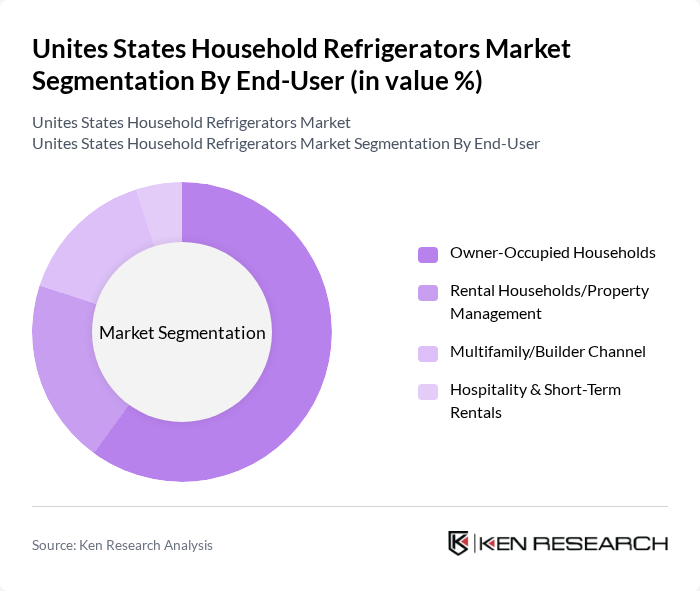
By End-User:The end-user segmentation includes Owner-Occupied Households, Rental Households/Property Management, Multifamily/Builder Channel, and Hospitality & Short-Term Rentals. Owner-Occupied Households represent the largest segment, supported by replacement cycles and kitchen upgrades, while builder/multifamily channels and rentals sustain steady unit demand.
Unites States Household Refrigerators Market Competitive Landscape
The United States Household Refrigerators Market is characterized by a dynamic mix of regional and international players. Leading participants such as Whirlpool Corporation, GE Appliances, a Haier company, Samsung Electronics America, LG Electronics USA, Electrolux North America (Frigidaire), BSH Home Appliances (Bosch, Thermador), Sub-Zero Group, Inc. (Sub-Zero, Wolf, Cove), Haier America, Miele, Inc. (USA), Hisense USA, Danby Products Inc. (USA), Viking Range, LLC (Middleby), Fisher & Paykel Appliances USA, KitchenAid (Whirlpool), and Amana (Whirlpool) contribute to innovation, geographic expansion, and service delivery in this space.
Unites States Household Refrigerators Market Industry Analysis
Growth Drivers
- Increasing Consumer Demand for Energy-Efficient Appliances:The U.S. household refrigerators market is witnessing a surge in demand for energy-efficient models, driven by rising energy costs. In future, the average household is expected to spend approximately $1,800 annually on energy bills, prompting consumers to seek appliances that reduce energy consumption. Energy-efficient refrigerators can save households up to $400 per year, making them an attractive option. This trend aligns with the U.S. Department of Energy's goal to reduce energy consumption by 20% by 2030, further fueling market growth.
- Technological Advancements in Refrigeration:Innovations in refrigeration technology are significantly enhancing the functionality and efficiency of household refrigerators. In future, the introduction of advanced cooling technologies, such as inverter compressors and improved insulation materials, is expected to increase energy efficiency ratings by up to 35%. Additionally, features like touch-screen interfaces and smart connectivity are becoming standard, appealing to tech-savvy consumers. The U.S. market is projected to see a 20% increase in sales of technologically advanced models, reflecting consumer preference for modern appliances.
- Rising Disposable Incomes:The increase in disposable incomes in the U.S. is a significant driver for the household refrigerators market. In future, the average disposable income is projected to reach $60,000, allowing consumers to invest in higher-quality appliances. This financial flexibility enables households to prioritize energy-efficient and technologically advanced refrigerators, which often come with a higher price tag. As consumers seek to enhance their living standards, the demand for premium refrigerators is expected to rise, contributing to market expansion.
Market Challenges
- Intense Competition Among Key Players:The U.S. household refrigerators market is characterized by fierce competition among major manufacturers, including Whirlpool, Samsung, and LG. In future, these companies are expected to invest over $1.2 billion in marketing and product development to capture market share. This intense rivalry can lead to price wars, reducing profit margins for manufacturers. Additionally, the constant need for innovation to stay ahead can strain resources, making it challenging for smaller players to compete effectively in this saturated market.
- Fluctuating Raw Material Prices:The household refrigerators market faces challenges due to the volatility of raw material prices, particularly steel and refrigerants. In future, the price of steel is projected to fluctuate between $900 and $1,100 per ton, impacting production costs. This unpredictability can lead to increased prices for consumers and reduced profit margins for manufacturers. Additionally, compliance with environmental regulations regarding refrigerants adds another layer of complexity, as companies must invest in alternative materials, further straining their financial resources.
Unites States Household Refrigerators Market Future Outlook
The future of the U.S. household refrigerators market appears promising, driven by technological advancements and a growing emphasis on sustainability. As consumers increasingly prioritize energy efficiency and smart home integration, manufacturers are likely to innovate continuously. The market is expected to see a rise in demand for customizable and multifunctional refrigerators, catering to diverse consumer preferences. Additionally, the expansion of e-commerce platforms will facilitate easier access to a wider range of products, enhancing consumer choice and convenience in purchasing decisions.
Market Opportunities
- Expansion of E-commerce Platforms:The growth of e-commerce is creating significant opportunities for the household refrigerators market. In future, online sales are projected to account for 35% of total refrigerator sales, driven by consumer preferences for convenience and variety. This shift allows manufacturers to reach a broader audience and streamline distribution, ultimately enhancing sales and market penetration.
- Increasing Focus on Sustainable Products:As environmental concerns rise, there is a growing market for sustainable refrigerators. In future, approximately 45% of consumers are expected to prioritize eco-friendly appliances, leading manufacturers to innovate in sustainable materials and energy-efficient technologies. This focus not only meets consumer demand but also aligns with regulatory trends, positioning companies favorably in a competitive landscape.
Scope of the Report
| Segment | Sub-Segments |
|---|---|
| By Type | Top-Freezer Refrigerators Bottom-Freezer Refrigerators Side-by-Side Refrigerators French Door Refrigerators Compact/Mini Refrigerators Built-in/Luxury Refrigerators Smart/WiFi Enabled Refrigerators Counter-Depth & Narrow-Width Refrigerators |
| By End-User | Owner-Occupied Households Rental Households/Property Management Multifamily/Builder Channel Hospitality & Short Term Rentals |
| By Price Range | Under $700 (Entry/Budget) $700–$1,299 (Lower Mid Range) $1,300–$2,499 (Upper Mid Range) $2,500–$4,999 (Premium) $5,000+ (Luxury/Professional) |
| By Distribution Channel | Online Big-Box & Home Improvement Retail National Appliance Chains Independent Appliance Dealers Builder/Contractor & Wholesale Channels |
| By Brand Ownership | Global/National Brands Private Labels European & Niche Luxury Brands |
| By Energy Efficiency | ENERGY STAR Certified Not ENERGY STAR Certified |
| By Features | Ice Makers & Craft Ice Water Dispensers & Filtration Smart Features Flexible Storage Convertible Compartments & Dual Evaporators Finish & Aesthetics |
Key Target Audience
Investors and Venture Capitalist Firms
Government and Regulatory Bodies (e.g., U.S. Department of Energy, U.S. Environmental Protection Agency)
Manufacturers and Producers
Distributors and Retailers
Home Appliance Wholesalers
Energy Efficiency Organizations
Trade Associations (e.g., Association of Home Appliance Manufacturers)
Financial Institutions
Players Mentioned in the Report:
Whirlpool Corporation
GE Appliances, a Haier company
Samsung Electronics America
LG Electronics USA
Electrolux North America (Frigidaire)
BSH Home Appliances (Bosch, Thermador)
SubZero Group, Inc. (SubZero, Wolf, Cove)
Haier America
Miele, Inc. (USA)
Hisense USA
Danby Products Inc. (USA)
Viking Range, LLC (Middleby)
Fisher & Paykel Appliances USA
KitchenAid (Whirlpool)
Amana (Whirlpool)
Table of Contents
Market Assessment Phase
1. Executive Summary and Approach
2. Unites States Household Refrigerators Market Overview
2.1 Key Insights and Strategic Recommendations
2.2 Unites States Household Refrigerators Market Overview
2.3 Definition and Scope
2.4 Evolution of Market Ecosystem
2.5 Timeline of Key Regulatory Milestones
2.6 Value Chain & Stakeholder Mapping
2.7 Business Cycle Analysis
2.8 Policy & Incentive Landscape
3. Unites States Household Refrigerators Market Analysis
3.1 Growth Drivers
3.1.1 Increasing Consumer Demand for Energy-Efficient Appliances
3.1.2 Technological Advancements in Refrigeration
3.1.3 Rising Disposable Incomes
3.1.4 Growth in the Real Estate Sector
3.2 Market Challenges
3.2.1 Intense Competition Among Key Players
3.2.2 Fluctuating Raw Material Prices
3.2.3 Regulatory Compliance Costs
3.2.4 Consumer Preference for Smart Appliances
3.3 Market Opportunities
3.3.1 Expansion of E-commerce Platforms
3.3.2 Increasing Focus on Sustainable Products
3.3.3 Development of Smart Refrigerators
3.3.4 Potential in Emerging Markets
3.4 Market Trends
3.4.1 Shift Towards Smart Home Integration
3.4.2 Growing Popularity of Customizable Refrigerators
3.4.3 Emphasis on Energy Efficiency
3.4.4 Rise of Online Retailing
3.5 Government Regulation
3.5.1 Energy Efficiency Standards
3.5.2 Environmental Protection Regulations
3.5.3 Consumer Product Safety Commission Guidelines
3.5.4 Incentives for Energy-Efficient Appliances
4. SWOT Analysis
5. Stakeholder Analysis
6. Porter's Five Forces Analysis
7. Unites States Household Refrigerators Market Market Size, 2019-2024
7.1 By Value
7.2 By Volume
7.3 By Average Selling Price
8. Unites States Household Refrigerators Market Segmentation
8.1 By Type
8.1.1 Top-Freezer Refrigerators
8.1.2 Bottom-Freezer Refrigerators
8.1.3 Side-by-Side Refrigerators
8.1.4 French Door Refrigerators
8.1.5 Compact/Mini Refrigerators
8.1.6 Built-in/Luxury Refrigerators
8.1.7 Smart/Wi?Fi Enabled Refrigerators
8.1.8 Counter-Depth & Narrow-Width Refrigerators
8.2 By End-User
8.2.1 Owner-Occupied Households
8.2.2 Rental Households/Property Management
8.2.3 Multifamily/Builder Channel
8.2.4 Hospitality & Short?Term Rentals
8.3 By Price Range
8.3.1 Under $700 (Entry/Budget)
8.3.2 $700–$1,299 (Lower Mid?Range)
8.3.3 $1,300–$2,499 (Upper Mid?Range)
8.3.4 $2,500–$4,999 (Premium)
8.3.5 $5,000+ (Luxury/Professional)
8.4 By Distribution Channel
8.4.1 Online (Brand.com, Retailers’ E?commerce, Marketplaces)
8.4.2 Big-Box & Home Improvement Retail (e.g., Home Depot, Lowe’s)
8.4.3 National Appliance Chains (e.g., Best Buy)
8.4.4 Independent Appliance Dealers
8.4.5 Builder/Contractor & Wholesale Channels
8.5 By Brand Ownership
8.5.1 Global/National Brands
8.5.2 Private Labels (Retail & OEM)
8.5.3 European & Niche Luxury Brands
8.6 By Energy Efficiency
8.6.1 ENERGY STAR Certified
8.6.2 Not ENERGY STAR Certified
8.7 By Features
8.7.1 Ice Makers & Craft Ice
8.7.2 Water Dispensers & Filtration
8.7.3 Smart Features (Voice, App Control, Cameras)
8.7.4 Flexible Storage (Adjustable Shelves, Drawers, Door?in?Door)
8.7.5 Convertible Compartments & Dual Evaporators
8.7.6 Finish & Aesthetics (Stainless, Panel?Ready, Matte)
9. Unites States Household Refrigerators Market Competitive Analysis
9.1 Market Share of Key Players
9.2 Cross Comparison of Key Players
9.2.1 Company Name
9.2.2 North America Refrigerator Revenue (USD, latest FY)
9.2.3 U.S. Unit Shipments/Share (latest year)
9.2.4 3?Year CAGR (Revenue/Units)
9.2.5 Average Selling Price (ASP) by Segment
9.2.6 Product Mix (% Top?Freezer/Bottom?Freezer/Side?by?Side/French Door/Compact)
9.2.7 ENERGY STAR Penetration (% of portfolio)
9.2.8 Smart/Connected Penetration (% of portfolio)
9.2.9 Retail Coverage (Doors/Locations; Big?Box vs. Independent)
9.2.10 Builder/Contractor Channel Share
9.2.11 On?Time Delivery/Lead Time (Days)
9.2.12 Warranty Terms & Claim Rate
9.2.13 Service Network Coverage (ZIP/Tech density)
9.2.14 Brand Awareness/Preference Index (U.S.)
9.2.15 R&D/Innovation Intensity (% of revenue; patents/features launched)
9.3 SWOT Analysis of Top Players
9.4 Pricing Analysis
9.5 Detailed Profile of Major Companies
9.5.1 Whirlpool Corporation
9.5.2 GE Appliances, a Haier company
9.5.3 Samsung Electronics America
9.5.4 LG Electronics USA
9.5.5 Electrolux North America (Frigidaire)
9.5.6 BSH Home Appliances (Bosch, Thermador)
9.5.7 Sub?Zero Group, Inc. (Sub?Zero, Wolf, Cove)
9.5.8 Haier America
9.5.9 Miele, Inc. (USA)
9.5.10 Hisense USA
9.5.11 Danby Products Inc. (USA)
9.5.12 Viking Range, LLC (Middleby)
9.5.13 Fisher & Paykel Appliances USA
9.5.14 KitchenAid (Whirlpool)
9.5.15 Amana (Whirlpool)
10. Unites States Household Refrigerators Market End-User Analysis
10.1 Procurement Behavior of Key Ministries
10.1.1 Budget Allocation Trends
10.1.2 Procurement Processes
10.1.3 Supplier Selection Criteria
10.1.4 Contract Management Practices
10.2 Corporate Spend on Infrastructure & Energy
10.2.1 Investment Trends in Energy-Efficient Appliances
10.2.2 Budgeting for Refrigeration Solutions
10.2.3 Long-term Procurement Strategies
10.3 Pain Point Analysis by End-User Category
10.3.1 Cost of Ownership
10.3.2 Maintenance Challenges
10.3.3 Energy Consumption Concerns
10.3.4 Product Reliability Issues
10.4 User Readiness for Adoption
10.4.1 Awareness of Energy-Efficient Options
10.4.2 Willingness to Invest in Smart Technology
10.4.3 Adoption Barriers
10.5 Post-Deployment ROI and Use Case Expansion
10.5.1 Measurement of Energy Savings
10.5.2 Impact on Operational Efficiency
10.5.3 User Satisfaction Metrics
11. Unites States Household Refrigerators Market Future Size, 2025-2030
11.1 By Value
11.2 By Volume
11.3 By Average Selling Price
Go-To-Market Strategy Phase
1. Whitespace Analysis + Business Model Canvas
1.1 Market Gaps Identification
1.2 Value Proposition Development
1.3 Revenue Streams Analysis
1.4 Customer Segmentation
1.5 Key Partnerships
1.6 Cost Structure Analysis
1.7 Channels of Distribution
2. Marketing and Positioning Recommendations
2.1 Branding Strategies
2.2 Product USPs
2.3 Target Audience Identification
2.4 Marketing Channels
2.5 Promotional Strategies
3. Distribution Plan
3.1 Urban Retail Strategies
3.2 Rural NGO Tie-ups
3.3 E-commerce Integration
3.4 Logistics and Supply Chain Management
4. Channel & Pricing Gaps
4.1 Underserved Routes
4.2 Pricing Bands Analysis
4.3 Competitor Pricing Strategies
5. Unmet Demand & Latent Needs
5.1 Category Gaps
5.2 Consumer Segments Analysis
5.3 Emerging Trends
6. Customer Relationship
6.1 Loyalty Programs
6.2 After-sales Service
6.3 Customer Feedback Mechanisms
7. Value Proposition
7.1 Sustainability Initiatives
7.2 Integrated Supply Chains
7.3 Customer-Centric Innovations
8. Key Activities
8.1 Regulatory Compliance
8.2 Branding Initiatives
8.3 Distribution Setup
9. Entry Strategy Evaluation
9.1 Domestic Market Entry Strategy
9.1.1 Product Mix Considerations
9.1.2 Pricing Band Strategy
9.1.3 Packaging Innovations
9.2 Export Entry Strategy
9.2.1 Target Countries Analysis
9.2.2 Compliance Roadmap
10. Entry Mode Assessment
10.1 Joint Ventures
10.2 Greenfield Investments
10.3 Mergers & Acquisitions
10.4 Distributor Model
11. Capital and Timeline Estimation
11.1 Capital Requirements
11.2 Timelines for Implementation
12. Control vs Risk Trade-Off
12.1 Ownership vs Partnerships
13. Profitability Outlook
13.1 Breakeven Analysis
13.2 Long-term Sustainability
14. Potential Partner List
14.1 Distributors
14.2 Joint Ventures
14.3 Acquisition Targets
15. Execution Roadmap
15.1 Phased Plan for Market Entry
15.1.1 Market Setup
15.1.2 Market Entry
15.1.3 Growth Acceleration
15.1.4 Scale & Stabilize
15.2 Key Activities and Milestones
15.2.1 Milestone Planning
15.2.2 Activity Tracking
Research Methodology
Phase 1: Approach1
Desk Research
- Analysis of industry reports from market research firms focusing on household appliances
- Review of government publications and statistics related to household energy consumption and appliance usage
- Examination of consumer behavior studies and surveys on refrigerator preferences and purchasing trends
Primary Research
- Interviews with product managers and marketing executives from leading refrigerator manufacturers
- Surveys conducted with consumers regarding their purchasing decisions and brand loyalty
- Focus groups with homeowners to discuss features and functionalities desired in household refrigerators
Validation & Triangulation
- Cross-validation of findings through comparison with historical sales data and market trends
- Triangulation of insights from consumer surveys, expert interviews, and industry reports
- Sanity checks through expert panel reviews to ensure data accuracy and relevance
Phase 2: Market Size Estimation1
Top-down Assessment
- Estimation of total market size based on national household appliance sales data
- Segmentation of the market by refrigerator type (e.g., side-by-side, top-freezer, bottom-freezer)
- Incorporation of demographic data to assess potential market growth in various regions
Bottom-up Modeling
- Collection of sales volume data from major retailers and e-commerce platforms
- Estimation of average selling prices across different refrigerator categories
- Calculation of market size based on unit sales multiplied by average prices
Forecasting & Scenario Analysis
- Utilization of time-series analysis to project future market trends based on historical data
- Scenario modeling based on economic indicators, such as disposable income and housing market trends
- Development of best-case, worst-case, and most-likely scenarios for market growth through 2030
Phase 3: CATI Sample Composition1
| Scope Item/Segment | Sample Size | Target Respondent Profiles |
|---|---|---|
| Consumer Refrigerator Purchases | 150 | Homeowners, Renters |
| Retail Sales Insights | 120 | Store Managers, Sales Associates |
| Energy Efficiency Preferences | 80 | Environmentally Conscious Consumers |
| Brand Loyalty and Awareness | 120 | Frequent Appliance Buyers, Brand Advocates |
| Market Trends and Innovations | 90 | Industry Analysts, Appliance Designers |
Frequently Asked Questions
What is the current value of the United States Household Refrigerators Market?
The United States Household Refrigerators Market is valued at approximately USD 11.6 billion, reflecting a five-year historical analysis. This valuation is influenced by factors such as rising demand for energy-efficient appliances and the adoption of smart features.
What are the key drivers of growth in the U.S. Household Refrigerators Market?
Which cities are leading in the U.S. Household Refrigerators Market?
What types of refrigerators are most popular in the U.S. market?
Other Regional/Country Reports
Indonesia Household Refrigerators Market
Malaysia Household Refrigerators Market
KSA Household Refrigerators Market
APAC Household Refrigerators Market
SEA Household Refrigerators Market
Vietnam Household Refrigerators Market
Why Buy From Us?

What makes us stand out is that our consultants follow Robust, Refine and Result (RRR) methodology. Robust for clear definitions, approaches and sanity checking, Refine for differentiating respondents' facts and opinions, and Result for presenting data with story.

We have set a benchmark in the industry by offering our clients with syndicated and customized market research reports featuring coverage of entire market as well as meticulous research and analyst insights.

While we don't replace traditional research, we flip the method upside down. Our dual approach of Top Bottom & Bottom Top ensures quality deliverable by not just verifying company fundamentals but also looking at the sector and macroeconomic factors.

With one step in the future, our research team constantly tries to show you the bigger picture. We help with some of the tough questions you may encounter along the way: How is the industry positioned? Best marketing channel? KPI's of competitors? By aligning every element, we help maximize success.

Our report gives you instant access to the answers and sources that other companies might choose to hide. We elaborate each steps of research methodology we have used and showcase you the sample size to earn your trust.

If you need any support, we are here! We pride ourselves on universe strength, data quality, and quick, friendly, and professional service.