About the Report
Base Year 2024Us Autonomous Car Market Overview
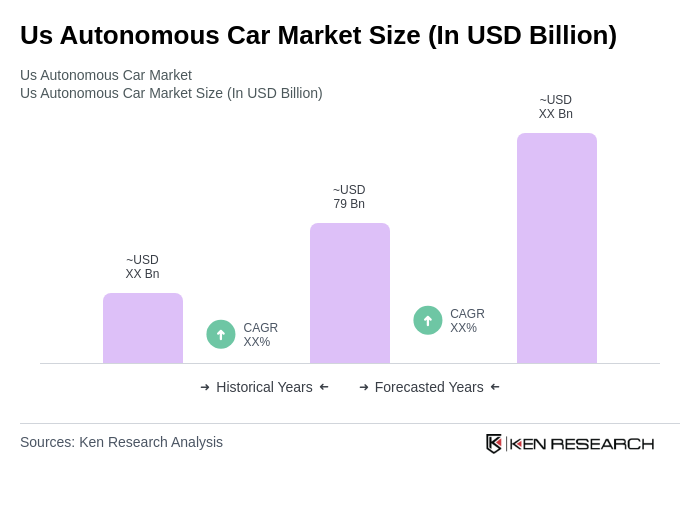
- The Us Autonomous Car Market is valued at USD 79 billion, based on a five-year historical analysis. This growth is primarily driven by advancements in artificial intelligence, increasing consumer demand for safety features, and significant investments from both private and public sectors in autonomous vehicle technology. Additional growth drivers include the expansion of smart infrastructure, integration of vehicle-to-everything (V2X) communication, and the rise of mobility-as-a-service (MaaS) platforms, which are accelerating the adoption and deployment of autonomous vehicles across the United States .
- Key players in this market include California, Texas, and Michigan, which dominate due to their robust automotive industries, supportive regulatory environments, and extensive testing facilities for autonomous vehicles. These regions have become hubs for innovation and development in the autonomous driving sector .
- There is currently no federal legislation named the AV START Act enacted in 2023. While the AV START Act has been proposed in previous sessions of Congress, it has not been passed into law. However, the U.S. government and various states continue to develop regulatory frameworks and safety guidelines to support the testing and deployment of autonomous vehicles, fostering innovation while prioritizing public safety .
Us Autonomous Car Market Segmentation
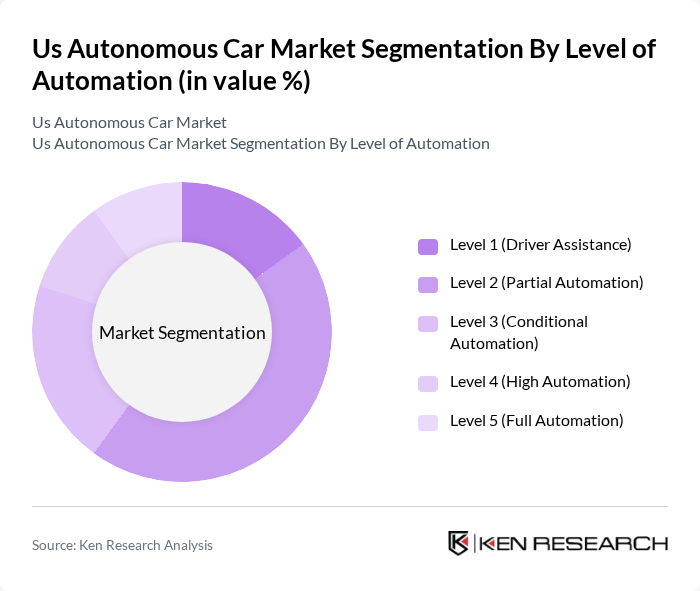
By Level of Automation:The market is segmented into five levels of automation, ranging from Level 1 (Driver Assistance) to Level 5 (Full Automation). Level 2 (Partial Automation) is currently the most dominant segment, as it is widely adopted in consumer vehicles, offering features like adaptive cruise control and lane-keeping assistance. This segment benefits from consumer familiarity and the gradual transition towards higher levels of automation. Level 1 also maintains a significant presence due to the high volume of vehicles equipped with basic driver assistance features, while Level 3 and above remain limited primarily to pilot programs and premium models .
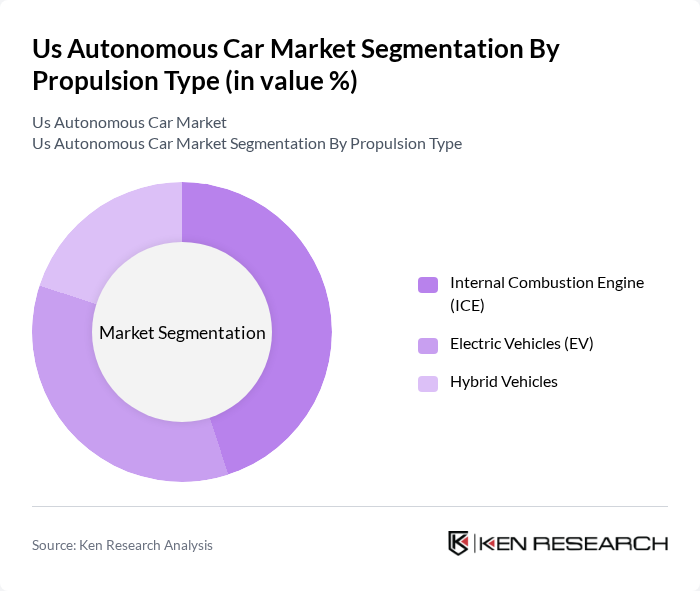
By Propulsion Type:The market is segmented into three propulsion types: Internal Combustion Engine (ICE), Electric Vehicles (EV), and Hybrid Vehicles. Internal Combustion Engine (ICE) vehicles currently hold the highest share in the U.S. autonomous car market, reflecting the ongoing dominance of traditional powertrains in the broader vehicle fleet. However, Electric Vehicles (EV) are rapidly gaining market share, driven by increasing environmental concerns, government incentives, and the alignment of most autonomous vehicle prototypes with electric platforms. Hybrid vehicles also contribute to the transition toward cleaner propulsion but remain a smaller segment compared to ICE and EV .
Us Autonomous Car Market Competitive Landscape
The Us Autonomous Car Market is characterized by a dynamic mix of regional and international players. Leading participants such as Waymo LLC, Tesla Inc., Cruise LLC (General Motors), Aurora Innovation Inc., Zoox Inc. (Amazon.com, Inc.), Mobileye Global Inc. (Intel Corporation), NVIDIA Corporation, Aptiv PLC, Apple Inc., Ford Motor Company, General Motors Company, Hyundai Motor Company, Baidu Inc., BMW AG, Honda Motor Co., Ltd. contribute to innovation, geographic expansion, and service delivery in this space.
Us Autonomous Car Market Industry Analysis
Growth Drivers
- Technological Advancements in AI:The rapid evolution of artificial intelligence (AI) technologies is a significant growth driver for the autonomous car market. In future, global spending on AI is projected to reach $600 billion, with a substantial portion allocated to automotive applications. Companies like Tesla and Waymo are investing heavily in AI algorithms, enhancing vehicle perception and decision-making capabilities. This technological progress is crucial for achieving higher levels of automation and improving overall vehicle performance, thereby attracting consumer interest and investment.
- Increasing Consumer Demand for Safety:Consumer demand for enhanced safety features is driving the adoption of autonomous vehicles. In future, traffic accidents in the U.S. are expected to cost approximately $500 billion, highlighting the urgent need for safer transportation solutions. Autonomous vehicles, equipped with advanced safety systems, can significantly reduce accident rates. A study by the National Highway Traffic Safety Administration indicates that 90% of serious crashes are due to human error, underscoring the potential of autonomous technology to save lives and reduce costs.
- Government Support and Funding:Government initiatives are pivotal in promoting the autonomous car market. In future, U.S. federal funding for autonomous vehicle research and development is projected to exceed $1.5 billion. This funding supports infrastructure improvements and regulatory frameworks that facilitate testing and deployment. Additionally, various states are implementing favorable policies, such as tax incentives and grants, to encourage innovation in autonomous vehicle technology, further stimulating market growth and attracting private investment.
Market Challenges
- High Development Costs:The development of autonomous vehicles involves substantial financial investment, posing a significant challenge. In future, the average cost of developing a fully autonomous vehicle is estimated to be around $2 million. This includes expenses related to research, technology integration, and regulatory compliance. Many companies, especially startups, struggle to secure the necessary funding, which can hinder innovation and slow down the overall market growth, limiting the number of players in the industry.
- Public Perception and Trust Issues:Public perception remains a critical challenge for the autonomous car market. A future survey indicates that only 40% of consumers feel comfortable riding in fully autonomous vehicles. Concerns about safety, reliability, and ethical implications of AI decision-making contribute to this skepticism. Building consumer trust is essential for widespread adoption, and companies must invest in education and transparent communication to address these concerns and foster acceptance of autonomous technology.
Us Autonomous Car Market Future Outlook
The future of the autonomous car market appears promising, driven by ongoing technological advancements and increasing consumer awareness of safety benefits. As AI technologies continue to evolve, the integration of autonomous vehicles into everyday life is expected to accelerate. Additionally, partnerships between automotive manufacturers and tech companies will likely enhance innovation. The focus on sustainability will also shape the market, as electric autonomous vehicles gain traction, aligning with global efforts to reduce carbon emissions and promote eco-friendly transportation solutions.
Market Opportunities
- Expansion into Emerging Markets:Emerging markets present significant opportunities for autonomous vehicle adoption. Countries like India and Brazil are experiencing rapid urbanization, with urban populations projected to reach 800 million in future. This growth creates a demand for innovative transportation solutions, making it an ideal environment for autonomous vehicles to thrive, especially in urban areas facing congestion and pollution challenges.
- Integration with Smart City Initiatives:The integration of autonomous vehicles into smart city initiatives offers substantial market potential. In future, global investment in smart city projects is expected to exceed $1.5 trillion. Autonomous vehicles can enhance urban mobility, reduce traffic congestion, and improve public transportation systems. Collaborations between city planners and automotive companies can lead to innovative solutions that address urban challenges, creating a conducive environment for autonomous vehicle deployment.
Scope of the Report
| Segment | Sub-Segments |
|---|---|
| By Level of Automation | Level 1 (Driver Assistance) Level 2 (Partial Automation) Level 3 (Conditional Automation) Level 4 (High Automation) Level 5 (Full Automation) |
| By Propulsion Type | Internal Combustion Engine (ICE) Electric Vehicles (EV) Hybrid Vehicles |
| By Vehicle Type | Passenger Cars Commercial Vehicles |
| By End-User | Personal Use Commercial Fleets Public Transportation Ride-Sharing & Mobility Services |
| By Application | Passenger Transport Goods Delivery & Logistics Emergency & Specialized Services |
| By Component | Sensors (LiDAR, Radar, Cameras, Ultrasonic) Software & Algorithms Control Systems Connectivity & V2X Modules |
| By Sales Channel | OEM Sales Aftermarket |
| By Region (U.S.) | West Midwest South Northeast |
Key Target Audience
Investors and Venture Capitalist Firms
Government and Regulatory Bodies (e.g., National Highway Traffic Safety Administration, Federal Motor Carrier Safety Administration)
Automobile Manufacturers
Technology Providers (e.g., Software Developers, Sensor Manufacturers)
Insurance Companies
Fleet Operators and Mobility Service Providers
Automotive Industry Associations
Public Transportation Authorities
Players Mentioned in the Report:
Waymo LLC
Tesla Inc.
Cruise LLC (General Motors)
Aurora Innovation Inc.
Zoox Inc. (Amazon.com, Inc.)
Mobileye Global Inc. (Intel Corporation)
NVIDIA Corporation
Aptiv PLC
Apple Inc.
Ford Motor Company
General Motors Company
Hyundai Motor Company
Baidu Inc.
BMW AG
Honda Motor Co., Ltd.
Table of Contents
Market Assessment Phase
1. Executive Summary and Approach
2. Us Autonomous Car Market Overview
2.1 Key Insights and Strategic Recommendations
2.2 Us Autonomous Car Market Overview
2.3 Definition and Scope
2.4 Evolution of Market Ecosystem
2.5 Timeline of Key Regulatory Milestones
2.6 Value Chain & Stakeholder Mapping
2.7 Business Cycle Analysis
2.8 Policy & Incentive Landscape
3. Us Autonomous Car Market Analysis
3.1 Growth Drivers
3.1.1 Technological Advancements in AI
3.1.2 Increasing Consumer Demand for Safety
3.1.3 Government Support and Funding
3.1.4 Urbanization and Traffic Congestion
3.2 Market Challenges
3.2.1 High Development Costs
3.2.2 Regulatory Hurdles
3.2.3 Public Perception and Trust Issues
3.2.4 Cybersecurity Threats
3.3 Market Opportunities
3.3.1 Expansion into Emerging Markets
3.3.2 Partnerships with Tech Companies
3.3.3 Development of New Business Models
3.3.4 Integration with Smart City Initiatives
3.4 Market Trends
3.4.1 Rise of Mobility-as-a-Service (MaaS)
3.4.2 Increased Investment in R&D
3.4.3 Focus on Sustainability and Eco-friendliness
3.4.4 Advancements in Sensor Technology
3.5 Government Regulation
3.5.1 Federal Autonomous Vehicle Policy
3.5.2 State-Level Testing Regulations
3.5.3 Safety Standards for Autonomous Vehicles
3.5.4 Data Privacy Regulations
4. SWOT Analysis
5. Stakeholder Analysis
6. Porter's Five Forces Analysis
7. Us Autonomous Car Market Market Size, 2019-2024
7.1 By Value
7.2 By Volume
7.3 By Average Selling Price
8. Us Autonomous Car Market Segmentation
8.1 By Level of Automation
8.1.1 Level 1 (Driver Assistance)
8.1.2 Level 2 (Partial Automation)
8.1.3 Level 3 (Conditional Automation)
8.1.4 Level 4 (High Automation)
8.1.5 Level 5 (Full Automation)
8.2 By Propulsion Type
8.2.1 Internal Combustion Engine (ICE)
8.2.2 Electric Vehicles (EV)
8.2.3 Hybrid Vehicles
8.3 By Vehicle Type
8.3.1 Passenger Cars
8.3.2 Commercial Vehicles
8.4 By End-User
8.4.1 Personal Use
8.4.2 Commercial Fleets
8.4.3 Public Transportation
8.4.4 Ride-Sharing & Mobility Services
8.5 By Application
8.5.1 Passenger Transport
8.5.2 Goods Delivery & Logistics
8.5.3 Emergency & Specialized Services
8.6 By Component
8.6.1 Sensors (LiDAR, Radar, Cameras, Ultrasonic)
8.6.2 Software & Algorithms
8.6.3 Control Systems
8.6.4 Connectivity & V2X Modules
8.7 By Sales Channel
8.7.1 OEM Sales
8.7.2 Aftermarket
8.8 By Region (U.S.)
8.8.1 West
8.8.2 Midwest
8.8.3 South
8.8.4 Northeast
9. Us Autonomous Car Market Competitive Analysis
9.1 Market Share of Key Players
9.2 KPIs for Cross Comparison of Key Players
9.2.1 Level of Autonomy Achieved (SAE Level)
9.2.2 Annual R&D Expenditure (USD)
9.2.3 Number of Patents Filed/Granted (Autonomous Tech)
9.2.4 Fleet Size of Autonomous Vehicles Deployed (U.S.)
9.2.5 Miles Driven in Autonomous Mode (U.S.)
9.2.6 Disengagement Rate (Interventions per 1,000 miles)
9.2.7 Strategic Partnerships & Alliances
9.2.8 Revenue from Autonomous Vehicle Segment (USD)
9.2.9 Market Penetration Rate (U.S. AV Market Share %)
9.2.10 Regulatory Approval Status (Testing/Deployment Permits)
9.3 SWOT Analysis of Top Players
9.4 Pricing Analysis
9.5 Detailed Profile of Major Companies
9.5.1 Waymo LLC
9.5.2 Tesla Inc.
9.5.3 Cruise LLC (General Motors)
9.5.4 Aurora Innovation Inc.
9.5.5 Zoox Inc. (Amazon.com, Inc.)
9.5.6 Mobileye Global Inc. (Intel Corporation)
9.5.7 NVIDIA Corporation
9.5.8 Aptiv PLC
9.5.9 Apple Inc.
9.5.10 Ford Motor Company
9.5.11 General Motors Company
9.5.12 Hyundai Motor Company
9.5.13 Baidu Inc.
9.5.14 BMW AG
9.5.15 Honda Motor Co., Ltd.
10. Us Autonomous Car Market End-User Analysis
10.1 Procurement Behavior of Key Ministries
10.1.1 Government Funding Initiatives
10.1.2 Procurement Policies for Autonomous Vehicles
10.1.3 Collaboration with Private Sector
10.2 Corporate Spend on Infrastructure & Energy
10.2.1 Investment in Charging Infrastructure
10.2.2 Budget Allocation for R&D
10.2.3 Partnerships with Tech Firms
10.3 Pain Point Analysis by End-User Category
10.3.1 Safety Concerns
10.3.2 Cost of Ownership
10.3.3 Technology Integration Issues
10.4 User Readiness for Adoption
10.4.1 Awareness and Education Levels
10.4.2 Trust in Autonomous Technology
10.4.3 Accessibility of Autonomous Vehicles
10.5 Post-Deployment ROI and Use Case Expansion
10.5.1 Cost Savings from Automation
10.5.2 Increased Efficiency Metrics
10.5.3 Expansion into New Markets
11. Us Autonomous Car Market Future Size, 2025-2030
11.1 By Value
11.2 By Volume
11.3 By Average Selling Price
Go-To-Market Strategy Phase
1. Whitespace Analysis + Business Model Canvas
1.1 Market Gaps Identification
1.2 Value Proposition Development
1.3 Revenue Streams Analysis
1.4 Cost Structure Evaluation
1.5 Key Partnerships Exploration
1.6 Customer Segments Definition
1.7 Channels for Delivery
2. Marketing and Positioning Recommendations
2.1 Branding Strategies
2.2 Product USPs
2.3 Target Audience Identification
2.4 Communication Strategies
2.5 Digital Marketing Approaches
3. Distribution Plan
3.1 Urban Retail Strategies
3.2 Rural NGO Tie-ups
3.3 Online Distribution Channels
3.4 Partnerships with Local Dealers
4. Channel & Pricing Gaps
4.1 Underserved Routes Analysis
4.2 Pricing Bands Evaluation
4.3 Competitor Pricing Comparison
5. Unmet Demand & Latent Needs
5.1 Category Gaps Identification
5.2 Consumer Segments Analysis
5.3 Emerging Trends Exploration
6. Customer Relationship
6.1 Loyalty Programs Development
6.2 After-sales Service Strategies
6.3 Customer Feedback Mechanisms
7. Value Proposition
7.1 Sustainability Initiatives
7.2 Integrated Supply Chains
7.3 Unique Selling Points
8. Key Activities
8.1 Regulatory Compliance Steps
8.2 Branding Initiatives
8.3 Distribution Setup Plans
9. Entry Strategy Evaluation
9.1 Domestic Market Entry Strategy
9.1.1 Product Mix Considerations
9.1.2 Pricing Band Strategy
9.1.3 Packaging Options
9.2 Export Entry Strategy
9.2.1 Target Countries Identification
9.2.2 Compliance Roadmap Development
10. Entry Mode Assessment
10.1 Joint Ventures
10.2 Greenfield Investments
10.3 Mergers & Acquisitions
10.4 Distributor Model Evaluation
11. Capital and Timeline Estimation
11.1 Capital Requirements Analysis
11.2 Timelines for Implementation
12. Control vs Risk Trade-Off
12.1 Ownership vs Partnerships
12.2 Risk Management Strategies
13. Profitability Outlook
13.1 Breakeven Analysis
13.2 Long-term Sustainability Plans
14. Potential Partner List
14.1 Distributors Identification
14.2 Joint Ventures Opportunities
14.3 Acquisition Targets
15. Execution Roadmap
15.1 Phased Plan for Market Entry
15.1.1 Market Setup
15.1.2 Market Entry
15.1.3 Growth Acceleration
15.1.4 Scale & Stabilize
15.2 Key Activities and Milestones
15.2.1 Milestone Planning
15.2.2 Activity Tracking
Research Methodology
Phase 1: Approach1
Desk Research
- Analysis of industry reports from automotive associations and market research firms
- Review of government publications on autonomous vehicle regulations and safety standards
- Examination of academic journals and white papers on technology advancements in autonomous driving
Primary Research
- Interviews with automotive industry experts and technology developers in the autonomous vehicle sector
- Surveys targeting consumers to gauge acceptance and concerns regarding autonomous vehicles
- Focus groups with fleet operators and logistics companies utilizing autonomous technology
Validation & Triangulation
- Cross-validation of findings through multiple data sources including sales data and consumer feedback
- Triangulation of insights from expert interviews and survey results to ensure consistency
- Sanity checks through peer reviews and expert panels to validate assumptions and projections
Phase 2: Market Size Estimation1
Top-down Assessment
- Estimation of market size based on national automotive sales and projected growth rates for autonomous vehicles
- Segmentation of the market by vehicle type, including passenger cars, commercial vehicles, and ride-sharing services
- Incorporation of government incentives and funding for autonomous vehicle research and development
Bottom-up Modeling
- Collection of data from leading manufacturers on production volumes and pricing strategies for autonomous vehicles
- Analysis of consumer adoption rates and projected sales based on demographic trends
- Cost analysis of technology integration and operational expenses for autonomous vehicle fleets
Forecasting & Scenario Analysis
- Multi-variable forecasting using factors such as technological advancements, regulatory changes, and consumer acceptance
- Scenario modeling based on varying levels of market penetration and competitive dynamics
- Development of baseline, optimistic, and pessimistic forecasts through 2030
Phase 3: CATI Sample Composition1
| Scope Item/Segment | Sample Size | Target Respondent Profiles |
|---|---|---|
| Consumer Acceptance of Autonomous Vehicles | 150 | General Public, Early Adopters |
| Fleet Operators' Perspectives | 100 | Logistics Managers, Fleet Supervisors |
| Technology Developers Insights | 80 | R&D Engineers, Product Managers |
| Regulatory Impact Assessment | 60 | Policy Makers, Compliance Officers |
| Market Trends and Forecasts | 90 | Market Analysts, Industry Experts |
Frequently Asked Questions
What is the current value of the US Autonomous Car Market?
The US Autonomous Car Market is valued at approximately USD 79 billion, driven by advancements in artificial intelligence, consumer demand for safety features, and significant investments from both private and public sectors in autonomous vehicle technology.
What are the key growth drivers for the US Autonomous Car Market?
Which states are leading in the US Autonomous Car Market?
What is the AV START Act and its status?
Other Regional/Country Reports
Indonesia Autonomous Car Market
Malaysia Autonomous Car Market
KSA Autonomous Car Market
APAC Autonomous Car Market
SEA Autonomous Car Market
Vietnam Autonomous Car Market
Why Buy From Us?

What makes us stand out is that our consultants follow Robust, Refine and Result (RRR) methodology. Robust for clear definitions, approaches and sanity checking, Refine for differentiating respondents' facts and opinions, and Result for presenting data with story.

We have set a benchmark in the industry by offering our clients with syndicated and customized market research reports featuring coverage of entire market as well as meticulous research and analyst insights.

While we don't replace traditional research, we flip the method upside down. Our dual approach of Top Bottom & Bottom Top ensures quality deliverable by not just verifying company fundamentals but also looking at the sector and macroeconomic factors.

With one step in the future, our research team constantly tries to show you the bigger picture. We help with some of the tough questions you may encounter along the way: How is the industry positioned? Best marketing channel? KPI's of competitors? By aligning every element, we help maximize success.

Our report gives you instant access to the answers and sources that other companies might choose to hide. We elaborate each steps of research methodology we have used and showcase you the sample size to earn your trust.

If you need any support, we are here! We pride ourselves on universe strength, data quality, and quick, friendly, and professional service.