About the Report
Base Year 2024Listen to the audio summary
US Autonomous Last-Mile Delivery Robots Market Overview
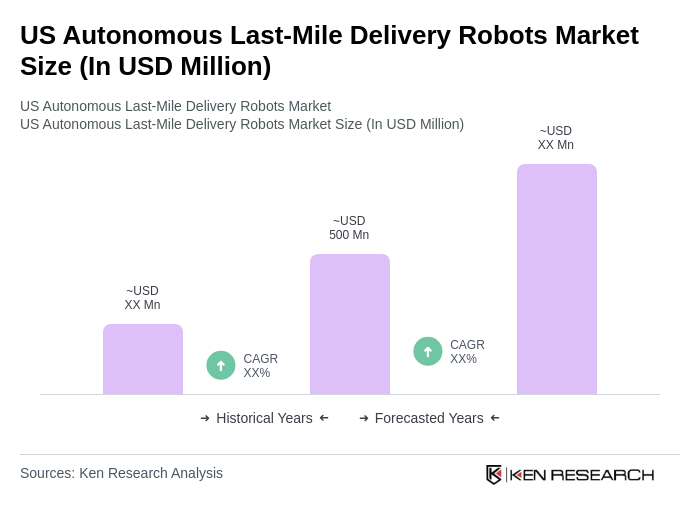
- The US Autonomous Last-Mile Delivery Robots Market is valued at USD 500 million, based on a five-year historical analysis. This growth is primarily driven by the increasing demand for efficient delivery solutions, particularly in urban areas, as well as advancements in robotics, artificial intelligence, and sensor technologies. The rise of e-commerce, the need for rapid and contactless delivery, and ongoing labor shortages in logistics have further accelerated the adoption of autonomous delivery robots .
- Key cities driving market adoption include San Francisco, New York, and Los Angeles, which lead due to high population density, significant e-commerce activity, and robust infrastructure for piloting and deploying autonomous delivery solutions. These urban centers offer favorable local regulatory frameworks and a tech-savvy consumer base, facilitating rapid testing and commercialization of autonomous delivery robots .
- In 2023, the US government introduced operational guidelines for autonomous delivery robots through the "National Highway Traffic Safety Administration Automated Vehicles Policy, 2023" issued by the US Department of Transportation. This regulation sets forth safety standards, operational zones, and requirements for pedestrian interaction, ensuring safe integration of autonomous robots into public spaces while supporting innovation in last-mile logistics.
US Autonomous Last-Mile Delivery Robots Market Segmentation
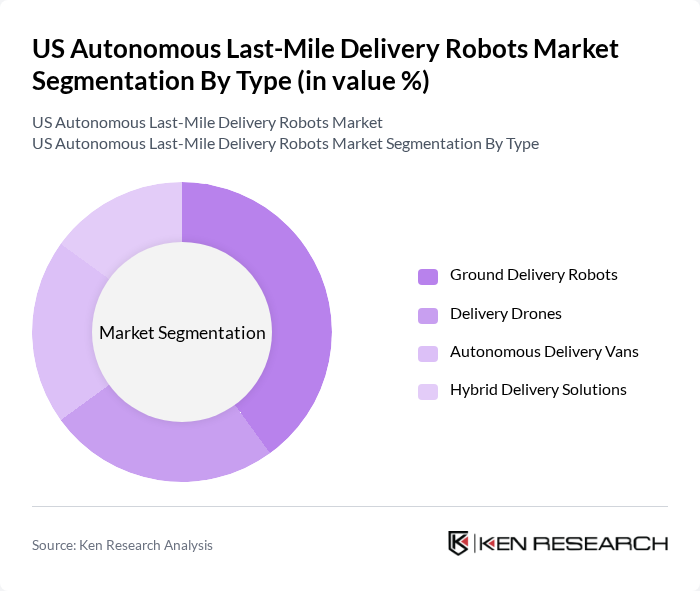
By Type:The market is segmented into Ground Delivery Robots, Delivery Drones, Autonomous Delivery Vans, and Hybrid Delivery Solutions. Ground Delivery Robots are the most widely adopted for short-distance, urban deliveries due to their ability to navigate sidewalks and congested city environments. Delivery Drones are gaining traction for urgent, lightweight deliveries, especially in areas with challenging road access. Autonomous Delivery Vans serve larger payloads and longer routes, while Hybrid Delivery Solutions combine multiple modalities to optimize efficiency and coverage .
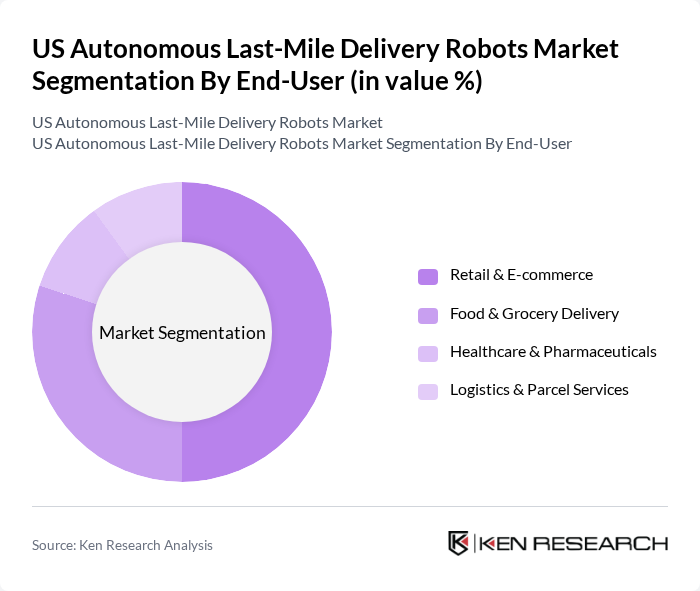
By End-User:The end-user segmentation includes Retail & E-commerce, Food & Grocery Delivery, Healthcare & Pharmaceuticals, and Logistics & Parcel Services. Retail & E-commerce dominates due to the surge in online shopping and consumer expectations for fast, reliable delivery. Food & Grocery Delivery is a major segment, leveraging autonomous robots for rapid, contactless fulfillment. Healthcare & Pharmaceuticals utilize robots for secure, timely medication and sample transport, while Logistics & Parcel Services focus on optimizing last-mile efficiency for a variety of goods .
US Autonomous Last-Mile Delivery Robots Market Competitive Landscape
The US Autonomous Last-Mile Delivery Robots Market is characterized by a dynamic mix of regional and international players. Leading participants such as Starship Technologies, Nuro, Amazon Robotics, Robby Technologies, Kiwibot, Postmates (Uber Eats), FedEx SameDay Bot, Zipline, Waymo, Boxbot, Marble, TeleRetail, Yandex.Rover, A2Z Drone Delivery, Gatik, Refraction AI, Udelv, Serve Robotics, Coco, Wing (Alphabet) contribute to innovation, geographic expansion, and service delivery in this space.
US Autonomous Last-Mile Delivery Robots Market Industry Analysis
Growth Drivers
- Increasing Demand for Contactless Delivery:The COVID-19 pandemic has accelerated the demand for contactless delivery solutions, with a reported 40% increase in online orders in future. According to the U.S. Census Bureau, e-commerce sales reached $1.1 trillion in future, reflecting a significant shift in consumer behavior. This trend is expected to continue, as 70% of consumers express a preference for contactless delivery options, driving the adoption of autonomous last-mile delivery robots in urban areas.
- Advancements in Robotics Technology:The robotics sector is witnessing rapid technological advancements, with investments in AI and machine learning projected to reach $150 billion in future, according to the International Federation of Robotics. These innovations enhance the capabilities of autonomous delivery robots, enabling them to navigate complex urban environments more efficiently. As a result, companies are increasingly integrating these technologies to improve delivery speed and reliability, further propelling market growth.
- Rising E-commerce Activities:The U.S. e-commerce market is projected to grow to $1.5 trillion in future, according to Statista. This growth is driven by changing consumer preferences and the convenience of online shopping. As e-commerce expands, the demand for efficient last-mile delivery solutions increases, creating a favorable environment for autonomous delivery robots. Companies are investing in these technologies to meet consumer expectations for faster and more reliable delivery services.
Market Challenges
- Regulatory Hurdles:The deployment of autonomous delivery robots faces significant regulatory challenges. As of future, only 20 states have enacted laws specifically addressing the operation of delivery robots, creating a fragmented regulatory landscape. This inconsistency can hinder the expansion of services, as companies must navigate varying state regulations, which can delay deployment and increase operational costs, ultimately impacting market growth.
- Public Acceptance and Trust Issues:Public perception plays a crucial role in the adoption of autonomous delivery robots. A survey by the Pew Research Center found that only 50% of Americans are comfortable with the idea of robots delivering goods. Concerns about safety, privacy, and reliability contribute to this skepticism. Building public trust is essential for widespread acceptance, and companies must invest in education and outreach to address these concerns effectively.
US Autonomous Last-Mile Delivery Robots Market Future Outlook
The future of the US autonomous last-mile delivery robots market appears promising, driven by technological advancements and evolving consumer preferences. As urbanization continues, cities are increasingly adopting smart city initiatives, which will integrate autonomous delivery solutions into urban infrastructure. Additionally, partnerships between delivery companies and retailers are expected to enhance service offerings, making delivery more efficient. The focus on sustainability will also drive innovation, as companies seek eco-friendly delivery options to meet consumer demand for greener solutions.
Market Opportunities
- Expansion into Suburban Areas:As urban areas become saturated, there is a significant opportunity for autonomous delivery robots to expand into suburban regions. With a growing population in these areas, the demand for efficient delivery solutions is increasing. Companies can tap into this market by offering tailored services that cater to the unique needs of suburban consumers, potentially increasing their market share.
- Partnerships with Retailers:Collaborating with retailers presents a lucrative opportunity for autonomous delivery companies. By forming strategic partnerships, companies can enhance their service offerings and streamline operations. Retailers are increasingly looking for innovative delivery solutions to meet consumer expectations, and these partnerships can lead to improved customer satisfaction and increased sales, benefiting both parties involved.
Scope of the Report
| Segment | Sub-Segments |
|---|---|
| By Type | Ground Delivery Robots Delivery Drones Autonomous Delivery Vans Hybrid Delivery Solutions |
| By End-User | Retail & E-commerce Food & Grocery Delivery Healthcare & Pharmaceuticals Logistics & Parcel Services |
| By Application | Package Delivery Grocery Delivery Medical Supplies Delivery Restaurant Meal Delivery |
| By Distribution Mode | Direct-to-Consumer (D2C) Business-to-Business (B2B) |
| By Payload Capacity | Light Payload (up to 5 kg) Medium Payload (5 kg to 20 kg) Heavy Payload (above 20 kg) |
| By Pricing Strategy | Premium Pricing Competitive Pricing Value-Based Pricing |
| By Range | Short Range (<20 km) Long Range (?20 km) |
Key Target Audience
Investors and Venture Capitalist Firms
Government and Regulatory Bodies (e.g., Federal Aviation Administration, Department of Transportation)
Manufacturers and Producers
Logistics and Supply Chain Companies
Retail Chains and E-commerce Platforms
Technology Providers
Industry Associations (e.g., Robotics Industries Association)
Financial Institutions
Players Mentioned in the Report:
Starship Technologies
Nuro
Amazon Robotics
Robby Technologies
Kiwibot
Postmates (Uber Eats)
FedEx SameDay Bot
Zipline
Waymo
Boxbot
Marble
TeleRetail
Yandex.Rover
A2Z Drone Delivery
Gatik
Refraction AI
Udelv
Serve Robotics
Coco
Wing (Alphabet)
Table of Contents
Market Assessment Phase
1. Executive Summary and Approach
2. US Autonomous Last-Mile Delivery Robots Market Overview
2.1 Key Insights and Strategic Recommendations
2.2 US Autonomous Last-Mile Delivery Robots Market Overview
2.3 Definition and Scope
2.4 Evolution of Market Ecosystem
2.5 Timeline of Key Regulatory Milestones
2.6 Value Chain & Stakeholder Mapping
2.7 Business Cycle Analysis
2.8 Policy & Incentive Landscape
3. US Autonomous Last-Mile Delivery Robots Market Analysis
3.1 Growth Drivers
3.1.1 Increasing Demand for Contactless Delivery
3.1.2 Advancements in Robotics Technology
3.1.3 Rising E-commerce Activities
3.1.4 Urbanization and Traffic Congestion
3.2 Market Challenges
3.2.1 Regulatory Hurdles
3.2.2 High Initial Investment Costs
3.2.3 Public Acceptance and Trust Issues
3.2.4 Competition from Traditional Delivery Services
3.3 Market Opportunities
3.3.1 Expansion into Suburban Areas
3.3.2 Partnerships with Retailers
3.3.3 Integration with Smart City Initiatives
3.3.4 Development of Advanced AI Algorithms
3.4 Market Trends
3.4.1 Increased Investment in R&D
3.4.2 Focus on Sustainability and Eco-friendliness
3.4.3 Adoption of Autonomous Fleet Management
3.4.4 Growth of Last-Mile Delivery Startups
3.5 Government Regulation
3.5.1 Safety Standards for Autonomous Vehicles
3.5.2 Zoning Laws for Delivery Robots
3.5.3 Data Privacy Regulations
3.5.4 Incentives for Green Technology Adoption
4. SWOT Analysis
5. Stakeholder Analysis
6. Porter's Five Forces Analysis
7. US Autonomous Last-Mile Delivery Robots Market Market Size, 2019-2024
7.1 By Value
7.2 By Volume
7.3 By Average Selling Price
8. US Autonomous Last-Mile Delivery Robots Market Segmentation
8.1 By Type
8.1.1 Ground Delivery Robots
8.1.2 Delivery Drones
8.1.3 Autonomous Delivery Vans
8.1.4 Hybrid Delivery Solutions
8.2 By End-User
8.2.1 Retail & E-commerce
8.2.2 Food & Grocery Delivery
8.2.3 Healthcare & Pharmaceuticals
8.2.4 Logistics & Parcel Services
8.3 By Application
8.3.1 Package Delivery
8.3.2 Grocery Delivery
8.3.3 Medical Supplies Delivery
8.3.4 Restaurant Meal Delivery
8.4 By Distribution Mode
8.4.1 Direct-to-Consumer (D2C)
8.4.2 Business-to-Business (B2B)
8.5 By Payload Capacity
8.5.1 Light Payload (up to 5 kg)
8.5.2 Medium Payload (5 kg to 20 kg)
8.5.3 Heavy Payload (above 20 kg)
8.6 By Pricing Strategy
8.6.1 Premium Pricing
8.6.2 Competitive Pricing
8.6.3 Value-Based Pricing
8.7 By Range
8.7.1 Short Range (<20 km)
8.7.2 Long Range (≥20 km)
8.8 Others
9. US Autonomous Last-Mile Delivery Robots Market Competitive Analysis
9.1 Market Share of Key Players
9.2 KPIs for Cross Comparison of Key Players
9.2.1 Company Name
9.2.2 Fleet Size (Active Robots/Vehicles)
9.2.3 Annual Revenue from Autonomous Delivery
9.2.4 Market Penetration (Cities/States Served)
9.2.5 Average Delivery Time (Minutes/Miles)
9.2.6 Successful Delivery Rate (%)
9.2.7 Customer Retention Rate (%)
9.2.8 Operational Cost per Delivery ($)
9.2.9 Technology Investment (% of Revenue)
9.2.10 Regulatory Compliance Score
9.2.11 Customer Satisfaction Score (NPS or Equivalent)
9.2.12 Innovation Index (Patents, New Features)
9.3 SWOT Analysis of Top Players
9.4 Pricing Analysis
9.5 Detailed Profile of Major Companies
9.5.1 Starship Technologies
9.5.2 Nuro
9.5.3 Amazon Robotics
9.5.4 Robby Technologies
9.5.5 Kiwibot
9.5.6 Postmates (Uber Eats)
9.5.7 FedEx SameDay Bot
9.5.8 Zipline
9.5.9 Waymo
9.5.10 Boxbot
9.5.11 Marble
9.5.12 TeleRetail
9.5.13 Yandex.Rover
9.5.14 A2Z Drone Delivery
9.5.15 Gatik
9.5.16 Refraction AI
9.5.17 Udelv
9.5.18 Serve Robotics
9.5.19 Coco
9.5.20 Wing (Alphabet)
10. US Autonomous Last-Mile Delivery Robots Market End-User Analysis
10.1 Procurement Behavior of Key Ministries
10.1.1 Government Contracts for Delivery Services
10.1.2 Budget Allocations for Technology Adoption
10.1.3 Evaluation Criteria for Vendor Selection
10.2 Corporate Spend on Infrastructure & Energy
10.2.1 Investment in Delivery Infrastructure
10.2.2 Energy Consumption Patterns
10.2.3 Budget for Technology Upgrades
10.3 Pain Point Analysis by End-User Category
10.3.1 Delivery Speed Concerns
10.3.2 Cost Efficiency Issues
10.3.3 Reliability and Trust Factors
10.4 User Readiness for Adoption
10.4.1 Awareness of Autonomous Delivery Solutions
10.4.2 Willingness to Pay for Convenience
10.4.3 Perceived Safety of Delivery Robots
10.5 Post-Deployment ROI and Use Case Expansion
10.5.1 Measurement of Cost Savings
10.5.2 Expansion into New Delivery Areas
10.5.3 Customer Feedback and Adaptation
11. US Autonomous Last-Mile Delivery Robots Market Future Size, 2025-2030
11.1 By Value
11.2 By Volume
11.3 By Average Selling Price
Go-To-Market Strategy Phase
1. Whitespace Analysis + Business Model Canvas
1.1 Market Gaps Identification
1.2 Business Model Framework
2. Marketing and Positioning Recommendations
2.1 Branding Strategies
2.2 Product USPs
3. Distribution Plan
3.1 Urban Retail vs Rural NGO Tie-ups
4. Channel & Pricing Gaps
4.1 Underserved Routes
4.2 Pricing Bands
5. Unmet Demand & Latent Needs
5.1 Category Gaps
5.2 Consumer Segments
6. Customer Relationship
6.1 Loyalty Programs
6.2 After-sales Service
7. Value Proposition
7.1 Sustainability
7.2 Integrated Supply Chains
8. Key Activities
8.1 Regulatory Compliance
8.2 Branding
8.3 Distribution Setup
9. Entry Strategy Evaluation
9.1 Domestic Market Entry Strategy
9.1.1 Product Mix
9.1.2 Pricing Band
9.1.3 Packaging
9.2 Export Entry Strategy
9.2.1 Target Countries
9.2.2 Compliance Roadmap
10. Entry Mode Assessment
10.1 JV
10.2 Greenfield
10.3 M&A
10.4 Distributor Model
11. Capital and Timeline Estimation
11.1 Capital Requirements
11.2 Timelines
12. Control vs Risk Trade-Off
12.1 Ownership vs Partnerships
13. Profitability Outlook
13.1 Breakeven Analysis
13.2 Long-term Sustainability
14. Potential Partner List
14.1 Distributors
14.2 JVs
14.3 Acquisition Targets
15. Execution Roadmap
15.1 Phased Plan for Market Entry
15.1.1 Market Setup
15.1.2 Market Entry
15.1.3 Growth Acceleration
15.1.4 Scale & Stabilize
15.2 Key Activities and Milestones
15.2.1 Activity Timeline
15.2.2 Milestone Tracking
Research Methodology
Phase 1: Approach1
Desk Research
- Industry reports from logistics and automation associations
- Market analysis from government publications on transportation and delivery
- Academic journals focusing on robotics and last-mile delivery innovations
Primary Research
- Interviews with executives from leading autonomous delivery robot manufacturers
- Surveys with logistics managers in urban delivery services
- Field interviews with technology developers in robotics and AI
Validation & Triangulation
- Cross-validation of data from multiple industry sources and reports
- Triangulation of insights from primary interviews and secondary data
- Sanity checks through expert panels comprising industry veterans
Phase 2: Market Size Estimation1
Top-down Assessment
- Analysis of total logistics market size and growth trends in the U.S.
- Segmentation of the market by urban vs. rural delivery needs
- Incorporation of government initiatives promoting autonomous delivery solutions
Bottom-up Modeling
- Volume estimates based on deployment rates of delivery robots in urban areas
- Cost analysis derived from operational expenses of existing delivery services
- Revenue projections based on average delivery fees and service frequency
Forecasting & Scenario Analysis
- Multi-variable regression analysis incorporating e-commerce growth rates
- Scenario modeling based on technological advancements and regulatory impacts
- Development of baseline, optimistic, and pessimistic market forecasts through 2030
Phase 3: CATI Sample Composition1
| Scope Item/Segment | Sample Size | Target Respondent Profiles |
|---|---|---|
| Urban Delivery Services | 100 | Logistics Coordinators, Operations Managers |
| Retail Sector Implementation | 60 | Supply Chain Directors, Retail Operations Managers |
| Technology Development in Robotics | 50 | R&D Managers, Robotics Engineers |
| Consumer Acceptance Studies | 80 | Market Researchers, Consumer Behavior Analysts |
| Regulatory Compliance Insights | 40 | Policy Makers, Compliance Officers |
Frequently Asked Questions
What is the current value of the US Autonomous Last-Mile Delivery Robots Market?
The US Autonomous Last-Mile Delivery Robots Market is valued at approximately USD 500 million, driven by the increasing demand for efficient delivery solutions, advancements in robotics, and the rise of e-commerce, particularly in urban areas.
What factors are driving the growth of autonomous delivery robots in the US?
Which cities are leading in the adoption of autonomous delivery robots?
What are the main types of autonomous delivery robots available in the market?
Other Regional/Country Reports
Indonesia Autonomous Last-Mile Delivery Robots Market
Malaysia Autonomous Last-Mile Delivery Robots Market
KSA Autonomous Last-Mile Delivery Robots Market
APAC Autonomous Last-Mile Delivery Robots Market
SEA Autonomous Last-Mile Delivery Robots Market
Vietnam Autonomous Last-Mile Delivery Robots Market
Other Adjacent Reports
KSA E-Commerce Logistics Market
Bahrain Autonomous Drone Delivery Market
Thailand Warehouse Robotics Market
Oman AI in Supply Chain Market
South Africa Urban Mobility Solutions Market
South Korea Food Delivery Services Market
Japan Retail Automation Market
Bahrain IoT Logistics Market
Germany Electric Vehicle Charging Market
KSA Smart City Infrastructure Market
Why Buy From Us?

What makes us stand out is that our consultants follow Robust, Refine and Result (RRR) methodology. Robust for clear definitions, approaches and sanity checking, Refine for differentiating respondents' facts and opinions, and Result for presenting data with story.

We have set a benchmark in the industry by offering our clients with syndicated and customized market research reports featuring coverage of entire market as well as meticulous research and analyst insights.

While we don't replace traditional research, we flip the method upside down. Our dual approach of Top Bottom & Bottom Top ensures quality deliverable by not just verifying company fundamentals but also looking at the sector and macroeconomic factors.

With one step in the future, our research team constantly tries to show you the bigger picture. We help with some of the tough questions you may encounter along the way: How is the industry positioned? Best marketing channel? KPI's of competitors? By aligning every element, we help maximize success.

Our report gives you instant access to the answers and sources that other companies might choose to hide. We elaborate each steps of research methodology we have used and showcase you the sample size to earn your trust.

If you need any support, we are here! We pride ourselves on universe strength, data quality, and quick, friendly, and professional service.