About the Report
Base Year 2024US Cattle Management Software Market Overview
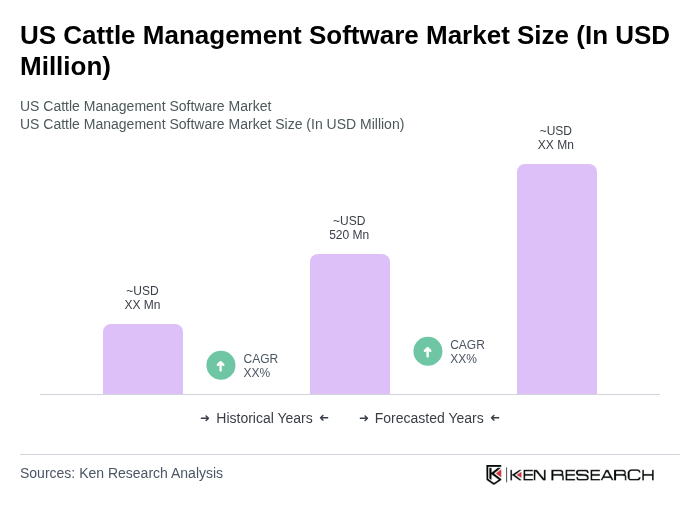
- The US Cattle Management Software Market is valued at USD 520 million, based on a five-year historical analysis. This growth is primarily driven by the increasing adoption of precision livestock farming, integration of artificial intelligence and Internet of Things (IoT) into herd management, and the rising demand for data-driven decision-making in both dairy and beef operations. The software solutions help farmers optimize operations through real-time health monitoring, feeding optimization, reproduction management, and financial analytics, which collectively improve productivity and enhance profitability.
- Key contributors to demand in this market include states like Texas, California, and Wisconsin, which consistently rank among the leading states in cattle and calf inventories, milk production, and large-scale feedlot and dairy operations. These regions have a high concentration of both dairy and beef farms, including large commercial dairies and feedlots, which creates strong demand for specialized software solutions for herd health, breeding, feeding, and traceability tailored to intensive, high-output production systems.
- The most recent federal framework shaping technology and digital tools in US agriculture is the Agriculture Improvement Act of 2018 (commonly referred to as the 2018 Farm Bill), enacted by the United States Congress and administered primarily by the United States Department of Agriculture (USDA). This legislation authorizes multiple programs that support technology adoption on farms, including competitive grants and loans under the USDA’s Farm Service Agency, Natural Resources Conservation Service, and Rural Development programs for precision agriculture, data systems, and animal monitoring technologies, which can encompass cattle management software when tied to productivity, conservation, or animal health outcomes. While the Act does not earmark a single dedicated amount exclusively for cattle management software, its authorized funding streams for digital and precision agriculture tools are an important policy driver for software uptake in the cattle sector.
US Cattle Management Software Market Segmentation
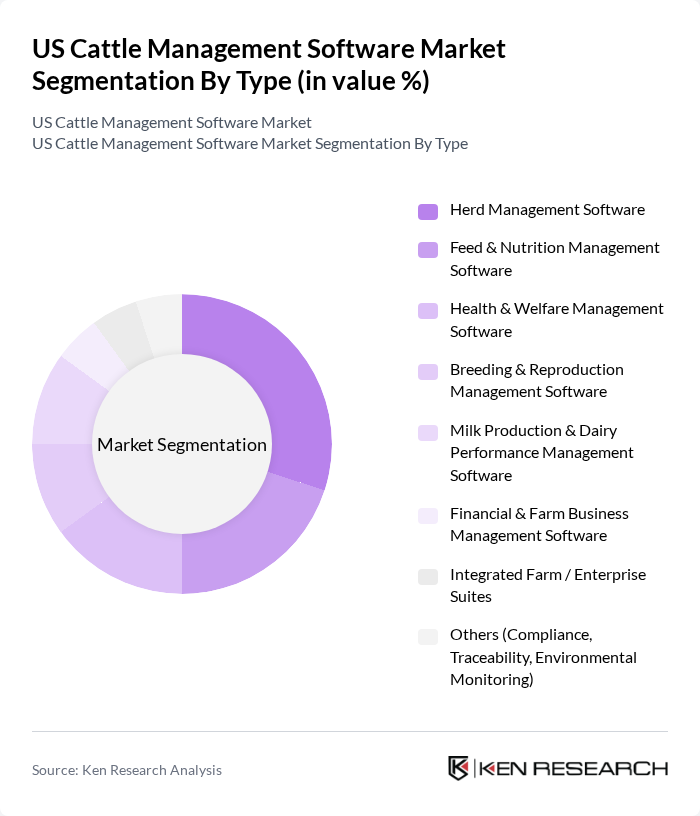
By Type:The market is segmented into various types of software solutions that cater to different aspects of cattle management. The primary subsegments include Herd Management Software, Feed & Nutrition Management Software, Health & Welfare Management Software, Breeding & Reproduction Management Software, Milk Production & Dairy Performance Management Software, Financial & Farm Business Management Software, Integrated Farm / Enterprise Suites, and Others (Compliance, Traceability, Environmental Monitoring). This functional segmentation aligns with global analyses that highlight herd health monitoring, breeding and reproduction, feeding and nutrition, milk yield tracking, and farm financial analytics as core modules of cattle management platforms. Among these, Herd Management Software is the most dominant segment, driven by the need to consolidate identification, health records, reproduction data, and productivity metrics into integrated dashboards that support daily operational and strategic decision-making.
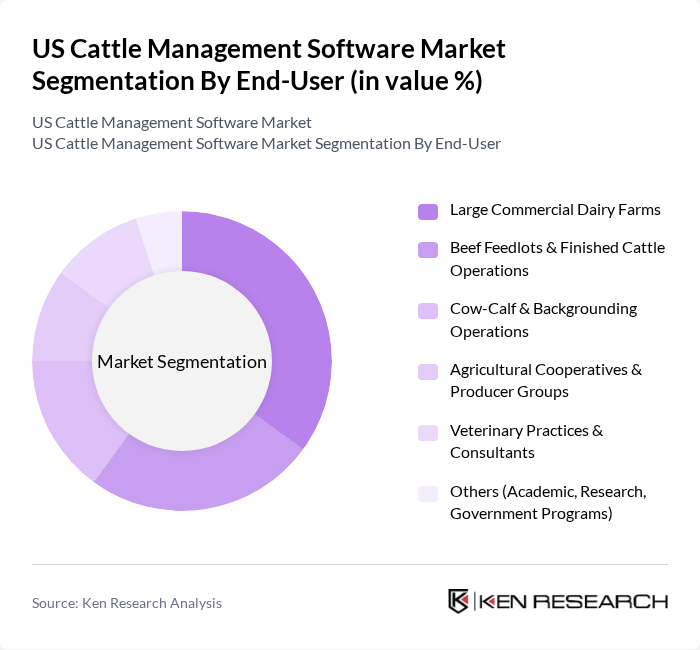
By End-User:The end-user segmentation includes Large Commercial Dairy Farms, Beef Feedlots & Finished Cattle Operations, Cow-Calf & Backgrounding Operations, Agricultural Cooperatives & Producer Groups, Veterinary Practices & Consultants, and Others (Academic, Research, Government Programs). Large Commercial Dairy Farms represent the largest segment, consistent with evidence that dairy operations are the leading revenue-generating sector for cattle management software in the US, reflecting intensive use of milking robots, sensors, and integrated herd management platforms. These users typically require comprehensive, integrated solutions for milk production tracking, reproductive performance, feed optimization, and health monitoring to maintain high output, meet quality standards, and manage labor efficiency.
US Cattle Management Software Market Competitive Landscape
The US Cattle Management Software Market is characterized by a dynamic mix of regional and international players. Leading participants such as CattleMax, AgriWebb, FarmWizard, Herdwatch, BoviSync, CowManager, Livestocked, PastureMap, VAS (Valley Agricultural Software), Afimilk, GEA Group (DairyNet / DairyPlan), Allflex Livestock Intelligence (MSD Animal Health Intelligence), Merck Animal Health Intelligence, Zoetis, CattleEye contribute to innovation, geographic expansion, and service delivery in this space.
US Cattle Management Software Market Industry Analysis
Growth Drivers
- Increasing Demand for Livestock Tracking:The US cattle industry is projected to reach approximately 96 million head of cattle in the future, driving the need for effective livestock tracking solutions. With the USDA reporting that 82% of cattle producers are adopting technology for tracking, the demand for cattle management software is surging. This trend is further supported by the increasing consumer preference for transparency in food sourcing, compelling farmers to invest in tracking technologies to enhance operational efficiency and meet market demands.
- Adoption of Precision Agriculture Technologies:The precision agriculture market is expected to grow to $14 billion in the future, with cattle management software playing a crucial role. Farmers are increasingly utilizing data-driven insights to optimize feed efficiency and reduce costs. The integration of GPS and remote sensing technologies allows for real-time monitoring of cattle health and pasture conditions, leading to improved productivity. This shift towards precision farming is essential for meeting the growing global food demand, further propelling software adoption in cattle management.
- Rising Focus on Animal Health and Welfare:The US cattle industry is witnessing a heightened emphasis on animal welfare, with the American Veterinary Medical Association reporting that 75% of consumers prioritize animal health in their purchasing decisions. This focus is driving cattle producers to implement management software that monitors health metrics and ensures compliance with welfare standards. As regulations tighten, the demand for software solutions that facilitate health tracking and reporting is expected to increase, enhancing overall herd management practices.
Market Challenges
- High Initial Investment Costs:The average cost of implementing cattle management software can range from $6,000 to $22,000, depending on the features and scale of the operation. Many small to medium-sized farms struggle with these upfront costs, which can deter technology adoption. Additionally, the ongoing costs associated with software maintenance and updates can further strain budgets, making it challenging for farmers to justify the investment despite potential long-term savings and efficiency gains.
- Lack of Technical Expertise Among Farmers:A significant barrier to the adoption of cattle management software is the limited technical expertise among farmers. According to the USDA, nearly 62% of farmers report feeling unprepared to utilize advanced technologies. This skills gap can lead to underutilization of software capabilities, resulting in suboptimal operational improvements. Training programs and user-friendly interfaces are essential to bridge this gap and encourage broader adoption of technology in cattle management practices.
US Cattle Management Software Market Future Outlook
The future of the US cattle management software market appears promising, driven by technological advancements and increasing consumer demand for sustainable practices. As farmers seek to enhance productivity and animal welfare, the integration of AI and machine learning into software solutions is expected to rise. Additionally, the growing trend of data analytics will enable more informed decision-making, fostering a more efficient cattle management ecosystem. This evolution will likely attract new entrants and investments, further stimulating market growth.
Market Opportunities
- Expansion into Emerging Markets:With the global cattle population projected to grow by 1.7% annually, there is significant potential for US cattle management software providers to expand into emerging markets. Countries in Asia and Africa are increasingly adopting modern farming practices, creating opportunities for tailored software solutions that address local challenges and enhance productivity in these regions.
- Development of Mobile Applications:The rise of mobile technology presents a unique opportunity for cattle management software developers. With over 85% of farmers using smartphones, creating mobile applications that facilitate real-time data access and management can significantly enhance user engagement. These applications can streamline operations, improve communication, and provide farmers with critical insights on-the-go, ultimately driving software adoption.
Scope of the Report
| Segment | Sub-Segments |
|---|---|
| By Type | Herd Management Software Feed & Nutrition Management Software Health & Welfare Management Software Breeding & Reproduction Management Software Milk Production & Dairy Performance Management Software Financial & Farm Business Management Software Integrated Farm / Enterprise Suites Others (Compliance, Traceability, Environmental Monitoring) |
| By End-User | Large Commercial Dairy Farms Beef Feedlots & Finished Cattle Operations Cow-Calf & Backgrounding Operations Agricultural Cooperatives & Producer Groups Veterinary Practices & Consultants Others (Academic, Research, Government Programs) |
| By Deployment Model | On-Premise Cloud-Based (SaaS) Hybrid |
| By Region | Midwest South West Northeast |
| By Software Features | Advanced Analytics & Decision Support Mobile & Offline Access Integration with IoT & Sensor Devices (Wearables, Tags, Collars) Integration with Milking, Feeding & Sorting Equipment Compliance, Traceability & Record-Keeping Custom Dashboards & Reporting Others |
| By Pricing Model | Subscription-Based (Monthly/Annual SaaS) One-Time License Purchase Per-Head / Per-Farm Usage-Based Pricing Tiered Plans (Basic, Professional, Enterprise) Others (Custom / Enterprise Contracts) |
| By Customer Size | Small Farms (<100 Head) Medium Farms (100–999 Head) Large Farms (?1,000 Head) |
Key Target Audience
Investors and Venture Capitalist Firms
Government and Regulatory Bodies (e.g., USDA, FDA)
Cattle Ranchers and Livestock Producers
Software Developers and Technology Providers
Livestock Associations and Cooperatives
Supply Chain and Logistics Companies
Financial Institutions and Banks
Agricultural Equipment Manufacturers
Players Mentioned in the Report:
CattleMax
AgriWebb
FarmWizard
Herdwatch
BoviSync
CowManager
Livestocked
PastureMap
VAS (Valley Agricultural Software)
Afimilk
GEA Group (DairyNet / DairyPlan)
Allflex Livestock Intelligence (MSD Animal Health Intelligence)
Merck Animal Health Intelligence
Zoetis
CattleEye
Table of Contents
Market Assessment Phase
1. Executive Summary and Approach
2. US Cattle Management Software Market Overview
2.1 Key Insights and Strategic Recommendations
2.2 US Cattle Management Software Market Overview
2.3 Definition and Scope
2.4 Evolution of Market Ecosystem
2.5 Timeline of Key Regulatory Milestones
2.6 Value Chain & Stakeholder Mapping
2.7 Business Cycle Analysis
2.8 Policy & Incentive Landscape
3. US Cattle Management Software Market Analysis
3.1 Growth Drivers
3.1.1 Increasing demand for livestock tracking
3.1.2 Adoption of precision agriculture technologies
3.1.3 Rising focus on animal health and welfare
3.1.4 Integration of IoT in cattle management
3.2 Market Challenges
3.2.1 High initial investment costs
3.2.2 Lack of technical expertise among farmers
3.2.3 Data privacy and security concerns
3.2.4 Resistance to change from traditional practices
3.3 Market Opportunities
3.3.1 Expansion into emerging markets
3.3.2 Development of mobile applications
3.3.3 Partnerships with agricultural organizations
3.3.4 Customization of software solutions
3.4 Market Trends
3.4.1 Increasing use of cloud-based solutions
3.4.2 Growth of data analytics in cattle management
3.4.3 Rising popularity of subscription-based models
3.4.4 Enhanced focus on sustainability practices
3.5 Government Regulation
3.5.1 Compliance with animal welfare standards
3.5.2 Regulations on data management and privacy
3.5.3 Incentives for technology adoption
3.5.4 Environmental regulations impacting cattle farming
4. SWOT Analysis
5. Stakeholder Analysis
6. Porter's Five Forces Analysis
7. US Cattle Management Software Market Size, 2019-2024
7.1 By Value
7.2 By Volume
7.3 By Average Selling Price
8. US Cattle Management Software Market Segmentation
8.1 By Type
8.1.1 Herd Management Software
8.1.2 Feed & Nutrition Management Software
8.1.3 Health & Welfare Management Software
8.1.4 Breeding & Reproduction Management Software
8.1.5 Milk Production & Dairy Performance Management Software
8.1.6 Financial & Farm Business Management Software
8.1.7 Integrated Farm / Enterprise Suites
8.1.8 Others (Compliance, Traceability, Environmental Monitoring)
8.2 By End-User
8.2.1 Large Commercial Dairy Farms
8.2.2 Beef Feedlots & Finished Cattle Operations
8.2.3 Cow-Calf & Backgrounding Operations
8.2.4 Agricultural Cooperatives & Producer Groups
8.2.5 Veterinary Practices & Consultants
8.2.6 Others (Academic, Research, Government Programs)
8.3 By Deployment Model
8.3.1 On-Premise
8.3.2 Cloud-Based (SaaS)
8.3.3 Hybrid
8.4 By Region
8.4.1 Midwest
8.4.2 South
8.4.3 West
8.4.4 Northeast
8.5 By Software Features
8.5.1 Advanced Analytics & Decision Support
8.5.2 Mobile & Offline Access
8.5.3 Integration with IoT & Sensor Devices (Wearables, Tags, Collars)
8.5.4 Integration with Milking, Feeding & Sorting Equipment
8.5.5 Compliance, Traceability & Record-Keeping
8.5.6 Custom Dashboards & Reporting
8.5.7 Others
8.6 By Pricing Model
8.6.1 Subscription-Based (Monthly/Annual SaaS)
8.6.2 One-Time License Purchase
8.6.3 Per-Head / Per-Farm Usage-Based Pricing
8.6.4 Tiered Plans (Basic, Professional, Enterprise)
8.6.5 Others (Custom / Enterprise Contracts)
8.7 By Customer Size
8.7.1 Small Farms (<100 Head)
8.7.2 Medium Farms (100–999 Head)
8.7.3 Large Farms (≥1,000 Head)
9. US Cattle Management Software Market Competitive Analysis
9.1 Market Share of Key Players
9.2 Cross Comparison of Key Players
9.2.1 Company Name
9.2.2 Headquarters Location (U.S. / International)
9.2.3 Primary Customer Segment (Dairy / Beef / Mixed)
9.2.4 Deployment Focus (Cloud, On-Premise, Hybrid)
9.2.5 Estimated US Installed Base (Number of Farms / Operations)
9.2.6 Estimated Cattle Under Management (Head Count Range)
9.2.7 Average Contract Value per Farm (Annual)
9.2.8 Revenue Mix from the US Market (%)
9.2.9 Customer Retention / Renewal Rate (%)
9.2.10 Annual Recurring Revenue from US Cattle Segment
9.2.11 Average Implementation Time (Onboarding Duration)
9.2.12 Integration Depth (IoT Devices, Milking & Feeding Systems Supported)
9.2.13 Product Breadth (Number of Active Modules / Functions)
9.2.14 R&D Intensity (% of Revenue Spent on Product Development)
9.2.15 Customer Support Coverage (Hours, Channels, Languages)
9.3 SWOT Analysis of Top Players
9.4 Pricing Analysis
9.5 Detailed Profile of Major Companies
9.5.1 CattleMax
9.5.2 AgriWebb
9.5.3 FarmWizard
9.5.4 Herdwatch
9.5.5 BoviSync
9.5.6 CowManager
9.5.7 Livestocked
9.5.8 PastureMap
9.5.9 VAS (Valley Agricultural Software)
9.5.10 Afimilk
9.5.11 GEA Group (DairyNet / DairyPlan)
9.5.12 Allflex Livestock Intelligence (MSD Animal Health Intelligence)
9.5.13 Merck Animal Health Intelligence
9.5.14 Zoetis
9.5.15 CattleEye
10. US Cattle Management Software Market End-User Analysis
10.1 Procurement Behavior of Key Ministries
10.1.1 Budget Allocation for Technology
10.1.2 Decision-Making Processes
10.1.3 Vendor Selection Criteria
10.1.4 Contracting Procedures
10.2 Corporate Spend on Infrastructure & Energy
10.2.1 Investment in Software Solutions
10.2.2 Budgeting for Training and Support
10.2.3 Long-term Financial Commitments
10.2.4 Others
10.3 Pain Point Analysis by End-User Category
10.3.1 Data Management Issues
10.3.2 Integration Challenges
10.3.3 User Training Needs
10.3.4 Cost Management Concerns
10.4 User Readiness for Adoption
10.4.1 Technology Familiarity
10.4.2 Training Availability
10.4.3 Support Infrastructure
10.4.4 Others
10.5 Post-Deployment ROI and Use Case Expansion
10.5.1 Measurement of Success Metrics
10.5.2 User Feedback Mechanisms
10.5.3 Opportunities for Upselling
10.5.4 Others
11. US Cattle Management Software Market Future Size, 2025-2030
11.1 By Value
11.2 By Volume
11.3 By Average Selling Price
Go-To-Market Strategy Phase
1. Whitespace Analysis + Business Model Canvas
1.1 Market Gaps Identification
1.2 Value Proposition Development
1.3 Revenue Streams Analysis
1.4 Cost Structure Evaluation
1.5 Key Partnerships Exploration
1.6 Customer Segmentation
1.7 Channels of Distribution
2. Marketing and Positioning Recommendations
2.1 Branding Strategies
2.2 Product USPs
2.3 Target Audience Identification
2.4 Communication Strategies
2.5 Digital Marketing Approaches
2.6 Trade Show Participation
2.7 Customer Engagement Tactics
3. Distribution Plan
3.1 Urban Retail Strategies
3.2 Rural NGO Tie-Ups
3.3 Online Distribution Channels
3.4 Direct Sales Approaches
3.5 Partnership with Distributors
3.6 Logistics and Supply Chain Management
3.7 Customer Service and Support
4. Channel & Pricing Gaps
4.1 Underserved Routes
4.2 Pricing Bands Analysis
4.3 Competitor Pricing Comparison
4.4 Customer Willingness to Pay
4.5 Value-Based Pricing Strategies
4.6 Discount and Promotion Strategies
4.7 Pricing Model Innovation
5. Unmet Demand & Latent Needs
5.1 Category Gaps Identification
5.2 Consumer Segments Analysis
5.3 Emerging Trends Exploration
5.4 Customer Feedback Utilization
5.5 Product Development Opportunities
5.6 Market Entry Strategies
5.7 Future Demand Forecasting
6. Customer Relationship
6.1 Loyalty Programs
6.2 After-Sales Service
6.3 Customer Feedback Mechanisms
6.4 Community Engagement
6.5 Customer Education Initiatives
6.6 Relationship Management Tools
6.7 Customer Retention Strategies
7. Value Proposition
7.1 Sustainability Initiatives
7.2 Integrated Supply Chains
7.3 Cost Efficiency
7.4 Enhanced User Experience
7.5 Innovation in Product Offerings
7.6 Competitive Advantage Development
7.7 Long-term Partnerships
8. Key Activities
8.1 Regulatory Compliance
8.2 Branding Initiatives
8.3 Distribution Setup
8.4 Training and Development
8.5 Market Research Activities
8.6 Customer Support Operations
8.7 Performance Monitoring
9. Entry Strategy Evaluation
9.1 Domestic Market Entry Strategy
9.1.1 Product Mix Considerations
9.1.2 Pricing Band Analysis
9.1.3 Packaging Strategies
9.2 Export Entry Strategy
9.2.1 Target Countries Identification
9.2.2 Compliance Roadmap Development
10. Entry Mode Assessment
10.1 Joint Ventures
10.2 Greenfield Investments
10.3 Mergers & Acquisitions
10.4 Distributor Model Evaluation
10.5 Risk Assessment
10.6 Strategic Fit Analysis
10.7 Long-term Viability Considerations
11. Capital and Timeline Estimation
11.1 Capital Requirements
11.2 Timelines for Implementation
11.3 Financial Projections
11.4 Funding Sources Exploration
11.5 Budget Allocation Strategies
11.6 Risk Management Planning
11.7 Milestone Tracking
12. Control vs Risk Trade-Off
12.1 Ownership vs Partnerships
12.2 Risk Mitigation Strategies
12.3 Control Mechanisms
12.4 Partnership Evaluation Criteria
12.5 Long-term Control Considerations
12.6 Flexibility in Operations
12.7 Strategic Alliances
13. Profitability Outlook
13.1 Breakeven Analysis
13.2 Long-term Sustainability
13.3 Profit Margin Projections
13.4 Revenue Growth Strategies
13.5 Cost Management Techniques
13.6 Financial Health Monitoring
13.7 Investment Return Analysis
14. Potential Partner List
14.1 Distributors
14.2 Joint Ventures
Research Methodology
Phase 1: Approach1
Desk Research
- Industry reports from agricultural technology associations and market research firms
- Government publications on cattle management practices and software adoption
- Academic journals focusing on livestock management and technology integration
Primary Research
- Interviews with cattle ranchers and farm managers utilizing management software
- Surveys with software developers specializing in agricultural solutions
- Focus groups with industry experts and agricultural consultants
Validation & Triangulation
- Cross-validation of data from multiple sources including trade publications and expert interviews
- Triangulation of findings from primary and secondary research to ensure consistency
- Sanity checks through feedback from a panel of agricultural technology experts
Phase 2: Market Size Estimation1
Top-down Assessment
- Analysis of total agricultural software market size and segmenting by cattle management
- Review of government initiatives promoting technology in livestock management
- Estimation of market share based on adoption rates in different states
Bottom-up Modeling
- Data collection from cattle farms regarding software usage and operational efficiencies
- Cost analysis of software solutions based on pricing models from leading providers
- Volume of cattle managed per software license to estimate total market potential
Forecasting & Scenario Analysis
- Regression analysis incorporating factors such as cattle prices, feed costs, and technology adoption rates
- Scenario modeling based on varying levels of regulatory support and market growth
- Projections for market growth through 2030 under different economic conditions
Phase 3: CATI Sample Composition1
| Scope Item/Segment | Sample Size | Target Respondent Profiles |
|---|---|---|
| Cattle Ranch Management Software | 120 | Farm Owners, Ranch Managers |
| Livestock Health Monitoring Solutions | 100 | Veterinarians, Animal Health Specialists |
| Feed Management Systems | 80 | Feedlot Operators, Nutritionists |
| Data Analytics for Cattle Production | 70 | Agricultural Data Analysts, Farm Technologists |
| Supply Chain Management in Cattle Industry | 90 | Logistics Coordinators, Supply Chain Managers |
Frequently Asked Questions
What is the current value of the US Cattle Management Software Market?
The US Cattle Management Software Market is valued at approximately USD 520 million, reflecting a significant growth trend driven by advancements in precision livestock farming and the integration of technologies like AI and IoT into herd management practices.
What are the primary drivers of growth in the US Cattle Management Software Market?
Which states are the largest contributors to the US Cattle Management Software Market?
What types of software solutions are available in the cattle management market?
Other Regional/Country Reports
Indonesia Cattle Management Software Market
Malaysia Cattle Management Software Market
KSA Cattle Management Software Market
APAC Cattle Management Software Market
SEA Cattle Management Software Market
Vietnam Cattle Management Software Market
Other Adjacent Reports
South Africa Livestock Monitoring Devices Market
Oman Precision Livestock Farming Market
Thailand Dairy Management Software Market
Philippines Beef Production Software Market
Singapore Animal Health Software Market
Japan Veterinary Practice Management Software Market
Egypt Agricultural IoT Market
Mexico Farm Management Software Market
Kuwait Feed Management Software Market
Brazil Breeding Management Software Market
Why Buy From Us?

What makes us stand out is that our consultants follow Robust, Refine and Result (RRR) methodology. Robust for clear definitions, approaches and sanity checking, Refine for differentiating respondents' facts and opinions, and Result for presenting data with story.

We have set a benchmark in the industry by offering our clients with syndicated and customized market research reports featuring coverage of entire market as well as meticulous research and analyst insights.

While we don't replace traditional research, we flip the method upside down. Our dual approach of Top Bottom & Bottom Top ensures quality deliverable by not just verifying company fundamentals but also looking at the sector and macroeconomic factors.

With one step in the future, our research team constantly tries to show you the bigger picture. We help with some of the tough questions you may encounter along the way: How is the industry positioned? Best marketing channel? KPI's of competitors? By aligning every element, we help maximize success.

Our report gives you instant access to the answers and sources that other companies might choose to hide. We elaborate each steps of research methodology we have used and showcase you the sample size to earn your trust.

If you need any support, we are here! We pride ourselves on universe strength, data quality, and quick, friendly, and professional service.