Ken Research Logo

Us Chemical Tanker Shipping Market Size, Share, Growth Drivers, Trends, Opportunities & Forecast 2025–2030

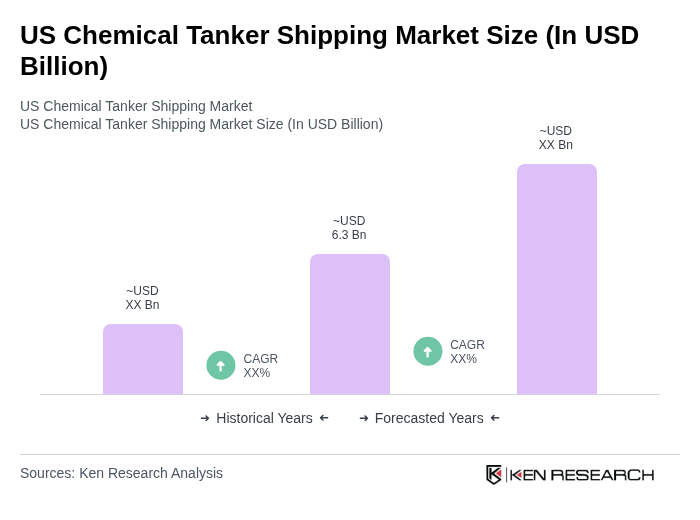
US Chemical Tanker Shipping Market is worth USD 6.3 Bn, fueled by rising chemical trade, eco-friendly vessels, and key hubs like Houston and New York.

Region:North America

Author(s):Dev

Product Code:KRAD3439

Pages:96

Published On:November 2025
About the Report

Base Year 2024

US Chemical Tanker Shipping Market Overview

  • The US Chemical Tanker Shipping Market is valued at USD 6.3 billion, based on a five-year historical analysis. This growth is primarily driven by the increasing demand for chemical transportation due to the expansion of the petrochemical and pharmaceutical industries, alongside rising international trade activities. The market has also benefited from advancements in shipping technology, such as digital navigation systems, and enhanced regulatory compliance, which have improved operational efficiencies and safety standards. Recent trends include the adoption of eco-friendly vessel designs and alternative fuels, reflecting the sector’s commitment to sustainability and emission reduction .
  • Key players in this market include major shipping hubs such as Houston, New York, and Los Angeles. The dominance of these cities is attributed to their strategic locations, robust port infrastructure, and proximity to major industrial centers, which facilitate efficient logistics and supply chain operations. Additionally, the presence of leading chemical manufacturers and specialized logistics providers in these regions further strengthens their market position .
  • The Chemical Facility Anti-Terrorism Standards (CFATS), issued by the US Department of Homeland Security in 2007 and updated through subsequent regulatory actions, mandates stringent security measures for chemical facilities and their transportation. CFATS requires facilities handling certain quantities of hazardous chemicals to implement risk-based performance standards, conduct vulnerability assessments, and ensure secure transportation, thereby enhancing the safety and security of chemical shipments in compliance with national security protocols .
US Chemical Tanker Shipping Market Size

US Chemical Tanker Shipping Market Segmentation

By Type:The market is segmented into various types of chemical tankers, including Inland Chemical Tankers, Coastal Chemical Tankers, Deep-Sea Chemical Tankers, and Specialty Chemical Tankers. Each type serves distinct operational needs based on cargo capacity and shipping routes. MR (Medium Range) chemical tankers, which typically fall within the coastal and deep-sea categories, account for the largest share due to their versatility and suitability for both domestic and international shipping .
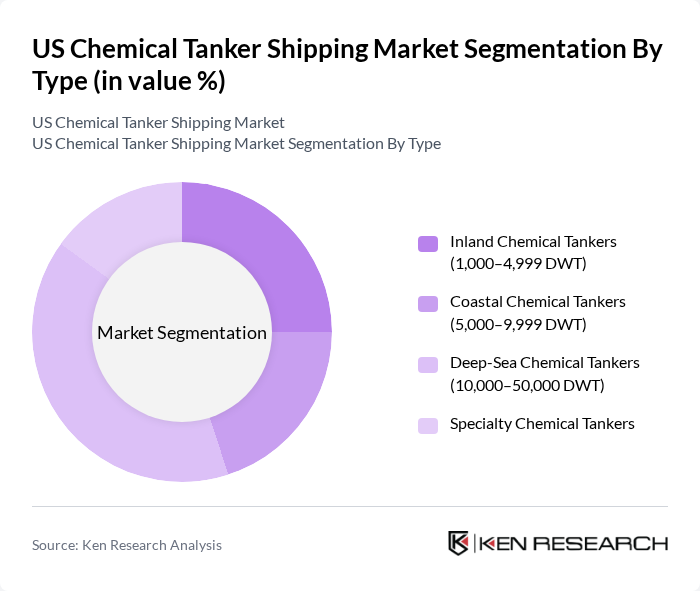
US Chemical Tanker Shipping Market segmentation by Type.

The Deep-Sea Chemical Tankers segment is currently dominating the market due to their ability to transport large volumes of chemicals over long distances, catering to international trade demands. The increasing globalization of supply chains and the need for efficient transportation of bulk chemicals have led to a higher preference for deep-sea tankers. Additionally, advancements in ship design, fuel efficiency, and digitalization have made these vessels more attractive to shipping companies, further solidifying their market leadership .

By End-User:The market is segmented based on end-users, including the Petrochemical Industry, Pharmaceutical Industry, Food and Beverage Industry, and Others. Each segment reflects the specific needs and demands of different sectors relying on chemical transportation. The petrochemical industry, in particular, remains the largest consumer due to the volume and diversity of chemical products shipped .
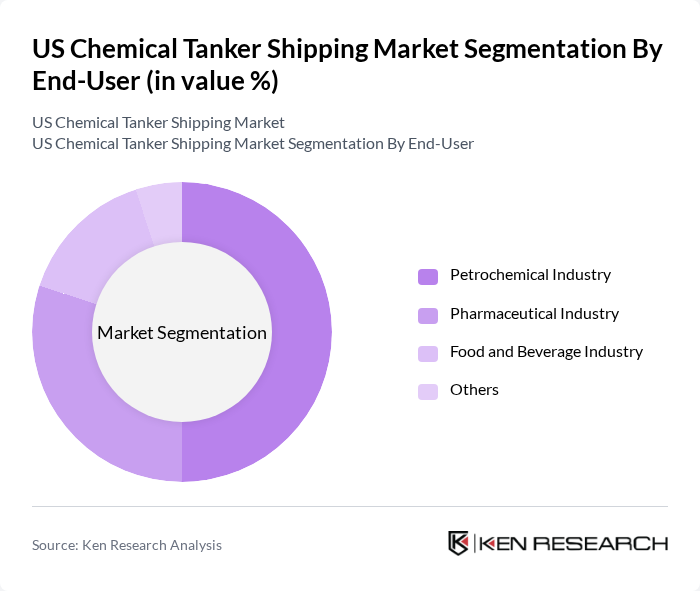
US Chemical Tanker Shipping Market segmentation by End-User.

The Petrochemical Industry is the leading end-user segment, accounting for a significant portion of the market. This dominance is driven by the high demand for petrochemicals in various applications, including plastics, fertilizers, and synthetic fibers. The continuous growth of the automotive and construction sectors, which heavily rely on petrochemical products, further fuels the need for efficient chemical transportation. Additionally, the industry's focus on sustainability and innovation is pushing for more advanced shipping solutions, reinforcing its market position .

US Chemical Tanker Shipping Market Competitive Landscape

The US Chemical Tanker Shipping Market is characterized by a dynamic mix of regional and international players. Leading participants such as Odfjell SE, Stolt-Nielsen Limited, Teekay Corporation, Navig8 Group, Hapag-Lloyd AG, MOL Chemical Tankers, Samco Shipholding, AET Tankers, DHT Holdings, Inc., American Shipping Company ASA, SeaTrade Maritime, BSM Tanker Management, V.Group Limited, K Line, NYK Line, Kirby Corporation, American Petroleum Tankers, Crowley Maritime Corporation, TOTE Maritime, Seabulk International contribute to innovation, geographic expansion, and service delivery in this space.

Odfjell SE

1916

Bergen, Norway

Stolt-Nielsen Limited

1959

Rotterdam, Netherlands

Teekay Corporation

1973

Hamilton, Bermuda

Navig8 Group

2008

London, United Kingdom

Hapag-Lloyd AG

1970

Hamburg, Germany

Company

Establishment Year

Headquarters

Fleet Size (Number of Vessels)

Fleet Utilization Rate (%)

Revenue per Ton-Mile (USD)

Average Turnaround Time (Days)

Customer Retention Rate (%)

Pricing Strategy (Premium, Competitive, Discount)

US Chemical Tanker Shipping Market Industry Analysis

Growth Drivers

  • Increasing Demand for Chemical Products:The US chemical industry is projected to generate approximately $1 trillion in revenue in the future, driven by rising consumer demand across various sectors, including pharmaceuticals and agriculture. This surge in demand necessitates efficient transportation solutions, particularly chemical tankers, which are essential for moving hazardous and non-hazardous materials. The growth in end-user industries, such as automotive and electronics, further fuels the need for reliable shipping services, enhancing the chemical tanker market's prospects.
  • Expansion of the US Manufacturing Sector:The US manufacturing sector is expected to grow by 3.5% in the future, contributing significantly to the demand for chemical transportation. As manufacturers ramp up production to meet both domestic and international needs, the requirement for chemical tankers to transport raw materials and finished products will increase. This growth is supported by government initiatives aimed at revitalizing manufacturing, which will further bolster the chemical tanker shipping market's growth trajectory.
  • Technological Advancements in Shipping:The adoption of advanced technologies in shipping, such as automation and real-time tracking systems, is set to enhance operational efficiency in the chemical tanker sector. In the future, it is estimated that 60% of shipping companies will implement digital solutions to optimize logistics and reduce transit times. These innovations not only improve safety and compliance but also attract more clients seeking reliable and efficient transportation of chemical products, driving market growth.

Market Challenges

  • High Operational Costs:The operational costs for chemical tanker shipping are projected to rise by 5% in the future, primarily due to increased maintenance expenses and regulatory compliance. The need for specialized equipment and training to handle hazardous materials adds to these costs. As companies strive to maintain profitability amidst rising expenses, the pressure on margins could hinder investment in fleet expansion and modernization, posing a significant challenge to market growth.
  • Regulatory Compliance Burdens:The chemical tanker industry faces stringent regulations, including MARPOL and EPA guidelines, which are expected to become more rigorous in the future. Compliance with these regulations often requires significant financial investment in technology and training. The complexity of navigating these regulations can deter smaller operators from entering the market, limiting competition and innovation, which may ultimately affect the overall growth of the chemical tanker shipping sector.

US Chemical Tanker Shipping Market Future Outlook

The US chemical tanker shipping market is poised for significant transformation as it adapts to evolving industry demands and regulatory landscapes. With a strong focus on sustainability and digitalization, companies are likely to invest in eco-friendly technologies and advanced fleet management systems. Additionally, the increasing demand for specialized chemical tankers will drive innovation and efficiency. As the market navigates challenges, strategic partnerships and investments in emerging markets will be crucial for long-term growth and competitiveness in the sector.

Market Opportunities

  • Growth in Exports of Chemical Products:The US is expected to see a 10% increase in chemical exports in the future, driven by global demand. This growth presents a significant opportunity for chemical tanker operators to expand their services and capture new markets, particularly in Asia and Europe, where demand for US-produced chemicals is rising.
  • Investment in Eco-Friendly Shipping Solutions:With environmental regulations tightening, there is a growing opportunity for investment in eco-friendly shipping solutions. In the future, it is anticipated that 30% of shipping companies will adopt green technologies, such as LNG-powered vessels, which can reduce emissions and operational costs, positioning them favorably in a competitive market.

Scope of the Report

SegmentSub-Segments
By Type

Inland Chemical Tankers (1,000–4,999 DWT)

Coastal Chemical Tankers (5,000–9,999 DWT)

Deep-Sea Chemical Tankers (10,000–50,000 DWT)

Specialty Chemical Tankers

By End-User

Petrochemical Industry

Pharmaceutical Industry

Food and Beverage Industry

Others

By Cargo Type

Hazardous Chemicals (IMO I, II, III)

Non-Hazardous Chemicals

Specialty Chemicals

Others

By Fleet Size

Large Fleets (10+ vessels)

Medium Fleets (5–9 vessels)

Small Fleets (1–4 vessels)

Others

By Shipping Route

Domestic Routes

International Routes

Coastal Routes

Inland Waterways

By Regulatory Compliance Level

Fully Compliant (IMO, USCG, EPA)

Partially Compliant

Non-Compliant

Others

By Service Type

Full-Service Shipping

Niche Shipping Services

Charter Services

Logistics & Terminal Services

Key Target Audience

Investors and Venture Capitalist Firms

Government and Regulatory Bodies (e.g., U.S. Coast Guard, Environmental Protection Agency)

Shipping and Logistics Companies

Chemical Manufacturers and Producers

Port Authorities and Terminal Operators

Insurance Providers and Underwriters

Trade Associations and Industry Groups

Financial Institutions and Banks

Players Mentioned in the Report:

Odfjell SE

Stolt-Nielsen Limited

Teekay Corporation

Navig8 Group

Hapag-Lloyd AG

MOL Chemical Tankers

Samco Shipholding

AET Tankers

DHT Holdings, Inc.

American Shipping Company ASA

SeaTrade Maritime

BSM Tanker Management

V.Group Limited

K Line

NYK Line

Kirby Corporation

American Petroleum Tankers

Crowley Maritime Corporation

TOTE Maritime

Seabulk International

Table of Contents

Market Assessment Phase

1. Executive Summary and Approach


2. US Chemical Tanker Shipping Market Overview

2.1 Key Insights and Strategic Recommendations

2.2 US Chemical Tanker Shipping Market Overview

2.3 Definition and Scope

2.4 Evolution of Market Ecosystem

2.5 Timeline of Key Regulatory Milestones

2.6 Value Chain & Stakeholder Mapping

2.7 Business Cycle Analysis

2.8 Policy & Incentive Landscape


3. US Chemical Tanker Shipping Market Analysis

3.1 Growth Drivers

3.1.1 Increasing Demand for Chemical Products
3.1.2 Expansion of the US Manufacturing Sector
3.1.3 Rising Environmental Regulations
3.1.4 Technological Advancements in Shipping

3.2 Market Challenges

3.2.1 High Operational Costs
3.2.2 Regulatory Compliance Burdens
3.2.3 Competition from Alternative Transport Modes
3.2.4 Fluctuating Fuel Prices

3.3 Market Opportunities

3.3.1 Growth in Exports of Chemical Products
3.3.2 Investment in Eco-Friendly Shipping Solutions
3.3.3 Strategic Partnerships with Chemical Manufacturers
3.3.4 Expansion into Emerging Markets

3.4 Market Trends

3.4.1 Shift Towards Digitalization in Shipping Operations
3.4.2 Increasing Focus on Sustainability
3.4.3 Adoption of Advanced Fleet Management Systems
3.4.4 Growing Demand for Specialized Chemical Tankers

3.5 Government Regulation

3.5.1 MARPOL Regulations on Pollution
3.5.2 US Coast Guard Safety Standards
3.5.3 Environmental Protection Agency (EPA) Guidelines
3.5.4 Federal Maritime Commission (FMC) Regulations

4. SWOT Analysis


5. Stakeholder Analysis


6. Porter's Five Forces Analysis


7. US Chemical Tanker Shipping Market Size, 2019-2024

7.1 By Value

7.2 By Volume

7.3 By Average Selling Price


8. US Chemical Tanker Shipping Market Segmentation

8.1 By Type

8.1.1 Inland Chemical Tankers (1,000–4,999 DWT)
8.1.2 Coastal Chemical Tankers (5,000–9,999 DWT)
8.1.3 Deep-Sea Chemical Tankers (10,000–50,000 DWT)
8.1.4 Specialty Chemical Tankers

8.2 By End-User

8.2.1 Petrochemical Industry
8.2.2 Pharmaceutical Industry
8.2.3 Food and Beverage Industry
8.2.4 Others

8.3 By Cargo Type

8.3.1 Hazardous Chemicals (IMO I, II, III)
8.3.2 Non-Hazardous Chemicals
8.3.3 Specialty Chemicals
8.3.4 Others

8.4 By Fleet Size

8.4.1 Large Fleets (10+ vessels)
8.4.2 Medium Fleets (5–9 vessels)
8.4.3 Small Fleets (1–4 vessels)
8.4.4 Others

8.5 By Shipping Route

8.5.1 Domestic Routes
8.5.2 International Routes
8.5.3 Coastal Routes
8.5.4 Inland Waterways

8.6 By Regulatory Compliance Level

8.6.1 Fully Compliant (IMO, USCG, EPA)
8.6.2 Partially Compliant
8.6.3 Non-Compliant
8.6.4 Others

8.7 By Service Type

8.7.1 Full-Service Shipping
8.7.2 Niche Shipping Services
8.7.3 Charter Services
8.7.4 Logistics & Terminal Services

9. US Chemical Tanker Shipping Market Competitive Analysis

9.1 Market Share of Key Players

9.2 Cross Comparison of Key Players

9.2.1 Company Name
9.2.2 Fleet Size (Number of Vessels)
9.2.3 Fleet Utilization Rate (%)
9.2.4 Revenue per Ton-Mile (USD)
9.2.5 Average Turnaround Time (Days)
9.2.6 Customer Retention Rate (%)
9.2.7 Pricing Strategy (Premium, Competitive, Discount)
9.2.8 On-Time Delivery Rate (%)
9.2.9 Compliance Rate with US Regulations (%)
9.2.10 Operational Cost per Voyage (USD)

9.3 SWOT Analysis of Top Players

9.4 Pricing Analysis

9.5 Detailed Profile of Major Companies

9.5.1 Odfjell SE
9.5.2 Stolt-Nielsen Limited
9.5.3 Teekay Corporation
9.5.4 Navig8 Group
9.5.5 Hapag-Lloyd AG
9.5.6 MOL Chemical Tankers
9.5.7 Samco Shipholding
9.5.8 AET Tankers
9.5.9 DHT Holdings, Inc.
9.5.10 American Shipping Company ASA
9.5.11 SeaTrade Maritime
9.5.12 BSM Tanker Management
9.5.13 V.Group Limited
9.5.14 K Line
9.5.15 NYK Line
9.5.16 Kirby Corporation
9.5.17 American Petroleum Tankers
9.5.18 Crowley Maritime Corporation
9.5.19 TOTE Maritime
9.5.20 Seabulk International

10. US Chemical Tanker Shipping Market End-User Analysis

10.1 Procurement Behavior of Key Ministries

10.1.1 Department of Transportation
10.1.2 Environmental Protection Agency
10.1.3 Department of Commerce
10.1.4 Others

10.2 Corporate Spend on Infrastructure & Energy

10.2.1 Investment in Shipping Infrastructure
10.2.2 Expenditure on Fleet Modernization
10.2.3 Budget Allocation for Compliance
10.2.4 Others

10.3 Pain Point Analysis by End-User Category

10.3.1 Delays in Shipping
10.3.2 High Transportation Costs
10.3.3 Regulatory Compliance Issues
10.3.4 Others

10.4 User Readiness for Adoption

10.4.1 Adoption of Digital Solutions
10.4.2 Readiness for Sustainable Practices
10.4.3 Training and Skill Development
10.4.4 Others

10.5 Post-Deployment ROI and Use Case Expansion

10.5.1 Cost Savings from Efficiency Improvements
10.5.2 Increased Market Reach
10.5.3 Enhanced Customer Satisfaction
10.5.4 Others

11. US Chemical Tanker Shipping Market Future Size, 2025-2030

11.1 By Value

11.2 By Volume

11.3 By Average Selling Price


Go-To-Market Strategy Phase

1. Whitespace Analysis + Business Model Canvas

1.1 Market Gaps Identification

1.2 Business Model Development


2. Marketing and Positioning Recommendations

2.1 Branding Strategies

2.2 Product USPs


3. Distribution Plan

3.1 Urban Retail vs Rural NGO Tie-Ups


4. Channel & Pricing Gaps

4.1 Underserved Routes

4.2 Pricing Bands


5. Unmet Demand & Latent Needs

5.1 Category Gaps

5.2 Consumer Segments


6. Customer Relationship

6.1 Loyalty Programs

6.2 After-Sales Service


7. Value Proposition

7.1 Sustainability

7.2 Integrated Supply Chains


8. Key Activities

8.1 Regulatory Compliance

8.2 Branding

8.3 Distribution Setup


9. Entry Strategy Evaluation

9.1 Domestic Market Entry Strategy

9.1.1 Product Mix
9.1.2 Pricing Band
9.1.3 Packaging

9.2 Export Entry Strategy

9.2.1 Target Countries
9.2.2 Compliance Roadmap

10. Entry Mode Assessment

10.1 JV

10.2 Greenfield

10.3 M&A

10.4 Distributor Model


11. Capital and Timeline Estimation

11.1 Capital Requirements

11.2 Timelines


12. Control vs Risk Trade-Off

12.1 Ownership vs Partnerships


13. Profitability Outlook

13.1 Breakeven Analysis

13.2 Long-Term Sustainability


14. Potential Partner List

14.1 Distributors

14.2 JVs

14.3 Acquisition Targets


15. Execution Roadmap

15.1 Phased Plan for Market Entry

15.1.1 Market Setup
15.1.2 Market Entry
15.1.3 Growth Acceleration
15.1.4 Scale & Stabilize

15.2 Key Activities and Milestones

15.2.1 Milestone Planning
15.2.2 Activity Tracking

Research Methodology

ApproachModellingSample

Phase 1: Approach1

Desk Research

  • Analysis of shipping industry reports from the American Bureau of Shipping (ABS)
  • Review of trade publications and journals focused on chemical transportation
  • Examination of regulatory frameworks from the U.S. Coast Guard and Environmental Protection Agency (EPA)

Primary Research

  • Interviews with fleet managers from leading chemical tanker operators
  • Surveys targeting logistics coordinators in chemical manufacturing firms
  • Field interviews with port authorities and terminal operators involved in chemical shipping

Validation & Triangulation

  • Cross-validation of data through multiple industry reports and government statistics
  • Triangulation of insights from primary interviews with secondary data findings
  • Sanity checks conducted through expert panels comprising industry veterans

Phase 2: Market Size Estimation1

Top-down Assessment

  • Estimation of total shipping volume based on national chemical production statistics
  • Segmentation of market size by chemical type and shipping routes
  • Incorporation of trends in international trade agreements affecting chemical exports

Bottom-up Modeling

  • Volume estimates derived from operational data of major chemical tanker fleets
  • Cost analysis based on freight rates and operational expenses in the sector
  • Calculation of market size using volume x average freight cost methodology

Forecasting & Scenario Analysis

  • Multi-variable forecasting models incorporating economic indicators and trade growth
  • Scenario analysis based on potential regulatory changes and environmental policies
  • Development of baseline, optimistic, and pessimistic market projections through 2030

Phase 3: CATI Sample Composition1

Scope Item/SegmentSample SizeTarget Respondent Profiles
Chemical Tanker Fleet Operations100Fleet Managers, Operations Directors
Chemical Manufacturing Logistics80Logistics Coordinators, Supply Chain Managers
Port Operations and Management60Port Authority Officials, Terminal Managers
Regulatory Compliance in Shipping50Compliance Officers, Environmental Managers
Market Trends and Forecasting70Market Analysts, Industry Consultants

Frequently Asked Questions

What is the current value of the US Chemical Tanker Shipping Market?

The US Chemical Tanker Shipping Market is valued at approximately USD 6.3 billion, driven by the increasing demand for chemical transportation, particularly from the petrochemical and pharmaceutical industries, as well as advancements in shipping technology and regulatory compliance.

What factors are driving growth in the US Chemical Tanker Shipping Market?

Which cities are major hubs for chemical tanker shipping in the US?

What are the main types of chemical tankers in the market?

Other Regional/Country Reports

Indonesia Chemical Tanker Shipping Market

Malaysia Chemical Tanker Shipping Market

KSA Chemical Tanker Shipping Market

APAC Chemical Tanker Shipping Market

SEA Chemical Tanker Shipping Market

Vietnam Chemical Tanker Shipping Market

Other Adjacent Reports

Japan Petrochemical Transportation Market

Brazil Hazardous Materials Logistics Market

Brazil Maritime Freight Services Market

KSA Tanker Fleet Management Market

Philippines Bulk Liquid Shipping Market

Kuwait Chemical Supply Chain Market

KSA Shipping Technology Solutions Market

Thailand Port Infrastructure Development Market

Japan Environmental Compliance Services Market

Singapore International Trade Logistics Market

Why Buy From Us?

Refine Robust Result (RRR) Framework

What makes us stand out is that our consultants follow Robust, Refine and Result (RRR) methodology. Robust for clear definitions, approaches and sanity checking, Refine for differentiating respondents' facts and opinions, and Result for presenting data with story.

Our Reach Is Unmatched

We have set a benchmark in the industry by offering our clients with syndicated and customized market research reports featuring coverage of entire market as well as meticulous research and analyst insights.

Shifting the Research Paradigm

While we don't replace traditional research, we flip the method upside down. Our dual approach of Top Bottom & Bottom Top ensures quality deliverable by not just verifying company fundamentals but also looking at the sector and macroeconomic factors.

More Insights-Better Decisions

With one step in the future, our research team constantly tries to show you the bigger picture. We help with some of the tough questions you may encounter along the way: How is the industry positioned? Best marketing channel? KPI's of competitors? By aligning every element, we help maximize success.

Transparency and Trust

Our report gives you instant access to the answers and sources that other companies might choose to hide. We elaborate each steps of research methodology we have used and showcase you the sample size to earn your trust.

Round the Clock Support

If you need any support, we are here! We pride ourselves on universe strength, data quality, and quick, friendly, and professional service.

Why Clients Choose Us?

400000+
Reports in repository
150+
Consulting projects a year
100+
Analysts
8000+
Client Queries in 2022








