Region:North America
Author(s):Dev
Product Code:KRAC3460
Pages:87
Published On:October 2025
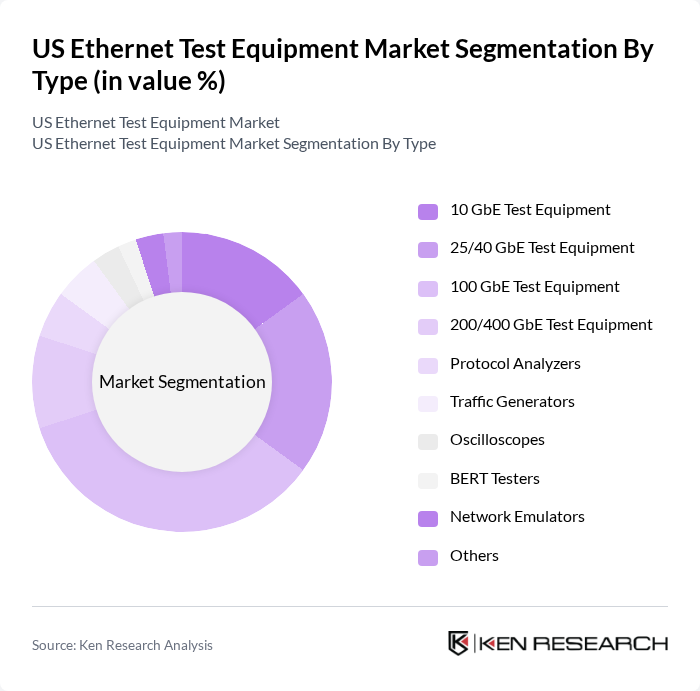
By Type:The Ethernet test equipment market is segmented into various types, including 10 GbE Test Equipment, 25/40 GbE Test Equipment, 100 GbE Test Equipment, 200/400 GbE Test Equipment, Protocol Analyzers, Traffic Generators, Oscilloscopes, BERT Testers, Network Emulators, and Others. Among these, the 100 GbE Test Equipment segment is currently leading the market due to the increasing demand for high-speed data transmission in enterprise networks and data centers. The growing trend of cloud computing and the need for efficient data handling are driving the adoption of this technology.
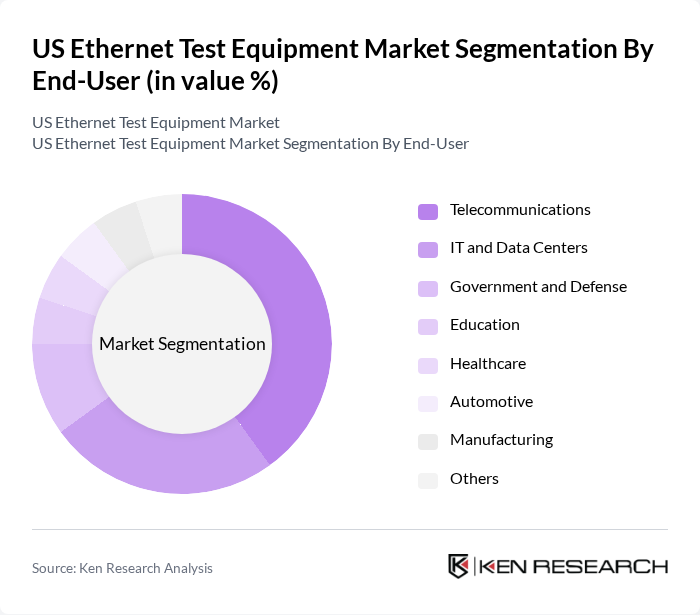
By End-User:The market is also segmented by end-user, which includes Telecommunications, IT and Data Centers, Government and Defense, Education, Healthcare, Automotive, Manufacturing, and Others. The Telecommunications sector is the largest end-user of Ethernet test equipment, driven by the need for reliable network performance and compliance with regulatory standards. The rapid expansion of 5G networks and the increasing demand for high-speed internet services are key factors contributing to the growth of this segment. The Enterprises segment is experiencing the fastest growth due to digital transformation, hybrid work models, and rising cybersecurity demands, which necessitate robust network testing solutions. Specific end-user market share percentages are not directly available in authoritative sources; the provided figures should be considered illustrative.
The US Ethernet Test Equipment Market is characterized by a dynamic mix of regional and international players. Leading participants such as Fluke Networks, VIAVI Solutions Inc., Keysight Technologies Inc., EXFO Inc., Tektronix, Inc., Spirent Communications plc, Anritsu Corporation, NetScout Systems, Inc., Ixia (Keysight Technologies), Corning Incorporated, Panduit Corporation, CommScope Holding Company, Inc., Teledyne LeCroy contribute to innovation, geographic expansion, and service delivery in this space.
The US Ethernet test equipment market is poised for significant evolution, driven by technological advancements and increasing connectivity demands. As 5G networks expand, the need for sophisticated testing solutions will intensify, ensuring optimal performance. Additionally, the integration of AI and machine learning in testing processes will enhance efficiency and accuracy. Companies that embrace these innovations will likely gain a competitive advantage, positioning themselves favorably in a rapidly changing landscape characterized by heightened connectivity and performance expectations.
| Segment | Sub-Segments |
|---|---|
| By Type | GbE Test Equipment /40 GbE Test Equipment GbE Test Equipment /400 GbE Test Equipment Protocol Analyzers Traffic Generators Oscilloscopes BERT Testers Network Emulators Others |
| By End-User | Telecommunications IT and Data Centers Government and Defense Education Healthcare Automotive Manufacturing Others |
| By Application | Network Installation Network Maintenance Network Troubleshooting Performance Monitoring Compliance Testing Others |
| By Distribution Channel | Direct Sales Online Retail Distributors Resellers Others |
| By Component | Hardware Software Services |
| By Price Range | Low-End Mid-Range High-End |
| By Brand | Established Brands Emerging Brands Private Labels |
| Scope Item/Segment | Sample Size | Target Respondent Profiles |
|---|---|---|
| Enterprise Network Testing | 100 | Network Engineers, IT Managers |
| Data Center Equipment Testing | 70 | Data Center Managers, Systems Administrators |
| Telecommunications Infrastructure | 60 | Telecom Engineers, Network Architects |
| IoT Device Connectivity Testing | 50 | IoT Solutions Architects, Product Managers |
| 5G Network Deployment | 80 | Telecom Project Managers, Field Technicians |
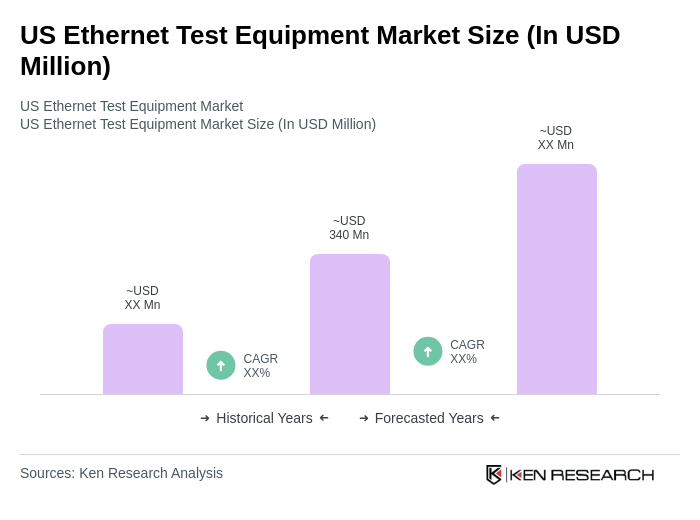
The US Ethernet Test Equipment Market is valued at approximately USD 340 million, reflecting a significant growth driven by the increasing demand for high-speed internet connectivity, data center expansion, and cloud computing services.

What makes us stand out is that our consultants follow Robust, Refine and Result (RRR) methodology. Robust for clear definitions, approaches and sanity checking, Refine for differentiating respondents' facts and opinions, and Result for presenting data with story.

We have set a benchmark in the industry by offering our clients with syndicated and customized market research reports featuring coverage of entire market as well as meticulous research and analyst insights.

While we don't replace traditional research, we flip the method upside down. Our dual approach of Top Bottom & Bottom Top ensures quality deliverable by not just verifying company fundamentals but also looking at the sector and macroeconomic factors.

With one step in the future, our research team constantly tries to show you the bigger picture. We help with some of the tough questions you may encounter along the way: How is the industry positioned? Best marketing channel? KPI's of competitors? By aligning every element, we help maximize success.

Our report gives you instant access to the answers and sources that other companies might choose to hide. We elaborate each steps of research methodology we have used and showcase you the sample size to earn your trust.

If you need any support, we are here! We pride ourselves on universe strength, data quality, and quick, friendly, and professional service.













