About the Report
Base Year 2024US Gas Detection Equipment Market Overview
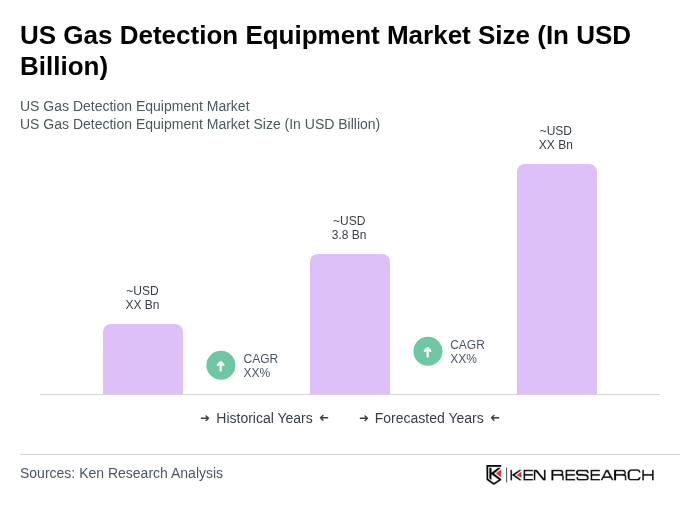
- The US Gas Detection Equipment Market is valued at USD 3.8 billion, based on a five-year historical analysis. This growth is primarily driven by increasing safety regulations, technological advancements, and the rising demand for gas detection solutions across various industries, including oil and gas, chemicals, and manufacturing. The market's expansion is also supported by the growing awareness of workplace safety and environmental protection, alongside the rising adoption of wireless gas detection systems and IoT-enabled monitoring solutions that enable real-time detection and remote area surveillance.
- Key players in this market include Texas, California, and New York, which dominate due to their extensive industrial activities and stringent safety regulations. These states have a high concentration of oil and gas operations, chemical manufacturing, and mining activities, necessitating advanced gas detection solutions to ensure compliance with safety standards and protect workers from hazardous gases.
- The Occupational Safety and Health Administration (OSHA) standards, including the General Duty Clause and specific regulations under 29 CFR 1910.119 (Process Safety Management), mandate comprehensive gas detection and monitoring systems in industrial facilities handling hazardous materials. These regulations aim to enhance workplace safety and reduce the risk of gas-related accidents, thereby driving the demand for gas detection equipment across various sectors.
US Gas Detection Equipment Market Segmentation
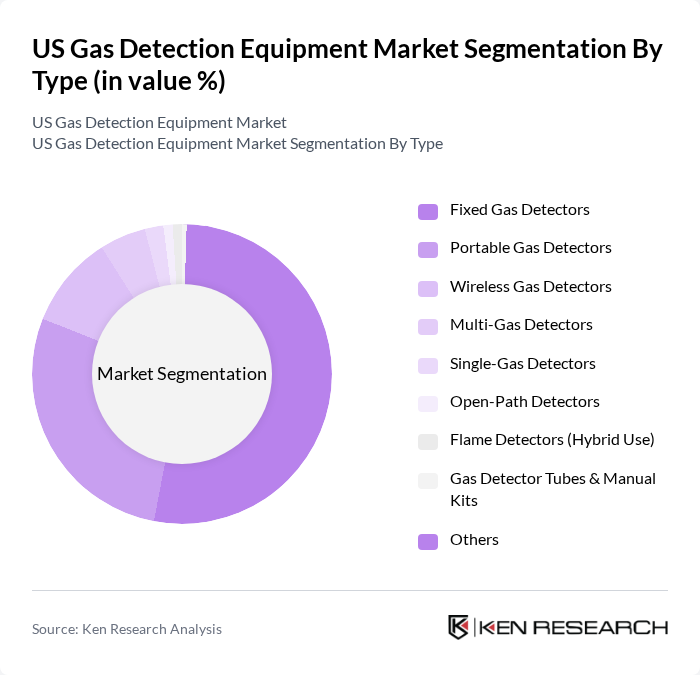
By Type:The market is segmented into various types of gas detection equipment, including Fixed Gas Detectors, Portable Gas Detectors, Wireless Gas Detectors, Multi-Gas Detectors, Single-Gas Detectors, Open-Path Detectors, Flame Detectors (Hybrid Use), Gas Detector Tubes & Manual Kits, and Others. Fixed Gas Detectors are leading the market due to their reliability and effectiveness in continuous monitoring of gas levels in industrial settings, commanding approximately 53% of the market share. The increasing focus on workplace safety and regulatory compliance is driving the demand for these devices. Portable gas detectors represent the second-largest segment and are expected to experience the highest growth rates, driven by their flexibility in various environments and their ability to provide localized detection in immediate surroundings.
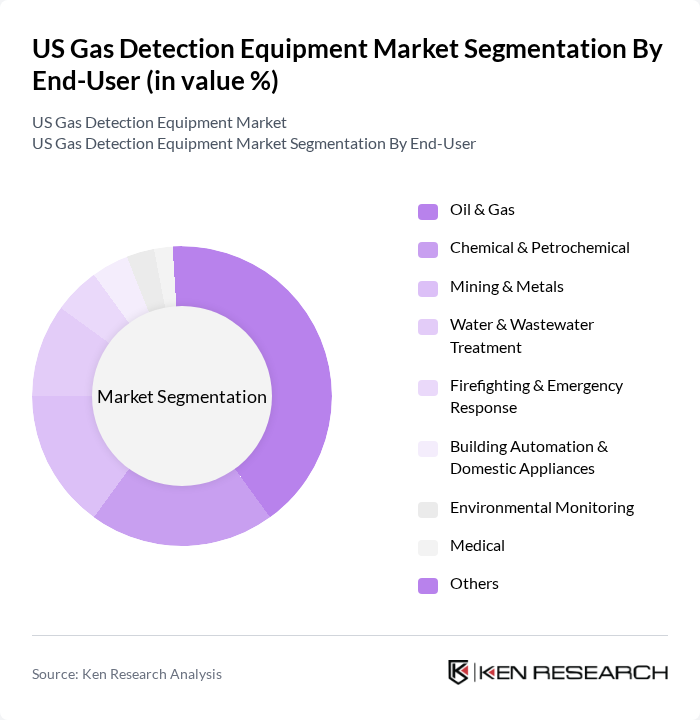
By End-User:The end-user segmentation includes Oil & Gas, Chemical & Petrochemical, Mining & Metals, Water & Wastewater Treatment, Firefighting & Emergency Response, Building Automation & Domestic Appliances, Environmental Monitoring, Medical, and Others. The Oil & Gas sector is the dominant end-user, driven by the need for stringent safety measures and compliance with regulations in hazardous environments. The increasing exploration and production activities in this sector, particularly shale gas exploration, further fuel the demand for gas detection equipment.
US Gas Detection Equipment Market Competitive Landscape
The US Gas Detection Equipment Market is characterized by a dynamic mix of regional and international players. Leading participants such as Honeywell International Inc., Drägerwerk AG & Co. KGaA, MSA Safety Incorporated, Siemens AG, RKI Instruments, Inc., Industrial Scientific Corporation, Teledyne Technologies Incorporated, 3M Company, Crowcon Detection Instruments Ltd., Gas Clip Technologies, Sensit Technologies, GfG Instrumentation, Inc., ABB Ltd., AMETEK, Inc., RAE Systems by Honeywell, Thermo Fisher Scientific Inc., General Electric Company (GE), Fluke Corporation, Sensata Technologies, Lynred, Airtest Technologies Inc., Opgal Optronics Industries Ltd., New Cosmos Electric Co., Ltd., RIKEN KEIKI Co., Ltd. contribute to innovation, geographic expansion, and service delivery in this space.
US Gas Detection Equipment Market Industry Analysis
Growth Drivers
- Increasing Industrial Safety Regulations:The US has seen a significant rise in industrial safety regulations, with OSHA reporting over 2.8 million workplace injuries in the previous year. This has led to stricter compliance requirements, driving the demand for gas detection equipment. The implementation of safety standards, such as the National Fire Protection Association (NFPA) codes, has resulted in an estimated 15% increase in gas detection equipment purchases across various sectors, including manufacturing and construction, emphasizing the need for enhanced safety measures.
- Rising Demand for Environmental Monitoring:Environmental concerns have escalated, with the EPA noting that air quality issues affect approximately 4 in 10 Americans. This has spurred demand for gas detection equipment to monitor emissions and ensure compliance with environmental regulations. In future, investments in environmental monitoring technologies are expected to reach $1.8 billion, reflecting a 20% increase from the previous year. This trend is expected to continue as industries seek to minimize their environmental impact and adhere to stricter regulations.
- Technological Advancements in Gas Detection:The gas detection equipment market is experiencing rapid technological advancements, with innovations such as smart sensors and real-time monitoring systems. In future, the introduction of IoT-enabled gas detectors is projected to contribute to a 30% increase in efficiency and accuracy in detecting hazardous gases. The global investment in smart gas detection technologies is projected to reach $2.5 billion, driven by the need for improved safety and operational efficiency in various industries.
Market Challenges
- High Initial Investment Costs:The high initial costs associated with gas detection equipment pose a significant barrier to market entry. For instance, advanced multi-gas detectors can range from $1,200 to $5,500, making them a substantial investment for small to medium-sized enterprises. This financial burden can deter companies from upgrading their safety equipment, especially in industries with tight profit margins, thereby limiting market growth and adoption rates.
- Lack of Skilled Workforce:The gas detection equipment sector faces a critical shortage of skilled professionals capable of operating and maintaining advanced detection systems. According to the Bureau of Labor Statistics, the demand for skilled technicians in this field is expected to grow by 12% in the coming years. However, the current workforce lacks adequate training, leading to operational inefficiencies and increased safety risks, which can hinder the overall effectiveness of gas detection systems in various industries.
US Gas Detection Equipment Market Future Outlook
The future of the US gas detection equipment market appears promising, driven by ongoing technological innovations and increasing regulatory pressures. As industries prioritize safety and environmental compliance, the adoption of advanced gas detection systems is expected to rise. Furthermore, the integration of artificial intelligence and machine learning into detection technologies will enhance predictive maintenance capabilities, ensuring timely responses to potential hazards. This evolution will likely lead to a more robust market landscape, fostering growth and innovation in the sector.
Market Opportunities
- Expansion in Emerging Markets:Emerging markets present significant growth opportunities for gas detection equipment. With industrialization accelerating in regions like Southeast Asia and Africa, the demand for safety equipment is projected to increase. In future, investments in these markets are expected to reach $600 million, indicating a growing recognition of the importance of safety and environmental monitoring, which could drive further market expansion.
- Development of Smart Gas Detection Systems:The shift towards smart gas detection systems offers substantial market potential. With the global smart sensor market expected to reach $3.5 billion in future, companies are increasingly investing in IoT-enabled solutions. These systems provide real-time data analytics and remote monitoring capabilities, enhancing safety protocols and operational efficiency, thus creating a lucrative opportunity for manufacturers and service providers in the gas detection sector.
Scope of the Report
| Segment | Sub-Segments |
|---|---|
| By Type | Fixed Gas Detectors Portable Gas Detectors Wireless Gas Detectors Multi-Gas Detectors Single-Gas Detectors Open-Path Detectors Flame Detectors (Hybrid Use) Gas Detector Tubes & Manual Kits Others |
| By End-User | Oil & Gas Chemical & Petrochemical Mining & Metals Water & Wastewater Treatment Firefighting & Emergency Response Building Automation & Domestic Appliances Environmental Monitoring Medical Others |
| By Application | Industrial Safety Environmental Monitoring Leak Detection Emergency Response Process Control Others |
| By Technology | Infrared (IR) Technology Ultrasonic Technology Photoionization Detector (PID) Technology Semiconductor Technology Catalytic Technology Metal Oxide Semiconductor Technology Thermal Conductivity Sensors Laser-Based Detection Photoacoustic Sensors Others |
| By Distribution Channel | Direct Sales (OEM to End-User) Distributors/Resellers Online Retail/E-Commerce System Integration Providers Retail Sales Others |
| By Region | Northeast Midwest South West |
| By Policy Support | Federal Grants State Incentives Tax Credits Regulatory Compliance Support Others |
Key Target Audience
Investors and Venture Capitalist Firms
Government and Regulatory Bodies (e.g., Environmental Protection Agency, Occupational Safety and Health Administration)
Manufacturers and Producers
Distributors and Retailers
Oil and Gas Industry Operators
Mining Companies
Fire and Safety Equipment Suppliers
Utility Companies
Players Mentioned in the Report:
Honeywell International Inc.
Dragerwerk AG & Co. KGaA
MSA Safety Incorporated
Siemens AG
RKI Instruments, Inc.
Industrial Scientific Corporation
Teledyne Technologies Incorporated
3M Company
Crowcon Detection Instruments Ltd.
Gas Clip Technologies
Sensit Technologies
GfG Instrumentation, Inc.
ABB Ltd.
AMETEK, Inc.
RAE Systems by Honeywell
Thermo Fisher Scientific Inc.
General Electric Company (GE)
Fluke Corporation
Sensata Technologies
Lynred
Airtest Technologies Inc.
Opgal Optronics Industries Ltd.
New Cosmos Electric Co., Ltd.
RIKEN KEIKI Co., Ltd.
Table of Contents
Market Assessment Phase
1. Executive Summary and Approach
2. US Gas Detection Equipment Market Overview
2.1 Key Insights and Strategic Recommendations
2.2 US Gas Detection Equipment Market Overview
2.3 Definition and Scope
2.4 Evolution of Market Ecosystem
2.5 Timeline of Key Regulatory Milestones
2.6 Value Chain & Stakeholder Mapping
2.7 Business Cycle Analysis
2.8 Policy & Incentive Landscape
3. US Gas Detection Equipment Market Analysis
3.1 Growth Drivers
3.1.1 Increasing industrial safety regulations
3.1.2 Rising demand for environmental monitoring
3.1.3 Technological advancements in gas detection
3.1.4 Growing awareness of workplace safety
3.2 Market Challenges
3.2.1 High initial investment costs
3.2.2 Lack of skilled workforce
3.2.3 Stringent regulatory compliance requirements
3.2.4 Competition from alternative technologies
3.3 Market Opportunities
3.3.1 Expansion in emerging markets
3.3.2 Development of smart gas detection systems
3.3.3 Integration with IoT technologies
3.3.4 Increasing investments in infrastructure
3.4 Market Trends
3.4.1 Shift towards portable gas detection devices
3.4.2 Adoption of multi-gas detectors
3.4.3 Growth in rental services for gas detection equipment
3.4.4 Emphasis on real-time monitoring solutions
3.5 Government Regulation
3.5.1 OSHA regulations on workplace safety
3.5.2 EPA standards for environmental protection
3.5.3 NFPA codes for fire safety
3.5.4 State-specific regulations on gas emissions
4. SWOT Analysis
5. Stakeholder Analysis
6. Porter's Five Forces Analysis
7. US Gas Detection Equipment Market Size, 2019-2024
7.1 By Value
7.2 By Volume
7.3 By Average Selling Price
8. US Gas Detection Equipment Market Segmentation
8.1 By Type
8.1.1 Fixed Gas Detectors
8.1.2 Portable Gas Detectors
8.1.3 Wireless Gas Detectors
8.1.4 Multi-Gas Detectors
8.1.5 Single-Gas Detectors
8.1.6 Open-Path Detectors
8.1.7 Flame Detectors (Hybrid Use)
8.1.8 Gas Detector Tubes & Manual Kits
8.1.9 Others
8.2 By End-User
8.2.1 Oil & Gas
8.2.2 Chemical & Petrochemical
8.2.3 Mining & Metals
8.2.4 Water & Wastewater Treatment
8.2.5 Firefighting & Emergency Response
8.2.6 Building Automation & Domestic Appliances
8.2.7 Environmental Monitoring
8.2.8 Medical
8.2.9 Others
8.3 By Application
8.3.1 Industrial Safety
8.3.2 Environmental Monitoring
8.3.3 Leak Detection
8.3.4 Emergency Response
8.3.5 Process Control
8.3.6 Others
8.4 By Technology
8.4.1 Infrared (IR) Technology
8.4.2 Ultrasonic Technology
8.4.3 Photoionization Detector (PID) Technology
8.4.4 Semiconductor Technology
8.4.5 Catalytic Technology
8.4.6 Metal Oxide Semiconductor Technology
8.4.7 Thermal Conductivity Sensors
8.4.8 Laser-Based Detection
8.4.9 Photoacoustic Sensors
8.4.10 Others
8.5 By Distribution Channel
8.5.1 Direct Sales (OEM to End-User)
8.5.2 Distributors/Resellers
8.5.3 Online Retail/E-Commerce
8.5.4 System Integration Providers
8.5.5 Retail Sales
8.5.6 Others
8.6 By Region
8.6.1 Northeast
8.6.2 Midwest
8.6.3 South
8.6.4 West
8.7 By Policy Support
8.7.1 Federal Grants
8.7.2 State Incentives
8.7.3 Tax Credits
8.7.4 Regulatory Compliance Support
8.7.5 Others
9. US Gas Detection Equipment Market Competitive Analysis
9.1 Market Share of Key Players
9.2 Cross Comparison of Key Players
9.2.1 Company Name
9.2.2 Company Size (Large, Medium, Small as per industry convention)
9.2.3 US Gas Detection Equipment Revenue (USD, latest available year)
9.2.4 Revenue Growth Rate (CAGR, 3-5 years)
9.2.5 Market Share in US Gas Detection Equipment (%)
9.2.6 Product Portfolio Breadth (Number of Gas Detection SKUs/Technologies)
9.2.7 R&D Investment as % of Revenue
9.2.8 Product Innovation Rate (New Product Launches per Year)
9.2.9 Distribution Network Coverage (US States/Regions Served)
9.2.10 Key End-User Segments Served
9.2.11 Pricing Strategy (Premium, Value, Volume)
9.2.12 Customer Retention Rate (%)
9.2.13 Customer Satisfaction Score (NPS or Equivalent)
9.2.14 Regulatory Compliance Certifications (OSHA, EPA, etc.)
9.2.15 After-Sales Service Coverage
9.3 SWOT Analysis of Top Players
9.4 Pricing Analysis
9.5 Detailed Profile of Major Companies
9.5.1 Honeywell International Inc.
9.5.2 Drägerwerk AG & Co. KGaA
9.5.3 MSA Safety Incorporated
9.5.4 Siemens AG
9.5.5 RKI Instruments, Inc.
9.5.6 Industrial Scientific Corporation
9.5.7 Teledyne Technologies Incorporated
9.5.8 3M Company
9.5.9 Crowcon Detection Instruments Ltd.
9.5.10 Gas Clip Technologies
9.5.11 Sensit Technologies
9.5.12 GfG Instrumentation, Inc.
9.5.13 ABB Ltd.
9.5.14 AMETEK, Inc.
9.5.15 RAE Systems by Honeywell
9.5.16 Thermo Fisher Scientific Inc.
9.5.17 General Electric Company (GE)
9.5.18 Fluke Corporation
9.5.19 Sensata Technologies
9.5.20 Lynred
9.5.21 Airtest Technologies Inc.
9.5.22 Opgal Optronics Industries Ltd.
9.5.23 New Cosmos Electric Co., Ltd.
9.5.24 RIKEN KEIKI Co., Ltd.
10. US Gas Detection Equipment Market End-User Analysis
10.1 Procurement Behavior of Key Ministries
10.1.1 Government procurement policies
10.1.2 Budget allocation for safety equipment
10.1.3 Evaluation criteria for suppliers
10.1.4 Contracting processes
10.2 Corporate Spend on Infrastructure & Energy
10.2.1 Investment trends in safety equipment
10.2.2 Budgeting for compliance and safety
10.2.3 Long-term contracts with suppliers
10.2.4 Impact of economic conditions on spending
10.3 Pain Point Analysis by End-User Category
10.3.1 Safety compliance challenges
10.3.2 Equipment reliability issues
10.3.3 Training and operational challenges
10.3.4 Cost management concerns
10.4 User Readiness for Adoption
10.4.1 Awareness of gas detection technologies
10.4.2 Training programs for end-users
10.4.3 Integration with existing systems
10.4.4 Feedback from early adopters
10.5 Post-Deployment ROI and Use Case Expansion
10.5.1 Measurement of safety improvements
10.5.2 Cost savings from reduced incidents
10.5.3 Expansion into new applications
10.5.4 Long-term benefits of technology adoption
11. US Gas Detection Equipment Market Future Size, 2025-2030
11.1 By Value
11.2 By Volume
11.3 By Average Selling Price
Go-To-Market Strategy Phase
1. Whitespace Analysis + Business Model Canvas
1.1 Market gaps identification
1.2 Value proposition development
1.3 Revenue model exploration
1.4 Customer segmentation analysis
1.5 Competitive landscape overview
1.6 Key partnerships identification
1.7 Risk assessment
2. Marketing and Positioning Recommendations
2.1 Branding strategies
2.2 Product USPs
2.3 Target audience definition
2.4 Marketing channels selection
2.5 Messaging and communication strategy
2.6 Performance metrics
3. Distribution Plan
3.1 Urban retail vs rural NGO tie-ups
3.2 Distribution channel optimization
3.3 Logistics and supply chain management
3.4 Partnership with distributors
3.5 E-commerce strategy
4. Channel & Pricing Gaps
4.1 Underserved routes
4.2 Pricing bands
4.3 Competitor pricing analysis
4.4 Value-based pricing strategy
4.5 Discount and promotion strategies
5. Unmet Demand & Latent Needs
5.1 Category gaps
5.2 Consumer segments
5.3 Product development opportunities
5.4 Market entry strategies
5.5 Customer feedback incorporation
6. Customer Relationship
6.1 Loyalty programs
6.2 After-sales service
6.3 Customer engagement strategies
6.4 Feedback loops
6.5 Community building
7. Value Proposition
7.1 Sustainability
7.2 Integrated supply chains
7.3 Cost-effectiveness
7.4 Innovation
7.5 Customer-centric approach
8. Key Activities
8.1 Regulatory compliance
8.2 Branding
8.3 Distribution setup
8.4 Training and support
8.5 Market research
9. Entry Strategy Evaluation
9.1 Domestic Market Entry Strategy
9.1.1 Product mix
9.1.2 Pricing band
9.1.3 Packaging
9.2 Export Entry Strategy
9.2.1 Target countries
9.2.2 Compliance roadmap
10. Entry Mode Assessment
10.1 JV
10.2 Greenfield
10.3 M&A
10.4 Distributor Model
11. Capital and Timeline Estimation
11.1 Capital requirements
11.2 Timelines
12. Control vs Risk Trade-Off
12.1 Ownership vs Partnerships
13. Profitability Outlook
13.1 Breakeven analysis
13.2 Long-term sustainability
14. Potential Partner List
14.1 Distributors
14.2 JVs
14.3 Acquisition targets
15. Execution Roadmap
15.1 Phased Plan for Market Entry
15.1.1 Market Setup
15.1.2 Market Entry
15.1.3 Growth Acceleration
15.1.4 Scale & Stabilize
15.2 Key Activities and Milestones
15.2.1 Milestone planning
15.2.2 Activity tracking
Research Methodology
Phase 1: Approach1
Desk Research
- Industry reports from organizations such as the American Gas Association and the National Fire Protection Association
- Market analysis from government publications and energy regulatory bodies
- Academic journals and white papers focusing on gas detection technologies and safety standards
Primary Research
- Interviews with product managers at leading gas detection equipment manufacturers
- Surveys with safety compliance officers in various industrial sectors
- Field interviews with technicians and engineers involved in gas detection system installations
Validation & Triangulation
- Cross-validation of findings through multiple industry sources and expert opinions
- Triangulation of data from market reports, sales figures, and regulatory frameworks
- Sanity checks conducted through expert panel discussions and feedback sessions
Phase 2: Market Size Estimation1
Top-down Assessment
- Analysis of the overall safety equipment market to estimate the gas detection segment
- Segmentation by application areas such as industrial, commercial, and residential markets
- Incorporation of trends in regulatory compliance and safety standards impacting market growth
Bottom-up Modeling
- Estimation of unit sales based on historical data from key manufacturers
- Operational cost analysis derived from pricing models of gas detection systems
- Volume projections based on installation rates and replacement cycles in various sectors
Forecasting & Scenario Analysis
- Multi-variable regression analysis incorporating factors such as industrial growth and safety regulations
- Scenario modeling based on potential shifts in technology adoption and market dynamics
- Development of baseline, optimistic, and pessimistic forecasts through 2030
Phase 3: CATI Sample Composition1
| Scope Item/Segment | Sample Size | Target Respondent Profiles |
|---|---|---|
| Industrial Gas Detection Systems | 100 | Safety Managers, Operations Directors |
| Commercial Building Safety Equipment | 80 | Facility Managers, Compliance Officers |
| Residential Gas Leak Detectors | 60 | Homeowners, Property Managers |
| Oil & Gas Sector Detection Solutions | 90 | Field Engineers, Safety Compliance Managers |
| Emergency Response Equipment | 50 | Fire Safety Officers, Emergency Response Coordinators |
Frequently Asked Questions
What is the current value of the US Gas Detection Equipment Market?
The US Gas Detection Equipment Market is valued at approximately USD 3.8 billion, reflecting a significant growth driven by increasing safety regulations, technological advancements, and heightened demand across various industries such as oil and gas, chemicals, and manufacturing.
What are the main drivers of growth in the US Gas Detection Equipment Market?
Which states are the largest markets for gas detection equipment in the US?
What types of gas detection equipment are available in the market?
Other Regional/Country Reports
Malaysia Gas Detection Equipment Market
KSA Gas Detection Equipment Market
APAC Gas Detection Equipment Market
SEA Gas Detection Equipment Market
Vietnam Gas Detection Equipment Market
Other Adjacent Reports
Oman Industrial Safety Equipment Market
Indonesia Environmental Monitoring Systems Market
UAE Oil and Gas Safety Solutions Market
Philippines Chemical Industry Sensors Market
Qatar Mining Safety Devices Market
Belgium Fire Detection Equipment Market
Indonesia IoT-Enabled Monitoring Market
Belgium Air Quality Sensors Market
KSA Hazardous Gas Analyzers Market
South Korea Workplace Health Monitoring Market
Why Buy From Us?

What makes us stand out is that our consultants follow Robust, Refine and Result (RRR) methodology. Robust for clear definitions, approaches and sanity checking, Refine for differentiating respondents' facts and opinions, and Result for presenting data with story.

We have set a benchmark in the industry by offering our clients with syndicated and customized market research reports featuring coverage of entire market as well as meticulous research and analyst insights.

While we don't replace traditional research, we flip the method upside down. Our dual approach of Top Bottom & Bottom Top ensures quality deliverable by not just verifying company fundamentals but also looking at the sector and macroeconomic factors.

With one step in the future, our research team constantly tries to show you the bigger picture. We help with some of the tough questions you may encounter along the way: How is the industry positioned? Best marketing channel? KPI's of competitors? By aligning every element, we help maximize success.

Our report gives you instant access to the answers and sources that other companies might choose to hide. We elaborate each steps of research methodology we have used and showcase you the sample size to earn your trust.

If you need any support, we are here! We pride ourselves on universe strength, data quality, and quick, friendly, and professional service.