About the Report
Base Year 2024US Oil Gas Corrosion Protection Market Overview
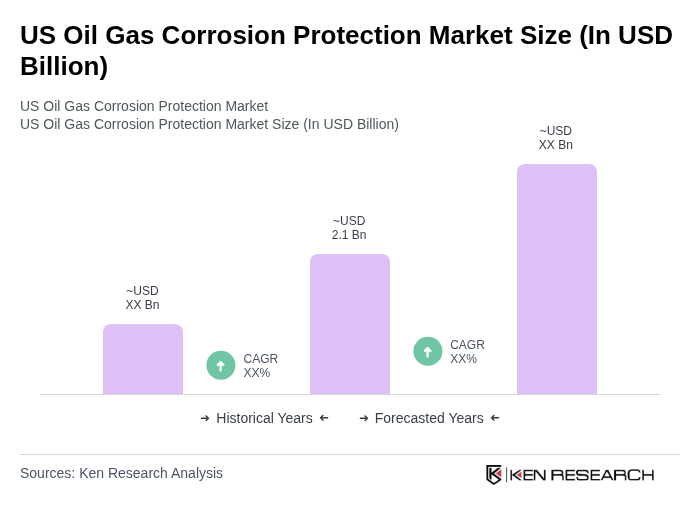
- The US Oil Gas Corrosion Protection Market is valued at USD 2.1 billion, based on a five-year historical analysis. This growth is primarily driven by the increasing need for infrastructure maintenance amid aging pipelines and facilities, rising investments in oil and gas exploration and production, growing awareness of corrosion management to extend asset life and reduce operational costs, and surging U.S. oil production reaching record highs.
- Key players in this market include Texas, California, and Louisiana, which dominate due to their significant oil and gas production activities. These states have a high concentration of refineries, pipelines, and offshore platforms, necessitating robust corrosion protection solutions to ensure operational efficiency and safety.
- The Pipeline and Hazardous Materials Safety Administration enforces the Pipeline Safety Regulations under 49 CFR Parts 192 and 195, issued by the U.S. Department of Transportation, which mandate corrosion control programs for pipelines including regular inspections, cathodic protection systems with specific potential criteria, and coating integrity assessments for operators of gas and hazardous liquid pipelines. This regulation requires compliance through external and internal corrosion control measures, with thresholds for pipeline segments in Class 1-4 locations and licensing for certified inspectors to enhance safety standards and reduce the risk of leaks and failures, thereby driving demand for advanced corrosion protection technologies in the oil and gas sector.
US Oil Gas Corrosion Protection Market Segmentation
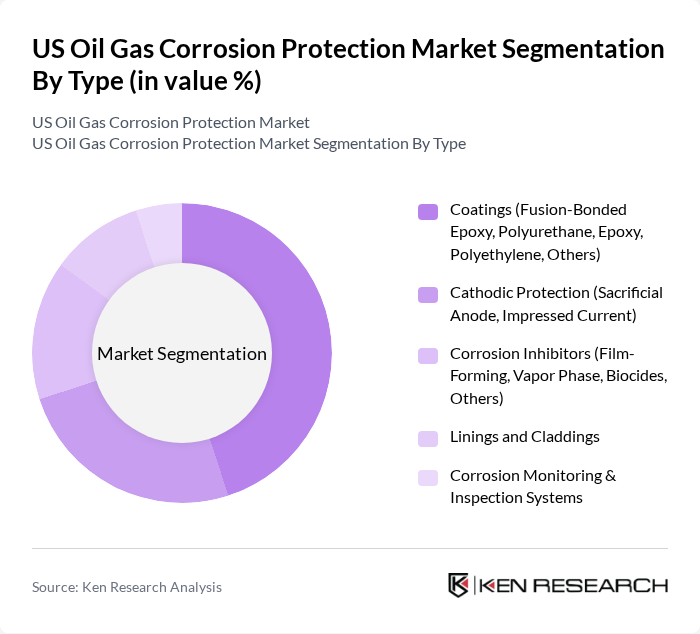
By Type:The segmentation by type includes various methods and materials used for corrosion protection in the oil and gas industry. The subsegments are Coatings (Fusion-Bonded Epoxy, Polyurethane, Epoxy, Polyethylene, Others), Cathodic Protection (Sacrificial Anode, Impressed Current), Corrosion Inhibitors (Film-Forming, Vapor Phase, Biocides, Others), Linings and Claddings, and Corrosion Monitoring & Inspection Systems. Among these, coatings are the most widely used due to their effectiveness in providing a protective barrier against corrosive environments.
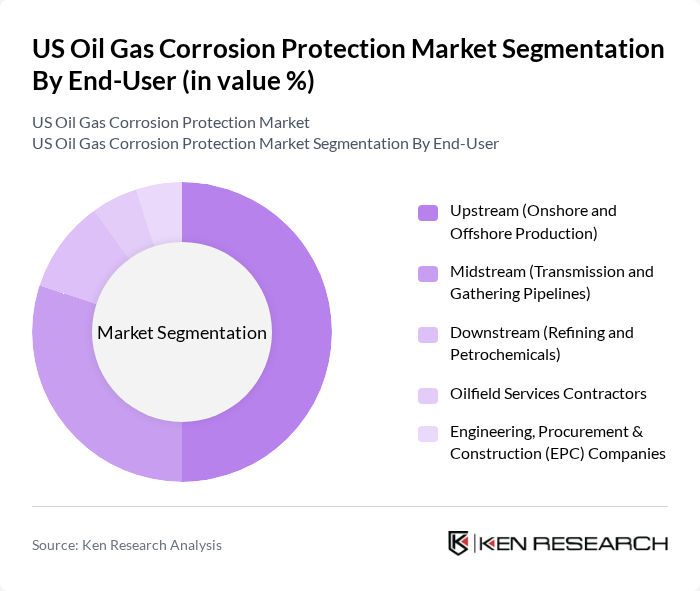
By End-User:The segmentation by end-user includes various sectors utilizing corrosion protection solutions. The subsegments are Upstream (Onshore and Offshore Production), Midstream (Transmission and Gathering Pipelines), Downstream (Refining and Petrochemicals), Oilfield Services Contractors, and Engineering, Procurement & Construction (EPC) Companies. The upstream sector is the largest consumer of corrosion protection solutions due to the harsh environments encountered in oil and gas extraction.
US Oil Gas Corrosion Protection Market Competitive Landscape
The US Oil Gas Corrosion Protection Market is characterized by a dynamic mix of regional and international players. Leading participants such as The Sherwin-Williams Company, PPG Industries, Inc., Akzo Nobel N.V. (International Paint LLC), Hempel A/S, 3M Company, Axalta Coating Systems, LLC, Carboline Company, Tnemec Company, Inc., Jotun A/S, Cortec Corporation, EonCoat, LLC, KTA-Tator, Inc., MESA Products, Inc. (MESA, Inc.), Aegion Corporation (including Corrpro Companies, Inc.), and ROSEN Group (U.S. Operations) contribute to innovation, geographic expansion, and service delivery in this space.
US Oil Gas Corrosion Protection Market Industry Analysis
Growth Drivers
- Increasing Infrastructure Investments:The US government allocated approximately $1.2 trillion for infrastructure improvements, with a significant portion directed towards oil and gas facilities. This investment is expected to enhance the durability of existing structures and promote the adoption of corrosion protection solutions. As infrastructure ages, the need for effective corrosion management becomes critical, driving demand for advanced protective coatings and technologies that can extend asset life and reduce maintenance costs.
- Rising Environmental Regulations:In future, the Environmental Protection Agency (EPA) is expected to enforce stricter regulations on emissions and waste management in the oil and gas sector. Compliance with these regulations necessitates the use of high-performance corrosion protection solutions to minimize environmental impact. Companies are increasingly investing in eco-friendly coatings that meet regulatory standards, thereby driving market growth as they seek to avoid penalties and enhance their sustainability profiles.
- Technological Advancements in Coating Solutions:The development of innovative coating technologies, such as nanotechnology-based solutions, is revolutionizing the corrosion protection market. In future, the market for advanced coatings is projected to reach $3 billion, driven by their superior performance and longevity. These advancements not only improve protection against corrosion but also reduce the frequency of maintenance, making them attractive to oil and gas operators looking to optimize operational efficiency and reduce downtime.
Market Challenges
- High Initial Costs of Corrosion Protection Solutions:The upfront investment required for advanced corrosion protection systems can be a significant barrier for many companies in the oil and gas sector. For instance, the cost of implementing high-performance coatings can range from $50,000 to $200,000 per facility, depending on the size and complexity. This financial burden often leads to delayed adoption, particularly among smaller operators who may lack the capital to invest in such solutions.
- Lack of Awareness Among End-Users:Many end-users in the oil and gas industry remain unaware of the benefits and availability of modern corrosion protection technologies. A survey conducted indicated that over 40% of operators had limited knowledge about advanced coatings and their long-term cost benefits. This lack of awareness can hinder market growth, as companies may continue to rely on outdated methods that do not effectively address corrosion issues, leading to increased maintenance costs and operational risks.
US Oil Gas Corrosion Protection Market Future Outlook
The US oil and gas corrosion protection market is poised for significant growth as technological innovations and regulatory pressures converge. Companies are increasingly adopting smart coatings and predictive maintenance technologies to enhance asset management and reduce operational risks. Furthermore, the integration of IoT in corrosion monitoring is expected to streamline maintenance processes, allowing for real-time data analysis. As sustainability becomes a priority, the demand for eco-friendly solutions will likely drive further advancements in the market, fostering a more resilient industry landscape.
Market Opportunities
- Expansion into Emerging Markets:Emerging markets in Asia and Africa are witnessing rapid industrialization, leading to increased investments in oil and gas infrastructure. This presents a lucrative opportunity for corrosion protection providers to enter these markets, offering tailored solutions that address local challenges and regulatory requirements, thereby expanding their global footprint.
- Development of Eco-Friendly Coating Solutions:The growing emphasis on sustainability is driving demand for eco-friendly coating solutions. Companies that invest in the research and development of biodegradable and low-VOC coatings can capture a significant share of the market, appealing to environmentally conscious consumers and meeting stringent regulatory standards, thus enhancing their competitive advantage.
Scope of the Report
| Segment | Sub-Segments |
|---|---|
| By Type | Coatings (Fusion-Bonded Epoxy, Polyurethane, Epoxy, Polyethylene, Others) Cathodic Protection (Sacrificial Anode, Impressed Current) Corrosion Inhibitors (Film?Forming, Vapor Phase, Biocides, Others) Linings and Claddings Corrosion Monitoring & Inspection Systems |
| By End-User | Upstream (Onshore and Offshore Production) Midstream (Transmission and Gathering Pipelines) Downstream (Refining and Petrochemicals) Oilfield Services Contractors Engineering, Procurement & Construction (EPC) Companies |
| By Application | Pipeline Protection (Transmission, Gathering, Flowlines) Storage Tanks and Terminals Offshore Platforms, Subsea Structures and Risers Refineries, Petrochemical Plants and Process Equipment Wellheads, Valves and Ancillary Infrastructure |
| By Material Protected | Carbon Steel and Low?Alloy Steel Stainless Steel and High?Alloy Materials Concrete Structures Non?Metallics (Composites, Plastics, Liners) Others |
| By Region | Northeast Midwest South (Including Gulf Coast) West |
| By Technology | Electrochemical Protection (Cathodic and Anodic) Organic Coatings (Liquid and Powder) Inorganic Coatings (Metallic, Zinc?Rich, Ceramic) Surface Engineering and Thermal Spray Systems Digital Corrosion Monitoring and Predictive Analytics |
| By Service Type | Inspection and Integrity Assessment Services Maintenance and Rehabilitation Services Engineering Design and Consulting Services Cathodic Protection Design, Installation and Commissioning Training and Certification Services |
Key Target Audience
Investors and Venture Capitalist Firms
Government and Regulatory Bodies (e.g., Environmental Protection Agency, Department of Energy)
Manufacturers and Producers of Corrosion Protection Solutions
Oil and Gas Exploration and Production Companies
Pipeline Operators and Maintenance Firms
Corrosion Engineering and Consulting Firms
Industry Associations (e.g., National Association of Corrosion Engineers)
Financial Institutions and Investment Banks
Players Mentioned in the Report:
The Sherwin-Williams Company
PPG Industries, Inc.
Akzo Nobel N.V. (International Paint LLC)
Hempel A/S
3M Company
Axalta Coating Systems, LLC
Carboline Company
Tnemec Company, Inc.
Jotun A/S
Cortec Corporation
EonCoat, LLC
KTA-Tator, Inc.
MESA Products, Inc. (MESA, Inc.)
Aegion Corporation (including Corrpro Companies, Inc.)
ROSEN Group (U.S. Operations)
Table of Contents
Market Assessment Phase
1. Executive Summary and Approach
2. US Oil Gas Corrosion Protection Market Overview
2.1 Key Insights and Strategic Recommendations
2.2 US Oil Gas Corrosion Protection Market Overview
2.3 Definition and Scope
2.4 Evolution of Market Ecosystem
2.5 Timeline of Key Regulatory Milestones
2.6 Value Chain & Stakeholder Mapping
2.7 Business Cycle Analysis
2.8 Policy & Incentive Landscape
3. US Oil Gas Corrosion Protection Market Analysis
3.1 Growth Drivers
3.1.1 Increasing Infrastructure Investments
3.1.2 Rising Environmental Regulations
3.1.3 Technological Advancements in Coating Solutions
3.1.4 Growing Demand for Oil and Gas
3.2 Market Challenges
3.2.1 High Initial Costs of Corrosion Protection Solutions
3.2.2 Lack of Awareness Among End-Users
3.2.3 Stringent Regulatory Compliance Requirements
3.2.4 Fluctuating Oil Prices
3.3 Market Opportunities
3.3.1 Expansion into Emerging Markets
3.3.2 Development of Eco-Friendly Coating Solutions
3.3.3 Strategic Partnerships and Collaborations
3.3.4 Increased R&D Investments
3.4 Market Trends
3.4.1 Shift Towards Smart Coatings
3.4.2 Adoption of Predictive Maintenance Technologies
3.4.3 Integration of IoT in Corrosion Monitoring
3.4.4 Focus on Sustainability and Green Solutions
3.5 Government Regulation
3.5.1 Environmental Protection Agency (EPA) Standards
3.5.2 Occupational Safety and Health Administration (OSHA) Regulations
3.5.3 National Association of Corrosion Engineers (NACE) Guidelines
3.5.4 State-Level Corrosion Control Policies
4. SWOT Analysis
5. Stakeholder Analysis
6. Porter's Five Forces Analysis
7. US Oil Gas Corrosion Protection Market Market Size, 2019-2024
7.1 By Value
7.2 By Volume
7.3 By Average Selling Price
8. US Oil Gas Corrosion Protection Market Segmentation
8.1 By Type
8.1.1 Coatings (Fusion-Bonded Epoxy, Polyurethane, Epoxy, Polyethylene, Others)
8.1.2 Cathodic Protection (Sacrificial Anode, Impressed Current)
8.1.3 Corrosion Inhibitors (Film?Forming, Vapor Phase, Biocides, Others)
8.1.4 Linings and Claddings
8.1.5 Corrosion Monitoring & Inspection Systems
8.2 By End-User
8.2.1 Upstream (Onshore and Offshore Production)
8.2.2 Midstream (Transmission and Gathering Pipelines)
8.2.3 Downstream (Refining and Petrochemicals)
8.2.4 Oilfield Services Contractors
8.2.5 Engineering, Procurement & Construction (EPC) Companies
8.3 By Application
8.3.1 Pipeline Protection (Transmission, Gathering, Flowlines)
8.3.2 Storage Tanks and Terminals
8.3.3 Offshore Platforms, Subsea Structures and Risers
8.3.4 Refineries, Petrochemical Plants and Process Equipment
8.3.5 Wellheads, Valves and Ancillary Infrastructure
8.4 By Material Protected
8.4.1 Carbon Steel and Low?Alloy Steel
8.4.2 Stainless Steel and High?Alloy Materials
8.4.3 Concrete Structures
8.4.4 Non?Metallics (Composites, Plastics, Liners)
8.4.5 Others
8.5 By Region
8.5.1 Northeast
8.5.2 Midwest
8.5.3 South (Including Gulf Coast)
8.5.4 West
8.6 By Technology
8.6.1 Electrochemical Protection (Cathodic and Anodic)
8.6.2 Organic Coatings (Liquid and Powder)
8.6.3 Inorganic Coatings (Metallic, Zinc?Rich, Ceramic)
8.6.4 Surface Engineering and Thermal Spray Systems
8.6.5 Digital Corrosion Monitoring and Predictive Analytics
8.7 By Service Type
8.7.1 Inspection and Integrity Assessment Services
8.7.2 Maintenance and Rehabilitation Services
8.7.3 Engineering Design and Consulting Services
8.7.4 Cathodic Protection Design, Installation and Commissioning
8.7.5 Training and Certification Services
9. US Oil Gas Corrosion Protection Market Competitive Analysis
9.1 Market Share of Key Players
9.2 Cross Comparison of Key Players
9.2.1 Company Name
9.2.2 Group Size (Global Major, Regional Player, Niche Specialist)
9.2.3 US Oil & Gas Corrosion Protection Revenue (USD Million)
9.2.4 Revenue Growth Rate in US Oil & Gas Segment (%)
9.2.5 US Market Share in Oil & Gas Corrosion Protection (%)
9.2.6 Installed Base of Protected Pipeline Length (km) in the US
9.2.7 Share of Revenue from Upstream / Midstream / Downstream (%)
9.2.8 R&D Intensity (% of Revenue Spent on Corrosion Technologies)
9.2.9 Average Contract Tenure with US Oil & Gas Operators (Years)
9.2.10 Order Backlog for Oil & Gas Corrosion Projects in the US (USD Million)
9.2.11 EBITDA Margin for US Corrosion Protection Business (%)
9.2.12 Geographic Footprint within the US (No. of Service/Coating Facilities)
9.3 SWOT Analysis of Top Players
9.4 Pricing Analysis
9.5 Detailed Profile of Major Companies
9.5.1 The Sherwin-Williams Company
9.5.2 PPG Industries, Inc.
9.5.3 Akzo Nobel N.V. (International Paint LLC)
9.5.4 Hempel A/S
9.5.5 3M Company
9.5.6 Axalta Coating Systems, LLC
9.5.7 Carboline Company
9.5.8 Tnemec Company, Inc.
9.5.9 Jotun A/S
9.5.10 Cortec Corporation
9.5.11 EonCoat, LLC
9.5.12 KTA-Tator, Inc.
9.5.13 MESA Products, Inc. (MESA, Inc.)
9.5.14 Aegion Corporation (including Corrpro Companies, Inc.)
9.5.15 ROSEN Group (U.S. Operations)
10. US Oil Gas Corrosion Protection Market End-User Analysis
10.1 Procurement Behavior of Key Ministries
10.1.1 Budget Allocation Trends
10.1.2 Decision-Making Processes
10.1.3 Preferred Suppliers
10.1.4 Compliance Requirements
10.2 Corporate Spend on Infrastructure & Energy
10.2.1 Investment Trends
10.2.2 Spending Priorities
10.2.3 Long-Term Contracts
10.2.4 Budget Cycles
10.3 Pain Point Analysis by End-User Category
10.3.1 Cost Management
10.3.2 Quality Assurance
10.3.3 Regulatory Compliance
10.3.4 Technology Integration
10.4 User Readiness for Adoption
10.4.1 Training Needs
10.4.2 Technology Familiarity
10.4.3 Investment Willingness
10.4.4 Support Requirements
10.5 Post-Deployment ROI and Use Case Expansion
10.5.1 Performance Metrics
10.5.2 Case Studies
10.5.3 Feedback Mechanisms
10.5.4 Future Expansion Plans
11. US Oil Gas Corrosion Protection Market Future Size, 2025-2030
11.1 By Value
11.2 By Volume
11.3 By Average Selling Price
Go-To-Market Strategy Phase
1. Whitespace Analysis + Business Model Canvas
1.1 Market Gaps Identification
1.2 Value Proposition Development
1.3 Revenue Streams
1.4 Cost Structure Analysis
1.5 Key Partnerships
1.6 Customer Segments
1.7 Channels
2. Marketing and Positioning Recommendations
2.1 Branding Strategies
2.2 Product USPs
2.3 Target Audience Identification
2.4 Communication Strategies
2.5 Digital Marketing Approaches
3. Distribution Plan
3.1 Urban Retail Strategies
3.2 Rural NGO Tie-Ups
3.3 Online Distribution Channels
3.4 Direct Sales Approaches
4. Channel & Pricing Gaps
4.1 Underserved Routes
4.2 Pricing Bands Analysis
4.3 Competitor Pricing Strategies
5. Unmet Demand & Latent Needs
5.1 Category Gaps
5.2 Consumer Segments
5.3 Emerging Trends
6. Customer Relationship
6.1 Loyalty Programs
6.2 After-Sales Service
6.3 Customer Feedback Mechanisms
7. Value Proposition
7.1 Sustainability Initiatives
7.2 Integrated Supply Chains
7.3 Competitive Advantages
8. Key Activities
8.1 Regulatory Compliance
8.2 Branding Efforts
8.3 Distribution Setup
9. Entry Strategy Evaluation
9.1 Domestic Market Entry Strategy
9.1.1 Product Mix
9.1.2 Pricing Band
9.1.3 Packaging
9.2 Export Entry Strategy
9.2.1 Target Countries
9.2.2 Compliance Roadmap
10. Entry Mode Assessment
10.1 Joint Ventures
10.2 Greenfield Investments
10.3 Mergers & Acquisitions
10.4 Distributor Model
11. Capital and Timeline Estimation
11.1 Capital Requirements
11.2 Timelines
12. Control vs Risk Trade-Off
12.1 Ownership vs Partnerships
13. Profitability Outlook
13.1 Breakeven Analysis
13.2 Long-Term Sustainability
14. Potential Partner List
14.1 Distributors
14.2 Joint Ventures
14.3 Acquisition Targets
15. Execution Roadmap
15.1 Phased Plan for Market Entry
15.1.1 Market Setup
15.1.2 Market Entry
15.1.3 Growth Acceleration
15.1.4 Scale & Stabilize
15.2 Key Activities and Milestones
15.2.1 Milestone Planning
15.2.2 Activity Tracking
Research Methodology
Phase 1: Approach1
Desk Research
- Industry reports from the American Petroleum Institute (API) and the National Association of Corrosion Engineers (NACE)
- Market analysis from government publications and energy sector databases
- Academic journals and white papers focusing on corrosion protection technologies and materials
Primary Research
- Interviews with corrosion engineers and specialists in oil and gas companies
- Surveys targeting procurement managers in the oil and gas sector
- Field visits to oil rigs and refineries to gather firsthand insights on corrosion management practices
Validation & Triangulation
- Cross-validation of findings through multiple industry expert interviews
- Triangulation of data from market reports, expert opinions, and field observations
- Sanity checks through peer reviews and feedback from industry stakeholders
Phase 2: Market Size Estimation1
Top-down Assessment
- Analysis of total oil and gas production volumes in the U.S. and associated corrosion protection expenditures
- Segmentation of the market by application areas such as upstream, midstream, and downstream
- Incorporation of regulatory impacts and environmental standards affecting corrosion protection investments
Bottom-up Modeling
- Estimation of market size based on the number of active oil and gas facilities and their corrosion protection budgets
- Cost analysis of various corrosion protection technologies and materials used in the industry
- Volume of corrosion protection products consumed across different segments of the oil and gas market
Forecasting & Scenario Analysis
- Multi-variable forecasting using historical data on oil prices, production levels, and corrosion incidents
- Scenario modeling based on potential regulatory changes and technological advancements in corrosion protection
- Development of baseline, optimistic, and pessimistic market growth projections through 2030
Phase 3: CATI Sample Composition1
| Scope Item/Segment | Sample Size | Target Respondent Profiles |
|---|---|---|
| Upstream Oil Production | 100 | Corrosion Engineers, Field Operations Managers |
| Midstream Pipeline Operations | 80 | Pipeline Integrity Managers, Safety Officers |
| Downstream Refining Processes | 90 | Refinery Managers, Maintenance Supervisors |
| Corrosion Protection Product Suppliers | 70 | Sales Managers, Product Development Engineers |
| Regulatory Compliance and Standards | 60 | Compliance Officers, Environmental Managers |
Frequently Asked Questions
What is the current value of the US Oil Gas Corrosion Protection Market?
The US Oil Gas Corrosion Protection Market is valued at approximately USD 2.1 billion, driven by the need for infrastructure maintenance, rising investments in oil and gas exploration, and growing awareness of corrosion management to extend asset life and reduce operational costs.
Which states are key players in the US Oil Gas Corrosion Protection Market?
What regulations govern corrosion protection in the US oil and gas sector?
What are the main types of corrosion protection methods used in the oil and gas industry?
Other Regional/Country Reports
Indonesia Oil Gas Corrosion Protection Market
Malaysia Oil Gas Corrosion Protection Market
KSA Oil Gas Corrosion Protection Market
APAC Oil Gas Corrosion Protection Market
SEA Oil Gas Corrosion Protection Market
Vietnam Oil Gas Corrosion Protection Market
Other Adjacent Reports
Thailand Oil and Gas Pipeline Maintenance Market
Egypt Industrial Coatings and Paints Market
Kuwait Cathodic Protection Systems Market
Qatar Corrosion Inhibitors and Chemicals Market
South Korea Oilfield Equipment Manufacturing Market
UAE Petrochemical Refining Market
Thailand Offshore Platform Construction Market
Belgium Environmental Monitoring Services Market
South Korea Asset Integrity Management Market
Germany Energy Infrastructure Development Market
Why Buy From Us?

What makes us stand out is that our consultants follow Robust, Refine and Result (RRR) methodology. Robust for clear definitions, approaches and sanity checking, Refine for differentiating respondents' facts and opinions, and Result for presenting data with story.

We have set a benchmark in the industry by offering our clients with syndicated and customized market research reports featuring coverage of entire market as well as meticulous research and analyst insights.

While we don't replace traditional research, we flip the method upside down. Our dual approach of Top Bottom & Bottom Top ensures quality deliverable by not just verifying company fundamentals but also looking at the sector and macroeconomic factors.

With one step in the future, our research team constantly tries to show you the bigger picture. We help with some of the tough questions you may encounter along the way: How is the industry positioned? Best marketing channel? KPI's of competitors? By aligning every element, we help maximize success.

Our report gives you instant access to the answers and sources that other companies might choose to hide. We elaborate each steps of research methodology we have used and showcase you the sample size to earn your trust.

If you need any support, we are here! We pride ourselves on universe strength, data quality, and quick, friendly, and professional service.