About the Report
Base Year 2024Listen to the audio summary
US Ophthalmic Microscope Market Overview
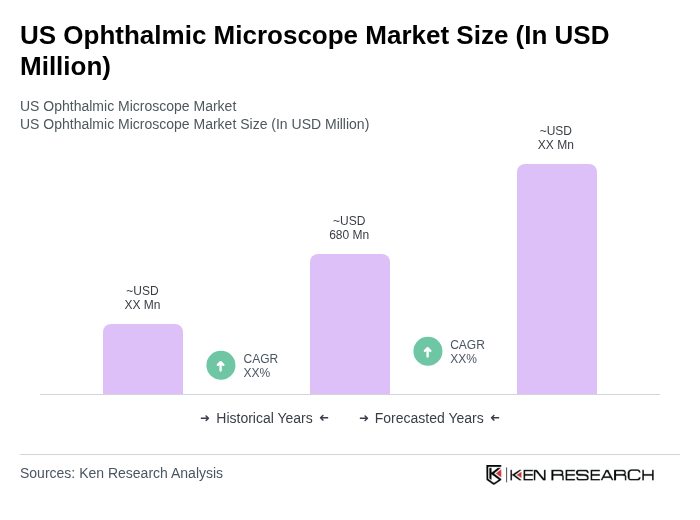
- The US Ophthalmic Microscope Market is valued at USD 680 million, based on a five-year historical analysis. This growth is primarily driven by advancements in surgical techniques, the rising prevalence of eye disorders among the aging population, and increasing demand for minimally invasive surgeries. Enhanced digital imaging capabilities and integration of artificial intelligence in ophthalmic microscopes have further fueled market expansion, enabling healthcare professionals to achieve greater precision and improve patient outcomes.
- Key players in this market are concentrated in major cities such as New York, Los Angeles, and Chicago, which dominate due to their advanced healthcare infrastructure, high patient volumes, and the presence of leading ophthalmic research institutions. Renowned hospitals and specialized clinics in these urban centers contribute significantly to the demand for ophthalmic microscopes, making them pivotal regions for market growth.
- The “Medical Device Reporting Requirements for Manufacturers, Importers, and Device User Facilities” under Title 21 of the Code of Federal Regulations (CFR) Part 803, issued by the US Food and Drug Administration (FDA) in 2023, mandates the use of advanced imaging technologies in surgical procedures to enhance patient safety and surgical outcomes. This regulation requires all ophthalmic surgeries to utilize state-of-the-art equipment, thereby increasing the demand for high-quality ophthalmic microscopes across healthcare facilities.
US Ophthalmic Microscope Market Segmentation
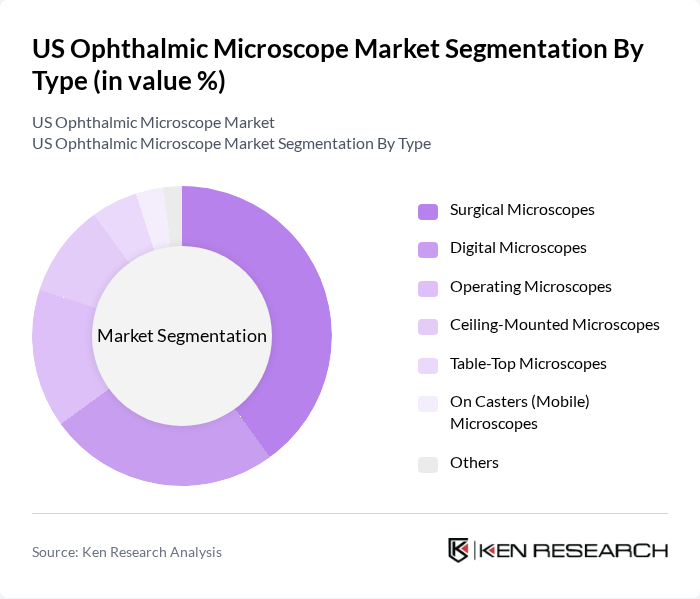
By Type:The market is segmented into various types of microscopes, each catering to specific surgical needs and preferences. The primary subsegments include Surgical Microscopes, Digital Microscopes, Operating Microscopes, Ceiling-Mounted Microscopes, Table-Top Microscopes, On Casters (Mobile) Microscopes, and Others. Surgical Microscopes are particularly dominant due to their critical role in complex eye surgeries, providing enhanced visualization and precision. Digital Microscopes are gaining traction for their ability to integrate with digital imaging systems and AI-based image processing, improving diagnostic and surgical capabilities.
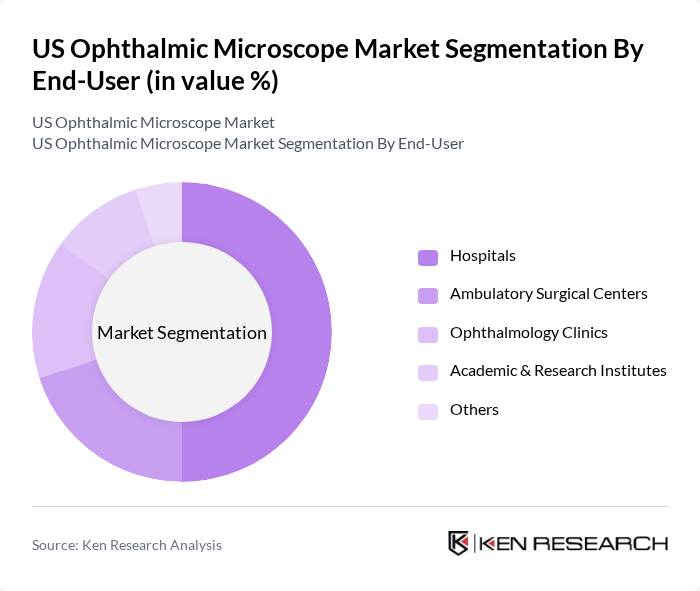
By End-User:The end-user segmentation includes Hospitals, Ambulatory Surgical Centers, Ophthalmology Clinics, Academic & Research Institutes, and Others. Hospitals are the leading end-users, driven by the high volume of surgical procedures and the need for advanced surgical equipment. Ambulatory Surgical Centers are also witnessing growth due to the trend towards outpatient surgeries, which require efficient and portable microscope solutions. Ophthalmology clinics and academic institutes are expanding their adoption of digital and AI-integrated microscopes for both clinical and research purposes.
US Ophthalmic Microscope Market Competitive Landscape
The US Ophthalmic Microscope Market is characterized by a dynamic mix of regional and international players. Leading participants such as Carl Zeiss Meditec AG, Leica Microsystems GmbH, Nikon Corporation, Alcon Inc., Bausch + Lomb Corporation, Topcon Corporation, Haag-Streit AG, Stryker Corporation, Olympus Corporation, Möller-Wedel GmbH & Co. KG, Kowa Company, Ltd., Optovue, Inc., Nidek Co., Ltd., Takagi Seiko Co., Ltd., Seiler Instrument Inc. contribute to innovation, geographic expansion, and service delivery in this space.
US Ophthalmic Microscope Market Industry Analysis
Growth Drivers
- Increasing Prevalence of Eye Disorders:The prevalence of eye disorders in the U.S. is projected to reach 62 million, driven by factors such as aging and lifestyle changes. Conditions like cataracts and age-related macular degeneration are significant contributors. The National Eye Institute estimates that the economic burden of vision loss and eye disorders will exceedUSD 139 billion annually, highlighting the urgent need for advanced ophthalmic solutions, including microscopes, to address these challenges effectively.
- Technological Advancements in Surgical Procedures:The U.S. ophthalmic microscope market is benefiting from rapid technological advancements, with overUSD 1.8 billioninvested in ophthalmic research and development in future. Innovations such as enhanced imaging systems and integrated digital platforms are improving surgical outcomes. These advancements are expected to increase the efficiency of procedures, leading to a projected25%rise in the adoption of advanced microscopes in surgical settings in future, enhancing patient care significantly.
- Rising Geriatric Population:In future, the U.S. population aged 65 and older is expected to reachapproximately 76 million, significantly increasing the demand for ophthalmic care. This demographic is particularly susceptible to eye disorders, necessitating advanced surgical interventions. The U.S. Census Bureau reports that this age group will account for approximately20%of the total population, driving the need for specialized ophthalmic microscopes to cater to the growing number of surgical procedures required for age-related conditions.
Market Challenges
- High Cost of Ophthalmic Microscopes:The average cost of advanced ophthalmic microscopes can exceedUSD 100,000, posing a significant barrier for many healthcare facilities, especially smaller practices. This high initial investment can deter adoption, particularly in regions with limited healthcare budgets. As a result, many facilities may opt for less advanced alternatives, impacting the overall growth of the ophthalmic microscope market in the U.S. and limiting access to cutting-edge technology.
- Limited Reimbursement Policies:Reimbursement policies for ophthalmic procedures remain inconsistent, with many insurers offering limited coverage for advanced surgical technologies. According to the American Academy of Ophthalmology, only60%of ophthalmic procedures receive adequate reimbursement, which can hinder the adoption of new technologies. This financial uncertainty creates challenges for healthcare providers, potentially stalling the growth of the ophthalmic microscope market as facilities weigh the costs against potential returns.
US Ophthalmic Microscope Market Future Outlook
The future of the U.S. ophthalmic microscope market appears promising, driven by ongoing technological innovations and an increasing focus on patient-centric care. As healthcare providers continue to adopt digital technologies, the integration of telemedicine and remote consultations is expected to enhance service delivery. Furthermore, the shift towards outpatient surgical centers will likely increase the demand for advanced ophthalmic microscopes, facilitating quicker and more efficient surgical procedures while improving patient outcomes in the coming years.
Market Opportunities
- Expansion in Emerging Markets:The U.S. ophthalmic microscope market can capitalize on emerging markets, where healthcare infrastructure is rapidly developing. With a projected growth rate of15%in these regions, companies can explore partnerships and distribution channels to introduce advanced technologies, thereby increasing their market share and addressing the rising demand for quality eye care solutions.
- Development of Portable Ophthalmic Microscopes:The demand for portable ophthalmic microscopes is on the rise, particularly in remote and underserved areas. With an estimated market potential ofUSD 200 millionin future, manufacturers can focus on creating lightweight, user-friendly devices that enhance accessibility and convenience, ultimately improving patient care and expanding their customer base in diverse settings.
Scope of the Report
| Segment | Sub-Segments |
|---|---|
| By Type | Surgical Microscopes Digital Microscopes Operating Microscopes Ceiling-Mounted Microscopes Table-Top Microscopes On Casters (Mobile) Microscopes Others |
| By End-User | Hospitals Ambulatory Surgical Centers Ophthalmology Clinics Academic & Research Institutes Others |
| By Application | Cataract Surgery Retinal Surgery Glaucoma Surgery Corneal Surgery Anterior Segment Surgery Posterior Segment Surgery Others |
| By Technology | Optical Microscopes Digital Imaging Microscopes Laser Microscopes D Visualization Microscopes Others |
| By Portability | Fixed Microscopes Mobile Microscopes Portable Microscopes Others |
| By Region | Northeast Midwest South West |
| By Market Segment | High-End Microscopes Mid-Range Microscopes Low-End Microscopes Basic Microscopes Standard Microscopes Advanced Microscopes Others |
Key Target Audience
Investors and Venture Capitalist Firms
Government and Regulatory Bodies (e.g., Food and Drug Administration, Centers for Medicare & Medicaid Services)
Manufacturers and Producers
Distributors and Retailers
Healthcare Providers and Hospitals
Medical Device Regulatory Consultants
Industry Associations (e.g., American Academy of Ophthalmology)
Financial Institutions
Players Mentioned in the Report:
Carl Zeiss Meditec AG
Leica Microsystems GmbH
Nikon Corporation
Alcon Inc.
Bausch + Lomb Corporation
Topcon Corporation
Haag-Streit AG
Stryker Corporation
Olympus Corporation
Moller-Wedel GmbH & Co. KG
Kowa Company, Ltd.
Optovue, Inc.
Nidek Co., Ltd.
Takagi Seiko Co., Ltd.
Seiler Instrument Inc.
Table of Contents
Market Assessment Phase
1. Executive Summary and Approach
2. US Ophthalmic Microscope Market Overview
2.1 Key Insights and Strategic Recommendations
2.2 US Ophthalmic Microscope Market Overview
2.3 Definition and Scope
2.4 Evolution of Market Ecosystem
2.5 Timeline of Key Regulatory Milestones
2.6 Value Chain & Stakeholder Mapping
2.7 Business Cycle Analysis
2.8 Policy & Incentive Landscape
3. US Ophthalmic Microscope Market Analysis
3.1 Growth Drivers
3.1.1 Increasing prevalence of eye disorders
3.1.2 Technological advancements in surgical procedures
3.1.3 Rising geriatric population
3.1.4 Growing demand for minimally invasive surgeries
3.2 Market Challenges
3.2.1 High cost of ophthalmic microscopes
3.2.2 Limited reimbursement policies
3.2.3 Stringent regulatory requirements
3.2.4 Competition from alternative surgical methods
3.3 Market Opportunities
3.3.1 Expansion in emerging markets
3.3.2 Development of portable ophthalmic microscopes
3.3.3 Increasing investment in healthcare infrastructure
3.3.4 Collaborations and partnerships for innovation
3.4 Market Trends
3.4.1 Integration of digital technologies in ophthalmic procedures
3.4.2 Shift towards outpatient surgical centers
3.4.3 Growing focus on patient-centric care
3.4.4 Rise in telemedicine and remote consultations
3.5 Government Regulation
3.5.1 FDA regulations on medical devices
3.5.2 Compliance with safety standards
3.5.3 Guidelines for clinical trials
3.5.4 Reimbursement policies for ophthalmic procedures
4. SWOT Analysis
5. Stakeholder Analysis
6. Porter's Five Forces Analysis
7. US Ophthalmic Microscope Market Market Size, 2019-2024
7.1 By Value
7.2 By Volume
7.3 By Average Selling Price
8. US Ophthalmic Microscope Market Segmentation
8.1 By Type
8.1.1 Surgical Microscopes
8.1.2 Digital Microscopes
8.1.3 Operating Microscopes
8.1.4 Ceiling-Mounted Microscopes
8.1.5 Table-Top Microscopes
8.1.6 On Casters (Mobile) Microscopes
8.1.7 Others
8.2 By End-User
8.2.1 Hospitals
8.2.2 Ambulatory Surgical Centers
8.2.3 Ophthalmology Clinics
8.2.4 Academic & Research Institutes
8.2.5 Others
8.3 By Application
8.3.1 Cataract Surgery
8.3.2 Retinal Surgery
8.3.3 Glaucoma Surgery
8.3.4 Corneal Surgery
8.3.5 Anterior Segment Surgery
8.3.6 Posterior Segment Surgery
8.3.7 Others
8.4 By Technology
8.4.1 Optical Microscopes
8.4.2 Digital Imaging Microscopes
8.4.3 Laser Microscopes
8.4.4 3D Visualization Microscopes
8.4.5 Others
8.5 By Portability
8.5.1 Fixed Microscopes
8.5.2 Mobile Microscopes
8.5.3 Portable Microscopes
8.5.4 Others
8.6 By Region
8.6.1 Northeast
8.6.2 Midwest
8.6.3 South
8.6.4 West
8.7 By Market Segment
8.7.1 High-End Microscopes
8.7.2 Mid-Range Microscopes
8.7.3 Low-End Microscopes
8.7.4 Basic Microscopes
8.7.5 Standard Microscopes
8.7.6 Advanced Microscopes
8.7.7 Others
9. US Ophthalmic Microscope Market Competitive Analysis
9.1 Market Share of Key Players
9.2 KPIs for Cross Comparison of Key Players
9.2.1 Company Name
9.2.2 Group Size (Large, Medium, or Small as per industry convention)
9.2.3 US Ophthalmic Microscope Revenue (USD Million)
9.2.4 Revenue Growth Rate (YoY %)
9.2.5 US Market Share (%)
9.2.6 Installed Base in US (Units)
9.2.7 R&D Investment as % of Revenue
9.2.8 Product Portfolio Breadth (No. of Models)
9.2.9 FDA Approvals/510(k) Clearances (Count)
9.2.10 Average Selling Price (USD)
9.2.11 Distribution Channel Coverage (No. of States/Regions)
9.2.12 Customer Satisfaction Index (Survey Score)
9.2.13 Service Response Time (Hours)
9.2.14 Brand Recognition Score (Survey-Based)
9.2.15 Product Innovation Rate (New Launches/Year)
9.3 SWOT Analysis of Top Players
9.4 Pricing Analysis
9.5 Detailed Profile of Major Companies
9.5.1 Carl Zeiss Meditec AG
9.5.2 Leica Microsystems GmbH
9.5.3 Nikon Corporation
9.5.4 Alcon Inc.
9.5.5 Bausch + Lomb Corporation
9.5.6 Topcon Corporation
9.5.7 Haag-Streit AG
9.5.8 Stryker Corporation
9.5.9 Olympus Corporation
9.5.10 Möller-Wedel GmbH & Co. KG
9.5.11 Kowa Company, Ltd.
9.5.12 Optovue, Inc.
9.5.13 Nidek Co., Ltd.
9.5.14 Takagi Seiko Co., Ltd.
9.5.15 Seiler Instrument Inc.
10. US Ophthalmic Microscope Market End-User Analysis
10.1 Procurement Behavior of Key Ministries
10.1.1 Budget Allocation Trends
10.1.2 Decision-Making Processes
10.1.3 Supplier Selection Criteria
10.1.4 Contracting Practices
10.2 Corporate Spend on Infrastructure & Energy
10.2.1 Investment Trends in Healthcare Facilities
10.2.2 Spending on Technological Upgrades
10.2.3 Budgeting for Equipment Maintenance
10.2.4 Others
10.3 Pain Point Analysis by End-User Category
10.3.1 Challenges in Equipment Procurement
10.3.2 Training and Skill Gaps
10.3.3 Maintenance and Support Issues
10.3.4 Others
10.4 User Readiness for Adoption
10.4.1 Awareness of New Technologies
10.4.2 Training Programs Availability
10.4.3 Financial Readiness
10.4.4 Others
10.5 Post-Deployment ROI and Use Case Expansion
10.5.1 Measurement of ROI
10.5.2 Case Studies of Successful Implementations
10.5.3 Expansion into New Applications
10.5.4 Others
11. US Ophthalmic Microscope Market Future Size, 2025-2030
11.1 By Value
11.2 By Volume
11.3 By Average Selling Price
Go-To-Market Strategy Phase
1. Whitespace Analysis + Business Model Canvas
1.1 Market Gaps Identification
1.2 Business Model Development
2. Marketing and Positioning Recommendations
2.1 Branding Strategies
2.2 Product USPs
3. Distribution Plan
3.1 Urban Retail Strategies
3.2 Rural NGO Tie-Ups
4. Channel & Pricing Gaps
4.1 Underserved Routes
4.2 Pricing Bands Analysis
5. Unmet Demand & Latent Needs
5.1 Category Gaps
5.2 Consumer Segments
6. Customer Relationship
6.1 Loyalty Programs
6.2 After-Sales Service
7. Value Proposition
7.1 Sustainability Initiatives
7.2 Integrated Supply Chains
8. Key Activities
8.1 Regulatory Compliance
8.2 Branding Efforts
8.3 Distribution Setup
9. Entry Strategy Evaluation
9.1 Domestic Market Entry Strategy
9.1.1 Product Mix Considerations
9.1.2 Pricing Band Strategy
9.1.3 Packaging Solutions
9.2 Export Entry Strategy
9.2.1 Target Countries Identification
9.2.2 Compliance Roadmap Development
10. Entry Mode Assessment
10.1 Joint Ventures
10.2 Greenfield Investments
10.3 Mergers & Acquisitions
10.4 Distributor Model
11. Capital and Timeline Estimation
11.1 Capital Requirements
11.2 Timelines for Implementation
12. Control vs Risk Trade-Off
12.1 Ownership Considerations
12.2 Partnerships Evaluation
13. Profitability Outlook
13.1 Breakeven Analysis
13.2 Long-Term Sustainability Strategies
14. Potential Partner List
14.1 Distributors
14.2 Joint Ventures
14.3 Acquisition Targets
15. Execution Roadmap
15.1 Phased Plan for Market Entry
15.1.1 Market Setup
15.1.2 Market Entry
15.1.3 Growth Acceleration
15.1.4 Scale & Stabilize
15.2 Key Activities and Milestones
15.2.1 Milestone Planning
15.2.2 Activity Tracking
Research Methodology
Phase 1: Approach1
Desk Research
- Industry reports from ophthalmic associations and healthcare market research firms
- Published articles and white papers on technological advancements in ophthalmic microscopes
- Government healthcare expenditure reports and statistics on eye care services
Primary Research
- Interviews with ophthalmologists and eye care professionals to understand usage patterns
- Surveys with hospital procurement managers regarding purchasing decisions
- Field interviews with manufacturers and distributors of ophthalmic equipment
Validation & Triangulation
- Cross-validation of data from multiple sources including trade publications and expert opinions
- Triangulation of market size estimates using sales data and industry growth rates
- Sanity checks through expert panel reviews comprising industry veterans
Phase 2: Market Size Estimation1
Top-down Assessment
- Analysis of total healthcare spending in the U.S. and its allocation to ophthalmic services
- Segmentation of the market by product type, including surgical and diagnostic microscopes
- Incorporation of trends in eye care demand driven by aging population statistics
Bottom-up Modeling
- Volume estimates based on sales data from leading ophthalmic microscope manufacturers
- Cost analysis derived from pricing models of various microscope types
- Estimation of market share based on distribution channels and regional sales
Forecasting & Scenario Analysis
- Multi-factor regression analysis incorporating technological advancements and healthcare policies
- Scenario modeling based on potential changes in reimbursement policies and healthcare access
- Baseline, optimistic, and pessimistic forecasts through 2030 based on market dynamics
Phase 3: CATI Sample Composition1
| Scope Item/Segment | Sample Size | Target Respondent Profiles |
|---|---|---|
| Ophthalmic Surgeons | 60 | Ophthalmologists, Eye Surgeons |
| Hospital Procurement Managers | 50 | Procurement Managers, Supply Chain Managers |
| Optometry Clinics | 40 | Optometrists, Clinic Managers |
| Medical Equipment Distributors | 40 | Sales Representatives, Distribution Managers |
| Healthcare Policy Makers | 40 | Health Administrators, Policy Analysts |
Frequently Asked Questions
What is the current value of the US Ophthalmic Microscope Market?
The US Ophthalmic Microscope Market is valued at approximately USD 680 million, reflecting a significant growth driven by advancements in surgical techniques and increasing demand for minimally invasive surgeries.
What factors are driving the growth of the US Ophthalmic Microscope Market?
Which cities are the major hubs for the US Ophthalmic Microscope Market?
What are the regulatory requirements affecting the US Ophthalmic Microscope Market?
Other Regional/Country Reports
Indonesia Ophthalmic Microscope Market
Malaysia Ophthalmic Microscope Market
KSA Ophthalmic Microscope Market
APAC Ophthalmic Microscope Market
SEA Ophthalmic Microscope Market
Vietnam Ophthalmic Microscope Market
Other Adjacent Reports
Philippines Surgical Microscope Market
Singapore Ophthalmic Device Market
UAE Medical Imaging Equipment Market
South Africa Ophthalmology Instrument Market
Brazil Diagnostic Tool Market
Mexico Eye Care Product Market
Singapore Laser Surgery Equipment Market
Egypt Vision Correction Device Market
UAE Healthcare Optics Market
South Korea Biomedical Imaging Market
Why Buy From Us?

What makes us stand out is that our consultants follow Robust, Refine and Result (RRR) methodology. Robust for clear definitions, approaches and sanity checking, Refine for differentiating respondents' facts and opinions, and Result for presenting data with story.

We have set a benchmark in the industry by offering our clients with syndicated and customized market research reports featuring coverage of entire market as well as meticulous research and analyst insights.

While we don't replace traditional research, we flip the method upside down. Our dual approach of Top Bottom & Bottom Top ensures quality deliverable by not just verifying company fundamentals but also looking at the sector and macroeconomic factors.

With one step in the future, our research team constantly tries to show you the bigger picture. We help with some of the tough questions you may encounter along the way: How is the industry positioned? Best marketing channel? KPI's of competitors? By aligning every element, we help maximize success.

Our report gives you instant access to the answers and sources that other companies might choose to hide. We elaborate each steps of research methodology we have used and showcase you the sample size to earn your trust.

If you need any support, we are here! We pride ourselves on universe strength, data quality, and quick, friendly, and professional service.