About the Report
Base Year 2024US Plastic Bags And Sacks Market Overview
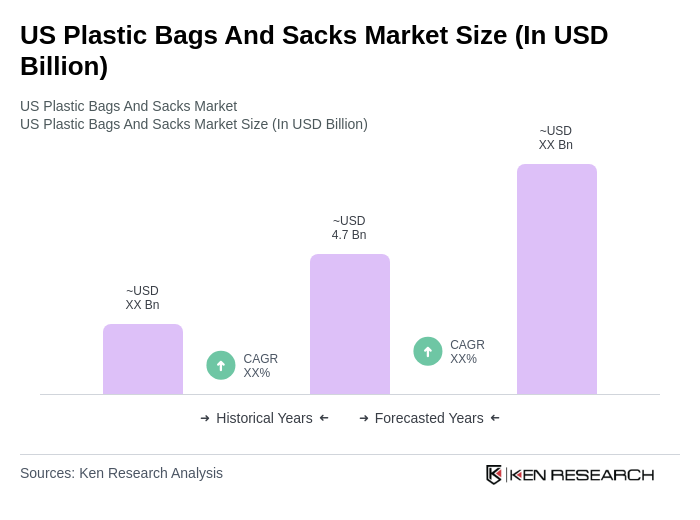
- The US Plastic Bags and Sacks Market is valued at approximately USD 4.7 billion, based on a five-year analysis. This reflects steady demand across retail carryout, trash/liner, e?commerce mailers, and industrial sacks in the broader context of a global market estimated around USD 23–24 billion. Growth is supported by rising convenience packaging needs in retail, foodservice, and parcel logistics, with food delivery and e?commerce continuing to lift usage of mailers, carryout, and secondary bags/liners. Industry sources note strong demand from retail, packaging, and food service in North America alongside e?commerce growth and development of recycled and compostable solutions.
- Key players in this market include major metropolitan areas such as New York, Los Angeles, and Chicago, which dominate due to their high population density and significant retail activities. These cities serve as major distribution hubs, leading to increased consumption of plastic bags and sacks in various applications, from grocery shopping to food delivery services.
- In recent years, several states have implemented regulations aimed at reducing plastic waste, such as California's statewide ban on single-use plastic bags. This regulation encourages the adoption of reusable bags and promotes environmental sustainability, impacting the production and consumption patterns within the plastic bags and sacks market.
US Plastic Bags And Sacks Market Segmentation
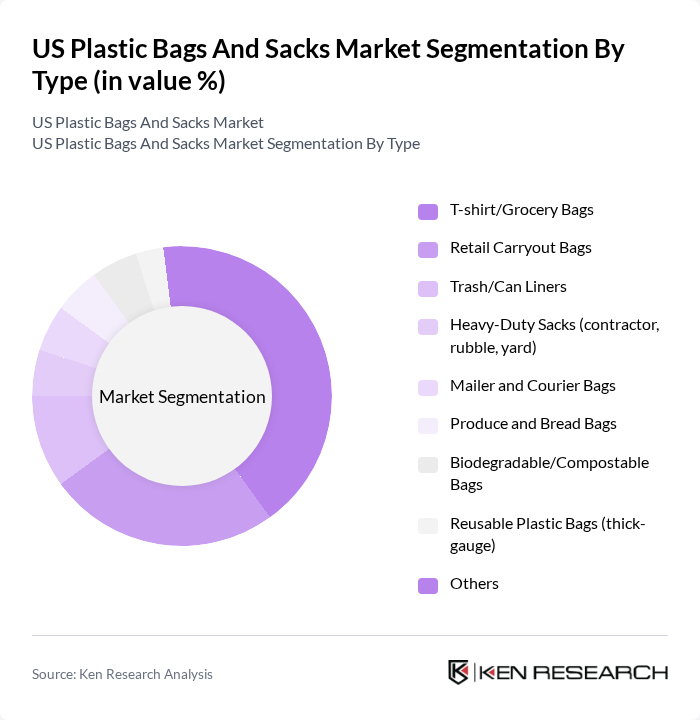
By Type:The market is segmented into various types of plastic bags and sacks, including T-shirt/Grocery Bags, Retail Carryout Bags, Trash/Can Liners, Heavy-Duty Sacks, Mailer and Courier Bags, Produce and Bread Bags, Biodegradable/Compostable Bags, Reusable Plastic Bags, and Others. Among these, T-shirt/Grocery Bags dominate the market in jurisdictions without bans due to their widespread use in retail environments; in regulated states, thicker-gauge reusable plastic and paper substitutes have partially displaced traditional thin HDPE bags, while trash/can liners and specialty retail/e?commerce mailers remain resilient. The convenience they offer for consumers and retailers alike has solidified their position as a staple in shopping practices, though policy-driven substitution is ongoing. Retail Carryout Bags also hold a significant share, driven by the foodservice industry's demand for takeout packaging and continued growth in food delivery. The growing trend towards sustainability has led to an increase in the adoption of Biodegradable/Compostable and recycled-content bags, although they currently represent a smaller segment of the overall market relative to conventional PE formats.
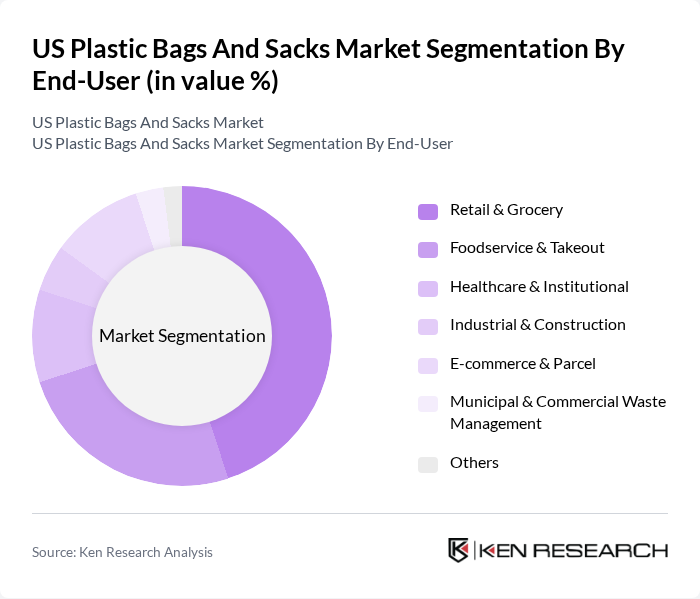
By End-User:The end-user segmentation includes Retail & Grocery, Foodservice & Takeout, Healthcare & Institutional, Industrial & Construction, E-commerce & Parcel, Municipal & Commercial Waste Management, and Others. The Retail & Grocery segment is the largest, supported by high-frequency consumer purchases; policy changes have shifted some volume to thicker-gauge reusable and paper alternatives in certain states, but plastic solutions remain prevalent in many markets. The Foodservice & Takeout segment is also significant as demand for takeout and delivery persists, sustaining carryout and liner needs. E-commerce & Parcel is a rapidly growing segment, reflecting online shopping’s continued expansion and the use of poly mailers and security bags. Sustainability commitments are influencing specifications across Healthcare & Institutional and Industrial & Construction, with increasing interest in recycled content and certified compostable options for defined use cases.
US Plastic Bags And Sacks Market Competitive Landscape
The US Plastic Bags And Sacks Market is characterized by a dynamic mix of regional and international players. Leading participants such as Novolex Holdings, LLC, Inteplast Group, Berry Global, Inc., Pactiv Evergreen Inc., Poly-America, L.P., AEP Industries Inc. (a Berry Global company), Reynolds Consumer Products (Hefty), Revolution Company (Revolution Plastics), Four Star Plastics, International Plastics, Inc., Crown Poly, Inc., Advance Polybag, Inc., Hilex Poly (a Novolex brand), Intertape Polymer Group Inc. (IPG), Roplast Industries, Inc. contribute to innovation, geographic expansion, and service delivery in this space.
US Plastic Bags And Sacks Market Industry Analysis
Growth Drivers
- Increasing Demand for Convenience Packaging:The US plastic bags and sacks market is driven by a growing consumer preference for convenience packaging, which is projected to reach a value of $4.5 billion in future. This demand is fueled by the fast-paced lifestyle of consumers, with 70% of shoppers indicating a preference for easy-to-carry packaging solutions. Additionally, the rise in single-use plastic bags for groceries and retail shopping contributes significantly to this trend, as convenience remains a top priority for consumers.
- Growth in E-commerce and Retail Sectors:The e-commerce sector in the US is expected to surpass $1 trillion in sales in future, significantly boosting the demand for plastic bags and sacks. Retailers increasingly rely on plastic bags for packaging and shipping, with 60% of online retailers using plastic bags for their deliveries. This growth in online shopping is driving the need for efficient and cost-effective packaging solutions, further propelling the plastic bags market.
- Innovations in Biodegradable Materials:The market is witnessing a surge in innovations related to biodegradable plastic bags, with the segment projected to grow by 15% annually. Companies are investing in research and development to create eco-friendly alternatives that meet consumer demand for sustainability. In future, the biodegradable plastic market is expected to reach $1.2 billion, reflecting a significant shift towards environmentally responsible packaging solutions that align with consumer preferences.
Market Challenges
- Stringent Environmental Regulations:The US plastic bags and sacks market faces challenges due to increasing environmental regulations. In future, over 10 states are expected to implement bans on single-use plastic bags, impacting market dynamics. These regulations are driven by growing concerns over plastic waste, with an estimated 8 million tons of plastic entering oceans annually. Compliance with these regulations poses a significant challenge for manufacturers and retailers in the industry.
- Competition from Alternative Packaging Solutions:The rise of alternative packaging solutions, such as paper and reusable bags, presents a significant challenge to the plastic bags market. In future, the market for paper bags is projected to reach $3 billion, driven by consumer preferences for sustainable options. This shift towards alternatives is compounded by the increasing availability of eco-friendly products, making it essential for plastic bag manufacturers to innovate and adapt to changing consumer demands.
US Plastic Bags And Sacks Market Future Outlook
The US plastic bags and sacks market is poised for transformation as sustainability becomes a central focus. Innovations in biodegradable materials and the development of reusable bags are expected to reshape consumer preferences. Additionally, the growth of e-commerce will continue to drive demand for efficient packaging solutions. As regulations tighten, companies that adapt to these changes and invest in sustainable practices will likely thrive, positioning themselves favorably in a competitive landscape.
Market Opportunities
- Expansion into Biodegradable and Compostable Bags:The increasing consumer demand for eco-friendly products presents a significant opportunity for manufacturers to expand their offerings in biodegradable and compostable bags. With the biodegradable segment projected to grow by 15% annually, companies can capitalize on this trend by developing innovative products that meet environmental standards and consumer expectations.
- Development of Reusable Plastic Bags:The market for reusable plastic bags is gaining traction, with a projected growth rate of 10% in future. Manufacturers can explore this opportunity by creating durable, stylish, and functional reusable bags that appeal to environmentally conscious consumers. This shift not only addresses sustainability concerns but also aligns with the growing trend of reducing single-use plastics.
Scope of the Report
| Segment | Sub-Segments |
|---|---|
| By Type | T-shirt/Grocery Bags Retail Carryout Bags Trash/Can Liners Heavy-Duty Sacks (contractor, rubble, yard) Mailer and Courier Bags Produce and Bread Bags Biodegradable/Compostable Bags Reusable Plastic Bags (thick-gauge) Others |
| By End-User | Retail & Grocery Foodservice & Takeout Healthcare & Institutional Industrial & Construction E-commerce & Parcel Municipal & Commercial Waste Management Others |
| By Material Type | High-Density Polyethylene (HDPE) Low-Density Polyethylene (LDPE) Linear Low-Density Polyethylene (LLDPE) Polypropylene (PP) and Woven Sacks Bioplastics (PLA, PBAT blends) Recycled Content (PCR) Polyethylene Others |
| By Thickness | Lightweight (<0.7 mil grocery/produce) Standard-Duty (0.7–1.5 mil carryout) Heavy-Duty (?1.5 mil contractor/liners) Others |
| By Distribution Channel | Online (direct-to-business and marketplaces) Supermarkets/Hypermarkets Convenience & Dollar Stores Jan/San and Foodservice Distributors Industrial/Wholesale Distributors Others |
| By Application | Retail & Consumer Packaging Waste & Recycling Liners Shipping & Fulfillment Agricultural & Landscaping Others |
| By Price Range | Economy Mid-Range Premium Others |
Key Target Audience
Investors and Venture Capitalist Firms
Government and Regulatory Bodies (e.g., Environmental Protection Agency, Food and Drug Administration)
Manufacturers and Producers
Distributors and Retailers
Packaging Industry Associations
Recycling and Waste Management Companies
Logistics and Supply Chain Firms
Environmental NGOs and Advocacy Groups
Players Mentioned in the Report:
Novolex Holdings, LLC
Inteplast Group
Berry Global, Inc.
Pactiv Evergreen Inc.
Poly-America, L.P.
AEP Industries Inc. (a Berry Global company)
Reynolds Consumer Products (Hefty)
Revolution Company (Revolution Plastics)
Four Star Plastics
International Plastics, Inc.
Crown Poly, Inc.
Advance Polybag, Inc.
Hilex Poly (a Novolex brand)
Intertape Polymer Group Inc. (IPG)
Roplast Industries, Inc.
Table of Contents
Market Assessment Phase
1. Executive Summary and Approach
2. US Plastic Bags And Sacks Market Overview
2.1 Key Insights and Strategic Recommendations
2.2 US Plastic Bags And Sacks Market Overview
2.3 Definition and Scope
2.4 Evolution of Market Ecosystem
2.5 Timeline of Key Regulatory Milestones
2.6 Value Chain & Stakeholder Mapping
2.7 Business Cycle Analysis
2.8 Policy & Incentive Landscape
3. US Plastic Bags And Sacks Market Analysis
3.1 Growth Drivers
3.1.1 Increasing Demand for Convenience Packaging
3.1.2 Growth in E-commerce and Retail Sectors
3.1.3 Innovations in Biodegradable Materials
3.1.4 Rising Environmental Awareness
3.2 Market Challenges
3.2.1 Stringent Environmental Regulations
3.2.2 Competition from Alternative Packaging Solutions
3.2.3 Fluctuating Raw Material Prices
3.2.4 Consumer Shift Towards Sustainable Products
3.3 Market Opportunities
3.3.1 Expansion into Biodegradable and Compostable Bags
3.3.2 Development of Reusable Plastic Bags
3.3.3 Partnerships with Retailers for Custom Solutions
3.3.4 Growth in Online Grocery Shopping
3.4 Market Trends
3.4.1 Increasing Adoption of Recyclable Materials
3.4.2 Shift Towards Minimalist Packaging Designs
3.4.3 Rise of Smart Packaging Technologies
3.4.4 Focus on Circular Economy Practices
3.5 Government Regulation
3.5.1 Plastic Bag Bans in Various States
3.5.2 Regulations on Biodegradable Standards
3.5.3 Incentives for Recycling Programs
3.5.4 Compliance Requirements for Manufacturing
4. SWOT Analysis
5. Stakeholder Analysis
6. Porter's Five Forces Analysis
7. US Plastic Bags And Sacks Market Market Size, 2019-2024
7.1 By Value
7.2 By Volume
7.3 By Average Selling Price
8. US Plastic Bags And Sacks Market Segmentation
8.1 By Type
8.1.1 T-shirt/Grocery Bags
8.1.2 Retail Carryout Bags
8.1.3 Trash/Can Liners
8.1.4 Heavy-Duty Sacks (contractor, rubble, yard)
8.1.5 Mailer and Courier Bags
8.1.6 Produce and Bread Bags
8.1.7 Biodegradable/Compostable Bags
8.1.8 Reusable Plastic Bags (thick-gauge)
8.1.9 Others
8.2 By End-User
8.2.1 Retail & Grocery
8.2.2 Foodservice & Takeout
8.2.3 Healthcare & Institutional
8.2.4 Industrial & Construction
8.2.5 E-commerce & Parcel
8.2.6 Municipal & Commercial Waste Management
8.2.7 Others
8.3 By Material Type
8.3.1 High-Density Polyethylene (HDPE)
8.3.2 Low-Density Polyethylene (LDPE)
8.3.3 Linear Low-Density Polyethylene (LLDPE)
8.3.4 Polypropylene (PP) and Woven Sacks
8.3.5 Bioplastics (PLA, PBAT blends)
8.3.6 Recycled Content (PCR) Polyethylene
8.3.7 Others
8.4 By Thickness
8.4.1 Lightweight (<0.7 mil grocery/produce)
8.4.2 Standard-Duty (0.7–1.5 mil carryout)
8.4.3 Heavy-Duty (?1.5 mil contractor/liners)
8.4.4 Others
8.5 By Distribution Channel
8.5.1 Online (direct-to-business and marketplaces)
8.5.2 Supermarkets/Hypermarkets
8.5.3 Convenience & Dollar Stores
8.5.4 Jan/San and Foodservice Distributors
8.5.5 Industrial/Wholesale Distributors
8.5.6 Others
8.6 By Application
8.6.1 Retail & Consumer Packaging
8.6.2 Waste & Recycling Liners
8.6.3 Shipping & Fulfillment
8.6.4 Agricultural & Landscaping
8.6.5 Others
8.7 By Price Range
8.7.1 Economy
8.7.2 Mid-Range
8.7.3 Premium
8.7.4 Others
9. US Plastic Bags And Sacks Market Competitive Analysis
9.1 Market Share of Key Players
9.2 Cross Comparison of Key Players
9.2.1 Company Name
9.2.2 Group Size (Large, Medium, or Small as per industry convention)
9.2.3 US Plastic Bags/Sacks Revenue and YoY Growth
9.2.4 Product Mix (HDPE/LDPE/LLDPE/Compostable; % of sales)
9.2.5 End-Market Exposure (Retail, Foodservice, Waste, Industrial; % of sales)
9.2.6 Capacity in the US (plants, annual KT of film/bag converting)
9.2.7 PCR Content Adoption (share of SKUs or tons with ?25% PCR)
9.2.8 Contract Coverage with National Retailers (number/scale of agreements)
9.2.9 Average Selling Price (ASP) and Pricing Strategy
9.2.10 Operating Margin (segments where disclosed)
9.2.11 On-time Delivery/Fill Rate
9.2.12 Sustainability Metrics (GHG intensity, certifications: How2Recycle, BPI)
9.2.13 Innovation Pipeline (new materials/formats launched in last 24 months)
9.3 SWOT Analysis of Top Players
9.4 Pricing Analysis
9.5 Detailed Profile of Major Companies
9.5.1 Novolex Holdings, LLC
9.5.2 Inteplast Group
9.5.3 Berry Global, Inc.
9.5.4 Pactiv Evergreen Inc.
9.5.5 Poly-America, L.P.
9.5.6 AEP Industries Inc. (a Berry Global company)
9.5.7 Reynolds Consumer Products (Hefty)
9.5.8 Revolution Company (Revolution Plastics)
9.5.9 Four Star Plastics
9.5.10 International Plastics, Inc.
9.5.11 Crown Poly, Inc.
9.5.12 Advance Polybag, Inc.
9.5.13 Hilex Poly (a Novolex brand)
9.5.14 Intertape Polymer Group Inc. (IPG)
9.5.15 Roplast Industries, Inc.
10. US Plastic Bags And Sacks Market End-User Analysis
10.1 Procurement Behavior of Key Ministries
10.1.1 Government Procurement Policies
10.1.2 Budget Allocations for Plastic Products
10.1.3 Sustainability Goals and Initiatives
10.2 Corporate Spend on Infrastructure & Energy
10.2.1 Investment in Sustainable Packaging
10.2.2 Budget for Waste Management Solutions
10.2.3 Expenditure on Compliance and Regulations
10.3 Pain Point Analysis by End-User Category
10.3.1 Retail Sector Challenges
10.3.2 Food Service Industry Concerns
10.3.3 Environmental Compliance Issues
10.4 User Readiness for Adoption
10.4.1 Awareness of Sustainable Options
10.4.2 Willingness to Pay for Eco-Friendly Products
10.4.3 Adoption of New Technologies
10.5 Post-Deployment ROI and Use Case Expansion
10.5.1 Measurement of Cost Savings
10.5.2 Impact on Brand Image
10.5.3 Opportunities for Product Line Expansion
11. US Plastic Bags And Sacks Market Future Size, 2025-2030
11.1 By Value
11.2 By Volume
11.3 By Average Selling Price
Go-To-Market Strategy Phase
1. Whitespace Analysis + Business Model Canvas
1.1 Identification of Market Gaps
1.2 Value Proposition Development
1.3 Revenue Streams Analysis
1.4 Cost Structure Evaluation
1.5 Key Partnerships Identification
1.6 Customer Segments Definition
1.7 Channels for Delivery
2. Marketing and Positioning Recommendations
2.1 Branding Strategies
2.2 Product USPs
2.3 Target Audience Identification
2.4 Communication Strategy
2.5 Digital Marketing Approaches
3. Distribution Plan
3.1 Urban Retail Strategies
3.2 Rural NGO Tie-Ups
3.3 Direct-to-Consumer Channels
3.4 Wholesale Distribution Tactics
4. Channel & Pricing Gaps
4.1 Underserved Routes
4.2 Pricing Bands Analysis
4.3 Competitor Pricing Strategies
5. Unmet Demand & Latent Needs
5.1 Category Gaps Identification
5.2 Consumer Segments Analysis
5.3 Emerging Trends Exploration
6. Customer Relationship
6.1 Loyalty Programs Development
6.2 After-sales Service Enhancements
6.3 Customer Feedback Mechanisms
7. Value Proposition
7.1 Sustainability Initiatives
7.2 Integrated Supply Chains
7.3 Competitive Differentiation
8. Key Activities
8.1 Regulatory Compliance
8.2 Branding Efforts
8.3 Distribution Setup
9. Entry Strategy Evaluation
9.1 Domestic Market Entry Strategy
9.1.1 Product Mix Considerations
9.1.2 Pricing Band Strategy
9.1.3 Packaging Innovations
9.2 Export Entry Strategy
9.2.1 Target Countries Identification
9.2.2 Compliance Roadmap Development
10. Entry Mode Assessment
10.1 Joint Ventures
10.2 Greenfield Investments
10.3 Mergers & Acquisitions
10.4 Distributor Model Evaluation
11. Capital and Timeline Estimation
11.1 Capital Requirements Analysis
11.2 Timelines for Implementation
12. Control vs Risk Trade-Off
12.1 Ownership vs Partnerships
13. Profitability Outlook
13.1 Breakeven Analysis
13.2 Long-term Sustainability Strategies
14. Potential Partner List
14.1 Distributors Identification
14.2 Joint Ventures Opportunities
14.3 Acquisition Targets
15. Execution Roadmap
15.1 Phased Plan for Market Entry
15.1.1 Market Setup
15.1.2 Market Entry
15.1.3 Growth Acceleration
15.1.4 Scale & Stabilize
15.2 Key Activities and Milestones
15.2.1 Milestone Planning
15.2.2 Activity Tracking
Research Methodology
Phase 1: Approach1
Desk Research
- Analysis of industry reports from the American Chemistry Council and other relevant trade associations
- Review of market trends and forecasts from government publications and environmental agencies
- Examination of academic journals and white papers focusing on plastic bag usage and sustainability initiatives
Primary Research
- Interviews with key stakeholders in the retail sector, including procurement and sustainability managers
- Surveys targeting consumers to understand preferences and attitudes towards plastic bags and alternatives
- Field interviews with manufacturers of plastic bags to gather insights on production processes and challenges
Validation & Triangulation
- Cross-validation of findings through comparison with historical data and market trends
- Triangulation of insights from primary interviews with secondary data sources
- Sanity checks conducted through expert panel reviews to ensure data reliability
Phase 2: Market Size Estimation1
Top-down Assessment
- Estimation of market size based on national consumption statistics and import/export data
- Segmentation of the market by application areas such as retail, food service, and industrial use
- Incorporation of legislative impacts on plastic bag usage and market dynamics
Bottom-up Modeling
- Collection of sales data from leading manufacturers and distributors of plastic bags
- Estimation of market share based on production capacity and sales volume
- Analysis of pricing strategies and cost structures across different segments
Forecasting & Scenario Analysis
- Development of forecasting models based on historical growth rates and market drivers
- Scenario analysis considering potential regulatory changes and shifts in consumer behavior
- Projections for market growth through 2030 under various economic conditions
Phase 3: CATI Sample Composition1
| Scope Item/Segment | Sample Size | Target Respondent Profiles |
|---|---|---|
| Retail Sector Plastic Bag Usage | 120 | Store Managers, Procurement Officers |
| Consumer Attitudes Towards Plastic Bags | 150 | General Consumers, Eco-conscious Shoppers |
| Manufacturers of Plastic Bags | 100 | Production Managers, Sales Directors |
| Environmental Impact Assessments | 80 | Environmental Consultants, Policy Makers |
| Retailer Sustainability Initiatives | 110 | Sustainability Officers, Corporate Social Responsibility Managers |
Frequently Asked Questions
What is the current value of the US Plastic Bags and Sacks Market?
The US Plastic Bags and Sacks Market is valued at approximately USD 4.7 billion, reflecting steady demand across various sectors such as retail carryout, trash liners, e-commerce mailers, and industrial sacks.
What factors are driving the growth of the US Plastic Bags and Sacks Market?
Which cities are the largest consumers of plastic bags and sacks in the US?
How are regulations affecting the plastic bags and sacks market in the US?
Other Regional/Country Reports
Indonesia Plastic Bags And Sacks Market
Malaysia Plastic Bags And Sacks Market
KSA Plastic Bags And Sacks Market
APAC Plastic Bags And Sacks Market
SEA Plastic Bags And Sacks Market
Vietnam Plastic Bags And Sacks Market
Why Buy From Us?

What makes us stand out is that our consultants follow Robust, Refine and Result (RRR) methodology. Robust for clear definitions, approaches and sanity checking, Refine for differentiating respondents' facts and opinions, and Result for presenting data with story.

We have set a benchmark in the industry by offering our clients with syndicated and customized market research reports featuring coverage of entire market as well as meticulous research and analyst insights.

While we don't replace traditional research, we flip the method upside down. Our dual approach of Top Bottom & Bottom Top ensures quality deliverable by not just verifying company fundamentals but also looking at the sector and macroeconomic factors.

With one step in the future, our research team constantly tries to show you the bigger picture. We help with some of the tough questions you may encounter along the way: How is the industry positioned? Best marketing channel? KPI's of competitors? By aligning every element, we help maximize success.

Our report gives you instant access to the answers and sources that other companies might choose to hide. We elaborate each steps of research methodology we have used and showcase you the sample size to earn your trust.

If you need any support, we are here! We pride ourselves on universe strength, data quality, and quick, friendly, and professional service.