About the Report
Base Year 2024US Semiconductor Laser Market Overview
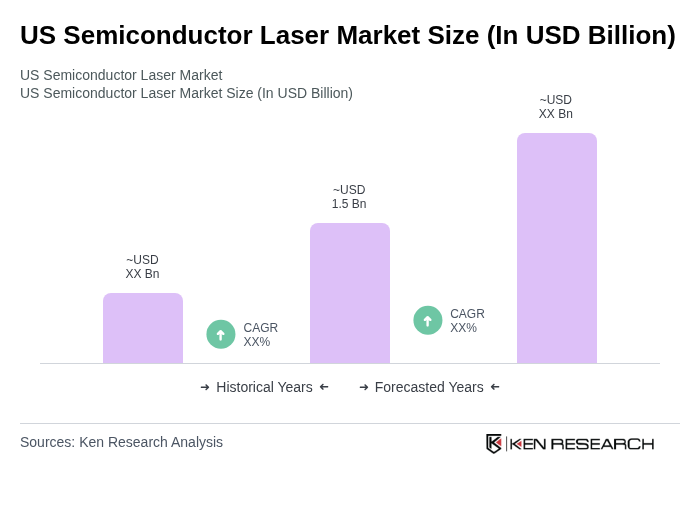
- The US Semiconductor Laser Market is valued at USD 1.5 billion, based on a five-year historical analysis. This growth is primarily driven by advancements in photonics, the rising adoption of semiconductor lasers in telecommunications, healthcare, and industrial manufacturing, and the increasing need for high-speed data transmission and miniaturized devices. The proliferation of laser-based applications in medical diagnostics, LiDAR, and fiber optics further accelerates market expansion .
- Key states in this market include California, Texas, and New York, which lead due to their robust technology ecosystems, significant investments in research and development, and a concentration of leading semiconductor companies and research institutions that foster innovation and collaboration .
- In 2023, the US government implemented the CHIPS and Science Act, which allocates USD 52 billion to support semiconductor manufacturing and research. This initiative, issued by the United States Congress and administered by the Department of Commerce, aims to enhance domestic production capabilities, reduce reliance on foreign supply chains, and promote innovation in semiconductor technologies, including lasers. The Act mandates funding for manufacturing incentives, R&D, and workforce development, with compliance requirements for grant recipients regarding domestic production and technology transfer .
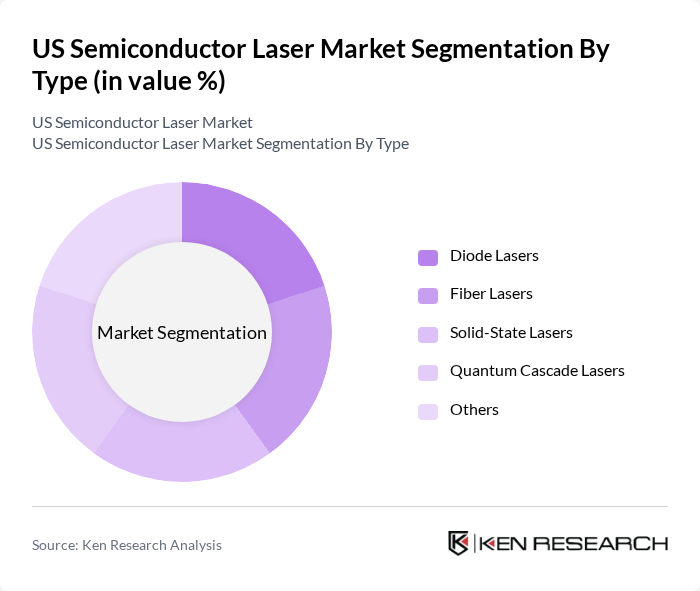
US Semiconductor Laser Market Segmentation
By Type:The semiconductor laser market is segmented into Diode Lasers, Fiber Lasers, Solid-State Lasers, Quantum Cascade Lasers, and Others. Diode Lasers are the most dominant segment, attributed to their high efficiency, compact size, and versatility in applications such as telecommunications, consumer electronics, and automotive LiDAR. Fiber Lasers are rapidly gaining traction in industrial manufacturing due to their high power, precision, and reliability for cutting, welding, and marking. The demand for miniaturized and high-performance laser devices is driving growth across all segments .
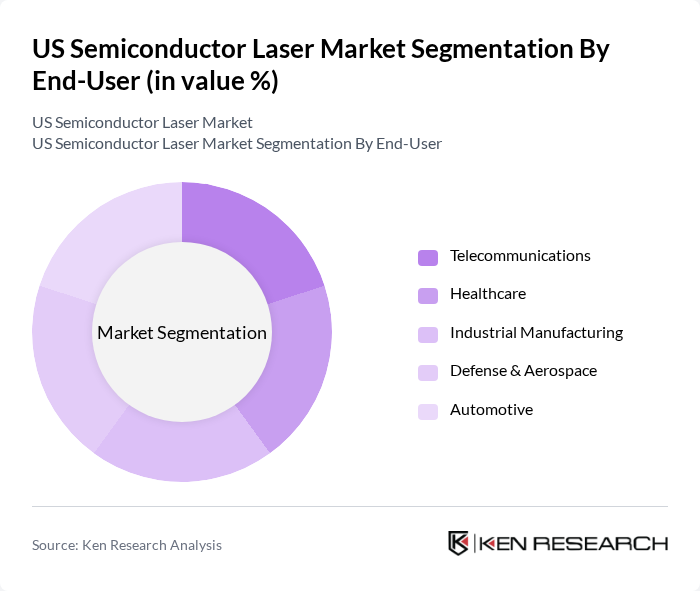
By End-User:The end-user segmentation includes Telecommunications, Healthcare, Industrial Manufacturing, Defense & Aerospace, Automotive, and Others. The Telecommunications sector is the leading end-user, driven by the expansion of high-speed internet, 5G infrastructure, and data center connectivity. Healthcare is a rapidly growing segment, with lasers used in surgical, diagnostic, and therapeutic applications. Industrial Manufacturing continues to expand with the adoption of laser-based material processing, marking, and quality control solutions .
US Semiconductor Laser Market Competitive Landscape
The US Semiconductor Laser Market is characterized by a dynamic mix of regional and international players. Leading participants such as Coherent, Inc., II-VI Incorporated (Now Coherent Corp.), Lumentum Holdings Inc., MKS Instruments, Inc., Newport Corporation (A MKS Instruments Company), Hamamatsu Photonics K.K. (USA), Spectra-Physics (A MKS Instruments Company), Jenoptik AG (USA), NKT Photonics (USA), Amonics Ltd. (USA), IPG Photonics Corporation, Thorlabs, Inc., Leonardo DRS, Inc., Excelitas Technologies Corp., NeoPhotonics Corporation contribute to innovation, geographic expansion, and service delivery in this space.
US Semiconductor Laser Market Industry Analysis
Growth Drivers
- Increasing Demand for High-Speed Data Transmission:The US semiconductor laser market is experiencing a surge in demand due to the increasing need for high-speed data transmission. In future, the global data traffic is projected to reach 175 zettabytes, driven by cloud computing and 5G technologies. This growth necessitates advanced laser technologies for efficient data transfer, with the semiconductor laser segment expected to capture a significant share of this demand, estimated at $12 billion in revenue.
- Advancements in Laser Technology:Continuous advancements in semiconductor laser technology are propelling market growth. Innovations such as vertical-cavity surface-emitting lasers (VCSELs) are enhancing performance and efficiency. The US laser technology market is projected to grow to $15 billion in future, with semiconductor lasers accounting for a substantial portion. These advancements are crucial for applications in telecommunications, industrial, and medical sectors, driving further adoption and investment.
- Rising Applications in Medical Devices:The integration of semiconductor lasers in medical devices is a significant growth driver. The US medical laser market is expected to reach $5.5 billion in future, with semiconductor lasers being pivotal in surgical and diagnostic applications. Their precision and efficiency in procedures such as laser surgery and phototherapy are enhancing patient outcomes, leading to increased adoption in healthcare settings across the country.
Market Challenges
- High Manufacturing Costs:One of the primary challenges facing the US semiconductor laser market is the high manufacturing costs associated with advanced laser technologies. The production costs for semiconductor lasers can exceed $1,000 per unit, primarily due to the complex materials and processes involved. This financial barrier can limit market entry for new players and restrict innovation, impacting overall market growth and competitiveness.
- Intense Competition:The semiconductor laser market is characterized by intense competition among established players and new entrants. Major companies like Coherent and II-VI Incorporated dominate the market, making it challenging for smaller firms to gain market share. In future, the top five companies are expected to hold over 60% of the market, leading to price wars and reduced profit margins, which can hinder investment in research and development.
US Semiconductor Laser Market Future Outlook
The future of the US semiconductor laser market appears promising, driven by technological advancements and increasing applications across various sectors. The demand for high-speed data transmission and energy-efficient solutions will likely propel growth. Additionally, the integration of semiconductor lasers in emerging technologies such as IoT and smart devices will create new avenues for expansion. Companies that invest in innovative applications and strategic partnerships are expected to thrive in this evolving landscape, ensuring sustained market relevance and competitiveness.
Market Opportunities
- Expansion in Emerging Markets:The expansion of semiconductor laser applications in emerging markets presents significant opportunities. Countries in Asia-Pacific are projected to increase their semiconductor laser adoption by 30% in future, driven by industrial automation and telecommunications growth. This trend offers US companies a chance to tap into new customer bases and enhance revenue streams.
- Investment in R&D:Increased investment in research and development is a vital opportunity for the semiconductor laser market. With the US government allocating $10 billion for semiconductor research initiatives in future, companies can leverage these funds to innovate and develop next-generation laser technologies. This investment will enhance competitiveness and drive advancements in applications across various industries.
Scope of the Report
| Segment | Sub-Segments |
|---|---|
| By Type | Diode Lasers Fiber Lasers Solid-State Lasers Quantum Cascade Lasers Others |
| By End-User | Telecommunications Healthcare Industrial Manufacturing Defense & Aerospace Automotive Others |
| By Application | Material Processing Medical Applications Communication Measurement and Sensing LiDAR Others |
| By Wavelength | Ultraviolet Visible Infrared Others |
| By Region | Northeast Midwest South West |
| By Technology | Semiconductor Laser Diodes Quantum Cascade Lasers Vertical-Cavity Surface-Emitting Lasers (VCSELs) Edge-Emitting Lasers (EELs) Others |
| By Market Segment | Commercial Industrial Government & Defense Others |
Key Target Audience
Investors and Venture Capitalist Firms
Government and Regulatory Bodies (e.g., U.S. Department of Commerce, Federal Communications Commission)
Manufacturers and Producers
Distributors and Retailers
Telecommunications Companies
Aerospace and Defense Contractors
Medical Device Manufacturers
Energy Sector Companies
Players Mentioned in the Report:
Coherent, Inc.
II-VI Incorporated (Now Coherent Corp.)
Lumentum Holdings Inc.
MKS Instruments, Inc.
Newport Corporation (A MKS Instruments Company)
Hamamatsu Photonics K.K. (USA)
Spectra-Physics (A MKS Instruments Company)
Jenoptik AG (USA)
NKT Photonics (USA)
Amonics Ltd. (USA)
IPG Photonics Corporation
Thorlabs, Inc.
Leonardo DRS, Inc.
Excelitas Technologies Corp.
NeoPhotonics Corporation
Table of Contents
Market Assessment Phase
1. Executive Summary and Approach
2. US Semiconductor Laser Market Overview
2.1 Key Insights and Strategic Recommendations
2.2 US Semiconductor Laser Market Overview
2.3 Definition and Scope
2.4 Evolution of Market Ecosystem
2.5 Timeline of Key Regulatory Milestones
2.6 Value Chain & Stakeholder Mapping
2.7 Business Cycle Analysis
2.8 Policy & Incentive Landscape
3. US Semiconductor Laser Market Analysis
3.1 Growth Drivers
3.1.1 Increasing demand for high-speed data transmission
3.1.2 Advancements in laser technology
3.1.3 Rising applications in medical devices
3.1.4 Growth in consumer electronics
3.2 Market Challenges
3.2.1 High manufacturing costs
3.2.2 Intense competition
3.2.3 Regulatory hurdles
3.2.4 Rapid technological changes
3.3 Market Opportunities
3.3.1 Expansion in emerging markets
3.3.2 Development of new applications
3.3.3 Collaborations and partnerships
3.3.4 Investment in R&D
3.4 Market Trends
3.4.1 Shift towards miniaturization
3.4.2 Increasing focus on energy efficiency
3.4.3 Growth of IoT applications
3.4.4 Adoption of smart technologies
3.5 Government Regulation
3.5.1 Compliance with safety standards
3.5.2 Environmental regulations
3.5.3 Export control regulations
3.5.4 Incentives for R&D investments
4. SWOT Analysis
5. Stakeholder Analysis
6. Porter's Five Forces Analysis
7. US Semiconductor Laser Market Market Size, 2019-2024
7.1 By Value
7.2 By Volume
7.3 By Average Selling Price
8. US Semiconductor Laser Market Segmentation
8.1 By Type
8.1.1 Diode Lasers
8.1.2 Fiber Lasers
8.1.3 Solid-State Lasers
8.1.4 Quantum Cascade Lasers
8.1.5 Others
8.2 By End-User
8.2.1 Telecommunications
8.2.2 Healthcare
8.2.3 Industrial Manufacturing
8.2.4 Defense & Aerospace
8.2.5 Automotive
8.2.6 Others
8.3 By Application
8.3.1 Material Processing
8.3.2 Medical Applications
8.3.3 Communication
8.3.4 Measurement and Sensing
8.3.5 LiDAR
8.3.6 Others
8.4 By Wavelength
8.4.1 Ultraviolet
8.4.2 Visible
8.4.3 Infrared
8.4.4 Others
8.5 By Region
8.5.1 Northeast
8.5.2 Midwest
8.5.3 South
8.5.4 West
8.6 By Technology
8.6.1 Semiconductor Laser Diodes
8.6.2 Quantum Cascade Lasers
8.6.3 Vertical-Cavity Surface-Emitting Lasers (VCSELs)
8.6.4 Edge-Emitting Lasers (EELs)
8.6.5 Others
8.7 By Market Segment
8.7.1 Commercial
8.7.2 Industrial
8.7.3 Government & Defense
8.7.4 Others
9. US Semiconductor Laser Market Competitive Analysis
9.1 Market Share of Key Players
9.2 Cross Comparison of Key Players
9.2.1 Company Name
9.2.2 Annual Revenue (USD)
9.2.3 Revenue Growth Rate (YoY)
9.2.4 Market Share (%)
9.2.5 R&D Investment (USD)
9.2.6 Product Portfolio Breadth
9.2.7 Customer Base Size
9.2.8 Operational Efficiency (EBITDA Margin)
9.2.9 Supply Chain Resilience
9.2.10 Customer Satisfaction Score (CSAT)
9.3 SWOT Analysis of Top Players
9.4 Pricing Analysis
9.5 Detailed Profile of Major Companies
9.5.1 Coherent, Inc.
9.5.2 II-VI Incorporated (Now Coherent Corp.)
9.5.3 Lumentum Holdings Inc.
9.5.4 MKS Instruments, Inc.
9.5.5 Newport Corporation (A MKS Instruments Company)
9.5.6 Hamamatsu Photonics K.K. (USA)
9.5.7 Spectra-Physics (A MKS Instruments Company)
9.5.8 Jenoptik AG (USA)
9.5.9 NKT Photonics (USA)
9.5.10 Amonics Ltd. (USA)
9.5.11 IPG Photonics Corporation
9.5.12 Thorlabs, Inc.
9.5.13 Leonardo DRS, Inc.
9.5.14 Excelitas Technologies Corp.
9.5.15 NeoPhotonics Corporation
10. US Semiconductor Laser Market End-User Analysis
10.1 Procurement Behavior of Key Ministries
10.1.1 Government contracts and tenders
10.1.2 Budget allocation for technology
10.1.3 Evaluation criteria for procurement
10.1.4 Supplier diversity initiatives
10.2 Corporate Spend on Infrastructure & Energy
10.2.1 Investment in laser technology
10.2.2 Budgeting for R&D
10.2.3 Infrastructure upgrades
10.2.4 Energy efficiency initiatives
10.3 Pain Point Analysis by End-User Category
10.3.1 Cost constraints
10.3.2 Technology integration challenges
10.3.3 Regulatory compliance issues
10.3.4 Performance reliability concerns
10.4 User Readiness for Adoption
10.4.1 Awareness of technology benefits
10.4.2 Training and support needs
10.4.3 Financial readiness
10.4.4 Infrastructure compatibility
10.5 Post-Deployment ROI and Use Case Expansion
10.5.1 Measurement of ROI
10.5.2 Case studies of successful implementations
10.5.3 Scalability of solutions
10.5.4 Future use case identification
11. US Semiconductor Laser Market Future Size, 2025-2030
11.1 By Value
11.2 By Volume
11.3 By Average Selling Price
Go-To-Market Strategy Phase
1. Whitespace Analysis + Business Model Canvas
1.1 Market gaps identification
1.2 Value proposition development
1.3 Revenue model exploration
1.4 Customer segmentation analysis
1.5 Competitive landscape overview
1.6 Key partnerships identification
1.7 Risk assessment
2. Marketing and Positioning Recommendations
2.1 Branding strategies
2.2 Product USPs
2.3 Target audience definition
2.4 Communication strategy
2.5 Digital marketing tactics
2.6 Trade show participation
2.7 Customer engagement initiatives
3. Distribution Plan
3.1 Urban retail vs rural NGO tie-ups
3.2 Online vs offline distribution
3.3 Logistics and supply chain management
3.4 Channel partner selection
3.5 Inventory management strategies
3.6 Distribution cost analysis
3.7 Performance metrics for distribution
4. Channel & Pricing Gaps
4.1 Underserved routes
4.2 Pricing bands
4.3 Competitor pricing analysis
4.4 Value-based pricing strategies
4.5 Discounting strategies
4.6 Price elasticity assessment
4.7 Customer willingness to pay
5. Unmet Demand & Latent Needs
5.1 Category gaps
5.2 Consumer segments
5.3 Emerging trends analysis
5.4 Customer feedback incorporation
5.5 Innovation opportunities
5.6 Market entry barriers
5.7 Future demand forecasting
6. Customer Relationship
6.1 Loyalty programs
6.2 After-sales service
6.3 Customer feedback mechanisms
6.4 Relationship management strategies
6.5 Community engagement
6.6 Customer education initiatives
6.7 Retention strategies
7. Value Proposition
7.1 Sustainability
7.2 Integrated supply chains
7.3 Cost-effectiveness
7.4 Quality assurance
7.5 Innovation-driven solutions
7.6 Customer-centric approach
7.7 Competitive differentiation
8. Key Activities
8.1 Regulatory compliance
8.2 Branding
8.3 Distribution setup
8.4 Marketing execution
8.5 Training and development
8.6 Performance monitoring
8.7 Stakeholder engagement
9. Entry Strategy Evaluation
9.1 Domestic Market Entry Strategy
9.1.1 Product mix
9.1.2 Pricing band
9.1.3 Packaging
9.2 Export Entry Strategy
9.2.1 Target countries
9.2.2 Compliance roadmap
10. Entry Mode Assessment
10.1 JV
10.2 Greenfield
10.3 M&A
10.4 Distributor Model
11. Capital and Timeline Estimation
11.1 Capital requirements
11.2 Timelines
12. Control vs Risk Trade-Off
12.1 Ownership vs Partnerships
13. Profitability Outlook
13.1 Breakeven analysis
13.2 Long-term sustainability
14. Potential Partner List
14.1 Distributors
14.2 JVs
14.3 Acquisition targets
15. Execution Roadmap
15.1 Phased Plan for Market Entry
15.1.1 Market Setup
15.1.2 Market Entry
15.1.3 Growth Acceleration
15.1.4 Scale & Stabilize
15.2 Key Activities and Milestones
15.2.1 Activity timelines
15.2.2 Milestone tracking
Research Methodology
Phase 1: Approach1
Desk Research
- Industry reports from semiconductor associations and market research firms
- Government publications on semiconductor manufacturing and technology trends
- Academic journals and white papers focusing on laser technology advancements
Primary Research
- Interviews with R&D heads at leading semiconductor laser manufacturers
- Surveys with industry analysts specializing in photonics and laser applications
- Field interviews with engineers involved in semiconductor laser production
Validation & Triangulation
- Cross-validation of data from multiple industry sources and reports
- Triangulation of market trends with sales data and technological advancements
- Sanity checks through expert panel discussions and feedback sessions
Phase 2: Market Size Estimation1
Top-down Assessment
- Analysis of total semiconductor market size and growth rates
- Segmentation by application areas such as telecommunications, medical devices, and consumer electronics
- Incorporation of government initiatives promoting semiconductor technology
Bottom-up Modeling
- Volume estimates based on production capacities of key semiconductor laser manufacturers
- Cost analysis derived from pricing models of semiconductor laser products
- Estimation of market share based on sales data from major players
Forecasting & Scenario Analysis
- Multi-variable regression analysis incorporating technological adoption rates and market demand
- Scenario planning based on potential regulatory changes and market disruptions
- Development of baseline, optimistic, and pessimistic forecasts through 2030
Phase 3: CATI Sample Composition1
| Scope Item/Segment | Sample Size | Target Respondent Profiles |
|---|---|---|
| Telecommunications Sector | 100 | Network Engineers, Product Managers |
| Medical Device Manufacturing | 60 | Regulatory Affairs Specialists, R&D Managers |
| Consumer Electronics Applications | 80 | Product Development Engineers, Marketing Directors |
| Industrial Laser Systems | 50 | Operations Managers, Technical Sales Representatives |
| Research Institutions and Academia | 40 | Research Scientists, Professors in Photonics |
Frequently Asked Questions
What is the current value of the US Semiconductor Laser Market?
The US Semiconductor Laser Market is valued at approximately USD 1.5 billion, driven by advancements in photonics and the increasing adoption of semiconductor lasers across various sectors, including telecommunications, healthcare, and industrial manufacturing.
What are the key growth drivers for the US Semiconductor Laser Market?
Which states are leading in the US Semiconductor Laser Market?
How does the CHIPS and Science Act impact the Semiconductor Laser Market?
Other Regional/Country Reports
Indonesia Semiconductor Laser Market
Malaysia Semiconductor Laser Market
APAC Semiconductor Laser Market
Other Adjacent Reports
Malaysia Fiber Optic Market
UAE Laser Diode MarketKSA Quantum Cascade Laser Market
Bahrain Solid-State Laser Market
Belgium Telecommunications Laser Market
Indonesia Medical Laser Market
Egypt Industrial Laser Market
South Africa LiDAR Market
Why Buy From Us?

What makes us stand out is that our consultants follow Robust, Refine and Result (RRR) methodology. Robust for clear definitions, approaches and sanity checking, Refine for differentiating respondents' facts and opinions, and Result for presenting data with story.

We have set a benchmark in the industry by offering our clients with syndicated and customized market research reports featuring coverage of entire market as well as meticulous research and analyst insights.

While we don't replace traditional research, we flip the method upside down. Our dual approach of Top Bottom & Bottom Top ensures quality deliverable by not just verifying company fundamentals but also looking at the sector and macroeconomic factors.

With one step in the future, our research team constantly tries to show you the bigger picture. We help with some of the tough questions you may encounter along the way: How is the industry positioned? Best marketing channel? KPI's of competitors? By aligning every element, we help maximize success.

Our report gives you instant access to the answers and sources that other companies might choose to hide. We elaborate each steps of research methodology we have used and showcase you the sample size to earn your trust.

If you need any support, we are here! We pride ourselves on universe strength, data quality, and quick, friendly, and professional service.