About the Report
Base Year 2024US Sorting Machines Market Overview
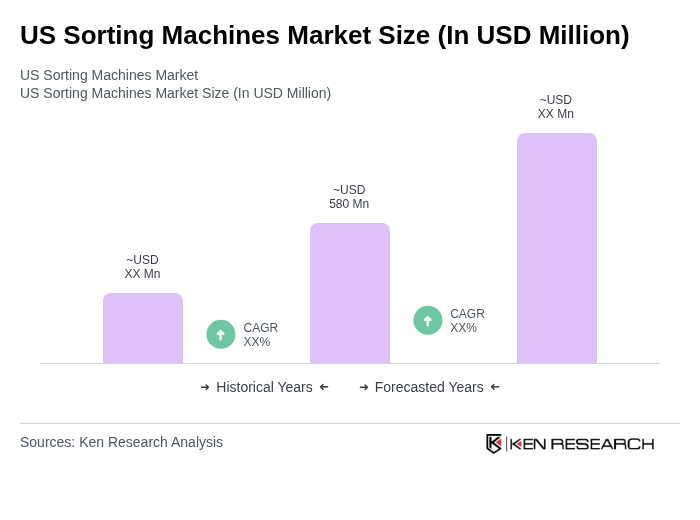
- The US Sorting Machines Market is valued at USD 580 million, based on a five-year historical analysis. This growth is primarily driven by the increasing demand for automation in various industries, including food processing, logistics, and recycling. The surge in adoption of advanced sorting technologies is propelled by the need for efficient solutions that enhance productivity, reduce operational costs, and support sustainability initiatives. Key growth drivers include rapid advancements in AI and sensor-based sorting, rising labor costs, and stringent quality assurance standards in food and beverage processing.
- Key players in this market are concentrated in major industrial hubs such as California, Texas, and New York. These states dominate the market due to their robust manufacturing sectors, significant investments in technology, and a high concentration of logistics and distribution centers. The presence of leading companies and research institutions further strengthens their position in the sorting machines market.
- In 2023, the US government implemented regulations aimed at promoting sustainable waste management practices. This includes the introduction of standards for sorting technologies used in recycling facilities, mandating the use of advanced sorting machines that enhance the efficiency of material recovery processes. The Resource Conservation and Recovery Act (RCRA), administered by the US Environmental Protection Agency (EPA), establishes operational requirements for recycling facilities, including technology standards for automated sorting equipment to improve material recovery rates and compliance with environmental objectives.
US Sorting Machines Market Segmentation
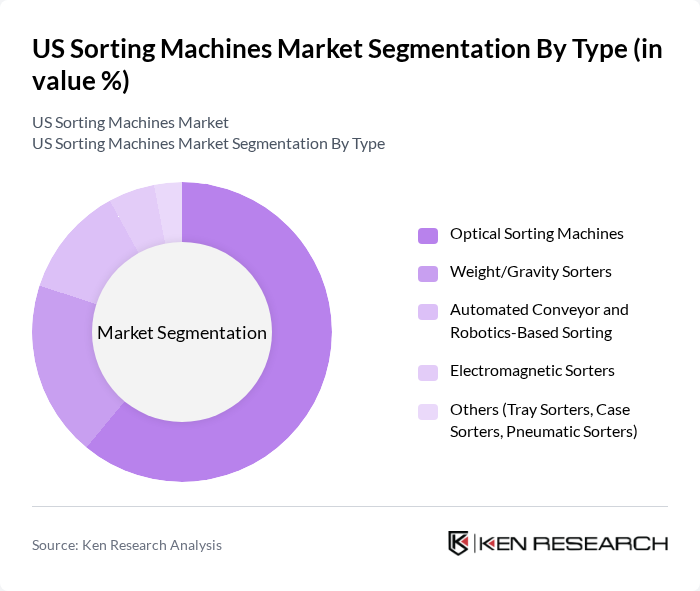
By Type:The sorting machines market can be segmented into various types, including Optical Sorting Machines, Weight/Gravity Sorters, Automated Conveyor and Robotics-Based Sorting, Electromagnetic Sorters, and Others (Tray Sorters, Case Sorters, Pneumatic Sorters). Among these, Optical Sorting Machines are leading the market due to their high efficiency and accuracy in sorting various materials, particularly in the food and recycling industries. The growing emphasis on quality control, product safety, and integration of AI and sensor technologies is driving the adoption of these advanced sorting solutions.
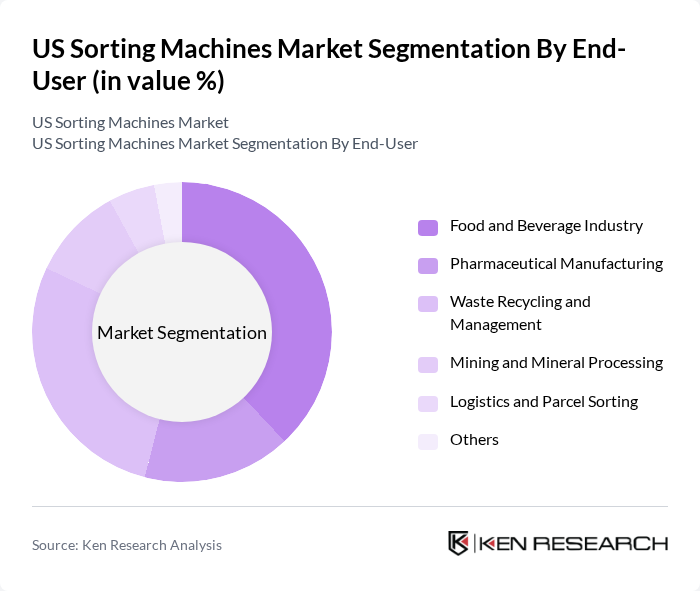
By End-User:The end-user segmentation includes the Food and Beverage Industry, Pharmaceutical Manufacturing, Waste Recycling and Management, Mining and Mineral Processing, Logistics and Parcel Sorting, and Others. The Food and Beverage Industry is the dominant segment, driven by the increasing need for quality assurance and compliance with safety standards. The rising consumer demand for processed and packaged foods, coupled with regulatory requirements for food safety, is further propelling the adoption of sorting machines in this sector. Waste Recycling and Management is also a rapidly growing segment due to sustainability initiatives and regulatory mandates.
US Sorting Machines Market Competitive Landscape
The US Sorting Machines Market is characterized by a dynamic mix of regional and international players. Leading participants such as Honeywell Intelligrated, Siemens AG, Dematic (KION Group), Vanderlande Industries, SICK AG, KUKA AG, Swisslog, Bastian Solutions, Murata Machinery, Automated Handling Solutions (AHS), Optosort, Tomra Systems, Bühler Group, Satake Corporation, Sesotec GmbH contribute to innovation, geographic expansion, and service delivery in this space.
US Sorting Machines Market Industry Analysis
Growth Drivers
- Increasing Demand for Automation in Manufacturing:The US manufacturing sector is projected to reach $2.3 trillion, driving the need for automation solutions. Automation can enhance productivity by up to 30%, as reported by the National Association of Manufacturers. This shift towards automated sorting machines is fueled by the desire to reduce labor costs and improve accuracy, with companies investing approximately $200 billion in automation technologies in recent periods, indicating a robust growth trajectory.
- Rising Focus on Operational Efficiency:US businesses are expected to invest around $1 trillion in operational efficiency improvements. Sorting machines play a crucial role in streamlining processes, reducing waste, and enhancing throughput. According to the Institute for Supply Management, companies that implement advanced sorting technologies can achieve efficiency gains of 20-25%, which translates to significant cost savings and improved service delivery in competitive markets.
- Growth in E-commerce and Logistics Sectors:The US e-commerce market is projected to exceed $1 trillion in sales, significantly boosting demand for sorting machines. The logistics sector, which is expected to grow by 5% annually, relies heavily on efficient sorting systems to manage increased parcel volumes. With over 21 billion packages shipped in recent periods, the need for advanced sorting solutions is critical to meet consumer expectations for speed and accuracy in delivery.
Market Challenges
- High Initial Investment Costs:The average cost of implementing sorting machines can range from $100,000 to $500,000, depending on the technology and scale. This high upfront investment poses a significant barrier for small to medium-sized enterprises (SMEs) looking to adopt automation. According to the Small Business Administration, nearly 30% of SMEs cite financial constraints as a primary reason for not investing in advanced technologies, limiting market growth potential.
- Rapid Technological Changes:The sorting machine industry is characterized by rapid technological advancements, with new innovations emerging frequently. Companies must continuously adapt to these changes, which can lead to obsolescence of existing systems. A report from the McKinsey Global Institute indicates that 70% of companies struggle to keep pace with technological advancements, resulting in increased operational risks and potential losses in competitive advantage.
US Sorting Machines Market Future Outlook
The US sorting machines market is poised for significant transformation as companies increasingly adopt smart manufacturing practices and integrate IoT technologies. In future, the focus on sustainability will drive demand for eco-friendly sorting solutions, while advancements in AI and machine learning will enhance operational capabilities. As logistics and e-commerce continue to expand, the need for efficient sorting systems will become paramount, creating a dynamic environment for innovation and investment in the sector.
Market Opportunities
- Expansion in Emerging Markets:As emerging markets experience rapid industrialization, the demand for sorting machines is expected to rise. With a projected growth rate of 6% in these regions, US manufacturers can capitalize on this trend by offering tailored solutions that meet local needs, potentially increasing their market share significantly.
- Development of Eco-Friendly Sorting Solutions:The growing emphasis on sustainability presents an opportunity for innovation in sorting technologies. Companies that develop eco-friendly sorting machines can tap into a market that is increasingly prioritizing environmental responsibility, potentially capturing a share of the green technology market, which is valued at over $1 trillion.
Scope of the Report
| Segment | Sub-Segments |
|---|---|
| By Type | Optical Sorting Machines Weight/Gravity Sorters Automated Conveyor and Robotics-Based Sorting Electromagnetic Sorters Others (Tray Sorters, Case Sorters, Pneumatic Sorters) |
| By End-User | Food and Beverage Industry Pharmaceutical Manufacturing Waste Recycling and Management Mining and Mineral Processing Logistics and Parcel Sorting Others |
| By Industry | Food Processing Logistics and Distribution Agriculture Mining Recycling Facilities Others |
| By Application | Sorting of Recyclables (Plastics, Metals, Paper) Sorting of Food Products (Fruits, Vegetables, Grains, Nuts) Sorting of Minerals and Waste Rock Sorting of Pharmaceutical Products (Tablets, Capsules, Medical Devices) Parcel and Package Sorting Others |
| By Technology | AI-Powered and Machine Vision Sorting Optical Sensors and Imaging Technology Laser and X-ray Based Sorting RFID-Based Sorting Conveyor Systems with Automation Others |
| By Region | Northeast Midwest South West |
| By End-User Size | Large-Scale Industrial Facilities Small and Medium Enterprises (SMEs) Public Sector and Municipal Operations |
Key Target Audience
Investors and Venture Capitalist Firms
Government and Regulatory Bodies (e.g., U.S. Department of Commerce, U.S. Environmental Protection Agency)
Manufacturers and Producers
Distributors and Retailers
Logistics and Supply Chain Companies
Technology Providers
Industry Associations (e.g., Material Handling Industry, National Association of Manufacturers)
Financial Institutions
Players Mentioned in the Report:
Honeywell Intelligrated
Siemens AG
Dematic (KION Group)
Vanderlande Industries
SICK AG
KUKA AG
Swisslog
Bastian Solutions
Murata Machinery
Automated Handling Solutions (AHS)
Optosort
Tomra Systems
Buhler Group
Satake Corporation
Sesotec GmbH
Table of Contents
Market Assessment Phase
1. Executive Summary and Approach
2. US Sorting Machines Market Overview
2.1 Key Insights and Strategic Recommendations
2.2 US Sorting Machines Market Overview
2.3 Definition and Scope
2.4 Evolution of Market Ecosystem
2.5 Timeline of Key Regulatory Milestones
2.6 Value Chain & Stakeholder Mapping
2.7 Business Cycle Analysis
2.8 Policy & Incentive Landscape
3. US Sorting Machines Market Analysis
3.1 Growth Drivers
3.1.1 Increasing demand for automation in manufacturing
3.1.2 Rising focus on operational efficiency
3.1.3 Growth in e-commerce and logistics sectors
3.1.4 Technological advancements in sorting technologies
3.2 Market Challenges
3.2.1 High initial investment costs
3.2.2 Rapid technological changes
3.2.3 Shortage of skilled workforce
3.2.4 Regulatory compliance issues
3.3 Market Opportunities
3.3.1 Expansion in emerging markets
3.3.2 Development of eco-friendly sorting solutions
3.3.3 Integration of AI and machine learning
3.3.4 Partnerships with logistics companies
3.4 Market Trends
3.4.1 Increasing adoption of IoT in sorting machines
3.4.2 Shift towards smart manufacturing
3.4.3 Customization of sorting solutions
3.4.4 Focus on sustainability and waste reduction
3.5 Government Regulation
3.5.1 Compliance with safety standards
3.5.2 Environmental regulations on waste management
3.5.3 Incentives for automation technologies
3.5.4 Labor regulations affecting workforce deployment
4. SWOT Analysis
5. Stakeholder Analysis
6. Porter's Five Forces Analysis
7. US Sorting Machines Market Market Size, 2019-2024
7.1 By Value
7.2 By Volume
7.3 By Average Selling Price
8. US Sorting Machines Market Segmentation
8.1 By Type
8.1.1 Optical Sorting Machines
8.1.2 Weight/Gravity Sorters
8.1.3 Automated Conveyor and Robotics-Based Sorting
8.1.4 Electromagnetic Sorters
8.1.5 Others (Tray Sorters, Case Sorters, Pneumatic Sorters)
8.2 By End-User
8.2.1 Food and Beverage Industry
8.2.2 Pharmaceutical Manufacturing
8.2.3 Waste Recycling and Management
8.2.4 Mining and Mineral Processing
8.2.5 Logistics and Parcel Sorting
8.2.6 Others
8.3 By Industry
8.3.1 Food Processing
8.3.2 Logistics and Distribution
8.3.3 Agriculture
8.3.4 Mining
8.3.5 Recycling Facilities
8.3.6 Others
8.4 By Application
8.4.1 Sorting of Recyclables (Plastics, Metals, Paper)
8.4.2 Sorting of Food Products (Fruits, Vegetables, Grains, Nuts)
8.4.3 Sorting of Minerals and Waste Rock
8.4.4 Sorting of Pharmaceutical Products (Tablets, Capsules, Medical Devices)
8.4.5 Parcel and Package Sorting
8.4.6 Others
8.5 By Technology
8.5.1 AI-Powered and Machine Vision Sorting
8.5.2 Optical Sensors and Imaging Technology
8.5.3 Laser and X-ray Based Sorting
8.5.4 RFID-Based Sorting
8.5.5 Conveyor Systems with Automation
8.5.6 Others
8.6 By Region
8.6.1 Northeast
8.6.2 Midwest
8.6.3 South
8.6.4 West
8.7 By End-User Size
8.7.1 Large-Scale Industrial Facilities
8.7.2 Small and Medium Enterprises (SMEs)
8.7.3 Public Sector and Municipal Operations
9. US Sorting Machines Market Competitive Analysis
9.1 Market Share of Key Players
9.2 Cross Comparison of Key Players
9.2.1 Company Name
9.2.2 Company Size Classification (Large, Medium, or Small)
9.2.3 Revenue Growth Rate (Year-over-Year %)
9.2.4 US Market Share (%)
9.2.5 Product Portfolio Breadth (Number of Sorting Technologies Offered)
9.2.6 R&D Investment as % of Revenue
9.2.7 Pricing Strategy (Premium, Mid-Range, Value)
9.2.8 Product Innovation Rate (New Products Launched Annually)
9.2.9 System Integration Capability (Standalone vs. Integrated Solutions)
9.2.10 Customer Satisfaction and Net Promoter Score (NPS)
9.3 SWOT Analysis of Top Players
9.4 Pricing Analysis
9.5 Detailed Profile of Major Companies
9.5.1 Honeywell Intelligrated
9.5.2 Siemens AG
9.5.3 Dematic (KION Group)
9.5.4 Vanderlande Industries
9.5.5 SICK AG
9.5.6 KUKA AG
9.5.7 Swisslog
9.5.8 Bastian Solutions
9.5.9 Murata Machinery
9.5.10 Automated Handling Solutions (AHS)
9.5.11 Optosort
9.5.12 Tomra Systems
9.5.13 Bühler Group
9.5.14 Satake Corporation
9.5.15 Sesotec GmbH
10. US Sorting Machines Market End-User Analysis
10.1 Procurement Behavior of Key End-Users
10.1.1 Budget Allocation Trends
10.1.2 Procurement Processes and Timelines
10.1.3 Supplier Selection Criteria
10.1.4 Contract Management Practices
10.2 Corporate Spend on Automation & Sorting Technologies
10.2.1 Investment Trends in Automation
10.2.2 Budgeting for Sorting Technologies
10.2.3 Cost-Benefit Analysis Practices
10.2.4 Long-term Financial Commitments
10.3 Pain Point Analysis by End-User Category
10.3.1 Operational Inefficiencies and Throughput Limitations
10.3.2 High Maintenance and Downtime Costs
10.3.3 System Integration Challenges
10.3.4 Food Safety and Quality Compliance Issues
10.4 User Readiness for Adoption
10.4.1 Training and Support Needs
10.4.2 Technology Familiarity and Digital Maturity
10.4.3 Change Management Strategies
10.4.4 Investment Willingness and ROI Expectations
10.5 Post-Deployment ROI and Use Case Expansion
10.5.1 Performance Metrics Tracking
10.5.2 Case Studies of Successful Implementations
10.5.3 Scalability of Solutions
10.5.4 Future Investment Plans
11. US Sorting Machines Market Future Size, 2025-2030
11.1 By Value
11.2 By Volume
11.3 By Average Selling Price
Go-To-Market Strategy Phase
1. Whitespace Analysis + Business Model Canvas
1.1 Market Gaps Identification
1.2 Value Proposition Development
1.3 Revenue Streams Analysis
1.4 Cost Structure Evaluation
1.5 Key Partnerships Exploration
1.6 Customer Segmentation
1.7 Competitive Advantage Assessment
2. Marketing and Positioning Recommendations
2.1 Branding Strategies
2.2 Product USPs
2.3 Target Market Identification
2.4 Communication Strategies
2.5 Digital Marketing Approaches
3. Distribution Plan
3.1 Direct Sales to Large Industrial Facilities
3.2 Distributor and Reseller Networks
3.3 E-commerce and Digital Sales Channels
3.4 System Integrator Partnerships
3.5 Regional Sales and Support Infrastructure
4. Channel & Pricing Gaps
4.1 Underserved Market Segments
4.2 Pricing Bands Analysis
4.3 Competitor Pricing Strategies
4.4 Customer Price Sensitivity
4.5 Value-Based Pricing Models
5. Unmet Demand & Latent Needs
5.1 Category Gaps Identification
5.2 End-User Segments Analysis
5.3 Emerging Trends Exploration
5.4 Future Needs Assessment
6. Customer Relationship
6.1 Loyalty Programs Development
6.2 After-sales Service and Maintenance Strategies
6.3 Customer Feedback Mechanisms
6.4 Relationship Management Tools
7. Value Proposition
7.1 Sustainability Initiatives
7.2 Integrated Supply Chains
7.3 Customer-Centric Solutions
7.4 Competitive Differentiation
8. Key Activities
8.1 Regulatory Compliance
8.2 Branding Initiatives
8.3 Distribution Setup
8.4 Training and Development
9. Entry Strategy Evaluation
9.1 Domestic Market Entry Strategy
9.1.1 Product Mix Considerations
9.1.2 Pricing Band Strategies
9.1.3 Technology Integration Approach
9.2 Regional Expansion Strategy
9.2.1 Target Regional Markets Identification
9.2.2 Compliance and Regulatory Roa
Research Methodology
Phase 1: Approach1
Desk Research
- Industry reports from the American Sorting Machine Association and relevant trade publications
- Market analysis from government databases and logistics industry white papers
- Historical sales data and trends from leading sorting machine manufacturers
Primary Research
- Interviews with operations managers at major distribution centers
- Surveys with logistics consultants specializing in automation technologies
- Field interviews with engineers involved in sorting machine design and implementation
Validation & Triangulation
- Cross-validation of findings through multiple industry reports and expert opinions
- Triangulation of data from primary interviews and secondary sources
- Sanity checks through feedback from a panel of industry experts
Phase 2: Market Size Estimation1
Top-down Assessment
- Analysis of the overall logistics market size and its growth trajectory
- Segmentation of the market by end-user industries such as e-commerce, retail, and manufacturing
- Incorporation of technological advancements and their impact on sorting machine adoption
Bottom-up Modeling
- Estimation of unit sales based on production capacity and historical sales data
- Operational cost analysis derived from pricing models of leading manufacturers
- Volume projections based on anticipated demand from key sectors
Forecasting & Scenario Analysis
- Multi-variable regression analysis considering factors like e-commerce growth and labor costs
- Scenario planning based on potential regulatory changes and technological disruptions
- Development of baseline, optimistic, and pessimistic forecasts through 2030
Phase 3: CATI Sample Composition1
| Scope Item/Segment | Sample Size | Target Respondent Profiles |
|---|---|---|
| Warehouse Automation Solutions | 120 | Warehouse Managers, Operations Directors |
| E-commerce Sorting Systems | 100 | Logistics Coordinators, Supply Chain Analysts |
| Manufacturing Sorting Equipment | 85 | Production Managers, Quality Control Supervisors |
| Retail Sorting Technologies | 75 | Retail Operations Managers, IT Directors |
| Sorting Machine Maintenance Services | 70 | Maintenance Managers, Technical Support Leads |
Frequently Asked Questions
What is the current value of the US Sorting Machines Market?
The US Sorting Machines Market is valued at approximately USD 580 million, reflecting a robust growth trajectory driven by increasing automation demands across various industries, including food processing, logistics, and recycling.
What are the key drivers of growth in the US Sorting Machines Market?
Which states dominate the US Sorting Machines Market?
What regulations has the US government implemented regarding sorting machines?
Other Regional/Country Reports
Indonesia Sorting Machines Market
Malaysia Sorting Machines Market
KSA Sorting Machines Market
APAC Sorting Machines Market
SEA Sorting Machines Market
Vietnam Sorting Machines Market
Other Adjacent Reports
Singapore Robotics Market
Oman Sensor Technology Market
UAE Waste Recycling Equipment Market
Asia Pacific Food Processing Machinery Market Outlook to 2030: Size, Share, Growth and TrendsKSA logistics automation market report Size, Share, Growth Drivers, Trends, Opportunities & Forecast 2025–2030Egypt Packaging Machinery Market
Global Mining Equipment MarketWhy Buy From Us?

What makes us stand out is that our consultants follow Robust, Refine and Result (RRR) methodology. Robust for clear definitions, approaches and sanity checking, Refine for differentiating respondents' facts and opinions, and Result for presenting data with story.

We have set a benchmark in the industry by offering our clients with syndicated and customized market research reports featuring coverage of entire market as well as meticulous research and analyst insights.

While we don't replace traditional research, we flip the method upside down. Our dual approach of Top Bottom & Bottom Top ensures quality deliverable by not just verifying company fundamentals but also looking at the sector and macroeconomic factors.

With one step in the future, our research team constantly tries to show you the bigger picture. We help with some of the tough questions you may encounter along the way: How is the industry positioned? Best marketing channel? KPI's of competitors? By aligning every element, we help maximize success.

Our report gives you instant access to the answers and sources that other companies might choose to hide. We elaborate each steps of research methodology we have used and showcase you the sample size to earn your trust.

If you need any support, we are here! We pride ourselves on universe strength, data quality, and quick, friendly, and professional service.