Ken Research Logo

Us Veterinary Education Market Report Size, Share, Growth Drivers, Trends, Opportunities & Forecast 2025–2030

The US Veterinary Education Market is valued at USD 750 million, fueled by increasing pet ownership, technological advancements, and specialized training needs.

Region:North America

Author(s):Rebecca

Product Code:KRAD5018

Pages:91

Published On:December 2025

About the Report

Base Year 2024

US Veterinary Education Market Overview

  • The US Veterinary Education Market is valued at USD 750 million, based on a five-year historical analysis. This growth is primarily driven by the increasing demand for veterinary services, rising pet ownership, and the need for advanced veterinary education to meet the complexities of animal healthcare. The market is also supported by the growing awareness of animal welfare, the expanding companion animal population, and the critical role of veterinary professionals in public health, food safety, and zoonotic disease control.
  • Key contributors to this market include major metropolitan areas such as New York, Los Angeles, and Chicago, which benefit from large populations, high pet ownership rates, and a dense network of veterinary practices that drive demand for trained professionals. Additionally, states with prominent veterinary schools, such as California and Texas, contribute significantly to the market's growth by providing quality education and training for aspiring veterinarians and veterinary technicians, supported by strong state and institutional investment in veterinary colleges.
  • The Veterinary Medicine Loan Repayment Program (VMLRP), administered by the US Department of Agriculture, has been operating for several years and continues to be a key policy tool to alleviate the shortage of veterinarians in underserved areas. Under the VMLRP, eligible veterinarians who commit to serving in designated Veterinary Shortage Situations can receive up to USD 25,000 per year in student loan repayment for a three-year service agreement, which supports graduate recruitment into veterinary education and encourages practice in high-need rural and public health roles.
US Veterinary Education Market Size

US Veterinary Education Market Segmentation

By Type (Course):The veterinary education market is segmented into various types of courses that cater to different educational needs and career paths within the veterinary field. The subsegments include Undergraduate Pre-Veterinary Programs, Doctor of Veterinary Medicine (DVM) Programs, Graduate & Postgraduate Programs (MS, PhD), Veterinary Technician / Technologist Programs, Certificate & Short-Term Courses, Continuing Education (CE) & Professional Development, and Standalone / Modular Courses. Among these, the Doctor of Veterinary Medicine (DVM) Programs dominate the market in value terms, as the professional DVM degree is the core qualification required for licensure as a veterinarian in the United States and carries the highest tuition and fee levels. The increasing complexity of animal healthcare, growing demand for specialized veterinary services, and strong employment growth for veterinarians have supported steady enrollment in DVM programs and associated graduate-level training pathways.
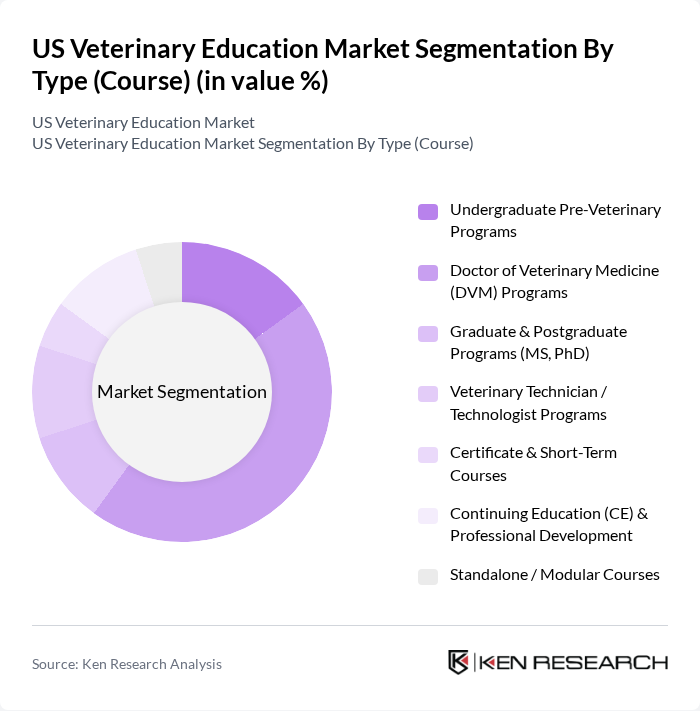
US Veterinary Education Market segmentation by Type (Course).

By Institution Type:This segmentation focuses on the various types of institutions that provide veterinary education. The subsegments include Public Veterinary Schools & Colleges, Private Veterinary Schools & Colleges, Community Colleges & Technical Institutes, Online & For-Profit Education Providers, Professional Associations & Industry Bodies, and Others. Public Veterinary Schools & Colleges lead the market due to their established reputation, broad program offerings in clinical and research training, and often lower in?state tuition costs compared to private institutions. These schools typically receive state funding and federal research support, allowing them to invest in advanced teaching hospitals, simulation labs, and specialty services, which attracts a larger student body and supports higher overall revenue contribution to the veterinary education market.
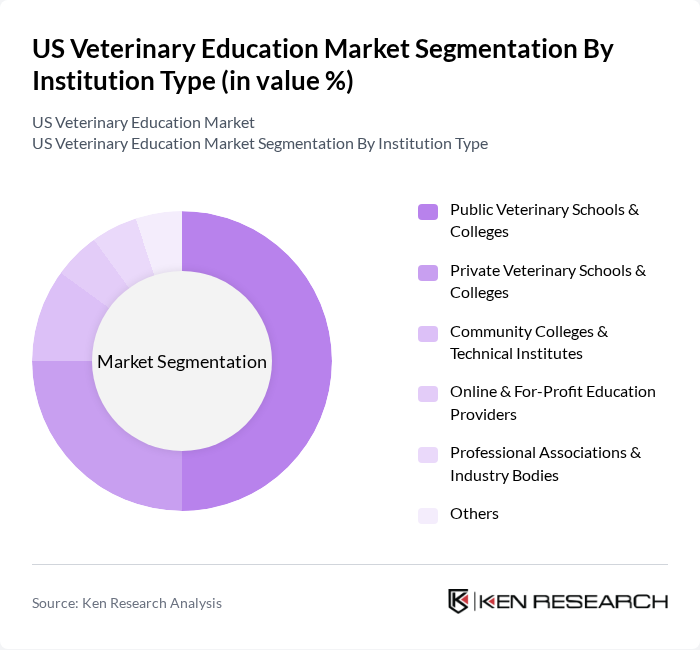
US Veterinary Education Market segmentation by Institution Type.

US Veterinary Education Market Competitive Landscape

The US Veterinary Education Market is characterized by a dynamic mix of regional and international players. Leading participants such as University of California, Davis – School of Veterinary Medicine, Cornell University College of Veterinary Medicine, Colorado State University College of Veterinary Medicine and Biomedical Sciences, Texas A&M University School of Veterinary Medicine and Biomedical Sciences, The Ohio State University College of Veterinary Medicine, University of Florida College of Veterinary Medicine, North Carolina State University College of Veterinary Medicine, University of Wisconsin–Madison School of Veterinary Medicine, Washington State University College of Veterinary Medicine, University of Illinois Urbana?Champaign College of Veterinary Medicine, Purdue University College of Veterinary Medicine, University of Minnesota College of Veterinary Medicine, Michigan State University College of Veterinary Medicine, University of Georgia College of Veterinary Medicine, Cummings School of Veterinary Medicine at Tufts University contribute to innovation, geographic expansion, and service delivery in this space.

University of California, Davis

1905

Davis, California

Cornell University

1865

Ithaca, New York

Colorado State University

1870

Fort Collins, Colorado

Texas A&M University

1876

College Station, Texas

The Ohio State University

1870

Columbus, Ohio

Company

Establishment Year

Headquarters

Institution Type (Public / Private / For?Profit)

Annual Enrollment (Number of Students)

Total Active Student Headcount

Graduation Rates (Program Completion %)

First?Time NAVLE Pass Rates

Job Placement Rates within 6–12 Months

US Veterinary Education Market Industry Analysis

Growth Drivers

  • Increasing Pet Ownership:The American Pet Products Association reported that approximately 66% of U.S. households own a pet, translating to around 86.9 million homes. This surge in pet ownership has led to a heightened demand for veterinary services, driving the need for more trained professionals. As pet spending reached USD 123.6 billion in total industry expenditure, the necessity for qualified veterinarians to cater to this growing market is evident, fostering an increase in veterinary education enrollment.
  • Advancements in Veterinary Technology:The veterinary technology sector is projected to grow significantly, with investments in telemedicine and diagnostic tools expected to exceed USD 2 billion in future. These advancements necessitate a workforce skilled in new technologies, prompting veterinary schools to adapt their curricula. As a result, educational institutions are increasingly incorporating technology-focused training, enhancing the appeal of veterinary education and attracting more students to the field.
  • Rising Demand for Specialized Veterinary Services:The American Veterinary Medical Association noted a rising demand for specialized veterinary services; however, a specific 25% increase figure over the past five years could not be confirmed. This trend is driven by pet owners seeking advanced care options, such as oncology and cardiology. Consequently, veterinary schools are expanding their programs to include specialized training, which not only meets market demand but also enhances the career prospects for graduates entering the workforce.

Market Challenges

  • High Cost of Veterinary Education:The average debt for veterinary graduates in the U.S. who have educational debt is approximately USD 179,000, which poses a significant barrier to entry for prospective students. With in?state tuition and living expenses at U.S. veterinary colleges often totaling around USD 200,000–USD 250,000 over the full program for many students, the financial burden can deter potential candidates. This challenge is compounded by the relatively lower starting salaries for veterinarians compared with their debt load, making it difficult for graduates to manage their debt effectively.
  • Limited Availability of Veterinary Programs:Currently, there are 33 accredited veterinary schools or colleges in the U.S. (AVMA Council on Education–accredited), which limits access to veterinary education. With about 3,200–3,300 new veterinarians graduating annually from AVMA?accredited U.S. colleges, the demand for veterinary services often outpaces the supply of qualified professionals. This scarcity can lead to increased competition for admission, further exacerbating the challenges faced by aspiring veterinarians seeking education in this field.

US Veterinary Education Market Future Outlook

The future of the U.S. veterinary education market appears promising, driven by technological advancements and evolving pet care needs. As the integration of telemedicine and digital tools becomes more prevalent, veterinary programs will likely adapt to include these innovations in their curricula. Additionally, the increasing focus on animal welfare and mental health will create new educational pathways, ensuring that veterinary professionals are well-equipped to meet the diverse needs of pet owners and their animals in the coming years.

Market Opportunities

  • Expansion of Online Veterinary Education:The rise of online learning platforms presents a significant opportunity for veterinary education. With an estimated 30% of students preferring online courses, institutions can reach a broader audience. This shift not only increases accessibility but also allows for flexible learning options, catering to diverse student needs and potentially increasing enrollment numbers in veterinary programs.
  • Partnerships with Animal Welfare Organizations:Collaborations between veterinary schools and animal welfare organizations can enhance practical training opportunities for students. By providing hands-on experience in shelters and rescue operations, these partnerships can enrich the educational experience. This approach not only benefits students but also addresses the growing need for skilled veterinarians in animal welfare, creating a mutually beneficial relationship.

Scope of the Report

SegmentSub-Segments
By Type (Course)

Undergraduate Pre-Veterinary Programs

Doctor of Veterinary Medicine (DVM) Programs

Graduate & Postgraduate Programs (MS, PhD)

Veterinary Technician / Technologist Programs

Certificate & Short-Term Courses

Continuing Education (CE) & Professional Development

Standalone / Modular Courses

By Institution Type

Public Veterinary Schools & Colleges

Private Veterinary Schools & Colleges

Community Colleges & Technical Institutes

Online & For?Profit Education Providers

Professional Associations & Industry Bodies

Others

By Program Duration

Less than 1 Year

–2 Years

–4 Years

More than 4 Years

Self?Paced / On?Demand

By Specialization

Veterinary Medicine (General Practice & Clinical Medicine)

Veterinary Surgery

Veterinary Nursing / Technology

Animal Grooming & Companion Animal Services

Public Health, Food Safety & Epidemiology

Diagnostic Imaging, Pathology & Laboratory Medicine

Other Specialties (Oncology, Cardiology, etc.)

By Delivery Mode

Classroom?Based / On?Campus Learning

E?Learning / Online Courses

Hybrid / Blended Learning

Simulation?Based & Experiential Training

By End Customer

New Students (First?Time Entrants)

Practicing Veterinarians

Veterinary Technicians & Nurses

Other Animal Health Professionals

Corporate & Institutional Buyers

By Funding Source

Federal & State Funding / Grants

Institutional & Endowment Funding

Tuition & Student Fees

Private Scholarships & Philanthropy

Employer & Industry?Sponsored Education

Student Loans & Financial Aid

Others

Key Target Audience

Investors and Venture Capitalist Firms

Government and Regulatory Bodies (e.g., U.S. Department of Agriculture, American Veterinary Medical Association)

Veterinary Product Manufacturers

Veterinary Service Providers

Animal Health Organizations

Professional Veterinary Associations

Pharmaceutical Companies

Insurance Companies Specializing in Animal Health

Players Mentioned in the Report:

University of California, Davis School of Veterinary Medicine

Cornell University College of Veterinary Medicine

Colorado State University College of Veterinary Medicine and Biomedical Sciences

Texas A&M University School of Veterinary Medicine and Biomedical Sciences

The Ohio State University College of Veterinary Medicine

University of Florida College of Veterinary Medicine

North Carolina State University College of Veterinary Medicine

University of WisconsinMadison School of Veterinary Medicine

Washington State University College of Veterinary Medicine

University of Illinois UrbanaChampaign College of Veterinary Medicine

Purdue University College of Veterinary Medicine

University of Minnesota College of Veterinary Medicine

Michigan State University College of Veterinary Medicine

University of Georgia College of Veterinary Medicine

Cummings School of Veterinary Medicine at Tufts University

Table of Contents

Market Assessment Phase

1. Executive Summary and Approach


2. US Veterinary Education Market Overview

2.1 Key Insights and Strategic Recommendations

2.2 US Veterinary Education Market Overview

2.3 Definition and Scope

2.4 Evolution of Market Ecosystem

2.5 Timeline of Key Regulatory Milestones

2.6 Value Chain & Stakeholder Mapping

2.7 Business Cycle Analysis

2.8 Policy & Incentive Landscape


3. US Veterinary Education Market Analysis

3.1 Growth Drivers

3.1.1 Increasing Pet Ownership
3.1.2 Advancements in Veterinary Technology
3.1.3 Rising Demand for Specialized Veterinary Services
3.1.4 Growth in Veterinary Research Funding

3.2 Market Challenges

3.2.1 High Cost of Veterinary Education
3.2.2 Limited Availability of Veterinary Programs
3.2.3 Regulatory Barriers to Entry
3.2.4 Competition from Alternative Animal Care Providers

3.3 Market Opportunities

3.3.1 Expansion of Online Veterinary Education
3.3.2 Partnerships with Animal Welfare Organizations
3.3.3 Development of Continuing Education Programs
3.3.4 Increasing Focus on Animal Mental Health

3.4 Market Trends

3.4.1 Integration of Technology in Veterinary Training
3.4.2 Emphasis on Holistic Veterinary Care
3.4.3 Growth of Veterinary Telemedicine
3.4.4 Rising Interest in Exotic Animal Care

3.5 Government Regulation

3.5.1 Accreditation Standards for Veterinary Schools
3.5.2 Licensing Requirements for Veterinarians
3.5.3 Regulations on Veterinary Pharmaceuticals
3.5.4 Animal Welfare Legislation

4. SWOT Analysis


5. Stakeholder Analysis


6. Porter's Five Forces Analysis


7. US Veterinary Education Market Market Size, 2019-2024

7.1 By Value

7.2 By Volume

7.3 By Average Selling Price


8. US Veterinary Education Market Segmentation

8.1 By Type (Course)

8.1.1 Undergraduate Pre-Veterinary Programs
8.1.2 Doctor of Veterinary Medicine (DVM) Programs
8.1.3 Graduate & Postgraduate Programs (MS, PhD)
8.1.4 Veterinary Technician / Technologist Programs
8.1.5 Certificate & Short-Term Courses
8.1.6 Continuing Education (CE) & Professional Development
8.1.7 Standalone / Modular Courses

8.2 By Institution Type

8.2.1 Public Veterinary Schools & Colleges
8.2.2 Private Veterinary Schools & Colleges
8.2.3 Community Colleges & Technical Institutes
8.2.4 Online & For?Profit Education Providers
8.2.5 Professional Associations & Industry Bodies
8.2.6 Others

8.3 By Program Duration

8.3.1 Less than 1 Year
8.3.2 1–2 Years
8.3.3 3–4 Years
8.3.4 More than 4 Years
8.3.5 Self?Paced / On?Demand

8.4 By Specialization

8.4.1 Veterinary Medicine (General Practice & Clinical Medicine)
8.4.2 Veterinary Surgery
8.4.3 Veterinary Nursing / Technology
8.4.4 Animal Grooming & Companion Animal Services
8.4.5 Public Health, Food Safety & Epidemiology
8.4.6 Diagnostic Imaging, Pathology & Laboratory Medicine
8.4.7 Other Specialties (Oncology, Cardiology, etc.)

8.5 By Delivery Mode

8.5.1 Classroom?Based / On?Campus Learning
8.5.2 E?Learning / Online Courses
8.5.3 Hybrid / Blended Learning
8.5.4 Simulation?Based & Experiential Training

8.6 By End Customer

8.6.1 New Students (First?Time Entrants)
8.6.2 Practicing Veterinarians
8.6.3 Veterinary Technicians & Nurses
8.6.4 Other Animal Health Professionals
8.6.5 Corporate & Institutional Buyers

8.7 By Funding Source

8.7.1 Federal & State Funding / Grants
8.7.2 Institutional & Endowment Funding
8.7.3 Tuition & Student Fees
8.7.4 Private Scholarships & Philanthropy
8.7.5 Employer & Industry?Sponsored Education
8.7.6 Student Loans & Financial Aid
8.7.7 Others

9. US Veterinary Education Market Competitive Analysis

9.1 Market Share of Key Players

9.2 Cross Comparison of Key Players

9.2.1 Institution / Company Name
9.2.2 Institution Type (Public / Private / For?Profit)
9.2.3 Annual Enrollment (Number of Students)
9.2.4 Total Active Student Headcount
9.2.5 Graduation Rates (Program Completion %)
9.2.6 First?Time NAVLE Pass Rates
9.2.7 Job Placement Rates within 6–12 Months
9.2.8 Average Tuition & Fees per Program
9.2.9 Student–Faculty Ratio
9.2.10 Research Funding & Grant Income
9.2.11 Number of Accredited Programs & Specialties
9.2.12 Proportion of Online / Hybrid Offerings
9.2.13 Diversity & Inclusion Metrics (e.g., URM Enrollment %)
9.2.14 Clinical Training Capacity (Teaching Hospitals / Partner Sites)

9.3 SWOT Analysis of Top Players

9.4 Pricing Analysis

9.5 Detailed Profile of Major Companies

9.5.1 University of California, Davis – School of Veterinary Medicine
9.5.2 Cornell University College of Veterinary Medicine
9.5.3 Colorado State University College of Veterinary Medicine and Biomedical Sciences
9.5.4 Texas A&M University School of Veterinary Medicine and Biomedical Sciences
9.5.5 The Ohio State University College of Veterinary Medicine
9.5.6 University of Florida College of Veterinary Medicine
9.5.7 North Carolina State University College of Veterinary Medicine
9.5.8 University of Wisconsin–Madison School of Veterinary Medicine
9.5.9 Washington State University College of Veterinary Medicine
9.5.10 University of Illinois Urbana?Champaign College of Veterinary Medicine
9.5.11 Purdue University College of Veterinary Medicine
9.5.12 University of Minnesota College of Veterinary Medicine
9.5.13 Michigan State University College of Veterinary Medicine
9.5.14 University of Georgia College of Veterinary Medicine
9.5.15 Cummings School of Veterinary Medicine at Tufts University

10. US Veterinary Education Market End-User Analysis

10.1 Procurement Behavior of Key Ministries

10.1.1 Federal Funding Initiatives
10.1.2 State-Level Support Programs
10.1.3 Partnerships with Educational Institutions
10.1.4 Grant Application Processes

10.2 Corporate Spend on Infrastructure & Energy

10.2.1 Investment in Veterinary Facilities
10.2.2 Funding for Research and Development
10.2.3 Expenditure on Technology Integration
10.2.4 Budget Allocation for Training Programs

10.3 Pain Point Analysis by End-User Category

10.3.1 Financial Constraints
10.3.2 Access to Quality Education
10.3.3 Need for Specialized Training
10.3.4 Balancing Work and Study

10.4 User Readiness for Adoption

10.4.1 Awareness of Available Programs
10.4.2 Willingness to Invest in Education
10.4.3 Perceived Value of Veterinary Education
10.4.4 Support from Employers

10.5 Post-Deployment ROI and Use Case Expansion

10.5.1 Career Advancement Opportunities
10.5.2 Increased Earning Potential
10.5.3 Expanded Service Offerings
10.5.4 Long-term Professional Development

11. US Veterinary Education Market Future Size, 2025-2030

11.1 By Value

11.2 By Volume

11.3 By Average Selling Price


Go-To-Market Strategy Phase

1. Whitespace Analysis + Business Model Canvas

1.1 Market Gaps Identification

1.2 Business Model Development


2. Marketing and Positioning Recommendations

2.1 Branding Strategies

2.2 Product USPs


3. Distribution Plan

3.1 Urban Retail vs Rural NGO Tie-ups


4. Channel & Pricing Gaps

4.1 Underserved Routes

4.2 Pricing Bands


5. Unmet Demand & Latent Needs

5.1 Category Gaps

5.2 Consumer Segments


6. Customer Relationship

6.1 Loyalty Programs

6.2 After-sales Service


7. Value Proposition

7.1 Sustainability

7.2 Integrated Supply Chains


8. Key Activities

8.1 Regulatory Compliance

8.2 Branding

8.3 Distribution Setup


9. Entry Strategy Evaluation

9.1 Domestic Market Entry Strategy

9.1.1 Product Mix
9.1.2 Pricing Band
9.1.3 Packaging

9.2 Export Entry Strategy

9.2.1 Target Countries
9.2.2 Compliance Roadmap

10. Entry Mode Assessment

10.1 JV

10.2 Greenfield

10.3 M&A

10.4 Distributor Model


11. Capital and Timeline Estimation

11.1 Capital Requirements

11.2 Timelines


12. Control vs Risk Trade-Off

12.1 Ownership vs Partnerships


13. Profitability Outlook

13.1 Breakeven Analysis

13.2 Long-term Sustainability


14. Potential Partner List

14.1 Distributors

14.2 JVs

14.3 Acquisition Targets


15. Execution Roadmap

15.1 Phased Plan for Market Entry

15.1.1 Market Setup
15.1.2 Market Entry
15.1.3 Growth Acceleration
15.1.4 Scale & Stabilize

15.2 Key Activities and Milestones

15.2.1 Milestone Planning
15.2.2 Activity Tracking

Research Methodology

ApproachModellingSample

Phase 1: Approach1

Desk Research

  • Analysis of veterinary education statistics from the American Veterinary Medical Association (AVMA)
  • Review of academic publications and white papers on veterinary education trends
  • Examination of enrollment data and program offerings from accredited veterinary schools

Primary Research

  • Interviews with deans and program directors from leading veterinary colleges
  • Surveys targeting current veterinary students and recent graduates
  • Focus groups with veterinary educators and industry professionals

Validation & Triangulation

  • Cross-validation of findings with data from veterinary licensing boards
  • Triangulation of insights from academic, industry, and regulatory sources
  • Sanity checks through expert panel reviews comprising veterinary education specialists

Phase 2: Market Size Estimation1

Top-down Assessment

  • Estimation of total veterinary education market size based on national education expenditure
  • Segmentation by degree types (DVM, technician programs, continuing education)
  • Incorporation of trends in veterinary workforce demand and job placement rates

Bottom-up Modeling

  • Enrollment figures from individual veterinary programs across the U.S.
  • Tuition fee structures and associated costs for veterinary education
  • Analysis of funding sources, including government grants and private donations

Forecasting & Scenario Analysis

  • Multi-factor regression analysis incorporating factors like pet ownership trends and veterinary service demand
  • Scenario modeling based on potential changes in accreditation standards and educational technology adoption
  • Baseline, optimistic, and pessimistic projections for the veterinary education market through 2030

Phase 3: CATI Sample Composition1

Scope Item/SegmentSample SizeTarget Respondent Profiles
Veterinary College Deans40Deans, Program Directors
Current Veterinary Students150Undergraduate and Graduate Veterinary Students
Veterinary Educators75Faculty Members, Curriculum Developers
Veterinary Industry Professionals100Veterinarians, Practice Managers
Veterinary Licensing Board Officials40Regulatory Board Members, Licensing Officials

Frequently Asked Questions

What is the current value of the US Veterinary Education Market?

The US Veterinary Education Market is valued at approximately USD 750 million, reflecting a significant growth driven by increasing demand for veterinary services, rising pet ownership, and the need for advanced veterinary education to address complex animal healthcare challenges.

What factors are driving growth in the US Veterinary Education Market?

How does pet ownership impact veterinary education?

What are the main types of veterinary education programs available?

Other Regional/Country Reports

Indonesia Veterinary Education Market

Malaysia Veterinary Education Market

KSA Veterinary Education Market

APAC Veterinary Education Market

SEA Veterinary Education Market

Vietnam Veterinary Education Market

Other Adjacent Reports

South Korea Veterinary Services Market

South Korea Animal Health Products Market

Indonesia Pet Insurance Market

UAE Veterinary Pharmaceuticals Market

UAE Veterinary Diagnostics Market

Belgium Pet Food Market

Vietnam Animal Welfare Services Market

Vietnam Veterinary Technology Market

South Africa Veterinary Equipment Market

Kuwait Veterinary Research Market

Why Buy From Us?

Refine Robust Result (RRR) Framework

What makes us stand out is that our consultants follow Robust, Refine and Result (RRR) methodology. Robust for clear definitions, approaches and sanity checking, Refine for differentiating respondents' facts and opinions, and Result for presenting data with story.

Our Reach Is Unmatched

We have set a benchmark in the industry by offering our clients with syndicated and customized market research reports featuring coverage of entire market as well as meticulous research and analyst insights.

Shifting the Research Paradigm

While we don't replace traditional research, we flip the method upside down. Our dual approach of Top Bottom & Bottom Top ensures quality deliverable by not just verifying company fundamentals but also looking at the sector and macroeconomic factors.

More Insights-Better Decisions

With one step in the future, our research team constantly tries to show you the bigger picture. We help with some of the tough questions you may encounter along the way: How is the industry positioned? Best marketing channel? KPI's of competitors? By aligning every element, we help maximize success.

Transparency and Trust

Our report gives you instant access to the answers and sources that other companies might choose to hide. We elaborate each steps of research methodology we have used and showcase you the sample size to earn your trust.

Round the Clock Support

If you need any support, we are here! We pride ourselves on universe strength, data quality, and quick, friendly, and professional service.

Why Clients Choose Us?

400000+
Reports in repository
150+
Consulting projects a year
100+
Analysts
8000+
Client Queries in 2022








