USA 3D Printing in Aerospace & Defense Market

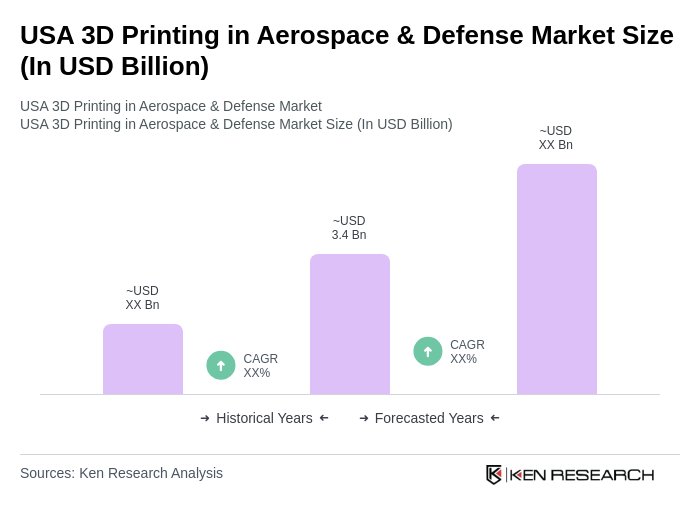
The USA 3D Printing in Aerospace & Defense Market, valued at USD 3.4 Bn, grows due to advancements in additive manufacturing and demand for customized, lightweight parts.

Region:North America

Author(s):Rebecca

Product Code:KRAB4178

Pages:100

Published On:October 2025
About the Report

Base Year 2024

USA 3D Printing in Aerospace & Defense Market Overview

  • The USA 3D Printing in Aerospace & Defense Market is valued at USD 3.4 billion, based on a five-year historical analysis. This growth is primarily driven by advancements in additive manufacturing technologies, increasing demand for lightweight components, and the need for rapid prototyping in aerospace and defense applications. The market is also supported by the rising adoption of 3D printing for producing complex geometries that traditional manufacturing methods cannot achieve. Additionally, the integration of artificial intelligence (AI) in 3D printing enhances design optimization, predictive maintenance, and quality control, further driving market growth.
  • Key players in this market include major aerospace hubs such as California, Texas, and Florida. These regions dominate due to their established aerospace industries, significant investments in research and development, and proximity to leading defense contractors. The presence of skilled labor and advanced manufacturing facilities further enhances their competitive edge in the 3D printing sector.
  • In 2023, the U.S. government implemented the National Defense Authorization Act (NDAA), which emphasizes the integration of advanced manufacturing technologies, including 3D printing, into defense supply chains. This regulation aims to enhance the resilience and efficiency of defense production, encouraging innovation and reducing dependency on foreign suppliers.
USA 3D Printing in Aerospace & Defense Market Size

USA 3D Printing in Aerospace & Defense Market Segmentation

By Material:The materials used in 3D printing for aerospace and defense applications are critical for ensuring the performance and reliability of components. The primary materials include metals, polymers, ceramics, and composites. Among these, metals are leading due to their strength and durability, making them ideal for critical aerospace components. Polymers are also gaining traction for their lightweight properties and versatility in various applications. The demand for ceramics and composites is growing, particularly for specialized applications requiring high-temperature resistance and lightweight structures.
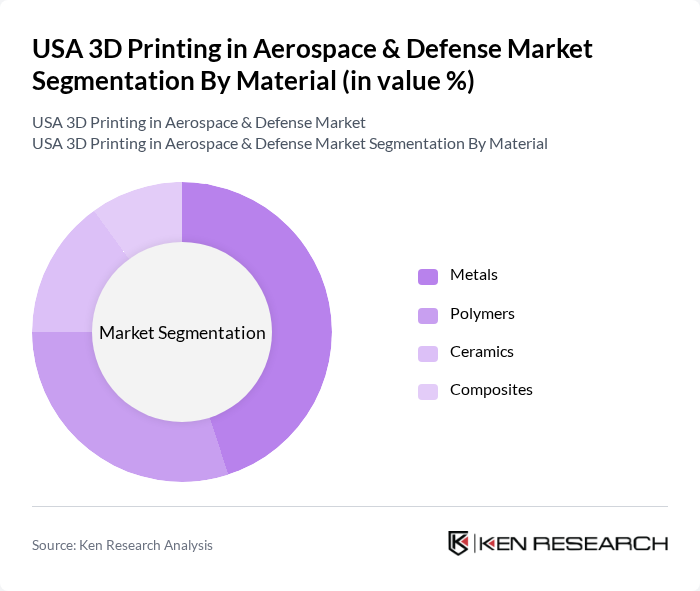
USA 3D Printing in Aerospace & Defense Market segmentation by Material.

By Technology:The technology segment in 3D printing for aerospace and defense encompasses various methods, including Stereolithography (SLA), Selective Laser Sintering (SLS), Material Jetting, and Fused Deposition Modeling (FDM). SLS is currently the dominant technology due to its ability to produce strong and functional parts from a variety of materials. SLA is also popular for its high precision and surface finish, making it suitable for prototyping. Material Jetting and FDM are gaining traction for specific applications, particularly in rapid prototyping and low-volume production.
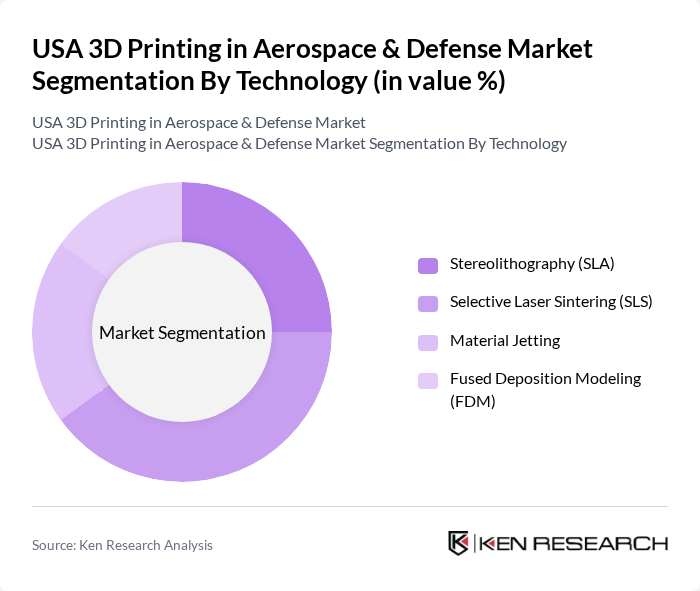
USA 3D Printing in Aerospace & Defense Market segmentation by Technology.

USA 3D Printing in Aerospace & Defense Market Competitive Landscape

The USA 3D Printing in Aerospace & Defense Market is characterized by a dynamic mix of regional and international players. Leading participants such as Boeing, Lockheed Martin, Northrop Grumman, Raytheon Technologies, GE Aviation, Airbus, 3D Systems Corporation, Stratasys Ltd., Materialise NV, Desktop Metal, Inc., Markforged, Inc., HP Inc., Siemens AG, Dassault Systèmes, Formlabs, Inc. contribute to innovation, geographic expansion, and service delivery in this space.

Boeing

1916

Chicago, Illinois, USA

Lockheed Martin

1995

Bethesda, Maryland, USA

Northrop Grumman

1994

Falls Church, Virginia, USA

Raytheon Technologies

2020

Waltham, Massachusetts, USA

GE Aviation

1917

Evendale, Ohio, USA

Company

Establishment Year

Headquarters

Revenue Growth Rate

Market Penetration Rate

Customer Retention Rate

Pricing Strategy

Production Efficiency

R&D Investment

USA 3D Printing in Aerospace & Defense Market Industry Analysis

Growth Drivers

  • Increased Demand for Lightweight Components:The aerospace sector is increasingly focused on reducing weight to enhance fuel efficiency. In future, the average weight reduction target for commercial aircraft is approximately 20%, translating to a demand for lightweight components. The global aerospace industry is projected to require around 1.6 million lightweight parts, with 3D printing technologies providing solutions that meet these specifications while maintaining structural integrity, as reported by the International Air Transport Association (IATA).
  • Customization and Rapid Prototyping:The need for customized components in aerospace and defense is driving the adoption of 3D printing. In future, the prototyping phase is expected to reduce from weeks to days, with an estimated 35% of new parts being produced through additive manufacturing. This shift allows manufacturers to respond swiftly to design changes and customer specifications, enhancing overall production efficiency, as highlighted by the National Institute of Standards and Technology (NIST).
  • Advancements in Material Technologies:The development of advanced materials, such as titanium alloys and carbon fiber composites, is propelling the 3D printing market in aerospace. In future, the market for advanced materials is projected to reach $1.3 billion, with a significant portion allocated to aerospace applications. These materials offer superior performance characteristics, enabling manufacturers to produce components that withstand extreme conditions, as noted by the Aerospace Industries Association (AIA).

Market Challenges

  • High Initial Investment Costs:The upfront costs associated with 3D printing technology remain a significant barrier for many aerospace manufacturers. In future, the average investment for a high-end 3D printer is estimated at $550,000, excluding operational costs. This financial burden can deter smaller companies from adopting these technologies, limiting market growth potential, as indicated by the U.S. Bureau of Economic Analysis (BEA).
  • Regulatory Compliance Issues:Navigating the complex regulatory landscape poses challenges for 3D printing in aerospace. In future, compliance with Federal Aviation Administration (FAA) regulations will require extensive testing and certification processes, which can take up to 20 months. This lengthy timeline can delay product launches and increase costs, as highlighted in reports by the FAA and the Department of Defense (DoD).

USA 3D Printing in Aerospace & Defense Market Future Outlook

The future of 3D printing in the aerospace and defense sectors appears promising, driven by technological advancements and increasing demand for customized solutions. By future, the integration of artificial intelligence in manufacturing processes is expected to enhance efficiency and reduce waste. Additionally, the shift towards on-demand manufacturing will likely reshape supply chains, allowing for more agile responses to market needs. These trends indicate a robust growth trajectory for the industry, fostering innovation and sustainability.

Market Opportunities

  • Expansion in Military Applications:The military sector is increasingly adopting 3D printing for rapid prototyping and production of spare parts. In future, the U.S. Department of Defense plans to allocate $250 million towards 3D printing initiatives, enhancing operational readiness and reducing supply chain vulnerabilities.
  • Collaborations with Research Institutions:Partnerships between aerospace companies and research institutions are expected to drive innovation in material science and printing technologies. In future, over 60 collaborative projects are anticipated, focusing on developing next-generation materials that can withstand extreme conditions, thereby expanding the application scope of 3D printing in aerospace.

Scope of the Report

SegmentSub-Segments
By Material

Metals

Polymers

Ceramics

Composites

By Technology

Stereolithography (SLA)

Selective Laser Sintering (SLS)

Material Jetting

Fused Deposition Modeling (FDM)

By Application

Prototyping

Tooling

Production Parts

Maintenance, Repair, and Overhaul (MRO)

By End-User

Military

Commercial Aviation

Space Exploration

Defense Contractors

By Component

Engines

Structural Components

Interior Components

Others

Key Target Audience

Investors and Venture Capitalist Firms

Government and Regulatory Bodies (e.g., Federal Aviation Administration, Department of Defense)

Aerospace Manufacturers

Defense Contractors

Material Suppliers

3D Printing Technology Providers

Industry Associations (e.g., Aerospace Industries Association)

Financial Institutions

Players Mentioned in the Report:

Boeing

Lockheed Martin

Northrop Grumman

Raytheon Technologies

GE Aviation

Airbus

3D Systems Corporation

Stratasys Ltd.

Materialise NV

Desktop Metal, Inc.

Markforged, Inc.

HP Inc.

Siemens AG

Dassault Systemes

Formlabs, Inc.

Table of Contents

Market Assessment Phase

1. Executive Summary and Approach


2. USA 3D Printing in Aerospace & Defense Market Overview

2.1 Key Insights and Strategic Recommendations

2.2 USA 3D Printing in Aerospace & Defense Market Overview

2.3 Definition and Scope

2.4 Evolution of Market Ecosystem

2.5 Timeline of Key Regulatory Milestones

2.6 Value Chain & Stakeholder Mapping

2.7 Business Cycle Analysis

2.8 Policy & Incentive Landscape


3. USA 3D Printing in Aerospace & Defense Market Analysis

3.1 Growth Drivers

3.1.1 Increased Demand for Lightweight Components
3.1.2 Customization and Rapid Prototyping
3.1.3 Cost Reduction in Manufacturing Processes
3.1.4 Advancements in Material Technologies

3.2 Market Challenges

3.2.1 High Initial Investment Costs
3.2.2 Regulatory Compliance Issues
3.2.3 Limited Material Options
3.2.4 Intellectual Property Concerns

3.3 Market Opportunities

3.3.1 Expansion in Military Applications
3.3.2 Collaborations with Research Institutions
3.3.3 Adoption of Sustainable Practices
3.3.4 Growth in Commercial Aerospace Sector

3.4 Market Trends

3.4.1 Integration of AI in 3D Printing Processes
3.4.2 Increased Use of Bioprinting in Defense
3.4.3 Shift Towards On-Demand Manufacturing
3.4.4 Rise of Digital Supply Chains

3.5 Government Regulation

3.5.1 Export Control Regulations
3.5.2 Safety Standards for Aerospace Components
3.5.3 Environmental Regulations on Materials
3.5.4 Defense Acquisition Regulations

4. SWOT Analysis


5. Stakeholder Analysis


6. Porter's Five Forces Analysis


7. USA 3D Printing in Aerospace & Defense Market Market Size, 2019-2024

7.1 By Value

7.2 By Volume

7.3 By Average Selling Price


8. USA 3D Printing in Aerospace & Defense Market Segmentation

8.1 By Material

8.1.1 Metals
8.1.2 Polymers
8.1.3 Ceramics
8.1.4 Composites

8.2 By Technology

8.2.1 Stereolithography (SLA)
8.2.2 Selective Laser Sintering (SLS)
8.2.3 Material Jetting
8.2.4 Fused Deposition Modeling (FDM)

8.3 By Application

8.3.1 Prototyping
8.3.2 Tooling
8.3.3 Production Parts
8.3.4 Maintenance, Repair, and Overhaul (MRO)

8.4 By End-User

8.4.1 Military
8.4.2 Commercial Aviation
8.4.3 Space Exploration
8.4.4 Defense Contractors

8.5 By Component

8.5.1 Engines
8.5.2 Structural Components
8.5.3 Interior Components
8.5.4 Others

9. USA 3D Printing in Aerospace & Defense Market Competitive Analysis

9.1 Market Share of Key Players

9.2 Cross Comparison of Key Players

9.2.1 Company Name
9.2.2 Revenue Growth Rate
9.2.3 Market Penetration Rate
9.2.4 Customer Retention Rate
9.2.5 Pricing Strategy
9.2.6 Production Efficiency
9.2.7 R&D Investment
9.2.8 Supply Chain Efficiency
9.2.9 Customer Satisfaction Score
9.2.10 Return on Investment (ROI)

9.3 SWOT Analysis of Top Players

9.4 Pricing Analysis

9.5 Detailed Profile of Major Companies

9.5.1 Boeing
9.5.2 Lockheed Martin
9.5.3 Northrop Grumman
9.5.4 Raytheon Technologies
9.5.5 GE Aviation
9.5.6 Airbus
9.5.7 3D Systems Corporation
9.5.8 Stratasys Ltd.
9.5.9 Materialise NV
9.5.10 Desktop Metal, Inc.
9.5.11 Markforged, Inc.
9.5.12 HP Inc.
9.5.13 Siemens AG
9.5.14 Dassault Systèmes
9.5.15 Formlabs, Inc.

10. USA 3D Printing in Aerospace & Defense Market End-User Analysis

10.1 Procurement Behavior of Key Ministries

10.1.1 Defense Procurement Trends
10.1.2 Budget Allocation for 3D Printing
10.1.3 Supplier Selection Criteria
10.1.4 Contracting Processes

10.2 Corporate Spend on Infrastructure & Energy

10.2.1 Investment in 3D Printing Facilities
10.2.2 Budget for R&D in Aerospace
10.2.3 Spending on Maintenance and Upgrades

10.3 Pain Point Analysis by End-User Category

10.3.1 Challenges in Supply Chain Management
10.3.2 Quality Assurance Issues
10.3.3 Integration with Legacy Systems

10.4 User Readiness for Adoption

10.4.1 Training and Skill Development Needs
10.4.2 Awareness of 3D Printing Benefits
10.4.3 Infrastructure Readiness

10.5 Post-Deployment ROI and Use Case Expansion

10.5.1 Measurement of ROI in Defense Projects
10.5.2 Case Studies of Successful Implementations
10.5.3 Future Use Case Exploration

11. USA 3D Printing in Aerospace & Defense Market Future Size, 2025-2030

11.1 By Value

11.2 By Volume

11.3 By Average Selling Price


Go-To-Market Strategy Phase

1. Whitespace Analysis + Business Model Canvas

1.1 Market Gaps Identification

1.2 Business Model Framework


2. Marketing and Positioning Recommendations

2.1 Branding Strategies

2.2 Product USPs


3. Distribution Plan

3.1 Urban Retail Strategies

3.2 Rural NGO Tie-Ups


4. Channel & Pricing Gaps

4.1 Underserved Routes

4.2 Pricing Bands Analysis


5. Unmet Demand & Latent Needs

5.1 Category Gaps

5.2 Consumer Segments


6. Customer Relationship

6.1 Loyalty Programs

6.2 After-Sales Service


7. Value Proposition

7.1 Sustainability Initiatives

7.2 Integrated Supply Chains


8. Key Activities

8.1 Regulatory Compliance

8.2 Branding Efforts

8.3 Distribution Setup


9. Entry Strategy Evaluation

9.1 Domestic Market Entry Strategy

9.1.1 Product Mix Considerations
9.1.2 Pricing Band Strategy
9.1.3 Packaging Approaches

9.2 Export Entry Strategy

9.2.1 Target Countries
9.2.2 Compliance Roadmap

10. Entry Mode Assessment

10.1 Joint Ventures

10.2 Greenfield Investments

10.3 Mergers & Acquisitions

10.4 Distributor Model


11. Capital and Timeline Estimation

11.1 Capital Requirements

11.2 Timelines for Implementation


12. Control vs Risk Trade-Off

12.1 Ownership Considerations

12.2 Partnerships Evaluation


13. Profitability Outlook

13.1 Breakeven Analysis

13.2 Long-Term Sustainability


14. Potential Partner List

14.1 Distributors

14.2 Joint Ventures

14.3 Acquisition Targets


15. Execution Roadmap

15.1 Phased Plan for Market Entry

15.1.1 Market Setup
15.1.2 Market Entry
15.1.3 Growth Acceleration
15.1.4 Scale & Stabilize

15.2 Key Activities and Milestones

15.2.1 Milestone Planning
15.2.2 Activity Tracking

Research Methodology

ApproachModellingSample

Phase 1: Approach1

Desk Research

  • Industry reports from aerospace and defense associations and organizations
  • Market analysis publications focusing on 3D printing technologies and applications
  • Government publications and white papers on defense spending and aerospace innovations

Primary Research

  • Interviews with R&D heads at leading aerospace manufacturers utilizing 3D printing
  • Surveys with procurement managers in defense contracting firms
  • Field interviews with engineers and designers specializing in additive manufacturing

Validation & Triangulation

  • Cross-validation of findings through multiple industry reports and expert opinions
  • Triangulation of data from primary interviews and secondary research sources
  • Sanity checks through expert panel discussions and feedback sessions

Phase 2: Market Size Estimation1

Top-down Assessment

  • Analysis of total defense budget allocations towards advanced manufacturing technologies
  • Segmentation of the aerospace market by aircraft type and defense applications
  • Incorporation of trends in military modernization and technology adoption rates

Bottom-up Modeling

  • Volume estimates based on production rates of 3D printed components in aerospace
  • Cost analysis derived from pricing models of 3D printing services and materials
  • Estimation of market share based on firm-level data from key players in the sector

Forecasting & Scenario Analysis

  • Multi-variable regression analysis incorporating technological advancements and regulatory impacts
  • Scenario modeling based on varying levels of defense spending and 3D printing adoption
  • Projections for market growth through 2030 under different economic conditions

Phase 3: CATI Sample Composition1

Scope Item/SegmentSample SizeTarget Respondent Profiles
Aerospace Component Manufacturing100Manufacturing Engineers, Production Managers
Defense Contracting Firms80Procurement Managers, Program Managers
3D Printing Technology Providers60Sales Directors, Technical Support Engineers
Research Institutions in Aerospace50Research Scientists, Academic Professors
Regulatory Bodies and Standards Organizations40Policy Analysts, Compliance Officers

Frequently Asked Questions

What is the current value of the USA 3D Printing in Aerospace & Defense Market?

The USA 3D Printing in Aerospace & Defense Market is valued at approximately USD 3.4 billion, driven by advancements in additive manufacturing technologies and increasing demand for lightweight components and rapid prototyping in aerospace and defense applications.

What are the key drivers of growth in the USA 3D Printing in Aerospace & Defense Market?

Which regions are leading in the USA 3D Printing in Aerospace & Defense Market?

What technologies are commonly used in 3D printing for aerospace and defense?

Other Regional/Country Reports

Indonesia 3D Printing in Aerospace & Defense Market

Malaysia 3D Printing in Aerospace & Defense Market

KSA 3D Printing in Aerospace & Defense Market

APAC 3D Printing in Aerospace & Defense Market

SEA 3D Printing in Aerospace & Defense Market

Vietnam 3D Printing in Aerospace & Defense Market

Other Adjacent Reports

Thailand 3D Printing Materials Market

Philippines Aerospace Composites Market

Singapore Defense Electronics Market

Mexico Aircraft Manufacturing Market

Japan Rapid Prototyping Market

UAE Additive Manufacturing Software Market

Belgium Military Drone Market

South Korea Satellite Components Market

Qatar Advanced Polymers Market

Oman Laser Sintering Technology Market

Why Buy From Us?

Refine Robust Result (RRR) Framework

What makes us stand out is that our consultants follow Robust, Refine and Result (RRR) methodology. Robust for clear definitions, approaches and sanity checking, Refine for differentiating respondents' facts and opinions, and Result for presenting data with story.

Our Reach Is Unmatched

We have set a benchmark in the industry by offering our clients with syndicated and customized market research reports featuring coverage of entire market as well as meticulous research and analyst insights.

Shifting the Research Paradigm

While we don't replace traditional research, we flip the method upside down. Our dual approach of Top Bottom & Bottom Top ensures quality deliverable by not just verifying company fundamentals but also looking at the sector and macroeconomic factors.

More Insights-Better Decisions

With one step in the future, our research team constantly tries to show you the bigger picture. We help with some of the tough questions you may encounter along the way: How is the industry positioned? Best marketing channel? KPI's of competitors? By aligning every element, we help maximize success.

Transparency and Trust

Our report gives you instant access to the answers and sources that other companies might choose to hide. We elaborate each steps of research methodology we have used and showcase you the sample size to earn your trust.

Round the Clock Support

If you need any support, we are here! We pride ourselves on universe strength, data quality, and quick, friendly, and professional service.

Why Clients Choose Us?

400000+
Reports in repository
150+
Consulting projects a year
100+
Analysts
8000+
Client Queries in 2022








