USA Home Loan Market

USA home loan market, worth USD 14.0-14.5 trillion, grows amid low rates and incentives, facing challenges like rising prices, with opportunities in digital platforms and refinancing.

Region:North America

Author(s):Dev

Product Code:KRAA1590

Pages:96

Published On:August 2025

About the Report

Base Year 2024

USA Home Loan Market Overview

  • The USA Home Loan Market is valued at approximately USD 14.0–14.5 trillion, based on a five-year historical analysis. This growth is primarily influenced by rate cycles, home price appreciation, and credit availability; in the most recent period, purchase originations softened amid higher rates while refinance and home-equity borrowing gained relative share. The demand for home loans has fluctuated as consumers navigate affordability constraints, refinancing incentives when rates dip, and the increased use of HELOCs for liquidity, shaping overall market dynamics.
  • Key cities dominating the USA Home Loan Market include New York, Los Angeles, and Chicago. These metropolitan areas are characterized by high population density, significant economic activity, and a diverse range of housing options; nevertheless, tight inventory and affordability constraints have limited transaction volumes even in large MSAs. The concentration of financial institutions and real estate services in these cities further enhances their market importance.
  • In 2023, the Federal Housing Finance Agency (FHFA) implemented updated conforming loan limits. The baseline one-unit conforming limit was set at USD 726,200 for areas of average cost; high-cost area limits were higher than this baseline according to statutory formulas. These adjustments aim to improve access to credit for eligible borrowers.

USA Home Loan Market Segmentation

By Type:The market is segmented into various types of home loans, including Fixed-Rate Mortgages, Adjustable-Rate Mortgages, FHA-Insured Loans, VA-Guaranteed Loans, USDA/Rural Development Loans, Jumbo/Non-Conforming Loans, Non-QM & Portfolio Loans, and HELOCs & Home Equity Loans. Among these, Fixed-Rate Mortgages are the most popular due to their stability and predictability, appealing to first-time homebuyers and those looking for long-term financial security. Recent data indicates fixed-rate loans continue to dominate originations, while ARMs remain a smaller share amid a relatively flat/inverted yield curve; refinance and HELOC activity have risen in relative mix during rate pullbacks and for equity extraction.
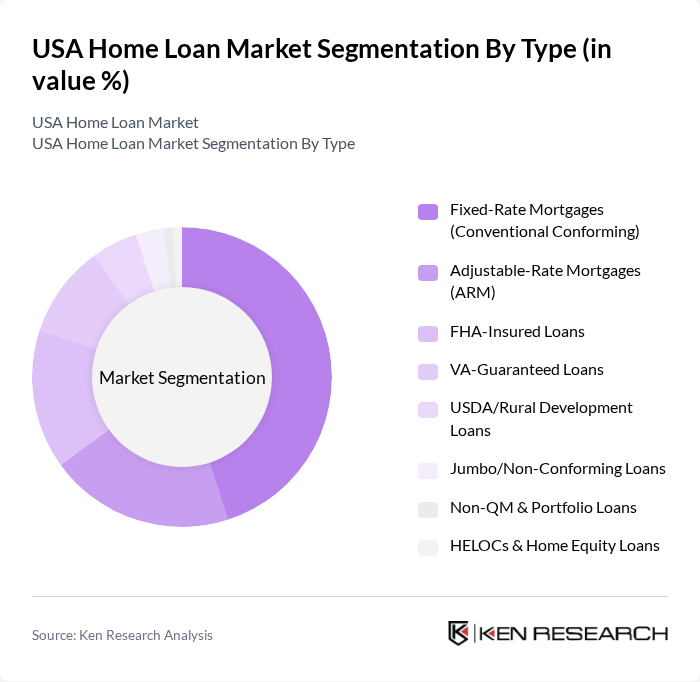
USA Home Loan Market segmentation by Type.

By Borrower Type:The borrower type segmentation includes First-Time Homebuyers, Repeat Homebuyers/Move-Up Buyers, Investors/Non-Owner Occupied, and Refinancers (Rate/Term & Cash-Out). First-Time Homebuyers have been supported by down-payment assistance and lower-down-payment programs (FHA/VA), though affordability pressures have limited overall purchase volumes; refinance activity’s share has grown at times due to episodic rate declines and equity tapping.
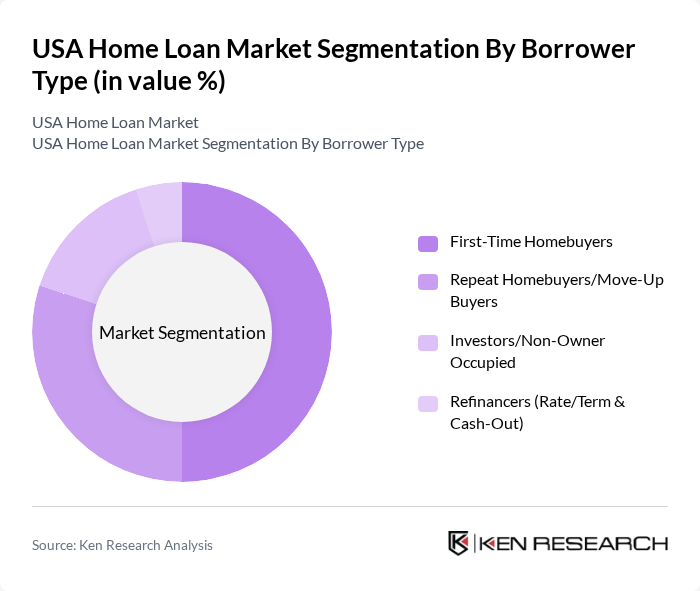
USA Home Loan Market segmentation by Borrower Type.

USA Home Loan Market Competitive Landscape

The USA Home Loan Market is characterized by a dynamic mix of regional and international players. Leading participants such as Rocket Mortgage (formerly Quicken Loans), Wells Fargo Home Lending, JPMorgan Chase Home Lending, Bank of America Home Loans, U.S. Bank Home Mortgage, Citi Mortgage, Caliber Home Loans, Guaranteed Rate, loanDepot, Flagstar Bank, Pennymac, New American Funding, Movement Mortgage, Fairway Independent Mortgage, Mr. Cooper, United Wholesale Mortgage (UWM), Guild Mortgage, Navy Federal Credit Union, Truist Mortgage, PNC Mortgage contribute to innovation, geographic expansion, and service delivery in this space.

Rocket Mortgage

1985

Detroit, MI

Wells Fargo Home Lending

1852

San Francisco, CA

JPMorgan Chase Home Lending

2000

New York, NY

Bank of America Home Loans

1904

Charlotte, NC

U.S. Bank Home Mortgage

1863

Minneapolis, MN

Company

Establishment Year

Headquarters

Institution Type (Bank, IMB, Credit Union, Fintech)

Total Loan Origination Volume (most recent FY/TTM, $ and units)

Purchase vs Refinance Mix (%)

Channel Mix (Retail, Wholesale/Broker, Correspondent %)

Product Mix (Conventional, FHA, VA, USDA, Jumbo, Non-QM %)

Average Note Rate and APR (by product)

USA Home Loan Market Industry Analysis

Growth Drivers

  • Low Interest Rates:The average interest rate for a 30-year fixed mortgage in the USA was approximately 6.5% in future, significantly lower than the historical average of around 5.5%. This reduction in borrowing costs has led to an increase in mortgage applications, with the Mortgage Bankers Association reporting a 10% rise in applications year-over-year. Lower interest rates make home loans more affordable, encouraging more consumers to enter the housing market and stimulating overall economic activity.
  • Increasing Homeownership Rates:The homeownership rate in the USA reached 66.4% in future, up from 65.8% in future. This increase reflects a growing trend among millennials and Gen Z, who are increasingly prioritizing homeownership as a long-term investment. The National Association of Realtors reported that first-time buyers accounted for 34% of all home purchases in future, indicating a robust demand for home loans and a positive outlook for the housing market.
  • Government Incentives for First-Time Buyers:In future, various state and federal programs allocated over $1 billion in grants and tax credits to assist first-time homebuyers. Programs like the FHA's 3.5% down payment option and state-specific initiatives have made homeownership more accessible. The Urban Institute noted that these incentives have led to a 15% increase in first-time homebuyer participation, driving demand for home loans and contributing to a more vibrant housing market.

Market Challenges

  • Rising Property Prices:The median home price in the USA surged to $400,000 in future, a 10% increase from the previous year. This escalation in property values poses a significant challenge for potential buyers, particularly first-time homeowners. The National Association of Realtors reported that affordability issues are leading to a slowdown in home sales, as many buyers are priced out of the market, which could dampen overall loan origination volumes.
  • Regulatory Compliance Costs:The cost of compliance with federal regulations, including the Dodd-Frank Act, has increased significantly, with estimates suggesting that lenders spend an average of $1.5 million annually on compliance-related activities. This financial burden can limit the ability of smaller lenders to compete effectively in the market. Additionally, the Consumer Financial Protection Bureau's stringent guidelines require ongoing investments in technology and training, further straining resources for many institutions.

USA Home Loan Market Future Outlook

The USA home loan market is poised for continued evolution, driven by technological advancements and changing consumer preferences. The integration of digital platforms is expected to streamline the loan application process, enhancing customer experience. Additionally, as sustainability becomes a priority, lenders may increasingly offer green mortgage options. The ongoing demand for affordable housing solutions will likely prompt innovative financing models, ensuring that the market remains dynamic and responsive to consumer needs in the coming years.

Market Opportunities

  • Expansion of Digital Mortgage Platforms:The digital mortgage sector is projected to grow significantly, with an estimated 30% increase in online applications in future. This shift presents an opportunity for lenders to enhance efficiency and reduce costs. By investing in user-friendly platforms, lenders can attract tech-savvy consumers, streamline operations, and improve overall customer satisfaction, positioning themselves favorably in a competitive market.
  • Growth in Refinancing Options:With interest rates remaining low, refinancing activity is expected to rise, with an estimated 1.5 million homeowners likely to refinance in future. This trend offers lenders a chance to capture additional market share by providing tailored refinancing solutions. By promoting competitive rates and flexible terms, lenders can effectively meet the needs of existing homeowners looking to reduce their monthly payments or access home equity.

Scope of the Report

SegmentSub-Segments
By Type

Fixed-Rate Mortgages (Conventional Conforming)

Adjustable-Rate Mortgages (ARM)

FHA-Insured Loans

VA-Guaranteed Loans

USDA/Rural Development Loans

Jumbo/Non-Conforming Loans

Non-QM & Portfolio Loans

HELOCs & Home Equity Loans

By Borrower Type

First-Time Homebuyers

Repeat Homebuyers/Move-Up Buyers

Investors/Non-Owner Occupied

Refinancers (Rate/Term & Cash-Out)

By Loan Purpose

Purchase

Rate/Term Refinance

Cash-Out Refinance

Home Improvement

By Credit Tier (FICO)

Super-Prime (720+)

Prime (660–719)

Near-Prime (620–659)

Subprime (<620)

By Loan Amount Band

Under $150,000

$150,000 – $300,000

$300,000 – $500,000

$500,000 – Conforming Limit

Above Conforming (Jumbo)

By Region

Northeast

Midwest

South

West

By Loan Term

–15-Year Fixed

Year Fixed

Year Fixed

Hybrid ARMs (e.g., 5/6, 7/6, 10/6)

Key Target Audience

Investors and Venture Capitalist Firms

Government and Regulatory Bodies (e.g., Federal Housing Administration, Consumer Financial Protection Bureau)

Mortgage Lenders and Banks

Real Estate Developers

Insurance Companies

Credit Rating Agencies

Housing Advocacy Groups

Financial Technology (FinTech) Companies

Players Mentioned in the Report:

Rocket Mortgage (formerly Quicken Loans)

Wells Fargo Home Lending

JPMorgan Chase Home Lending

Bank of America Home Loans

U.S. Bank Home Mortgage

Citi Mortgage

Caliber Home Loans

Guaranteed Rate

loanDepot

Flagstar Bank

Pennymac

New American Funding

Movement Mortgage

Fairway Independent Mortgage

Mr. Cooper

United Wholesale Mortgage (UWM)

Guild Mortgage

Navy Federal Credit Union

Truist Mortgage

PNC Mortgage

Table of Contents

Market Assessment Phase

1. Executive Summary and Approach


2. USA Home Loan Market Overview

2.1 Key Insights and Strategic Recommendations

2.2 USA Home Loan Market Overview

2.3 Definition and Scope

2.4 Evolution of Market Ecosystem

2.5 Timeline of Key Regulatory Milestones

2.6 Value Chain & Stakeholder Mapping

2.7 Business Cycle Analysis

2.8 Policy & Incentive Landscape


3. USA Home Loan Market Analysis

3.1 Growth Drivers

3.1.1 Low Interest Rates
3.1.2 Increasing Homeownership Rates
3.1.3 Government Incentives for First-Time Buyers
3.1.4 Technological Advancements in Loan Processing

3.2 Market Challenges

3.2.1 Rising Property Prices
3.2.2 Regulatory Compliance Costs
3.2.3 Economic Uncertainty
3.2.4 Competition from Alternative Financing Options

3.3 Market Opportunities

3.3.1 Expansion of Digital Mortgage Platforms
3.3.2 Growth in Refinancing Options
3.3.3 Increasing Demand for Sustainable Housing
3.3.4 Partnerships with Real Estate Agencies

3.4 Market Trends

3.4.1 Rise of Fintech in Mortgage Lending
3.4.2 Shift Towards Remote Closing Processes
3.4.3 Increased Focus on Customer Experience
3.4.4 Adoption of AI in Risk Assessment

3.5 Government Regulation

3.5.1 Dodd-Frank Act Compliance
3.5.2 Consumer Financial Protection Bureau (CFPB) Guidelines
3.5.3 Federal Housing Administration (FHA) Loan Requirements
3.5.4 Home Mortgage Disclosure Act (HMDA) Reporting

4. SWOT Analysis


5. Stakeholder Analysis


6. Porter's Five Forces Analysis


7. USA Home Loan Market Market Size, 2019-2024

7.1 By Value

7.2 By Volume

7.3 By Average Selling Price


8. USA Home Loan Market Segmentation

8.1 By Type

8.1.1 Fixed-Rate Mortgages (Conventional Conforming)
8.1.2 Adjustable-Rate Mortgages (ARM)
8.1.3 FHA-Insured Loans
8.1.4 VA-Guaranteed Loans
8.1.5 USDA/Rural Development Loans
8.1.6 Jumbo/Non-Conforming Loans
8.1.7 Non-QM & Portfolio Loans
8.1.8 HELOCs & Home Equity Loans

8.2 By Borrower Type

8.2.1 First-Time Homebuyers
8.2.2 Repeat Homebuyers/Move-Up Buyers
8.2.3 Investors/Non-Owner Occupied
8.2.4 Refinancers (Rate/Term & Cash-Out)

8.3 By Loan Purpose

8.3.1 Purchase
8.3.2 Rate/Term Refinance
8.3.3 Cash-Out Refinance
8.3.4 Home Improvement

8.4 By Credit Tier (FICO)

8.4.1 Super-Prime (720+)
8.4.2 Prime (660–719)
8.4.3 Near-Prime (620–659)
8.4.4 Subprime (<620)

8.5 By Loan Amount Band

8.5.1 Under $150,000
8.5.2 $150,000 – $300,000
8.5.3 $300,000 – $500,000
8.5.4 $500,000 – Conforming Limit
8.5.5 Above Conforming (Jumbo)

8.6 By Region

8.6.1 Northeast
8.6.2 Midwest
8.6.3 South
8.6.4 West

8.7 By Loan Term

8.7.1 10–15-Year Fixed
8.7.2 20-Year Fixed
8.7.3 30-Year Fixed
8.7.4 Hybrid ARMs (e.g., 5/6, 7/6, 10/6)

9. USA Home Loan Market Competitive Analysis

9.1 Market Share of Key Players

9.2 Cross Comparison of Key Players

9.2.1 Company Name
9.2.2 Institution Type (Bank, IMB, Credit Union, Fintech)
9.2.3 Total Loan Origination Volume (most recent FY/TTM, $ and units)
9.2.4 Purchase vs Refinance Mix (%)
9.2.5 Channel Mix (Retail, Wholesale/Broker, Correspondent %)
9.2.6 Product Mix (Conventional, FHA, VA, USDA, Jumbo, Non-QM %)
9.2.7 Average Note Rate and APR (by product)
9.2.8 Average Processing/Cycle Time to Close (days)
9.2.9 Pull-Through Rate (application-to-funding %)
9.2.10 Delinquency and Default Rates (30+, 60+, 90+ DPD)
9.2.11 Servicing Portfolio (UPB, delinquency %, MSR multiple)
9.2.12 Gain-on-Sale Margin / Net Production Income (bps)
9.2.13 Cost to Originate (per loan $) and Productivity (loans/LO/month)
9.2.14 Customer Satisfaction / NPS and Complaint Rate (CFPB)
9.2.15 Geographic Footprint (licenses, top states, branch count)
9.2.16 Capital & Liquidity Metrics (warehouse capacity, cash, CET1 where applicable)
9.2.17 Technology Capability (POS/LOS, eClose, RON adoption)
9.2.18 Revenue Growth Rate and Market Share Trend (YoY)
9.2.19 Profitability Metrics (ROE/ROA for banks; EBITDA margin for IMBs)
9.2.20 Repurchase/Indemnification Rate and QC Defect Rate

9.3 SWOT Analysis of Top Players

9.4 Pricing Analysis

9.5 Detailed Profile of Major Companies

9.5.1 Rocket Mortgage (formerly Quicken Loans)
9.5.2 Wells Fargo Home Lending
9.5.3 JPMorgan Chase Home Lending
9.5.4 Bank of America Home Loans
9.5.5 U.S. Bank Home Mortgage
9.5.6 Citi Mortgage
9.5.7 Caliber Home Loans
9.5.8 Guaranteed Rate
9.5.9 loanDepot
9.5.10 Flagstar Bank
9.5.11 Pennymac
9.5.12 New American Funding
9.5.13 Movement Mortgage
9.5.14 Fairway Independent Mortgage
9.5.15 Mr. Cooper
9.5.16 United Wholesale Mortgage (UWM)
9.5.17 Guild Mortgage
9.5.18 Navy Federal Credit Union
9.5.19 Truist Mortgage
9.5.20 PNC Mortgage

10. USA Home Loan Market End-User Analysis

10.1 Procurement Behavior of Key Ministries

10.1.1 Federal Housing Administration
10.1.2 Department of Housing and Urban Development
10.1.3 State Housing Finance Agencies

10.2 Corporate Spend on Infrastructure & Energy

10.2.1 Investment in Affordable Housing
10.2.2 Funding for Homebuyer Assistance Programs

10.3 Pain Point Analysis by End-User Category

10.3.1 Affordability Issues
10.3.2 Access to Credit
10.3.3 Complexity of Loan Processes

10.4 User Readiness for Adoption

10.4.1 Awareness of Loan Options
10.4.2 Digital Literacy

10.5 Post-Deployment ROI and Use Case Expansion

10.5.1 Long-Term Financial Benefits
10.5.2 Impact on Property Value

11. USA Home Loan Market Future Size, 2025-2030

11.1 By Value

11.2 By Volume

11.3 By Average Selling Price


Go-To-Market Strategy Phase

1. Whitespace Analysis + Business Model Canvas

1.1 Market Gaps Identification

1.2 Value Proposition Development

1.3 Revenue Streams Analysis

1.4 Cost Structure Evaluation

1.5 Key Partnerships Exploration

1.6 Customer Segmentation

1.7 Channels of Distribution


2. Marketing and Positioning Recommendations

2.1 Branding Strategies

2.2 Product USPs


3. Distribution Plan

3.1 Urban Retail vs Rural NGO Tie-ups


4. Channel & Pricing Gaps

4.1 Underserved Routes

4.2 Pricing Bands


5. Unmet Demand & Latent Needs

5.1 Category Gaps

5.2 Consumer Segments


6. Customer Relationship

6.1 Loyalty Programs

6.2 After-Sales Service


7. Value Proposition

7.1 Sustainability

7.2 Integrated Supply Chains


8. Key Activities

8.1 Regulatory Compliance

8.2 Branding

8.3 Distribution Setup


9. Entry Strategy Evaluation

9.1 Domestic Market Entry Strategy

9.1.1 Product Mix
9.1.2 Pricing Band
9.1.3 Packaging

9.2 Export Entry Strategy

9.2.1 Target Countries
9.2.2 Compliance Roadmap

10. Entry Mode Assessment

10.1 JV

10.2 Greenfield

10.3 M&A

10.4 Distributor Model


11. Capital and Timeline Estimation

11.1 Capital Requirements

11.2 Timelines


12. Control vs Risk Trade-Off

12.1 Ownership vs Partnerships


13. Profitability Outlook

13.1 Breakeven Analysis

13.2 Long-Term Sustainability


14. Potential Partner List

14.1 Distributors

14.2 JVs

14.3 Acquisition Targets


15. Execution Roadmap

15.1 Phased Plan for Market Entry

15.1.1 Market Setup
15.1.2 Market Entry
15.1.3 Growth Acceleration
15.1.4 Scale & Stabilize

15.2 Key Activities and Milestones

15.2.1 Activity Planning
15.2.2 Milestone Tracking

Research Methodology

ApproachModellingSample

Phase 1: Approach1

Desk Research

  • Analysis of government reports and publications from the Federal Housing Finance Agency (FHFA)
  • Review of industry reports from the Mortgage Bankers Association (MBA) and National Association of Realtors (NAR)
  • Examination of housing market trends and economic indicators from the U.S. Census Bureau

Primary Research

  • Interviews with mortgage brokers and loan officers to gather insights on current lending practices
  • Surveys targeting homebuyers to understand preferences and challenges in the loan application process
  • Focus groups with real estate agents to discuss market dynamics and consumer behavior

Validation & Triangulation

  • Cross-validation of findings with data from the Federal Reserve and private financial institutions
  • Triangulation of qualitative insights from interviews with quantitative data from market reports
  • Sanity checks through expert panel reviews consisting of economists and housing market analysts

Phase 2: Market Size Estimation1

Top-down Assessment

  • Estimation of total mortgage origination volume based on national housing sales data
  • Segmentation of the market by loan type (e.g., FHA, VA, conventional) and geographic region
  • Incorporation of macroeconomic factors such as interest rates and employment rates

Bottom-up Modeling

  • Analysis of loan volume data from major lenders and mortgage servicers
  • Estimation of average loan sizes and terms based on historical data
  • Calculation of market share for different loan products based on lender performance

Forecasting & Scenario Analysis

  • Multi-factor regression analysis incorporating economic indicators, housing supply, and demand trends
  • Scenario modeling based on potential changes in interest rates and government housing policies
  • Development of baseline, optimistic, and pessimistic forecasts through 2030

Phase 3: CATI Sample Composition1

Scope Item/SegmentSample SizeTarget Respondent Profiles
First-Time Homebuyers120Individuals aged 25-35, seeking mortgage options
Real Estate Agents90Agents with 3+ years of experience in residential sales
Mortgage Brokers80Professionals with expertise in various loan products
Homeowners Refinancing110Homeowners looking to refinance existing mortgages
Investors in Rental Properties70Individuals or entities owning multiple rental properties

Frequently Asked Questions

What is the current value of the USA Home Loan Market?

The USA Home Loan Market is valued at approximately USD 14.014.5 trillion, influenced by factors such as interest rate cycles, home price appreciation, and credit availability. Recent trends show a softening in purchase originations amid higher rates, while refinancing and home-equity borrowing have gained traction.

Which cities dominate the USA Home Loan Market?

What are the updated conforming loan limits for 2023?

What types of home loans are available in the USA?

Other Regional/Country Reports

Philippines Home Loan Market Outlook to 2029

Indonesia Home Loan Market

Malaysia Home Loan Market

KSA Home Loan Market

APAC Home Loan Market

SEA Home Loan Market

Why Buy From Us?

Refine Robust Result (RRR) Framework

What makes us stand out is that our consultants follow Robust, Refine and Result (RRR) methodology. Robust for clear definitions, approaches and sanity checking, Refine for differentiating respondents' facts and opinions, and Result for presenting data with story.

Our Reach Is Unmatched

We have set a benchmark in the industry by offering our clients with syndicated and customized market research reports featuring coverage of entire market as well as meticulous research and analyst insights.

Shifting the Research Paradigm

While we don't replace traditional research, we flip the method upside down. Our dual approach of Top Bottom & Bottom Top ensures quality deliverable by not just verifying company fundamentals but also looking at the sector and macroeconomic factors.

More Insights-Better Decisions

With one step in the future, our research team constantly tries to show you the bigger picture. We help with some of the tough questions you may encounter along the way: How is the industry positioned? Best marketing channel? KPI's of competitors? By aligning every element, we help maximize success.

Transparency and Trust

Our report gives you instant access to the answers and sources that other companies might choose to hide. We elaborate each steps of research methodology we have used and showcase you the sample size to earn your trust.

Round the Clock Support

If you need any support, we are here! We pride ourselves on universe strength, data quality, and quick, friendly, and professional service.

Why Clients Choose Us?

400000+
Reports in repository
150+
Consulting projects a year
100+
Analysts
8000+
Client Queries in 2022








