
Vietnam Diesel Generator Market Outlook to 2030
Region:Asia
Author(s):Shubham Kashyap
Product Code:KROD4159
December 2024
90
About the Report
Vietnam Diesel Generator Market Overview
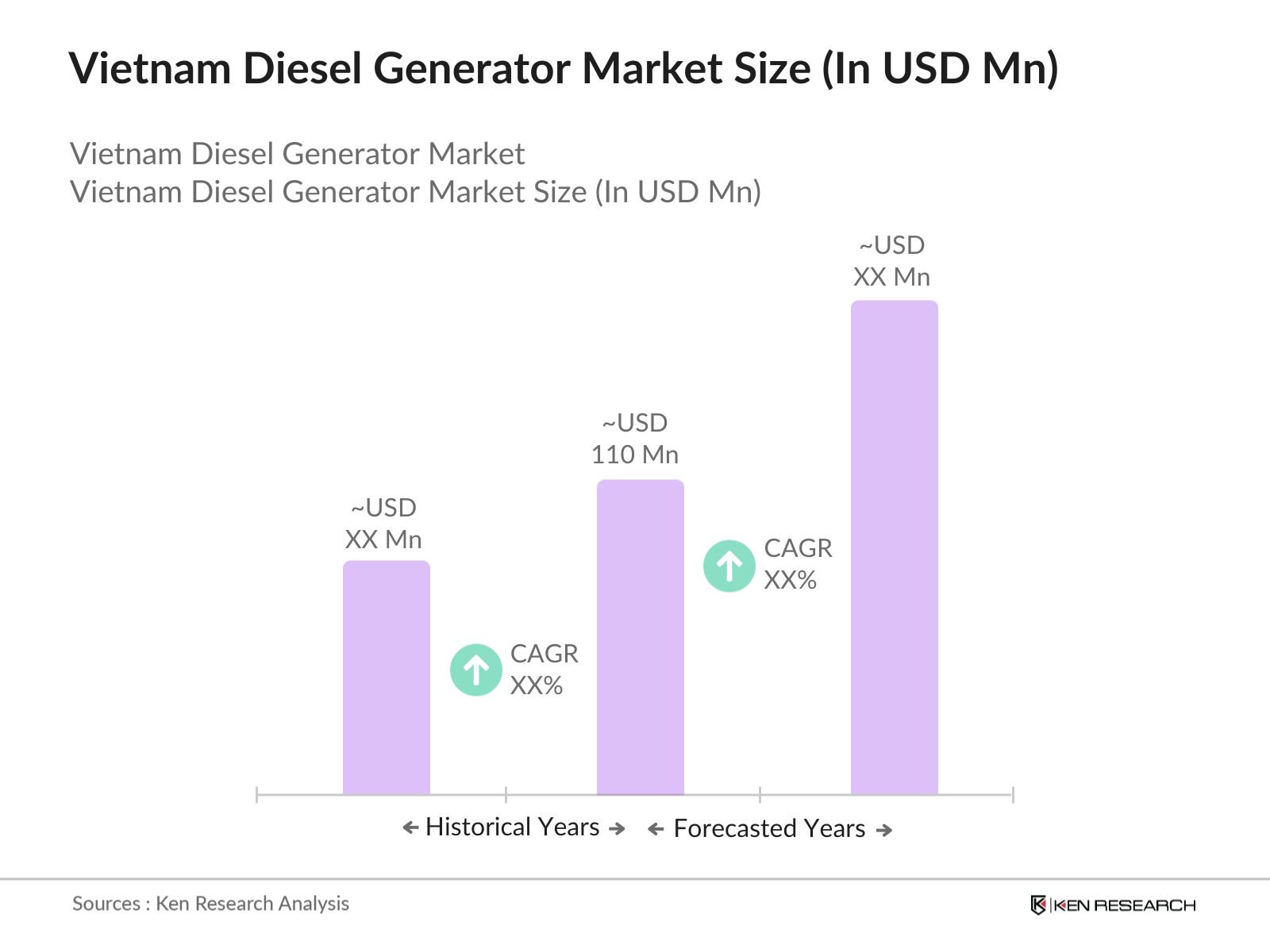
- The Vietnam Diesel Generator Market has seen substantial growth in recent years, currently valued at USD 110 million, driven by the increasing demand for backup power solutions across industries. The market is primarily fueled by industrialization, infrastructure development, and the growing need for uninterrupted power supply in both urban and rural areas. Diesel generators are widely used in sectors such as manufacturing, healthcare, construction, and data centers, where continuous power is crucial to operations.
- Major urban centers like Ho Chi Minh City, Hanoi, and Da Nang dominate the market due to their rapid industrial expansion, real estate development, and the rising number of commercial projects. These cities are leading adopters of diesel generators as they continue to experience infrastructure upgrades and expansions. Rural areas are also witnessing growth in generator usage, particularly in remote locations where access to the national power grid is limited or unreliable.
- In 2023, Vietnam implemented new regulations mandating that all diesel engines meet Euro 4 emission standards, pushing manufacturers to adopt cleaner technologies. The government is also working towards increasing the proportion of renewable energy, with a target of reducing CO2 emissions by 9% by 2030.
Vietnam Diesel Generator Market Segmentation
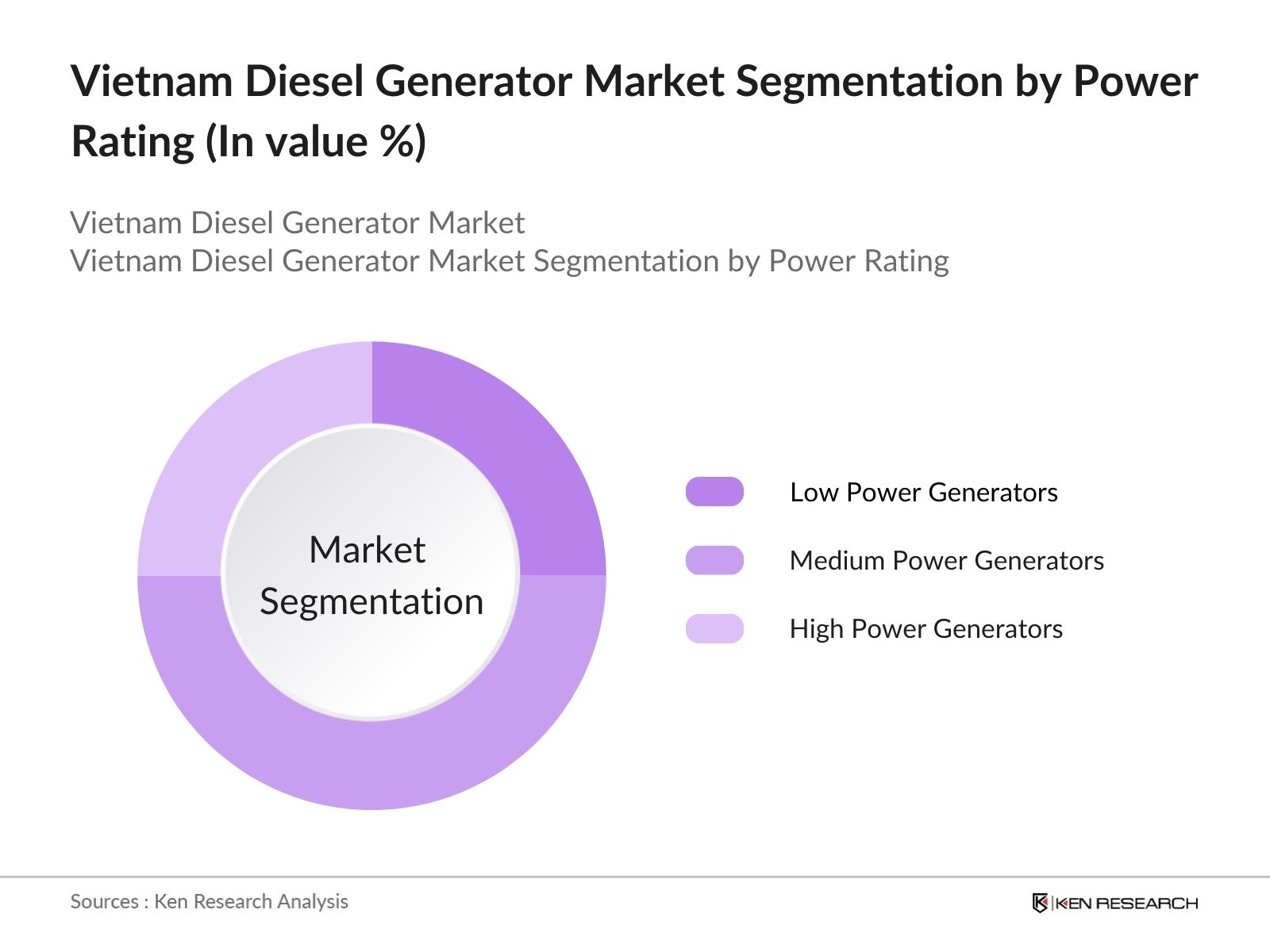
- By Power Rating: The market is segmented into Low Power Generators (up to 100 kVA), Medium Power Generators (101 kVA to 500 kVA), and High-Power Generators (above 500 kVA). Medium Power Generators hold the largest market share, driven by their extensive use in construction, small-scale industrial applications, and commercial buildings. Low Power Generators are predominantly used in residential areas and small commercial establishments, while High Power Generators are primarily deployed in large-scale industrial operations, data centers, and healthcare facilities where higher power output is required.
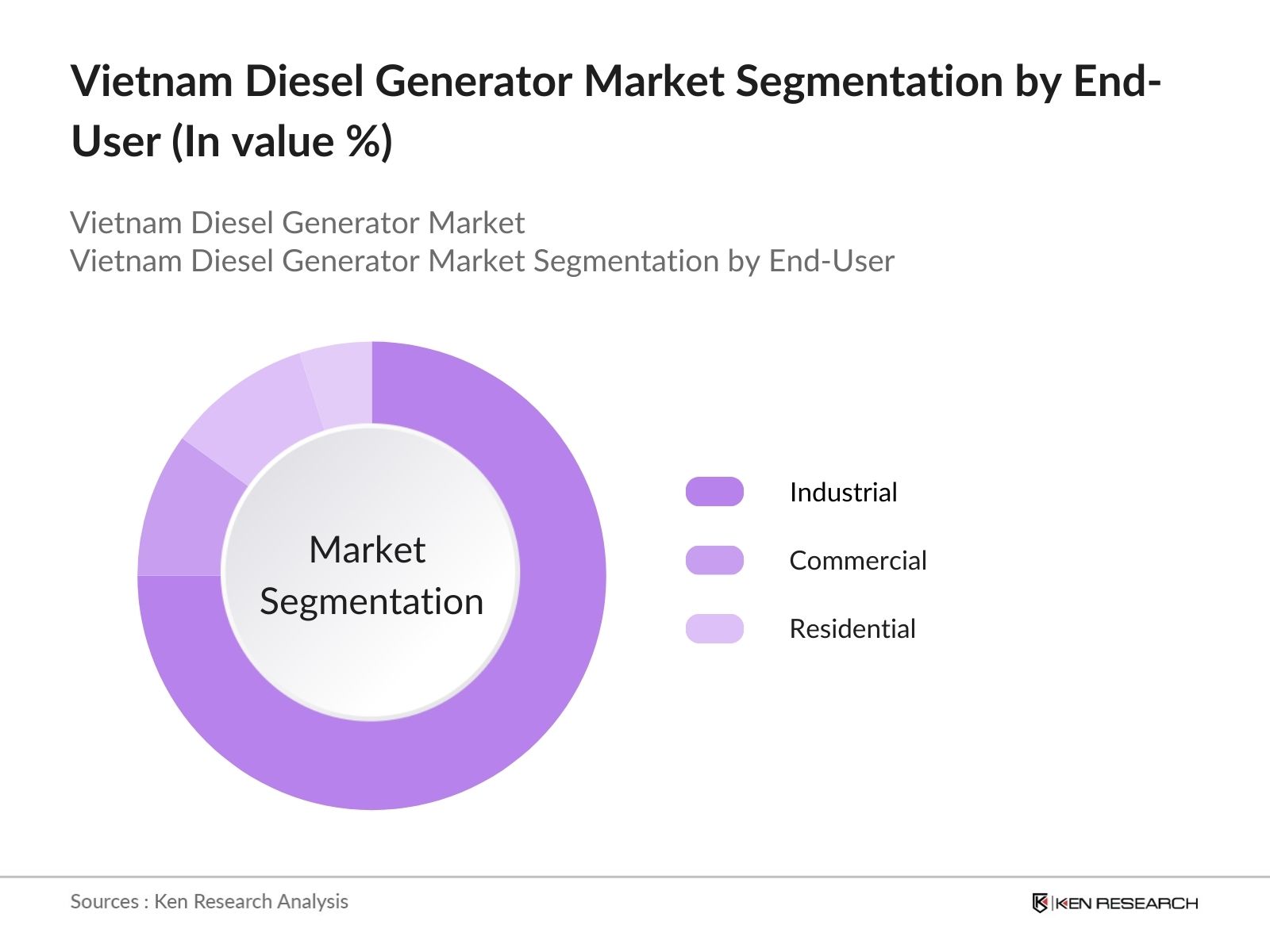
- By End-User: The market is further segmented into Industrial, Commercial, and Residential sectors. The Industrial sector dominates the market, with industries such as manufacturing, construction, and mining being major consumers of diesel generators. The Commercial sector, including office buildings, shopping malls, and hotels, also contributes significantly to the demand, particularly in urban areas experiencing frequent power disruptions. The Residential sector, while smaller in comparison, is growing as more households in rural and semi-urban areas invest in diesel generators to ensure a steady power supply.
Vietnam Diesel Generator Market Competitive Landscape
The Vietnam Diesel Generator Market is competitive, with both local and international players vying for market dominance. Key domestic companies like Viettracimex and Power Machine Joint Stock Company are well-established in the market, catering to a wide range of industrial and commercial clients. These companies benefit from their strong local presence and understanding of the specific power needs of Vietnamese industries.
International brands such as Cummins, Caterpillar, and Perkins also have a significant presence, known for their high-performance generators and strong after-sales support. These companies focus on providing innovative and fuel-efficient solutions, catering to large industrial clients who require dependable and durable power solutions. The competition in the market is intensifying, with companies focusing on improving their product offerings and expanding their distribution networks.
|
Company Name |
Establishment Year |
Headquarters |
Key Products |
Revenue |
R&D Investments |
Market Reach |
Sustainability Initiatives |
Export Markets |
Certifications |
|
Viettracimex |
1969 |
Hanoi, Vietnam |
|||||||
|
Power Machine JSC |
1990 |
Ho Chi Minh City, VN |
|||||||
|
Cummins |
1919 |
Columbus, USA |
|||||||
|
Caterpillar |
1925 |
Illinois, USA |
|||||||
|
Perkins |
1932 |
Peterborough, UK |
Vietnam Diesel Generator Market Analysis
Growth Drivers
- Industrial Expansion and Infrastructure Development: Vietnams economy is rapidly industrializing, with major industrial projects under development. Between 2022 and 2024, Vietnam's industrial production value reached USD 101 billion, driven by sectors like manufacturing, construction, and logistics. Key developments include construction projects like the Long Thanh International Airport and expanding industrial zones such as Binh Duong and Hai Phong. This infrastructure growth boosts the demand for diesel generators to support power supply in large construction sites and industrial projects. Data centers, like those built by Viettel and FPT, are expanding significantly, creating higher demands for reliable backup power solutions.
- Power Supply Challenges and Outages: Power supply remains inconsistent, especially in rural areas. In 2023, 3.0 million people in rural Vietnam still lacked access to a reliable electricity grid, while urban power grids experienced frequent interruptions due to load-shedding. Urban centers like Ho Chi Minh City face increased energy demand that outstrips supply during peak seasons. Diesel generators provide crucial backup during these outages, especially in sectors like healthcare and logistics, ensuring consistent operations in both rural and urban areas. The governments target to achieve full rural electrification by 2025 pushes diesel generator usage as a bridge solution.
- Increased Demand from Data Centers and Tech Sector: With the rise of digital transformation and the rapid growth of Vietnam's tech industry, data centers have become significant consumers of diesel generators. Data centers require a constant and reliable power supply, and diesel generators provide an essential backup in case of power failures. The Ministry of Information and Communications reported a 20% increase in data center investments in 2023, further driving the demand for high-power diesel generators.
Market Challenges
- Environmental Concerns and Emission Regulations: One of the main challenges facing the Vietnam Diesel Generator Market is the growing concern over emissions and environmental sustainability. Diesel generators are associated with high levels of greenhouse gas emissions, and the government has introduced regulations to curb emissions from industrial activities. The Ministry of Natural Resources and Environment implemented stricter emission standards in 2023, requiring companies to adopt more environmentally friendly power solutions, which could impact the long-term demand for diesel generators.
- Fluctuating Fuel Prices: The volatility of fuel prices presents a challenge for the diesel generator market. Global fuel price fluctuations in 2023 have led to increased operational costs for businesses relying on diesel generators. This volatility has affected market demand, particularly among cost-sensitive industries such as small-scale manufacturing and retail, where higher fuel costs can significantly impact profitability. These price variations create uncertainty in operational costs for industries that rely on diesel generators. The Vietnamese government is working on stabilizing fuel supplies, but the impact of global oil volatility continues to challenge market stability for diesel generators.
Vietnam Diesel Generator Market Future Outlook
The Vietnam Diesel Generator Market is poised for steady growth through 2028, driven by continued industrialization, infrastructure development, and the expansion of critical sectors such as healthcare and data centers. The demand for medium and high-power diesel generators is expected to remain robust, particularly in urban and industrial areas.
The market is also likely to witness a shift towards more eco-friendly and fuel-efficient generators as companies adapt to stricter environmental regulations. Manufacturers are expected to invest in product innovation, focusing on reducing emissions and improving fuel efficiency to meet evolving regulatory standards.
Future Market Opportunities
- Hybrid and Renewable Diesel Generator Solutions: Hybrid diesel-solar generators are gaining popularity, as Vietnam is pushing for renewable energy integration. By 2023, hybrid systems accounted for a major portion of all diesel generators sold, offering cleaner and more cost-effective energy solutions, especially for rural and off-grid areas. These systems align with the government's push towards 30% renewable energy by 2030, offering immense growth potential for companies in the energy sector. Solar-diesel hybrid systems can operate in areas without stable grids, combining solars eco-friendly benefits with the reliability of diesel.
- Demand from Growing Healthcare and Hospitality Sectors: Healthcare and hospitality sectors have grown steadily, with the number of hospitals increasing to 1,400 and 34 million tourists visiting in 2023. Both sectors require constant, reliable power, especially in remote or tourist-heavy areas where electricity grids are less stable. Diesel generators have become an essential part of backup power solutions for hospitals, hotels, and resorts to ensure uninterrupted service, boosting demand in these sectors. The expansion of high-end resorts along the central coast and medical facilities in northern provinces supports market growth.
Scope of the Report
|
By Power Rating |
Low Power Generators (up to 100 kVA) Medium Power Generators (101 to 500 kVA) High Power Generators (above 500 kVA) |
|
By End-User Industry |
Industrial (Manufacturing, Mining) Commercial (Retail, Offices, Hotels) Residential |
|
By Application |
Standby Power Prime Power Continuous Power |
|
By Fuel Type |
Diesel Generators Hybrid Diesel Generators Bio-Diesel Generators |
|
By Region |
Northern Vietnam Central Vietnam Southern Vietnam |
Products
Key Target Audience
Industrial Manufacturers
Commercial Building Owners
Data Centers and IT Facilities
Healthcare Facilities
Construction Companies
Investors and Venture Capitalist Firms
Government and Regulatory Bodies (Ministry of Industry and Trade, Ministry of Construction)
Energy Service Providers
Banks and Financial Institutions
Companies
Major Players Mentioned in the Report
Viettracimex
Power Machine JSC
Cummins
Caterpillar
Perkins
Doosan
Mitsubishi Heavy Industries
Kirloskar Electric Company
Yanmar Holdings
Hyundai Heavy Industries
ABB Ltd
Atlas Copco
Kohler Co.
FG Wilson
General Electric
Table of Contents
1. Vietnam Diesel Generator Market Overview
1.1. Definition and Scope
1.2. Market Taxonomy
1.3. Market Growth Rate
1.4. Market Segmentation Overview
2. Vietnam Diesel Generator Market Size (In USD Mn)
2.1. Historical Market Size
2.2. Year-On-Year Growth Analysis
2.3. Key Market Developments and Milestones
3. Vietnam Diesel Generator Market Analysis
3.1. Growth Drivers
3.1.1. Industrialization and Infrastructure Development (Industrial Projects, Construction Growth, Data Center Expansion)
3.1.2. Power Supply Instability (Rural Electrification Gaps, Urban Power Interruptions)
3.1.3. Technological Advancements in Generator Efficiency (Fuel Efficiency, Automation, IoT-Enabled Generators)
3.2. Market Challenges
3.2.1. Environmental Regulations (Emission Standards, Sustainability Mandates)
3.2.2. Fluctuating Fuel Prices (Oil Market Volatility, Operational Cost Impacts)
3.2.3. Competitive Price Pressure (Local Manufacturing vs. Imported Generators)
3.3. Opportunities
3.3.1. Hybrid and Renewable Diesel Generator Solutions (Solar-Diesel Integration, Renewable Energy Synergy)
3.3.2. Demand from Growing Healthcare and Hospitality Sectors (Backup Power Requirements)
3.3.3. Expansion into Emerging Rural and Semi-Urban Markets (Off-Grid Solutions)
3.4. Trends
3.4.1. Increasing Adoption of Smart Generators (IoT Integration, Predictive Maintenance)
3.4.2. Growing Focus on Eco-Friendly Generators (Low Emission, Noise-Reduction Technology)
3.4.3. Demand Surge in Remote Industrial and Mining Projects
3.5. Government Regulation
3.5.1. Emission Standards and Green Energy Policies
3.5.2. Subsidies for Rural Electrification Projects
3.5.3. Import Tariff Reforms for Diesel Equipment
3.6. SWOT Analysis
3.7. Stakeholder Ecosystem
3.8. Porters Five Forces
3.9. Competition Ecosystem
4. Vietnam Diesel Generator Market Segmentation
4.1. By Power Rating (In Value %)
4.1.1. Low Power Generators (up to 100 kVA)
4.1.2. Medium Power Generators (101 kVA to 500 kVA)
4.1.3. High Power Generators (Above 500 kVA)
4.2. By End-User Industry (In Value %)
4.2.1. Industrial Sector (Manufacturing, Mining, Oil & Gas)
4.2.2. Commercial Sector (Offices, Hotels, Retail)
4.2.3. Residential Sector
4.3. By Application (In Value %)
4.3.1. Standby Power (Hospitals, Data Centers, Commercial Establishments)
4.3.2. Prime Power (Construction, Remote Industrial Sites)
4.3.3. Continuous Power (Utilities, Large Factories)
4.4. By Fuel Type (In Value %)
4.4.1. Diesel Generators
4.4.2. Hybrid Diesel Generators
4.4.3. Bio-Diesel Generators
4.5. By Region (In Value %)
4.5.1. Northern Vietnam
4.5.2. Central Vietnam
4.5.3. Southern Vietnam
5. Vietnam Diesel Generator Market Competitive Analysis
5.1 Detailed Profiles of Major Companies
5.1.1. Viettracimex
5.1.2. Power Machine JSC
5.1.3. Cummins
5.1.4. Caterpillar
5.1.5. Perkins
5.1.6. Doosan
5.1.7. Mitsubishi Heavy Industries
5.1.8. Kirloskar Electric Company
5.1.9. Yanmar Holdings
5.1.10. Hyundai Heavy Industries
5.1.11. ABB Ltd
5.1.12. Atlas Copco
5.1.13. Kohler Co.
5.1.14. FG Wilson
5.1.15. General Electric
5.2 Cross Comparison Parameters (No. of Employees, Headquarters, Revenue, Market Share, Product Portfolio, Distribution Networks, R&D Investments, Export Markets)
5.3 Market Share Analysis
5.4 Strategic Initiatives
5.5 Mergers And Acquisitions
5.6 Investment Analysis
5.7 Joint Ventures and Partnerships
6. Vietnam Diesel Generator Market Regulatory Framework
6.1. Emission Standards Compliance
6.2. Certification Processes for Environmental Standards
6.3. Import and Export Regulations on Diesel Equipment
6.4. Safety Standards for Installation and Maintenance
7. Vietnam Diesel Generator Future Market Size (In USD Mn)
7.1. Future Market Size Projections
7.2. Key Factors Driving Future Market Growth
8. Vietnam Diesel Generator Future Market Segmentation
8.1. By Power Rating (In Value %)
8.2. By End-User Industry (In Value %)
8.3. By Application (In Value %)
8.4. By Fuel Type (In Value %)
8.5. By Region (In Value %)
9. Vietnam Diesel Generator Market Analysts Recommendations
9.1. Total Addressable Market (TAM) / Serviceable Available Market (SAM) / Serviceable Obtainable Market (SOM) Analysis
9.2. Strategic Positioning Recommendations
9.3. Key Marketing and Distribution Strategies
9.4. Untapped Market Opportunities
Research Methodology
Step 1: Identification of Key Variables
The research begins with identifying key market variables, including power supply challenges, industrial growth rates, and rural electrification projects. Extensive desk research using proprietary databases, industry reports, and government publications is conducted to map out these market dynamics.
Step 2: Market Analysis and Construction
Historical data on diesel generator usage, industrial penetration, and demand fluctuations are compiled and analyzed. This phase assesses how diesel generators are distributed across different sectors and evaluates the consistency of power supply within those sectors.
Step 3: Hypothesis Validation and Expert Consultation
Market hypotheses are developed, focusing on fuel efficiency and technological innovations. Industry experts from major companies are consulted via CATIs to gain direct insights into market trends, helping refine market data and projections.
Step 4: Research Synthesis and Final Output
The final stage involves synthesizing the collected data and cross-referencing it with diesel generator manufacturers feedback. This ensures a thorough understanding of consumer needs, product innovation, and the market's growth trajectory, providing a validated report for stakeholders.
Frequently Asked Questions
01 How big is the Vietnam Diesel Generator Market?
The Vietnam Diesel Generator Market was valued at USD 110 million, driven by the increasing demand for backup power in industrial, commercial, and residential sectors.
02 What are the challenges in the Vietnam Diesel Generator Market?
Challenges in Vietnam Diesel Generator Market include fluctuating fuel prices, tightening environmental regulations, and rising competition among both domestic and international players, which impact market growth and profitability.
03 Who are the major players in the Vietnam Diesel Generator Market?
Key players in the Vietnam Diesel Generator Market include Viettracimex, Cummins, Caterpillar, Power Machine JSC, and Perkins, which dominate due to their extensive distribution networks and innovation in generator technologies.
04 What are the growth drivers of the Vietnam Diesel Generator Market?
Growth is propelled by Vietnam’s ongoing industrialization, infrastructure development, and the increasing need for reliable power solutions in critical sectors like healthcare, manufacturing, and construction.
Why Buy From Us?

What makes us stand out is that our consultants follows Robust, Refine and Result (RRR) methodology. i.e. Robust for clear definitions, approaches and sanity checking, Refine for differentiating respondents facts and opinions and Result for presenting data with story

We have set a benchmark in the industry by offering our clients with syndicated and customized market research reports featuring coverage of entire market as well as meticulous research and analyst insights.

While we don't replace traditional research, we flip the method upside down. Our dual approach of Top Bottom & Bottom Top ensures quality deliverable by not just verifying company fundamentals but also looking at the sector and macroeconomic factors.

With one step in the future, our research team constantly tries to show you the bigger picture. We help with some of the tough questions you may encounter along the way: How is the industry positioned? Best marketing channel? KPI's of competitors? By aligning every element, we help maximize success.

Our report gives you instant access to the answers and sources that other companies might choose to hide. We elaborate each steps of research methodology we have used and showcase you the sample size to earn your trust.

If you need any support, we are here! We pride ourselves on universe strength, data quality, and quick, friendly, and professional service.